Tuesday, June 17, 2014

[Mammalogy • 2012] Paucidentomys vermidax • Evolutionary Novelty in A Rat with No Molars | A New Genus and Species (Rodentia: Muridae) from montane forest of Sulawesi Island, Indonesia


Abstract
Rodents are important ecological components of virtually every terrestrial ecosystem. Their success is a result of their gnawing incisors, battery of grinding molars and diastema that spatially and functionally separates the incisors from the molars. Until now these traits defined all rodents. Here, we describe a new species and genus of shrew-rat from Sulawesi Island, Indonesia that is distinguished from all other rodents by the absence of cheek teeth. Moreover, rather than gnawing incisors, this animal has bicuspid upper incisors, also unique among the more than 2200 species of rodents. Stomach contents from a single specimen suggest that the species consumes only earthworms. We posit that by specializing on soft-bodied prey, this species has had no need to process food by chewing, allowing its dentition to evolve for the sole purpose of procuring food. Thus, the removal of functional constraints, often considered a source of evolutionary innovations, may also lead to the loss of the very same traits that fuelled evolutionary diversification in the past.
Keywords: convergence, key innovation, new species, shrew-rat, Sulawesi, vermivory


Paucidentomys vermidax
Esselstyn, Achmadi & Rowe 2012

Distribution: Paucidentomys is known only from montane forest on Mount Latimojong and the transition between lowland and montane forest on Mount Gandangdewata, but probably occurs more broadly in mid- to high- elevation areas. The species may be endemic to the southwestern mountains of central Sulawesi.
 Etymology: The generic name combines the Latin ‘paucus’ (few) with ‘dentis’ (tooth) and the Greek ‘mys’ (mouse) in reference to the lack of molars. The epithet is a hybrid of ‘vermi’ (worm) and ‘edax’ (devourer), in reference to the animal’s diet. "worm-eating few-toothed mouse"

 Ecology: The stomach of MZB 35001 was distended by segments of earthworms, each 5–10 mm long. No other contents were found. Paucidentomys probably eats only soft animal tissues and perhaps only earthworms. The incisors probably serve to cut or tear earthworms into segments before they are swallowed. Paucidentomys is probably a terrestrial (i.e. not scansorial or arboreal) earthworm specialist restricted to moist forests above ca 1500 m.

Jacob A. Esselstyn, Anang Setiawan Achmadi and Kevin C. Rowe. 2012. Evolutionary Novelty in A Rat with No Molars. Biology Letters, published online 22 August 2012, doi: dx.doi.org/10.1098/rsbl.2012.0574


Sunday, June 15, 2014

[Mammalogy • 2014] Rediscovery of the New Guinea Big-eared Bat Pharotis imogene from Central Province, Papua New Guinea


New Guinea Big-eared Bat Pharotis imogene from near Oio Village, live animal showing erect ears (scale, ear length from base of tragus = 24.0 mm).
photo Catherine Hughes | DOI: 10.3853/j.2201-4349.66.2014.1632

Abstract
 The New Guinea Big-eared Bat Pharotis imogene has not been reported since the first and only specimens were collected in 1890 and the species was presumed extinct. We document the capture of one individual of the species from the coastal district of Abau, in Central Province, Papua New Guinea, 120 km east of the only previous known locality at Kamali. We recommend that field surveys be urgently undertaken to assess the conservation status of the species.
Keywords: Pharotis; Chiroptera; Vespertilionidae; bat conservation; endemic species; New Guinea


live Pharotis imogene captured near Oio Village, the Central Province, Papua New Guinea, taken July 2012 illustrating characteristic large ears and tragus (scale, forearm length = 39.6 mm).
photo J. Broken-Brow

Hughes, Catherine, Julie Broken-Brow, Harry Parnaby, Steve Hamilton, and Luke K.-P. Leung. 2014. Rediscovery of the New Guinea Big-eared Bat Pharotis imogene from Central Province, Papua New Guinea. Records of the Australian Museum. 66(4): 225–232.


Saturday, June 14, 2014

[Paleontology | Ichnotaxa • 2014] Dikoposichnus luopingensis • Nothosaur Foraging Tracks from the Middle Triassic of southwestern China


ABSTRACT 
The seas of the Mesozoic (266–66 Myr ago) were remarkable for predatory marine reptiles, but their modes of locomotion have been debated. One problem has been the absence of tracks, although there is no reason to expect that swimmers would produce tracks. We report here seabed tracks made by Mesozoic marine reptiles, produced by the paddles of nothosaurs (Reptilia, Sauropterygia) in the Middle Triassic of the Luoping localities in Yunnan, southwestern China. These show that the track-making nothosaurs used their forelimbs for propulsion, they generally rowed (both forelimbs operating in unison rather than alternately), and the forelimb entered medially, dug in as the paddle tip gained purchase, and withdrew cleanly. These inferences may provide evidence for swimming modes, or it could be argued that the locomotory modes indicated by the tracks were restricted to such contact propulsion. Such punting behaviour may have been used to flush prey from the bottom muds.

The nothosaur, Lariosaurus, prowls along the seafloor, searching for lobsters and fishes hiding in the soupy bottom mud. She uses her front paddles to punt along, keeping at the right height for feeding, and leaving the Dikoposichnus track behind. The reconstruction scene is based on the tracks, and our identification of the most likely track maker, as well as an interpretation of a likely function.
Original artwork Brian Choo, 2014 | gogosardina.deviantART.com
DOI: dx.doi.org/10.1038/ncomms4973


A small nothosaur (Lariosaurus cf. hongguoenis) forages on a shallow seabed in search of lobsters and small fishes. It propels itself along with rowing motions of it's paddle-like forelimbs, leaving behind distinctive prints on the sediment (ichnotaxon Dikoposichnus luopingensis)
 Lariosaurus goes for a stroll by Gogosardina on @deviantART 

Relationship of the print impressions (lower slab) and the mould. Photograph taken within minutes of uncovering a new trackway, showing the imprint moulds on the overlying bed bottom and the imprints on the top of bed 107. The animal was moving from left to right.
photo: Chengdu Center of China Geological Survey.


Zhang Qiyue, Wen Wen, Hu Shixue, Michael J Benton, Zhou Changyong, Xie Tao, Lu Tao, Huang Jinyuan, Brian Choo, Chen Zhong-Qiang, Liu Jun, Zhang Qican. 2014. Nothosaur Foraging Tracks from the Middle Triassic of southwestern China. Nature Communications. 5(3973): 1-12. DOI: dx.doi.org/10.1038/ncomms4973

Newly discovered paddle prints show how ancient sea reptiles swam
Trackways formed on an ancient seabed have shed new light on how nothosaurs, ancient marine reptiles that lived during the age of the dinosaurs, propelled themselves through water. The evidence is described by a team from Bristol and China in Nature Communications today.
 NH Notes: Discovery of a Marine Reptile Fossil Trackway

Thursday, June 12, 2014

[Ornithology • 2014] Molecular and Phenotypic Data Support the Recognition of the Wakatobi Flowerpecker Dicaeum kuehni from the Unique and Understudied Sulawesi Region


male Wakatobi Flowerpecker Dicaeum kuehni Hartert, 1903
from the Wakatobi archipelago, the Sulawesi region of Indonesia

Abstract
Accurate estimates of species richness are essential to macroecological and macroevolutionary research, as well as to the effective management and conservation of biodiversity. The resolution of taxonomic relationships is therefore of vital importance. While molecular methods have revolutionised taxonomy, contemporary species delimitation requires an integrative, multi-disciplinary approach. Despite boasting a remarkably high level of endemism, the avifauna of the Sulawesi region of Indonesia remains poorly studied. Previous studies of avian diversity in Sulawesi have focussed predominantly on phenotypic characteristics, thus potentially overlooking any genetically distinct lineages. Grey-sided Flowerpecker Dicaeum celebicum populations from the Wakatobi archipelago were originally described as a separate species from those on nearby mainland Sulawesi. However, for reasons that remain unknown, the Wakatobi populations were reclassified as a subspecies of the mainland form. Combining estimates of genetic divergence with phylogenetic and morphological analyses, we reassessed the status of Wakatobi populations. Our results describe the Wakatobi populations as a separate species to those on mainland Sulawesi; reproductively isolated, genetically and morphologically distinct. We therefore recommend the reclassification of these populations to their original status of Dicaeum kuehni and propose the vernacular name ‘Wakatobi Flowerpecker’. In consideration of our findings and the lack of integrative ornithological research within the Sulawesi region, we believe species richness and avian endemism within the region are underestimated.

Figure 3. A comparison of overall plumage characteristics between male (top row) and female (bottom row) flowerpeckers.
(Left) Grey-sided flowerpeckers Dicaeum celebicum from mainland Sulawesi
(Right) Wakatobi flowerpeckers Dicaeum kuehni from the archipelago. 

Seán B. A. Kelly, David J. Kelly, Natalie Cooper, Andi Bahrun, Kangkuso Analuddin and Nicola M. Marples. 2014. Molecular and Phenotypic Data Support the Recognition of the Wakatobi Flowerpecker (Dicaeum kuehni) from the Unique and Understudied Sulawesi Region. PLoS ONE. 9(6): e98694. doi: dx.doi.org/10.1371/journal.pone.0098694

[PaleoMammalogy • 2014] Vulpes qiuzhudingi • From ‘Third Pole’ to North Pole: a Himalayan Origin for the Arctic Fox


 the Zanda fauna from the Pliocene about 5-2.5 million years ago, with Vulpes quizhudingi (foreground)
reconstruction: Artist Julie Selan; Natural History Museum of Los Angeles County 

Abstract
The ‘third pole’ of the world is a fitting metaphor for the Himalayan–Tibetan Plateau, in allusion to its vast frozen terrain, rivalling the Arctic and Antarctic, at high altitude but low latitude. Living Tibetan and arctic mammals share adaptations to freezing temperatures such as long and thick winter fur in arctic muskox and Tibetan yak, and for carnivorans, a more predatory niche. Here, we report, to our knowledge, the first evolutionary link between an Early Pliocene (3.60–5.08 Myr ago) fox, Vulpes qiuzhudingi new species, from the Himalaya (Zanda Basin) and Kunlun Mountain (Kunlun Pass Basin) and the modern arctic fox Vulpes lagopus in the polar region. A highly hypercarnivorous dentition of the new fox bears a striking resemblance to that of V. lagopus and substantially predates the previous oldest records of the arctic fox by 3–4 Myr. The low latitude, high-altitude Tibetan Plateau is separated from the nearest modern arctic fox geographical range by at least 2000 km. The apparent connection between an ancestral high-elevation species and its modern polar descendant is consistent with our ‘Out-of-Tibet’ hypothesis postulating that high-altitude Tibet was a training ground for cold-environment adaptations well before the start of the Ice Age.

Keywords: Himalaya, Tibet, Arctic Fox, Canidae, Pliocene, zoogeography

Map of Pliocene Tibetan fox Vulpes qiuzhudingi localities (red stars), Ice Age arctic fox localities (yellow circles), and extant arctic fox Vulpes lagopus distribution.


Xiaoming Wang, Zhijie Jack Tseng, Qiang Li, Gary T. Takeuchi and Guangpu Xie. 2014. From ‘Third Pole’ to North Pole: a Himalayan Origin for the Arctic Fox. Proc. R. Soc. B. 281(1787). doi: dx.doi.org/10.1098/rspb.2014.0893


Ferocious foxes prowled the Himalayas five million years ago
: Fossils suggest Tibet was a 'training ground' for Ice Age adaptations http://dailym.ai/1piHq4L via @MailOnline

- Vulpes quizhudingi was a hunter living in the Himalayas and Tibet
- The ancient fox lived between 3.6 million and five million years ago
- Experts think the creature was around the same size as a large modern fox
- They claim Tibet was a training ground for cold environment adaptations well before the start of the Ice Age

Wednesday, June 11, 2014

[PaleoEcology / Paleontology • 2014] Integrating Palaeoecology and Morphology in Theropod Diversity Estimation: A Case from the Aptian-Albian of Tunisia


Highlights
• Theropod diversity in the mid-Cretaceous of northern Africa is discussed.
• Detailed morphological, phylogenetic, and stratigraphic data are combined.
• Saharan theropod include Spinosauridae, Abelisauroidea, and Carcharodontosauridae.
• Environment-related partitioning of specific group of taxa are discussed.

Abstract
Current knowledge of theropod dinosaurs of northern Africa and their diversity during the Early Cretaceous is deceptively fragmentary and commonly associated with inadequate stratigraphic and palaeoecological data. Thereby, confused taxonomic affinities of theropod remains, represented primarily by isolated teeth and fragmentary skeletal remains, resulted in speculations on the number of genera and their stratigraphic, geographic and ecological distribution. In this study, we introduce a discussion on the theropod diversity in the Aptian–Albian of southern Tunisia based on a multidisciplinary approach that combines detailed sedimentological analyses with canonical morphological and phylogenetic analyses. This study indicates the presence of three theropod clades, Spinosauridae, Abelisauroidea, and Carcharodontosauridae. Relevant for the identification of isolated specimens from the Saharan regions, carcharodontosaurids are not represented in the Aptian-Albian teeth record and thus relatively less abundant than spinosaurids and abelisauroids. Five ziphodont tooth morphotypes are referred to ontogenetic and/or positional differences among a single abelisauroid taxon. The other three teeth morphotypes most likely represent two distinct spinosaurid taxa. Finally, the calibrated stratigraphic distribution of discussed elements indicates a clear ecological partition between theropod taxa. In particular, abelisauroids and carcharodontosaurids are commonly found in inland, fluvial deposits together with titanosauriform and rebbachisaurid sauropods, and rare crocodilians. Conversely, spinosaurids are limited to estuarine to coastal deposits dominated by a rich and diverse crocodilian fauna along with actinopterygians and sarcopterygians, including large-sized coelacanthiforms.

Keywords: Aptian-Albian; Morphology; Palaeoecology; theropod diversity; Tunisia


Fanti F., Cau A., Martinelli A., Contessi M. 2014. Integrating Palaeoecology and Morphology in Theropod Diversity Estimation: A Case from the Aptian-Albian of Tunisia. Palaeogeography, Palaeoclimatology, Palaeoecology doi: dx.doi.org/10.1016/j.palaeo.2014.05.033

Dinosauri, la convivenza pacifica (Dinosaurs, peaceful coexistence)

[Paleontology • 2014] Zhanghenglong yangchengensis • A New Basal hadrosauroid Dinosaur (Dinosauria: Ornithopoda) with Transitional Features from the late Cretaceous of Henan Province, China


Zhanghenglong yangchengensis
Xing, Wang, Han, Sullivan, Ma, He, Hone, Yan, Du & Xu. 2014

ABSTRACT 
Background
Southwestern Henan Province in central China contains many down-faulted basins, including the Xixia Basin where the Upper Cretaceous continental sediments are well exposed. The Majiacun Formation is a major dinosaur-bearing stratigraphic unit that occurs in this basin.

Methodology/Principal Findings
A new basal hadrosauroid dinosaur, Zhanghenglong yangchengensis gen. et sp. nov., is named based on newly collected specimens from the middle Santonian Majiacun Formation of Zhoujiagou Village, Xixia Basin. Two transitional features between basal hadrosauroids and hadrosaurids are attached to the diagnosis of the new taxon, namely five maxillary foramina consisting of four small scattered ones anteroposteriorly arranged in a row and a large one adjacent to the articular facet for the jugal, and dentary tooth crowns bearing both median and distally offset primary ridges. Zhanghenglong also displays a unique combination of plesiomorphic and derived features of hadrosauroids, and is clearly morphologically transitional between basal hadrosauroids and hadrosaurids. Furthermore, some measurement attributes in osteology are applied to the quantitative analysis of Zhanghenglong. For these attributes, the partition of the dataset on most hadrosauroid species resulting from model-based cluster analysis almost matches taxonomic separation between basal hadrosauroids and hadrosaurids. Data of Zhanghenglong on selected measurement attributes straddle the two combinations of intervals of partitioned datasets respectively related to basal hadrosauroids and hadrosaurids. This condition is similar to mosaic evolution of morphological characters present in the specimens of the taxon. The phylogenetic analysis of Hadrosauroidea recovers a clade composed of Zhanghenglong, Nanyangosaurus, and Hadrosauridae with an unresolved polytomy.

Conclusions/Significance
Zhanghenglong is probably a relatively derived non-hadrosaurid hadrosauroid, based on the inferences made from the morphological comparisons, quantitative evaluation of measurements, and cladistic analysis. In combination with information on the stratigraphy, phylogeny and biogeography, the material of Zhanghenglong provides direct evidence for the hypothesis that hadrosaurids might have originated in Asia.

FIGURE 2: Reconstruction and restoration of the skeleton of Zhanghenglong yangchengensis.
(A) Skull reconstruction of Z. yangchengensis in left lateral view. (B) Restoration of the head and the anterior part of the neck of Z. yangchengensis in left lateral view. (C) Skeleton reconstruction of Z. yangchengensis in left lateral view. Bones in white are preserved in the specimens of Z. yangchengensis (XMDFEC V0013 and V0014). Bones in grey are unknown.
Abbreviations: d, dentary; f, frontal; j, jugal; l, lacrimal; mx, maxilla; na, nasal; pd, predentary; pmx, premaxilla; po, postorbital; prf, prefrontal; q, quadrate; qj, quadratojugal; sa, surangular; sq, squamosal. 

Systematic Paleontology

Dinosauria Owen, 1842
Ornithischia Seeley, 1887 
Ornithopoda Marsh, 1881 

Iguanodontia Dollo, 1888 sensu Sereno, 1998
Ankylopollexia Sereno, 1986 sensu Sereno, 1998
Styracosterna Sereno, 1986 sensu Sereno, 1998
Hadrosauriformes Sereno, 1986 sensu Sereno, 1998
Hadrosauroidea Cope, 1870 sensu You et al., 2003 

Zhanghenglong yangchengensis  gen. et sp. nov.

Etymology: Zhangheng” is derived from the full name of Mr. Zhang Heng, a famous Chinese astronomer, mathematician, inventor, poet, and statesman who lived during the Eastern Han Dynasty (AD 25–220) of China. The figure was born in the outskirts of Nanyang in southwestern Henan Province, quite close to the Xixia Basin. The word “long” is the direct transliteration of the Mandarin Chinese word that means dragon. The specific name is derived from a large administrative region called Yangcheng that was established in the Spring and Autumn period (BC 770–403) of the Eastern Zhou Dynasty of China. This ancient administrative region included what is now southwestern Henan Province.


Hai Xing, Deyou Wang, Fenglu Han, Corwin Sullivan, Qingyu Ma, Yiming He, David W E Hone, Ronghao Yan, Fuming Du, Xing Xu. 2014. A New Basal hadrosauroid Dinosaur (Dinosauria: Ornithopoda) with Transitional Features from the late Cretaceous of Henan Province, China. PLoS ONE. 9(6):e98821. DOI: dx.doi.org/10.1371/journal.pone.0098821

Tuesday, June 10, 2014

[Herpetology • 2014] ตุ๊กกายดอยสุเทพ | Cyrtodactylus doisuthep | Doi Suthep Bent-toed Gecko • A New Forest-Dwelling Bent-toed Gecko (Squamata: Gekkonidae) from Doi Suthep, Chiang Mai Province, northern Thailand


ตุ๊กกายดอยสุเทพ | Doi Suthep Bent-toed Gecko
Cyrtodactylus doisuthep
Kunya, Panmongkol, Pauwels, Sumontha, Meewasana, Bunkhwamdi & Dangsri. 2014

photo: M. Sumontha siamensis.org | DOI: 10.11646/zootaxa.3811.2.6 

Abstract
We describe a new forest-dwelling Cyrtodactylus from Doi Suthep, Chiang Mai Province, northern Thailand. Cyrtodactylus doisuthep sp. nov. is characterized by a maximal known SVL of 90.5 mm; 19 or 20 longitudinal rows of dorsal tubercles; a continuous series of 34 or 35 enlarged femoro-precloacal scales, including six or seven pitted scales on each femur (male and females) separated by a diastema from six pitted (females) or pore-bearing (male) precloacal scales; no precloacal groove or depression; transversely enlarged subcaudal scales; and six or seven irregular thin beige dorsal bands between limb insertions.

Keywords: Cyrtodactylus doisuthep sp. nov., taxonomy, new species, Doi Suthep-Pui National Park


Kunya, Kirati, Aumporn Panmongkol, Olivier S. G. Pauwels, Montri Sumontha, Jiraporn Meewasana, Woraphot Bunkhwamdi & Siriwat Dangsri. 2014. A New Forest-Dwelling Bent-toed Gecko (Squamata: Gekkonidae: Cyrtodactylus) from Doi Suthep, Chiang Mai Province, northern Thailand. Zootaxa3811(2): 251–261. DOI: dx.doi.org/10.11646/zootaxa.3811.2.6

[Herpetology • 2014] ตุ๊กกายถ้ำลำปาง | Cyrtodactylus khelangensis | Lampang Cave-dwelling Bent-toed Gecko • A New Cave-dwelling Bent-toed Gecko (Squamata: Gekkonidae) from Lampang Province, northern Thailand


ตุ๊กกายถ้ำลำปาง | Lampang Cave-dwelling Bent-toed Gecko
Cyrtodactylus khelangensis Pauwels, Sumontha, Panitvong & Varaguttanonda, 2014
photo: M. Sumontha: siamensis.org

Abstract
We describe Cyrtodactylus khelangensis sp. nov. from a limestone cave in Pratu Pha, Mae Mo District, Lampang Province, northern Thailand. It is characterized by a maximal known SVL of 95.3 mm; 16–20 longitudinal rows of dorsal tubercles; a continuous series of 37–40 enlarged femoroprecloacal scales, including six-seven pitted or pore-bearing scales (males) or one or two pitted scales (females) on each femur separated by a diastema from 2–6 pore-bearing precloacal scales (males and females); no precloacal groove nor depression; transversely enlarged subcaudal scales; and four irregular brown dorsal bands between nuchal loop and hind limb insertions.

Keywords: Cyrtodactylus khelangensis sp. nov., new species, taxonomy

Pauwels, Olivier S. G., Montri Sumontha, Nonn Panitvong & Varawut Varaguttanonda. 2014. Cyrtodactylus khelangensis, A New Cave-dwelling Bent-toed Gecko (Squamata: Gekkonidae) from Lampang Province, northern Thailand. Zootaxa. 3755(6): 584–594. DOI: 10.11646/zootaxa.3755.6.5

[Herpetology • 2014] Cyrtodactylus samroiyot | ตุ๊กกายสามร้อยยอด | Sam Roi Yot Bent-toed Gecko • A New Limestone-dwelling Bent-toed Gecko (Squamata: Gekkonidae) from Prachuap Khiri Khan Province, peninsular Thailand


ตุ๊กกายสามร้อยยอด | Sam Roi Yot Bent-toed Gecko
female 
Cyrtodactylus samroiyot Pauwels & Sumontha, 2014
photo: M. Sumontha | siamensis.org

Abstract

We describe Cyrtodactylus samroiyot sp. nov. from a limestone relief in Sam Roi Yot District, Prachuap Khiri Khan Province, peninsular Thailand. It is characterized by a maximal known SVL of 66.9 mm; 17–18 longitudinal rows of dorsal tubercles; 33–34 longitudinal rows of ventrals across the abdomen between the ventrolateral skin folds; a continuous series of seven precloacal pores in males (six shallow precloacal pits in females); a series of slightly enlarged, poreless and pitless femoral scales; no precloacal groove nor depression; median row of transversely enlarged subcaudal scales; a complete nuchal loop; and a dorsal pattern consisting of three long dark brown bands, one above shoulders and two above abdomen.

Keywords: Thai-Malay Peninsula, Khao Sam Roi Yot, Cyrtodactylus samroiyot sp. nov.


Pauwels, Olivier S. g. & Montri Sumontha. 2014. Cyrtodactylus samroiyot, A New Limestone-dwelling Bent-toed Gecko (Squamata: Gekkonidae) from Prachuap Khiri Khan Province, peninsular Thailand. Zootaxa. 3755(6): 573–583. DOI: 10.11646/zootaxa.3755.6.4

[Herpetology • 2014] Pygmy Chameleons of the Rhampholeon (Rhinodigitum) platyceps complex (Squamata: Chamaeleonidae): Description of Four New Species from isolated ‘Sky Islands’ of northern Mozambique | Rhampholeon (Rhinodigitum) maspictus, Rh. nebulauctor, Rh. tilburyi & Rh. bruessoworum


Abstract
The taxonomic status of recently discovered populations of pygmy chameleons (Rhampholeon) from the northern Mozambique montane isolates of Mt. Chiperone, Mt. Mabu, Mt. Inago and Mt. Namuli are assessed, and compared with the closest geographical congeners, including Rhampholeon platyceps Günther 1893 from Mt. Mulanje, and Rhchapmanorum Tilbury 1992 from the Malawi Hills, both in southern Malawi. Relationships were examined using morphological features and a phylogenetic analysis incorporating two mitochondrial and one nuclear marker. The phylogeny showed that each montane isolate contained a distinct, well-supported clade of chameleons. Chameleons from the Mozambican montane isolates are within a monophyletic clade inclusive of species from southern Malawi (Rhplatyceps and Rhchapmanorum). Although some relationships are unresolved, the southern Malawi and Mozambican isolates appear to share their most recent common ancestor with species from the Eastern Arc Mountains and Southern Highlands of Tanzania and Malawi (Rh. moyeri, Rh. uluguruesisRh. nchisiensis). Along with Rh. beraduccii and Rh. acuminatus, all are included in the subgenus Rhinodigitum. Sister to this larger clade are species from west/central Africa (Rh. temporalisRh. spectrum) and the Rh. marshalli-gorongosae complex from southwest Mozambique and adjacent Zimbabwe.

Morphological and molecular results confirm that Brookesia platyceps carri Loveridge 1953 is a junior subjective synonym of Rhampholeon platyceps Günther 1892. Historical records of Rh. platyceps from the Shire Highlands (Chiromo) and the Zomba Plateau, are incorrect and the species is now considered endemic to the Mulanje massif.

All of the four newly discovered, isolated populations are genetically and morphologically distinct, and we take the opportunity to describe each as a new species. 
Rhampholeon (Rhinodigitummaspictus sp. nov. is restricted to Mt. Mabu and distinguished by its large size, well-developed dorsal crenulations, and bright male breeding coloration;
Rhampholeon (Rhinodigitumnebulauctor sp. nov. is restricted to Mt. Chiperone and distinguished by its small size, weakly-developed dorsal crenulations, and a large rostral process in males;
Rhampholeon (Rhinodigitumtilburyi sp. nov. is restricted to Mt. Namuli and distinguished by its small size, weakly-developed dorsal crenulations, and prominent flexure of the snout in males; and
Rhampholeon (Rhinodigitumbruessoworum sp. nov. is restricted to Mt. Inago and distinguished by its small size, weakly-developed dorsal crenulations, large rostral process in males, and relatively long tail in both sexes.

Keywords: Afromontane, Biodiversity, Chamaeleonidae, Rhampholeon, East Africa, new species, reptiles, Southern Africa


Branch, William R., Julian Bayliss & Krystal A. Tolley. 2014. Pygmy chameleons of the Rhampholeon platyceps complex (Squamata: Chamaeleonidae): Description of four new species from isolated ‘sky islands’ of northern Mozambique. Zootaxa. 3814(1): 1–36.

Monday, June 9, 2014

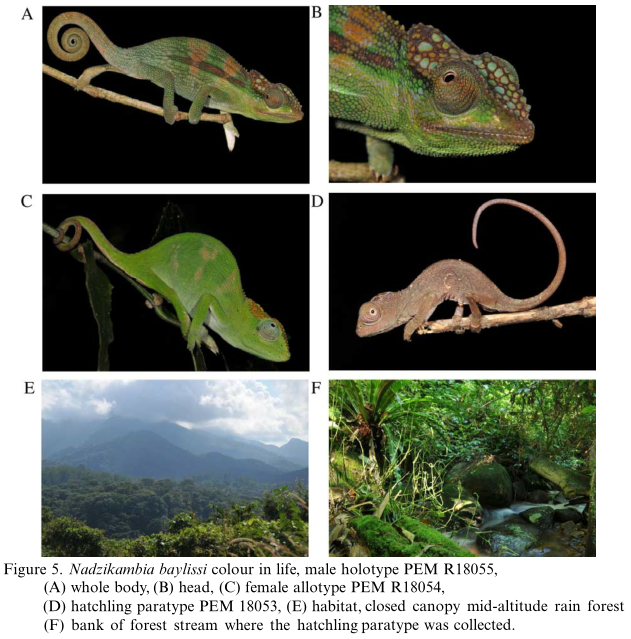
[Herpetology • 2010] Nadzikambia baylissi • A New Species of Chameleon (Sauria: Chamaeleonidae) from Mount Mabu, central Mozambique


Nadzikambia baylissi 
Branch & Tolley 2010

ABSTRACT 
Nadzikambia is a monotypic genus described to accommodate the Mulanje chameleon, N. mlanjensis. During herpetological surveys of isolated mountains in Mozambique a population of chameleons was discovered on Mount Mabu. It is referable to the genus Nadzikambia, but features of scalation, colouration and genetic divergence distinguish this population from N. mlanjensis. It is described as a new species, Nadzikambia baylissi, and represents the second species in the genus and the first record of the genus in Mozambique. Notes on reproduction in N. mlanjensis are appended. The discovery of the new species in a mid-altitude evergreen forest remnant on Mount Mabu emphasises the high conservation importance of the region, previously signalled by the discovery of a new species of forest viper (Atheris mabuensis), and a number of undescribed butterflies and freshwater crab species in the region.

Keywords:  Chamaeleonidae, Nadzikambia, new species, Mount Mabu, Mozambique


William R. Branch and Krystal A. Tolley. 2010. A New Species of Chameleon (Sauria: Chamaeleonidae: Nadzikambia) from Mount Mabu, central Mozambique. African Journal of Herpetology. 59:157-172. DOI: dx.doi.org/10.1080/21564574.2010.516275

Saturday, June 7, 2014

[Paleontology • 2014] Hamipterus tianshanensis • Sexually Dimorphic Tridimensionally Preserved Pterosaurs and Their Eggs from China


Highlights
• A population of a new pterosaur was discovered with 40 male and female individuals
• Sexually dimorphic morphologies differ in crest size, shape, and robustness
• Pliable eggs have a thin calcareous hard eggshell and a thick soft membrane layer
• The expansion of the rostrum is an ontogenetic character for the new species

A three-dimensionally preserved pterosaur egg that was found in the Turpan-Hami Basin in China

Summary
Background
The pterosaur record is generally poor, with little information about their populations, and pterosaur eggs are even rarer, with only four isolated and flattened eggs found to date.

Results
We report here a population of a new sexually dimorphic pterosaur species (Hamipterus tianshanensis gen. et sp. nov.), with five exceptionally well-preserved three-dimensional eggs, from the Early Cretaceous deposit in northwestern China. About 40 male and female individuals in total were recovered, but the actual number associated might be in the hundreds. All of the discovered skulls have crests, which exhibit two different morphologies in size, shape, and robustness. The eggs show pliable depressions with cracking and crazing on the outer surface. The eggshell, observed by scanning electron microscopy and energy-dispersive spectroscopy, comprises a thin calcareous external hard shell followed by a soft membrane.

Conclusions
These fossils shed new light on the reproductive strategy, ontogeny, and behavior of pterosaurs. The cranial crests show sexually dimorphic morphologies, with presumed males and females differing in crest size, shape, and robustness. Ontogenetic variation is reflected mainly in the expansion of the rostrum. The eggs have some external rigidity of the general pliable eggshell, and the microstructure of the eggshell is similar to that of some modern “soft” snake eggs. We suggest that this new pterosaur nested in colonies and thus exhibited gregarious behavior, a possible general trend for at least derived pterodactyloid pterosaurs


colony of Hamipterus tianshanensis
illustration: Chuang Zhao


An artistic representation of male and female Hamipterus tianshanensis
illustration: Chuang Zhao


Hamipterus tianshanensis
illustration: Maurílio Oliveira | paleoufes.wordpress.com


Xiaolin Wang, Alexander W.A. Kellner, Shunxing Jiang, Qiang Wang, Yingxia Ma, Yahefujiang Paidoula, Xin Cheng, Taissa Rodrigues, Xi Meng, Jialiang Zhang, Ning Li1 and Zhonghe Zhou. 2014. Sexually Dimorphic Tridimensionally Preserved Pterosaurs and Their Eggs from China. Current Biology. DOI: 10.1016/j.cub.2014.04.054

Photos: Ancient Pterosaur Eggs & Fossils Uncovered in China http://shar.es/Pr7tX via @LiveScience

[Paleontology • 2014] Anthracosuchus balrogus • A New Blunt-snouted dyrosaurid (Crocodylomorpha, Mesoeucrocodylia) from the Palaeocene of Colombia


Titanoboa cerrejonensis and Anthracosuchus balrogus 

Abstract
A new exceptionally brevirostrine dyrosaurid is described from the middle Palaeocene (58–60 million years ago) Cerrejón Formation, northeastern Colombia, based on four partial skulls and associated postcrania. This taxon is unique among dyrosaurids not only in skull shape, but also in having orbital tuberosities, and osteoderms that are dorsoventrally thick and unpitted, a trait otherwise unknown in Crocodylomorpha. Results from a cladistic analysis of Dyrosauridae suggest that the new taxon, together with Cretaceous–Palaeocene Chenanisuchus lateroculi from Africa and Cerrejonisuchus improcerus also from the Cerrejón Formation, are the most basal members of the family. Results from a biogeographic analysis indicate at least three independent dispersals of dyrosaurids from Africa to the New World occurred in the Late Cretaceous or early Palaeocene. Widely set orbits in the new taxon indicate a deviation from surface-based predation, characteristic of other dyrosaurids, to sub-surface predation, as in modern Gavialis. Tooth impressions found on turtle shells recovered from the same locality match well with teeth of the new taxon indicating possible predation. 

Keywords: Dyrosauridae, Crocodylomorpha, Palaeocene, Colombia, Cerrejón, biogeography


a new dyrosaurid crocodyliform has been named Anthracosuchus balrogus.

The specific epithet, balrogus, derives from the Balrog, the name of a ferocious fictional creature that appeared in J.R.R. Tolkien’s novel ‘The Lord of the Rings’ and dwelled deep in the middle-Earth ‘Mines of Moria.’

Anthracosuchus balrogus belongs to Dyrosauridae, a family of now-extinct crocodyliforms that lived from Late Cretaceous to the Eocene.

Originating in Africa, these crocodile-like reptiles swam across the Atlantic Ocean to South America about 75 million year ago. The family somehow survived the extinction event that wiped out the dinosaurs and persisted to become a top predator.

Four specimens of Anthracosuchus balrogus were unearthed in the Cerrejon coal mine, northern Colombia.


Alexander K. Hastings, Jonathan I. Bloch & Carlos A. Jaramillo. 2014. A New Blunt-snouted dyrosaurid, Anthracosuchus balrogus gen. et sp. nov. (Crocodylomorpha, Mesoeucrocodylia), from the Palaeocene of Colombia. Historical Biology: An International Journal of Paleobiology. 


Sunday, June 1, 2014

[Botany • 2013] Coespeletia palustris • A New Species of Coespeletia (Asteraceae, Millerieae) from Venezuela


Abstract
A new species of Coespeletia from the páramos of Mérida (Venezuela) is described here. This species, named Coespeletia palustris, is found in a few marshy areas of the páramo. It is closely related to C. moritziana, but differs from it in a smaller number of florets in the capitula, larger ray flowers with longer ligulae and longer linguiform appendages, smaller pollen grains, larger cypselae, ebracteate scapes, leaves and inflorescences with more whitish indumentum, larger leaf sheaths, and marshy habitat.

Keywords: Coespeletia, Compositae, Espeletiinae, frailejón, Millerieae, Páramos, Venezuela


Coespeletia palustris M. Diazgranados & G. Morillo

Figure 1. Coespeletia palustris: A abaxial view of the involucre B young leaves showing white basal portion C parts of the collection D capitulum of the holotype collection (Morillo et al. 14155) E acaulescent (or subsessile) habit and marshy habitat F whitish rosette from top. Coespeletia moritziana: G capitulum H caulescent habit and rocky habitat I yellowish rosette from top.


Mauricio Diazgranados and Gilberto Morillo. 2013. A New Species of Coespeletia (Asteraceae, Millerieae) from Venezuela. PhytoKeys. 28: 9–18. doi: dx.doi.org/10.3897/phytokeys.28.6378