Showing posts with label Cactaceae. Show all posts

Sunday, November 17, 2024

[Botany • 2024] Sclerocactus dawsoniae (Cactaceae) • A New Species from Western Colorado, U.S.A.


Sclerocactus dawsoniae McGlaughlin & Naibauer, 

in McGlaughlin et Naibauer. 2024. 

Abstract
Sclerocactus dawsoniae McGlaughlin & Naibauer (Cactaceae), a new species from western Colorado, is described. Sclerocactus dawsoniae is segregated from S. glaucus (K. Schum.) L. D. Benson, differing by having a smaller overall size, fewer spines per areole, an allopatric distribution, and substantial genetic differentiation.

KEYWORDS: Cactaceae, cactus, Colorado, new species, Sclerocactus dawsoniae


Sclerocactus dawsoniae McGlaughlin & Naibauer, sp. nov.


Mitchell E. McGlaughlin and Samantha K. Naibauer. 2024. Sclerocactus dawsoniae (Cactaceae), A New Species from Western Colorado, U.S.A. Novon: A Journal for Botanical Nomenclature. 32(1); 79 - 83. DOI: doi.org/10.3417/2024771
Researchgate.net/publication/380064530_Sclerocactus_dawsoniae_a_New_Species_from_Western_Colorado_USA

Friday, May 3, 2024

[Botany • 2024] Opuntia fortanelli (Cactaceae) • A New Species from the Huastec Region of San Luis Potosí, México


 Opuntia fortanelli Reyes-Agüero, Orta & Heindorf,

Reyes-Agüero, Orta-Salazar, Heindorf et González. 2024, 

 Abstract 
In Mexico there are between 66 and 97 species of Opuntia, divided into 17 series. One of these series is the Tunae, which consist of low shrubs with cladodes that detach from the plant, though not easily, and have a pubescent epidermis. In the dry season the areoles are sometimes surrounded by a purple spot. The cladodes have acicular, subulate, yellow or white spines. The fruit is red and fleshy. During the exploration in the Sierra of Abra Tanchipa Biosphere Reserve, situated in the first foothills of the Sierra Madre Oriental, East of the state of San Luis Potosí, a cactus pear was discovered. This cactus pear cannot be classified among the known species of Opuntia due to its distinct morphological characteristics. However, it does possess features typical of the members of the Tunae section. Therefore, it is proposed as a new species within this series, named Opuntia fortanelli. The differences between O. fortanelli, the proposed species, and the closely related species O. decumbens and O. elizondoana, are discussed.

KEYWORDS: Cactus pear, new species, taxonomy, tunae, Cactaceae, San Luis Potosi


 Opuntia fortanelli Reyes-Agüero, Orta & Heindorf sp. nov.


Juan Antonio Reyes-Agüero, Carolina Orta-Salazar, Claudia Heindorf and Eleazar Carranza González. 2024. Opuntia fortanelli (Cactaceae), A New Species from the Huastec Region of San Luis Potosí, México. Haseltonia. 31 (1), 26-33. DOI: 10.2985/026.031.0104

Thursday, November 23, 2023

[Botany • 2020] Cochemiea thomasii (Cactaceae: Cacteae) • A New Species from Sinaloa, Mexico


 Cochemiea thomasii García-Mor., Rodr. González, J. García-Jim. & Iamonico, 

in Morales, González, Jiménez et Iamonico, 2020. A

Abstract
Background and Aims: Cochemiea is a genus which currently comprises five species occurring in Mexico. It is morphologically characterized by cylindrical decumbent to prostrate stems and by a long red-scarlet zygomorphic perianth, presumably specialized for hummingbird pollination. As part of the ongoing taxonomic studies on the North Mexican flora, a population discovered by Thomas Linzen in 2012 in central Sinaloa (Mexico), previously identified as Mammillaria sp., actually refers to a Cochemiea species and cannot be ascribed to any of the known species of that genus. As a consequence, we here propose to describe this population as a a new species for science.

Methods: The work is based on field surveys (autumn 2018 and spring 2019) in central Sinaloa, examination of herbarium specimens, and analysis of relevant literature. Its conservation status was assessed following the guidelines of the IUCN; AOO and EOO were calculated with the program GeoCAT.Key 

Results: Cochemiea thomasii is described and illustrated from Sinaloa. The new species is morphologically similar to C. halei from which it differs by the hanging stems, the larger conical tubercles, less numerous and shorter central spines, and the ovoid fruits. A diagnostic key of the known Cochemiea species is included.

Conclusions: Cochemiea thomasii is endemic to the state of Sinaloa where it occupies a small area. On the basis of the criteria B2a (geographic range) and C (small population) of IUCN, the new species can be assessed as Critically Endangered (CR) or Vulnerable (VU). Adopting the precautionary approach, Cochemiea thomasii is considered as Critically Endangered (CR).

Key words: Cochemiea halei, Cochemiea thomasii, endemic, Sierra Madre Occidental.

 Cochemiea thomasii García-Mor., Rodr. González, J. García-Jim. & Iamonico. 
A. Plant (scale bar=10 cm); B. spines (scale bar=1 cm); C. flowers (scale bar=1 cm); D1. seed; D2. seed surface magnified
(photos A-C by T. Linzen).

Cochemiea thomasii García-Mor., Rodr. González, J. García-Jim. & Iamonico, sp. nov.
   

Leccinum Jesús García Morales, Rodrigo Homero González González, Jesús García Jiménez and Duilio Iamonico. 2020. A New Species of Cochemiea (Cactaceae, Cacteae) from Sinaloa, Mexico [Una nueva especie de Cochemiea (Cactaceae, Cacteae) de Sinaloa, México]. Acta botánica Mexicana. 127(e1626): 1-6. DOI: 10.21829/abm127.2020.1626


Resumen: 
Antecedentes y Objetivos: Cochemiea es un género que actualmente comprende cinco especies que se encuentran en México, y se caracteriza morfológicamente por sus tallos decumbentes cilíndricos o postrados y por su largo perianto zigomorfo rojo escarlata presumiblemente especializado para la polinización por colibríes. Como parte de los estudios taxonómicos en curso sobre la flora del norte de México proponemos como nueva especie una población descubierta por Thomas Linzen en 2012 en el centro de Sinaloa (México), previamente identificada como Mammillaria sp., se trata de una especie de Cochemiea que no concuerda con ninguna especie conocida del género, la cual proponemos como nueva especie para la ciencia.
Métodos: Este trabajo se basa en estudios de campo (otoño 2018 y primavera 2019) en el centro de Sinaloa, la revisión de ejemplares de herbario y de literatura relevante. Se evaluó su estatus de conservación siguiendo los lineamientos propuestos por la IUCN; AOO y EOO fueron calculados usando el programa GeoCAT.
Resultados clave: Cochemiea thomasii es descrita e ilustrada de Sinaloa. Esta nueva especie es morfológicamente similar a C. halei, de la cual difiere por sus tallos colgantes, los tubérculos cónicos más grandes, las espinas radiales menos numerosas y más cortas, y los frutos ovoides. Se incluye una clave diagnóstica de las especies conocidas de Cochemiea.
Conclusiones: Cochemiea thomasii es endémica del estado de Sinaloa donde vive en un área reducida. Con base en los criterios B2a (distribución geográfica) y C (población pequeña) de la IUCN, esta especie se evalúa como En Peligro Crítico (CR) o Vulnerable (VU). Adoptando el principio de precaución, Cochemiea thomasii es considerada en Peligro Crítico (CR).

Tuesday, October 17, 2023

[Botany • 2021] Chichimecactus (Cactaceae: Cactoideae) • A New Genus based on molecular characterisation of highly endangered Strombocactus species


Chichimecactus corregidorae (S.Arias & E.Sánchez) Bárcenas, H.M.Hern., & P.Hern.-Led., 

in Bárcenas, Hernández, Hernández-Ledesma et Gómez, 2021.

Abstract
Molecular characterisation of the three taxa currently circumscribed under Strombocactus (Cactaceae, Cactoideae) based on the analysis of the plastid matK, psbA-trnH and atpB-rbcL datasets, provided unambiguous identification of the two endangered and highly wanted cacti species: S. corregidorae and S. disciformis (including subsp. disciformis and subsp. esperanzae). The combined autapomorphies in each of the three markers and even the autapomorphies in each of the single molecular datasets provide a positive and clear-cut identification for each of the taxa. The Bayesian, maximum likelihood and parsimony phylogenetic analyses of the three datasets including 46 terminals of cacti, recover a paraphyletic Strombocactus with S. corregidorae as sister to a clade containing Ariocarpus, Turbinicarpus, and Strombocactus disciformis subsp. disciformis + subsp. esperanzae. Autapomorphies for each of the three taxa for every dataset are identified, and as a consequence, the new genus Chichimecactus, based on S. corregidorae, is proposed.

Keywords: Eudicots, Chihuahuan Desert, endemic species, México, Querétaro, Queretaroan-Hidalgoan Arid Zone, Sierra Gorda

A depressed middle-aged specimen of Chichimecactus corregidorae including a close up of a flowering individual.
 photographs by Rolando T. Bárcenas.

Chichimecactus Bárcenas, H.M.Hern. & P.Hern.-Led., gen. nov. 

Type species: Chichimecactus corregidorae (S.Arias & E.Sánchez) Bárcenas, H.M.Hern., & P.Hern.-Led.

Etymology:—The generic name makes reference to the original assemblage of Aridoamerican ethnic groups of the Chichimeca Nation that inhabited the vast arid and semiarid lands of northern Mexico and Southwestern United States, including the harsh regions of the Sierra Gorda in the state of Querétaro, where Chichimecactus corregidorae occurs. 

Chichimecactus corregidorae (S.Arias & E.Sánchez) Bárcenas, H.M.Hern., & P.Hern.-Led. comb. nov. 
≡ Strombocactus corregidorae S.Arias & E.Sánchez (2010: 620).
 

Rolando T. Bárcenas, Héctor M. Hernández, Patricia Hernández-Ledesma and Luis Manuel Montoya Gómez. 2021. Chichimecactus (Cactoideae, Cactaceae), A New Genus based on molecular characterisation of highly endangered Strombocactus species. Phytotaxa. 512(3); 147–158.  DOI: 10.11646/phytotaxa.512.3.2 

Saturday, August 26, 2023

[Botany • 2023] Acanthocereus lempirensis (Cactaceae) • A New Species from Honduras


Acanthocereus lempirensis H. Vega, Gómez-Hin. & H.M. Hern.,

in Vega, Oyuela, Alemán, Hinostrosa et Hernández, 2023.

Abstract
Background and Aims: During explorations in the Parque Nacional Montaña de Celaque, Honduras, a new species of Acanthocereus (Cactaceae) was discovered. The aim of the present study is to describe and illustrate A. lempirensis, and to compare it with its putatively closest relative, A. chiapensis

Methods: Botanical field collections were conducted during 2023. In order to compare the possible new species with other species in the genus, the collections in different herbaria and a Database of Cactaceae from North and Central America were examined and a distribution map was prepared. A preliminary assessment of the conservation status of the new species was preliminarily assessed using the IUCN Red List criteria.

Key results: Acanthocereus lempirensis appears to be closely related to A. chiapensis by the presence in both species of green glaucous stems ramified from the base, similar spination, and nocturnal flowers. It can easily be distinguished from that species by the combination of the following morphological characters: pink perianth segments, internal perianth segments oblanceolate, rounded to retuse and mostly subacute apically, and the apical margins minutely lacerate. The species is restricted to a small area of limestone cliffs and steep slopes with tropical deciduous forests intermixed with Pinus and Quercus. Only ca. 150 individuals have been detected in the wild. A Critically Endangered (CR) conservation category is suggested for this species. 

Conclusion: This new discovery places Honduras as an important diversity center for species of Acanthocereus (five spp.), preceded by Mexico (12 spp.). The recent botanical findings in Honduras (Acanoensis A. lempirensis) confirm the importance of continuing and supporting floristic studies in the country and the conservation it its ecosystems. 

Key words: Acanthocereus canoensisAcanthocereus chiapensis, Acanthocereus lempirensis, Colohete, endemic, Lempira

Acanthocereus lempirensis H. Vega, Gómez-Hin. & H.M. Hern.

Acanthocereus lempirensis H. Vega, Gómez-Hin. & H.M. Hern., sp. nov. 

Acanthocereus lempirensisis similar to A. chiapensis by the arbustive habit, the glaucous stems ramified from the base, and nocturnal flowers. It differs from this species by the combination of the following morphological characters: pink perianth segments, internal perianth segments oblanceolate, apically rounded to retuse, the inner ones mostly subacute, with the apex minutely lacerate, 2.4-3.7 cm long, 1-1.2 cm wide in their widest portion, light pink in the marginal area becoming deep pink to-wards the center.


 Hermes Leonel Vega, Olvin Oyuela, Maryury Alemán, Carlos Gómez Hinostrosa and Héctor M. Hernández. 2023. A New Species of Acanthocereus (Cactaceae) from Honduras. Acta Botanica Mexicana. 130: e2233. DOI: 10.21829/abm130.2023.2233

Monday, February 6, 2023

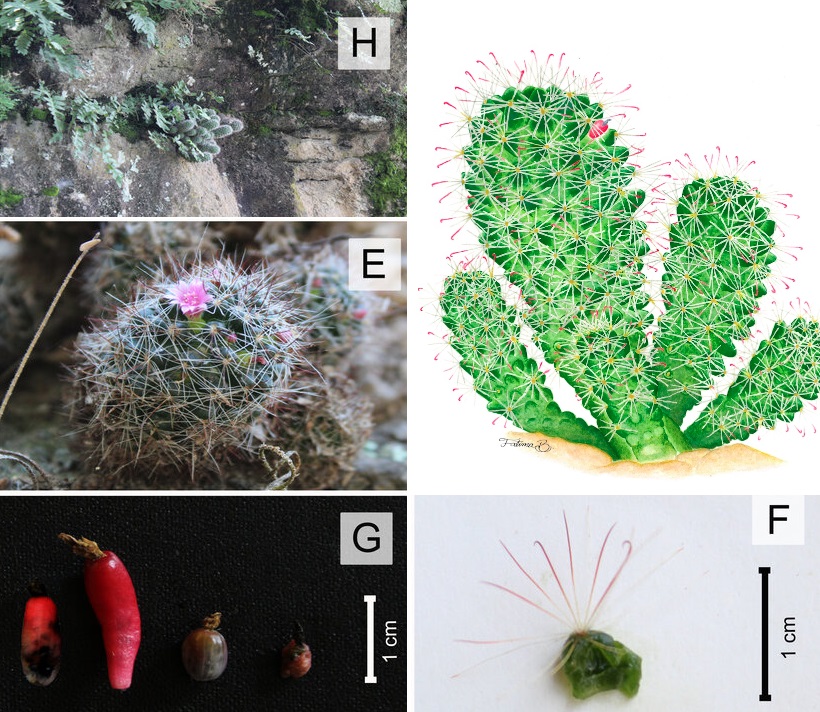
[Botany • 2022] Mammillaria arreolae (Cactaceae) • A Morphological Analysis of the Mammillaria fittkaui species complex reveals A New Species from Jalisco, México


Mammillaria arreolae P. Carrillo & Ortiz-Brunel, 
H) M. arreolae in habitat. 
E) M. arreolae
G) fruit comparison among the Mammillaria fittkaui species complex. From left to right: M. fittkauiM. limonensisM. mananaM. arreolae
F) tubercle and spines of M. arreolae

in Ortiz-Brunel, Carrillo-Reyes, Sánchez, Ruíz-Sánchez & Rodríguez, 2022. 

 Abstract
Background: The Mammillaria series Stylothelae (Cactaceae) includes 16 taxa distributed mostly among the limits of the Chihuahuan Desert (CD) with the Sierra Madre Oriental and the Transmexican Volcanic Belt (TVB). In Jalisco, four pink flowered species occur at the southwestern end of the CD where it meets the TVB. The boundaries and recognition of three species related with M. fittkaui (M. fittkaui complex) are debatable.

Question: Should the taxa of the Mammillaria fittkaui species complex be considered as species?

Studied species: Four pink flowered Mammillaria series Stylothelae (M. fittkaui species complex) and M. zeilmanniana as comparative species.

Study site: Western Mexico.

Methods: Six morphological characters were sampled in specimens from the type locations of three pink flowered species, one locality of Mammillaria sp., and M. zeilmanniana. We used a permutational multivariate analysis of variance on six characters of each of the groups and a discriminant analysis to evaluate the morphological variation among species and to determine the correct classification of each individual.

Results: The analyses identified four well defined morphological groups with statistical significance within the Mammillaria fittkaui complex. We recognized M. fittkaui, M. limonensis, and M. manana as species and here describe M. arreolae as a new species from Jalisco.

Conclusions: In Cactaceae, morphometry has been useful to establish species boundaries. The Mammillaria fittkaui complex includes four species. Mammillaria arreolae differs from the other species by the shorter tubercles, flowers, and fruits. In addition, it develops more than one hooked central spine per areole.

keywords: cacti, morphometry, Stylothelae

Mammillaria arreolae P. Carrillo & Ortiz-Brunel;
Drawn by Fátima Bracamontes 
based on the type material (Brunel & P. Carrillo 887). 

Pink flowered Mammillaria series Stylothelae of western Mexico;
A) M. fittkaui; B) M. limonensis; C) M. manana; D) M. zeilmanniana;
E) Mammillaria arreolae; F) tubercle and spines of M. arreolae; G) fruit comparison among the Mammillaria fittkaui species complex. From left to right: M. fittkauiM. limonensisM. mananaM. arreolae; H) M. arreolae in habitat.

Mammillaria arreolae P. Carrillo & Ortiz-Brunel, sp. nov. 

Diagnosis. Mammillaria arreolae is similar to M. manana and M. limonensis but it produces shorter tubercles [4-5(-7) mm], 1-4 uncinated central spines, shorter flowers (11-14 mm), and shorter ovoid fruits (4-5 mm). Also, it could be confused with M. fittkaui, from which it differs by the presence of axillary bristles, the noticeable thinner radial spines, and the fruit size and shape (ovoid 4-5 mm long in M. arreolae vs ellipsoidal 5-10 mm long in M. fittkaui).


Etymology. The specific epithet honors Hilda Julieta Arreola Nava. She was a professor at the Universidad de Guadalajara, an outstanding cactologist, and an extraordinary human being. She died in September 26 of 2019.


Juan Pablo Ortiz-Brunel, Pablo Carrillo-Reyes, Daniel Sánchez, Eduardo Ruíz-Sánchez and Aarón Rodríguez. 2022. A Morphological Analysis of the Mammillaria fittkaui species complex (Cactaceae) reveals A New Species from Jalisco, México.  Botanical Sciences. 100(1); 100(1). DOI: 10.17129/botsci.3221


Friday, January 27, 2023

[Botany • 2022] Mammillaria morentiniana (Cactaceae) • A New Endemic Species from San Luis Potosí, Mexico


Mammillaria morentiniana  Gonz.-Zam., D. Aquino, J. Mohl & Dan. Sánchez,

in González-Zamora, Aquino, Mohl & Sánchez, 2022.

Abstract  
We describe a new endemic densely spined Mammillaria from San Luis Potosí, Mexico. The new species, named M. morentiniana, is distinctive by the presence of a globose to shortly cylindric stem with several glabrous, reddish central spines, radial spines that protrude from the plant like white needle-bristles, and small flowers with pale yellow, lanceolate tepals. We compare it with similar and sympatric species of M. ser. Stylothelae. We include data about habitat and the preliminary status of conservation of the new taxon.

KEYWORDS: Cactaceae, Cacteae, Mammillaria, Mammillaria ser. Stylothelae, Mexico, morphology, multivariate statistics, new species, species delimitation

Morphology of Mammillaria morentiniana during dry and rainy seasons.
– A: plant flowering in habitat; B: stem and roots; C: stems during dry season covered by radial spines resembling white needle-bristles; D: stems during rainy season showing hydrated and expanded tubercles; E: close-up of tubercle and areole bearing six central spines; F: plant bearing red and claviform fruits; G: flower in longitudinal section, outside and inside views; H: seeds.
 – Scale bars: A = primary graduations of 1 cm, secondary graduations of 1 mm; B = 10 mm; E = graduations of 0.5 mm; G = 10 mm; H = 1 mm.

Mammillaria morentiniana Gonz.-Zam., D. Aquino, J. Mohl & Dan. Sánchez, sp. nov.  

Holotype: Mexico, San Luis Potosí, Santa María del Río, 2056 m, 28 Aug 2019, P. González-Zamora 11 (IBUG 215375; isotype: SLPM).

Diagnosis — Mammillaria morentiniana is distinguishable from M. bocasana, M. crinita and M. nana by the presence of more than 4 central spines (mean = 5), and differs from M. schwarzii, which presents, on average, 7 thinner central spines (Supplemental content online; Fig. 2). Mammillaria morentiniana bears fewer than 32 straight radial spines (mean = 24.49), whereas M. schwarzii bears more than 32 straight radial spines (mean = 38.98). Mammillaria morentiniana has completely red central spines and black, non-arillate seeds, whereas M. bocasana has red central spines with a yellow base and reddish brown, arillate seeds. Mammillaria morentiniana has glabrous spines and straight radial spines, whereas M. crinita has pubescent spines and tortuous or straight radial spines. Mammillaria morentiniana differs from the sympatric M. nana because the latter has tuberous roots and 0 or 1 pubescent central spines.
 
Etymology — The specific epithet is dedicated to the Morentín family from Colima, Mexico. Don Marco and Doña Laura spent their lives preserving the flora in W Mexico. They inspired the first author to observe and admire the local and xerophytic flora.

Comparison of the stem (left), areole, central and radial spines (right) in the populations of Mammillaria ser. Stylothelae included in the analysis.
– A: Mammillaria sp.; B: M. bocasana (bocasana_SLP); C: M. bocasana (bocasana_SLP2);
D: M. crinita (c_crinita_QRO); E: M. crinita (c_crinita_QRO2); F: M. crinita (c_crinita_GTO); G: M. crinita subsp. leucantha (c_leucantha); H: M. crinita subsp. wildii (c_wildii);
I: M. nana (nana); J: M. schwarzii (schwarzii).
– Scale bars: A–E, G, I, J = graduations of 1 mm; F, H = 10 mm.


Pedro González-Zamora, David Aquino, Jonathan Mohl and Daniel Sánchez. 2022. A New Endemic Species of Mammillaria (Cactaceae) from San Luis Potosí, Mexico. Willdenowia. 52 (3); 359-372. DOI: 10.3372/wi.52.52305 
 

Tuesday, December 20, 2022

[Botany • 2022] Deamia funis (Cactaceae) • A New Species from Nicaragua


Deamia funis Hammel & S. Arias, 

in Hammel & Arias, 2022.

Abstract
Deamia funis sp. nov. (Cactaceae) from Nicaragua, in the Mesoamerican region, is described and illustrated based on morphological data. The new species is characterized by its often long, dangling (ropey), and relatively narrow, multiribbed stems with relatively small flowers like those of D. chontalensis, but with the stigma exerted among or slightly beyond the anthers as occurs in D. montalvoae and D. testudo.

Keywords: brevistyly, floral morphology, taxonomy

Deamia funis, reproductive characters (A–D from Stevens & Montiel 39242, E from Stevens & Calero 44070). A. Side-view of flower on specimen. B. Side-view of flower in life. C. Front-view of flower in life (arrow at stigma). D. Close-up of base of flower in life. E. Submature fruit, in life.
Photos: A, Hammel; B–D, Montiel; E, Chamorro.

Deamia funis, vegetative characters.
 A–C. Habitat and habit (Stevens & Montiel 33938). D. Close-up of stem showing cracks in epidermal wax (Stevens & Montiel 39242).
Photos: all Montiel.


Deamia funis Hammel & S. Arias sp. nov. 

Diagnosis:— In its flowers Deamia funis is outwardly similar to D. chontalensis, but has stamens (1.5–3 vs. 0.4–0.7 cm long) and styles (6–8 vs. 2–2.2 cm long) much longer, and with the stigma exerted among or slightly beyond the anthers (vs. the brevistylous flowers of the latter), furthermore, its stems are less than half the diameter of those of the latter, and with more ribs; the stems are similar to those of D. montalvoae, but the flowers are smaller, less than 1/2 (mostly 1/3) as long as in that species.

Etymology:— The epithet refers to the long, dangling, rope-like stems common in this species when found growing on horizontal branches of trees.


Barry Hammel and Salvador Arias. 2022. A New Species of Deamia (Cactaceae) from Nicaragua. Phytotaxa. 576(2); 220-226. DOI: 10.11646/phytotaxa.576.2.8


Resumen: Deamia funis sp. nov. (Cactaceae) de Nicaragua, en la región de Mesoamérica, se describe con base en datos morfológicos y se ilustra. La especie nueva se caracteriza por sus tallos a menudo largos y péndulos (como mecate), relativamente angostos y multicostillados, con las flores relativamente pequeñas parecidas a las de D. chontalensis, pero con el estigma exerto entre o algo más allá de las anteras como ocurre en D. montalvoae y D. testudo. 

Sunday, June 12, 2022

[Botany • 2021] Leptocereus velozianus (Cactaceae) • Phylogenetics of Leptocereus on Hispaniola: Clarifying Species Limits in the L. weingartianus complex and A New Species from the Sierra de Bahoruco


 Leptocereus velozianus Clase, Y.Encarn., Peguero & Majure, 

in Majure, Encarnación, Clase, Peguero, Ho & Barrios, 2021. 
Photos taken by L.C. Majure.

Abstract
The Antillean genus Leptocereus represents an in-situ radiation among the Greater and Lesser Antilles of 19 currently recognized species. Extensive fieldwork carried out in the Dominican Republic over recent years has revealed that the species limits of Leptocereus of Hispaniola are more complex than previously thought. There are four currently recognized species that occur on the island, L. demissus, L. paniculatus, L. undulosus and L. weingartianus. We evaluate species limits in this group based on DNA sequence data and phylogenetic analysis, morphological characters and a survey of herbarium specimens from across Hispaniola. Based on our analyses, it is clear that at least five species occur on the island of Hispaniola, with the new species from Sierra de Bahoruco, L. velozianus, described here. We provide an identification key, distribution maps and photographic plates for all species on Hispaniola based on our own fieldwork and the study of herbarium specimens. The description of yet another species of Leptocereus on Hispaniola reiterates the importance of the poorly studied, but yet biodiverse, seasonally dry tropical forest in the Antilles.

Keywords: Biodiversity, Greater Antilles, plastome phylogeny, Seasonally Dry Tropical Forest

Leptocereus velozianus Clase, Y.Encarn., Peguero & Majure. 
A–C stems showing crenate margins D, E cross sections showing 4-5 ribbed stems, also showing large crystals in the parenchyma F day old flower showing rounded external tepal apices and spiny pericarpel, and G immature fruit showing spiny pericarpel and remnant floral tube.
 A from Majure 7842, and B–F from Majure 7843.

Leptocereus velozianus Clase, Y.Encarn., Peguero & Majure. 
A small tree habit of L. velozianus alongside T. Clase for scale B, C arching branches and spine color D trunk and bark E growing stem showing white spines as they mature F spiny, immature fruit G colliculate-pitted seed, and H stems with immature fruit, showing crenate rib margins.
A, D, F, G from Majure 7851 B, C, H from Majure 7843, and E from Majure 7842. 
Photos taken by L.C. Majure.

 Leptocereus velozianus Clase, Y.Encarn., Peguero & Majure, sp. nov.
 
Diagnosis: Differing from both L. weingartianus and L. demissus by the white young spines (vs. yellowish spines) and larger stem diameter (up to 3.7 cm in diameter in L. velozianus). Differing from L. demissus by the erect, primary trunk rather than the sprawling growth form, and oblong hypanthium in L. velozianus rather than obconic hypanthium as in L. demissus.

 Etymology: The specific epithet, “velozianus” is given honoring the Dominican botanist Alberto Veloz, who is the Head and Curator of the Herbarium JBSD of the “Dr. Rafael M. Moscoso” National Botanical Garden of Dominican Republic. For 27 years, Veloz has dedicated his life to the study of the Hispaniolan flora and has conducted extensive fieldwork across the island, with many collections from the Sierra de Bahoruco, where this new species was found. Together with other botanists he has collected over 10,000 specimens and has published several papers on the flora in national and international journals. His publications have included different approaches, such as floristics, taxonomy, ecology and conservation. Veloz has also contributed to the formation of young botanists by involving students as part of the staff in the herbarium JBSD and through fieldwork.


 Lucas C. Majure, Yuley Encarnación, Teodoro Clase, Brígido Peguero, Kelly Ho and Duniel Barrios. 2021. Phylogenetics of Leptocereus (Cactaceae) on Hispaniola: Clarifying Species Limits in the L. weingartianus complex and A New Species from the Sierra de Bahoruco. PhytoKeys. 172: 17-37. DOI: 10.3897/phytokeys.172.59497

Thursday, February 3, 2022

[Botany • 2021] Acanthocereus atropurpureus (Cactaceae: Hylocereeae) • A New Endemic Species from southern Jalisco, Mexico


Acanthocereus atropurpureus P. González-Zamora & Dan. Sánchez, 

in González-Zamora, Rodríguez-Contreras & Sánchez, 2021

Abstract
A new species of Acanthocereus, endemic from southern Jalisco, is described and illustrated. Acanthocereus atropurpureus distinguishes by the diameter of mature stems, presence of low ribs with sinuate margins, dull green stem epidermis turning purple during dry season, and the occurrence of four small central spines. We discuss the morphological differences from other Acanthocereus species and we provide information about its habitat and conservation status.

Keywords: Acanthocereus atropurpureus, dry deciduous forest, Hylocereeae, Mexican Pacific Lowlands, Sierra de Manantlán, Eudicots


Acanthocereus atropurpureus P. González-Zamora & Dan. Sánchez, sp. nov.

Etymology: —The specific epithet refers to the non-maculated purple color of the new and older stems under dry conditions.

Vernacular name: —Queen of the night (local name).
 
FIGURE 3. Comparison of mature stem and flower morphology of Acanthocereus atropurpureus and close species. 
A and E: A. castellae. B and F: A. atropurpureus. C and G: A. cuixmalensis. D and H: A. paradoxus
I: Plantlets of A. atropurpureus (top) and A. paradoxus (bottom). J: Growing apices of A. atropurpureus (top) and A. paradoxus (bottom). K: Mature stems of A. atropurpureus (left) and A. paradoxus (right) under hydric stress. L: Mature stems of A. atropurpureus (left) and A. paradoxus (right) stems under continuous watering.


Pedro González-Zamora, Aarón Rodríguez-Contreras and Daniel Sánchez. 2021. A New Endemic Species of Acanthocereus (Cactaceae) from southern Jalisco, Mexico. Phytotaxa. 522(2); 131-138. DOI: 10.11646/phytotaxa.522.2.5

Sunday, January 3, 2021

[Botany • 2020] Acanthocereus paradoxus (Cactaceae) • A New Endemic Species from Jalisco, Mexico


Acanthocereus paradoxus   

in González-Zamora, Carrillo-Reyes & Sánchez, 2020. 

Abstract
Acanthocereus paradoxus sp. nov., an endemic narrow cylindrical cactus from the state of Jalisco is described and illustrated. The species can be distinguished by its narrow cylindrical mature stems, stem epidermis dull green with some dark green margins, the presence of four central spines, and a greater number of ribs and spines in young stems. A morphological  comparison with the other cylindrical members of Acanthocereus and sympatric species of the genus is provided. Data about its habitat and the conservation status are also given.

Keywords: dimorphic stems, dry deciduous forest, Hylocereeae, Pacific Lowlands, “tasajillo”, Eudicots


Pedro González-Zamora, Pablo Carrillo-Reyes and Daniel Sánchez. 2020. Acanthocereus paradoxus (Cactaceae), A New Endemic Species from Jalisco, Mexico. Phytotaxa.470(2); 145-154. DOI: 10.11646/phytotaxa.470.2.3

𝘈𝘤𝘢𝘯𝘵𝘩𝘰𝘤𝘦𝘳𝘦𝘶𝘴 𝘱𝘢𝘳𝘢𝘥𝘰𝘹𝘶𝘴

Friday, July 17, 2020

[Botany • 2020] Mammillaria breviplumosa (Cactaceae, Cacteae) • A New Species from Mexico


 Mammillaria breviplumosa 

in García-Morales, Ramírez-Chaparro, et al., 2020.

Abstract
A new species of Mammillaria, named Mammillaria breviplumosa, is described from Mexico (Durango, Municipality of Mapimí). It is morphologically very similar to M. sanchez-mejoradae. Diagnostic features of the proposed new species are the cylindrical and apically truncate tubercles, the embedded fruits, the white-magenta striped perianth segments, the small feather-like spines and the helicoidal arrangement of the tubercles on the stem. A diagnostic key for the closest species of Mammillaria occurring in northern Mexico is proposed.

Keywords: Chihuahuan Desert, Durango, Mammillaria ser. Lasiacanthae, taxonomy, Eudicots


 Mammillaria breviplumosa 


Leccinum J. García-Morales, Ricardo Ramírez-Chaparro, Alejandro Sigala-Chávez and Duilio Iamonico. 2020. Mammillaria breviplumosa (Cactaceae, Cacteae), A New Species from Mexico. Phytotaxa. 452(3); 231–235. DOI: 10.11646/phytotaxa.452.3.6