Showing posts with label Scorpiones - Scorpion. Show all posts

Saturday, April 25, 2026

[Arachnida • 2026] Androctonus tinzaouatinensis • A New scorpion Species (Scorpiones: Buthidae) from In Guezzam Province, Algeria


Androctonus tinzaouatinensis 
Yağmur, Benali, Derradj & Bikada, 2026


 ABSTRACT
A new scorpion species, Androctonus tinzaouatinensis sp. n. is described and illustrated from the hyperarid Saharan regions of the Tin Zaouatine District, In Guezzam Province and Timiaouine District, Bordj Badji Mokhtar Province, southern Algeria. This new species represents the first record of the genus Androctonus from the Timiaouine and Tin Zaouatine areas. It is compared with congeners from Algeria and Niger, notably A. ajjer Ythier, Sadine, Alioua & Lourenço, A. amoreuxi (Audouin), and A. eburneus (Pallary).
 
KEYWORDS: Morphology, taxonomy, Tin Zaouatine, Sahara, endemic


Androctonus tinzaouatinensis sp. n. 


Ersen Aydın Yağmur, Noureddine Benali, Lotfi Derradj and Manna Bikada. 2026. Androctonus tinzaouatinensis A New scorpion Species from In Guezzam Province, Algeria (Scorpiones: Buthidae). Journal of Natural History. 60(17-20); 1033-1047. DOI: doi.org/10.1080/00222933.2026.2642870 [21 Apr 2026]


Thursday, April 9, 2026

[Arachnida • 2026] Urophonius andinus • First total evidence dated Phylogeny of the Scorpion Genus Urophonius (Scorpiones: Bothriuridae), with New Insights into the Transition to Winter Activity, and the Description of the First highland Andean Species of the Genus


Urophonius andinus 
Ojanguren-Affilastro, Santibáñez-López, Alfaro, Ramírez, Iuri, Mattoni & Pizarro-Araya, 2026. 
  

Abstract 
This study presents the first total evidence dated phylogenetic analysis of the scorpion genus Urophonius, integrating 115 morphological characters and five molecular markers (28S, 18S, H3, 16S, COI). Our comprehensive phylogenetic framework provides novel insights into the genus' diversification timeline and evolutionary processes. Additionally, we described Urophonius andinus n. sp. from the central Chilean Andes, a high-altitude species found at 2400 m.s.a.l., representing the highest elevational record for the genus. This new species is placed within the granulatus species group, characterized by a spring–summer activity period.

Keywords: Andes, new species, highland, Scorpiones, total evidence dated phylogeny, Urophonius, winter activity


Urophonius andinus n. sp. 


Andrés A. Ojanguren-Affilastro, Carlos Eduardo Santibáñez-López, Fermín M. Alfaro, Martín J. Ramírez, Hernán A. Iuri, Camilo I. Mattoni and Jaime Pizarro-Araya. 2026. First total evidence dated Phylogeny of the Scorpion Genus Urophonius (Bothriuridae), with New Insights into the Transition to Winter Activity, and the Description of the First highland Andean Species of the Genus. Systematic Entomology. DOI: doi.org/10.1111/syen.70032 [17 March 2026]
 

Saturday, July 26, 2025

[Arachnida • 2025] Megaschizomus zhongshanensis • First Record of the Subfamily Megaschizominae Rowland, 1973 (Schizomida: Hubbardiidae) from China, with Description of A New Species of Megaschizomus Lawrence, 1969

 
Megaschizomus zhongshanensis
Zheng, Wu & Zhang, 2025


Abstract
The subfamily Megaschizominae Rowland, 1973 is recorded from China for the first time through the description of a new species in the genus Megaschizomus Lawrence, 1969: M. zhongshanensis sp. nov. (male, female). This study presents the first illustrated description of male genital structures for a species within this subfamily. In addition to the detailed description, illustrations, diagnosis, and a distribution map are provided. Additionally, the DNA barcode of the new species is also provided.

Scorpiones, Schizomida, Asia, male genital, short-tailed whipscorpions, taxonomy


Tao ZHENG, Keliang WU and Feng ZHANG. 2025. First Record of the Subfamily Megaschizominae Rowland, 1973 from China, with Description of A New Species of Megaschizomus Lawrence, 1969 (Schizomida: Hubbardiidae).  Zootaxa. 5661(1); 80-94. DOI: doi.org/10.11646/zootaxa.5661.1.3 [2025-07-14]

Wednesday, June 18, 2025

[Arachnida • 2025] Scorpiops doiphukha • A Newly discovered Species of the Genus Scorpiops Peters, 1861, subgenus Euscorpiops Vachon, 1980 (Scorpiones: Scorpiopidae) from Doi Phu Kha National Park, Thailand


Scorpiops (Euscorpiopsdoiphukha  

 Ythier, Košulič, Nawanetiwong & Lourenço, 2025

Abstract
A new scorpion speciesScorpiops (Euscorpiopsdoiphukha sp. nov., belonging to the family Scorpiopidae Kraepelin, 1905, is described based on 12 specimens of both sexes (three adults and nine immatures) collected in Doi Phu Kha National Park, Nan Province, Thailand. The new species presents key features exhibited by scorpions of the subgenus Euscorpiops and can be characterized notably by a large size, a sexual dimorphism strongly marked with male pedipalps elongated, a distinct trichobothrial pattern and other morphological features. This new taxon represents the 115th species among the currently recognized species for the genus Scorpiops Peters, 1861, and the 44th species described for the subgenus Euscorpiops Vachon, 1980. It is likely an endemic element of Thailand’s scorpion fauna, raising the number of known Scorpiops (Euscorpiops) species in the country to 13. Ecological and distributional aspects of the new species are discussed and compared with closely related Scorpiops species, highlighting its distinctiveness within the genus.

Key words: Description, ecology, forest, morphology, scorpion, Southeast Asia, taxonomy

Scorpiops (Euscorpiopsdoiphukha sp. nov. 
 A, B. Male holotype, habitus, dorsal and ventral aspects, respectively;
C, D. Female paratype, habitus, dorsal and ventral aspects, respectively. Scale bar: 2 cm.

Scorpiops (Euscorpiopsdoiphukha sp. nov., alive.
A. Male holotype and female paratype, in their natural habitat; B. Female, alive with pre-juveniles (instar I).
 
Natural habitat of Scorpiops (Euscorpiopsdoiphukha sp. nov. in Doi Phu Kha National Park, Nan Province, Thailand.
A. Track trail near a small stream; B. Rock wall where the male holotype and female paratype were discovered. Both specimens were found hiding in small rock crevices.


 Eric Ythier, Ondřej Košulič, Wasin Nawanetiwong and Wilson R. Lourenço. 2025. A Newly discovered Species of the Genus Scorpiops Peters, 1861, subgenus Euscorpiops Vachon, 1980 from Doi Phu Kha National Park, Thailand (Scorpiones, Scorpiopidae). ZooKeys. 1241: 171-184. DOI: doi.org/10.3897/zookeys.1241.142549 [12-06-2025]
 

Monday, June 9, 2025

[Arachnida • 2025] Brachistosternus pehuenche • A New scorpion Species (Scorpiones: Bothriuridae) from the upper Maule Valley, in the southern Chilean Andes


 Brachistosternus pehuenche  
Ojanguren-Affilastro, Alfaro, Iuri, Camousseigt-Montolivo & Pizarro-Araya, 2025
.  

Abstract
Brachistosternus pehuenche sp. nov. (Scorpiones, Bothriuridae) is described from the Mauline Andean forests of the northern Chilean Patagonia, located within the upper basin of the Maule Valley. Its unique geography and the discovery of this partial isolation, as a result of the surrounding higher altitudes, support the role of this valley as a biodiversity hotspot, fostering a variety of endemic epigean arthropods. The discovery of this third endemic scorpion species highlights the area’s ecological uniqueness. The species is most similar to Brachistosternus negrei, a species found in the southern Chilean forests, but distinct morphological traits, such as pigmentation patterns and metasomal structures, clearly separate the two. This study underscores the ecological value of the Maule Valley, which, despite its high endemism, remains unprotected and is subject to significant anthropogenic pressures, including agriculture, hydropower projects, and international transit routes. The need for conservation initiatives in this region is critical to preserve its exceptional biodiversity. This work not only adds to the taxonomy of Brachistosternus but also raises fundamental questions about the processes driving endemism in the Andes and the broader implications for the conservation of montane ecosystems.

Key Words: Area of endemism, Bothriuridae, Chile, Mauline woods, new species, Scorpiones

 Brachistosternus pehuenche sp. nov., habitus.
A. Male, dorsal aspect; B. Male, ventral aspect;
C. Female, dorsal aspect; D. Female, ventral aspect. Scale bar: 1 cm.

 Brachistosternus pehuenche sp. nov. (Scorpiones; Bothriuridae). 
A. Preying on an adult of Athlia rustica (Coleoptera: Scarabaeidae); B. Climbing on branches of Lobelia sp. (Campanulaceae) in a hunting position for flying insects; C. Male, living specimen.


  Brachistosternus pehuenche sp. nov.

Diagnosis: Brachistosternus pehuenche sp. nov. is most similar to B. negrei, which is the only Brachistosternus species occurring in nearby areas of the south-central Chilean woods. Both species can be easily distinguished by several morphological characters. Brachistosternus pehuenche, on one hand, has tergites that bear two lateral spots, with pigment occupying most of the posterior lateral margins and leaving a median unpigmented stripe (Figs 4A, C, 5A); B. negrei, on the other hand, has five spots on each segment, one antero-median, two lateral, and two postero-submedian, in some cases connected by faint reticulate pigment (Fig. 5E). The metasomal segments I–IV of B. pehuenche bear two VL narrow stripes and a VM wide stripe (the VM stripe can be very faint or absent in segments I–III) (Fig. 5B), whereas in B. negrei there are two VL stripes and two VSM stripes (VSM stripes can be faint or absent in segments I–III) (Fig. 5F). The paired dorsal glands of metasomal segment V of males, or Androvestigia, are medium-sized in B. pehuenche, occupying from a third to almost the entire posterior half of the segment (Fig. 5C), whereas in B. negrei these glands are small, occupying between 10 to 25 percent of the dorsal surface of the segment (Fig. 5G). Metasomal segment V is more granular ventrally in B. pehuenche than in B. negrei, with some granules even forming a slight ventro-median carinae in the former (Fig. 5D), whereas in B. negrei there is no VM carina at all, and ventral granules are more sparse and smaller (Fig. 5H).

Etymology: The specific epithet “pehuenche” is a noun in apposition referring to the Pehuenche International Pass between Argentina and Chile, in the northern Patagonia, where this and other endemic scorpion species have been collected. Pehuenche is also the name of the indigenous people of this area, belonging to the Mapuche cultural group.

 
  Andrés A. Ojanguren-Affilastro, Fermín M. Alfaro, Hernán A. Iuri, Bernardino Camousseigt-Montolivo and Jaime Pizarro-Araya. 2025. Description of Brachistosternus pehuenche sp. nov. (Scorpiones, Bothriuridae), A New scorpion Species from the upper Maule Valley, in the southern Chilean Andes. Zoosystematics and Evolution. 101(3): 969-981. DOI: doi.org/10.3897/zse.101.146451

Monday, April 28, 2025

[Arachnida • 2025] Scorpiops bahunetraIn the Rocks: An Integrative Assessment of Scorpiops Peters, 1861 (Scorpiones: Scorpiopidae) in peninsular India with A Description of A New Species


Scorpiops bahunetra 
Deshpande, Joshi, Ukale, Bastawade, Tang, Gowande, Monod & Sulakhe, 2025

 
Abstract
The genus Scorpiops Peters, 1861 exhibits significant diversity, especially in Peninsular India. From our continued arachnological surveys in the Western Ghats and Peninsular India, we describe a new species based on molecular and morphological data. Furthermore, additional sampling revealed new species with distinct molecular signatures, but future investigation is warranted to gather additional data before species are formally described.

Keywords: 16S, COI, integrated taxonomy, molecular phylogeny, systematics

Scorpiops bahunetra sp. nov. male holotype (BNHS SC 401) in vivo habitus (A, B).

Scorpiops bahunetra sp. nov. male holotype (BNHS SC 401) under white light:
A, habitus, dorsal view; B, habitus, ventral view; C, sternopectinal area; D, metasomal segment V and telson, lateral view; E, chelicera, dorsal view <scale bars: 5 mm (A); 2 mm (C)>.

Scorpiops bahunetra sp. nov.
 
Diagnosis (♂♀). Total length 50.32-55.82 mm. Base color light brown. Median ocular islet morphology conforms to Type 2 (OI-2). Pectine morphology conforms to type P3; pectinal teeth number 7-8 in both sexes; fulcra reduced to absent. Pedipalp patella with 20-26 (5 eb, 2 esb, 2 em, 6-11 est, 5-6 et) external and 14-16 ventral trichobothria. Pedipalp chela with 4 ventral trichobothria. Chelal trichobothrium Eb3 located in proximal half of manus between trichobothria Dt and Db. Pedipalp movable finger margins strongly undulate in male and weakly undulate in female. Chela length-to-width ratio 3.0-3.2 in males. Total pedipalp length to total tergite length ratio 1.3-1.4 in males. Tarsomere II of legs with 4-6 stout ventromedian ventral spinules. Metasoma I–V with 10-10-10-10-7 carinae. Dorsal lateral carinae on metasoma III-IV ending posteriorly into a moderately developed spine. Telson elongate and smooth, length to depth ratio 2.8-3.2; annular ring weakly developed.

Etymology. The specific epithet is derived from a Sanskrit word ‘bahunetra’, ‘bahu’ (=many) and ‘netra’ (=eyes). The word is an adjective reflecting the unique feature of scorpions having multiple ocelli.

Scorpiops bahunetra sp. nov. male holotype (BNHS SC 401) under UV light:
A, habitus, dorsal view; B, habitus, ventral view <scale bar: 5 mm>.

 
Shubhankar Deshpande, Mihir Joshi, Sajiri Ukale, Deshabhushan Bastawade, Victoria Tang, Gaurang Gowande, Lionel Monod and Shauri Sulakhe. 2025. In the Rocks: An Integrative Assessment of Scorpiops Peters, 1861 (Scorpiones: Scorpiopidae) in peninsular India with A Description of A New Species. Journal of Asia-Pacific Biodiversity. In Press. DOI: doi.org/10.1016/j.japb.2025.02.004  [8 March 2025]

Friday, March 7, 2025

[Paleontology • 2025] Jeholia longchengi • First Mesozoic Scorpion (Scorpiones: Buthida) from China and its Ecological Implications


Jeholia longchengi
Xuan, Cai, Y. Huang & D. Huang, 2025 

artwork by Jie Sun
 
The top predators of arthropods, such as scorpions, spiders, and centipedes, are less commonly discovered in Mesozoic terrestrial Lagerstätten. Scorpiones belong to the class Arachnida within Arthropoda, with relatively few fossil records [Dunlop, et al., 2023]. The earliest scorpions come from the mid Silurian, and at least some of them have been interpreted as transitional forms from sea to land [Waddington, et al., 2015]. Despite being among the earliest terrestrial arthropods, fossil and living scorpions retain a largely conservative body plan [Dunlop, et al., 2008]. Mesozoic scorpions are mainly from mid-Cretaceous Burmese amber [Xuan, et al., 2023], whereas compression fossils of scorpions normally deposited in the strata are relatively rare except in the Late Triassic Keuper Sandstone Formation of England and the Early Cretaceous Crato Formation of Brazil [Dunlop, et al., 2023].

Three fossil scorpions have been reported from China, including a Miocene scorpion Sinoscorpius shandongensis Hong [1983] from Shandong Province, a Devonian scorpion Hubeiscorpio gracilitarsis Walossek et al. [1990] from Hubei Province, and a Permian scorpion Eoscorpius sp. [Lei et al., 2020] from Wuda, Nei Mongol. The Early Cretaceous Jehol Biota is internationally famous thanks to discoveries of exceptional fossils, including feathered dinosaurs, early birds, diverse mammals and pterosaurs, as well as some arthropod fossils which are mainly represented by insects and a few crustacean species [Chang. et al., 2003]. Here, we document the first scorpion, Jeholia longchengi gen. et sp. nov., from the Yixian Formation of Nei Mongol, uncovering a new member for this terrestrial ecosystem and the first Mesozoic scorpion form China. This scorpion is unusually large among fossil taxa. We tentatively infer the potential predation relationships of the new fossil scorpion and reconstruct the trophic dynamics of Early Cretaceous Jehol palaeo-food webs.
...

General habitus ofJeholia longchengi gen. et sp. nov. 

Order Scorpiones C. L. Koch, 1837.
Parvorder Buthida Soleglad & Fet 2003.

Family incertae sedis.
Jeholia gen. nov. 
Type species. Jeholia longchengi sp. nov., by monotypy.

Etymology. The generic name is derived from the “Jehol Biota”, from where the specimen was discovered. “Jehol” refers to a historical and geographical region in northeastern China. The name is feminine in gender.

Jeholia longchengi sp. nov.

Etymology. The specific name ‘longcheng’ is derived from Longcheng District in Chaoyang City where the fossil was stored.

Paleoecological environment reconstruction of Jeholia longchengi gen. et sp. nov.
artwork by Jie Sun


Qiang Xuan, Chenyang Cai, Yuangeng Huang and Diying Huang. 2025. First Mesozoic Scorpion from China and its Ecological Implications. Science Bulletin.  In Press. DOI: doi.org/10.1016/j.scib.2025.01.035 


Tuesday, January 28, 2025

[Arachnida • 2024] Tityus achilles • Biomechanics of Venom Delivery in South America’s First Toxungen-spraying Scorpion


Tityus (Tityusachilles Laborieux, 2024 

 
Abstract
Venom is a metabolically expensive secretion used sparingly in a variety of ecological contexts, most notably predation and defence. Accordingly, few animals employ their toxins from a distance, and venom-squirting behaviour is only known from select taxa. In scorpions, species belonging to two genera are known to spray venom when threatened, and previous work in Parabuthus transvaalicus shows that venom delivery depends on perceived levels of threat. Here, I describe Tityus (Tityusachilles sp. nov., a new species of buthid scorpion from Cundinamarca, Colombia. Remarkably, this species is capable of venom spraying, a first for both the genus and the South American continent. Using frame-by-frame video analysis and ballistic equations, I show that T. (Tityusachilles sp. nov. employs not one, but two types of airborne defences with dramatic differences in reach and venom expenditure. Further, the new species uses an unusually large reserve of prevenom-like secretion for spraying, as opposed to the costly venom used by other spraying scorpions. In light of these key specializations, I propose that toxungen spraying convergently evolved in response to different selection pressures, laying the groundwork for future investigation.

behaviour, Colombia, evolutionary biology, new species, taxonomy, toxin, toxungen, venom spitting


 Léo Laborieux. 2024. Biomechanics of Venom Delivery in South America’s First Toxungen-spraying Scorpion. Zoological Journal of the Linnean Society. 202(4) zlae161. DOI: doi.org/10.1093/zoolinnean/zlae161  

Wednesday, June 26, 2024

[Arachnida • 2024] Hottentotta hatamtiorum • Integrative Systematics of the widespread Middle Eastern buthid Scorpion, Hottentotta saulcyi (Simon, 1880) (Scorpiones: Buthidae), reveals A New Species in Iran


Hottentotta hatamtiorum 
Amiri, Prendini, Hussen, Aliabadian, Siahsarvie & Mirshamsi, 2024


Abstract
Morphological and genetic variation among populations of the widespread buthid scorpion, Hottentotta saulcyi (Simon, 1880), occurring in western and southwestern Iran was explored using morphometric variables, one nuclear marker (28S rDNA) and three mitochondrial markers (12S rDNA, 16S rDNA, and Cytochrome c Oxidase Subunit I). Genetic and morphometric statistical analyses revealed extensive cryptic diversity. Phylogenetic analysis with Bayesian Inference and Maximum Likelihood uncovered two divergent clades, one of which is described as a new species, Hottentotta hatamtiorum sp. nov., from Ilam and Khuzestan Provinces, southwestern Iran. The description of the new species raises the total count of Hottentotta Birula, 1908 species to 61, twelve of which are endemic or subendemic to the Iranian Plateau.

Key words: Cryptic diversity, morphology, morphometrics, taxonomy


Hottentotta hatamtiorum sp. nov., habitus, dorsal aspect (A, C), ventral aspect (B, D).
 A, B Holotype ♂ (ZMFUM 1977). C, D Paratype ♀ (ZMFUM 1981).
Scale bars = 10 mm.

Hottentotta hatamtiorum sp. nov.
 
Diagnosis: Hottentotta hatamtiorum sp. nov. may be distinguished from H. saulcyi by the wider metasomal segment I (MtIL/WHsau 1.01 ± 0.06; MtIL/WHhat 1.17 ± 0.11) and telson (TWHsau 3.99 ± 0.62; TWHhat 4.25 ± 0.70); from H. akbarii by the infuscate anterior part of the carapace, metasomal segment V, and telson; from H. lorestanus by the uniformly yellowish-brown base color; and from H. khoozestanus by the shorter fingers of the pedipalp chela (ChL/ML 2.35; MFL/ML 1.36) and the infuscate ventral and ventrolateral surfaces of metasomal segment V and telson.

Etymology: The specific epithet refers to Hatamti, an ancient civilization centered in the far west and southwest of modern-day Iran (3200–539 BC), in the lowlands of present-day Khuzestan and Ilam provinces and a small part of southern Iraq.


Masoumeh Amiri, Lorenzo Prendini, Fenik Sherzad Hussen, Mansour Aliabadian, Roohollah Siahsarvie and Omid Mirshamsi. 2024. Integrative Systematics of the widespread Middle Eastern buthid Scorpion, Hottentotta saulcyi (Simon, 1880), reveals A New Species in Iran. Arthropod Systematics & Phylogeny. 82: 323-341. DOI: 10.3897/asp.82.e98662

Friday, May 31, 2024

[Arachnida • 2024] Microtityus adrikiOn one of the smallest Amazonian scorpions: A New Species of Microtityus Kjellesvig-Waering, 1966 (Scorpiones: Buthidae) from Brazil, with amended Diagnosis and potential Distribution Analysis for the Genus


 Microtityus (Microtityusadriki 
Moreno-González, Bertani & Carvalho, 2024


A new scorpion species, Microtityus adriki n. sp., is described based on adult specimens collected in Cantá, state of Roraima (RR), northern Brazil. Microtityus adriki n. sp. is the second species of Microtityus Kjellesvig-Waering, 1966 known from Brazil and is one of the smallest scorpion species (12.39-19.47 mm) in the Amazonian region. In this study, we propose an amended generic diagnosis and a specific diagnosis, describe the male hemispermatophore of Microtityus, give the sequence of COI barcode, and present a potential distribution analysis for the genus. The morphology of the male hemispermatophore of Microtityus differs from that of other Neotropical buthid genera, except for the number of lobes (three lobes), which is a character state shared with several genera. The potential distribution model generated by MaxEnt suggests high environmental suitability for the genus in the Antilles and northern South America, with scattered high suitability in several regions of Central America. However, the model did not indicate high suitability in areas where Brazilian species occur (i.e., Microtityus adriki n. sp. and Microtityus vanzolinii Lourenço & Eickstedt, 1983), and this could be explained by a sampling bias. Therefore, future studies, including extensive sampling, are required to better understand the biogeographic processes behind the distribution of this genus.

KEYWORDS: scorpion, biogeography, MaxEnt, microbuthids, niche, Roraima, new species


 Microtityus (Microtityusadriki n. sp.:
 A, B, ♂ paratype (MZSP 76548): dorsal (A); ventral (B);
C, D, ♀ holotype (MZSP 76547): dorsal (C); ventral (D).
Scale bars: 5 mm.

 Microtityus (Microtityusadriki n. sp., live habitus:
A, B, females, on leaf litter.
photos: Rogério Bertani.


Jairo A. MORENO-GONZÁLEZ, Rogério BERTANI and Leonardo S. CARVALHO. 2024. On one of the smallest Amazonian scorpions: A New Species of Microtityus Kjellesvig-Waering, 1966 (Scorpiones, Buthidae) from Brazil, with amended Diagnosis and potential Distribution Analysis for the Genus. ZOOSYSTEMA. 46(10); 245-268.  

Wednesday, May 8, 2024

[Arachnida • 2020] Isometrus kovariki • A New Species of Isometrus (Scorpiones: Buthidae) from southern India


Isometrus kovariki
Sulakhe, Dandekar, Mukherjee, Pandey, Ketkar, Padhye & Bastawade, 2020


A new species of Isometrus (Buthidae) is described from India using integrated taxonomic approach. Isometrus kovariki sp. n. is closely related to I. thurstoni, and differs in morphological features and raw genetic divergence of more than 9%.

Isometrus kovariki sp. n., male holotype, in vivo habitus.

Isometrus kovariki sp. n.  


Shauri Sulakhe, Nikhil Dandekar, Shomen Mukherjee, Malay Pandey, Makarand Ketkar, Anand Padhye and Deshabhushan Bastawade. 2020. A New Species of Isometrus (Scorpiones: Buthidae) from southern India. Euscorpius - Occasional Publications in Scorpiology. No. 310.   Researchgate.net/publication/341489428_A_new_species_of_Isometrus_from_southern_India

[Arachnida • 2024] Urophonius trewanke • A New Species of Genus Urophonius Pocock, 1893 (Scorpiones: Bothriuridae), from Andean Mauline Chilean Forests, with a phylogenetic re-analysis of the Genus


Urophonius trewanke
 Ojanguren-Affilastro, Alfaro, Ramírez, Camousseigt-Montolivo & Pizarro-Araya, 2024


Abstract
Urophonius trewanke sp. nov. is described from the Mauline Andean woods of northern Chilean Patagonia. This species belongs to the granulatus species group, which includes the most basal species within the genus. This species is only active in summer as in all species of its group. We performed a phylogenetic analysis of the genus Urophonius based on morphological characters to establish the position and relationships of the new species in the genus.

Key Words: Bothriuridae, Chile, Mauline woods, new species, phylogeny

 
Urophonius trewanke sp. nov.,
a, b. Holotype ♂; c, d. Paratype ♀; a, c.
Dorsal aspect; b, d. Ventral aspect. Scale bar: 10 mm.

  Habitat of Urophonius trewanke sp. nov., woods at Fundo La Escuadra, Maule Valley, Maule Region, Chile; 

b. Couple of Urophonius trewanke sp. nov. during courtship in its natural environment;
c. Urophonius trewanke sp. nov. male, living specimen.
 
Urophonius trewanke sp. nov.

Diagnosis: Urophonius trewanke sp. nov. is most closely related to U. tregualemuensis from south-central Chile (Fig. 2a). Both species can be easily separated by their pigment pattern; in U. trewanke sp. nov. the dorso-submedian spots of tergites are poorly developed, being reduced to small triangles in the posterior half of the segment (Figs 4a, 5a), whereas in U. tregualemuensis, these spots are much more developed, occupying almost the whole median part of the segment (Fig. 5b).
...

Etymology: The specific epithet “trewanke” is a noun in apposition meaning scorpion in Mapungudun, the language of the Mapuche people, the original inhabitants from most parts of southern and central Chile.


 Andrés A. Ojanguren-Affilastro, Fermín M. Alfaro, Martín J. Ramírez, Bernardino Camousseigt-Montolivo and Jaime Pizarro-Araya. 2024. A New Species of Genus Urophonius Pocock, 1893 (Scorpiones, Bothriuridae), from Andean Mauline Chilean Forests, with a phylogenetic re-analysis of the Genus.  Zoosystematics and Evolution. 100(2): 469-482. DOI: 10.3897/zse.100.119153


Wednesday, May 1, 2024

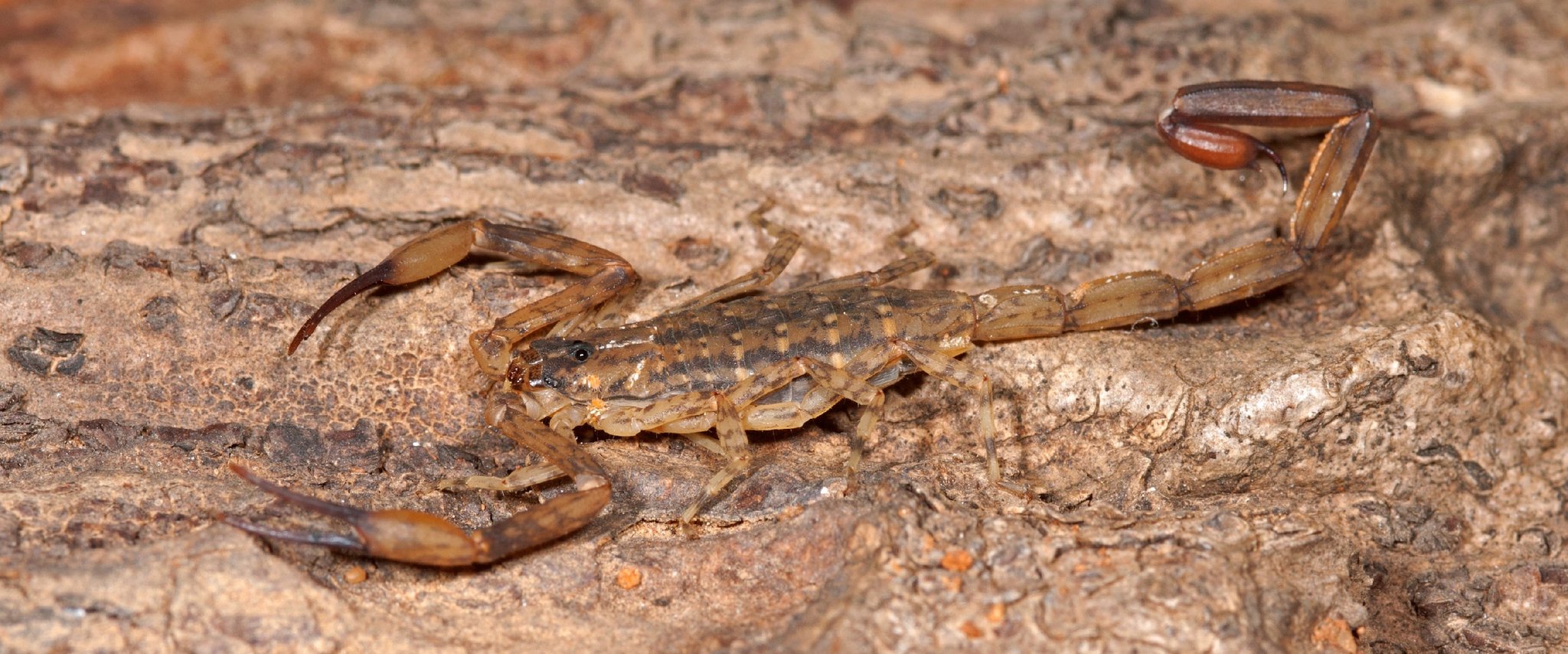
[Arachnida • 2019] Chaerilus agnellivanniorum • The Cave Population of Chaerilus Simon, 1877 (Scorpiones: Chaerilidae) from Palawan, Philippines, and Description of A New Species


Chaerilus agnellivanniorum 
Lourenço & Rossi, 2019


Abstract
The study of an important collection of scorpions, belonging to the genus Chaerilus, recently collected from a cave in the Palawan Island, Philippines, allows the clarification of the identity of this population, often misidentified with Chaerilus chapmani Vachon & Lourenço, 1985 known from caves in the Gunong Mulu National Park in Sarawak (Borneo). Chaerilus agnellivanniorum sp. n. is described from the Puerto Princesa Underground River Cave in Palawan Island based on 14 specimens, males, females, and juveniles. The new species is totally distinct morphologically from Chaerilus chapmani, a true troglobitic species. Chaerilus agnellivanniorum sp. n. may also be a true troglobitic element, but with a less marked degree of regression for several characters. Some comments on the ecology of the new species and on regional biogeography of Borneo and Palawan islands are also proposed.

Keywords: Biogeography, Cave-life, Chaerilus, Ecology, Identity


Chaerilus agnellivanniorum sp. n. 

Patronym: the name honours Dr Paolo Agnelli (MZUF) and Dr Stefano Vanni (MZUF), who organised the scientific expedition in Palawan, The Philippines.


 Wilson R. Lourenço and Andrea Rossi. 2019. The Cave Population of Chaerilus Simon, 1877 from Palawan, Philippines, and Description of A New Species (Scorpiones: Chaerilidae)  [La population cavernicole de Chaerilus Simon, 1877 à Palawan, Philippines, avec la description d’une nouvelle espèce (Scorpiones : Chaerilidae)]. Comptes Rendus Biologies. 342(1–2); 45-53. DOI: 10.1016/j.crvi.2018.12.001 
Résumé: L’étude d’une importante collection de scorpions appartenant au genre Chaerilus, récemment collectée dans une grotte de l’île de Palawan, aux Philippines, permet désormais de clarifier l’identité de cette population souvent incorrectement identifiée comme Chaerilus chapmani Vachon & Lourenço, 1985 connue des grottes du Gunong Mulu National Park au Sarawak (Bornéo). Chaerilus agnellivanniorum sp. n. est décrite de la grotte de Puerto Princesa, dans l’île de Palawan, à partir de 14 spécimens, mâles, femelles et juvéniles. Par sa morphologie, la nouvelle espèce est globalement distincte de Chaerilus chapmani, une véritable espèce troglobie. Chaerilus agnellivanniorum sp. n. pourrait également représenter un véritable élément troglobie, mais avec un moindre dégrée de régression pour plusieurs caractères. Des commentaires sont également ajoutés sur l’écologie de la nouvelle espèce et sur la biogéographie de Bornéo et de l’île de Palawan.
Mots clés: Biogéographie, Chaerilus, Écologie, Identité, Vie souterraine