Showing posts with label Eurasia. Show all posts

Friday, March 27, 2026

[PaleoMammalogy • 2026] Masripithecus moghraensis • An Early Miocene Ape from the Biogeographic Crossroads of African and Eurasian Hominoidea


Masripithecus moghraensis
Al-Ashqar, Seiffert, El-Sayed, Salem, Gohar, El-Saka, Amin & Sallam, 2026

Illustration by Mauricio Antón

Abstract
The Early Miocene fossil record documenting hominoid evolution has long been restricted primarily to sites in East Africa, whereas contemporaneous North African sites have only yielded remains of cercopithecoid monkeys. Here, we describe a fossil ape from North Africa, a new genus (Masripithecus) from the Early Miocene (~17 million to 18 million years) of northern Egypt, on the basis of mandibular remains. A combined molecular-morphological Bayesian tip-dating analysis positions Masripithecus closer to crown hominoids than coeval fossil apes from East Africa, thereby filling a phylogenetic and biogeographic gap in the evolution of stem hominoids. This evidence suggests that crown Hominoidea might have originated during the Early Miocene in the underexplored northeastern part of Afro-Arabia, rather than in eastern Africa or Eurasia.
 

Masripithecus moghraensis


Illustration of Masripithecus moghraensis by Mauricio Antón

Masripithecus moghraensis and the dispersal of crown hominoids in the Miocene. The map highlights Wadi Moghra, Egypt (star), which is the discovery site of Masripithecus—the first definitive North African ape—alongside key Miocene hominoid localities (see table S1) across Afro-Arabia and Eurasia. Arrows indicate inferred dispersal routes based on the phylogenetic and biogeographic analyses presented here. The inset phylogeny places Masripithecus as the closest sampled sister taxon of crown Hominoidea. At lower left, a life reconstruction of Masripithecus based on the Masripithecus mandible combined with the facial morphology of the middle Miocene hominoid Pierolapithecus. Illustration by Mauricio Antón
 

SHOROUQ F. AL-ASHQAR, ERIK R. SEIFFERT, SANAA EL-SAYED, BELAL S. SALEM, ABDULLAH S. GOHAR, HOSSAM EL-SAKA, MOHAMED AMIN, AND HESHAM M. SALLAM. 2026. An Early Miocene Ape from the Biogeographic Crossroads of African and Eurasian Hominoidea. SCIENCE. 391(6792); 1383-1386. DOI: doi.org/10.1126/science.adz4102 [26 Mar 2026]
Editor’s summary: The vast majority of early hominoid fossil hunting has occurred in East Africa, where a trove of early fossils and lineages have been found. Other regions in Africa have been less explored for various reasons, inspiring the question of whether a focus on East Africa has shaped opinions about where early hominoid evolution occurred. Al-Ashqar et al. now describe a Miocene ape from Egypt with crown hominoid affinities suggesting both that this lineage diverged before entering Eurasia and that a focus on one African region may have shaped our ideas about where hominoids first emerged (see the Perspective by Alba and Arias-Martorell). —Sacha Vignieri

Monday, October 13, 2025

[Paleontology • 2025] Latonia dimenticataWhy extant, Why not Extinct? A New extinct Latonia Species (Anura: Discoglossidae) from the Early Pleistocene of the Apennine Peninsula provides clues on the survival of the genus in Eurasia


 Latonia dimenticata 
 Sorbelli, Azzarà, Cherin, Delfino, Roček & Villa, 2025
 
artwork: Leonardo Sorbelli
 
Abstract
Pietrafitta is one of the richest Early Pleistocene localities in the Italian Peninsula and it hosts one of the latest occurrences of the discoglossid frog Latonia in Europe. This occurrence is here described as a new species of Latonia, a large-bodied frog, potentially feeding on hard invertebrates in the Pietrafitta palaeoswamp. Our first attempt at the phylogenetic reconstruction of Latonia, based on a matrix consisting of 20 taxa and 39 characters, placed the new Italian species within a poorly understood clade that also includes Latonia caucasica from the Late Miocene of northern Caucasus. Almost all other extinct Latonia species make up a second clade, represented in the fossil record from the Oligocene and including the youngest occurrence of the genus in Europe, from the Middle Pleistocene of Hungary. The only extant species, Latonia nigriventer, was the earliest branching taxon in our topology, which could be due to its unique unsculptured morphology, a trait that may represent a secondary loss during the Quaternary. The exostosis on cranial bones, which is considered a diagnostic feature of the genus, might have developed in the earliest Latonia in response to pronounced warming and drought. Later, starting after the Middle Miocene, this exostosis underwent a reduction process, possibly triggered by cooling, that led to Plio–Pleistocene forms sharing a narrower frontoparietal with a less pustular sculpturing. Latonia dimenticata is a clear example of this frontoparietal morphology. Latonia nigriventer may have further evolved a completely unsculptured morphology to face rapid environmental changes in the last Quaternary glacial phases and ultimately facilitating its survival into the present day.  

Keywords: Quaternary, Italian Peninsula, Europe, Middle East, Latonia nigriventer, exostosis


Latonia dimenticata sp. nov. 


Leonardo Sorbelli, Beatrice Azzarà, Marco Cherin, Massimo Delfino, Zbyněk Roček and Andrea Villa. 2025. Why extant, Why not Extinct? A New extinct Latonia Species (Anura: Discoglossidae) from the Early Pleistocene of the Apennine Peninsula provides clues on the survival of the genus in Eurasia. Journal of Systematic Palaeontology. 23(1); 2554727. DOI: doi.org/10.1080/14772019.2025.2554727 [10 Oct 2025]
  facebook.com/acinonyxpardinensis/posts/2889113174614421

Thursday, September 18, 2025

[Mollusca • 2025] Caucasopsiinae subfam. nov. Little Treasures hidden in the Darkness: Diversity and Phylogeny of stygobiotic Hydrobiidae (Gastropoda) of the Caucasus


Caucasopsiinae Chertoprud & Vinarski,

in Chertoprud, Ekimova, Palatov, Grego, Mumladze et Vinarski, 2025

Highlights
• Hydrobiidae inhabit groundwaters on both south and north sides of the Great Caucasus.
• Caucasian hydrobiids are represented by three distinct phylogenetic lineages of subfamily taxonomical rank.
• A new subfamily of Hydrobiidae endemic to the Caucasus is described.
• A high morphological variability in the shell morphology within Caucasopsiinae subfam.nov. has been revealed.
• Female reproductive system morphology better supports high-level taxa phylogeny than other features.

Abstract
Hydrobiidae is the most diverse and species-rich freshwater gastropod family in the Palearctic. Their diversity in the Caucasus region remains largely unexplored and the phylogenetic relationships with European taxa have not been clarified yet. The primary objective of this study is to perform a molecular phylogenetic analysis of the stygobiotic Hydrobiidae of the Caucasus with an increased taxon sampling and incorporation of multiple molecular markers. We show that the Caucasian hydrobiids are represented by three distinct lineages of a subfamily rank: (1) Caucasopsiinae subfam. nov., comprises most of the stygobiotic hydrobiid genera endemic to Caucasus; (2) Belgrandiellinae includes a single stygobiotic genus Sitnikovia and a complex of crenobiotic genera; (3) Islamiinae is represented by a single monotypic genus. The Caucasian stygobiotic hydrobiids are represented by 13 genera, five of which were identified as new for science, and at least 37 species, including a significant number (20 species) of putative new taxa. Analysis of the soft-body anatomy revealed that the female reproductive system showed the best congruence with the phylogenetic relationships. Shell morphology showed high variability at both inter- and intrageneric level, questioning the generic assignment of species based on empty shells. The Caucasian stygobiotic Hydrobiidae show high endemism at all taxonomical levels from species to subfamilies, which probably reflects their long evolution in relative isolation from the hydrobiid clades inhabiting other regions.
 
Keywords: Groundwater ecosystems, Integrative taxonomy, Freshwater snails, Endemism, New Subfamily, Springsnails


Class Gastropoda Cuvier, 1795
Subclass Caenogastropoda Cox, 1960

Superfamily Truncatelloidea Gray, 1840
Family Hydrobiidae W. Stimpson, 1865

Subfamily Caucasopsiinae Chertoprud et Vinarski, n. Subf.

Type genus: Caucasopsis Grego et Mumladze, 2020
Type species: Caucasopsis letsurtsume Grego et Mumladze, 2020

Shells of Caucasian Hydrobiidae (SEM photographs):
A – Caucasopsis sp. 3; B – Caucasopsis sp. 8; C – Caucasopsis letsurtsume, conic form; D – Caucasopsis letsurtsume, robust form;
E – Pontohoratia birsteini; F – Caucasopsis vinarskii comb. nov.; G – Imeretiopsis gorgoleti;
 H – Schapsugia pulcherrima; I – Gen. 2; J – Gen. 1; K – Caucasogeyeria chrysomallos; L – Gen. 3; M – Sitnikovia megruli.


Elizaveta Chertoprud, Irina Ekimova, Dmitry Palatov, Jozef Grego, Levan Mumladze and Maxim Vinarski. 2025. Little Treasures hidden in the Darkness: Diversity and Phylogeny of stygobiotic Hydrobiidae (Mollusca: Gastropoda) of the Caucasus. Molecular Phylogenetics and Evolution.  213, 108439. DOI: doi.org/10.1016/j.ympev.2025.108439 

Sunday, September 14, 2025

[Mollusca • 2020] Imeretiopsis gen. nov., Caucasopsis gen. nov., Caucasogeyeria colchis, C. chrysomallos, Imeretiopsis prometheus, Kartvelobia sinuata, Hausdorfenia shareula, ... • The Phylogeny of stygobiotic Sadlerianinae Szarowska, 2006 (Gastropoda: Hydrobiidae) from Georgia with Descriptions of Five New Genera and Twenty-one New Species [Revealing the stygobiotic and crenobiotic Molluscan Biodiversity Hotspot in Caucasus: Part I]


 5–8 Caucasogeyeria colchis sp. nov., live specimens Pirveli Balda, spring in the village
9–12 C. chrysomallos sp. nov.  

in Grego, Mumladze, Falniowski, Osikowski, Rysiewska, Palatov et Hofman, 2020.

Abstract
The position of the southwestern Caucasus as a stygobiotic Mollusca hotspot is confirmed. Molecular data of stygobiotic gastropods revealed the diversity of subfamily Sadlerianinae Szarowska, 2006, inhabiting the subterranean environment of Georgia. In addition to the well-known endemic genera Pontohoratia Vinarski, Palatov & Glöer, 2014 and Motsametia Vinarski, Palatov & Glöer, 2014, five more genera were identified in northwestern Georgia as new to the scienceKartvelobia gen. nov., Imeretiopsis gen. nov., Caucasopsis gen. nov., Caucasogeyeria gen. nov., and Hausdorfenia gen. nov. Additionally, 21 new species were found to inhabit the studied area (Samegrelo, Imereti, Racha regions in Georgia).

Keywords: cave, biodiversity, freshwater, interstitial, mtDNA, molecular taxonomy, spring, subterranean

Caucasogeyeria specimens used for molecular and anatomical studies
 1 Caucasogeyeria chrysomallos sp. nov. 2–4 C. ignidona sp. nov. 5–8 C. colchis sp. nov., live specimens Pirveli Balda, spring in the village 9–12 C. chrysomallos sp. nov. The numbers correspond to individuals. Photograph A. Falniowski, J. Grego, A. Rysiewska.


 Jozef Grego, Levan Mumladze, Andrzej Falniowski, Artur Osikowski, Aleksandra Rysiewska, Dimitry M. Palatov and Sebastian Hofman. 2020. Revealing the stygobiotic and crenobiotic Molluscan Biodiversity Hotspot in Caucasus: Part I. The Phylogeny of stygobiotic Sadlerianinae Szarowska, 2006 (Mollusca, Gastropoda, Hydrobiidae) from Georgia with Descriptions of Five New Genera and Twenty-one New Species. ZooKeys. 955: 1-77. DOI: doi.org/10.3897/zookeys.955.51983 


Thursday, August 28, 2025

[Entomology • 2025] Dyspessa sudoli • Another New Armenian Species (Lepidoptera: Cossidae: Cossinae: Endagriini)


Dyspessa sudoli Saldaitis, Yakovlev, Dobrzański & Prozorov, 

in SaldaitisYakovlevDobrzański,  Kalashian, Müller et Prozorov, 2025. 

Abstract
A new species from Armenia, Dyspessa sudoli sp. nov., is described in the present article. It is compared with the Armenian Dyspessa gayane Yakovlev et al., 2025 and Dyspessa daralagezi Yakovlev, 2008b, and occurring closely to Dyspessa stroehlei Yakovlev, 2008a described from Kars Province in northeastern Turkey. Adults of both sexes, their genitalia, map with collection localities, and habitat for the new species are illustrated.

Lepidoptera, biodiversity, Caucasus mixed forests ecoregion, fauna, new taxon, transcaucasia, West Asia

FIGURES 1–6. Adults of Dyspessa spp. from Armenia.
1–2. Dyspessa gayane. 3–6. Dyspessa sudoli sp. nov.
Depositories: 1. WIGJ. 2, 6. ASV. 3. Upper Silesian Museum. 4. GMF. 5. DSL. Scale bars—1 cm.

Dyspessa sudoli Saldaitis, Yakovlev, Dobrzański & Prozorov sp. nov.

 Habitat of Dyspessa sudoli sp. nov. 
(Photo by X. Dobrzański).


Aidas SALDAITIS, Roman V. YAKOVLEV, Xavier DOBRZAŃSKI, Mark KALASHIAN, Günter C. MÜLLER, Alexey M. PROZOROV. 2025. Dyspessa sudoli sp. nov.—Another New Armenian Species (Lepidoptera, Cossidae, Cossinae, Endagriini).  Zootaxa. 5659(3); 426-438. DOI: doi.org/10.11646/zootaxa.5659.3.7 [2025-07-04]

Friday, May 2, 2025

[Ichthyology • 2025] Gobio uralensisOn the border of Europe and Asia: A New Species of Gudgeons (Cypriniformes: Gobionidae) from the Caspian Sea Basin


Gobio uralensis
 Turbanov, Bolotovskiy, Artaev, Gandlin, Levina, Vasil’eva & Levin, 2025
 
 Ural gudgeon | уральский пескарь  ||  DOI: doi.org/10.3897/zse.101.147368 

Abstract
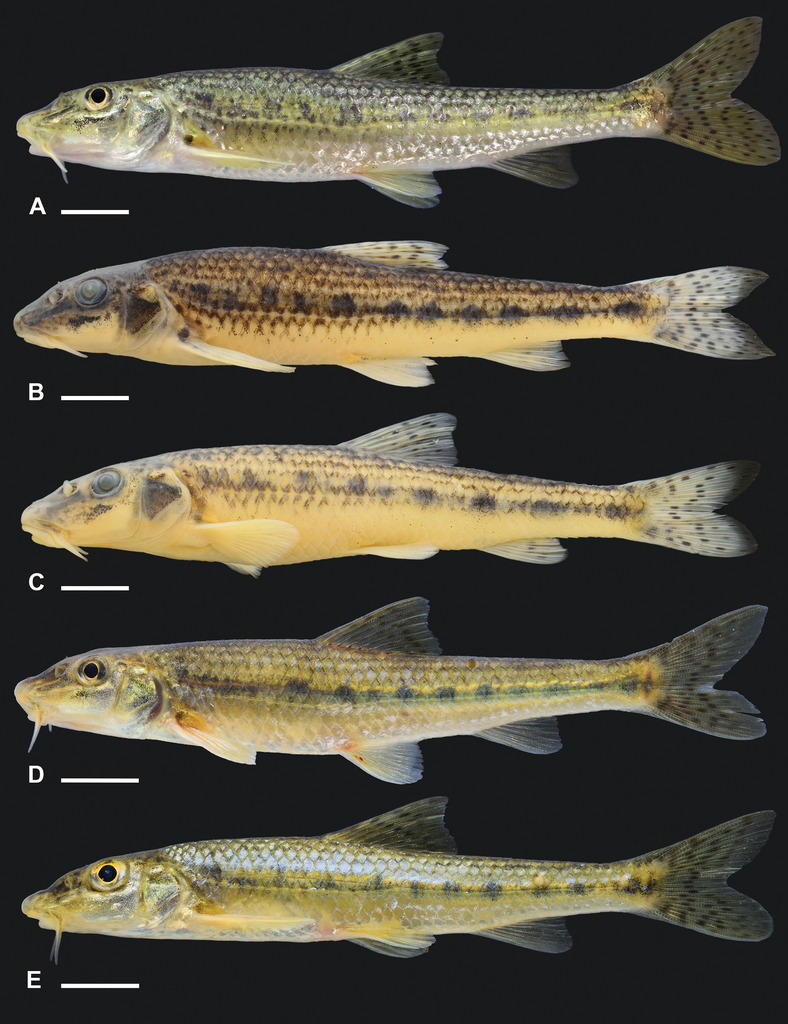
A new species of cypriniform fish was discovered during studies of the riverine fish fauna of the Caspian Sea basin, employing an integrative taxonomy approach. The Ural gudgeon is herein described as a new species from the Ural River system, which is considered a geographical boundary between Europe and Asia. The new species is distinguished from the other gudgeon species by a combination of morphological characters and genetic data. Morphologically, it is very similar to Gobio volgensis from the Volga basin. Genetically, however, it is closer to G. acutipinnatus, which occurs in the upper Irtysh River (Ob’ River system), and to G. multipunctatus from the Lake Alakol basin in Central Asia (p-distance = 0.037; COI mtDNA). Therefore, the Ural gudgeon, which is endemic to the Ural River system, is of Asian rather than European origin. The biogeography of freshwater aquatic animals in the region is discussed in relation to paleogeographic events and connections between the Caspian Sea and Ob’ drainages.

Key Words: Biogeography, DNA barcoding, endemics, freshwater fish, genetics, taxonomy

Lateral view of Gobio uralensis sp. nov.:
A–C. Bolshoy Kizil River near Ryskuzhino (A, B. Holotype; C. Paratype);
D. Uskalyk River near Verkhniy Muinak; E. Ural River near Krasnogor (right side, inverted image).
A, D, E. Live coloration; B, C. After fixation in 10% formalin (5 months), then transferred to 70% ethanol.
Scale bar: 10 mm.


Class Actinopteri Cope, 1871
Order Cypriniformes Bleeker, 1859

Family Gobionidae Bleeker, 1863
Genus Gobio Cuvier, 1816

 Gobio uralensis sp. nov.
 (English name – Ural gudgeon, 
Russian name – уральский пескарь)


 Ilya S. Turbanov, Aleksey A. Bolotovskiy, Oleg N. Artaev, Aleksandr A. Gandlin, Marina A. Levina, Ekaterina D. Vasil’eva and Boris A. Levin. 2025. On the border of Europe and Asia: Gobio uralensis, A New Species of Gudgeons (Cypriniformes, Gobionidae) from the Caspian Sea basin. Zoosystematics and Evolution. 101(2): 855-874.  DOI: doi.org/10.3897/zse.101.147368 

Tuesday, February 18, 2025

[PaleoMammalogy • 2025] Cranial Anatomy of the hypercarnivore Bastetodon syrtos gen. nov. (Hyaenodonta: Hyainailourinae) and A Reevaluation of Pterodon in Africa


Bastetodon syrtos (Holroyd, 1999)
Bastetodon 
gen. nov.

Al-Ashqar, Borths, El-Desouky,  Heritage, Abed, Seiffert, El-Sayed & Sallam, 2025
artwork by Ahmed Morsi

ABSTRACT
During the Paleogene in Afro-Arabia, most terrestrial mammalian carnivores belonged to Hyaenodonta, an extinct lineage bearing a pair of carnassials between each set of molars. The Fayum Depression of Egypt preserves multiple lineages of hyaenodonts across the Eocene–Oligocene boundary. Here, we describe one of the most complete hyaenodont crania ever recovered from the lower Oligocene of the Fayum (Jebel Qatrani Formation, Quarry I, ∼30 Ma). The cranium is about the size of a hyena’s and preserves the complete upper tooth row. The long, shearing metastyle and reduced and mesially shifted protocones indicate a hypercarnivorous diet, and robust zygomatic arches suggest strong chewing muscles. Based on dental comparisons, we refer the cranium to Bastetodon syrtos (previously “Pterodonsyrtos). Bastetodon syrtos has three premolars and two molars—a reduced dental formula compared with other Fayum hyainailourines such as Akhnatenavus and European hyainailourines such as Pterodon. The cranium preserves the clover-shaped lambdoidal crest and long pharyngeal tube that unites Hyainailouroidea (Apterodontinae, Teratodontinae, and Hyainailourinae). The new Fayum cranium allows us to reevaluate the genus Pterodon and explore characters that distinguish Afro-Arabian and Eurasian species placed in this genus. Our phylogenetic analysis recovers a paraphyletic Pterodon, with B. syrtos as the sister taxon of Falcatodon schlosseri. We erect Sekhmetops to describe the large Fayum hyainailourine species S. phiomensis and S. africanus. This effort clarifies the biogeographic history of the clade that includes Pterodon, revealing multiple Tethys Seaway dispersals during the Paleogene followed by endemic radiations in Eurasia and Afro-Arabia.


Genus  Bastetodon gen. nov.

Pterodon syrtos Holroyd, 1999:8, fig. 4 (original description).
 
Etymology—Bastetodon, from “Bastet,” one transliteration of the name of the ancient Egyptian, cat-headed goddess of protection, pleasure, and bringer of good health. She was also associated with the lion-headed goddess Sekhmet. And ancient Greek “odon” meaning tooth. Literally, “Teeth like the cat-headed goddess.”


 Genus SEKHMETOPS gen. nov.

Type Species—Sekhmetops africanus (Andrews, 1904)
Included Species—Sekhmetops phiomensis (Osborn, 1909)

Etymology—From Sekhmet, the wrathful lion-headed goddess of Ancient Egypt associated with war and pestilence. And “ops” meaning “face” in ancient Greek. Literally, “Having the face of the lion-headed goddess.”


Shorouq F. Al-Ashqar, Matthew Borths, Heba El-Desouky, Steven Heritage, Mohamed Abed, Erik R. Seiffert, Sanaa El-Sayed and Hesham M. Sallam. 2025. Cranial Anatomy of the hypercarnivore Bastetodon syrtos gen. nov. (Hyaenodonta, Hyainailourinae) and A Reevaluation of Pterodon in Africa. Journal of Vertebrate Paleontology. e2442472. DOI: doi.org/10.1080/02724634.2024.2442472

Notably, this study refutes the monophyly of “Pterodon.” Based on the morphological features and the phylogenetic analyses conducted within this study, we suggest that Pterodon has never been found in Afro-Arabia. “Pterodon syrtos is now placed in Bastetodon syrtos and “Pterodon africanus and “Pterodon phiomensis are placed in the new genus Sekhmetops. Under this taxonomic scheme, Pterodon is now restricted to the Eocene of Europe.


Saturday, January 4, 2025

[Crustacea • 2024] Proasellus abini • A New Species of the Genus Proasellus (Isopoda: Asellidae) from the Abin River Basin, with the preliminary data on the Diversity of the Genus in the southwestern foothills of the Russian Caucasus


Proasellus abini 
Marin & Sinelnikov, 2024
 

ABSTRACT 
 A new stygobiotic species of the genus Proasellus Dudich, 1925 (Crustacea: Isopoda: Asellidae), Proasellus abini sp. n., is described from the hyporheic habitats and groundwater of the Abin River basin, located in the southwestern foothills of the Caucasian Ridge. The new species is morphologically and genetically close to Proasellus linearis Birštein, 1967, known from the Evstafiev Sсhel (=Ashamba River) near Gelendzhik. Data on phylogeny, ecology and feeding of the species and other SW Caucasian species of the genus are also presented in the paper.

KEY WORDS: Crustacea, diversity, Proasellus, new species, hyporhea, stygobiotic, southwestern Caucasus, Russia.

General view and natural habitat of Proasellus abini sp. n.:
 A — a forest well, Shids, general view; B, C — individuals of the new species on the bottom and walls of the well; D, F — general dorsal view of alive individual of the new Proasellus abini sp.n. and its lateral view (E).

 Proasellus abini sp. n.

 
Marin I.N. and Sinelnikov S.Yu. 2024. A New Species of the Genus Proasellus (Crustacea: Isopoda: Asellidae) from the Abin River Basin, with the preliminary data on the Diversity of the Genus in the southwestern foothills of the Russian Caucasus. Invertebrate Zoology. 21(1); 81–93. 
  x.com/iee_ras/status/1871075641082237437

Friday, December 27, 2024

[Botany • 2022] Myriophyllum rubricaule (Haloragaceae) • a M. aquaticum look-alike only known in cultivation


Myriophyllum rubricaule Valk. & Duist.,

in Van Valkenburg, Duistermaat, Boer et Raaymakers, 2022. 

Abstract
A confusingly labeled water-milfoil of obscure status, known only in cultivation, is here formally described as a new species, Myriophyllum rubricaule Valk. & Duist. sp. nov. This species has fully replaced M. aquaticum in the horticultural trade in Europe since the addition of M. aquaticum to the list of invasive alien species of Union concern (EU regulation no. 1143/2014) in 2016. This manuscript provides a morphological description of M. rubricaule sp. nov., and its distinction from M. aquaticum is further supported by molecular data (chloroplast and nuclear loci).

Keywords: Myriophyllum, water-milfoil, EU regulation no. 1143/2014, invasive plant, horticulture


Myriophyllum rubricaule Valk. & Duist. sp. nov. 

Diagnosis: Herba perennis aquatica vel paludigena. Folia omnia verticillata pectinata. Flores unisexuales, solae plantae femininae culturaeque cognitus. Flores intra axillas foliorum solitarii. Planta valde similaris Myriophyllo aquatico, sed caules foliaque modice, caules purpurei et folia emergentia virida. Flores feminei subrosei

Etymology: The species epithet is based on the purplish red color of the stem.


Johan L.C.H. Van Valkenburg, Leni (H.) Duistermaat, Edu Boer and Tom M. Raaymakers. 2022. Myriophyllum rubricaule sp. nov., a M. aquaticum look-alike only known in cultivation. European Journal of Taxonomy. 828(1), 1-15. DOI: doi.org/10.5852/ejt.2022.828.1847 

Monday, December 23, 2024

[Crustacea • 2024] Proasellus mikhaili • A New stygobiotic Species of the genus Proasellus Dudich, 1925 (Isopoda: Asellidae) from the Black Sea coast of the Caucasus, Russia


 Proasellus mikhaili Palatov & Chertoprud, 2024

Map of collection sites in the Black Sea coast of the Caucasus, general view and natural habitats of described species: A — habitus of P. mikhaili sp.n., paratype (♂); 6 — collection sites
C — photos of collection sites of P. mikhaili: 6a — spring stream (rheokrene) on Kadosh Cape, 3.5 km to NW of Tuapse town, ...; 6b — the Agoy River on the NE outskirts of Agoy village, ...


ABSTRACT 
A new stygobiotic species of water louses of the genus Proasellus Dudich, 1925 (Crustacea: Isopoda), P. mikhaili sp. n., is described from springs and groundwaters in the vicinity of the town of Tuapse on the Black Sea coast of the northwestern Caucasus, Russia. Representatives of this genus are reported for the first time from this coastal area. This new species is characterized by a number of unique features that immediately distinguish it from all known other Caucasian species of the genus. At present, this is the only species described from the region that has three connecting hooks in the retinacula of male pleopods I, as well as a shortened exopodite of pleopod V, significantly shorter than the endopodite in length. Among the diagnostic characters of this species are also a poor ornamentation of pereopods I–VII and a specific chetotaxis of the pleotelson represented by a dense covering of thin, hair-like setae. Probably, this species is an endemic of the Tuapsinsky District.

KEY WORDS: Crustacea, Asellidae, new species, stygobionts, crenobionts, local endemism, Transcaucasia.

Map of collection sites for Proasellus mikhaili sp. n. in the Black Sea coast of the Caucasus, general view and natural habitats of described species: 
A — habitus of P. mikhaili sp.n., paratype (♂);
B — map of collection sites for Proasellus in the Black Sea coast of the Caucasus. Numbers refer to: 1 — P. infirmus; 2 — P. linearis; 3 — P. ljovuschkini; 4 — P. similis; 5 — P. abini; 6 — P. mikhaili sp. n.;
C — photos of collection sites of P. mikhaili: 6a — spring stream (rheokrene) on Kadosh Cape, 3.5 km to NW of Tuapse town, 44°07ʹ37.55″N 39°02ʹ03.92″E; 6b — the Agoy River on the NE outskirts of Agoy village, 44°09ʹ05.1″N 39°02ʹ59.7″E.

Order Isopoda Latreille 1816 
Suborder Asellota Latreille, 1802 

Superfamily Aselloidea Latreille, 1802 
Family Asellidae Latreille, 1802 
Genus Proasellus Dudich, 1925 
 
Proasellus mikhaili sp. n.

DIAGNOSIS. Medium sized, depigmented species. Antenna I with six to seven flagellar articles, flagellum of antenna II with 42–55 articles. Inner plate of maxillula with five or six apical pappose setae. Propodus I elongate, oval, its inferior margin without a proximal apophysa, with two or three robust spiniform setae. Dactylus I with four or five short robust setae on inferior margin and ...

ETYMOLOGY. The species is named in honor of the renowned Russian hydrobiologist Mikhail Vitalievich Chertoprud (30.01.1975–23.02.2023), who spent many years studying aquatic invertebrates in the Krasnodar Territory and repeatedly conducted hydrobiological training courses at Cape Kadosh near Tuapse. 


Dmitry M. Palatov and Elizaveta M. Chertoprud. 2024. A New stygobiotic Species of the genus Proasellus Dudich, 1925 (Crustacea: Isopoda: Asellidae) from the Black Sea coast of the Caucasus, Russia. Invertebrate Zoology. 21(3); 369–383. 

Saturday, December 21, 2024

[PaleoMammalogy • 2023] Tavridia gromovi • A New Antelope (Artiodactyla: Bovidae) from the Lower Pleistocene of the Taurida Cave in the Crimea


 Tavridia gromovi 
Vislobokova, 2023


Abstract
A new form of small antelope is described from the Lower Pleistocene of the Taurida Cave in the Crimea. A new genus and species Tavridia gromovi is identified from a fragment of the skull roof with a horn core and the lower jaw. This small antelope differed from all known forms in the morphological features of the horn cores and the dental system. Based on the combination of characters, it is assigned to the tribe Antilopini (Eurasia and Africa, Middle Miocene to Recent). The discovery of T. gromovi in the Crimea testifies to the significant diversity of this group of antelopes in the middle of the Early Pleistocene.

Keywords: Tavridia gromovi gen. et sp. nov., Antilopini, Early Pleistocene, the Crimea, Taurida Cave


SYSTEMATIC PALEONTOLOGY
Family Bovidae Gray, 1821
Subfamily Antilopinae Gray, 1821

Tribe Antilopini Gray, 1821

Genus Tavridia Vislobokova, gen. nov.

Etymology. From the Taurida Cave locality.
 
Tavridia gromovi Vislobokova, sp. nov.

Etymology. Named in honor of V.I. Gromov, the outstanding Russian researcher of the Quaternary.

 
I. A. Vislobokova. 2023. A New Antelope Tavridia gromovi gen. et sp. nov. (Artiodactyla, Bovidae) from the Lower Pleistocene of the Taurida Cave in the Crimea. Paleontological Journal. 57; 463–472.  DOI: doi.org/10.1134/S0031030123040147 

 
НАЙДЕННУЮ В КРЫМУ ДРЕВНЮЮ АНТИЛОПУ НАЗВАЛИ В ЧЕСТЬ ТАВРИДЫ


Tuesday, December 17, 2024

[Crustacea • 2024] Protracheoniscus krivolutskyi • A New Species of the Genus Protracheoniscus Verhoeff, 1917 (Isopoda: Oniscidea: Agnaridae) from the northwestern Caucasus


Protracheoniscus krivolutskyi Gongalsky, 

in Gongalsky, Byzov et Medvedev, 2024

ABSTRACT 
 Protracheoniscus krivolutskyi sp. n. (Agnaridae) is described from the Utrish State Nature Reserve at the Black Sea coast of Russia. Analysis of COI gene and Scanning Electron Microscopy support the validity of this species. Affinities of the species within the genus are discussed.

KEY WORDS: Isopoda, COI, phylogenetic analysis, Oniscidea, Abrau Peninsula, woodlouse, Protracheoniscus.

Alive specimen of Protracheoniscus krivolutskyi sp. n. (female), from the Urtish State Nature Reserve, NE Caucasus, Russia, kept in culture.

TAXONOMY 
Class Malacostraca Latreille, 1802 
Order Isopoda Latreille, 1817 
Family Agnaridae Schmidt, 2003 

Genus Protracheoniscus Verhoeff, 1917 

Protracheoniscus krivolutskyi Gongalsky sp. n.
 
DIAGNOSIS. The species of Protracheoniscus is characterized by the antennal flagellum with the articles of a ratio 1:2; noduli laterales are located anteriorly of the middle line of pereonite 1.

ETYMOLOGY. The species name krivolutskyi originates from Prof. Dr. Dmitri A. Krivolutsky (1939–2004), a prominent Russian soil zoologist who encouraged the first author to study soil biology.


Konstantin B. Gongalsky, Philipp S. Byzov and Dmitry A. Medvedev. 2024. A New Species of the Genus Protracheoniscus Verhoeff, 1917 (Isopoda: Oniscidea: Agnaridae) from the northwestern Caucasus. Arthropoda Selecta. 33(1): 65–75. DOI: doi.org/10.15298/arthsel.33.1.06  

Sunday, December 8, 2024

[Botany • 2024] A Taxonomic Monograph of the Eurasian holoparasitic plant Genus Lathraea L. (Orobanchaceae)


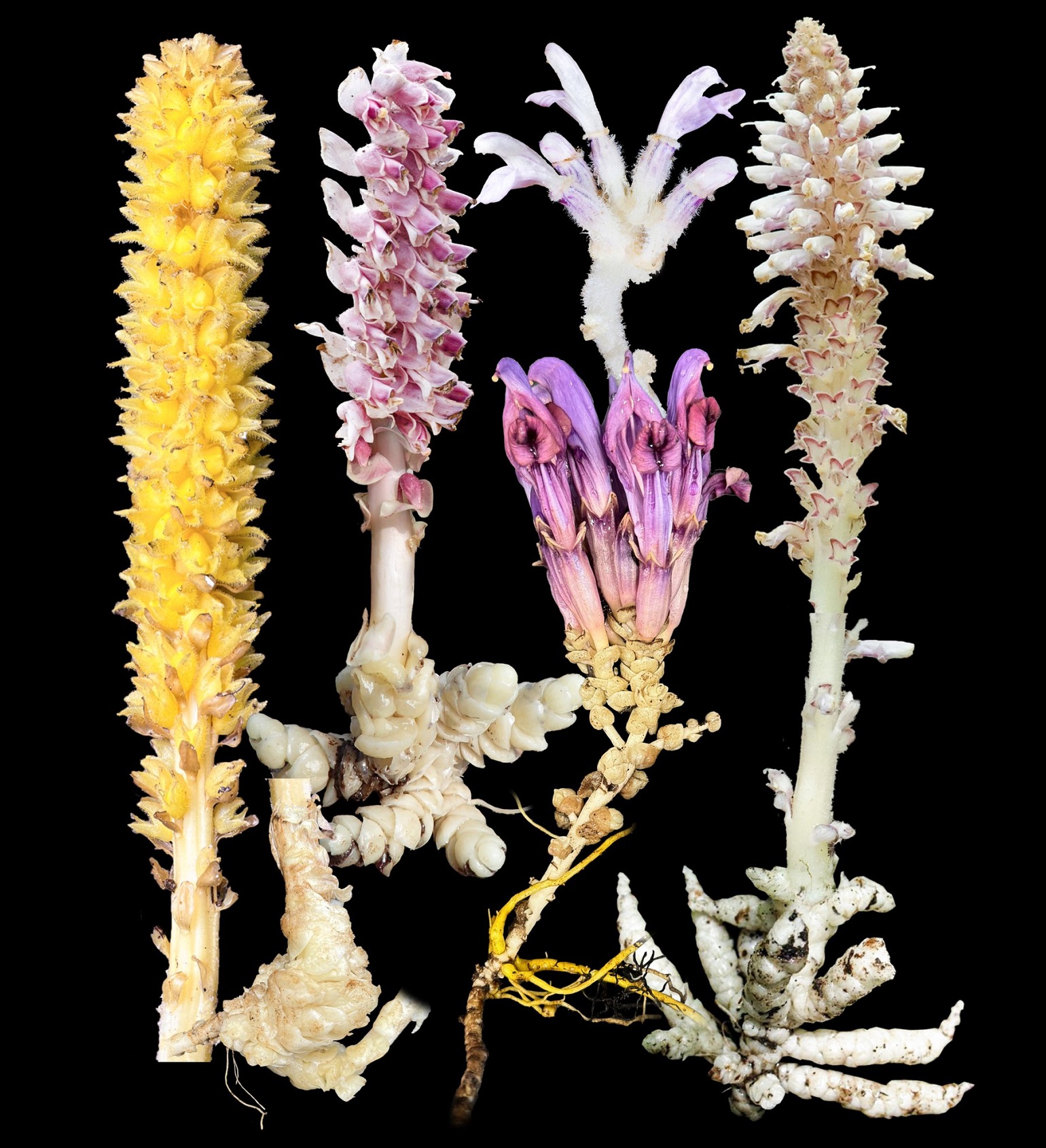
 Five species of Lathraea
 Lathraea squamariaLathraea clandestina, Lathraea japonicaLathraea rhodopeaLathraea purpurea

in Hatt, Tsiftsis et Thorogood, 2024. 

Abstract
A taxonomic monograph is presented for Lathraea L. (Orobanchaceae), a genus of holoparasitic plants distributed across Europe and Asia. Plants in this genus are characterised by their underground stems, achlorophyllous scales with internal gland-lined cavities, and, in some species, explosive seed dehiscence. Despite their conspicuousness, no taxonomic treatment of the genus has been written since 1930. Our work draws upon extensive international field data and a comprehensive survey of herbarium specimens. Detailed descriptions are provided for each species, along with full synonymy, distribution maps, and notes on habitat, host specificity, phenology, ecology, ethnobotany and threat risk. We present evidence to consolidate Lathraea into five species, resolving taxonomic confusion. The infrageneric classification is reviewed and a key to species is provided. Species are illustrated with photographs of living and dried material.

Lamiales, Lathraea, Orobanchaceae, Lathraea squamariaLathraea clandestina, parasitic plants, holoparasite, Lathraea japonicaLathraea rhodopeaLathraea purpurea, Eudicots


Sebastian A. Hatt, Spyros Tsiftsis and Chris J. Thorogood. 2024. A Taxonomic Monograph of the Eurasian holoparasitic plant Genus Lathraea L. (Orobanchaceae). Phytotaxa. 672(1); 1-29. DOI: doi.org/10.11646/phytotaxa.672.1.1

Friday, November 29, 2024

[Botany • 2024] Orobanche dagestanica (Orobanchaceae) • A New Species from the Greater Caucasus


Orobanche dagestanica Ó.Sánchez, Piwow., Fateryga, Svirin & Murtaz., 

in Piwowarczyk, Sánchez Pedraja, Fateryga, Svirin et Murtazaliev, 2024.
 
Abstract
A new, probably endemic species, Orobanche dagestanica is described from Dagestan in Russia (the Greater Caucasus). The species grows in alpine shale scree slopes, and is a parasite of the roots of species from the genus Lophiolepis (Asteraceae). Based on morphological and phylogenetic data, the newly-described species belongs to Orobanche subsect. Curvatae, and specifically to O. ser. Krylowianae, however it is distinct from all other taxa in this group. A detailed description, diagnosis, illustrations, a comparison with related species, as well as phylogenetic analysis are provided.

Curvatae, Krylowianae, holoparasites, Dagestan, Lophiolepis, Cirsium, taxonomy, Eudicots


Renata Piwowarczyk, Óscar Sánchez Pedraja, Alexander V. Fateryga, Sergey A. Svirin and Ramazan A. Murtazaliev. 2024. Orobanche dagestanica (Orobanchaceae): A New Species from the Greater Caucasus.  Phytotaxa. 653(1); 67-78. DOI: doi.org/10.11646/phytotaxa.653.1.5