Showing posts with label Gentianaceae. Show all posts

Monday, July 6, 2026

[Botany • 2022] Gentiana ranae (Gentianaceae) • A New Species from Himachal Pradesh, India revealed by morphology and molecular phylogeny


Gentiana ranae M.Shabir & M.D.Dwivedi, 

in Shabir, Pal, Dwivedi et Tiwari, 2022.
 Rheedea. 32(1);  
 
Abstract 
A new species of the genus Gentiana, G. ranae sp. nov., from Rohtang Pass in Himachal Pradesh (India) is described here. The species shows morphological resemblances with G. glauca Pall. and G. venusta Wall. of sect. Monopodiae, but differs in key morphological characters such as a stem with 4–6 fine lines, upper stem leaves more densely enveloping the inflorescence, a light blue corolla with margins of the corolla lobes scabrous to crenulate, horizontally truncate plicae, dentate to erose margins, and ovate to sub-orbicularseeds. Along with the morphological characters the species is supported as a new member of sect. Monopodiae in a molecular phylogenetic analyses using the nuclear ribosomal DNA internal transcribed spacer (ITS) and chloroplast trnL-F intergenic-spacer regions. The species is described, illustrated and discussed.

Keywords: cpDNA trnL-F, Gentiana glauca, nrDNA ITS, sect. Monopodiae, western Himalaya
 
Gentiana ranae M.Shabir & M.D.Dwivedi:
b. Flowering plant; c. Habit; d. Seeds
 (Photos by Mohd Shabir).

Gentiana ranae M.Shabir & M.D.Dwivedi: a. Habitat
 (Photos by Mohd Shabir).

Gentiana ranae sp. nov.


Shabir M., Pal A.K., Dwivedi M.D. and J.K. Tiwari. 2022. Gentiana ranae (Gentianaceae), A New Species from India revealed by morphology and molecular phylogeny.  Rheedea. 32(1); 30-45. DOI: 10.22244/rheedea.2022.32.01.01 https://rheedea.in/IAAT/article/view/898 
 

Saturday, June 6, 2026

[Botany • 2026] Gentiana macneilliana (Gentianaceae) • A New Species Sikkim Himalaya (India) based on Morphological and Molecular Data


Gentiana macneilliana A.K.Halder & D.Maity, 

in Halder, Saha, Dwivedi, Banerjee, Jha, Pradhan, Maity et Pandey, 2026. 

Abstract
Gentiana macneilliana (Gentianaceae), a new species from North Sikkim, in the Eastern Himalayan region of India, is described, illustrated and discussed. It is morphologically similar to Gentiana lacinulata T.N.Ho of Gentiana sect. Chondrophyllae Bunge but differs markedly in having acute and usually mucronate leaf apex, ovate corolla lobes with acuminate apex, much longer plicae (1.5–2.6 mm), which are more than half as long as corolla lobes, and longer pedicel (up to 8 mm). This new species also resembles Gentiana muscicola C.Marquand (Gentiana sect. Chondrophyllae) but can easily be differentiated by its unique corolla lobe, shorter petiole, narrowly based leaf lamina, longer pedicel and shorter style. The affinity of the new species with Gentiana grata Harry Sm., a member of the same section, is also highlighted. A taxonomic description, images and illustrations of the new taxon are provided, along with a discussion of closely related taxa.
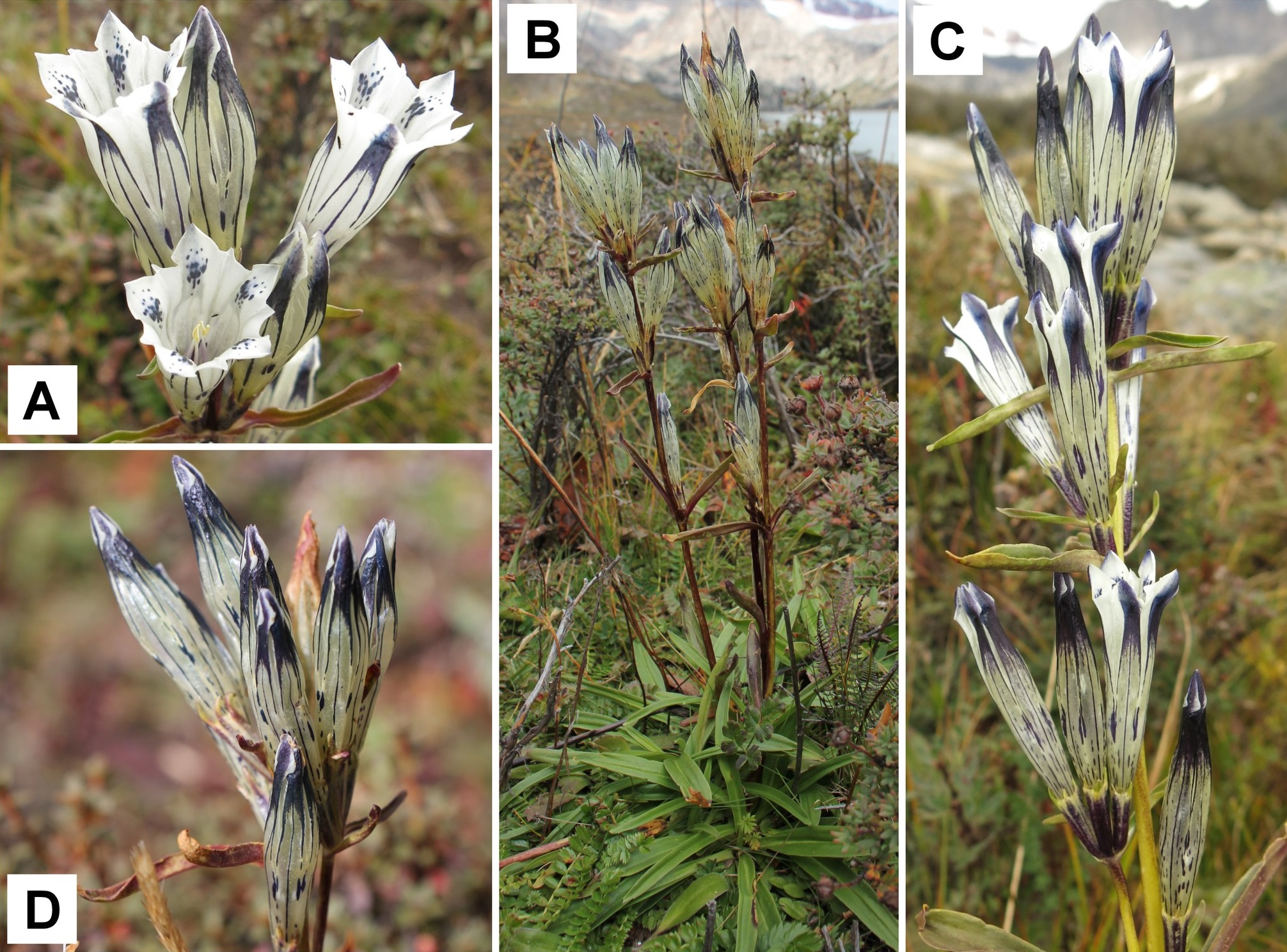
Keywords: Gentiana sect. Chondrophyllae, Eastern Himalaya, ITS, IUCN, trnL-F, new species

Gentiana macneilliana A.K.Halder & D.Maity, sp. nov.
A, Habitat; B and C, habit; D, open flower
Photographs: A. K. Halder (A–D) 

Gentiana macneilliana A.K.Halder & D.Maity, sp. nov.

Gentiana macneilliana is morphologically most similar to Gentiana lacinulata but differs from that species by its short petiole, 0.5–1.5 mm long (vs up to 3 mm); acute and usually mucronate leaf apex (vs obtuse leaf apex); narrowly revolute leaf margin (vs flat leaf margin); longer pedicel, up to 8 mm long (vs up to 3 mm long); ovate corolla lobes with acuminate apex (vs suborbicular with obtuse-rounded or rounded apex); much longer plicae, 1.5–2.6 mm long (vs 0.7–1 mm); and plicae more than 1/2 as long as corolla lobes (vs less than 1/3 as long as corolla lobes). It also resembles Gentiana muscicola but can be differentiated from that species by its unique ovate, acuminate corolla lobes with erose margin and distinctly contracted base (vs ovate–lanceolate or ovate–triangular, obtuse or subacute lobes with entire margin and widened base); short petiole, 0.5–1.5 mm long (vs up to 2.5 mm); narrowed leaf bases (vs rounded to cordate leaf bases); long pedicel, up to 8 mm (vs up to 3.1 mm); and short style, 1.5–1.9 mm (vs 3–4 mm). 

Etymology. The specific epithet ‘macneilliana’ is given in honour of Dr John McNeill, Royal Botanic Garden Edinburgh (E), the legendary taxonomist and nomenclature specialist, who has given immense support with the nomenclature of Indian Gentiana.


A.K. Halder, S. Saha, M. D. Dwivedi, A. Banerjee, B. K. Jha, D. K. Pradhan, D. Maity and A. K. Pandey. 2026. Gentiana macneilliana (GENTIANACEAE), A New Species Sikkim Himalaya (India) based on Morphological and Molecular Data. Edinburgh Journal of Botany. 83; 1-21. DOI: doi.org/10.24823/ejb.2026.2089 [2026-05-18]


Monday, March 23, 2026

[Botany • 2026] Gentiana daofuensis (Gentianaceae) • A New Species from Sichuan, China

 
Gentiana daofuensis  Y.M.Yuan & P.C.Fu, 

in Sun, Guo, Zhang, Yi, Xu et Fu, 2026.
道孚小龙胆  ||  DOI: doi.org/10.3897/phytokeys.272.183828

Abstract
Gentiana daofuensis, a new species of the family Gentianaceae, is described and illustrated here. Currently, this species is known only from Daofu County, Sichuan Province, China. Phylogenetic analyses based on chloroplast genome data indicate that it belongs to G. section Chondrophyllae s.l. Morphologically and genetically, it is closely related to G. crassuloides but can be clearly distinguished from the latter by its shorter calyx and pale blue-purple corolla with numerous dark blue short stripes or spots.

Key words: Chloroplast genome, Gentiana, Qinghai-Tibet Plateau, section Chondrophyllae

Morphological characteristics of Gentiana daofuensis sp. nov.
A. Habit; B. Whole plants; C. Stem with flower at anthesis; D. Stem with mature flower bud; E. Leaf pair (front view); F. Leaf pair (reverse view); G. Calyx; H. Flower (front view); I. Fruit (front view); J. Seed; K. Fruit (side view); L. Pistil; M. Dissected flower; N. Flower.
Photographs by Peng-Cheng Fu (B–N) and Yong-Ming Yuan (A).

Gentiana daofuensis Y.M.Yuan & P.C.Fu, sp. nov.

Diagnosis. Gentiana daofuensis is distinguishable from all other similar species of the genus by the combination of the reniform leaves on the upper stem and the pale blue-purple corolla with numerous dark blue short stripes or spots.

Etymology. The specific epithet “daofuensis” is derived from the type locality of the new species, Daofu County, and the Latin suffix -ensis, indicating the place of origin or growth.

Vernacular name. Chinese mandarin: dao fu xiao long dan (道孚小龙胆).


Shan-Shan Sun, Yuan-Meng Guo, Xin-Yue Zhang, Wen-Jie Yi, Shu-Han Xu and Peng-Cheng Fu. 2026. Gentiana daofuensis (Gentianaceae), A New Species from Sichuan, China. PhytoKeys. 272: 1-10.  DOI: doi.org/10.3897/phytokeys.272.183828  [18 Mar. 2026] 

Saturday, January 3, 2026

[Botany • 2025] Gentianella tayacajensis (Gentianaceae: Swertiinae) • A New Species from Peru


Gentianella tayacajensis  S.J. Castillo, H. Beltrán & J.S. Pringle,

in Castillo, Beltrán et Pringle, 2025.

Abstract
A new species from Peru, Gentianella tayacajensis, collected in the department of Huancavelica, Tayacaja province, is described and illustrated. It is morphologically close to G. tristicha, G. graminea and G. oreosilene, from which it is distinguished by presenting rotaceous corollas with narrowly oblanceolate coroline lobes, 18-22 mm long and 5-6.2 mm wide; also, by the presence of filiform trichomes with rounded protuberances inside the corolla. The morphological differences between the new species and related species are discussed and its geographic distribution is mapped.

Keywords: Endemic, floral trichome, Swertiinae, taxonomy, Andean

Gentianella tayacajensis: A, plant habit; B, corolla and androecium; C, calyx; D, bract; E, bract colleters; F, ginoecium.
Drawings by Susy J. Castillo.

Gentianella tayacajensis: A, habitat; B, plant habit; C, basal branching; D, flowers; E, fruits; F, corolla trichomes.
Photographs by Susy J. Castillo.

Gentianella tayacajensis S.J. Castillo, H. Beltrán & J.S. Pringle, sp. nov.

Diagnosis. Gentianella tayacajensis sp. nov. is morphologically closer to Gentianella tristicha (Gilg) J.S. Pringle, Gentianella graminea (Kunth) Fabris and Gentianella oreosilene (Gilg) J.S. Pringle; but differs from G. tristicha in its opposite (vs. verticillate) leaves and narrowly obovate corolla lobes 18–22 mm long and 5–6.2 mm wide (vs. wide obovate, 13–19 mm long and 6–10 mm wide); from G. graminea in its lilac, rotate (vs. white, campanulate) corolla, and longer and narrower corolla lobes (vs. obovate, 10–14 mm long and 6–9.5 mm wide); from G. oreosilene in its pedicels 13–50 mm long (vs. 10–20 mm long), rotate (vs. campanulate) corolla, 26–31 mm long (vs. 15–17 mm long), and longer corolla lobes (vs. 11–12 long); and from all three species in presence of filiform adaxial corolla trichomes with rounded protuberances (vs. trichomes smooth in G. graminea and G. tristicha, absent in G. oreosilene).


Susy Juanita Castillo, Hamilton Beltrán and James S. Pringle. 2025. Gentianella tayacajensis (Gentianaceae), A New Species from Perú. Darwiniana, Nueva Serie, 13(1), 145–152. DOI: doi.org/10.14522/darwiniana.2025.131.1266

Saturday, July 12, 2025

[Botany • 2025] Crawfurdia minuticalyx (Gentianaceae) • A New Species from Arunachal Pradesh, India


Crawfurdia minuticalyx R.Maity, Debta & S.S.Dash,

in Maity, Debta et Dash, 2025. 

Abstract
Crawfurdia minuticalyx, a new species of Crawfurdia (Gentianaceae) is described here from Arunachal Pradesh, situated in Eastern part of Indian Himalayan Region (IHR). This new species is unique in its very small calyx from its allied taxa. Morphologically, it shows close affinity towards C. speciosa Wall.; however, it can be differentiated by its much smaller leaves with entire margin; minute, non-splitted, calyx; relatively shorter corolla; stamens inserted below the middle of the corolla-tube, oblong anthers; short gynophore, and very short style. A detailed description and illustration are provided here along with comparative table of morphological characters, for easy identification.

Keyword: Arunachal Pradesh, Crawfurdia minuticalyx, Crawfurdia speciosa, Indian Himalayan Region (IHR), novel species

 Illustration of Crawfurdia minuticalyx R.Maity, Debta & S.S.Dash.
 A. portion of twig, B. calyx, C. corolla (split open), D. stamen, E. gynoecium, F. fruit.
Scale bar: A = 1 cm; B = 1.5 mm; C = 1 cm; D = 2 mm; E = 5 mm; F = 1 cm. 
(Drawn by R.Maity from M. R. Debta 44017)


Field photograph of Crawfurdia minuticalyx R.Maity, Debta & S.S.Dash.
A. Habit, B. Flowers. C. Distribution map.
A, photographed by Manas Ranjan Debta; B photographed by Bipankar Hajong

Crawfurdia minuticalyx R.Maity, Debta & S.S.Dash, sp.nov. 

Diagnosis: Crawfurdia minuticalyx show close morphological affinity to C. speciosa Wall., but it can be differentiated by its much smaller habit; leaves with entire margin, and slightly flattened, 0.3–0.5 cm long petiole (vs crenulate leaf margin, and terete, 0.5–0.7 cm long petiole,); single bracteate flower (vs 2-bracteate flowers); 0.4–1.0 cm long pedicels (vs 1.0–6.0 cm long pedicels); 1–2 mm long, linear to narrow lanceolate bracts (vs 7–10 mm long, lanceolate bract); 0.2–0.5 cm long, ridged, campanulate, non-splitted calyx with 0.1–0.2 cm long, ovate to narrow ovate or lanceolate lobes (1.0–1.2 cm long, smooth, tubular calyx with split on one side, with 0.2–0.3 cm long, triangular lobes); 2.0–2.5 cm long, ...

Etymology: The specific epithet “minuticalyx” denotes very small or minute size of calyx which has been observed in the specimen during study and makes this species unique from other allied taxa


Rohan Maity, Manas Ranjan Debta and Sudhansu Sekhar Dash. 2025. A New Species of Crawfurdia (Gentianaceae) from India. Taiwania. 70(3); 445-448. DOI: 10.6165/tai.2025.70.445 [07 July 2025]  taiwania.ntu.edu.tw/abstract/2093

Sunday, October 20, 2024

[Botany • 2024] Metagentiana jiangyouensis (Gentianaceae) • A New Species from Sichuan, China


Metagentiana jiangyouensis H.F.Cao, 

in Cao, Cai, Zou, Sun, Li, Xiong et Xu, 2024.  
江油狭蕊龙胆  ||  DOI: 10.3897/phytokeys.247.129934

Abstract
Metagentiana jiangyouensis, a new species of Gentianaceae from Sichuan, China, is described and illustrated. This new species is similar to Metagentiana villifera, but differs by the fact that the plant is glabrous and has 1–4 flowering stems, well-developed basal vegetative rosettes, a pale purple corolla with dark purple spots on the tube and erose or denticulate, non-fringed plicae margins. It also somewhat resembles M. rhodantha, but can be easily distinguished by having shorter stems, entire leaf margins, smooth, shorter sepal lobes, spotted corolla tubes, non-fringed plicae and narrowly winged seeds.

Key words: Gentianaceae, Metagentiana, Morphology, taxonomy

Metagentiana jiangyouensis H.F.Cao, sp. nov.
A habit B longitudinally opened corolla C pistil D longitudinally opened calyx E middle or upper cauline leaf F seed G, H closed and open fruit.
Drawn by H.F. Cao A–E Yuan Zou QYS01 F–H Hai-Feng Cao CAOHF033.

 Metagentiana jiangyouensis H.F.Cao, sp. nov.
A, B habitat C habit D vegetative rosettes E seedling F stem G corolla, front view H calyx, side view I cauline leaves, adaxial view J fruits K opened fresh flower L seeds.
Scale bars: 2 cm (C); 1 cm (D–G, J, K); 5 mm (H, I); 1 mm (L). 
A, B photographed by Y. Zou C–L photographed by H.F. Cao 
A–I, K Yuan Zou QYS01 J, L Hai-Feng Cao CAOHF033.

 Metagentiana jiangyouensis H.F.Cao, sp. nov.
 
Diagnosis: Metagentiana jiangyouensis is similar to M. villifera and M. rhodantha, but differs from these species by the fact that the plant is completely glabrous and has green flowering stems 8–11 cm long with 6–9 pairs of leaves per stem, well-developed basal vegetative rosettes, glabrous stem leaves with entire margin, spatulate to lanceolate, 1.3–2(–3) mm long calyx lobes with glabrous margins, a pale purple corolla with dark purple spots on the tube, and erose or denticulate, but never fringed plicae margins.

Etymology: The specific epithet “jiangyouensis” refers to Jiangyou County, Mianyang City, Sichuan, China, the type locality of Metagentiana jiangyouensis.

Vernacular name: Chinese mandarin: jiang you xia rui long dan (江油狭蕊龙胆).


 Hai-Feng Cao, Jie Cai, Yuan Zou, Hong Sun, Fang-Fang Li, An-dong Xiong and Mei-Jun Xu. 2024. Metagentiana jiangyouensis, A New Species of Metagentiana (Gentianaceae) from Sichuan, China. PhytoKeys. 247: 137-144. DOI: doi.org/10.3897/phytokeys.247.129934

Tuesday, July 2, 2024

[Botany • 2024] Gentiana betongensis (Gentianaceae) • A New Species from tropical montane sphagnum bog in Peninsular Thailand


Gentiana betongensis  J.Wai,

in Sae Wai, 2024.  
ดอกหรีดเบตง  ||  DOI: 10.11646/phytotaxa.633.1.7
 
Abstract
Gentiana betongensis is described as a new species from Thailand. It was discovered in tropical montane sphagnum bog of the High Plateau in Betong District, Yala Province near the Thai-Malay Border. The new species is morphologically most similar to G. malayana in having erect, simple or few-branched stems, but differs markedly in having smaller flowers, triangular-ovate, acute corolla lobes, and long, recurved and coiled stigma lobes. This paper provides morphological description, illustration, photographs, distribution map, ecological data, reproductive biology, DNA barcode sequence, vernacular name, conservation status, a key to the species of Gentiana in Thailand, Peninsular Malaysia and Borneo, and a special note on conservation perspectives.

Eudicots, Betong, Malesian flora, morphology, new taxon, taxonomy


Jarearnsak Sae Wai. 2024. Gentiana betongensis (Gentianaceae), A New Species from tropical montane sphagnum bog in Peninsular Thailand.  Phytotaxa. 633(1); 60-67. DOI: 10.11646/phytotaxa.633.1.7
  Researchgate.net/publication/377109464_Gentiana_betongensis_a_new_species_from_tropical_montane_sphagnum_bog_in_Peninsular_Thailand

Friday, June 28, 2024

[Botany • 2020] Gentiana ciliolata (Gentianaceae) • A New Species from Yunnan and Sichuan, China


 Gentiana ciliolata S. Yang, H. C & F. Du 

in Yang, Cao, Du, J. Wang, Zhang et W.-T. Wang, 2020.

Drawn by L.Wang. 

Abstract
A new species of Gentiana (Gentianaceae), Gentiana ciliolata is described and illustrated; it has a spectacular characteristics of calyx lobe ciliolate, distributed in Yunnan and Sichuan Provinces on the two sides of Jinsha River, and then two subspecies have been further re-classified as Gentiana ciliolata subsp. ciliolata and Gentiana ciliolata subsp. longiloba respectively. The subsp. ciliolata idistributes on the right side of Jinsha River in Yiliang County, Yunnan Province and the subsp. longiloba distributes itself on the southwest and west part of Sichuan Province, such as Leibo County, Wenchuan County and Mabian Yi Autonomous Prefacture, in the grassland under forests and moist rock slopes at an altitude of 1300 - 3200 m.

Keywords: Gentiana ciliolate, subsp. ciliolate, subsp. longiloba, Yiliang County, Leibo County, Jinsha River, Yunnan, Sichuan

 Gentiana ciliolata S. Yang, H. C & F. Du sp. nov. Drawn by L.Wang.
(a) Plant of Gentiana ciliolata subsp. ciliolata; (b) Corrola and stamen; (c) Calxy; (d) flower before anthesis, (e) Ovary & Pistil;
(f) Plant of Gentiana ciliolata subsp. ciliolata; (g) Inflorescence; (h) Top Stem leaves; (i) Calxy; (j) Corrola and stamen; (k) Ovary & Pistil.

 Gentiana ciliolata S. Yang, H. C & F. Du sp. nov.

 
Shaoyong Yang, Haifeng Cao, Fan Du, Juan Wang, Qiaorong Zhang and Wen-Tsai Wang. 2020. A New Species of GentianaGentiana ciliolata and It’s Two Subspecies of subsp. ciliolata and subsp. longiloba of Yunnan and Sichuan Provinces. American Journal of Plant Sciences. 11; 1137-1143. DOI: 10.4236/ajps.2020.117080

Monday, March 25, 2024

[Botany • 2024] Gentiana mopanshanensis (Gentianaceae) • A New Species from Yunnan, southwest China


Gentiana mopanshanensis Huan C. Wang & Tao Chen bis

in Chen, T.-T. Wang, Liu et H.-C. Wang, 2024. 
 (Photographed by Huan-Chong Wang and Tao Chen)
 
Abstract
Gentiana mopanshanensis, a new species of the family Gentianaceae is here described and illustrated. This species is presently known only from the Mopanshan Mountain, Yunnan Province, southwest China. Phylogenetic analysis based on ITS sequence data has shown that this new species is a member of the series Fimbriatae of the section Chondrophyllae. Morphologically, it mostly resembles G. mairei and G. panthaica, but differs clearly from the latter two species in the shape and size of the leaves, and the characters of the corolla throat and plicae.

Key words: Diffuse herbs, endemism, ITS sequence, Mopanshan Mountain, series Fimbriatae, Yunnan-Guizhou Plateau

Holotype of Gentiana mopanshanensis sp. nov. (YUKU-05008414).

Gentiana mopanshanensis sp. nov.
 A habitat B habit C root D leaf blade (side view, showing adaxially densely and minutely papillate and transparent denticulate on margin) E closed flower F flower (front view) G dissected flower (showing the stamens and style) H mature fruit protruding from persistent corolla I stamens J pistils K seed.
 (Photographed by Huan-Chong Wang and Tao Chen)

 Gentiana mopanshanensis Huan C. Wang & Tao Chen bis, sp. nov.

Diagnosis: Gentiana mopanshanensis is distinguishable from all other similar species of the genus by the combination of its rosulate basal leaves lanceolate to gladiate, up to 5 (6) cm long, cauline leaves lanceolate or linear-lanceolate, throat of corolla blue maculate, plicae with 5–10 fimbriations, and fimbriation irregular in length, usually 0.5–2 mm long.

Etymology: The specific epithet “mopanshanensis” is derived from the type locality of the new species, the Mopanshan Mountain, and the Latin suffix -ensis, indicating the place of origin or growth.


Tao Chen, Ting-Ting Wang, Shao-Yun Liu and Huan-Chong Wang. 2024. Gentiana mopanshanensis (Gentianaceae), A New Species from Yunnan, southwest China. PhytoKeys. 239: 215-228. DOI: 10.3897/phytokeys.239.119800

[Botany • 2024] Zeltnera fonsecae (Gentianaceae: Chironieae) • A New gypsophilous Species endemic from Oaxaca, Mexico


 Zeltnera fonsecae Vigosa, D.Sandoval & D.Morales, 

in Sandoval-Gutiérrez, Vigosa-Mercado et Morales-García, 2024. 

Abstract
During a recent study of the gypsicolous flora of the municipality of San Juan Teita, Oaxaca, a new species of Zeltnera was identified. We revised several herbarium collections, protologues and types, and we concluded that this does not belong to any of the previously described species. In this work, Zeltnera fonsecae, the only Mexican strictly gypsophilous species of the genus, is described and illustrated. Similarities with other species of the genus are commented, a preliminary conservation assessment is proposed, and a key to the species of the genus in Mexico provided. The new species is distinguished from other similar species of Zeltnera by the small size of the plants, cauline and divergent leaves, as well as pentamerous and white flowers. According to the criteria of the IUCN, the category of Vulnerable (VU, D2) is proposed.

biodiversity, endemism, conservation status, Gentianales, taxonomy, Eudicots


 Zeltnera fonsecae Vigosa, D.Sandoval & D.Morales


Daniel Sandoval-Gutiérrez, J. Luis Vigosa-Mercado and E. Darinka Morales-García. 2024. Zeltnera fonsecae (Gentianaceae, Chironieae, Chironiinae), A New gypsophilous Species endemic from Oaxaca, Mexico.  Phytotaxa. 636(2); 194-202. DOI: 10.11646/phytotaxa.636.2.8


Sunday, March 10, 2024

[Botany • 2024] Swertia jayantii (Gentianaceae) • A New Species from North-East India


Swertia jayantii Amber Srivastava & JS Khuraijam, 

in Srivastava et Khuraijam, 2024.
 
Abstract
Swertia jayantii (Gentianaceae), a new species from Jaintia hills, Meghalaya, India is described here with photographic illustration. The new species is described under Swertia subgenus Ophelia sect. Ophelia due to the presence of single, naked nectary on each corolla lobe. It closely resembles S. cordata in having corolla lobes with blue-purple veins and quadrangular, narrowly winged stem. However, it can be distinguished by its deltoid-shaped nectary, calyx lobes shorter than corolla lobes, and obtuse leaf base. A taxonomic description showing detailed morphological characters with a key to the closely related species is provided here to facilitate its proper identification.

checklist, Onagraceae, Pan-Himalaya, taxonomy, Eudicots 


Swertia jayantii Amber Srivastava & JS Khuraijam


Amber Srivastava, Jibankumar Singh Khuraijam. 2024. Swertia jayantii (Gentianaceae): A New Species from North-East India.  Phytotaxa. 640(1); 57-64. DOI: 10.11646/phytotaxa.640.1.6

Tuesday, November 28, 2023

[Botany • 2023] Fagraea christinae (Gentianaceae) • Taxonomic Appraisal of Fagraea ceilanica, and Description of A New Tree Species from the Bird's Head Peninsula, western New Guinea


Fagraea christinae Y.W. Low & V.A. Albert,  

in Low, Wanma, Ibrahim, Heatubun et Albert, 2023.

 Abstract  
A new rainforest understorey treeFagraea christinae Y.W. Low & V.A. Albert (Gentianaceae), is described here based on three collections from the Bird's Head Peninsula, western New Guinea. The new species was previously included in the species complex F. ceilanica Thunb. s.l. Fagraea christinae is superficially similar to F. annulata Hiern and F. berteroana A. Gray ex Benth. in having stamens inserted upon a fleshy ring on the inner surface of the corolla tube, but differs from those two taxa in having crenate bracteoles and calyx lobes. The new species is provided with line drawings, field photographs and a distribution map.

KEYWORDS: Gentianaceae, Fagraea, Malesia, Southwest Papua Province, Vogelkop Peninsula, endemic, taxonomy


Yee Wen Low, Jimmy F. Wanma, Bazilah Ibrahim, Charlie D. Heatubun and Victor A. Albert.  2023. Taxonomic Appraisal of Fagraea ceilanica (Gentianaceae), and Description of A New Tree Species from the Bird's Head Peninsula, western New Guinea. Candollea. 78(2); 167-175. DOI: 10.15553/c2023v782a8

Thursday, November 2, 2023

[Botany • 2019] Sebaea solaris (Gentianaceae) • A New Species from the Western Cape of South Africa


Sebaea solaris Kissling, 

in Kissling et Zeltner, 2019.
 
Highlights
• A new species of Sebaea has been discovered and is here described.

Abstract
Sebaea solaris (Gentianaceae) is here described as a new species from the Overberg region, Western Cape, South Africa. This new species is at first glance very distinct from all others in the genus mainly due to its relative large yellow flowers of c. 2.5 cm diameter with oblanceolate to obdeltoid erose corolla lobes. The petal ornamentation with several orange lines indicating the flower centre (versus two lines per petal for a few other Sebaea species) and a conspicuous undulated calyx wing are also unique in the genus. Furthermore, the position of large secondary stigmas above the middle of the style (versus at the base of the style for its morphologically closest relative: S. exacoides) possibly indicates differences in pollination strategies.

Keywords: Africa, Cape floristic region, Taxonomy

 Sebaea solaris Kissling:
(A) aerial parts; (B) flower from above; (C) calyx with conspicuous undulated wings; (D) pistil; (E) open flower, showing the respective position of the anthers and pistil; (F) anther furnished with apical and basal glands; (G) anther's basal gland enlarged.
 Drawn from Kissling and Zeltner 214. 
Artist: Lena Ihringer.

Sebaea solaris Kissling, species nova 
 
Diagnosis: Sebaea solaris is a pentamerous annual herb 5–20 cm tall, which differs from all other Sebaea species by its oblanceolate to obdeltoid erose corolla lobes; its petal ornamentation with several orange lines per petal indicating the flower centre (versus two lines per petal for a few other Sebaea species) and a conspicuous undulated calyx wing (Fig. 1). The morphologically closest related species to S. solaris is S. exacoides (L.) Schinz. Sebaea solaris, in addition to the above-mentioned characters, differs from S. exacoides by the orangish outer epidermis of the corolla tube and lobes crossed by conspicuous green veins (versus no conspicuous veins); pistil with secondary stigmas situated at the midst of the style – at the anthers level (versus secondary stigmas situated at the base of the style much below the anthers level).


 J. Kissling and L. Zeltner. 2019. Sebaea solaris (Gentianaceae), A New Species from the Western cape of South Africa. South African Journal of Botany. 123; 20-22. DOI: 10.1016/j.sajb.2019.02.002

Wednesday, June 29, 2022

[Botany • 2022] Gentiana susanneae (Gentianaceae, sect. Frigida) • A New Species from Sichuan, China


Gentiana susanneae  

in Favre, Pringle & Fu, 2022. 
Susanne’s Gentian  ||  DOI: 10.1600/036364422X16512564801579
 
Abstract 
The region of the Qinghai-Tibet Plateau hosts a remarkable biodiversity, including a plethora of endemics. There, the process of documenting biodiversity is still ongoing, and recently, an unusual plant of Gentiana section Frigida was discovered at Cuopu Lakes (Sichuan, China). Although Flora of China identified these specimens as G. algida based upon unmistakable traits (e.g. corolla colour and length, sessile flowers), it was obvious that the Sichuanese plants strongly differed morphologically from G. algida specimens from Siberia and North America. In order to clarify their relationships, we used an integrative approach, investigating not only morphological traits, but also phylogenetic relationships (based upon plastome and rDNA-cistron), as well as chloroplast structure. Whereas the rDNA-cistron phylogeny was poorly resolved, the plastome phylogeny was well supported in both Bayesian inference and maximum likelihood analyses. Our findings indicate that the samples of G. algida from Cuopu Lakes are morphologically and genetically distinct from those collected elsewhere, supporting the recognition of a new species, G. susanneae. The new species differs from G. purdomii (another similar species) by having sessile flowers, and from G. algida by being a generally much taller plant with more and longer flowers, and by having a smaller calyx. Gentiana susanneae clusters with other species from the region of the Qinghai-Tibet Plateau from which it differs morphologically, and is only distantly related to the G. algida/G. frigida clade, which stems from a dispersal event out of Tibet. Based upon these solid lines of evidence, G. susanneae is described and illustrated (drawings and photographs). In addition, a conservation assessment and an identification key modified from Flora of China are provided.

Keywords: Biogeography; Gentiana sect. Frigida; Qinghai-Tibet Plateau


Gentiana susanneae 

 
   Adrien Favre, James S. Pringle and Peng-Cheng Fu. 2022. Phylogenetics Support the Description of A New Sichuanese Species, Susanne’s Gentian, Gentiana susanneae (Gentianaceae). Systematic Botany. 47(2); 506-513. DOI: 10.1600/036364422X16512564801579