Showing posts with label Capparaceae. Show all posts

Sunday, June 22, 2025

[Botany • 2025] Capparis montis-aquae (Capparaceae) • A New Species from Da Nang Province, central Vietnam


Capparis montis-aquae Fici & Sy, 
 
in Fici et Sy, 2025. 
 
Summary
Capparis montis-aquae, a new species from limestones of the Da Nang Province, Vietnam, is described and illustrated. The new species is an erect shrub, characterised by complete glabrescence of the vegetative and reproductive parts, the presence of cataphylls at the base of the twigs, stipular thorns straight, small or in some cases lacking, leaves coriaceous, elliptic or narrowly obovate, flowers in lateral or terminal, few-flowered racemes, petals large, white, ovary ribbed and a knob-shaped stigma. The new species is related to C. brachybotrya, a species from Indonesia, but C. brachybotrya differs in slightly recurved thorns, an acuminate leaf apex, up to 20-flowered racemes, puberulous pedicels, longer sepals, shorter petals, puberulous outside, more stamens and a smaller ovary. The affinities of the new species are discussed and its conservation status is provisionally assessed.

Key Words: Capparis sect. Monostichocalyx, diversity, ecology, limestone, Marble Mountains, Thuy Son

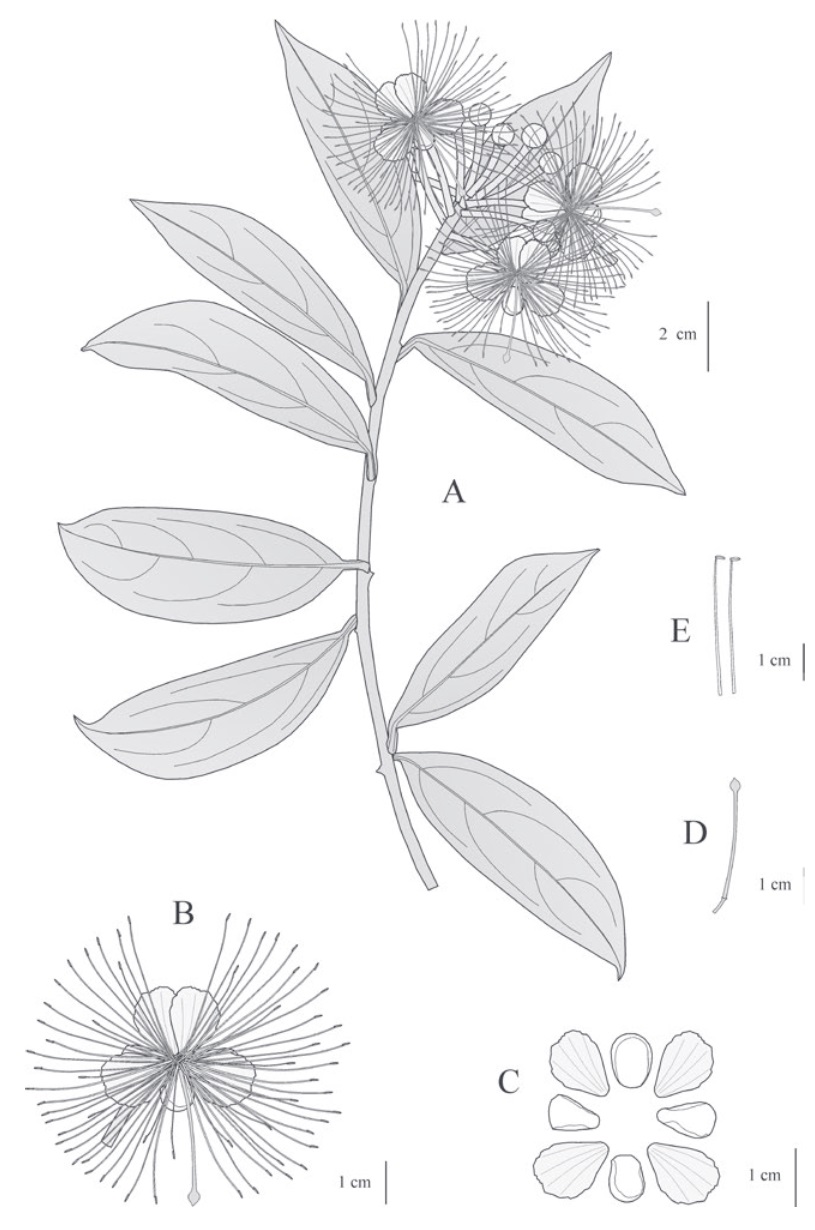
Capparis montis-aquae.
A flowering branch; B flower; C dissected flower showing sepals and petals; D gynophore and ovary. All from Fici et al. 2445 (holotype PAL). drawn by silvio fici.

Capparis montis-aquae.
A habitat; B habit, individual plant; C inflorescences; D flower; E flowering branches; F inflorescence, showing flowers at different stages.
photos: Silvio Fici.

Capparis montis-aquae Fici & Sy, sp. nov.

Recognition. Related to Capparis brachybotrya Hallier f., but differs in several characters, such as the stipular thorns straight (vs slightly recurved in C. brachybotrya), leaf apex rounded, acute or retuse (vs acuminate), racemes up to 4-flowered (vs up to 20-flowered), pedicels glabrous (vs puberulous), sepals 8 – 11 mm long (vs c. 11 – 14 mm), petals 20 – 28 mm long, glabrous (vs 12 – 20 mm, puberulous outside), stamens c. 56 – 78 (vs (80 –) 100 – 160) and ovary 3.5 – 4 × 1.5 – 2 mm (vs 2 – 3 × 1 mm).

Etymology. The specific epithet is named after the toponym Thuy Son, meaning “Water Mountain”.


Silvio Fici and Dan Thuong Sy. 2025. Capparis montis-aquae, A New Species of Capparaceae from Da Nang Province, central Vietnam.  Kew Bulletin.  DOI: doi.org/10.1007/s12225-025-10293-w [17 June 2025]

Tuesday, December 27, 2022

[Botany • 2022] Capparis phatadke • A New Species from Bolikhamxai Province [Studies on the Genus Capparis L. (Capparaceae) in Lao PDR. VI]


Capparis phatadke Fici, Lanors., Lamxay & Souvann., 

in Fici, Lanorsavanh, Lamxay & Souvannakhoummane, 2022. 
 
Abstract
A new species of CapparisC. phatadke, is described and illustrated from the Bolikhamxai Province, central Lao PDR. The new species is characterized by lianous habit, brown-reddish indumentum, straight stipular thorns, laminar bracts, large flowers arranged in terminal corymbs or subumbels, long filaments and large ovary. It is so far known from a single locality, where has been observed in mixed deciduous forest and secondary forest in a limestone area. Its ecology and phenology are discussed, and its conservation status is assessed.

Keywords: Bolikhamxai Province, Capparis sect. Monostichocalyx, endemism, Indo-Pacific area, plant taxonomy

Capparis phatadke. Flowering branch.
Photo by S. Lanorsavahn.

Capparis phatadke.
(A) Flowering branch. (B) Flower. (C) Dissected flower showing sepals and petals. (D) Gynophore and ovary. (E) Stamens.
 All from Lanorsavanh et al. LP123 (holotype). Drawn by S. Fici.

Capparis phatadke.
(A) Leaves, adaxial side (above) and abaxial side (below). (B) Flower buds. (C) Flowers. (D) Gynophore and ovary.
Photos by S. Lanorsavahn

Capparis phatadke Fici, Lanors., Lamxay & Souvann., sp. nov. 

Diagnosis Differs from Capparis trinervia Hook. f. & Thom-son var. trinervia in the longer, foliaceous bracts, sepals outside glabrous, pubescent at the base, longer filaments and larger ovary.

 Etymology: The new species is named after Pha Tad Ke, the first botanical garden in Laos, involved in plant conservation and in educational programs on the flora of the country and its ethnobotanical uses.


Silvio Fici, Soulivanh Lanorsavanh, Vichith Lamxay and Keooudone Souvannakhoummane. 2022. Studies on the Genus Capparis L. (Capparaceae) in Lao PDR. VI: A New Species from the Bolikhamxai Province. Webbia. Journal of Plant Taxonomy and Geography 77(2); 271-275. DOI:  10.36253/jopt-13377 
ພືດຊະນິດໃໝ່ຂອງໂລກ 


Saturday, February 5, 2022

[Botany • 2021] Capparidastrum estrellae (Capparaceae) • Notes on the Genus Capparidastrum and the Description of A New Species from Northwestern Ecuador


Capparidastrum estrellae Cornejo & N. Mejía-Pazos,

in Cornejo, Mejía-Pazos & Soto, 2021.

Abstract 
The genus Capparidastrum (Capparaceae) is discussed and C. estrellae, a new tree species endemic to northwestern Ecuador, is described and illustrated. Its conservation status is here assessed as endangered. 

Keywords: Capparaceae, Ecuador, Capparidastrum estrellae, endemic 

 
Capparidastrum estrellae Cornejo & N. Mejía-Pazos.
A, raceme bearing globose, snow-white flower buds, lateral view; B, flower at anthesis, lateral view; C, calyx, corolla, fleshy compressed nectary glands and base of filaments, lateral view; D, fruit nearly at maturity; E, mature leaf blade, abaxial view; F, gray bark.
Photographs of the holotype, N. Mejía-Pazos s.n. (GUAY).
 Photographs by Nicanor Mejía-Pazos.

Capparidastrum estrellae Cornejo & N. Mejía-Pazos, sp. nov.

Etymology: the epithet estrellae of this taxonomic novelty honors Dr. Eduardo Estrella Aguirre (1941–1996), an Ecuadorian researcher, founder of the Ecuador National Museum of Medicine and the great discoverer and editor of the long-lost work Flora Huayaquilensis by Juan Tafalla, a botanical masterpiece and the first flora of present Ecuador from the colonial period, in which the most common species of Capparaceae from coastal Ecuador were documented with splendid handmade, natural-sized illustrations. 

Habitat and distribution: known from the type in the vicinity of San Miguel de los Bancos toward Saloya, a lower montane secondary wet forest, in which individuals of Capparidastrum estrellae are scattered forest elements at 1230 m and may persist as solitary individuals in open areas. On the basis of field photographs sent by Jaime West to the first author, it is most likely that a second population of this taxonomic novelty occurs at 500 m on the same western side of Pichincha Province.


 Xavier Cornejo, Nicanor Mejía-Pazos and Mónica Armas Soto. 2021. Notes on the Genus Capparidastrum (Capparaceae) and the Description of C. estrellae, A New Species from Northwestern Ecuador. Harvard Papers in Botany. 26(1); 101–104. DOI: 10.3100/hpib.v26iss1.2021.n4

Resumen. Se comenta el género Capparidastrum (Capparaceae), y se describe e ilustra Capparidastrum estrellae, una nueva especie de árbol endémica del noroccidente de Ecuador. El estado de conservación de Capparidastrum estrellae aquí asignado es en peligro. 
Palabras claves: Capparaceae, Ecuador, Capparidastrum estrellae, endémica

Sunday, August 22, 2021

[Botany • 2021] Stixis yingjiangensis (Resedaceae) • A New Species from Yunnan, China


Stixis yingjiangensis J. Y. Shen  

in Shen, Ma, Gong, ... et Shi, 2021.

Abstract
Stixis yingjiangensis (Resedaceae), a new species from Yingjiang, Yunnan, China, is described and illustrated. It is compared with two morphologically similar species S. philippinensis, and S. villiflora. It differs from the two species by both surfaces with sparsely strigillose on lateral nerves, midrib and pustules (each pustule is formed by a multicellular cushion from which one short hair can also be produced), inflorescences axillary, racemes, 3–9 cm, filaments lower third pubescent, upper two thirds glabrous, androgynophores 2–3 mm, glabrous except apex sparsely puberulent, gynophores with densely white hairs, ovary glabrous. A complete morphological description of Stixis yingjiangensis is provided, together with photographs, a conservation assessment, and a diagnostic key to 4 species and 1 subspecies of Stixis from China.

Keyword: China, new species, Resedaceae, Stixis philippinensis, Stixis yingjiangensis, Stixis villiflora, Yunnan


 Holotype of Stixis yingjiangensis J. Y. Shen.

Stixis yingjiangensis J. Y. Shen.
A. Flowering branch. B. Flower with corolla opened showing staminal column and nectary. C. Flower remove sepals and stamens to show androgynophore, gynophore and pistil. D. Stamen. E. Adaxial leaf surface. F. Longitudinal section of the ovary. G. Cross section of the ovary.
(Drawn by Jian-Yong Shen)

Stixis yingjiangensis J. Y. Shen.
A. Habitat. B. stem. C-E. Flowers from different periods. F. Flower dissection (remove sepals and filaments) to show androgynophore, gynophore, pistil. G. hairs on the top of androgynophore and base of filaments. H. Ovary opened longitudinally showing the ovules. I-J. Adaxial and abaxial leaf surface. K. Adaxial leaf surface to show the pustules. L. Adaxial leaf surface to show hairs (red arrows) on the pustules
 (Photo by Jian-Yong Shen).


Stixis yingjiangensis J. Y. Shen sp. nov. 
盈江斑果藤 

Diagnosis: In terms of morphology, Stixis yingjiangensis exhibits morphology similar to S. philippinensis (Turcz.) Merr. and S. villiflora J.Y. Shen, S. Landrein, W.G. Wang & X.D. Ma, both of which calyx are reflexed at anthesis and with long gynophores (longer than 6 mm), but can be distinguished from them by several characters (See Table 1). S. yingjiangensis both leaf surfaces with sparsely strigillose on lateral nerves, midrib and pustules (each pustule is formed by a multicellular cushion from which one short hair can also be produced), while in S. philippinensis both surfaces glabrous except for a few pustules (without any hairs on it) above near the base of the midrib, and in S. villiflora both surfaces pubescent and pustulate (each pustule is formed by a multicellular cushion from which one to several hairs can also be produced), inflorescences axillary, racemes, 3–9 cm (vs. terminal, panicle, up to 25 cm long in S. philippinensis, axillary or terminal, racemes, 5–12 cm in S. villiflora), stamens 15–22, filaments lower third pubescent, upper two thirds glabrous (vs. 35–40(– 48), filaments glabrous in S. philippinensis, 14–18, filaments lower half pubescent, upper half sparsely pubescent or glabrous in S. villiflora), androgynophore 2– 4 mm, glabrous except apex sparsely puberulent (vs. 2–3 mm glabrous in S. philippinensis, ca. 1mm, lower half glabrous, upper half tomentose in S. villiflora), ovary glabrous (vs. glabrous in S. philippinensis, densely white hairs in S. villiflora). 

Etymology: The specific epithet is derived from the type locality, Yingjiang County, Dehong Dai and Jingpo Autonomous Prefecture, Yunnan, China.
  

Jian-Yong Shen, Xing-Da Ma, Qiang-Bang Gong, Guo-Hui Huang, Xue-Lian Yang and Ji-Pu Shi. 2021. Stixis yingjiangensis, A New Species of Resedaceae from Yunnan, China. Taiwania. 66(3); 326-331. DOI: 10.6165/tai.2021.66.326 

Saturday, May 29, 2021

[Botany • 2021] Maerua koratensis (Capparaceae) แจงสุรนารี • A New Species from eastern Thailand


Maerua koratensis   

in Srisanga, Muangsan, Choopan, ... et Watthana, 2021.
แจงสุรนารี ||  facebook.com/SantiQSBG 

Abstract
A new species, Maerua koratensis (Capparaceae), only known from a restricted locality in Nakhon Ratchasima Province, eastern Thailand, is here described and illustrated. This is the second species of Maerua to be described from South-East Asia. This new species is distinguished by the simple leaves, petaliferous flowers with distinctly 4-lobed laciniate disc, and cylindrical, torulose to moniliform fruits. Morphological characteristics of M. koratensis and M. juncea subsp. juncea, its most similar, are compared. A key to the Maerua species occurring in mainland South-East Asia is provided.

Keywords: Capparaceae, Maerua, Nakhon Ratchasima, South-East Asia, taxonomy, Eudicots


 Maerua koratensis


Prachaya Srisanga, Nooduan Muangsan, Thiamhathai Choopan, Jakrapong Thangthong, Ratchada Pratcharoenwanich and Santi Watthana. 2021. Maerua koratensis (Capparaceae), A New Species from Thailand. Phytotaxa. 498(3); 213–219. DOI: 10.11646/phytotaxa.498.3.7

Sunday, June 7, 2020

[Botany • 2020] Capparis macrantha (Capparaceae) • A New Shrub Species from A Deciduous Forest of the Nam Kading National Protected Area (central Lao PDR)


Capparis macrantha Souvann., Fici & Lanor.,

in Souvannakhoummane, Fici, Lanorsavanh, ... et Bounithiphonh, 2020. 

Abstract
Capparis macrantha Souvannakhoummane, Fici & Lanorsavanh sp. nov.a new shrub species characterized by erect or ascending habit, stipular thorns, large lanceolate-elliptic leaves and large flowers in supra-axillary rows, is described and illustrated from the deciduous forest in Nam Kading National Protected Area (central Lao PDR). The new species belongs to Capparis sect. Monostichocalyx Radlk. and is morphologically similar to C. radula Gagnep., a shrub widespread in the Indochinese area, differing in the shorter, straight stipular thorns, larger leaves, larger sepals and petals, higher number of stamens with longer filaments and longer gynophore and ovary. Its affinities with related taxa are discussed and a key is provided for the species of Capparis L. known from Lao PDR. The conservation status of the new species is provisionally assessed as Vulnerable (VU D1).

Keywords: Bolikhamxai Province; Capparaceae; Capparis sect. Monostichocalyx; diversity; ecology


Fig. 1. Capparis macrantha Souvannakhoummane, Fici & Lanorsavanh sp. nov.
A. Flowering branch. B. Flower (lateral view). C. Flower (front view). D. Stipular thorn and petiole. E. Sepals. F. Petals. G. Gynophore and ovary. H. Stamens. 
Drawn from holotype (Lanorsavanh et al. SL1641) by K. Souvannakhoummane.

Fig. 2. Capparis macrantha Souvannakhoummane, Fici & Lanorsavanh sp. nov. 
A. Habit and detail of a branch bearing thorns. B. Flowering branch. C. Young twigs. D. Young leaves. E. Flower (top view). F. Flower (lateral view). G. Petal (outside view).
 Photos by S. Lanorsavanh.

Class Magnoliopsida Brongn.
Order Brassicales Bromhead

Family Capparaceae Juss.

Genus Capparis L.
Section Monostichocalyx Radlk.

Capparis macrantha Souvannakhoummane, Fici & Lanorsavanh sp. nov. 

Diagnosis: A C. radula Gagnep. stipulis rectis brevioribus, foliis majoribus, sepalis petalisque majoribus, staminum numero superiore, filamentis longioribus, gynophoro atque ovario longioribus praecipue differt. 

Etymology: The specific epithet is composed of the Greek words ʻmakrósʼ, meaning ʻlargeʼ, and ʻánthosʼ, ʻflowerʼ.

Distribution, habitat and phenology: The new species is so far known from a single location in the Nam Kading National Protected Area in Bolikhamxai Province, ... (Fig. 3). Capparis macrantha sp. nov. has been observed in mixed deciduous forest on limestone, at ca 200–230 m elevation, with Amorphophallus laoticus Hett., Arisaema Mart. sp., Wurfbainia glabrifolia (Lamxay & M.F.Newman) Škorničk. & A.D.Poulsen. The flowering occurs from May to June.


 Keooudone Souvannakhoummane, Silvio Fici, Soulivanh Lanorsavanh, Jeong Ho Park, Ho Sang Kang and Chaloun Bounithiphonh. 2020. Capparis macrantha sp. nov. (Capparaceae, Brassicales), A New Shrub Species from A Deciduous Forest of the Nam Kading National Protected Area (central Lao PDR). European Journal of Taxonomy. 656; 1–12.  DOI: 10.5852/ejt.202.656


Wednesday, April 8, 2020

[Botany • 2020] Capparis lianosa • A New Species from Limestones of the Luang Prabang Province [Studies on the Genus Capparis L. (Capparaceae) in Lao PDR. V]


Capparis lianosa Fici & Souvannakhoummane

in Fici & Souvannakhoummane, 2020. 

Abstract
A new species of Capparis L., Capparis lianosa Fici & Souvannakhoummane, is described and illustrated from limestones of the Muang Ngoi District, Luang Prabang Province, in northern Lao PDR. The new species, belonging to Capparis sect. Monostichocalyx Radlk., is related to C. zeylanica L., differing in several characters as the shorter stipular thorns, the leaves with apex acuminate, the shorter, glabrous or glabrescent gynophore and the flattened stigma.

KEY WORDS: Capparaceae, Capparis, Lao PDR, sect. Monostichocalyx, new species


Fig. 2. — Capparis lianosa Fici & Souvannakhoummane, sp. nov.:
 A, vegetative branch; B, leaf base with stipular thorn; C, flower; D, dissected flower showing sepals, petals, gynophore and ovary. (All from the holotype). Drawn by S. Fici. Scale bars: A, 1 cm; B, 4 mm; C, D, 3 mm.

Fig. 3. — Capparis lianosa Fici & Souvannakhoummane, sp. nov.:
A, habitat; B, view of the vegetation in the type locality; C, base of stem bearing knobs with thorns; D, vegetative branch; E, base of young leaf with stipular thorn; F, leaf; G, flower. Photos by S. Fici.

Capparis lianosa Fici & Souvannakhoummane, sp. nov. 
 A C. zeylanica L. spinis stipularibus minoribus, foliis cum apice acuminato, petalis brevioribus, gynophoro breviore glabro vel glabrescente, stigmate plano praecipue differt.

Fig. 1. — Known distribution of Capparis lianosa Fici & Souvannakhoummane, sp. nov.

Distribution and ecology. — The new species is only known from the type locality (Fig. 1), where few scattered individuals were observed in the evergreen forest at the top of a Permo-Carboniferous limestone formation, with Dracaena cambodiana Pierre ex Gagnep., Euphorbia antiquorum L., Ficus sp., Schefflera pueckleri (K. Koch) Frodin, Platycerium holttumii Joncheere & Hennipman, Asplenium nidus L. var. nidus (Fig. 3); 410-510 m a.s.l.


Silvio Fici and Keooudone Souvannakhoummane. 2020. Studies on the Genus Capparis L. (Capparaceae) in Lao PDR. V: A New Species from Limestones of the Luang Prabang Province.  Adansonia. 42(5); 113-118.  DOI: 10.5252/adansonia2020v42a5

RÉSUMÉ: Une nouvelle espèce de Capparis (Capparaceae) des calcaires de la province de Luang Prabang, Lao PDR. Une nouvelle espèce de Capparis L., Capparis lianosa Fici & Souvannakhoummane, est décrite et illustrée des calcaires du district de Muang Ngoi, province de Luang Prabang, nord du Laos PDR. La nouvelle espèce appartient à Capparis sect. Monostichocalyx Radlk., et ressemble à C. zeylanica L., dont elle se distingue par plusieurs caractères comme les épines stipulaires plus courtes, les feuilles à sommet acuminé, le gynophore plus court, glabre ou glabrescent et le stigmate plat.


Wednesday, June 6, 2018

[Botany • 2018] Capparis hinnamnoensis (Capparaceae) • A New Species from the Deciduous Forest of the Hin Nam No National Protected Area, central Laos [Studies on the Genus Capparis L. in Lao PDR. III]


Capparis hinnamnoensis  Souvann. & Fici

in  Souvannakhoummane, Fici, Lanorsavanh & Lamxay, 2018


Abstract
A new species of Capparis, Capparis hinnamnoensis, is described from the Khammouan Province, central Lao PDR. The new species is characterized by the indumentum constituted by stellate, two-armed and simple hairs, and by the terminal racemes bearing trifid bracts and medium-sized flowers. It is so far known from a single locality in the Hin Nam No National Protected Area, where it has been observed in the deciduous forest on Permo-Carboniferous limestone. Its conservation status is assessed.

Key words: Capparis sect. Monostichocalyx, ecology, endemism, Khammouan Province, phenology

 Capparis hinnamnoensis. flowering branch.
(Photo by S. lanorsavanh).

Capparis hinnamnoensis Souvann. & Fici

Diagnosis: C. assamica Hook. f. & Thomson pilis stellatis, bracteis trifidis, pedicellis longioribus, petalis maioribus, staminibus et gynophoro longioribus differt.

....

Capparis hinnamnoensis. flowering branch.
(Photo by S. lanorsavanh).


Keooudone Souvannakhoummane, Silvio Fici, Soulivanh Lanorsavanh and Vichith Lamxay. 2018. Studies on the Genus Capparis L. (Capparaceae) in Lao PDR. III: A New Species from the Deciduous Forest of the Hin Nam No National Protected Area. Webbia. DOI:   10.1080/00837792.2018.1470708