Showing posts with label Lentibulariaceae. Show all posts

Monday, December 29, 2025

[Botany • 2025] Utricularia damingshanensis (Lentibulariaceae) • A New Species from Guangxi, China


Utricularia damingshanensis S. Wu & Z. Z. Li, 

in Li, Wu, Nong, G.-R. Zhou, P.-L. Zhou, Lin, Outang, Jobson et Shao, 2025.  
大明山挖耳草 — DOI: doi.org/10.11646/phytotaxa.733.2.7 

Abstract  
Utricularia damingshanensis (Lentibulariaceae), a new species from Guangxi, China, is described and illustrated. It resembles U. caerulea and U. warburgii but differs in having a corolla palate with four hooked processes on the distal margin; lower calyx lobe distinctly shorter than the upper; distinctly striped corolla with 8–15 deep violet lines on the lower lip and 6–9 radiating lines on the upper lip, as well as a helmet-like swelling at the base of the lower lip. Phylogenetic analysis based on nrITS, rps16, and trnD–trnT strongly supported its placement in sect. Nigrescentes as sister to U. warburgii. Both morphological and molecular evidence support its status as a new species.

Utricularia, sect. Nigrescentes, phylogeny, taxonomy, new species, Eudicots


Utricularia damingshanensi


ZHI-ZHONG LI, SHUANG WU, DONG-XIN NONG, GUANG-RONG ZHOU, PI-LIN ZHOU, LI LIN, XUHONG OUYANG, RICHARD W. JOBSON and JIAN-WEN SHAO. 2025. Utricularia damingshanensis (Lentibulariaceae), A New Species from Guangxi, China. Phytotaxa. 733(2); 245-252. DOI: doi.org/10.11646/phytotaxa.733.2.7 [2025-12-11]
广西大明山发现植物新种——大明山挖耳草


Friday, October 10, 2025

[Botany • 2025] Pinguicula panfetiae (Lentibulariaceae) • A New Caribbean Butterwort from eastern Cuba


Pinguicula panfetiae Panco, P.Temple & Y.Domínguez,
  
in Pančo, Temple, Cobas, Lobaina, Matisova et Domínguez, 2025. 

Abstract
Background and aims – Pinguicula is a cosmopolitan genus of carnivorous plants with more than 100 species, most of them distributed in two centres of diversity: Europe and the Central American-Caribbean region. Fourteen species are reported for Cuba. During fieldwork to study Pinguicula populations in eastern Cuba, a white-flowered taxon, previously misidentified as Pinguicula albida or Pinguicula jaraguana, was collected in the mountainous regions of the Alejandro de Humboldt National Park. This taxon represents a new species for which we present a full description, a distribution map, illustrations, photographs, and a conservation status.

Material and methods – Living and preserved material of several populations of white-flowered Pinguicula from Cuba were analysed, measured, and described based on vegetative and reproductive characters. Statistical analyses were carried out to explore the differences among the collections. The preliminary conservation status of the new species was assessed based on the IUCN guidelines and criteria.

Key results – Pinguicula panfetiae is described as a new species endemic to eastern Cuba. It thrives on permanently wet, ferritic soils derived from serpentine bedrocks, on slopes above the banks of the River Toa in association with surrounding semi-arid montane serpentine shrubwood (charrascal). It differs from the closely related species, Pinguicula albida and Pinguicula jaraguana, primarily by its smaller rosettes with obovate, suberect to erect leaves, non-involute leaf margins, smaller flowers up to 1–1.3 cm including the spur, longer (0.6–0.7 mm) and wider (0.18–0.22 mm) seeds, and that it grows in full sun.

Conclusion – The newly described species increases the number of Pinguicula in the Cuban archipelago to 15. Pinguicula panfetiae is preliminarily assessed as Critically Endangered (CR) according to the IUCN Red List Categories and Criteria.

Keywords: butterwort, carnivorous plant, critically endangered, endemic, Pinguicula albidaPinguicula jaraguana, taxonomy

Pinguicula panfetiae based on type specimens (holotype HAJB [G 002601], isotypes B, BSC [22092]) and on living material.
A. Habit, perennial herb with details of the trichomes of the leaf and the inflorescence scape (circles). B. Emerging leaf with involute margin. C. Frontal view of the flower. D. Lateral view of the flower. E1. Internal trichomes of the outer part of the corolla tube. E2. Internal trichomes of the middle part of the corolla tube. E3. Internal trichomes of the inner part of the corolla tube. F. Dissected flower with the persistent calyx and lateral view of the stamens and gynoecium. G. Fruit with persistent calyx. H. Lateral view of the seed.
Illustration by Yoannis Domínguez.

Pinguicula panfetiae at the type locality in the Alejandro de Humboldt National Park, eastern Cuba.
A. Habit. B. Frontal view of the flower. C. Lateral view of the flower. D. Dissected flower showing the persistent calyx and stamens and gynoecium. E. Lateral view of the fruit. F. Habitat at the banks of the River Toa. G. Regular rosettes with suberect leaves. H. Calathiform rosettes with erect leaves.
Photos by Ivan Pančo (A–E, G–H) and Ivana Matisova (F).

Pinguicula panfetiae Panco, P.Temple & Y.Domínguez, sp. nov.

Diagnosis: Pinguicula jaraguana Casper affinis sed brevibus, foliis ovobatis, erectis suberectis, margine integerrima non involute, flores parvi 10–13 mm (calcari incluso), semina 0.6–0.7 mm longa (appendix incluso), 0.18–0.22 mm lata.

Distinct vegetative and reproductive morphological traits of related species.
 A. Pinguicula panfetiae. B. Pinguicula albida. C. Pinguicula jaraguana.
Photos by Ivan Pančo (A, C) and Yoannis Domínguez (B).

Etymology: Pinguicula panfetiae is named in honour of the late Cuban botanist, Prof. Dr Cristina Mercedes Panfet Valdés, to acknowledge her contributions to Cuban flora research, in particular, with regard to the carnivorous plant families for which she was the main Cuban specialist. Besides her research, Prof. Panfet dedicated most of her life to empowering many generations of Cuban botanists to achieve professional standing, which is also acknowledged herein.


 Ivan Pančo, Paul Temple, Geovanys Rodríguez Cobas, Noel Coutin Lobaina, Ivana Matisova and Yoannis Domínguez. 2025. Pinguicula panfetiae (Lentibulariaceae), A New Caribbean Butterwort from eastern Cuba. Plant Ecology and Evolution. 158(3): 382-391. DOI: doi.org/10.5091/plecevo.161641
 

Sunday, August 17, 2025

[Botany • 2025] Pinguicula tonalaensis • A New Species and Species Richness Distribution of the Gypsophyte Butterworts (Pinguicula, Lentibulariaceae) in Mexico


Pinguicula tonalaensis López-Pérez & Zamudio,

in López-Pérez, Zamudio, Rodríguez et Munguía-Lino, 2025.

Abstract
Background: Mexico harbours the highest species richness of Pinguicula, with 54 species. Plants collected on gypsum soils in Oaxaca do not coincide with any known species.

Questions: Do plants collected represent a new species? What is its conservation status? How many Pinguicula gypsophytes are there in Mexico? How are they different? Where are they distributed?

Studied species: Pinguicula gypsophytes.
Study site and dates: Santo Domingo Tonalá, Oaxaca, Mexico, 2023-2024.

Methods: A morphological analysis and description were made based on herbarium specimens and living plants. We employed Bayesian Inference and Maximum Likelihood to analyse the regions rpl32-trnL, trnQ-rps16, and ITS to infer their phylogenetic position concerning similar species. The conservation status of the species was assessed following the IUCN Red List Criteria and Categories. Gypsophyte specimens of Pinguicula in Mexico were examined to construct a key. The species richness distribution of gypsophyte Pinguicula was analysed by state, physiographic provinces, and 1 × 1° cells.

Results: Pinguicula tonalaensis is proposed as new species distinguished by linear-lanceolate summer leaves, geniculate corolla tube, and without propagules in the apex of summer leaves. Pinguicula tonalaensis is sister of the clade P. heterophylla-P. medusina and together form a monophyletic group. Pinguicula tonalaensis is Critically Endangered. There are 10 gypsophytes of Pinguicula in Mexico. Nuevo León and the Sierra Madre Oriental are the richest. The location of the cell richest coincide with these.
 
Conclusions: The morphology and phylogenetic hypothesis support Pinguicula tonalaensis as new species. This increasing the taxonomic richness of Pinguicula in Mexico to 55.

Keywords: carnivorous plants , Mexican Transition Zone, Oaxaca, Pinguicula diversification, gypsum soils


Pinguicula tonalaensis López-Pérez & Zamudio sp. nov.  

Diagnosis. Pinguicula tonalaensis shares winter and summer leaf forms and size with P. medusina. The geniculate corolla tube and the lack of apical propagules on the summer leaves set P. tonalaensis apart.


Jorge David López-Pérez, Sergio Zamudio, Aarón Rodríguez and Guadalupe Munguía-Lino. 2025. A New Species and Species Richness Distribution of the Gypsophyte Butterworts (Pinguicula, Lentibulariaceae) in Mexico. Botanical Sciences 103(3). DOI: doi.org/10.17129/botsci.3657 
https://botanicalsciences.com.mx/index.php/botanicalSciences/article/view/3657


Sunday, August 4, 2024

[Botany • 2018] Utricularia sunilii (Lentibulariaceae) • A striking New Species from southern Western Ghats, Kerala, India


Utricularia sunilii Naveen Kum. & K.M.P.Kumar, 

in Kumar, Prabhukumar, Jagadeesan, Harinarayanan, Nair, Janarthanam et Balachandran, 2018.

Abstract
Utricularia sunilii, a new species of Utricularia Sect. Oligocista from Kerala state of Western Ghats is described here. The new species shows similarities with U. graminifolia in having 3-nerved foliar organs and thickened capsule wall along the margin of dehiscence but differs by deeply 3-lobed lower lip of corolla.

Keywords: Nelliyampathy, New taxon, Palakkad, Utricularia, Eudicots


Utricularia sunilii Naveen Kum. & K.M.P.Kumar, sp. nov.

Vannaratta Veettil Naveen Kumar, Konickal Mambetta Prabhukumar, Raveendran Jagadeesan, Cheruppoyilath Mana Harinarayanan, Maya C. Nair, Malapati K. Janarthanam and Indira Balachandran. 2018. Utricularia sunilii (Lentibulariaceae), A striking New Species from southern Western Ghats, Kerala, India. Phytotaxa. 371(2):140. DOI: doi.org/10.11646/phytotaxa.371.2.9

Sunday, July 7, 2024

[Botany • 2024] Pinguicula tlahuica (Lentibulariaceae) • A New endemic Species and Species Richness Distribution of the Genus Pinguicula in the Trans-Mexican Volcanic Belt, Mexico


Pinguicula tlahuica López-Pérez & Zamudio, 

in López-Pérez, Zamudio, Munguía-Lino et Rodríguez, 2024. 
 Artwork by Fatima Bracamontes 

Abstract
Background: The genus Pinguicula harbors 110 species, of which 53 are distributed in Mexico. The formation of the Mexican mountains has favored the Pinguicula diversification. Pinguicula specimens collected in the State of México, along the Trans-Mexican Volcanic Belt (TMVB) do not correspond with any known species.

Questions: Do the collected specimens belong to a new species? What is its conservation status? How many Pinguicula species are there along the TMVB and how do they differentiate? How is the Pinguicula species richness distributed?

Studied species: Pinguicula.

Study site and dates: TMVB, 2005-2023.

Methods: Based on herbarium specimens and recently collected material, a morphological analysis and description were made. Conservation status was assessed following IUCN Red List Categories and Criteria. Herbarium specimens and digital records of Pinguicula from the TMVB were examined to generate a list and key. We analyzed the richness distribution of Pinguicula by states, vegetation types, elevation ranges, and grid cells.

Results: Pinguicula tlahuica is proposed as a new species. It is distinguished by the linear-spatulate summer leaves. The new species falls into the Endangered (EN) category. Along the TMVB, 16 species of Pinguicula are distributed. The State of México, Hidalgo and Michoacán, and the pine-oak forest were the richest. Pinguicula appeared between 759-3,427 m asl. The grid cell analyses revealed different areas with high richness.

Conclusions: Along the TMVB, the Pinguicula species richness centered on the Eastern and Western sectors. Pinguicula crassifolia, P. michoacana, P. tlahuica, and P. zamudioana are endemic to the TMVB.

Keywords: butterworts, carnivorous plants, diversification, Mexican Transition Zone, Pinguicula section Orcheosanthus

Pinguicula tlahuica.
A) Summer rosette. B) Flowering winter rosette. C) Summer leaves. D) Winter leaves. E) Stipitate glands on the leaf. F) Flower frontal view. G) Flower lateral view. H) Fruit.
 Illustrated by Fatima Bracamontes 
based on type material (J. López-Pérez & G. Munguía-Lino 641).

Pinguicula tlahuica.
A) Habitat. B) Flower frontal view. C-D) Winter rosette with flowers. E) Sterile winter rosette. F) Summer rosette. G) Transition among winter and summer leaves.
 A-G by Jorge López-Pérez.

Pinguicula tlahuica López-Pérez & Zamudio, sp. nov. 

Diagnosis. Pinguicula tlahuica is morphologically similar to P. moranensis Kunth in the form and size of the flow-ers, but it is distinguished from it by: the oblong to oblong-spathulate winter leaves; linear-spatulate summer leaves, 7.0-14.5 × 0.5-1.7 cm; blooming with winter rosette.

Etymology. The specific epithet honors the Tlahuica ethnical people. The tlahuicas inhabit some villages in Ocuilan de Arteaga, State of México (Álvarez Fabela 2006).
 

Mexico Jorge David López-Pérez, Sergio Zamudio, Guadalupe Munguía-Lino, Aarón Rodríguez. 2024. A New endemic Species and Species Richness Distribution of the Genus Pinguicula (Lentibulariaceae) in the Trans-Mexican Volcanic Belt, Mexico. Botanical Sciences. 102(3), 995-1008. DOI: 10.17129/botsci.3485
  facebook.com/100063883189278/posts/928738855932212


Tuesday, January 10, 2023

[Botany • 2023] Pinguicula warijia (Lentibulariaceae) • A Newly Rediscovered Species from the Sierra Obscura, northern Mexico


Pinguicula warijia Zamudio, Hern.Rend., M.Mata-Rosas & M.M.Salinas,

in Zamudio, Mata-Rosas, Salinas-Rodríguez & Hernández-Rendón, 2023. 
Photos by Julián Hernández-Rendón and Martín Mata-Rosas.
 
Abstract
An undescribed species of Pinguicula (Lentibulariaceae), first collected in 1972 was recently rediscovered in the Arroyo Babarocos canyon, located in the Sierra Obscura region, in the municipality of Uruachi, Chihuahua, Mexico. This plant is described and illustrated as Pinguicula warijia. The taxon is compared with the related species P. oblongiloba and P. zamudioana, and a key to the species of P. section Orcheosanthus of western Mexico is provided, along with photographs, distribution map, and taxonomic discussion.

Keywords: Mexican Pinguicula, Sierra Madre Occidental, taxonomy, Eudicots

Pinguicula warijia Zamudio, Hern.Rend., M.Mata-Rosas & M.M.Salinas.
  A. Habitat overview. B. Plants growing on igneous rocks on a ca. 30° slope. C. Plants growing upside down on the ceiling of a small cave.
D. Detail of the flower. E. Capsule. F. Plant growing in a dry area with reduced leaves. G. A two-tailed swallowtail (Papilio multicaudata) butterfly pollinating a P. warijia flower.
Photos A, F and G by Julián Hernández-Rendón; B, C, D and E by Martín Mata-Rosas.
 
Pinguicula warijia Zamudio, Hern.Rend., M.Mata-Rosas & M.M.Salinas, sp. nov.

 Similar to Pinguicula zamudioana but differs in having numerous, sessile, spathulate to elliptic-spathulate leaves (vs. 4–8(10) petiolate, oblong–elliptical to suborbicular leaves), upper calyx lip lobes ovate to elliptic (vs. triangular-lanceolate), lower calyx lip lobes triangular (vs. lanceolate), upper corolla lip lobes suborbicular to oblate (vs. oblong–elliptical to suborbicular), capsule botuliform (vs. subglobose), seeds 1–1.28 mm long, ca. 0.2 mm wide, surface slightly reticulate (vs. ca. 0.5 mm long, ca. 0.1 mm wide, surface reticulate).

Etymology:—The specific epithet honors the Warijó or Guarijó indigenous people, who inhabit this portion of the Sierra Madre Occidental in the municipalities of Chinipas, Moris, and Uruachi in the state of Chihuahua, as well as in the municipalities of Álamos, Quiriego, and Rosario in the state of Sonora. In addition, it is also the ethnic group to which our guide, Mr. Arnulfo Méndez, belongs. The word Warijó means “the people” or “the people that speak the Guarijía language”. Other names by which this ethnic group is known are Marakawe, Macoragüi, Varihio, Varohío, and warijío(a) (Porras 1997). 
 

Sergio Zamudio, Martín Mata-Rosas, María Magdalena Salinas-Rodríguez and Julián Hernández-Rendón. 2023. Pinguicula warijia sp. nov. (Lentibulariaceae), A Newly Rediscovered Species from the Sierra Obscura, northern Mexico. Phytotaxa. 578(3); 219-227. DOI: 10.11646/phytotaxa.578.3.1

Thursday, December 29, 2022

[Botany • 2022] Unveiling Utricularia amethystina’s True Colours: A Taxonomic Revision of One of the Largest Species Complexes (U. sect. Foliosa: Lentibulariaceae)


Utricularia amethystina  Salzm. ex Saint-Hilaire & Girard (1838)

in Baleeiro, Gonella, Sano & Jobson, 2022.
 
Abstract
The genus Utricularia (Lentibulariaceae) is the most diverse and cosmopolitan among carnivorous plants. Utricularia sect. Foliosa sensu Taylor (1989) is composed of three South American species, U. amethystina, U. tricolor and U. tridentata, the first species being recognized as highly diverse. In his taxonomic revision of the genus Utricularia, Taylor (1989) circumscribed the polymorphic U. amethystina comprising 27 synonyms involving a wide variation in corolla size and colour, morphology of corolla parts, indumentum, and overall plant size. The original publications of the synonyms provide limited information disencouraging a revision study and therefore inflating U. amethystina as new variations were discovered. In order to shed light onto the problem, a taxonomic revision, a morphometric and a molecular study showed evidence of a larger complex than previously thought, and U. amethystina s.str. sister to U. tricolor. A previously published molecular phylogeny provided strong support for all sampled U. amethystina synonyms and potential new taxa found to be nested outside the U. amethystina s.str. and U. tricolor clade. Here, we incorporate these new relationships and describe and comment on the species that comprise U. sect. Foliosa, including the restablishment of six synonyms, the description of three new species and lectotypification of five names. The current study disentangles U. amethystina complex so that further studies can approach it in a more realistic way, especially studies using population genetics tools. Our study shows that more needs to be done and here U. hirtella is presented as a new complex.

Keywords: carnivorous plants, Lamiales, Neotropical biodiversity, new species, taxonomy


Utricularia sect. Foliosa Kamieński, 
Lentibulariaceae preprint from Nat. Pflanzenfam. 120 (1891)

TYPE: Utricularia amethystina Salzm. ex A.St.-Hil. & Girard. 
(Designated by P. Taylor).  

1. Utricularia amethystina Salzm. ex Saint-Hilaire & Girard (1838: 870)
2. Utricularia biceps Gonella & Baleeiro (2018: 215)
3. Utricularia bicolor Saint-Hilaire & Girard (1838: 870)

4. Utricularia chapadensis Baleeiro, Gonella, R.W.Jobson, sp. nov.

5. Utricularia damazioi Beauverd (1907: 703)
6. Utricularia hirtella Saint-Hilaire & Girard (1838: 869) 
7. Utricularia lindmanii Sylvén (1909: 26)

8. Utricularia lunaris Baleeiro, Gonella, R.W.Jobson, sp. nov.

9. Utricularia pantaneira Baleeiro, Gonella, R.W.Jobson, sp. nov.

10. Utricularia roraimensis Brown (1901: 54)
11. Utricularia tricolor Saint-Hilaire (1833: 418)
12. Utricularia tridentata Sylvén (1909: 28)
13. Utricularia trinervia Benjamin (1847: 247) 
14. Utricularia velascoensis Kuntze (1898: 240) 


Paulo C. Baleeiro, Paulo M. Gonella, Paulo T. Sano and Richard W. Jobson. 2022. Unveiling Utricularia amethystina’s True Colours: A Taxonomic Revision of One of the Largest Species Complexes (U. sect. Foliosa, Lentibulariaceae). Phytotaxa. 576(1); 29–54. DOI: 10.11646/phytotaxa.576.1.2


Saturday, September 3, 2022

[Botany • 2022] Utricularia elephanthoides (Lentibulariaceae) • A New Species from the Guayana Shield


Utricularia elephanthoides J.R. Grande,

in Grande Allende, 2022. 

Abstract:
Background and Aims: Utricularia (Lentibulariaceae) includes ca. 240 carnivorous species of cosmopolitan distribution. The Guayana Shield has 48 species, about 20% of the world total. Of the 35 groups into which the genus is divided, Utricularia sect. Orchidioides is one of the best known and studied, as it usually has large and striking flowers. In this paper, the identity of one of the species in this section, present in the Guayana Shield, is clarified. Methods: The taxonomic literature, herbarium material, and photographs of cultivated plants from the study area (Bolívar and Amazonas states of Venezuela, in the central portion of the Guayana Shield) available on the internet, were reviewed. Additionally, and for comparative purposes, material from the most closely related species (Utricularia asplundii, U. jamesoniana and U. uxoris) was also reviewed.

Key results: Utricularia elephanthoides sp. nov., which is characterized by the photosynthetic organs with an acute apex, upper lip of the corolla shallowly tetralobulate, applied to the lower lip, and spur ≤1.5 times the length of the lower lip of the corolla, is described and illustrated. This new species, together with Utricularia asplundii, U. jamesoniana and U. uxoris, forms a natural group with relatively small flowers and deeply trilobulate lower corolla lobe, which is named here “U. jamesoniana complex”. A table of morphological characters, a key and two maps are presented, by means of which these four species can be compared and differentiated.

Conclusions: The Guayanan populations of Utricularia sect. Orchidioides with a deeply trilobulate lower corolla lip and a spur with basal (conical) and apical (subulate) portions of similar length should be assigned to the new concept (U. elephanthoides), so far only known from Venezuela. This species is part of the “Utricularia jamesoniana” complex, which is monophyletic and widely distributed in the Neotropics.

Key words: Guayana, Pantepui, tepui, Utricularia sect. Orchidioides, Venezuela.


Utricularia elephanthoides J.R. Grande.
A. habit; B. flower at anthesis; C. upper lip of corolla; D. lower lip of corolla; E. calyx; F. spur; G. trap or utricle; H. bract (center) and bracteoles (left and right); I. scale of the peduncle.
 (A and G-I: based on the holotype; A (flower) and B: based on Welge and Teichert, 2003-2004; C-F: based on F. Cardona 851 (VEN)).

Utricularia elephanthoides J.R. Grande, sp. nov.  

Etymology: the epithet “elephanthoides” (from Greek ἐλέφας, elephant; ἄνθος, flower; -ειδής, similar) alludes to the curious morphology of the flowers, which resemble the head of a proboscis.


José Ramón Grande Allende. 2022. Utricularia elephanthoides (Lentibulariaceae), especie nueva del Escudo Guayanés. [Utricularia elephanthoides (Lentibulariaceae), A New Species from the Guayana Shield]. Acta botánica mexicana. 129[Epub 30-Jun-2022]. DOI: 10.21829/abm129.2022.2049  
 

Sunday, January 30, 2022

[Botany • 2020] Utricularia sainthomia (Lentibulariaceae) • A New Remarkable Carnivorous Species from the Lateritic Plateau of northern Kerala, India


Utricularia sainthomia P.Biju, Josekutty, Janarth. & Augustine, 

in Biju, Josekutty, Janarthanam & Jomy, 2020. 

Abstract
A new species of Lentibulariaceae, Utricularia sainthomia collected from the lateritic plateau of northern Kerala, India is described and illustrated. It is compared with similar species, U. malabarica Janarth. & A.N.Henry and U. lazulina P.Taylor based on vegetative, floral and seed morphology. A key to the violet flowered species in India are provided.

Keywords: New species, Utricularia, Utricularia sect. Oligocista.


Utricularia sainthomia P.Biju, Josekutty, Janarth. & Augustine:
 a. Habit; b. Habitat; c. Rhizoids; d. Stamens; e. Pistil; f. Trap different views
 (from Biju & Jomy 1008; photos by P. Biju).


Utricularia sainthomia P.Biju, Josekutty, Janarth. & Augustine, sp. nov.

 This new species is morphologically similar to U. malabarica Janarth. & A.N.Henry and U. lazulina P.Taylor in its 3- nerved leaves, basifixed bracts, shorter peduncles, recurved fruiting pedicels (absent in U. lazulina), papillate calyx lobes and bigibbous corolla but differs in having large oblate traps (1.5–2.5 mm) with a lateral mouth, traps confined to the expanded portion of the leaves, 1.5–2.5 mm long nonglandular trap appendages, terete brownish green peduncles, papillate scales, bracts and bracteoles, broad obovate upper lip of corolla, deep violet lower lip of corolla, shallowly trilobed upper lobe of stigma, globular capsules, terminal hilum, elongated overlapping testa cells with raised anticlinal boundaries and periclinal walls transversely striated.

Etymology: The species is named after the educational institution Saint Thomas College, Pala, Kerala, India, where one of the authors pursuing research work. 

Distribution: Endemic to the lateritic plateau in Kerala, India.


Biju P., Josekutty E.J., Janarthanam M.K. and A. Jomy. 2020. Utricularia sainthomia (Lentibulariaceae), A New Remarkable Carnivorous Species from the Lateritic Plateau of northern Kerala, India. Rheedea: Journal of Indian Association for Angiosperm Taxonomy. DOI: 10.22244/rheedea.2020.30.02.02 rheedea.in/journal/IEmyDef7

Saturday, January 22, 2022

[Botany • 2021] Utricularia amotape-huancabambensis (Lentibulariaceae) • A New Species of Utricularia (Sect. Orchidioides) from the Amotape-Huancabamba Zone of North Peru


Utricularia amotape-huancabambensis T. Henning, E. Rodr. & J.P. Allen. 

in Henning, Allen & Rodríguez-Rodríguez, 2021.  

A new species of Utricularia Section Orchidioides: Utricularia amotape-huancabambensis sp. nov. (Lentibulariaceae), endemic to Northern Peru is described and illustrated. It is known from two populations so far, both located in the Province Bongará, Dpto. Amazonas at ca. 2200 m altitude. The new species inhabits the páramo of the low white sandstone plateaus, an extension of the southern branches of the Condor mountain range in the southeastern part of the Amotape-Huancabamba phytogeographic zone. A diagnosis, description, etymology and an identification key covering the Andean and selected similar species of the section are presented. The distribution, habitat, ecology, associated flora, preliminary conservation status, an observed hybridization with sympatric U. unifolia and the affinities of the new species with other related taxa are discussed. The new species is known from two close-by populations in the same region and likely affected by anthropic pressure. Threatening changes in land use, resulting in habitat fragmentation or loss or changing water regimes in the course of climate change will have severe consequences for the sensitive páramo ecosystem and thus the populations of U. amotape-huancabambensis. Therefore, this new spectacular species of Utricularia is preliminarily considered Critically Endangered (CR).


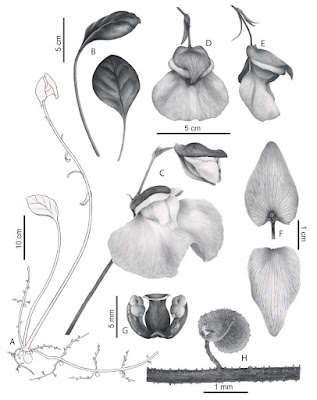
Utricularia amotape-huancabambensis.
 A, habit. B, leaves. C, inflorescence. D, flower, frontal view. E, flower, lateral view. F, calyx. G, stamen and pistil. H, utricle.
Drawing prepared by Olivia Mendoza.

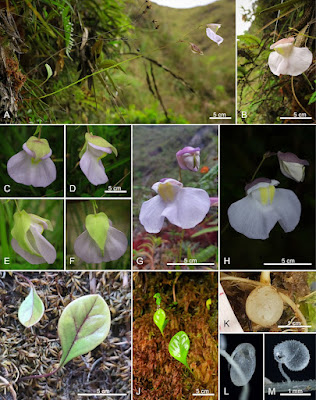
Utricularia amotape-huancabambensis.
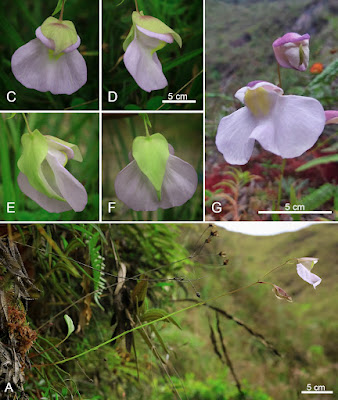
A, flowering plant, growing fully exposed to sunlight with upwardsbended, shield-like leaf. B, ditto, flower in front-lateral view. C-F, flower of a plant growing in the shade with thinner corolla and greenish calyx. G-H, inflorescence of the typical form. I-J, leaves growing out of the moss cushions. K, tuber. L, utricle, frontal view. M, utricle, lateral view.
All photographs by J. P. Allen.

Utricularia amotape-huancabambensis sp. nov. T. Henning, E. Rodr. & J.P. Allen. 

Diagnosis: Utricularia amotape-huancabambensis belongs to Utricularia section Orchidioides and is closely related to U. unifolia. It differs from it by having a more robust habit, a broadly ovate to rounded leaf lamina, longer petioles and inflorescences, much larger flowers with a white or slightly lavender corolla and an upper lip slightly longer and wider than the calyx. The spur is terminally curved downwards.

Etymology: The name refers to the Amotape-Huancabamba Zone, the area around the Huancabamba depression, a partial interruption of the Andean mountain range by the Chamaya river drainage system, which occupies large parts of northernmost Peru and the southern tip of Ecuador (Fig. 1). The mosaic landscape in this region is characterized by a remarkable diversity in different habitat types and a corresponding exceptional zoo- and phytodiversity. In particular, the high rate of narrow endemism concentrated in this relatively small area is intriguing and has led to the idea to consider this area a phytogeographical zone of its own right (such as e.g. the Capensis). “A sizable part of Andean biodiversity seems to be concentrated into this relatively small area, which makes effective protection of the diverse habitats of this zone a high priority” (Weigend, 2002). The name of this new species has been chosen to reinforce this demand and encourage Peru and Ecuador to intensify the urgent conservation efforts for the remaining habitats in this otherwise highly fragmented landscape. Both climate change and urban sprawl are massive threats especially to the remaining forest patches. They are home to an unparalleled diversity of flora and fauna, the known extent of which is here complemented by this emblematic species of flowering plant. The name is intended to serve as a hortatory reminder of the unabated destruction of irreplaceable biodiversity in areas such as the Amotape-Huancabamba Zone (Karger et al., 2021) that are both: heavily overexploited while still underexplored.


Tilo Henning, Joshua P. Allen and Eric F. Rodríguez-Rodríguez. 2021.  A New Species of Utricularia Sect. Orchidioides (Lentibulariaceae) from the Amotape-Huancabamba Zone of North Peru. Darwiniana. 9(2); 299-311. DOI: 10.14522/darwiniana.2021.92.955

Tuesday, November 16, 2021

[Botany • 2020] Utricularia kamarudeenii (Lentibulariaceae) • A New Species from Kerala, India


 Utricularia kamarudeenii  V. S. A. Kumar & S. Arya

in Arya, Raju, Arunraj, ... et Anilkumar, 2020. 

Abstract
A new species of Utricularia named U. kamarudeenii, from the paddy fields of Kottayam district of Kerala, India, is described and illustrated. The new species resembles U. aurea but differs from it in the length of spur with respect to lower lip, deeply bilobed lower lip, presence of one type of trap having basal mouth without appendages and hexagonal shape of the seed.

Keywords: bladderwort, insectivorous plant, Lamiales, stolons, Eudicots


Sindhu Arya, Reshma Raju, Parappurakkal Thazhe Arunraj, Walsan Kalarikkal Vishnu, Punnakot Biju and Venugopalan Nair Saradhamma Anilkumar. 2020. Utricularia kamarudeenii (Lentibulariaceae): A New Species from Kerala, India. Phytotaxa. 447(1); 68–72. DOI:  10.11646/phytotaxa.447.1.7