Showing posts with label ichnotaxa - footprint. Show all posts

Monday, April 20, 2026

[Paleontology • 2026] Jinjuichnus procerus • New large Pterosaur Tracks from Korea and their implications on terrestrial behavior


Jinjuichnus procerus and tetrapod trackmakers. The neoazhdarchian trackmaker is following the small vertebrate.

Jung, Kim, Xing & Choi, 2026
illustration created by Jun Seung Yi.  

Abstract
Pterosaurs were important components of Mesozoic ecosystems, occupying diverse ecological niches from the Late Triassic to the end of the Cretaceous. Among them, neoazhdarchians have been hypothesized as terrestrial carnivorous based on anatomical and functional evidence, yet direct indications of predation on land have remained elusive. Here we report Jinjuichnus procerus ichnogen. et ichnosp. nov., a new pterosaur track discovered in the Jinju Formation of South Korea. The track, characterized by a compact and long metatarsus in its pedal configuration, is consistent with neoazhdarchian pterosaurs. The trackway is preserved in close association with a small tetrapod trackway that exhibits abrupt changes in direction and increased stride length. This association provides the potential ichnological evidence of terrestrial vertebrate interaction by a pterosaur. Nonetheless, an alternative interpretation of the two trackways remains possible, making it difficult to confirm any direct interaction between the trackmakers. The paired trackways offer insight into the factors to consider when evaluating potential interactions with the trackmaker. While scenarios such as predation remain ambiguous, they nonetheless highlight the interpretive complexity inherent in assessing behavioral associations preserved in trackway assemblages.

Life reconstruction drawing of Jinjuichnus procerus and tetrapod trackmakers. The neoazhdarchian trackmaker is following the small vertebrate. The illustration in this figure was created by Jun Seung Yi. Reproduced with permission from the copyright holder and published under CC BY 4.0 license.

Systematic ichnology
Pterosauria Kaup 1834.
Pterodactyloidea Plieninger, 1901.

Ichnofamily Agadirichnidae Masrour et al., 2018.

Ichnogenus Junjuichnus ichnogen. nov.

Etymology – The generic name Jinjuichnus combines Jinju, the location where the specimen was found, with Greek ichnus (ἴχνος), meaning “track.”

Ichnospecies Jinjuichnus procerus ichnogen. et ichnosp. nov.

Etymology. The specific name procerus is a Latin adjective meaning “extended” or “elongated,” describing the notably elongated manus impressions.
  

Conclusion: 
A new pterosaur ichnotaxon, Jinjuichnus procerus et ichnogen. et ichnosp. nov., is described from the Lower Cretaceous Jinju Formation of South Korea. This trackway is characterized by a large size, highly elongated digit III, a blunt digit I, and a wide manus divarication angle, features that distinguish it from previously reported pterosaur ichnotaxa. Based on pedal morphology and comparative analysis, the trackmaker is most plausibly attributed to a neoazhdarchian pterosaur that inhabited the Korean Peninsula during the Early Cretaceous.
...


Jongyun Jung, Kyung Soo Kim, Lida Xing and Byung-Do Choi. 2026. New large Pterosaur Tracks from Korea and their implications on terrestrial behavior. Scientific Reports. 16: 12363. DOI: doi.org/10.1038/s41598-026-48019-y [16 April 2026]
 

Thursday, June 12, 2025

[Paleontology • 2025] Diverse Dinosaur Tracks from the Upper Jurassic – Lower Cretaceous Chacarilla Formation of Quebrada de Arcas, northeast Chile: Evidence of high ichnodiversity in an arid palaeoenviroment


 Paleoartistic reconstruction of the Quebrada de Arcas. 

in Gesualdi, Belvedere, Yurac, ... et Meyer, 2025. 
Illustration by Joschua Knüppe.
 
Highlights: 
• New track-bearing surfaces are found in the Chacarilla Fm. in Quebrada des Arca.
• Five morphotypes: one of sauropod and four for different size theropod tracks are defined.
• Huge theropod tracks have been found and identified.

Abstract
We report diverse dinosaur tracks from siltstone to fine-grained sandstone facies of the Chacarilla Formation, Quebrada de Arcas of northeast Chile. Track-bearing surfaces were studied using 3D modelling and false-colour depth maps, derived from UAV photographs. Five morphotypes are identified based on morphology and morphometric criteria. Morphotype I comprises rounded tracks with a consistent narrow-gauge and resembles the sauropod ichnogenus, Parabrontopodus; diplodocids or titanosaurids are probable trackmakers. Morphotype II is assigned to the theropod ichnotaxon Abelichnus astigerrae and comprises some of the largest theropod tracks ever recorded from South America with a maximum footprint length of 51 cm; the trackmaker was most likely a large carcharodontosaurid, such as Giganotosaurus carolinii. Morphotype III is an indeterminate theropod track, which shows a distinctive and prominent metatarsal impression, but does not closely match any ichnotaxon although it bears some morphometrical affinity to Changpeipus carbonicus. The Morphotypes IV and V both belong to small-sized theropod trackmakers, and resemble Grallatoridae and Kayentapus-like forms, respectively. Additional theropod material cannot be assigned to specific morphotypes or trackmakers, due to poor preservation. Our findings show the existence of three distinct size classes (small, medium and large) of theropod morphotypes and point to a high ichnodiversity at the Jurassic-Cretaceous transition in the subtropical arid environments of Gondwana.

Keywords: Dinosaur tracks, Abelichnus astigerrae, Chacarilla Formation, Gondwana, Jurassic-Cretaceous boundary

 Sedimentary structures in the Chacarilla Fm. Ripple marks (a, d, e), planar lamination (a, c), microbial mats from surface QA12 (b), Ophiomorpha (f) and cross-section dinosaur tracks (c).
Scale bars are: 50 cm in (a), 18 cm in (b), 25 cm in (c), 10 cm in (d, e, f).

 Paleoartistic reconstruction of the Quebrada de Arcas.
 Illustration by Joschua Knüppe.

 
Vincenzo Gesualdi, Matteo Belvedere, Marko Yurac, Dorothee Hippler, Nejla Hurem, Christian Salazar, Javiera Mendez and Christian A. Meyer. 2025. Diverse Dinosaur Tracks from the Upper Jurassic – Lower Cretaceous Chacarilla Formation of Quebrada de Arcas, northeast Chile: Evidence of high ichnodiversity in an arid palaeoenviroment. Palaeogeography, Palaeoclimatology, Palaeoecology. 113088; In Press. DOI: doi.org/10.1016/j.palaeo.2025.113088 [9 June 2025]

Sunday, December 1, 2024

[Paleontology • 2024] Digestive Contents and Food Webs Record the advent of Dinosaur Supremacy


in Qvarnström, Wernström, Wawrzyniak, Barbacka, ... et Niedźwiedzki, 2024. 


Abstract
The early radiation of dinosaurs remains a complex and poorly understood evolutionary event. Here we use hundreds of fossils with direct evidence of feeding to compare trophic dynamics across five vertebrate assemblages that record this event in the Triassic–Jurassic succession of the Polish Basin (central Europe). Bromalites, fossil digestive products, increase in size and diversity across the interval, indicating the emergence of larger dinosaur faunas with new feeding patterns. Well-preserved food residues and bromalite-taxon associations enable broad inferences of trophic interactions. Our results, integrated with climate and plant data, indicate a stepwise increase of dinosaur diversity and ecospace occupancy in the area. This involved (1) a replacement of non-dinosaur guild members by opportunistic and omnivorous dinosaur precursors, followed by (2) the emergence of insect and fish-eating theropods and small omnivorous dinosaurs. Climate change in the latest Triassic resulted in substantial vegetation changes that paved the way for ((3) and (4)) an expansion of herbivore ecospace and the replacement of pseudosuchian and therapsid herbivores by large sauropodomorphs and early ornithischians that ingested food of a broader range, even including burnt plants. Finally, (5) theropods rapidly evolved and developed enormous sizes in response to the appearance of the new herbivore guild. We suggest that the processes shown by the Polish data may explain global patterns, shedding new light on the environmentally governed emergence of dinosaur dominance and gigantism that endured until the end-Cretaceous mass extinction.


Martin Qvarnström, Joel Vikberg Wernström, Zuzanna Wawrzyniak, Maria Barbacka, Grzegorz Pacyna, Artur Górecki, Jadwiga Ziaja, Agata Jarzynka, Krzysztof Owocki, Tomasz Sulej, Leszek Marynowski, Grzegorz Pieńkowski, Per E. Ahlberg and Grzegorz Niedźwiedzki. 2024. Digestive Contents and Food Webs Record the advent of Dinosaur Supremacy. Nature. DOI: doi.org/10.1038/s41586-024-08265-4

Wednesday, October 23, 2024

[Paleontology • 2024] Theropod Trackways as indirect evidence of Pre-avian Aerial Behavior


The animal responsible for Dromaeosauriformipes rarus tracks is believed to be a small microraptorine related to the ancestors of birds.

in Dececchi, Kim, Lockley, Larsson, Holtz, Farlow et Pittman, 2024.
artwork: Julius Csotonyi.  

Abstract
Body fossils set limits on feasible reconstructions of functional capacity and behavior in theropod dinosaurs, but do not document in-life behaviors. In contrast, trace fossils such as footprints preserve in-life behaviors that can potentially test and enhance existing reconstructions. Here, we demonstrate how theropod trackways can be used as indirect evidence of pre-avian aerial behavior, expanding the approaches available to study vertebrate flight origins. This involved exploring the behavioral implications of a two-toed Cretaceous-aged theropod trackway produced by a small, bird-like microraptorine moving at high speed. Applying first principle running biomechanics, we were able to conclude that the trackway is atypical, indirectly evidencing pre-avian aerial behavior. This trackway documents the evidence of wing-assisted aerodynamic force production during locomotion, supporting a broader distribution of this behavior than currently known. These findings support previously proposed aerial behavior in early bird-like theropods, showing how trackways will help to deepen our understanding of theropod flight origins.


Illustrated reconstruction of Dromaeosauriformipes rarus running along the muddy shore of an ancient lake.
artwork: Alex Boersma

The animal responsible for Dromaeosauriformipes rarus tracks is believed to be a small microraptorine related to the ancestors of birds.
artwork: Julius Csotonyi.  


 T. Alexander Dececchi, Kyung Soo Kim, Martin G. Lockley, Hans C.E. Larsson, Thomas R. Holtz Jr., James O. Farlow and Michael Pittman. 2024. Theropod Trackways as indirect evidence of Pre-avian Aerial Behavior. PNAS. 121 (44) e2413810121. DOI: doi.org/10.1073/pnas.2413810121 

Researchers Solve Mystery of ‘Dinky’ Dinosaur’s Unusually Long Stride 
UMD paleontologist Thomas R. Holtz Jr. helped recreate the movements of a bird-sized raptor, shedding new light on the origin of flight.

Monday, September 2, 2024

[PaleoOrnithology • 2024] The Moa Footprints from the Pliocene – early Pleistocene of Kyeburn, Otago, New Zealand


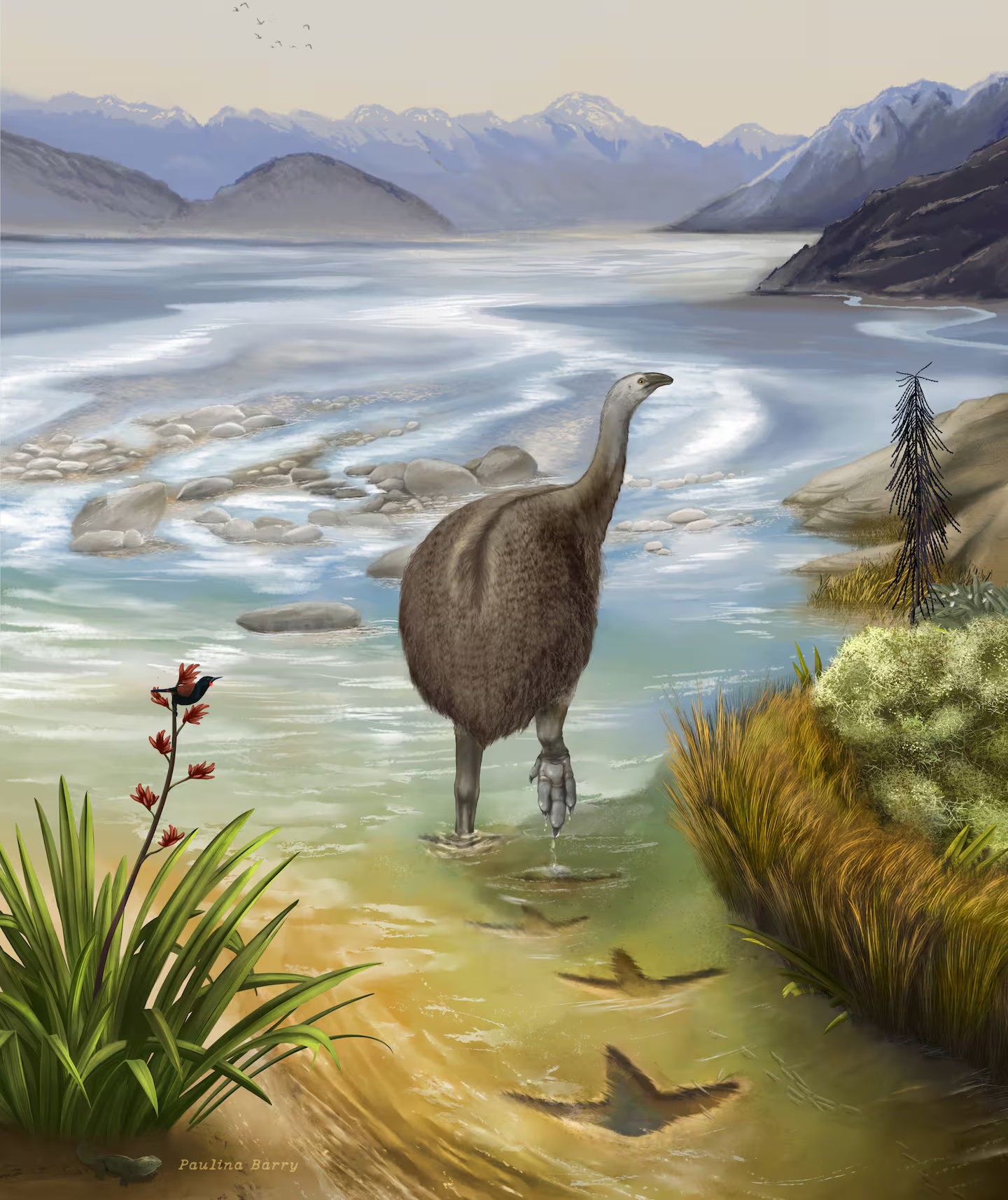
An artist’s impression of the moa which created the Kyeburn footprints.

in Fleury, Burns, Richards, Norton, Read, Wesley, Fordyce et Wilcken, 2024. 
 Artwork by Paulina Barry.
 
ABSTRACT
In March, 2019, a trackway of seven footprints was found at a riverbank outcrop of Maniototo Conglomerate Formation in the Kyeburn River, Central Otago, South Island, New Zealand. In this study, we describe this first known occurrence of moa (Dinornithiformes) footprints to be found and recovered in Te Waipounamu/South Island. Footprints of the trackway were ∼46 mm deep, 272–300 mm wide and 260–294 mm in length. An associated separate footprint was 448 mm wide and 285 mm long. Cosmogenic nuclide dating of adjacent overlying beds from the same formation establishes a mean minimum age of burial age for the tracks of 3.57 Ma (+1.62/−1.18 Ma) with a mode of 2.9 Ma, which we interpret to be Late Pliocene, with a conservative age range of Pliocene to Early Pleistocene. The trackway maker is identified as a moa from the Emeidae family, probably from the genus Pachyornis, with a mean mass of 84.61 kg that was travelling at a speed of 2.61 kmh−1. The single adjacent footprint was made by an individual from the family Dinornithidae, most likely from the genus Dinornis with an estimated mass of 158 kg. These moa footprints represent the second earliest fossil record of moa.

KEYWORDS: Trackway, moa footprint‌, Dinornithiformes, cosmogenic nuclide dating, Pliocene‌, Maniototo Conglomerate


Kane Fleury, Emma Burns, Marcus D. Richards, Kevin Norton, Stephen Read, Rachel Wesley, R. Ewan Fordyce and Klaus Wilcken. 2024. The Moa Footprints from the Pliocene – early Pleistocene of Kyeburn, Otago, New Zealand. Journal of the Royal Society of New Zealand. 54(5); 620-642. DOI: doi.org/10.1080/03036758.2023.2264789 
Special issue: Fossil vertebrates from Southern Zealandia: taonga of international significance. Guest Editors: Carolina Loch, Daniel Thomas, Jeffrey Robinson

www.linkedin.com/posts/pamela-naidoo-ameglio_feathery-moas-fossilised-footprints-ancient-activity-7132122722146385920-rgTz

Saturday, August 17, 2024

[Paleontology • 2024] Sousatitanosauripus robsoni • A new ichnosite and ichnogenus from the Lower Cretaceous Rio do Peixe Basin, Brazil, with novel insights into the evolution of Titanosauriformes


 Sousatitanosauripus robsoni
 Gomes, Erickson, Aureliano & Ghilardi, 2024


ABSTRACT
Sauropods were a successful group of herbivorous dinosaurs that colonised all continents throughout the Mesozoic. At first glance, the organisms in this group present a conservative shape of quadrupedal animals with elongated necks and tails. However, there was great diversification in the morphology of sauropods, which is still poorly understood in detail, especially during the Early Cretaceous. In this study, we describe a new ichnosite dated from the earliest stages of the Cretaceous of Brazil. The site includes a well-preserved trackway of a large sauropod dinosaur, with manus and pes prints, as well as tracks of theropods and indeterminate tetrapods. The sauropod trackway shows a unique set of characteristics that allowed the erection of a new ichnogenus and ichnospecies, Sousatitanosauripus robsoni igen. nov. et isp. nov. The probable trackmaker was a Titanosauriformes with a mosaic of basal and advanced features, bringing new insights into the diversity and evolution of the group.

KEYWORDS: Dinosauria, Ichnology, Sauropoda, Titanosauria, Sousa Formation


 Sousatitanosauripus robsoni igen. nov. et isp. nov.


Zarah Trindade Gomes, Rebecca Fernandes Erickson, Tito Aureliano and Aline Marcele Ghilardi. 2024. A new ichnosite and ichnogenus from the Lower Cretaceous Rio do Peixe Basin, Brazil, with novel insights into the evolution of Titanosauriformes. Historical Biology: An International Journal of Paleobiology. DOI: doi.org/10.1080/08912963.2024.2385613 

Wednesday, October 25, 2023

[Paleontology • 2023] Coneroichnus marinus • A Fossil Trackway of Marine Reptile in the Maiolica Formation (Upper Jurassic–Lower Cretaceous) from Monte Conero, Marche, Italy


 Coneroichnus marinus
Natali & Leonardi, 2023

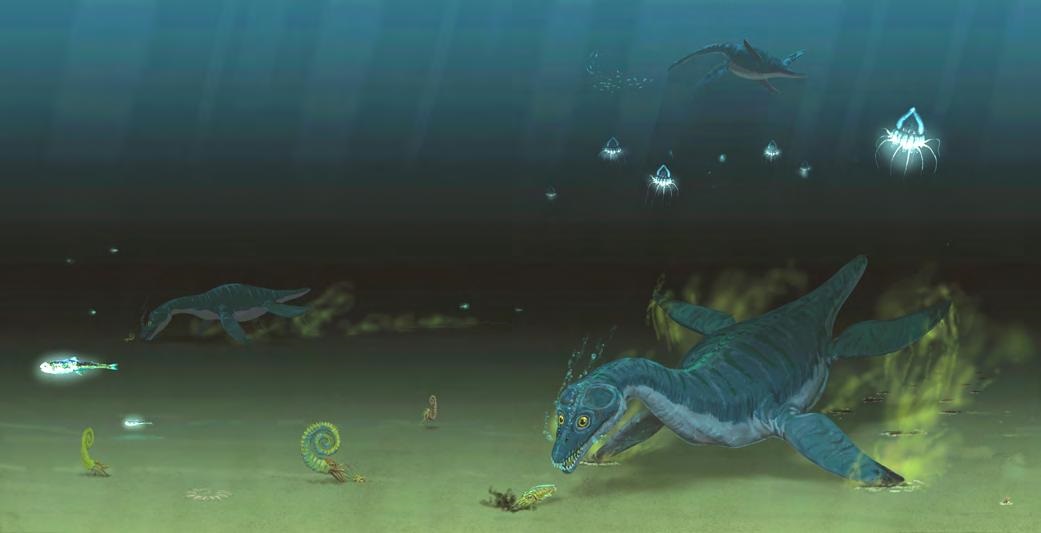
 marine reptiles of the order Plesiosauria, on the seabed of the Tethys Ocean. The plesiosaur shown here in the foreground, together with the one on the left, is inspired by Leptocleidus, a short-necked plesiosaur, as an example of the supposed author of the trackway under study. In the background on the right side, one sees another plesiosaurid: Brancasaurus, a typical long-necked plesiosaur, another hypothetical author of the trackway.
Art by Marco Astracedi.

 Abstract
An uncommon ichnofossil, constituted of a sequence of eleven imprints, named as Coneroichnus marinus ichnog. et ichnosp. nov., is described from Mount Conero, Province of Ancona, Italy. The trackway is impressed in whitish micritic limestone of the Maiolica Formation (Upper Jurassic–Lower Cretaceous), herein interpreted as the passage on the sea bottom of a marine reptile, softly interfering in the sediment-water interface. Its gait can be defined as half-swimming, that is the swimming in exploratory and punting propulsive contact with the mud at the bottom. We discuss the probable trackmaker and we suggest it was probably a pliosaurid Plesiosauria. The extreme rarity of ichnofossils of tetrapods on the deep-sea bottom in the whole world is herein confirmed.

Keywords: Early Cretaceous, Coneroichnus marinus ichnog. et ichnosp. nov., pelagic reptile trackway.


The image shows marine reptiles of the order Plesiosauria, on the seabed of the Tethys Ocean. The plesiosaur shown here in the foreground, together with the one on the left, is inspired by Leptocleidus, a short-necked plesiosaur, as an example of the supposed author of the trackway under study. In the background on the right side, one sees another plesiosaurid: Brancasaurus, a typical long-necked plesiosaur, another hypothetical author of the trackway.
Art by Marco Astracedi.


CONCLUSIONS: 
In the present paper we have allocated from an ichnotaxonomical and ichnological point of view a trackway, from deep pelagic environment, on the seabed of the Tethys Ocean, which then became a limestone bank of the Maiolica Formation, of the Berriasian–Hauterivian, Early Cretaceous of Mount Conero (Sirolo, Marche, Italy). We have updated the most likely stratigraphic position of the outcrop bearing the sequence of tracks;we have assigned to them the name of Coneroichnus marinus ichnog. et ichnosp. nov.
We concluded that its gait can be defined as the half-swimming manner of gait, that is the exploratory and propulsive contact swimming with the mud saturated with water on the bottom. Since this kind of underwater progression happens, in this specific case, in contact with the sea bottom, it was here also defined as a punting and foraging manner of gait.
Only two other tracksites with tracks attributed to fossil marine reptiles had been so far found in sediments from the deep seabed paleoenvironment, not only in Italy, but in the entire world. Mount Conero is the third ichnosite in the world with deep-marine fossil trackways. It will be useful to carry out more intense research along all the outcrops of Maiolica at Mount Conero and along the Adriatic Sea, but also in other areas, on tabular surfaces of layers not too eroded, looking for other specimens of marine reptile tracks like these or similar to them.


Luca Natali and Giuseppe Leonardi. 2023. Coneroichnus marinus ichnogenus et ichnospecies nov., A Fossil Trackway of Marine Reptile in the Maiolica Formation (Upper Jurassic–Lower Cretaceous) from Monte Conero, Marche, Italy.  Revista Brasileira De Paleontologia. 26(3), 156–171. DOI: 10.4072/rbp.2023.3.02

RESUMO – Um raro icnofóssil, ou seja, uma sequência de onze impressões em micrite calcária da Formação Maiolica (Jurássico Superior–Cretáceo Inferior), é aqui nomeado como Coneroichnus marinus ichnog. et ichnosp. nov. sendo detalhadamente descrito. A pista se encontra no Monte Conero, na Província de Ancona, Itália. Ela é atribuída à passagem sobre o fundo do mar de um réptil marinho, o qual deformou a superfície na interface sedimento-água. Seu deslocamento pode ser definido como semi-natação, que corresponde a uma natação de caráter exploratório e propulsivo em contato com a lama do fundo. Discute-se o produtor desta pista, possivelmente um pliosaurídeo Plesiosauria. A extrema raridade de icnofósseis de tetrápodes no substrato marinho profundo em todo o mundo é confirmada.
Palavras-chave: Cretáceo Inferior, Coneroichnus marinus ichnog. et ichnosp. nov., pista de um réptil pelágico.

Sunday, October 8, 2023

[Paleontology • 2023] Farlowichnus rapidus • A Speedy and Small Theropod in the Early Cretaceous Botucatu Paleodesert (Paraná Basin), Brazil


Farlowichnus rapidus 
 Leonardi, Fernandes, Carvalho, Schutzer & Silva, 2023


Abstract
The Botucatu Formation (Paraná Basin, Brazil and the southern neighboring countries) comprises one of the richest tetrapod ichnological deposits of the Lower Cretaceous in South America. The ichnofossils are found in reddish sandstones lithofacies -interpreted to be dune and interdune deposits. The sandstones of Botucatu Formation originally covered a surface estimated in at least 1,300,000 km2, the largest known fossil desert in the Earth’s history. The distribution area of the Botucatu paleodesert presents one of the world’s largest megatracksites. The tetrapod ichnofauna from the Botucatu Formation comprises minor bipedal dinosaur tracks (almost all attributable to theropods, with one exception, a doubt ornithopod trackway) along with many thousands of footprints of early mammals, and a single trackway of a lacertiform reptile. Among the bipedal dinosaur footprints, the most common and typical are considered theropod tracks, with long strides and high step angle and always with an acuminate termination. These trackways are straight and very narrow, with long strides and step angles showing high values. The footprints have a relatively large and very wide III digit and small, short, pointed, bladelike outer digits. The most special characteristic is that the II digit is longer and more important than the IV digit. Because of this morphology, the general outline of the footprint often reminds that of a waterdrop and, although it is structurally tridactyl, it usually looks like functionally monodactylous. These tracks are herein assigned to small theropods adapted to desert life with a prevalently cursorial gait, probably ancestors of clades such as noasaurs and velocisaurs. Due its unique morphological aspects it is defined a new ichnogenus and ichnospecies.


 Farlowichnus rapidus new ichnogen., new ichnosp.
 

 Giuseppe Leonardi, Marcelo Adorna Fernandes, Ismar de Souza Carvalho, Julia Beatrice Schutzer and Rafael Costa da Silva. 2023. Farlowichnus rapidus new ichnogen., new ichnosp.: A Speedy and Small Theropod in the Early Cretaceous Botucatu Paleodesert (Paraná Basin), Brazil. Cretaceous Research. 105720. DOI: 10.1016/j.cretres.2023.105720

Thursday, September 21, 2023

[Paleontology • 2023] Moyenisauropus lusitanicusThe First Dinosaurs in Iberia: A New Dinosaur Tracksite from the Sinemurian (Lower Jurassic) of Portugal


Moyenisauropus lusitanicus 
 Figueiredo, de Carvalho, Cunha, Duarte, Fonseca, Monteiro & Forte, 2023

Artwork: Alexandre Fonseca twitter.com/lex_fonseca_ 

ABSTRACT
Dinosaur fossils from the Lower Jurassic are very scarce in the Iberian Peninsula, which lacks a dinosaur track record. This study reports a new ichnosite from this age, at the Alvaiázere Municipality (Lusitanian Basin, Portugal) with several well-defined dinosaur and other archosaurs tracks. Seventeen tracks were identified at the top sedimentary surface of a fine-grained dolostone bed belonging to the Coimbra Formation (Sinemurian, Lower Jurassic). Therefore, the tracksite could have an age of ~196 to 194 Ma, based in the stratigraphic position of the tracksite in the Coimbra Formation succession. The ichnological comparison allows us to ascribe these tracks to Moyenisauropus and Batrachopus ichnogenera. The dinosaur tracks are assigned to the new ichnospecies Moyenisauropus lusitanicus isp. nov. The trackmaker could be a basal thyreophoran dinosaur related to Emausaurus or Scelidosaurus, and the presence of a manus-pes pair track set verifies that these tracks were made by a quadrupedal gait. The crocodylomorph trackmaker could be a teleosaurid. The analysed bioturbated fine-grained dolostone bed was deposited in very shallow subtidal to intertidal, carbonate lagoonal (?) environment. The evidence provided here indicates the presence of crocodylomorphs and thyreophoran dinosaurs in a tropical coastal wetland carbonate system developed during the Early Jurassic in the Lusitanian Basin (Atlantic western margin of Iberia).

KEYWORDS: Ornithischian tracks, dinosaurs, crocodylomorphs, Coimbra Formation, Sinemurian, Lusitanian Basin


 Moyenisauropus lusitanicus isp. nov.


Silvério D. Figueiredo, Carlos Neto de Carvalho, Pedro P. Cunha, Luís V. Duarte, Alexandre Fonseca, Cláudio Monteiro and João Forte. 2023. The First Dinosaurs in Iberia: A New Dinosaur Tracksite from the Sinemurian (Lower Jurassic) of Portugal. Historical Biology: An International Journal of Paleobiology. DOI: 10.1080/08912963.2023.2256751  


Monday, September 18, 2023

[Paleontology • 2023] Crococopros naduongensis • Exceptionally Well-preserved Crocodilian Coprolites from the Late Eocene of Northern Vietnam: Ichnology and Paleoecological Significance


The Eocene of Na Duong Basin is considered as a fossil Lagerstätte of Southeast Asia
Flora and fauna constituent in the drawing were an actual reconstruction based on palynology analyses, and of body fossil findings from various workers 

Crococopros naduongensis Halaçlar, Rummy, Liu, Hunt, Do, Minh & Deng, 2023
Illustration by Chung-Tat Cheung  facebook.com/ChungTatCheung

Highlights: 
• New ichnogenus and ichnospecies Crococopros naduongensis
• First quantitative study on crocodilian coprolites
• Multidisciplinary approach to understand paleoecology of Na Duong Basin
• Tangible evidence supporting Na Duong Basin as a fossil-Lagerstätte of Southeast Asia

Summary
This study examines 55 coprolites from the Na Duong Basin to reconstruct the paleoenvironment. Coproecology sheds light on understanding the complex prey-predator relationships, trophic dynamics, and ecosystem evolution. Through quantitative and multidisciplinary analysis, the putative coprolites were attributed to crocodilian producers, leading to the establishment of a new ichnogenus and species, Crococopros naduongensis igen. et isp. nov., based on distinct characteristics and comparisons. The study provides compelling evidence of an ancient river or lake-like environment dominated by diverse crocodilian fauna, indicating a thriving food chain in the Na Duong Basin. The findings also highlight the remarkable richness of ichnofauna, fauna, flora, and the presence of a favorable climate, confirming the area as a significant fossil Lagerstätte in Southeast Asia. Overall, this study offers a unique snapshot of the past, providing valuable insights into the regional ecosystem and significantly contributing to our understanding of paleoenvironmental conditions and biotic interactions.


Paleoenvironment reconstruction drawing reflects a real ‘snapshot’ of an intermittently swamped lacustrine–fluvial plain ecosystem with an abundance of crocodilians and testudines
 The Eocene of Na Duong Basin is considered as a fossil Lagerstätte of Southeast Asia (Flora and fauna constituent in the drawing were an actual reconstruction based on palynology analyses, and of body fossil findings from various workers).
Illustration by Chung-Tat Cheung

 
Kazım Halaçlar, Paul Rummy, Jia Liu, Adrian P. Hunt, Truong Van Do, Nguyen Trung Minh and Tao Deng. 2023. Exceptionally Well-preserved Crocodilian Coprolites from the Late Eocene of Northern Vietnam: Ichnology and Paleoecological Significance. iScience.   26(9); 107607. DOI: 10.1016/j.isci.2023.107607


Thursday, August 17, 2023

[Paleontology • 2023] Parilisthelyphonus bryantae & Inmontibusichnus charleshenryturneri • The Largest Palaeozoic Whip Scorpion and the Smallest (Arachnida: Uropygi: Thelyphonida); A New Species and A New ichnospecies from the Carboniferous of New England, USA


Parilisthelyphonus bryantae
Knecht, Benner, Dunlop & Renczkowski, 2023


Abstract
Palaeozoic fossils of whip scorpions (Arachnida: Uropygi: Thelyphonida) are extremely rare, with only seven species of this age previously described. A new species of fossil whip scorpion, as well as the first ichnospecies assignable to this group, are described here from the Carboniferous Narragansett Basin of Massachusetts, USA. A body fossil from the Rhode Island Formation (Moscovian) is referred to as Parilisthelyphonus bryantae gen. nov., sp. nov.. At more than 34 mm long it represents both the largest known Palaeozoic whip scorpion and the first fossil arachnid found in the Rhode Island Formation in ~130 years of scrutiny. The whip scorpion trace fossil, comprising a full-body impression and associated tracks, is described from the subjacent Wamsutta Formation (Late Bashkirian) of Massachusetts, USA as Inmontibusichnus charleshenryturneri  igen. nov., isp. nov.. With an estimated body length of less than 10 mm, the producer would be the smallest known Palaeozoic thelyphonid. These discoveries within the Narragansett Basin represent only the second site in the western hemisphere, in what was western Laurasia, to yield Palaeozoic whip scorpions. The Narragansett Basin is of significant Pangaean biogeographical importance among whip scorpion sites, being located between the westernmost Mazon Creek Lagerstätte of Illinois and the eastern assemblage of localities in Europe, and serves as an important new fossil calibration point for phylogenetic studies of this arachnid group.

Keywords: Parilisthelyphonus bryantae, Inmontibusichnus charleshenryturneri, Wamsutta Formation, Rhode Island Formation, Moscovian, Bashkirian, Pennsylvanian, tracks

The holotype of Parilisthelyphonus bryantae gen. nov., sp. nov..
Part (A; MCZ:IP:198710a) and counterpart (B; MCZ:IP:198710b)


Richard J. Knecht, Jacob S. Benner, Jason A. Dunlop and Mark D. Renczkowski. 2023. The Largest Palaeozoic Whip Scorpion and the Smallest (Arachnida: Uropygi: Thelyphonida); A New Species and A New ichnospecies from the Carboniferous of New England, USA. Zoological Journal of the Linnean Society. zlad088. DOI: 10.1093/zoolinnean/zlad088

Thursday, June 22, 2023

[Paleontology • 2023] Tramuntanasaurus tiai • A New medium-sized moradisaurine captorhinid Eureptile (Eureptilia: Captorhinidae) from the Permian of Mallorca (Balearic Islands, western Mediterranean) and Correlation with the Co-occurring Ichnogenus Hyloidichnus


Tramuntanasaurus tiai
 Matamales-Andreu, Mujal, Galobart & Fortuny, 2023

Artwork by Hank Sharpe
 
Abstract
Moradisaurine captorhinid eureptiles are one of the best-known groups of Permian herbivorous tetrapods. Moradisaurines, with several rows of teeth on the maxillae and jaws, first appeared in the Cisuralian and went extinct at the end of the Lopingian; they were especially abundant in the equatorial latitudes of Pangaea. However, the postcranial skeleton of this clade is relatively poorly known, given that most of the species described have been based on skulls. This fact has precluded a detailed correlation with coeval tracks. The present work describes a new moradisaurine genus and species, Tramuntanasaurus tiai, based on an almost complete, semi-articulated skeleton from the Port des Canonge Formation of Mallorca (Balearic Islands, western Mediterranean), identifying it as the trackmaker of the co-occurring small-sized traces of the ichnogenus Hyloidichnus. Apart from documenting the new moradisaurine species, the results presented herein strongly support the hypothesis that Hyloidichnus was produced by both non-moradisaurine captorhinids and moradisaurines; those of small to medium size, at least, had a very conserved autopodial morphology and gait. Therefore, this study provides new data to infer the trackmakers of Hyloidichnus where bone remains are missing, and thus contributes to our understanding of Permian tetrapod ichnofaunas and tetrapod communities.

Keywords: Permian, Moradisaurinae, Captorhinidae, eureptile, Hyloidichnus, track–trackmaker correlation


Tramuntanasaurus tiai


Rafel Matamales-Andreu, Eudald Mujal, Àngel Galobart, Josep Fortuny. 2023. A New medium-sized moradisaurine captorhinid Eureptile from the Permian of Mallorca (Balearic Islands, western Mediterranean) and Correlation with the Co-occurring Ichnogenus HyloidichnusPapers in Palaeontology. DOI: 10.1002/spp2.1498


Wednesday, January 25, 2023

[Paleontology • 2022] Unusual Sauropod Slipping Tracks preserved on A Biostabilized Tidal Flat from the Lower Cretaceous of northern Patagonia, Argentina


in Heredia, Pazos & Fernández, 2022.  
illustration: Gabriel Lio

Abstract
Several elongated and other crescent-shaped impressions interpreted as dinosaur tracks and preserved on Lower Cretaceous tidal flat deposits from the Agrio Formation (northern Patagonia, Argentina) are studied in detail. These tracks were documented on a palaeosurface showing palaeotopographic differences over a short distance, related to the lateral migration of a tidal channel. A genetic order between biostabilization and bioturbation of the palaeosurface is recognized. Ripples generated within the channel during the flood tide were first biostabilized; there, horseshoe crab trace fossils were produced. Then, the area bearing the tracks studied here was subaerially exposed, with the biostabilized substrate generating a slippery surface. Scanning electron microscope analysis of the rims indicates that the microbial mat was disturbed by the trampling. Finally, microbial mats recovered, and some tracks preserved wrinkle marks inside the tracks. Taking into account the substrate properties and track features analysed (morphology, size, depth and orientation), it is concluded that the tracks were produced by dinosaurs, probably small sauropods, trampling on a slippery surface and moving parallel to the channel margin. This study is an unusual case of slipping tetrapod tracks preserved on a biostabilized tidal flat developed in a mixed carbonate–siliciclastic environment.


Arturo M. Heredia, Pablo J. Pazos and Diana E. Fernández. 2022. Unusual Sauropod Slipping Tracks preserved on A Biostabilized Tidal Flat from the Lower Cretaceous of northern Patagonia, Argentina. Geological Society, London, Special Publications. 522.

Descubren en Patagonia inusuales “patinadas” fosilizadas de dinosaurios saurópodos
El equipo de especialistas del CONICET y de la UBA identificó 23 huellas de 130 millones de años de antigüedad que corresponden a pisadas de esos animales en una región que era una antigua línea de costa de la Cuenca Neuquina.