Showing posts with label Rio Xingu. Show all posts

Friday, December 15, 2023

[Ichthyology • 2017] Platydoras birindellii • A New Species of Striped Raphael Catfish (Siluriformes: Doradidae) from the Xingu Basin, Brazil


 Platydoras birindellii
 Sousa, Chaves, Akama, Zuanon & Sabaj, 2017


Abstract.
A new species of Platydoras is described from the rio Xingu Basin, Brazil. Platydoras birindellii is distinguished from congeners by having gas bladder simple (vs. with posterior secondary chamber) and dorsal and caudal fins uniformly dusky (vs. with distinct marks composed of dark broad band or blotch on central portion of dorsal fin and pair of dark broad stripes on caudal fin, one central to each lobe). Platydoras birindellii shares a simple gas bladder with the sister taxon to Platydoras, Centrochir crocodili, a monotypic genus endemic to the Magdalena Basin. With respect to the caudal skeleton, the parhypural is incompletely fused to hypurals 1+2 in P. birindellii, a condition that is intermediate between those of Centrochir (parhypural typically separated from hypurals 1+2 by distinct suture) and Platydoras (parhypural typically fully fused to hypurals 1+2). Platydoras birindellii is commonly found in rocky clearwater rapids and apparently endemic to the middle and upper portions of the Xingu draining the Brazilian Shield.

Keywords: Amazon basin, taxonomy, gas bladder morphology, caudal skeleton

Live photos of Platydoras birindellii, n. sp. from rio Xingu, Pará State, Brazil.
A. INPA 57507 [ex LIA 1296] (77.5 mm SL, holotype), Pedra Preta, São Félix do Xingu, .., 22 Sep 2014, L.M. Sousa, A. Gonçalves & C. Martins.
B. ANSP 199617 (103 mm SL, paratype), Cachoeira do Espelho, .., M.H. Sabaj et al.
Photos by L.M. Sousa (A) and M.H. Sabaj (B).

Platydoras birindellii n. sp.

Diagnosis.—
Platydoras birindellii is easily diagnosed from all congeners by having gas bladder simple (vs. with secondary bladder) and dorsal and caudal fins uniformly dusky (vs. with distinct marks composed of dark blotch or broad band on central portion of dorsal fin and pair of dark broad stripes on caudal fin, one central to each lobe).

Etymology.—Species name honors our colleague and friend José Luís Olivan Birindelli, for enriching our knowledge of doradid catfishes and inspiring the next generation of Neotropical ichthyologists with his enthusiasm and integrity.


Leandro M. Sousa, Mateus S. Chaves, Alberto Akama, Jansen Zuanon and Mark Henry Sabaj. 2017. Platydoras birindellii, New Species of Striped Raphael Catfish (Siluriformes: Doradidae) from the Xingu Basin, Brazil. Proceedings of the Academy of Natural Sciences of Philadelphia. 166(1); 1-13. DOI:  10.1635/053.166.0106
  Researchgate.net/publication/325992376_Platydoras_birindellii_new_species_of_striped_raphael_catfish_from_the_Xingu_Basin_Brazil
facebook.com/groups/230491263804381/892025044317663 
facebook.com/IchthyologyoftheWorld/photos/1979104228777031

Thursday, May 19, 2022

[Ichthyology • 2022] Phenacorhamdia suia • A New Species of Phenacorhamdia (Siluriformes: Heptapteridae) from the Xingu River Basin


Phenacorhamdia suia 
 Silva, Ochoa & Castro, 2022

Photographed by Dario Faustino-Fuster.

Heptapteridae is a diverse group of catfishes composed of 231 valid species endemic to the Neotropical region, recognized in two subfamilies: Rhamdiinae and Heptapterinae. Phenacorhamdia is a Heptapterinae member and currently has 13 valid species broadly distributed throughout the main river basins of South America. Here we described a new species of Phenacorhamdia from the Xingu River basin. Morphological data were obtained from 30 specimens under 23 morphometric measures and 6 meristic counts. The new species differs from congeners based on the exclusive combination of the following diagnostic characters: atypical mottled colored body and all fins with interradial membranes mottled pigmented; multicuspid teeth; maxillary barbel reaching pectoral-fin origin; lacking a short extension of the first pectoral-fin ray; caudal fin lobes extremely elongated and pointed; and 43−45 total vertebrae.

Keywords: Amazon River basin, Brazilian Shield, Catfishes, Taxonomy.


Phenacorhamdia suia, MNRJ 24850, holotype, 81.8 mm SL,
Brazil, Mato Grosso State, São Félix do Araguaia, upper Xingu River basin.
Photographed by Dario Faustino-Fuster.

Phenacorhamdia suia, new species

Diagnosis. Phenacorhamdia suia differs from all congeners by having an atypical mottled colored body (Figs. 1−2) (vs. uniformly counter-shaded, without mottled pattern; with a longitudinal dark brown stripe along the dorsal half of the body in P. unifasciata), and by having all fins with interradial membranes pigmented and mottled (vs. fins with interradial membranes hyaline). Additionally, P. suia differs from all congeners, except P. taphorni by having multicuspid teeth (vs. conical teeth) (Fig. 3). The new species differs from some of its congeners by maxillary barbel reaching pectoral-fin origin (vs. maxillary barbel reaching the end of adpressed pectoral fin in P. anisura, P. boliviana, P. nigrolineata, and P. tenebrosa; reaching half the length of pectoral fin in P. tenuis; surpassing pectoral fin in P. provenzanoi and P. taphorni; reachingpelvic-fin origin in P. macarenensis); lacking a short extension of the first pectoral-fin ray (vs. present in P. anisura, P. macarenensis, P. nigrolineata, P. provenzanoi, and P. taphorni), by caudal fin deeply forked with extremely elogated and pointed lobes (vs. moderately pointed in P. hoehnei; rounded in P. somnians); and by having 43−45 total vertebrae (vs. 39 in P. taphorni; 41 in P. hoehnei; 41−42 in P. tenebrosa;46−47 P. unifasciata; 47−48 in P. provenzanoi; 53−55 in P. tenuis). 

Etymology. The specific name “suia” refers to the Suias indigenous people who, since the 90’s, have stood out in the fight to protect the Suiá-Missu River environment and for recovery of their traditional lands outside the limits of Xingu park. A noun in apposition.


 Gabriel S. C. Silva, Luz E. Ochoa and  Íthalo S. Castro. 2022. New Species of Phenacorhamdia (Siluriformes: Heptapteridae) from the Xingu River Basin. Neotrop Ichthyol. 20(2); e210143.  DOI: 10.1590/1982-0224-2021-0143


Resumo: Heptapteridae é um grupo diverso de bagres neotropicais composto por 231 espécies válidas, endêmicas da região Neotropical, divididas em duas subfamílias: Rhamdiinae e Heptapterinae. Phenacorhamdia é um membro de Heptapterinae e atualmente possui 13 espécies válidas amplamente distribuídas pelos principais rios da América do Sul. Aqui nós descrevemos uma nova espécie de Phenacorhamdia da bacia do rio Xingu. Dados morfológicos foram obtidos de 30 espécimes, 23 medidas morfométricas e seis contagens merísticas. A nova espécie é diferenciada de suas congêneres com base na seguinte combinação de características: um atípico corpo manchado com as membranas interradiais de todas as nadadeiras manchadas; dentes multicuspidados; barbilhão maxilar atingindo a origem da nadadeira peitoral; ausência de uma curta extensão do primeiro raio da nadadeira peitoral; lóbulos da nadadeira caudal extremamente alongados e pontiagudos, e 43−45 vértebras.
Palavras-chave: Bacia do rio Amazonas; Bagres; Escudo Brasileiro; Taxonomia

Sunday, May 8, 2022

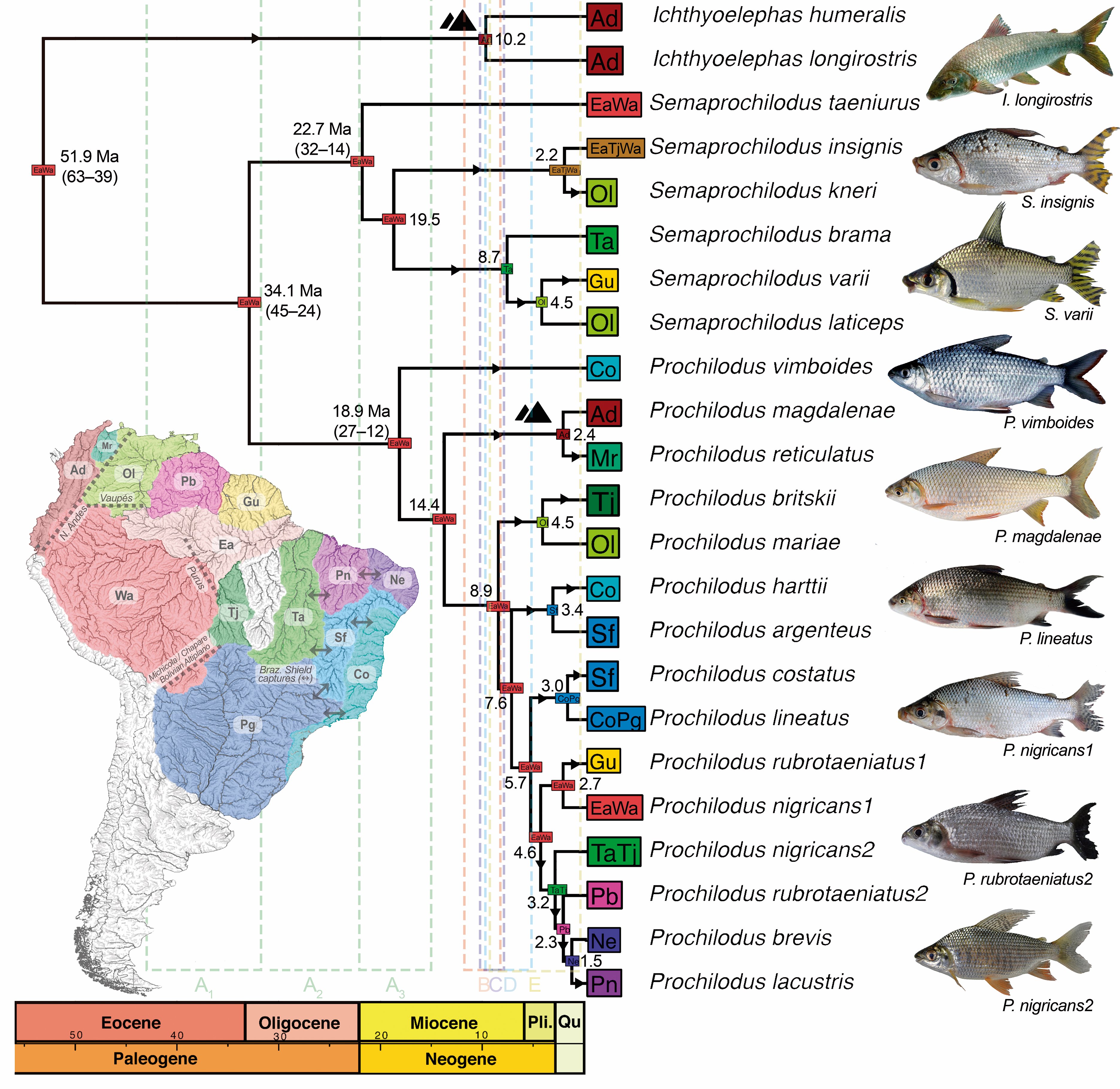
[Ichthyology • 2022] Biogeographic Reconstruction of the Migratory Neotropical Fish Family Prochilodontidae (Teleostei: Characiformes)


in Frable, Melo, Fontenelle, et al., 2022.

Abstract
Geographically, widespread Neotropical fish lineages offer opportunities to reconstruct historical biogeography patterns and infer processes leading to modern ichthyological diversity and distribution. The characiform family Prochilodontidae is well suited for such reconstruction because their migrations limit population substructure within river systems. Therefore, their biogeographic history should match closely the history of connectivity among Neotropical river basins. Here, we combine a time-calibrated phylogeny with biogeographic model testing to recover the history of this family's diversification. Results support the Miocene rise of the Andean Eastern Cordillera as a dispersal barrier, but also indicate a much earlier Eocene origin of the trans-Andean genus Ichthyoelephas. Despite the early origin of the family and its three constituent genera, most prochilodontid lineages originated during the Miocene in Greater Amazonia, likely due to drainage reorganizations caused by Andean uplift. Subsequent speciation appears linked to interbasin exchanges and expansions of Amazonian lineages into Brazilian coastal systems. The modern richness of Prochilodus in easterly drainages appears to be relatively young, with only Prochilodus vimboides likely reaching that region prior to the late Miocene. The rise of the Vaupes Arch coincides with two splits between Orinocoan and Amazonian lineages circa 9 million years ago (Ma). However, two instances of later dispersal between these drainages reveal the permeability of the Vaupes Arch, suggesting that it may promote periodic speciation. This study illustrates how model-based biogeographic studies of widespread groups can reconstruct historic paths of dispersal and help reveal how landscape evolution promoted modern diversity patterns.

Keywords: Amazon, BioGeoBEARS, Eastern Cordillera, historical biogeography, Ostariophysi


Time-calibrated phylogeny and ancestral range evolution of Prochilodontidae estimated by BEAST and BioGeoBEARS.

Photos by A. Nobile (Prochilodus lineatus), B. Melo (Semaprochilodus insignis, P. nigricans1, P. rubrotaeniatus2), J. García-Melo (Ichthyoelephas longirostris), M. Sabaj (S. varii, P. magdalenae, P. nigricans2) and R. Castro (P. vimboides).


Benjamin W. Frable, Bruno F. Melo, João P. Fontenelle, Claudio Oliveira and Brian L. Sidlauskas. 2022. Biogeographic Reconstruction of the Migratory Neotropical Fish Family Prochilodontidae (Teleostei: Characiformes). Zoologica Scripta. DOI: 10.1111/zsc.12531 


Tuesday, December 28, 2021

[Ichthyology • 2021] Schizodon trivittatus • Integrative Taxonomy reveals A New Species of Neotropical Headstanding Fish in Genus Schizodon (Characiformes: Anostomidae)


Schizodon trivittatus
Garavello, Ramirez, de Oliveira, Britski, Birindelli & Galetti, 2021


Abstract

Schizodon encompasses approximately 15 species of Neotropical headstanding fishes. Integrative taxonomy, combining molecular and morphometric analyses with traditional taxonomic methods, was used to investigate Schizodon vittatus and its potential new sister species. Molecular differences between the two species in the barcode are greater than intra-specific variation recovered in species of Schizodon, and the two species represent distinct lineages for approximately one million years. The two species are morphologically very similar, and the meristic data showed great overlap. Morphometric analyses also showed overlap among the putative species but indicated differences in caudal-peduncle depth, orbital diameter, and length of anal-fin rays. Color pattern seems to provide a clear diagnostic feature for the two species. Schizodon vittatus usually has four dark brown transversal bars on body, and its sister species has three conspicuous bars, with the fourth, if present, inconspicuous and dorsal to the lateral line. Schizodon vittatus is redescribed based on the type and recently collected specimens, its type locality is revisited, and its known distribution restricted to the Araguaia and Tocantins drainages. The new species, sister to S. vittatus, distributed in the Xingu and Tapajós drainages, is described. A key for the identification of the Amazon clade species of Schizodon is provided.

Keywords: Amazon; Identification key; Ostariophysi; Systematics; Taxonomy

Schizodon trivittatus, new species.
A. holotype, MZUSP 115362, 285.0 mm SL, Brazil, Mato Grosso, São José do Couto, Culuene river, Xingu River tributary;
 B–C. LIA uncatalogued, Xingu river at Altamira, Pará.
 Specimen A alcohol preserved, B–C photographed live 
Scale bars = 10 mm. 
(B, photo by José Birindelli; C, photo by Leandro Sousa).

Schizodon trivittatus, new species

Diagnosis. Schizodon trivittatus is distinguished from S. isognathus, S. jacuiensis, S. knerii, S. nasutus, S. platae, and S. scotorhabdotus, by having conspicuous dark transversal bars on the trunk formed by the epidermal and dermal pigment (vs. vertical bars absent or inconspicuous and formed exclusively by dermal pigment); from S. australis, S. borellii, S. corti, S. dissimilis, S. fasciatus, S. intermedius, by having a dark midlateral stripe on caudal peduncle (vs. caudal peduncle and base of median caudal-fin rays pale in S. borellii, S. dissimilis, S. intermedius, or a single rounded spot in S. australis, S. corti, S. fasciatus); and from S. vittatus by lacking a dark transversal bar ventral to the adipose fin or having an inconspicuous bar restricted to the region dorsal to the lateral line (vs. possessing a conspicuous dark transversal bar ventral to the adipose fin that extends ventral to the lateral line).

Geographical distribution. Schizodon trivittatus occurs widely in the Xingu and Tapajós drainages, including their tributaries, in Mato Grosso and Pará states, Brazil (Fig. 7).

Etymology. The name trivittatus is an adjective in allusion to the presence of three dark vertical bars on the trunk exhibited by the new species, its main diagnostic feature.
 
 
Júlio C. Garavello, Jorge L. Ramirez, Alexandre K. de Oliveira, Heraldo A. Britski, José L. O. Birindelli and Pedro M. Galetti Jr. 2021. Integrative Taxonomy reveals A New Species of Neotropical Headstanding Fish in Genus Schizodon (Characiformes: Anostomidae).  Neotrop. ichthyol. 19(4); DOI: 10.1590/1982-0224-2021-0016  
Resumo: Schizodon engloba aproximadamente 15 espécies de peixes neotropicais. A taxonomia integrativa, combinando análises moleculares e morfométricas com métodos taxonômicos tradicionais, foi utilizada para investigar Schizodon vittatus e sua potencial espécie irmã. As diferenças moleculares (DNA barcoding) entre as duas espécies são maiores do que a variação intraespecífica observada em espécies congêneres, e as duas espécies representam linhagens distintas por aproximadamente um milhão de anos. As duas espécies são morfologicamente muito similares e os dados merísticos mostram grande sobreposição. As análises morfométricas também mostraram sobreposição entre as duas espécies, mas indicaram diferenças na altura do pedúnculo caudal, no diâmetro interorbital, e no comprimento dos raios da nadadeira anal. O padrão de colorido parece fornecer uma característica diagnóstica clara para as duas espécies. Schizodon vittatus normalmente possui quatro faixas escuras transversais no corpo e sua espécie irmã tem três faixas, com a quarta, se presente, inconspícua e dorsal à linha lateral. Schizodon vittatus é redescrita com base no tipo e em espécimes coletados recentemente; sua localidade tipo é revisitada e a sua distribuição conhecida é restringida às drenagens do Araguaia e Tocantins. A nova espécie, irmã de S. vittatus e distribuída nas drenagens do Xingu e Tapajós, é descrita. Uma chave para a identificação das espécies do clado amazônico de Schizodon é apresentada.
Palavras-chave: Amazônia; Chave de identificação; Ostariophysi; Sistemática; Taxonomia

Tuesday, September 14, 2021

[Ichthyology • 2021] Phylogeography of Baryancistrus xanthellus (Siluriformes: Loricariidae), A Rheophilic Catfish Endemic to the Xingu River Basin in eastern Amazonia


Baryancistrus xanthellus Py-Daniel, Zuanon & de Oliveira, 2011

in Magalhães, da Silva, Sawakuchi, ... et de Sousa, 2021. 
 
Baryancistrus xanthellus (Loricariidae) is an endemic fish species from the Xingu River basin with its life history in the shallow rapid waters flowing over bedrock substrates. In order to investigate the genetic diversity and demographic history of B. xanthellus we analyzed sequence data for one mitochondrial gene (Cyt b) and introns 1 and 5 of nuclear genes Prolactin (Prl) and Ribosomal Protein L3 (RPL3). The analyses contain 358 specimens of B. xanthellus from 39 localities distributed throughout its range. The number of genetically diverged groups was estimated using Bayesian inference on Cyt b haplotypes. Haplotype networks, AMOVA and pairwise fixation index was used to evaluate population structure and gene flow. Historical demography was inferred through neutrality tests and the Extended Bayesian Skyline Plot (EBSP) method. Five longitudinally distributed Cyt b haplogroups for B. xanthellus were identified in the Xingu River and its major tributaries, the Bacajá and Iriri. The demographic analysis suggests that rapids habitats have expanded in the Iriri and Lower Xingu rivers since 200 ka (thousand years) ago. This expansion is possibly related to an increase in water discharge as a consequence of higher rainfall across eastern Amazonia. Conversely, this climate shift also would have promoted zones of sediment trapping and reduction of rocky habitats in the Xingu River channel upstream of the Iriri River mouth. Populations of B. xanthellus showed strong genetic structure along the free-flowing river channels of the Xingu and its major tributaries, the Bacajá and Iriri. The recent impoundment of the Middle Xingu channel for the Belo Monte hydroelectric dam may isolate populations at the downstream limit of the species distribution. Therefore, future conservation plans must consider the genetic diversity of B. xanthellus throughout its range.


Fig 1. Different color patterns present in Baryancistrus xanthellus.
 Photographs of live specimens taken right after collection.
Not all color morphs are represented in the figure.


Keila Xavier Magalhães, Raimundo Darley Figueiredo da Silva, André Oliveira Sawakuchi, Alany Pedrosa Gonçalves, Grazielle Fernanda Evangelista Gomes, Janice Muriel-Cunha, Mark H. Sabaj and Leandro Melo de Sousa. 2021. Phylogeography of Baryancistrus xanthellus (Siluriformes: Loricariidae), A Rheophilic Catfish Endemic to the Xingu River Basin in eastern Amazonia.  PLoS ONE. 16(8): e0256677. DOI: 10.1371/journal.pone.0256677

Sunday, June 6, 2021

[Ichthyology • 2021] Parotocinclus kwarup • A New Species of the Armored Catfish Parotocinclus (Loricariidae: Hypoptopomatinae) from the Upper Xingu River Basin, Brazil


Parotocinclus kwarup
Lehmann A. & Reis, 2021


Abstract
Parotocinclus kwarup, new species, is described as a new hypoptopomatine cascudinho from tributaries of the upper Xingu River in the Amazon basin of Brazil. The new species is distinguished from its congeners in northeastern and southeastern Brazil by having the cheek canal plate elongated posteriorly on the ventral surface of the head and in contact with the cleithrum. Parotocinclus kwarup, new species, is diagnosed from other species of Parotocinclus in the Amazon, Orinoco, and Guianas watersheds by the number of oral teeth, the snout length, having odontodes on the ventral surface of the first pelvic-fin ray bent and pointing mesially, lacking a Y-shaped light marking dorsally on the head (from the posterodorsal margin of orbit to posterior parieto-supraoccipital tip), lacking premaxillary and dentary accessory teeth, and having an adipose fin. The extinction risk of the new species is preliminarily assessed as Least Concern based on its wide distribution area and its inferred presence in the large Xingu Indigenous Park.

Holotype of Parotocinclus kwarup, MZUSP 125830, 21.9 mm SL, female, Rio Couto de Magalha˜es near Vila São José do Couto, Campinápolis, MT, Brazil.


Parotocinclus kwarup, new species

Etymology.— Parotocinclus kwarup in named after the Kwarup (also known as Kuarup or Quarup), an annual ritual celebrated by the upper Xingu indigenous people in honor of their beloved dead, that originally aimed to bring them back to life. A noun in apposition. This name is in honor to the nearly 5,500 people belonging to 14 different ethnicities that currently live in the Xingu Indigenous Park, which plays an essential role in the conservation of this and other fish species.


Pablo Lehmann A. and Roberto E. Reis. 2021. A New Species of the Armored Catfish Parotocinclus (Loricariidae: Hypoptopomatinae) from the Upper Xingu River Basin, Brazil. Ichthyology & Herpetology, 109(2); 449-455. DOI: 10.1643/i2021046

Monday, July 9, 2018

[Herpetology • 2018] A Pan-Amazonian Species Delimitation: High Species Diversity within the Genus Amazophrynella (Anura: Bufonidae)


 (A–B) Amazophrynella minuta; (C–D) Ateko sp. nov.; (E–F) A. siona sp. nov.; (G–H) A. xinguensis sp. nov.;


(O) A. matses; (Q) A. javierbustamantei; (S) Avote; (U) A. moisesii sp. nov.

Rojas, Fouquet, Ron, Hernández-Ruz, Melo-Sampaio, et al​., 2018. 
photos by Rommel R. Rojas, Antoine Fouquet, Santiago R. Ron, Emil Hernándes-Ruz, Juan Carlos Chapparro,  Robson W. Ávila & Paulo R. Melo-Sampaio.

Abstract
Amphibians are probably the most vulnerable group to climate change and climate-change associate diseases. This ongoing biodiversity crisis makes it thus imperative to improve the taxonomy of anurans in biodiverse but understudied areas such as Amazonia. In this study, we applied robust integrative taxonomic methods combining genetic (mitochondrial 16S, 12S and COI genes), morphological and environmental data to delimit species of the genus Amazophrynella (Anura: Bufonidae) sampled from throughout their pan-Amazonian distribution. Our study confirms the hypothesis that the species diversity of the genus is grossly underestimated. Our analyses suggest the existence of eighteen linages of which seven are nominal species, three Deep Conspecific Lineages, one Unconfirmed Candidate Species, three Uncategorized Lineages, and four Confirmed Candidate Species and described herein. We also propose a phylogenetic hypothesis for the genus and discuss its implications for historical biogeography of this Amazonian group.


Amazophrynella teko sp. nov.
 Amazonella sp. Guianas (Fouquet et al., 2012a: 829, French Guiana [in part])
Amazophrynella sp. Guianas (Fouquet et al., 2012b: 68, French Guiana [in part])
Amazophrynella sp. Guianas (Rojas et al., 2015: 85, French Guiana [in part])
Amazophrynella sp1. (Fouquet et al., 2015: 365, French Guiana [in part])
Amazophrynella sp. aff. manaos (Rojas et al., 2016: 49, French Guiana [in part])

Diagnosis. An Amazophrynella with (1) SVL12.9–15.8 mm in males, 17.9–21.5 mm in females; (2) snout acute in lateral view; upper jaw, in lateral view, protruding beyond lower jaw; (3) texture of dorsal skin granular; (4) cranial crest, vocal slits and nuptial pads absent; (5) dorsum covered by abundant rounded granules; (6) abundance of granules on tympanic area, on edges of upper arms and on dorsal surface of arms; (7) ventral skin highly granular; (8) fingers slender, basally webbed; (9) finger III relatively short (HAL/SVL 0.2–0.22 mm, n = 30); (10) finger I shorter than finger II; (11) palmar tubercle protruding and elliptical; (12) hind limbs relatively short (TAL/SVL 0.48–0.49, n = 30); (13) toes slender, basally webbed; in life: (14) venter cream; small blotches on venter.

Distribution and natural history. Amazophrynella teko sp. nov. have been recorded from the district of Saint Laurent du Marioni, Saint Georges and Camopi, French Guiana, the state of Amapá, Brazil and in the southern region of Suriname (A Fouquet, pers. obs., 2017). It occurs at elevations ranging from 70 m a.s.l. to 350 m a.s.l. The species is diurnal and crepuscular but is also active at night during peak breeding period, which normally occurs at the beginning of the rainy season (January–February). This species shows a conspicuous sexual dimorphism, with males being much smaller than females. The conservation status of this species remains unknown. The habitat destruction and pollution must affect their populations; however, due to its abundance we believe that this species probably needs not be classified above Least Concern category.

Etymology. The specific epithet is a noun in apposition and refers to the name of the Teko Amerindians who occupy the southern half of French Guiana; the area occupied by the Teko tribe also encompasses the type locality.


Amazophrynella siona sp. nov.
 Atelopus minutus: (Duellman & Lynch, 1969: 238, Sarayacu [Ecuador])
Dendrophryniscus minutus (Duellman, 1978: 120, Santa Cecilia [Ecuador])
Dendrophryniscus minutus (Duellman & Mendelson III 1995: 336, vicinities of San Jacilllo and Teniente Lopez [Peru])
Amazonela cf. minutus “western Amazonia” (Fouquet et al., 2012a: 829, “western Amazonia”, Ecuador [in part])
Amazophrynella cf. minutus “western Amazonia” (Fouquet et al., 2012a: 68, “western Amazonia”, Ecuador [in part])
Amazophrynella aff. minuta “western Amazonia” (Rojas et al., 2015: 84, “western Amazonia”, Ecuador [in part])
Amazophrynella aff. minuta (Rojas et al., 2016: 49, “western Amazonia”, Ecuador [in part])

Diagnosis. An Amazophrynella with (1) SVL 11.5–14.7 mm in males, 16.1–20.0 mm in females; (2) snout acute in lateral view; upper jaw, in lateral view, protruding beyond lower jaw; (3) texture of dorsal skin finely granular; (4) cranial crests, vocal slits and nuptial pads absent; (5) small granules from the outer edge of the mouth to upper arm; (6) ventral skin granular; (7) tiny granules on ventral surfaces; (8) fingers slender, basally webbed; (9) finger III relative short (HAL/SVL 0.20–0.21, n = 62); (10) finger I shorter than finger II; (11) palmar tubercle rounded; (12) hind limbs relatively large (TAL/SVL 0.5–0.52, n = 62); (13) toes lacking lateral fingers; in life: (14) venter reddish brown; yellow blotches on venter.

Distribution and natural history. Amazophrynella siona sp. nov. have been recorded from Ecuador, in Provinces of Orellana, Sucumbíos and Pastaza and Peru in the Province Andoas, northern Loreto Department. It occurs at elevations ranging from 200–900 m a.s.l. The species is found in the leaf litter of primary and secondary forest, terra firme or flooded forest, and swamps. It is active during the day; at night individuals rest on leaves, usually less than 50 cm above ground. It breeds throughout the year (Duellman, 1978). This species shows conspicuous sexual dimorphism, with males being much smaller than females. The amplexus is axillar. Eggs are pigmented; males call from amidst leaf litter. Duellman & Lynch (1969) reported that this species deposited its eggs in gelatinous strands 245–285 mm long, with 245–291 eggs. It can be abundant at some sites (e.g., Cuyabeno reserve; SR Ron, pers. obs., 2018) Given its large distribution range (>20,000 km2) which also includes vast protected areas and locally abundant populations, we suggest assignment this species to the Least Concern category.

Etymology. The specific epithet is a noun in apposition and refers to the Siona, a western Tucanoan indigenous group that inhabits the Colombian and Ecuadorian Amazon. The Siona inhabit the Cuyabeno Lakes region, an area where Amazophrynella siona sp. nov. is be abundant. While working in his undergraduate thesis in the early 1990s, SRR lived with the Siona at Cuyabeno. The Siona chief, Victoriano Criollo, had an encyclopedic knowledge of the natural history of the Amazonian forest, superior in extent and detail to that of experienced biologists. His death, a few years ago, represents one of many instances of irreplaceable loss of traditional knowledge triggered by cultural change among Amazonian Amerindians.

  (C–D) Amazophrynella teko sp. nov. photo by Antoine Fouquet; 
(E–F) A. siona sp. nov. photo by Santiago R. Ron;
(G–H)
 A. xinguensis sp. nov. photo by Emil Hernándes-Ruz; 
(U–V)
 A. moisesii sp. nov. photo by Paulo R. Melo-Sampaio.

Amazophrynella xinguensis sp. nov.

Diagnosis. An Amazophrynella with (1) SVL 17.0–20.0 mm in males, 22.4–26.3 mm in females; (2) snout pointed in lateral view; (3) upper jaw, in lateral view, protruding beyond lower jaw; 4) tympanums, vocal sac, parotid gland and cranial crest not evident; (5) texture of dorsal skin highly granular; (6) abundance of small tubercles on dorsum, on upper arm and on arms; (7) texture of ventral skin granular; (8) fingers I and II basally webbed; (9) finger III relative short (HAL/SVL = 0.20–0.22, n = 18); (10) thumb larger and robust; (11) finger I larger or equal than finger II, FI = 2.1 vs. FII = 2.1 in adult males, n = 5 and FI = 2.8 mm, vs. FII = 2.9 mm, in adult females, n = 13; (12) palmar tubercle ovoid; (13) toes slender, basally webbed; in life: (14) venter greyish; black dots on venter.

Distribution and natural history. Amazophrynella xinguensis sp. nov. have been recorded from State of Pará, Brazil, at three localities: PDS Virola Jatoba, municipality of Anapú, Fazenda Paraiso, municipality of Senador José Porfirio (right bank of Xingu River) and Ramal dos Cocos, municipality of Altamira (left bank of Xingu River), all of them in area of influence of the Belo Monte dam. It occurs in elevations of 86–106 m a.s.l. This species is found amidst leaf litter. The amplexus is axillar (Fig. 18C). Reproduction occurs in the rainy season in tiny puddles. Males were found hidden in the leaf litter. Tadpoles and advertisement call are unknown. The conservation status of this species remains unknown, but the recent construction of the Belo Monte hydroelectric complex on the Xingu River represents a threat to the population status of this species.

Etymology. The specific epithet refers to geographic distribution of the species within the lower Xingu River basin, Brazil.

Amazophrynella moisesii sp. nov.
Dendrophryniscus minutus (Bernarde et al. 2011: 120 plate 2, Fig. d)
Amazophrynella minuta (Bernarde et al. 2013: 224, 227 plate 7 Fig. c; Miranda et al. 2015: 96)

Diagnosis. An Amazophrynella with (1) SVL 12.2–15.8 mm in males, 16.4–20.9 mm in females; (2) snout acuminate in lateral view, upper jaw, in lateral view, protruding beyond lower jaw; (3) snout length protuberant, large for the genus (SL/HL = 0.48–0.5); (4) cranial crest, vocal slits and nuptial pads absent; (5) small tubercles on upper arms and posterior area of tympanums; (6) texture of dorsal skin tuberculate; (7) texture of ventral skin highly granular (8) finger III relative large (HAL/SVL 0.23–0.25, n = 28); (9) fingers slender, basally webbed; (10) finger I shorter than finger II; (11) palmar tubercle elliptic; (12) hind limbs relatively large (TAL/SVL 0.51–0.53, n = 28); (13) toes slender basally webbed; in life: (14) venter pale yellow; small irregular dots on venter.

Distribution and natural history. Amazophrynella moisesii sp. nov. have been recorded from Brasil. State of Acre: municipalities of Cruzeiro do Sul, Mâncio Lima, Porto Walter and Tarauacá; State of Amazonas: municipality of Envira. Peru: Department of Huanuco, Panguana, Rio Llullapichis. Due to its abundance and presence in conservation units of Brazil (Floresta Estadual do Gregório, Reserva Extrativista do Alto Juruá and Parque Nacional da Serra do Divisor) we recommend the IUCN Least Concern category.

Etymology. The specific epithet refers to Dr. Moisés Barbosa de Souza, a Brazilian biologist, professor and friend at the Universidade Federal do Acre (UFAC), to whom we dedicate this species in recognition of his contributions to herpetological research and amphibian conservation in the state of Acre, Brazil.


Figure 25: Confirmed candidate species (CCS) of Amazophrynella. (A–B) Amazophrynella minuta photo by Rommel R. Rojas; (C–D) Ateko sp. nov. photo by Antoine Fouquet; (E–F) A. siona sp. nov. photo by Santiago R. Ron; (G–H) A. xinguensis sp. nov. photo by Emil Hernándes-Ruz; (I–J) A. bokermanni photo by Marcelo Gordo; (K–L) A. manaos photo by Rommel R. Rojas. (M–N) A. amazonicola photo by Rommel R. Rojas. (O–P) A. matses photo by Rommel R. Rojas; (Q–R) A. javierbustamantei photo by Juan Carlos Chapparro; (S–T) A. vote photo by Robson W. Ávila; (U–V) A. moisesii sp. nov. photo by Paulo R. Melo-Sampaio.

Rommel R. Rojas, Antoine Fouquet, Santiago R. Ron, José Hernández-Ruz, Paulo R. Melo-Sampaio, Juan C. Chaparro, Richard C. Vogt, Vinicius Tadeu de Carvalho, Leandra Cardoso Pinheiro, Robson W. Avila, Izeni Pires Farias, Marcelo Gordo and Tomas Hrbek​. 2018. A Pan-Amazonian Species Delimitation: High Species Diversity within the Genus Amazophrynella (Anura: Bufonidae). PeerJ. 6:e4941  DOI: 10.7717/peerj.4941


Thursday, May 24, 2018

[Ichthyology • 2018] Corydoras benattii From the Inside Out: A New Species of Armoured Catfish Corydoras (Siluriformes, Callichthyidae) with the Description of Poorly‐explored Character Sources


Corydoras benattii  Espindola, Tencatt, Pupo, Villa-Verde & Britto, 2018

Photo by  Hans Evers

Abstract  
A new species of the armoured catfish genus Corydoras is described from the Xingu–Tapajos ecoregion, Brazilian Amazon. The new species can be distinguished from its congeners by having the following combination of features: short mesethmoid, with anterior tip poorly developed, smaller than 50% of bone length; posterior margin of pectoral spine with serrations directed towards spine tip or perpendicularly oriented; infraorbital 2 only in contact with sphenotic; ventral laminar expansion of infraorbital 1 poorly or moderately developed; flank midline covered by small dark brown or black saddles with similar size to remaining markings on body; relatively larger, scarcer and more sparsely distributed dark brown or black spots on body; absence of stripe on flank midline; caudal fin with conspicuous dark brown or black spots along its entire surface; slender body; and strongly narrow frontals. A more comprehensive description of poorly‐explored internal character sources, such as the gross morphology of the brain, Weberian apparatus and swimbladder capsule elements is presented.

Keywords: Brazilian Amazon, Corydoradinae, Corydoras sp. C22, gross brain morphology, taxonomy, Xingu–Tapajos ecoregion


Figure 1: Corydoras benattii sp. nov. in (a) aquarium and (b) natural habitat, uncatalogued specimens, both near Altamira, lower Rio Xingu Basin. 

Figure 2: Corydoras benattii sp. nov., MZUSP 121671, holotype, 25·4 mm standard length, Brazil, Mato Grosso, Canarana–Gaúcha do Norte, Rio Culuene, tributary to Rio Xingu Basin.

Corydoras benattii, sp. nov.

Corydoras sp. 4. Castilhos & Buckup, 2011: 241 (species list).
Corydoras sp. C22. Evers, 1994: 755, Fig. 2 (species catalogue). Glaser et al., 1996: 92 (photos, species catalogue). Evers & Schäfer, 2004: 11, 12 (photos, species catalogue). Füller & Evers, 2005: 281, 285, 294 (species catalogue).
Corydoras sp. aff. C22. Glaser et al., 1996: 90 (photos, species catalogue).

Geographical distribution: Corydoras benattii occurs in both the Rio Xingu and Rio Tapajós basins, Brazilian Amazon (Fig. 10). In the Rio Xingu basin, it is known in Mato Grosso State from tributaries to the Rio Culuene, a clearwater tributary of the upper Rio Xingu (type locality) and in Pará State from the Rio Fresco sub drainage (Rio Trairão and Igarapé Manguari), middle Rio Xingu and from the lower Rio Xingu basin near Altamira. In the Rio Tapajós basin, it occurs in the Rio Peixoto de Azevedo, a tributary to the Rio Teles Pires, Mato Grosso and from Rio Cururu, a tributary to the Rio São Manuel, Pará.

Habitat notes: Specimens of Corydoras benattii were found in lotic habitats in the Rio Culuene, Rio Xingu basin and Rio Braço Norte, tributary to Rio Peixoto de Azevedo, Rio Tapajós basin (Fig. 11). Both localities have muddy‐brown water with clay and sandy substrata. Most specimens were captured in the small forest streams of black or clearwater, or in marginal ponds.

Etymology: The specific name, benattii, honours the late Laert Benatti for his humanitarian work, providing fresh water from artesian wells to poor communities in Brazil. Case is genitive.


V. C. Espíndola, L. F. C. Tencatt, F. M. Pupo, L. Villa‐Verde and M. R. Britto. 2018. From the Inside Out: A New Species of Armoured Catfish Corydoras with the Description of Poorly‐explored Character Sources (Teleostei, Siluriformes, Callichthyidae). Journal of Fish Biology.   DOI: 10.1111/jfb.13602


Friday, April 20, 2018

[Ichthyology • 2018] Diversity and Community Structure of Rapids-dwelling Fishes of the Xingu River: Implications for Conservation Amid Large-scale Hydroelectric Development


Fig. 1. Examples of the habitat and fishes (C) characteristic of the Middle Xingu River.

Species shown are: a) 
Leporinus maculatus (Anostomidae), b) Baryancistrus xanthellus (Loricariidae), c) Ossubtus xinguense (Serrasalmidae), d) Crenicichla sp. (Cichlidae), e) Ancistrus ranunculus (Loricariidae), f) Cichla melaniae (Cichlidae), g) Tometes kranponhah (Serrasalmidae), h) Hypancistrus sp. (Loricariidae), i) Leporinus fasciatus (Anostomidae), j) Rhinodoras sp. (Doradidae) and k) Hypancistrus zebra (Loricariidae).

in Fitzgerald, Sabaj Perez, Sousa, et al. 2018. 

Highlights
• 193 rapids-dwelling fish species were sampled prior to flow alteration.
• Fish community structure differed significantly between river segments.
• Rapids specialists and threatened species were concentrated in the Volta Grande.
• The Volta Grande rapids are now flooded and dewatered due to a hydropower facility.
• Maintaining rapids in the dewatered section will be critical for aquatic diversity.

Abstract
A recent boom in hydroelectric development in the world's most diverse tropical river basins is currently threatening aquatic biodiversity on an unprecedented scale. Among the most controversial of these projects is the Belo Monte Hydroelectric Complex (BMHC) on the Xingu River, the Amazon's largest clear-water tributary. The design of the BMHC creates three distinctly altered segments: a flooded section upstream of the main dam, a middle section between the dam and the main powerhouse that will be dewatered, and a downstream section subject to flow alteration from powerhouse discharge. This region of the Xingu is notable for an extensive series of rapids known as the Volta Grande that hosts exceptional levels of endemic aquatic biodiversity; yet, patterns of temporal and spatial variation in community composition within this highly threatened habitat are not well documented. We surveyed fish assemblages within rapids in the three segments impacted by the BMHC prior to hydrologic alteration, and tested for differences in assemblage structure between segments and seasons. Fish species richness varied only slightly between segments, but there were significant differences in assemblage structure between segments and seasons. Most of the species thought to be highly dependent on rapids habitat, including several species listed as threatened in Brazil, were either restricted to or much more abundant within the upstream and middle segments. Our analysis identified the middle section of the Volta Grande as critically important for the conservation of this diverse, endemic fish fauna. Additional research is urgently needed to determine dam operations that may optimize energy production with an environmental flow regime that conserves the river's unique habitat and biodiversity.

Keywords: Anostomidae; Assemblage structure; Belo Monte; Brazil; Cichlidae; Hydrologic connectivity; Loricariidae; Rheophilic


Fig. 1. Examples of the habitat (A, B) and fishes (C) characteristic of the Middle Xingu River. Species shown are: a) Leporinus maculatus (Anostomidae), b) Baryancistrus xanthellus (Loricariidae), c) Ossubtus xinguense (Serrasalmidae), d) Crenicichla sp. (Cichlidae), e) Ancistrus ranunculus (Loricariidae), f) Cichla melaniae (Cichlidae), g) Tometes kranponhah (Serrasalmidae), h) Hypancistrus sp. (Loricariidae), i) Leporinus fasciatus (Anostomidae), j) Rhinodoras sp. (Doradidae) and k) Hypancistrus zebra (Loricariidae).


Daniel B. Fitzgerald, Mark H. Sabaj Perez, Leandro M. Sousa, Alany P. Gonçalves, Lucia Rapp Py-Daniel, Nathan K. Lujan, Jansen Zuanon, Kirk O. Winemiller and John G. Lundberg. 2018. Diversity and Community Structure of Rapids-dwelling Fishes of the Xingu River: Implications for Conservation Amid Large-scale Hydroelectric Development. Biological Conservation. 222; 104–112.  DOI: 10.1016/j.biocon.2018.04.002

Monday, December 18, 2017

[Ichthyology • 2017] Brachychalcinus reisi • A New Species of Brachychalcinus (Characiformes: Characidae) from the rio Xingu basin, Serra do Cachimbo, Brazil


Brachychalcinus reisi 
Garcia-Ayala, Ohara, Pastana & Benine, 2017


Abstract

Brachychalcinus reisi, a new species of characid fish, is described from the rio Curuá, tributary of rio Iriri, rio Xingu basin, Serra do Cachimbo, Pará State, Brazil. The new species can be distinguished from its congeners by the presence of a series of longitudinal black wavy stripes on the entire body and by a lower number of longitudinal scale rows between dorsal-fin origin and lateral line (7–8 vs. 8–12). Additionally, the new species differs from B. copei, B. parnaibae, and B. retrospina by the lower number of branched dorsal-fin rays (9 vs.10). This is the first description of a new species of the subfamily since the revisionary study of Stethaprioninae, published almost 30 years ago.

Keywords: Pisces, Stethaprioninae, Neotropical region, freshwater fishes, taxonomy, Amazon

FIGURE 4. Brachychalcinus reisi, MZUSP 119456, paratype, 57.3 mm SL, Brazil, Pará, Altamira, rio Curuá, rio Xingu basin. 

Brachychalcinus reisi new species

Etymology. The specific name reisi is in honor of Roberto Esser dos Reis, for his great contributions to the knowledge of the Stethaprioninae and the Neotropical ichthyology as a whole. A genitive noun.  

  FIGURE 6. Type-locality of Brachychalcinus reisi, Brazil, Pará, Altamira, upper rio Curuá, rio Xingu basin.  


James R. Garcia-Ayala, Willian M. Ohara, Murilo N. L. Pastana and Ricardo C. Benine. 2017. A New Species of Brachychalcinus (Characiformes: Characidae) from the rio Xingu basin, Serra do Cachimbo, Brazil. Zootaxa. 4362(4); 564–574.  DOI:  10.11646/zootaxa.4362.4.5