Showing posts with label Mongolia. Show all posts

Wednesday, October 1, 2025

[Entomology • 2025] The Genus Sophronia (Lepidoptera: Gelechiidae) in the Altai Mountains


1–3. Sophronia huiagaai sp. nov. Šumpich, 2025
 4–6. S. consanguinella (Herrich-Schäffer, 1855)
 7–9. S. chilonella (Treitschke, 1833)  

in Šumpich, 2025. 
 
Abstract 
This work summarizes current knowledge about the occurrence of Sophronia Hübner, [1825] species in the Altai Mountains. Previously, two species of the genus have been recorded, both two from the Russian Altai. Sophronia huiagaai sp. nov. is described from the southern Altai Mts in Mongolia. No Sophronia species is known from the Chinese and Kazakh parts of the mountains. Photographs of moths and genitalia of both sexes are provided for S. huiagaai sp. nov. S. chilonella (Treitschke, 1833) is recorded from the Altai Mts for the first time.

1–3. Sophronia huiagaai sp. nov., Mongolia; 1. Holotype, male; 2. Paratype, female; 3. Head, paratype, male;
4–6. S. consanguinella (Herrich-Schäffer, 1855). 4. Male, Russia, Southern Ural; 5. Female, Czechia; 6. Head, Czechia, male;
7–9. S. chilonella (Treitschke, 1833); 7. Male, Russia, Altai Mts; 8. Female, Czechia; 9. Head, Czechia, male.
 

Jan Šumpich. 2025. The Genus Sophronia in the Altai Mountains (Lepidoptera, Gelechiidae). Nota Lepidopterologica. 48: 137-144. DOI: doi.org/10.3897/nl.48.147394 

Wednesday, September 17, 2025

[Paleontology • 2025] Zavacephale rinpoche • A domed pachycephalosaur from the early Cretaceous of Mongolia


Zavacephale rinpoche
Chinzorig, Takasaki, Yoshida, Tucker, Buyantegsh, Mainbayar, Tsogtbaatar & Zanno, 2025 
 
Artwork by Masaya Hattori

Abstract
The dome-headed pachycephalosaurians are among the most enigmatic dinosaurs. Bearing a hypertrophied skull roof and elaborate cranial ornamentation, members of the clade are considered to have evolved complex sociosexual systems. Despite their importance in understanding behavioural ecology in Dinosauria, the absence of uncontested early diverging taxa has hindered our ability to reconstruct the origin and early evolution of the clade. Here we describe Zavacephale rinpoche gen. et sp. nov., from the Lower Cretaceous Khuren Dukh Formation of Mongolia, the most skeletally complete and geologically oldest pachycephalosaurian discovered globally. Z. rinpoche exhibits a well-developed frontoparietal dome and preserves the clade’s first record of manual elements and gastroliths. Phylogenetic analysis recovered Z. rinpoche as one of the earliest diverging pachycephalosaurians, pushing back fossil evidence of the frontoparietal dome by at least 14 Myr and clarifying macroevolutionary trends in its assembly. We found that the earliest stage of dome evolution occurred by means of a frontal-first developmental pattern with retention of open supratemporal fenestra, mirroring proposed ontogenetic trajectories in some Late Cretaceous taxa. Finally, intraskeletal osteohistology of the frontoparietal dome and hindlimb demonstrate decoupling of sociosexual and somatic maturity in early pachycephalosaurians, with advanced dome development preceding terminal body size.


 Zavacephale rinpoche gen. et sp. nov.


Tsogtbaatar Chinzorig, Ryuji Takasaki, Junki Yoshida, Ryan T. Tucker, Batsaikhan Buyantegsh, Buuvei Mainbayar, Khishigjav Tsogtbaatar and Lindsay E. Zanno. 2025. A domed pachycephalosaur from the early Cretaceous of Mongolia. Nature. DOI: doi.org/10.1038/s41586-025-09213-6 [17 September 2025]

Tuesday, September 16, 2025

[Paleontology • 2025] Gobiazhdarcho tsogtbaatari & Tsogtopteryx mongoliensis • Azhdarchid Pterosaur Diversity in the Bayanshiree Formation, Upper Cretaceous of the Gobi Desert, Mongolia


 The coexistence between Gobiazhdarcho tsogtbaatari and Tsogtopteryx mongoliensis in the Bayanshiree paleoenvironment.
Pêgas, Zhou​ & Kobayashi, 2025
  
Artwork by Zhao Chuang. 

Abstract 
Pterosaur remains are very rare in Mongolian Mesozoic deposits, in stark contrast with the great abundance of dinosaur fossils in the region. This contribution presents a reassessment of the azhdarchid pterosaur remains from the Bayanshiree Formation’s “upper beds” (Turonian–Santonian), represented by two specimens coming from two distinct localities: the Burkhant and the Bayshin Tsav azhdarchids. These specimens, collected by the Japanese−Mongolian Joint Paleontological Expedition and originally described in 2009, have been previously interpreted as indeterminate azhdarchids. Under the light of current knowledge on the morphological diversity of azhdarchid cervical vertebrae, as well as on the taxonomic and phylogenetic signals these skeletal elements carry, we herein identify diagnostic features and reassess the phylogenetic affinities of the Bayanshiree azhdarchids in further detail. Our results suggest that the Burkhant azhdarchid, hereby named Gobiazhdarcho tsogtbaatari gen. et sp. nov., represents a medium-sized (3.0–3.5 meters in wingspan) basal member of a Quetzalcoatlus-Arambourgiania lineage. The Bayshin Tsav azhdarchid, Tsogtopteryx mongoliensis gen. et sp. nov., is recovered as a basal member of a Hatzegopteryx-lineage and, surprisingly, seems to represent a small form under 2 m in wingspan. Our results shed fresh light on the diversity and phylogeny of azhdarchid pterosaurs, and reinforce the reoccurring pattern of coexistence between multiple, differently-sized azhdarchid species from a same deposit.

Life restoration of the Bayanshiree azhdarchids. The coexistence between Gobiazhdarcho tsogtbaatari and Tsogtopteryx mongoliensis in the Bayanshiree paleoenvironment, with a group of Gobihadros mongoliensis nearby.
Artwork by Zhao Chuang. 

 Gobiazhdarcho tsogtbaatari gen. et sp. nov. 
 Tsogtopteryx mongoliensis gen. et sp. nov.

 
R. V. Pêgas, Xuanyu Zhou​ and Yoshitsugu Kobayashi. 2025. Azhdarchid Pterosaur Diversity in the Bayanshiree Formation, Upper Cretaceous of the Gobi Desert, Mongolia. PeerJ 13:e19711. DOI: doi.org/10.7717/peerj.19711 [September 16, 2025]

Monday, July 14, 2025

[Paleontology • 2025] Shri rapax • A New bird-like Dinosaur from the Upper Cretaceous of Mongolia with extremely robust hands supports niche partitioning among velociraptorines


Shri rapax
Moutrille, Cau, Chinzorig, Escuillié, Tsogtbaatar, Ganzorig, Mallet & Godefroit, 2025

 
ABSTRACT
Dromaeosauridae is a clade of bird-like theropod dinosaurs including, among others, the genera Deinonychus and Velociraptor, and characterised by a specialised second toe bearing an enlarged and falciform ungual. Here, we describe an exquisitely-preserved velociraptorine dromaeosaurid from the Upper Cretaceous Djadokhta Formation of Mongolia, and refer it to the new species Shri rapax. This dromaeosaurid is diagnosed by a peculiar combination of vertebral and pelvic features and by an exceptionally robust hand with a very stout pollex bearing the ungual proportionally larger than in any other dromaeosaurid. Combined with cranial adaptations which could support a bite more powerful than in other velociraptorines, the enlarged unguals in both Shri species suggest ecological partitioning in prey preference among the sympatric Djadokhtan dromaeosaurids.

KEYWORDS: Cretaceous, Djadokhta Formation, Dromaeosauridae, Mongolia, Theropoda


Shri rapax


Léa Moutrille, Andrea Cau, Tsogtbaatar Chinzorig, François Escuillié, Khishigjav Tsogtbaatar, Bayasgaa Ganzorig, Christophe Mallet and Pascal Godefroit. 2025. A New bird-like Dinosaur from the Upper Cretaceous of Mongolia with extremely robust hands supports niche partitioning among velociraptorines. Historical Biology: An International Journal of Paleobiology. DOI: doi.org/10.1080/08912963.2025.2530148 [13 Jul 2025] 

Thursday, June 12, 2025

[Paleontology • 2025] Khankhuuluu mongoliensis • A new Mongolian tyrannosauroid and the Evolution of Eutyrannosauria


Khankhuuluu mongoliensis 
Voris, Zelenitsky, Kobayashi, Modesto, Therrien, Tsutsumi, Chinzorig & Tsogtbaatar, 2025


Abstract
Eutyrannosaurians were large predatory dinosaurs that dominated Asian and North American terrestrial faunas in latest Cretaceous times. These apex predators arose from smaller-bodied tyrannosauroids during the ‘middle’ Cretaceous that are poorly known owing to the paucity of fossil material. Here we report on a new tyrannosauroid, Khankhuuluu mongoliensis gen. et sp. nov., from lower Upper Cretaceous deposits of Mongolia that provides a new perspective on eutyrannosaurian origins and evolution. Phylogenetic analyses recover Khankhuuluu immediately outside Eutyrannosauria and recover the massive, deep-snouted Tyrannosaurini and the smaller, gracile, shallow-snouted Alioramini as highly derived eutyrannosaurian sister clades. Khankhuuluu and the late-diverging Alioramini independently share features related to a shallow skull and gracile build with juvenile eutyrannosaurians, reinforcing the key role heterochrony had in eutyrannosaurian evolution. Although eutyrannosaurians were mainly influenced by peramorphosis or accelerated growth, Alioramini is revealed as a derived lineage that retained immature features through paedomorphosis and is not a more basal lineage as widely accepted. Our results reveal that Asian tyrannosauroids (similar to Khankhuuluu) dispersed to North America, giving rise to Eutyrannosauria in the mid-Late Cretaceous. Eutyrannosauria diversified and remained exclusively in North America until a single dispersal to Asia in the latest Cretaceous that established Alioramini and Tyrannosaurini. Stark morphological differences between Alioramini and Tyrannosaurini probably evolved due to divergent heterochronic trends—paedomorphosis versus peramorphosis, respectively—allowing them to coexist in Asia and occupy different ecological niches.


Khankhuuluu mongoliensis gen. et sp. nov.


Jared T. Voris, Darla K. Zelenitsky, Yoshitsugu Kobayashi, Sean P. Modesto, François Therrien, Hiroki Tsutsumi, Tsogtbaatar Chinzorig and Khishigjav Tsogtbaatar. 2025. A new Mongolian tyrannosauroid and the Evolution of Eutyrannosauria. Nature. DOI: doi.org/10.1038/s41586-025-08964-6 [11 June 2025]

Wednesday, May 7, 2025

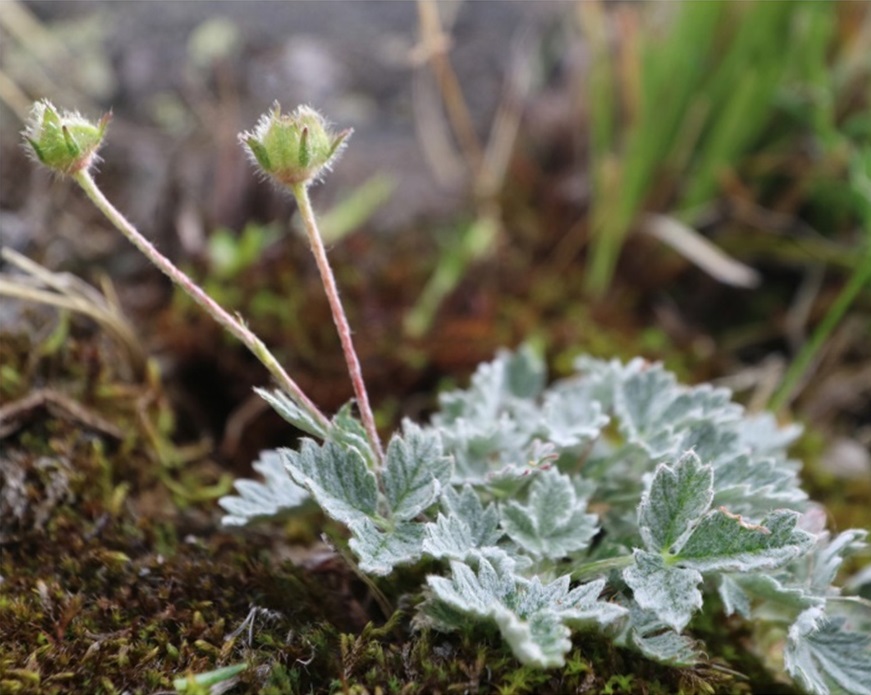
[Botany • 2025] Potentilla sanczirii (Rosaceae) • A New Species from high Mountain Range in Western Mongolia


Potentilla sanczirii V. Gundegmaa., G. Onolragchaa & M.Urgamal, 

in GundegmaaOnolragchaa , Javzandolgor, Dashmaa, Munkh-Erdene et Urgamal, 2025. 
 
Abstract
The genus Potentilla L. is one of the genus with controversial taxonomic position in family Rosaceae, and show a rich species diversity, adapting in mountains hills, high-altitude mountains and arid communities in Palearctic region. Potentilla sanczirii is described and illustrated as new species from Western Mongolian high mountain range. We used conventional morphometric and molecular phylogeny methods to describe new species. With this new contribution, we added a species to the genus Potentilla. L, which makes it with 79 elements in Mongolia. It is morphologically similar to P. nivea, such as, basal leaves ternate, Lower leaflet surface covered with whitish or grayish tomentose. However, differs in multiple caudex covered with dark-brown remains of decayed stipules, and the upper surface of its leaves is adorned with long, silky hairs (light grey). This species' mature nuts (achenes) are light green, approximately 1.0 mm long, and have a smooth surface.A Bayesian Inference tree was reconstructed to further understand the phylogenetic relationships within the genus, and a time-calibrated phylogenetic tree of the subtribe Potentillinae, including 15 species of Pot entilla from Mongolia. The time-calibrated phylogenetic tree suggests that the newly discovered P. sanczirii originated approximately 6.50 million years ago during the late Miocene.

Phylogenetic analysis, Taxonomy, Western Mongolia, Eudicots


Potentilla sanczirii V. Gundegmaa., G. Onolragchaa & M.Urgamal sp. nov.


GUNDEGMAA Vanjil, ONOLRAGCHAA Ganbold, JAVZANDOLGOR Chuluunbat, DASHMAA Tsogtbayar, MUNKH-ERDENE Tovuudorj and URGAMAL Magsar. 2025. Potentilla sanczirii (Rosaceae), A New Species from high Mountain Range in Western Mongolia. Phytotaxa. 691(3); 293-300. DOI: doi.org/10.11646/phytotaxa.691.3.6 [2025-03-07]


Wednesday, April 9, 2025

[PaleoMammalogy • 2025] Ravjaa ishiii • New Late Cretaceous zhelestid mammal (Eutheria: Zhelestidae) from the Bayanshiree Formation, Mongolia


Ravjaa ishiii 
Okoshi, Takasaki, Chiba, Natori, Saneyoshi, Takahashi, Kodaira, Hayashi, Ishigaki, Mainbayar & Tsogtbaatar, 2025


Numerous exquisitely preserved mammal fossils unearthed from Upper Cretaceous strata in the Gobi Desert of Mongolia have played a key role in understanding Mesozoic mammalian evolution. These splendid mammal fossils have been recovered mainly from the Baruungoyot and Djadokhta formations, but only two fragmentary remains of mammals have been collected from the underlying Bayanshiree Formation. Here we report a new species of Zhelestidae, Ravjaa ishiii gen. et sp. nov., based on a new mammal specimen recently discovered from the Bayanshiree Formation at the Bayan Shiree locality. The new specimen is represented by a well-preserved partial right dentary with the distal portion of an ultimate premolar and the first to the third molars. The gross observation and the phylogenetic analyses demonstrate zhelestid affinities: the subequally tall protoconid and metaconid, closely approximated hypoconulid and entoconid. Zhelestidae was widely distributed from Eurasia to North America in the Late Cretaceous but has not previously been recovered in the abundant Late Cretaceous mammalian fauna of Mongolia. This species represents the first zhelestid from the Mongolian Upper Cretaceous strata and contributes to further understanding of their paleobiogeographic and ecological insights.

Key words: Mammalia, Eutheria, Cretaceous, Bayanshiree Formation, Mongolia.


. Holotype of the zhelestid eutherian mammal Ravjaa ishiii gen. et sp. nov. (MPC-M 100s/001) from the Upper Cretaceous Bayanshiree Formation, Dornogovi, Mongolia.
Right mandible in labial (A), occlusal (B) and lingual (C) views.
Photographs (A1–C1) and 3D model (A2–C2) produced from a CT scan.
 
Mammalia Linnaeus, 1758 
Theria Parker and Haswell, 1897 
Eutheria Gill, 1872 
Zhelestidae Nessov, 1985a 

Genus Ravjaa nov. 

 Etymology: Derived from the 5th Noyon Khutugt lama of the Gobi, Dulduityn Danzanravjaa, the famous Buddhist scholar who was deeply respected by people in the Dornogobi region, where this specimen was unearthed. Given that the genus name “Ravjaa” originates from the personal name of a male figure, it should be considered masculine. 

Ravjaa ishiii sp. nov. 

Etymology: In honor of Ken-ichi Ishii, the director of Hayashibara Museum of Natural Sciences, Okayama, Japan, for his leading role in the Japanese team of the Mongolia-Japan joint expedition, which tremendously contributes to Mongolian paleontology. Holotype: MPC-M 100s/001, partial right dentary with a distal portion of the ultimate premolar, damaged m1, and well-preserved m2–3. 

Type locality: Bayan Shiree, located approximately 25 km southwest of Dzüünbayan, Dornogovi, Mongolia. 

Type horizon: Cenomanian–Santonian, Upper Cretaceous, Bayanshiree Formation. 

Diagnosis.—A zhelestid eutherian that differs from all other zhelestids in: the faint coronoid crest of the dentary with the shallow masseteric fossa, the concave dorsal alveolar margin of the dentary, the complete absence of the labial mandibular foramen, and the significantly high m2 crown that reaches approximately 70% of the height of the horizontal ramus directly below it on labial view.


Tsukasa Okoshi, Ryuji Takasaki, Kentaro Chiba, Masahito Natori, Mototaka Saneyoshi, Akio Takahashi, Shota Kodaira, Shoji Hayashi, Shinobu Ishigaki, Buuvei Mainbayar, and Khishigjav Tsogtbaatar. 2025. New Late Cretaceous zhelestid mammal from the Bayanshiree Formation, Mongolia. Acta Palaeontologica Polonica. 70 (1); 193-203. DOI: doi.org/10.4202/app.01213.2024

Tuesday, March 25, 2025

[Paleontology • 2025] Duonychus tsogtbaatari • Didactyl therizinosaur (Coelurosauria: Therizinosauridae) with a preserved keratinous claw from the Late Cretaceous of Mongolia


Duonychus tsogtbaatari
Kobayashi, Zelenitsky, Fiorillo & Chinzorig, 2025
 
illustration by Masato Hattori

Highlights: 
• Duonychus tsogtbaatari is described as another therizinosaur from Mongolia
• It is a didactyl therizinosaur, possessing only two manual digits
• A keratinous sheath on digit I provides rare insight into theropod claw structure
• Duonychus reveals convergent digit III loss in at least five theropod clades

Summary
Therizinosaurs were a group of herbivorous/omnivorous theropod dinosaurs that lived in Asia and North America during the Cretaceous Period. These theropods are notable for their three-fingered hands sporting large claw-like unguals. Here, we describe a new and unusual species of the therizinosaurid Duonychus tsogtbaatari, recovered from the lower Upper Cretaceous Bayanshiree Formation of the Gobi Desert of Mongolia. This species is different from other therizinosaurs in that the hand possesses only two fingers, rather than three fingers, the typical condition for Avetheropoda, providing further insight into forelimb/hand reduction among theropods. Phylogenetically, Duonychus reveals a broader but still limited appearance of didactyly among avetheropodans. The manual ungual of Duonychus tsogtbaatari also preserves a nearly complete three-dimensional structure covering the ungual of the left manual digit I, which represents a keratinous manual claw. The strong curvature of this large claw and high ungual flexion indicate that Duonychus was likely amplectorial (grasping) and an effective grasper of vegetation, despite having only two functional fingers.

Systematic Paleontology
Theropoda  
Coelurosauria  
Therizinosauria  
Therizinosauridae 


Duonychus tsogtbaatari gen. et sp. nov.
 
Horizon and locality: The holotype specimen was collected from the Urlibe Khudak Locality (N43°27.092′, E107°23.476′) within the Bayanshiree Formation (Figure 1), which primarily consists of conglomerates, sandstones, and mudstones deposited in alluvial and fluvial settings, in the eastern Gobi Desert, Mongolia. This formation, dated to the Late Cretaceous, spans the Cenomanian to Santonian stages, as indicated by radiometric dating and biostratigraphic data. ...

Diagnosis: A derived therizinosaur exhibiting the following unique combination of characters: dorsal vertebrae with a long neural spine; a thick centrodiapophyseal lamina without additional laminae; dorsal vertebrae lacking pleurocoels; sacral vertebrae (2–4) with flat ventral surfaces; dorsal vertebrae possessing a weak ventral keel; pneumatic dorsal ribs; fused distal carpals 1 and 2; distal carpals 1 and 2 semilunate-shaped with a mediodorsal process; a small angle between the articular surfaces of the radiale for the semilunate carpal and the radius; a reduced metacarpal III forming a splint; absence of digit III; equally sized manual unguals I-2 and II-3; absence or reduction of the flexor fossa in manual phalanges; and a reduced dorsal process at the proximal end of manual phalanges. Duonychus can be distinguished from other therizinosaurs of the Bayanshiree Formation by several features. Its humerus has a more proximally positioned deltopectoral crest compared to Erlikosaurus, and in Duonychus, the entepicondyle is reduced with a markedly narrow groove separating it from the ulnar condyle. Unlike Enigmosaurus, which has a fused pubic boot and coalesced sacral vertebrae, Duonychus has an unfused pubic boot and ventrally flat sacral vertebrae with a shorter second sacral. Duonychus has an anteriorly deflected humeral shaft and a nearly straight ventral border of the pubic boot, distinguishing it from the convex shape seen in Segnosaurus.


Etymology: The generic epithet is derived from duo for two in Greek in reference to the presence of a didactyl hand which is unusual in therizinosaurs, and from onyx for claw in Greek. The species epithet honors Khishigjav Tsogtbaatar, a paleontologist and former director of the Institute of Paleontology, Mongolian Academy of Sciences in Ulaanbaatar, Mongolia.


Yoshitsugu Kobayashi, Darla K. Zelenitsky, Anthony R. Fiorillo and Tsogtbaatar Chinzorig. 2025. Didactyl therizinosaur with a preserved keratinous claw from the Late Cretaceous of Mongolia.  iScience. www.cell.com/iscience/fulltext/S2589-0042(25)00401-8  
DOI: 10.1016/j.isci.2025.112141 [March 25, 2025]

Tuesday, July 16, 2024

[Paleontology • 2024] Harenadraco prima • The first troodontid (Theropoda: Troodontidae) from the Upper Cretaceous Baruungoyot Formation of Mongolia


Harenadraco prima
S. Lee, Y.-N. Lee, Park, Kim, Badamkhatan, Idersaikhan & Tsogtbaatar, 2024
 
artwork by Yusik Choi

ABSTRACT
Among non-avian dinosaurs, troodontids are relatively rare but diverse. The Nemegt Basin in the Mongolian Gobi Desert, which incorporates three of the most fossiliferous beds in the world, is one such region with high troodontid diversity and has also produced eight troodontid taxa until now. The diversity of troodontids is biased towards the two formations, Nemegt and Djadochta. Despite its rich vertebrate fossil record, no troodontids have been described from the Baruungoyot Formation. This faunal absence is perplexing as the Baruungoyot Formation has often been considered intermediate between the other two units in stratigraphy and paleoenvironment, but there are no definite troodontid materials that could fill this ‘gap.’ Here, we report a new troodontid, Harenadraco prima gen. et sp. nov., from the Baruungoyot Formation in Hermiin Tsav, Mongolia. It is represented by an incomplete skeleton that mainly consists of partially articulated left hind limb elements. Harenadraco is small and lightly built like other troodontids, but its tarsometatarsus exhibits extreme slenderness comparable only to Philovenator among cursorial non-avian maniraptorans. It also implies high cursoriality that could be an adaptation of Harenadraco to its environment where potential prey animals like mammals and predators such as eudromaeosaurs were likely to be agile. The discovery of Harenadraco confirms the presence of troodontids in all three formations in the Nemegt Basin.

 Left pedal phalanges and the skeletal reconstruction of the preserved parts in Harenadraco prima (MPC-D 110/119, holotype). A, left pedal digits II–IV in lateral view. 
 M, skeletal reconstruction of Harenadraco prima (MPC-D 110/119, holotype) with missing parts in gray.
Abbreviations: II-3, pedal phalanx II-3; III-3, pedal phalanx III-3; IV-2, pedal phalanx IV-2.

 Life reconstruction of Harenadraco prima 
(artwork by Yusik Choi).

DINOSAURIA Owen, 1842
THEROPODA Marsh, 1881

TROODONTIDAE Gilmore, 1924

HARENADRACO PRIMA, gen. et sp. nov.

Diagnosis—A small-sized troodontid diagnosed by the following unique combination of characters (autapomorphies indicated with an asterisk): tall S-shaped medial margin of medial condyle of astragalocalcaneum in anterior view*, poorly developed flexor sulcus on the distal articular end of metatarsal II, which also lacks collateral ligament fossae*, metatarsal III excluded from the proximal end of the metatarsus in dorsal view (shared with Tochisaurus, Zanabazar, and Philovenator), metatarsal IV only slightly more robust than metatarsal II at the proximal end in ventral view (shared with Daliansaurus and Philovenator), pronounced ventral protrusion near the proximal end of metatarsal IV (shared with Liaoningvenator), extremely narrow proximal shaft of metatarsal IV*, greatly elongated flexor tubercle of pedal phalanx II-3 that reaches the shaft of the preceding phalanx when in articulation*, and the distal articular surface of pedal phalanx III-3 not ginglymoid*.

Etymology—The name of the genus is a composition of the Latin words harena (sand) and draco (dragon). The species name “prima” means first in Latin, referring to the taxon being the first troodontid from the Baruungoyot Formation.
 

Sungjin Lee, Yuong-Nam Lee, Jin-Young Park, Su-Hwan Kim, Zorigt Badamkhatan, Damdinsuren Idersaikhan and Khishigjav Tsogtbaatar. 2024. The first troodontid (Dinosauria: Theropoda) from the Upper Cretaceous Baruungoyot Formation of Mongolia. Journal of Vertebrate Paleontology. e2364746. DOI: doi.org/10.1080/02724634.2024.2364746  

Thursday, November 16, 2023

[Paleontology • 2023] Jaculinykus yaruui • A New alvarezsaurid Dinosaur (Theropoda: Alvarezsauria) from the Upper Cretaceous Baruungoyot Formation of Mongolia provides insights for Bird-like Sleeping behavior in Non-avian Dinosaurs


Jaculinykus yaruui
Kubo, Kobayashi, Chinzorig & Tsogtbaatar, 2023
 
Artwork courtesy of Seiji Yamamoto
 
Abstract
Alvarezsauria is a group of early-branching maniraptoran theropods that are distributed globally from the Late Jurassic to the latest Cretaceous. Despite recent increases in the fossil record of this group, the scarcity of complete specimens still restricts interpreting their detailed anatomy, ecology, and evolution. Here, we report a new taxon of derived alvarezsaur, Jaculinykus yaruui gen. et sp. nov., from the Late Cretaceous of Mongolia, which represents a nearly complete and articulated skeleton. Our phylogenetic analysis reveals that Jaculinykus belongs to the sub-clade of Alvarezsauridae, Parvicursorinae, and forms a mononphyletic group with Mononykus and Shuvuuia. Its well-preserved manus has only two fingers, composed of a hypertrophied digit I and greatly reduced digit II, which implies an intermediate condition between the tridactyl manus of Shuvuuia and monodactyl manus of Linhenykus. This highlights a previously unrecognized variation in specialization of alvarezsaurid manus. Notably, the preserved posture of the specimen exhibits a stereotypical avian-like sleeping position seen in the troodontids Mei and Sinornithoides. Evidence of this behavior in the alvarezsaur Jaculinykus suggests that stereotypically avian sleeping postures are a maniraptoran synapomorphy, providing more evidence of bird-like traits being distributed broadly among avian ancestors.

Geographic and stratigraphic occurrence of the Mongolian alvarezsaurids.
(C) The stratigraphic horizon of  Jaculinykus yaruui gen. et sp. nov. and other alvarezsaurids in the Nemegt, Baruungoyot, and Djadokhta formations. The composite stratigraphy was modified from Eberth [2018] and Jerzykiewicz and Russell [1991].

Geographic and stratigraphic occurrence of the Mongolian alvarezsaurids.
(A) Plan view of Mongolia. (B) Location of Jaculinykus yaruui gen. et sp. nov. (MPC-D 100/209) and alvarezsaurid occurrences in the Nemegt Basin. The map was generated using Simplemappr (www.simplemappr.net) before modification and modified from Jerzykiewicz et al. [2021]. 

Holotype of Jaculinykus yaruui gen. et sp. nov. (MPC-D 100/209).
(A) Photograph of the specimen. (B) Explanatory drawing of (A). Highlighted areas refer to the indication of the skeletal elements; skull in green, tail in grey, pectoral girdle and forelimbs in red, pelvis and hind limbs in purple.
(C) Reconstruction of Jaculinykus yaruui gen. et sp. nov. Grey areas are missing parts.

Life restoration of sleeping posture of Jaculinykus yaruui
 (Artwork courtesy of Seiji Yamamoto)

Systematic paleontology
Dinosauria Owen, 1842  
Theropoda Marsh, 1882 
Maniraptora sensu Gauthier, 1986  

Alvarezsauria Bonaparte, 1991  
Alvarezsauridae Bonaparte, 1991  
Parvicursorinae Karhu and Rautian, 1996  

Jaculinykus yaruui gen. et sp. nov.
 
Etymology: Jaculinykus is from “Jaculus,” a tiny dragon from the Greek myth, and “onykus,” claw; yaruui, derived from Mongolian word, yaruu (яаруу): speedy (= hasty).

Holotype: The type specimen (MPC-D 100/209) is a nearly complete skeleton with a skull, missing some cranial elements (vomers, nasals, postorbitals, and supraoccipitals), eighth or ninth cervical vertebra, posterior dorsal vertebrae, seven anterior caudal vertebrae, sternum, furcula, right manual phalanx (II-2), right manual ungual and left fibula (Fig 2). It is housed in the Institute of Paleontology of Mongolian Academy of Sciences (IP-MAS), Ulaanbaatar, Mongolia.

Type locality and horizon: Nemegt locality, Ömnögovi Province, Mongolia (Fig 1). The specimen was collected from the upper section of the Baruungoyot (or Barun Goyot) Formation, suggested as the Campanian in age, (Fig 1). The stratigraphic horizon of Jaculinykus belongs to a part of “Big Red” in the transitional stratigraphic interval (Zone 4).

Diagnosis: Jaculinykus differs from all other alvarezsaurs in having a dorsoventrally high narial opening of the premaxilla, medially curved parasagittal crest on the parietal, slender and nearly straight dentaries, triangular-shaped deltopectoral crest being separated from the humeral head by a notch, strong medial tab of metacarpal I, weakly developed proximodorsal process of phalanx I-1, robust medial condyle of the tibia relative to the fibular condyle, and sharply indented base of the ascending process of astragalus. Jaculinykus is also distinguished from other alvarezsaurs by the unique combination of the following characters: slender ischial shaft relative to the pubic shaft, an open popliteal fossa of the femur, and prominent external projection of the ectocondylar tuber of the femur. It differs from the hypothesized sister taxon Shuvuuia deserti in possessing the following additional features: the deltopectoral crest being separated from the humeral head by a notch; the absence of the third manual digit. It also differs from stratigraphically same or older (the Baruungoyot Formation) alvarezsaurid, Ondogurvel alifanovi, from the same locality (the Nemegt locality) in possessing the following features ....

Evolution of avian-like sleeping posture in theropod dinosaurs. Skeletal disposition of Jaculinykus yaruui gen. et sp. nov. (MPC-D 100/209) in dorsal (photograph courtesy of Tomonori Tanaka) (A) and ventral (reversed) (B) views. (C), Interpretive line drawing of skeletal disposition.
 (D), Life restoration of sleeping posture of Jaculinykus yaruui (Artwork courtesy of Seiji Yamamoto).
(E), Simplified coelurosaurian phylogeny represents presence for evidence of avian ‘tuck-in’ posture.


 Kohta Kubo, Yoshitsugu Kobayashi, Tsogtbaatar Chinzorig and Khishigjav Tsogtbaatar. 2023. A New alvarezsaurid Dinosaur (Theropoda, Alvarezsauria) from the Upper Cretaceous Baruungoyot Formation of Mongolia provides insights for Bird-like Sleeping behavior in Non-avian Dinosaurs. PLoS ONE. 18(11): e0293801. DOI: 10.1371/journal.pone.0293801

Sunday, October 8, 2023

[PaleoEntomology • 2019] Kaluginamyia enigmatica & K. baissica • Kaluginamyiidae, A New Family of Mesozoic Simulioidea (Insecta: Diptera) from the Cretaceous of Asia


Kaluginamyia enigmatica 
Lukashevich, Pepinelli & Currie, 2019


Abstract
Simulioidea are extremely rare in the fossil record of the Mesozoic, when members of Culicomorpha originated. Based on numerous compressions from the Cretaceous of Asia (Khasurty and Baissa, Western Transbaikalia and Gurvan-Ereny-Nuruu, Mongolia) a new monotypic family, Kaluginamyiidae fam. nov., is described. Members of the new family bear a marked resemblance to Simuliidae, but lack many of the synapomorphies ascribed to that family, including: eye of male with a line of discontinuity between large upper facets and small lower facets, hind basitarsus laterally flattened and ventrally keeled, tergite I of abdomen with posterior fringe of long hairs, a single large spermatheca, and probably claw of male with dorsal grooved lobes. Most of these features are known to be present in previously described Mesozoic black flies. Other characters of the new family, such as the basal shift of crossvein r-m and elongation of Rs and the M1 + 2 fork, are typical of Thaumaleidae; however, the extremely long Rs, originating at the level of the humeral crossvein, is unique in the new family. The new family also exhibits a suite of plesiomorphic characters previously unknown in Simulioidea; namely, a long antenna with 12 flagellomeres and both CuP and A1 thick and subparallel. Some features of the new family, such as shortening of the maxillary palp (at least in the male) and sigmoid pleural suture on the thorax are unknown in Culicomorpha. However, such features are common in basal lineages of certain Bibionomorpha (Anisopodidae: Mycetobiinae and Scatopsoidea). These peculiarities notwithstanding, the overall gestalt of the fossils, the small antennal pedicel in both sexes, the absence of ocelli, the general shape and venation of the wing point to a close (perhaps sister-group) relationship with simuliids.
 
Keywords:
new taxa, black flies, Simuliidae, seepage midges, Thaumaleidae, Scatopsoidea, Early Cretaceous

Superfamily Simulioidea Newman, 1834

Family Kaluginamyiidae fam. nov.

Genus Kaluginamyia gen. nov.

 Type species. Kaluginamyia enigmatica sp. nov.; 
Early Cretaceous of Transbaikalia.

 Included species. Kaluginamyia enigmatica sp. nov., Kaluginamyia baissica sp. nov.

Etymology. The genus is dedicated to Nadezhda Kalugina, an outstanding expert on Mesozoic nematocerous flies, including Simuliidae.

 Occurrence. Early Cretaceous of Asia (Baissa, Khasurty, Gurvan-Ereny-Nuruu).


Kaluginamyia enigmatica gen. et sp. nov., Khasurty, K1. holotype PIN, No. 5026/1077, female, total view (inset, head), under alcohol


 Kaluginamyia enigmatica sp. nov

Etymology. From the curious combination of plesiomorphic and apomorphic character states exhibited by this species.


Kaluginamyia baissica sp. nov.

Etymology. The species name is derived from name of the type locality

Occurrence. Western Transbaikalia, Buryatia, Eravnensk District, on the left bank of Vitim river, 3 km below mouth of river Baissa (53 180 N 112 50 E); Zaza Formation, Lower Cretaceous.


Conclusions: 
Kaluginamyia gen. nov. is an enigmatic Mesozoic lineage of nematocerous Diptera with a complex array of primitive and derived character states. Although certain peculiarities of the head and thorax of the new genus are shared with members of Bibionomorpha, the preponderance of evidence points to a closer relationship with the culicomorphan superfamily Simulioidea – in particular Simuliidae. While an argument could be made to assign Kaluginamyia gen. nov. to that family, the lack of convincing synapomorphies, in combination with the considerable morphological gap between members of that genus and all known extinct and extant simuliids, induces us to propose a new family. Better-preserved material is needed to clarify certain characters of the head and thorax, including the wings and legs. But even if the hypothesis of a sister-group relationship between Kaluginamyiidae fam. nov. and Simuliidae is upheld in view of future discoveries, specialists may nonetheless be inclined to maintain separate family status given the marked morphological disparity between the two lineages


Elena D. Lukashevich, Mateus Pepinelli and Douglas C. Currie. 2019. A New Family and Genus of Mesozoic Simulioidea (Insecta: Diptera). Journal of Systematic Palaeontology.  DOI: 10.1080/14772019.2019.1588796