Showing posts with label Afrotropic. Show all posts

Friday, May 15, 2026

[Entomology • 2026] Pseudodelta melas • A New Wasp-mimicking Clearwing Moth (Lepidoptera: Sesiidae: Sesiini) from Uganda

Pseudodelta melas
Bartsch & Sáfián, 2026


Abstract
In this study a new genus of Sesiini, Pseudodelta gen. nov., and its type species Pseudodelta melas sp. nov., are described from the Ziika (Zika) Forest, Uganda. This highly mimetic species bears a striking resemblance to Delta emarginatum (Linnaeus, 1758), the black mud wasp widespread in Africa, which is probably its model.

Lepidoptera, Cossoidea, new species, Afrotropical region, taxonomy


Pseudodelta melas holotype, male (1) upperside, (2) underside.

Pseudodelta melas holotype, genitalia structure.

Pseudodelta gen. nov. 

Etymology. The name refers to ancient Greek ψευδο [pseudo] = false, pretended, not real, and the genus Delta Fabricius, 1804 (Vespidae); gender is neuter.

Pseudodelta melas sp. nov. 

Etymology. Ancient Greek μέλας [mélas] = black, dark.


DANIEL BARTSCH and SZABOLCS SÁFIÁN. 2026. A New Wasp-mimicking Clearwing Moth from Uganda (Lepidoptera: Sesiidae: Sesiini).  Zootaxa. 5807(1); 184-188. DOI: doi.org/10.11646/zootaxa.5807.1.9  [2026-05-08]

Sunday, April 26, 2026

[Botany • 2026] Afzelia corallina (Fabaceae: Detarioideae) • A New micro-endemic Tree from Pemba Island, Zanzibar, Tanzania


Afzelia corallina  A.Bianchi, S.Orsenigo & Baldesi, 

in Bianchi, Baldesi, Calzoni, Delledonne, Focaia, Luke, Khamis, Tomasi et Orsenigo, 2026. 

Abstract
Afzelia corallina A.Bianchi, S.Orsenigo & Baldesi (Fabaceae: Detarioideae) is described from the coral rag forests of the Tondooni Peninsula in the Ngezi–Vumawimbi Forest Reserve on Pemba Island, Zanzibar, Tanzania. Morphologically distinct from all known members of the genus, this large, emergent tree shows the closest affinities to Afzelia quanzensis but differs in several vegetative and floral characters, including its falcate leaflets, highly branched terminal inflorescences, petal colour, the colour of stamens, and the number of extra staminodes. The species is currently known only from a restricted coastal limestone habitat, indicating a micro-endemic distribution. An updated diagnostic key to East African Afzelia species is provided. This discovery highlights the botanical uniqueness and conservation importance of Pemba’s remaining forest ecosystems.

Key words: Afzelieae, Detarioideae, new species, Ngezi, taxonomy, Vumawimbi

Afzelia corallina. a. Flower close-up showing two rudimentary subulate petals; b. Single flower; c. Inflorescence. Pictures by: Andrea Bianchi.


Afzelia corallina A.Bianchi, S.Orsenigo & Baldesi sp. nov.

Diagnosis. This species is similar to Afzelia quanzensis but can be distinguished by paniculate inflorescence (vs. racemose or one-forked inflorescence), number of flowers per inflorescence (up to 150 vs. 4–12), colour of the large petal (white and red, with a white median stripe vs. entirely green outside and red inside, occasionally mottled with white or greenish-white), the shape of small petals (subulate vs. clavate), the colour of stamen and staminodes that are crimson red in A. corallina and green, often with a red base, in A. quanzensis. Moreover, A. corallina shows a bigger style (40–50 mm vs 25 mm) and ovary (7 × 2.2–2.7 vs. 3.5 × 1.5 mm) compared to A. quanzensis. Finally, pods are thinly woody and 1–4 seeded (vs. thickly woody and 5–13 seeded in A. quanzensis), and seeds have much smaller aril (4–5 vs. 8–13 mm long) (Table 1).
 
Etymology. The epithet corallina (from the Latin ‘corallium’, coral) refers to this species’ habit of growing on coral rag, a rubbly limestone composed of ancient coral reef material. Furthermore, the colourful and dense inflorescence may resemble a coral head, as does the red marking on the large petal.


 Andrea Bianchi, Giacomo Baldesi, Daniela Calzoni, Massimo Delledonne, Riccardo Focaia, Quentin Luke, Khamis A. Khamis, Laura Tomasi and Simone Orsenigo. 2026. Afzelia corallina (Fabaceae), A New micro-endemic Tree from Pemba Island, Zanzibar, Tanzania. PhytoKeys. 273: 55-69. DOI: doi.org/10.3897/phytokeys.273.186903 [9 Apr 2026]


Wednesday, April 22, 2026

[Herpetology • 2026] Nadzikambia nubila, N. evanescens, N. franklinae & N. goodallae • Sky Islands of Mozambique harbour Cryptic Species of Chameleons: Description of Four New Species of Sylvan Chameleons (Squamata: Chamaeleonidae: Nadzikambia Tilbury, Tolley & Branch, 2006)


 A adult male Nadzikambia mlanjensis (Broadley, 1965); B adult male N. baylissi Branch & Tolley, 2010;
C adult male Nadzikambia franklinae sp. nov.; D adult male N. goodallae sp. nov.;
E adult male N. evanescens sp. nov.; F adult female N. nubila sp. nov. 
Tolley & Conradie, 2026

  
Abstract
Several populations of forest-living chameleons in the genus Nadzikambia have been recorded from the montane sky island forests in northern Mozambique. These populations have not been evaluated for their species status, despite the potential for these allopatric populations having diverged at the species level due to vicariance of forest since the mid-Miocene. With only two described species of Nadzikambia, we hypothesised that candidate (new) species occur on each of four additional montane sky islands surveyed. We applied an integrative taxonomic approach to evaluate this, using morphological and genetic data collected from each population. Their distributions were mapped, the morphological dataset was quantitatively analysed using a multivariate analysis, and one nuclear and three mitochondrial genes were sequenced to generate a phylogeny and allele networks. Independent species delimitation analyses were applied to the genetic dataset (mPTP, SpeciesIdentifier, p distances) as supporting evidence for candidate species. By applying integrative taxonomy under the General Lineage Species Concept, we find support for four new species of Nadzikambia. The montane forests where they occur have declined in extent due to slash and burn agriculture and these forest endemics are presumed to be in a proportional decline as their habitat contracts. By examining historical and present-day satellite imagery, we show that all Nadzikambia species have lost significant proportions of their range. Given they do not occur outside these forests, these species are in imminent danger of extinction.

Keywords: Africa, Chamaeleonidae, conservation priority, Critically Endangered, habitat loss, morphological conservatism, reptiles, species declines, species delimitation, taxonomy
 
Life photos of Nadzikambia: A adult male N. mlanjensis (PEM R18445), B adult male N. baylissi (unvouchered specimen),
C adult holotype male N. franklinae sp. nov. (PEM R21165), D adult holotype male N. goodallae sp. nov. (PEM R24394),
E adult holotype male N. evanescens sp. nov. (PEM R24372), F adult paratype female N. nubila sp. nov. (NHMUK 2025.3278).


Nadzikambia franklinae sp. nov.
Namuli sylvan chameleon

Etymology. The new species is named after the British chemist Rosalind Franklin (1920–1958) whose work on X-Ray crystallography, particularly her legendary “photo 51”, revealed the structure of DNA (Franklin and Gosling 1953). Her ground-breaking work subsequently allowed for the field of phylogenetics to develop, decades later. Today, nearly all modern taxonomy is phylogenetically informed, including the description of N. franklinae sp. nov.

Nadzikambia goodallae sp. nov.
Ribáuè sylvan chameleon

Etymology. This species is named after Jane Goodall (1934–2025), an inspirational scientist who lived and worked in Africa throughout her lengthy career. Although her work was dedicated to the study of Pan troglodytes, the Chimpanzee, she spent much of her life living and working in tropical forest, in particular at Gombe National Park, Tanzania. Like her own study species, this chameleon is a forest endemic and the destruction of forest, and other habitats, both at Mount Ribáuè as well as within the home range of P. troglodytes in Central and West Africa is causing forest-living species to decline to the brink of extinction.

Nadzikambia evanescens sp. nov.
Inago sylvan chameleon

Etymology. This species is named Nadzikambia evanescens with the specific epithet from the Latin ‘evanescens’ meaning ‘vanishing’. The name is a present participle that can be used as an adjective or a noun in apposition, and the specific epithet is the same for all genders. The etymology is to highlight the rapidly vanishing forest on Mount Inago and the peril that this species is currently under. The forest has already been reduced to a few small patches, and the uncontrolled conversion of forest to agriculture is continuing. The consequence could be the demise of this endemic forest species, if action is not taken to stop the forest destruction.

Nadzikambia nubila sp. nov.
Chiperone sylvan chameleon

Etymology. This species is named after the “Ciperoni” – the term used locally for the weather that brings heavy clouds and orographic rainfall to the area. The cloud sustains the mid-elevation wet forest on this mountain. The epithet ‘nubila’ is derived from the Latin ‘nubilus’ meaning “cloudy,” and is modified to the feminine form to agree with the feminine gender of the genus Nadzikambia.


 Krystal Tolley and Werner Conradie. 2026. Sky Islands of Mozambique harbour Cryptic Species of Chameleons: Description of Four New Species of Sylvan Chameleons (Squamata: Chamaeleonidae: Nadzikambia Tilbury, Tolley & Branch, 2006). Vertebrate Zoology. 76: 207-246. DOI: doi.org/10.3897/vz.76.e178403 [21 Apr 2026]

Wednesday, March 4, 2026

[Arachnida • 2026] Planochelas jingdaBreaking the Afrotropical Boundary: Discovery of Planochelas (Araneae: Trachelidae) in Asia reveals Transcontinental Distribution, with A New bark-dwelling Species from China


Planochelas jingda Liu,

in Wang, Shi, Li, Jin, Luo et Liu, 2026. 
井大平蛛  ||  DOI: doi.org/10.3897/BDJ.14.e182804 

Abstract
Background: Arboreal microhabitats, such as tree bark, remain poorly studied in subtropical China. During exploratory surveys in Jiangxi, specimens of the trachelid spider genus Planochelas — previously known only from Africa — were collected, representing its first record in Asia. This finding disproves the genus’ assumed endemic status and underscores the value of surveying overlooked microhabitats for biogeographic discovery.

New information: The spider genus Planochelas Lyle & Haddad, 2009 is reported for the first time outside the Afrotropical Region, based on material collected in Ji’an City, Jiangxi Province, south-eastern China. A new species, Planochelas jingda Liu, sp. nov., is described and illustrated. Specimens were collected from beneath the bark of Platanus spp. (e.g. P. acerifolia, P. occidentalis and P. orientalis), confirming the arboreal and cryptic habits of the genus. This discovery significantly expands the known distribution of Planochelas and challenges its previous status as a strictly Afrotropical endemic. The finding underscores the importance of targeted microhabitat sampling for revealing overlooked spider diversity and contributes to the understanding of the biogeography of the family Trachelidae in the Oriental Region.

Keywords: Afrotropical Region, dark sac-spiders, Jiangxi Province, taxonomy

Planochelas jingda sp. nov., male holotype.
A habitus, dorsal view; B same, ventral view; C palp, prolatero-ventral view; D same, ventral view; E same, retrolateral view.
 Scale bars: 0.5 mm (A, B); 0.1 mm (C–E).

Planochelas jingda sp. nov., photos of living specimen
A–C male; D–F female.

Planochelas jingda Liu, sp. nov.

Diagnosis: Males of the new species resemble those of Planochelas botulus Lyle & Haddad, 2009 (Lyle and Haddad (2009): 93, figs. 15−16) and P. brevis Khoza & Lyle, 2019 (Khoza and Lyle (2019): 150, figs. 9−10) in having an S-shaped sperm duct, the anterior tegulum with an arched ridge and the slightly curved embolus situated distally on tegulum, but can be distinguished (...

Etymology: The name is taken from Jinggangshan University, referring to the type locality; noun in apposition. Common Chinese name: 井大平蛛.

Distribution: Known only from Ji'an City, in Jiangxi Province, China (Fig. 5).

Ecology: The specimens were collected from under the bark (Fig. 4) of plane trees (e.g. P. acerifolia, P. occidentalis and P. orientalis) by hand.


Yujin Wang, Yingying Shi, Congzheng Li, Chi Jin, Liangkai Luo and Keke Liu. 2026. Breaking the Afrotropical boundary: Discovery of Planochelas in Asia reveals Transcontinental Distribution, with A New bark-dwelling Species from China (Araneae, Trachelidae). Biodiversity Data Journal. 14: e182804. DOI: doi.org/10.3897/BDJ.14.e182804 [03 Mar 2026] 

Saturday, February 28, 2026

[Botany • 2025] Tessmannia princeps (Fabaceae: Detarieae) • A New rainforest Tree from the Udzungwa Mountains, Tanzania


Tessmannia princeps A.Bianchi, Tomasi, Mwakisoma, Barbieri & Q.Luke, 

in BianchiTomasiMwakisomaBarbieri et Luke, 2025. 
 
Abstract
Tessmannia princeps, a new canopy emergent rainforest tree species from the Udzungwa Mountains, Tanzania, is described and illustrated. It is a montane, unarmed tree distinguished by its large stature, extensively buttressed bole, and high number of leaflets. Tessmannia princeps shows morphological affinities with another Tanzanian species, T. densiflora, nevertheless the two species can be distinguished by morphological characters as well as by ecology and geography. A diagnostic key to the East African species of Tessmannia is provided. Due to its restricted range and small number of recorded mature individuals, the conservation status of T. princeps is assessed as Vulnerable under the IUCN criteria.

Eastern Arc, Fabaceae, Detarieae, new species, taxonomy, Eudicots 


Tessmannia princeps A.Bianchi, Tomasi, Mwakisoma, Barbieri & Q.Luke, sp. nov. 

Diagnosis:—Superficially comparable to Tessmannia densiflora, but Tessmannia princeps is a taller tree, growing up to 40 m in height; leaves bear 18–24 pairs of leaflets on a rachis 68–94 mm long; leaflets are opposite to alternate, sub-rectangular or oblong in shape; flowers are white, with sepals and tepals up to 5 mm in length. Tessmannia densiflora is a smaller tree, reaching 20–25 m in height; leaves bear 8–13 pairs of leaflets on a rachis 30–60 mm long; leaflets are sub-opposite to alternate and may be oblong, lanceolate, ovate-oblong, or ovate-lanceolate in shape; flowers are red, with sepals and tepals measuring 10–20 mm in length.


ANDREA BIANCHI, LAURA TOMASI, ALOYCE MWAKISOMA, MATTEO BARBIERI and QUENTIN LUKE. 2025. Tessmannia princeps (Fabaceae), A New rainforest Tree from the Udzungwa Mountains, Tanzania.  Phytotaxa. 694(2); 109-118. DOI: doi.org/10.11646/phytotaxa.694.2.1 [2025-03-20]
https://news.mongabay.com/2025/03/3000-year-old-trees-in-tanzania-are-new-species/

Wednesday, February 18, 2026

[Entomology • 2026] Richtersveldiella sanparkensis, Pentamerica gazella, Nama mirifica, ... • A New Genus and Six New Species of Namaini (Coleoptera: Curculionidae: Entiminae) from the Richtersveld (South Africa, Northern Cape)


Richtersveldiella sanparkensis 
Borovec & Meregalli, 2026

 
Abstract
One new genus and six new species of Namaini are described: Richtersveldiella sanparkensis Borovec and Meregalli, new genus and new species (type locality: Koeroegab); Pentamerica gazella Borovec and Meregalli new species (type locality: Kodaspiek); Namaquania hirta Borovec and Meregalli new species (type locality: Armmanshoek valley); Nama mirifica Borovec and Meregalli new species (type locality: south of Helskloof Pass); Nama vanwyki Borovec and Meregalli new species (type locality: Armmanshoek valley); Nama armmanshoek Borovec and Meregalli new species (type locality: Armmanshoek valley). Biological notes and comparative remarks are added, along with considerations on their distribution. An assessment of their conservation status is also proposed.

Coleoptera, weevils, taxonomy, new genus, new species, species discovery, Afrotropical region


Richtersveldiella sanparkensis Borovec & Meregalli, sp. nov.
Nama vanwyki Borovec & Meregalli, sp. nov.

Richtersveldiella sanparkensis Borovec and Meregalli, new genus and new species 

Pentamerica gazella Borovec and Meregalli new species 
Namaquania hirta Borovec and Meregalli new species 

Nama mirifica Borovec and Meregalli new species 
 Nama vanwyki Borovec and Meregalli new species 
Nama armmanshoek Borovec and Meregalli new species


Roman BOROVEC and Massimo MEREGALLI. 2026. A New Genus and Six New Species of Namaini from the Richtersveld (South Africa, Northern Cape) (Coleoptera: Curculionidae: Entiminae).  Zootaxa. 5748(2); 193-214. DOI: doi.org/10.11646/zootaxa.5748.2.2 [2026-01-13]

Friday, September 26, 2025

[Diplopoda • 2025] Scaptodesmus manengouba, S. kala & S. vandenspiegeli • Taxonomic Review of the Afrotropical Millipede Genus Scaptodesmus Cook, 1896 (Polydesmida: Chelodesmidae), with Integrative Descriptions of Three New Species from Cameroon


Scaptodesmus manengouba
Scaptodesmus kala
Scaptodesmus vandenspiegeli
Fiemapong, Blandenier, Tamesse & Mitchell, 2025


Abstract
The genus Scaptodesmus Cook, 1896, is revised based on recent material collected from Cameroon. Three new species are described and illustrated: Scaptodesmus kala sp. nov., S. manengouba sp. nov., and S. vandenspiegeli sp. nov. Additionally, the diagnoses of two old and well-defined species of the genus, S. porati Cook, 1896, and S. granulosus (Attems, 1931), are revised. The species Scaptodesmus dentatus Silvestri, 1909, previously regarded as incertae sedis, is here confirmed as such, since its taxonomic affiliation remains uncertain. An identification key to and a distribution map for all Scaptodesmus species known so far are provided. Barcoding base on COI sequencing was successfully performed for all three new species and compared with previously published sequences from the family Chelodesmidae. The results reveal that the three new species are all genetically distinct from one another. A maximum likelihood phylogenetic tree constructed using the dataset of available species resulted in a well-resolved and well-supported phylogeny. In all cases, barcoding data were consistent with traditional morphological taxonomic classifications. This work highlights the importance of integrated taxonomy in resolving relationships within millipede species groups below the family level.

Myriapoda, taxonomy, COI, DNA barcoding, millipede, Pepodesminae, Afrotropical Region
 
Scaptodesmus kala sp. nov,. female paratype (NHMN-62-4).
A, B & C. Habitus, dorsolateral, ventrolateral and lateral views, respectively. Scale bars: 1.0 mm.

Scaptodesmus manengouba sp. nov., male paratype (NHMN-62-11).
A. habitus, lateral view; B. ventral view, C. dorsal view. Scale bars: 1.0 mm (A, B , C)

Scaptodesmus vandenspiegeli sp. nov., male paratype (NHMN-62-14), habitus, dorsal view. Scale bar: 5 mm.


Armand Richard Nzoko FIEMAPONG, Quentin BLANDENIER, Joseph Lebell TAMESSE and Edward A. D. MITCHELL. 2025. Taxonomic Review of the Afrotropical Millipede Genus Scaptodesmus Cook, 1896 (Diplopoda, Polydesmida, Chelodesmidae), with Integrative Descriptions of Three New Species from Cameroon.  Zootaxa. 5696(3); 361-384. DOI: doi.org/10.11646/zootaxa.5696.3.3 [2025-09-25]

Friday, September 5, 2025

[Botany • 2025] Uvariopsis niangadoumae (Annonaceae)Passion and Combat on a Floral Stage: A New Species from Monts de Cristal, Gabon, with Notes on its Unique Pollination Ecology


Uvariopsis niangadoumae  Couvreur & Dagallier,

in Couvreur, Niangadouma, Nguimbit, Paradis, Dagallier, Baudoin-Huit, Collin, Haran et Droissart, 2025. 

Abstract
Background and aims – Gabon is a major centre of biodiversity. We describe a new species from the tropical plant family Annonaceae: Uvariopsis niangadoumae sp. nov., known from a single population in the Monts de Cristal National Park.

Material and methods – Field work was conducted to collect plant specimens and observe floral visitors. Pollen samples were collected and prepared for microscopic analysis. The phylogenetic tree of Uvariopsis was reconstructed using a maximum likelihood method and based on hundreds of nuclear markers. Pollination biology was studied using a DIY camera trap (PICT) placed near a female flower to record floral visitors and their behaviour for one full day. Several flower visitors were collected and identified using DNA barcoding.

Key results – Uvariopsis niangadoumae is a tree reaching five metres tall, characterized by strong-scented leaves, few-flowered cauliflorous foul-smelling flowers, and large pollen grains shed in tetrads. The species is endemic to a small area within the Monts de Cristal National Park. Phylogenetic analysis places U. niangadoumae within the “large-leaved clade” species complex with now five taxa. Pollination is diurnal, and the primary pollinator is a rove beetle (Staphylinidae), which uses the female flowers as a mating site, with males fighting for control of the flower. The rove beetles might be attracted by a chemical cue, the foul scent of the flowers, and visual cues, with the inner part of the petals resembling mushrooms.

Conclusion – These results emphasize once again the importance of the Monts de Cristal National Park for biodiversity and highlight conservation concerns for the newly described species. The new species is monitored regularly, especially for fruiting individuals, to support ex situ propagation. The Kinguélé Aval project maintains a conservation nursery with 56 species, including 20 individuals of this new species.

Keywords: camera trap, hydrological dam, IUCN conservation, plant-insect interactions, saprocantharophily, Staphylinidae

Uvariopsis niangadoumae, detail of male and female flowers. 
A. Detail of inner side of female (left) and male (right) flowers, one petal removed. B. Detail of female flower, one petal removed. C. Detail of inner side of one female petal. D. Old female flower. E. Detail of sepals on male flower. F. Young male flower, not at anthesis yet. 
From Couvreur 1803. Photos by Thomas L.P. Couvreur. Scale bars: A–D = 0.5 cm.

Uvariopsis niangadoumae, natural habit and vegetative characters.
A. Habitat along a small stream. B. General view. C. Young leaves, light green, dropping. D. Detail of adaxial side of leaf base. E. Detail of abaxial side of leaf base.
From Couvreur 1803. Photos by Thomas L.P. Couvreur.

Uvariopsis niangadoumae, detail of fruits and flower visitors.
A. One monocarp. B. Longitudinal section of a single monocarp showing the seeds. C. Male flower with small Diptera visitors. D. Female flower with one large Staphylinidae beetle. F. Upper side of male flower covered with Crematogaster sp. ants. F. Male flower with large Staphylinidae beetle emerging covered in pollen.
 From Couvreur 1803. Photos by Thomas L.P. Couvreur. Scale bars: A, B = 1 cm.

 Uvariopsis niangadoumae Couvreur & Dagallier, sp. nov.
 
Diagnosis: Uvariopsis niangadoumae resembles U. korupensis in the shape and dimensions of its leaves and the overall size of the flowers. It differs by having strong scented leaves versus no clear scent in U. korupensis. Furthermore, U. niangadoumae bears no more than two, few-flowered inflorescences on small protrusions at the base of the trunk, whereas in U. korupensis the base of the trunk is densely covered with inflorescences. Flowers of U. niangadoumae have free petals with a length:width ratio between 1.3 and 1.7 vs fused at base and a l:w ratio between 2.2 and 7 in U. korupensis. Uvariopsis niangadoumae also has fewer carpels than U. korupensis (20–25 vs 25–120).

Etymology: This species is dedicated to the Gabonese botanist Raoul Niangadouma who participated in the (long and arduous) botanical inventories that led to the official recognition of the Monts de Cristal National Park. Raoul Niangadouma is also one of the collectors of the type specimen of this species.


 Thomas L.P. Couvreur, Raoul Niangadouma, Igor Nguimbit, Anne-Hélène Paradis, Léo-Paul M.J. Dagallier, Lola Baudoin-Huit, Myriam Collin, Julien M. Haran and Vincent Droissart. 2025. Passion and Combat on a Floral Stage: A New Species of Uvariopsis (Annonaceae) from Monts de Cristal, Gabon, with Notes on its Unique Pollination Ecology. Plant Ecology and Evolution. 158(2): 294-308. DOI: doi.org/10.5091/plecevo.152843

Tuesday, July 8, 2025

[Entomology • 2025] Pterotiltus bioko • A New Species of Pterotiltus Karsch (Orthoptera: Acrididae: Oxyinae) from Equatorial Guinea


 Pterotiltus bioko Oumarou-Ngoute & Rowell, 

in Oumarou-Ngoute, Song, Mariño-Pérez, Woo, Linde et Rowell, 2025. 

Abstract
The genus Pterotiltus Karsch, 1893 currently contains 18 described species. The genus is distributed in West, Central, and East Africa from Ghana to the Congo basin as far as Western Uganda. Pterotiltus bioko sp. nov. is described from specimens recently collected on Bioko Island in Equatorial Guinea. A key to Pterotiltus species is provided.

Keywords: Caelifera, grasshopper, humid forest, new species, taxonomy, West-Central Africa

Habitus of Pterotiltus bioko sp. nov.
A. Male lateral view, road to Ureka, Reserva Cientifica de la Caldera de Luba, Bioko Island, 15-xii-2023; B. Male dorsal view, same data than A;
C. Female with red patches, lateral view, same data than A; D. Female with yellow patches, lateral view (maybe newly molted female), Pico Basile National Park, Bioko Island, 18-xii-2023;
E. Holotype, male for MfN, lateral view; F. Paratype, female for MfN, lateral view.

 Pterotiltus bioko Oumarou-Ngoute & Rowell, sp. nov.

Type locality.— Reserva Cientifica de la Caldera de Luba, Bioko Island, EQUATORIAL GUINEA.

Etymology.— Toponymic, referring to Bioko Island, Equatorial Guinea.


 Charly Oumarou-Ngoute, Hojun Song, Ricardo Mariño-Pérez, Brandon M. Woo, Jackson Linde and C.H.F. Rowell. 2025. A New Species of Pterotiltus Karsch (Orthoptera, Acrididae, Oxyinae) from Equatorial Guinea. Journal of Orthoptera Research. 34(2): 201-212. DOI: doi.org/10.3897/jor.34.141073

Tuesday, May 6, 2025

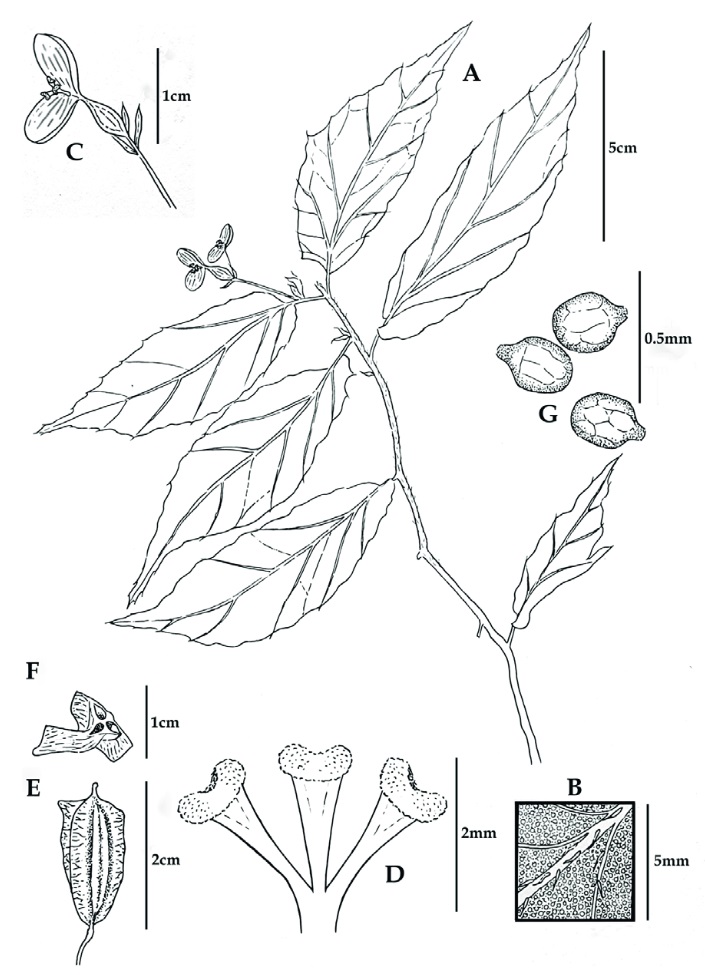
[Botany • 2025] Begonia ebo sp. nov. (Begoniaceae, sect. Filicibegonia), endangered in Ebo, a highly threatened forest in Littoral Region, Cameroon


Begonia ebo H.Lockwood,

in Lockwood et Tchatchouang, 2025. 

Abstract  
Begonia ebo H.Lockwood sp. nov., a terrestrial herb endemic to Cameroon cloud forest, is described, mapped and illustrated. It is the first species of Begonia Section Filicibegonia known to have yellow flowers (vs pink or white), to have inflorescences that are epiphyllous, appearing to emerge from the upper leaf surface (vs ordinarily axillary) and, also, the first species of the section known to be endemic to Cameroon. It is also endemic to the Cross-Sanaga River Interval. In contrast, six of the nine species of Sect. Filicibegonia are endemic to the interval between the Sanaga River of Cameroon and the Congo River. So far Begonia ebo is only known from inside or adjacent to the Ebo forest, Littoral Region, Cameroon, apart from a single record from the Chaine de Nkohom in Central Region c. 60 km distant. In view of the massive ongoing threats of industrial logging to the Ebo Forest, the stronghold and main centre of this species on current evidence, the conservation status of Begonia ebo is provisionally assessed as Endangered, EN B1 ab(iii) +B2ab(iii).

Keywords: Cross-Sanaga River interval, epiphyllous, yellow-flowered

Begonia ebo.
Habit showing male and female flower. Lockwood 61 (K, YA).
Photo by H. Lockwood.

Begonia ebo.
A habit, flowering stem; B. detail of abaxial blade surface showing midrib and hairs; C. female flower and inflorescence; D. style and stigmas; E fruit, side view showing unequal dorsal wing; F. fruit, transverse section showing locules; G. seeds, side view.
All from Lockwood 61 (K). Drawn by H. Lockwood.

Begonia ebo H.Lockwood sp. nov.

 Diagnosis: Begonia ebo differs from all known species of Begonia Sect. Filicibegonia due to its yellow (not white or pink) perianth lobes, and also in the peculiar posture of the inflorescence, which lie along the groove of the adaxial petiole leaf-blade midrib, the flowers appearing superficially to arise from the middle of the leaf-blade (vs inflorescence sessile, or held above or below the leaf blades).

Etymology: Named as a noun in apposition for the forest of Ebo, Littoral  Region,  whence  most  of  the  known  specimens  were found.


Helen Lockwood and Eric Ngansop Tchatchouang. 2025. Begonia ebo sp. nov. (Sect. Filicibegonia-Begoniaceae), endangered in Ebo, a highly threatened forest in Littoral Region, Cameroon. Webbia. Journal of Plant Taxonomy and Geography. 80(1); 77-87. DOI: doi.org/10.36253/jopt-17739 [2025-04-17]

Tuesday, April 22, 2025

[Mammalogy • 2024] Phylogeny, Biogeography, and Integrative Taxonomic Revision of the Afro-Arabian Rodent Genus Ochromyscus (Muridae: Murinae: Praomyini)


the Afro-Arabian rodent Genus Ochromyscus (Muridae: Murinae: Praomyini)

in Meheretu, Mikula, Frynta, Frýdlová, Mulualem, Lavrenchenko, Kostin, Elmi, Šumbera et Bryja, 2024. 

Abstract
The analyses of Plio-Pleistocene speciation processes in the Horn of Africa are relevant for understanding the evolution of biodiversity patterns of this understudied part of the world. Here we analyse comprehensive genomic and morphological data of the recently delimited murid genus Ochromyscus, one of the few with Afro-Arabian distribution. Using an integrative taxonomic approach, we delimit three species in the genus: two in eastern Africa (O. brockmani and O. niveiventris) and one in southern Arabia (O. yemeni), and detail their distribution, genetic structure, and evolutionary history. Despite their morphological similarity, the three species split before the Pleistocene, and their interspecific genetic divergence level is comparable to that between sister genera of murine rodents. The split between two taxa living on opposite sides of the Red Sea (O. brockmani vs. O. yemeni) is younger than the separation of their ancestor and O. niveiventris living in eastern Africa. The colonization of Arabia can be explained either by the presence of a relatively recent continental bridge or by the past occurrence of the genus along the eastern coast of the Red Sea and subsequent spreading through the Sinai Peninsula.

ddRAD, Horn of Africa, integrative taxonomy, phylogeography, rodents, Somali-Masai savanna


Ochromyscus brockmani (Thomas, 1906)
Brockman’s white-bellied rocky mouse.

Ochromyscus niveiventris (Osgood, 1910)
Snowy white-bellied rocky mouse. 
The Latin name ‘niveiventris’ means ‘snowy-white-bellied’. 
Because the English genus name is ‘white-bellied rocky mouse’ (Nicolas et al., 2021), we propose to simplify the English name to avoid redundant use of ‘white-bellied’.

Ochromyscus yemeni (Sanborn and Hoogstraal, 1953)
Yemen white-bellied rocky mouse.


Yonas Meheretu, Ondřej Mikula, Daniel Frynta, Petra Frýdlová, Getachew Mulualem, Leonid A Lavrenchenko, Danila S Kostin, Hassan Sh Abdirahman Elmi, Radim Šumbera and Josef Bryja. 2024. Phylogeny, Biogeography, and Integrative Taxonomic Revision of the Afro-Arabian Rodent Genus Ochromyscus (Muridae: Murinae: Praomyini). Zoological Journal of the Linnean Society. 202(1); zlad158. DOI: doi.org/10.1093/zoolinnean/zlad158 [04 November 2023]

Study of mammal evolutionary histories sheds light on existence of continental bridge between Africa and Arabian Peninsula  https://sev-in.ru/en/node/4067

Monday, April 21, 2025

[Mammalogy • 2021] Chingawaemys gen. nov., Montemys gen. nov. & Ochromyscus gen. nov. ... • Phylogenomics of African Radiation of Praomyini Rodents (Rodentia: Muridae: Murinae): First fully resolved Phylogeny, Evolutionary History and Delimitation of Extant Genera


Chingawaemys Lavrenchenko, Mikula & Bryja, gen. nov. 
Congomys Nicolas & Bryja, gen. nov.
Ochromyscus Nicolas, Mikula & Bryja, gen. nov.

Serengetimys 
Nicolas & Bryja, gen. nov. 
Montemys Nicolas & Bryja, gen. nov. 

in Nicolas, Mikula, Lavrenchenko, Šumbera, Bartáková, Bryjová, Meheretu, Verheyen, Missoup, Lemmon, Lemmon et Bryja, 2021. 
 
Highlights: 
• Fully resolved phylogeny of a highly diversified group of African mammals using genome-scale data.
• Mechanisms of adaptive radiation in Late Miocene/Early Pliocene.
• Delimitation of monophyletic genera in Praomyini rodents.
• Discovery of a new mammal genus in Ethiopian forests.

Abstract
The tribe Praomyini is a diversified group including 64 species and eight extant rodent genera. They live in a broad spectrum of habitats across whole sub-Saharan Africa. Members of this tribe are often very abundant, they have a key ecological role in ecosystems, they are hosts of many potentially pathogenic microorganisms and comprise numerous agricultural pests. Although this tribe is well supported by both molecular and morphological data, its intergeneric relationships and the species contents of several genera are not yet fully resolved. Recent molecular data suggest that at least three genera in current sense are paraphyletic. However, in these studies the species sampling was sparse and the resolution of relationships among genera was poor, probably due to a fast radiation of the tribe dated to the Miocene and insufficient amount of genetic data. Here we used genomic scale data (395 nuclear loci = 610,965 bp long alignment and mitogenomes = 14,745 bp) and produced the first fully resolved species tree containing most major lineages of the Praomyini tribe (i.e. all but one currently delimited genera and major intrageneric clades). Results of a fossil-based divergence dating analysis suggest that the radiation started during the Messinian stage (ca. 7 Ma) and was likely linked to a fragmentation of the pan-African Miocene forest. Some lineages remained in the rain forests, while many others adapted to a broad spectrum of new open lowland and montane habitats that appeared at the beginning of Pliocene. Our analyses clearly confirmed the presence of three polyphyletic genera (Praomys, Myomyscus and Mastomys). We review current knowledge of these three genera and suggest corresponding taxonomic changes. To keep genera monophyletic, we propose taxonomic re-arrangements and delimit four new genera. Furthermore, we discovered a new highly divergent genetic lineage of Praomyini in southwestern Ethiopia, which is described as a new species and genus.
Graphical abstract
 
Keywords: Late Miocene, Radiation, Anchored phylogenomics, Rodentia, Tropical Africa, Complete mitochondrial DNA, Taxonomy

Praomys Thomas, 1915


Montemys Nicolas & Bryja, gen. nov. 
Type species: Epimys delectorum Thomas, 1910. 
Ann. Mag. Nat. Hist., ser. 8, 6: 430.

Etymology: The new generic name is a masculine noun composed of Latin “montem” (mountain) and greek “mys” (mouse). Oldfield Thomas described the type species of this genus in 1910 from S Malawi, Mulanje (=Mlanji) Plateau, 5500 ft., and all known populations of the genus are known to live in montane forests of Eastern Africa (Bryja et al., 2014, Carleton and Stanley, 2012).

Species included: Montemys delectorum (Thomas, 1910).

English name: Several names were previously proposed for this species: Delicate Soft-furred Mice, Delectable Soft-furred Mouse, Delicate Praomys and East African Praomys (Wilson et al., 2017). Given that it is no longer included in the genus Praomys and that the term “soft-furred” is usually used for Praomys species, we propose to use the name Delicate Montane Mouse for Montemys delectorum.


Congomys Nicolas & Bryja, gen. nov. 
Type species: Praomys tullbergi lukolelae Hatt, 1934. 
Am. Mus. Novit., 708: 13.

Etymology: The new generic name is a masculine noun composed of “Congo” (geographical name) and “mys” (=mouse). The name acknowledges the Congo Basin, where the two currently known species of this genus are endemic.

Species included: Congomys lukolelae (Hatt, 1934); 
Congomys verschureni (Verheyen & Van der Straeten, 1977).


English names: Several names were previously proposed for C. lukolelae (Lukolela soft-furred mouse, Lukolela Praomys and Lukolela Swamp rat) and C. verschureni (Verschuren’s Praomys or Verschuren Swamp rat) (Wilson et al., 2017). Given that these species are no longer included into the genus Praomys and that the term “soft-furred” is usually used for Praomys species, we propose using the names Lukolela Swamp rat for C. lukolelae and Verschuren’s Swamp rat for C. verschureni.

Myomyscus

 Species included: M. verreauxii (Smith, 1834)

English name: The names Verreaux’s Meadow Mouse, Verreaux’s Myomyscus, Verreaux’s White-footed Rat and White-footed Mouse are commonly used for this species (Wilson et al. 2017). We propose to retain the name Verreaux’s Meadow Mouse for this species.


Ochromyscus Nicolas, Mikula & Bryja, gen. nov. 
Type species: Mus brockmani Thomas, 1906. 
Ann. Mag. Nat. Hist., ser. 7, 18: 298.

Etymology: The new generic name is a masculine noun composed of “ωχρος” [ochros] (which means “pale” in Greek) and “myscus” (derived from myskos = small mouse, diminutive of mys = mouse). The name acknowledges the typical color of these rodents, which has no bright hue.
 
Species included: Ochromyscus brockmani (Thomas, 1906); 
Ochromyscus yemeni (Sanborn & Hoogstraal, 1953).

English name: We propose the name White-bellied Rocky mouse, because the purely white belly is typical of all species within this genus and they are most abundant in rocky outcrops.


Serengetimys Nicolas & Bryja, gen. nov. 
Type species: Rattus pernanus Kershaw, 1921. 
Ann. Mag. Nat. Hist., ser. 9, 8: 568.

Etymology: The new generic name is a masculine noun composed of “Serengenti” (geographical name) and “mys” (=mouse). P. S. Kershaw described the type species of this genus in 1921 from Amala (=upper course of Mara) River in southern Kenya. All known records (except an aberrant specimen from Eastern Tanzania and an unconfirmed record from Rwanda) of this monotypic genus are from the so-called Serengeti ecosystem with prevailing grasslands in northern Tanzania and southern Kenya (Van der Straeten, 1999).

Species included: Serengetimys pernanus (Kershaw, 1921).

English name: Dwarf Serengeti mouse. Happold (2013) proposed the English name “Dwarf Multimammate Mouse”, because it was thought that the species belong to the genus Mastomys (“multimammate mice”). However, our first observation of a lactating female from southern Kenya revealed that they have only five pairs of nipples.

Mastomys 
Mastomys angolensis (Bocage, 1890), comb. nov.


Species included: M. angolensis (Bocage, 1890), M. awashensis Lavrenchenko, Likhnova & Baskevich, 1998, M. coucha (Smith, 1834), M. erythroleucus (Temminck, 1853), M. huberti (Wroughton, 1909), M. kollmannspergeri (Petter, 1957), M. natalensis (Smith, 1834), M. shortridgei (St. Leger, 1933)


Chingawaemys Lavrenchenko, Mikula & Bryja, gen. nov. 
Type species: Chingawaemys rarus
the new species described below.

Etymology: The new generic name is a masculine noun composed of “Chingawa” (geographical name) and the Greek “mys”, referring to mouse, or rat in this case. The name acknowledges the Chingawa Forest, where the single known species of this genus is endemic.

Chingawaemys rarus Lavrenchenko, Mikula & Bryja, sp. nov.

Etymology: The species name is derived from the Latin word “rarus” – rare (see Ecology).

English name: We propose the vernacular name “Chingawa Forest Rat” for Chingawaemys rarus sp. nov. The name reflects that this rare rodent appears to be endemic to the unique Chingawa Forest.


Violaine Nicolas, Ondřej Mikula, Leonid A. Lavrenchenko, Radim Šumbera, Veronika Bartáková, Anna Bryjová, Yonas Meheretu, Erik Verheyen, Alain Didier Missoup, Alan R. Lemmon, Emily Moriarty Lemmon and Josef Bryja. 2021. Phylogenomics of African Radiation of Praomyini (Muridae: Murinae) Rodents: First fully resolved Phylogeny, Evolutionary History and Delimitation of Extant Genera. Molecular Phylogenetics and Evolution. 163, 107263. DOI: doi.org/10.1016/j.ympev.2021.107263