Showing posts with label 1993. Show all posts

Thursday, June 30, 2022

[Crustacea • 2022] Caridina stellata • A New Species of Atyid Shrimp (Decapoda, Caridea, Atyidae) with the Male Description of Caridina cavernicola Liang & Zhou, 1993 from Guangxi, China

 
(A) Caridina stellata 
Guo, Chen, Chen, Cai & Guo. 2022
Caridina cavernicola 
Liang & Zhou, 1993

Abstract
Caridina stellata sp. nov. is described from streams in Guangxi, south-western China. The new species clearly belongs to “Caridina serrata group” of the genus and shows a morphological similarity with C. cantonensis Yu, 1938, C. serrata Stimpson, 1860 and C. pacbo Do et al. 2020. Caridina stellata is distinguished from congeners, based on differences in its male first pleopod and appendix masculina morphology, along with COI and 16S rRNA molecular evidence. The first pleopod endopod in male is rectangle, about 0.70 × length of exopod, about 3.7–3.9 × as long as proximally wide, inner margin concave, bearing nearly equal spine setae, outer margin bearing nearly equal long and dense spine setae; appendix interna well developed, arising from distal 1/5 of endopod, reaching to end of endopod, with cincinuli distally. The new species displays a unique and brightly coloured pattern and, therefore, can be easily recognised in the field. Liang & Zhou, 1993 described C. cavernicola from the Lenggu Cave, Du’an County, Guangxi. However, the description was based exclusively on two females. We have collected specimens of both sexes near the type locality and describe herein the previously unknown male and present morphological data on females. Data on the habitat, ecology and levels of threat of the two species are provided and suggest that they should be categorised as vulnerable (VU) under the current IUCN Criteria.

Keywords: COI and 16S rRNA, ecology, habitat, levels of threat, new species, south-western China
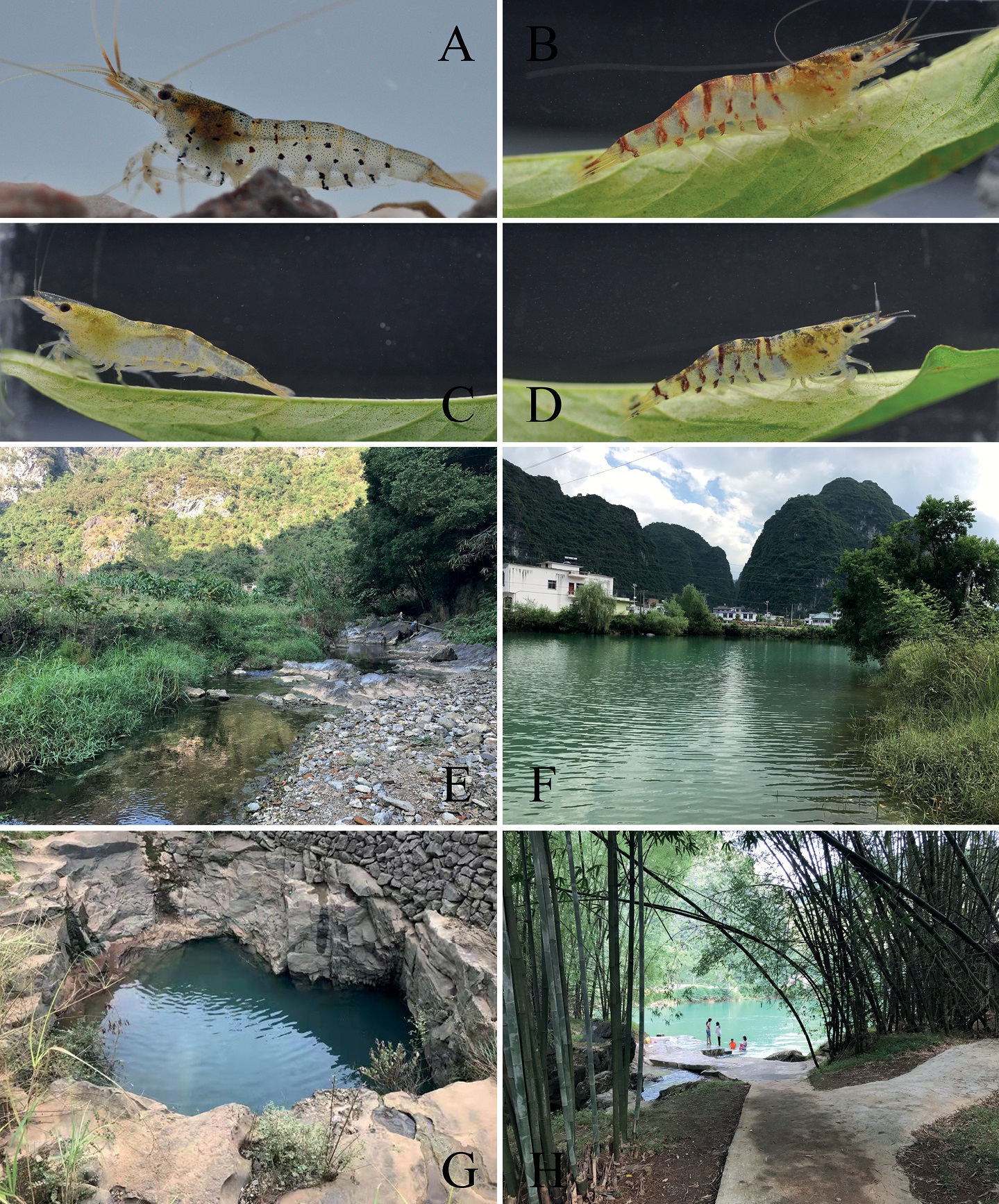

Habitats and live colouration of Caridina stellata sp. nov. and C. cavernicola
C. stellata sp. nov. B–D C. cavernicola;
E–H surrounding environment of C. stellata sp. nov. (E) and C. cavernicola (F–H).

Family Atyidae De Haan, 1849

Genus Caridina H. Milne Edwards, 1837

 Caridina stellata sp. nov.

Diagnosis: Rostrum long, straight, slightly sloping downwards, reaching to end of 2nd segment of antennular peduncle, occasionally reaching to end of 3rd segment of antennular peduncle; rostral formula 6-8+7-16/6-13. 1st pereiopod carpus 0.43–0.71 × as long as chela, 1.2–1.4 × as long as high; chela 1.8–2.4 × as long as broad; fingers 0.80–1.1 × as long as palm. 2nd pereiopodcarpus 1.1–1.3 × as long as chela, 4.0–4.8 × as long as high; chela 2.1–2.4 × as long as broad; fingers 1.1–1.4 × as long as palm. 3rd pereiopod propodus 4.0–5.5 × as long as dactylus, with two rows thin spines on the posterior margin, ischium with one spine on the posterior margin. 5th pereiopod propodus 4.2–5.3 × as long as dactylus, with two rows of thin spines on the posterior and lateral margins, dactylus terminating in one claw, with 35–40 spinules on flexor margin. Endopod of male 1st pleopod extending to 0.68 × exopod length, wider proximally, rectangle, about 3.7–3.9 × as long as wide, appendix interna well developed, arising from distal 1/6 of endopod, reaching end of endopod. Appendix masculina of male 2nd pleopod cylindrical, reaching to 0.58 length of endopod, appendix interna reaching to 0.50 length of appendix masculina. Uropodal diaeresis with 17–19 movable spinules. Eggs 0.84–0.89 × 1.27–1.39 mm in diameter.
 
Etymology: Caridina stellata is named after the Latin word stellatus, for dots, alluding to the pigmented pattern of the body.


 Guo-Cai Guo, Qing-Hua Chen, Wen-Jian Chen, Chao-Huang Cai and Zhao-Liang Guo. 2022. Caridina stellata, A New Species of Atyid Shrimp (Decapoda, Caridea, Atyidae) with the Male Description of Caridina cavernicola Liang & Zhou, 1993 from Guangxi, China. ZooKeys. 1104: 177-201. DOI: 10.3897/zookeys.1104.81836


Thursday, January 30, 2020

[Mammalogy • 2020] Colombian Hippo Population: Ecosystem Effects of the World’s Largest Invasive Animal


 the Colombian hippo population.
Four individuals were present at the time of Pablo Escobar’s death in 1993, and the population is presently estimated to number between 65 and 80.
in Shurin, Riaño, Negro, et al., 2020. 
 DOI: 10.1002/ecy.2991 

Abstract
The keystone roles of mega‐fauna in many terrestrial ecosystems have been lost to defaunation. Large predators and herbivores often play keystone roles in their native ranges, and some have established invasive populations in new biogeographic regions. However, few empirical examples are available to guide expectations about how mega‐fauna affect ecosystems in novel environmental and evolutionary contexts. We examined the impacts on aquatic ecosystems of an emerging population of hippopotamus (Hippopotamus amphibus) that has been growing in Colombia over the last 25 years. Hippos in Africa fertilize lakes and rivers by grazing on land and excreting wastes in the water. Stable isotopes indicate that terrestrial sources contribute more carbon in Colombian lakes containing hippo populations, and daily dissolved oxygen cycles suggest that their presence stimulates ecosystem metabolism. Phytoplankton communities were more dominated by cyanobacteria in lakes with hippos, while bacteria, zooplankton and benthic invertebrate communities were similar regardless of hippo presence. Our results suggest that hippos recapitulate their role as ecosystem engineers in Colombia, importing terrestrial organic matter and nutrients with detectable impacts on ecosystem metabolism and community structure in the early stages of invasion. Ongoing range expansion may pose a threat to water resources.

 Keywords: hippopotamus, lakes, productivity, water resources, exotic species, eutrophication


Jonathan B. Shurin, Nelson Aranguren Riaño, Daniel Duque Negro, David Echeverri Lopez, Natalie T. Jones, Oscar Laverde‐R, Alexander Neu and Adriana Pedroza Ramos. 2020. Ecosystem Effects of the World’s Largest Invasive Animal. Ecology.  DOI: 10.1002/ecy.2991

UC San Diego scientists and their colleagues have published the first scientific assessment of the impact that an invasive hippo population, imported by infamous drug lord Pablo Escobar, is having on Colombian aquatic ecosystems. The study revealed that the hippos are changing the area's water quality by importing large amounts of nutrients and organic material from the surrounding landscape.

A Drug Lord and the World’s Largest Invasive Animal ucsdnews.UCSD.edu/feature/a-drug-lord-and-the-worlds-largest-invasive-animal


Monday, December 16, 2013

[Herpetology • 1993] Oreolalax multipunctatus • A New Frog of the Genus Oreolalax (Pelobatidae Megophryidae) from Sichuan, China


Oreolalax multipunctatus Wu, Zhao, Inger & Shaffer, 1993


Abstract
A new species of Oreolalax is described from southwestern Sichuan, China. The species is distinguished from its many congeners in Sichuan by its small size (males = 50 mm SVL), smooth dorsum, and its black-spotted body. Unlike all other congeners, tadpoles of the new form have black spots on the body and tail. 


Guan-Fu Wu, Er-Mi Zhao, Robert F. Inger, H. and Bradley Shaffer. 1993. A New Frog of the Genus Oreolalax (Pelobatidae Megophryidae) from Sichuan, China. Journal of Herpetology. 27(4); 410-413.

Sunday, November 25, 2012

[Paleomammalogy • 2012] Herds Overhead: Nimbadon lavarackorum (Diprotodontidae), Heavyweight Marsupial Herbivores in the Miocene Forests of Australia

This is an artist’s reconstruction of Nimbadon lavarackorum mother and juvenile (Art: Peter Schouten)

Abstract 
The marsupial family Diprotodontidae (Diprotodontia, Vombatiformes) is a group of extinct large-bodied (60–2500 kg) wombat-like herbivores that were common and geographically widespread in Cenozoic fossil deposits of Australia and New Guinea. Typically they are regarded to be gregarious, terrestrial quadrupeds and have been likened in body form among placental groups to sheep, rhinoceros and hippopotami. Arguably, one of the best represented species is the zygomaturine diprotodontid Nimbadon lavarackorum which is known from exceptionally well-preserved cranial and postcranial material from the middle Miocene cave deposit AL90, in the Riversleigh World Heritage Area, northwestern Queensland. Here we describe and functionally analyse the appendicular skeleton of Nimbadon lavarackorum and reveal a far more unique lifestyle for this plesiomorphic and smallest of diprotodontids. Striking similarities are evident between the skeleton of Nimbadon and that of the extant arboreal koala Phascolarctos cinereus, including the powerfully built forelimbs, highly mobile shoulder and elbow joints, proportionately large manus and pes (both with a semi-opposable digit I) and exceedingly large, recurved and laterally compressed claws. Combined with the unique (among australidelphians) proportionately shortened hindlimbs of Nimbadon, these features suggest adept climbing ability, probable suspensory behaviour, and an arboreal lifestyle. At approximately 70 kg, Nimbadon is the largest herbivorous mammal to have occupied the forest canopies of Australia - an ecological niche that is no longer occupied in any Australian ecosystem and one that further expands the already significant niche diversity displayed by marsupials during the Cenozoic.

Citation: Black KH, Camens AB, Archer M, Hand SJ. 2012. Herds Overhead: Nimbadon lavarackorum (Diprotodontidae), Heavyweight Marsupial Herbivores in the Miocene Forests of Australia. PLoS ONE. 7(11): e48213. doi: 10.1371/journal.pone.0048213


Research Sheds More Light on Enigmatic, Long-Extinct Nimbadon
According to a new research led by Dr Karen Black of the University of New South Wales, Nimbadon lavarackorum – a large bear-like animal that lived in Australia’s lush forests 15 million years ago – was well suited to life in the treetops: it used massive sharp claws to haul its hefty body up trees, hugging the trunk like a bear, and its huge hands and long arms let it hang from branches like an orangutan.


Monday, July 30, 2012

[Paleontology • 1995] Montanazhdarcho minor • an azhdarchid pterosaur from the Two Medicine Formation (Late Cretaceous, Campanian) of Montana.


The wing skeleton of the Campanian azhdarchid pterosaur Montanazhdarcho minor Vidian et al. 1995 is described and compared to other Cretaceous pterosaurs. It is distinguished from all other known azhdarchids by its small mature size, among other characters. Notable features include elongated cervical vertebrae with weak neural crests, a ring-like pectoral girdle, and an unwarped deltopectoral crest that is 30% of the length of the humerus. The ulna is slightly longer than the wing metacarpal, and the articular surface of the radius lacks a central pneumatic foramen. The wing metacarpal has a rounded dorsal condyle but there is no median ridge between the distal condyles. The mandible is edentulous, further support is given to the reduced distal expansion of the deltopectoral crest as an azhdarchid svnapomorphv. 


Padian, K., Horner, J.R., and de Ricqlès, A.J. 1993. A new azhdarchid pterosaur from the Two Medicine Formation (Late Cretaceous, Campanian) of Montana, identified on the basis of bone histology. Journal of Vertebrate Paleontology. 13: 52A
K. Padian, A. J. de Ricqlès, and J. R. Horner. 1995. Bone histology determines identification of a new fossil taxon of pterosaur (Reptilia: Archosauria). Comptes Rendus de l’Academie des Science, Serie II (320): 77-84.
McGowen, M.R.; Padian, K.; de Sosa, M.A.; Harmon, R.J. 2002. Description of Montanazhdarcho minor, an azhdarchid pterosaur from the Two Medicine Formation (Campanian) of Montana. PaleoBios. 22 (1): 1–9.

Friday, July 6, 2012

[Paleontology • 1993] Naashoibitosaurus ostromi • a hadrosaurid dinosaur from the Kirtland Formation of the San Juan Basin in New Mexico, United States


Naashoibitosaurus ostromi
Hunt and Lucas, 1993

Naashoibitosaurus (—"lizard creek") is a genus of hadrosaurid dinosaur that lived about 73 million years ago, in the Late Cretaceous, and was found in the Kirtland Formation of the San Juan Basin in New Mexico, United States. Only a partial skeleton has been found to date. It was first described as a specimen of Kritosaurus by Jack Horner, and has been intertwined with Kritosaurus since its description.

Hunt, Adrian P.; and Lucas, Spencer G. 1993. Cretaceous vertebrates of New Mexico. In Lucas, S.G.; and Zidek, J. (eds.). Dinosaurs of New Mexico. New Mexico Museum of Natural History and Science Bulletin, 2. Albuquerque, New Mexico: New Mexico Museum of Natural History and Science. pp. 77–91.


Wednesday, August 31, 2011

[Palaeontology • 1993] Teilhardina brandti • North American euprimate (Omomyidae) from the Paleocene–Eocene thermal maximum


Teilhardinabrandti, which was originally described as the earliest Teilhardina from North America (Gingerich, 1993)


Gingerich PD. 1993. Early Eocene Teilhardina brandti: oldestomomyid primate from North America. Contrib Mus Paleontol Univ Michigan. 28:321–326.: [PDF file]


2011. New fossils of the oldest North American euprimate Teilhardina brandti (Omomyidae) from the paleocene–eocene thermal maximum: DOI: 10.1002/ajpa.21579