Showing posts with label Clusiaceae. Show all posts

Friday, July 4, 2025

[Botany • 2025] Garcinia kusumae (Clusiaceae) • A New Species From Assam, India


Garcinia kusumae J. Sarma & Barbhuiya,

in Sarma et Barbhuiya. 2025.
 
ABSTRACT
A new species, Garcinia kusumae (Clusiaceae), is described and illustrated from Assam, India. Detailed comparisons with morphologically similar species are provided to support its novelty. This discovery contributes to the underexplored diversity of Garcinia in Northeast India and highlights the importance of continued botanical exploration in the region.

Keywords: Clusiaceae, Garcinia section Brindonia, new species, Northeast India


Garcinia kusumae J. Sarma & Barbhuiya—♀ Female Plant:
(A) plant in its natural habitat, (B) blaze showing exudates, (C) flowers in a terminal fascicle, (D) various positions of flowers, (E) solitary flower from the axil of a fallen leaf, (F) sepals, (G) petals, (H) side view of the calyx and ovary, (I) top view of the ovary showing shallowly lobed discoid papillate stigma, (J) ovary with calyx attached to the axil of a fallen leaf, (K) side view of an ovary showing position of staminodes, (L) unusual flower with five petals, (M) same flower with petals removed, (N) developing ovary, (O) transverse section (T.S.) through a developing 6-locular ovary, (P) unripe greenish fruit with heavy resinous exudates on the surface and papillate stigma at the apex, (Q) T.S. through an unripe fruit showing nine locule, (R) ripe pinkish-orange fruits with resinous exudates, (S) pericarp of fruit cut open transversely, (T) fruit cut longitudinally showing seed sections, (U) seeds covered with pulpy aril, (V) reniform seeds.
Photos by J. Sarma and H.A. Barbhuiya, based on HBARC-00006644.

Garcinia kusumae J. Sarma & Barbhuiya—♂ Male Plant:
(A) leafy crown, (B–C) fasciculate cymes in axillary and terminal position, (D) close-up of a flower in terminal fascicle, (E) leaves of varying sizes and shape, (F) obscurely quadrangular branchlets bearing flower fascicles, (G) close-up of flower fascicles, (H) staminate flowers—top view, (I) staminate flowers—side view, (J & L) flower with petals removed, (K) a flower bud, (M–N) calyx with pedicel and stamens united into a single central bundle, (O) pedicel, sepals, and central stamen bundle separated, (P) 4-thecous anthers.
 Photos by J. Sarma and H.A. Barbhuiya, based on HBARC-00006645, HBARC-00006646; (K–P) from spirit material.

Garcinia kusumae J. Sarma & Barbhuiya sp. nov. 

Diagnosis: The newly described species shows superficial similarity to Garcinia assamica J. Sarma, P.S. Shameer & N.N. Mohanan, G. cowa Roxb. var. cowa and var. kydia (Roxb.) Shameer & N. Mohanan, G. indica (Thouars) Choisy, and G. succifolia Kurz in having fasciculate axillary and terminal inflorescences, tetragonous flowers with creamy to yellow petals, and stamens united into a single central bundle. However, it differs from all the aforementioned taxa in possessing up to 15 staminate flowers per fascicle, fewer stamens (≤ 30) per flower (except G. assamica), and berries bearing blackish resinous exudations on the surface.
...


Etymology: The specific epithet kusumae is named in honor of the late Kusum Devi, mother of the first author, in recognition of her enduring support and sacrifices for his education at Sainik School, Goalpara, Assam, and his further studies, as well as for inspiring him to work hard from his early childhood.

  Ethnobotanical Uses: The plant is locally known as Thoikora in Assamese. The sun-dried pulp is preserved and used to make a sherbet (soft drink) with salt and sugar to taste, serving as a remedy for heat stroke during hot summer days and for relief from thirst. It is also used as a curry ingredient with fish, as an antidiabetic remedy, and to control dysentery. The seed aril, which is slightly sour and sweet, is eaten raw—often mixed with a little salt, chillies, and a pinch of mustard oil.
 

Jatindra Sarma and Hussain A. Barbhuiya. 2025. Garcinia kusumae (Clusiaceae): A New Species From Assam, India.  Feddes Repertorium. DOI: doi.org/10.1002/fedr.70018 [03 July 2025]

[Botany • 2025] Garcinia isthmensis (Clusiaceae) • A New tree Species for Central America


Garcinia isthmensis Mouzinho, 

in Mouzinho, Carrión, Marinho et Giacomin, 2025. 

Abstract
We present a new species, Garcinia isthmensis Mouzinho, sp. nov. ined., known to occur in Costa Rica and Panama. Garcinia isthmensis is described and distribution data, photographs and preliminary conservation status are provided, as well as its diagnostic characteristics and morphological affinities.

Guttiferae, jorco, Mesoamerica, Neotropics, satra, Eudicots

Garcinia isthmensis Mouzinho (R. Aguilar 10734).
 A. Branch. B. Cut branch, showing the exudate with orange-colored oxidation. C. Leaf blades. D. Staminate inflorescence. Photos: Reinaldo Aguilar. Image courtesy of the C.V. Starr Virtual Herbarium (http://bluegum.nybg.org/science/vh/).

Garcinia isthmensis Mouzinho, sp. nov. 

Diagnosis:—Garcinia isthmensis is vegetatively similar to G. magnifolia due to its elliptical to elliptic-oblong shape and size of the leaf blades (≥ 19 cm long), but differs from it due to its slightly verrucose branches (vs. smooth in G. magnifolia), conspicuous exudate canals (vs. inconspicuous in G. magnifolia), staminate flowers with 40–55 stamens per flower (vs. ca. 30 stamens in G. magnifolia), non-rostrate fruits (vs. rostrate in G. magnifolia) and fruit pedicels of 33.5–44 mm long (vs. 7–10 mm long in G. magnifolia).

Etymology:—The epithet refers to the Panama isthmus, that connects Meso- and South American regions.


Thiago MOUZINHO, Juan F. CARRIÓN, Lucas Cardoso MARINHO and Leandro Larerda GIACOMIN. 2025. Garcinia isthmensis (Clusiaceae): A New tree Species for Central America.  Phytotaxa. 708(1); 16-22. DOI: doi.org/10.11646/phytotaxa.708.1.2 [2025-07-02]

Saturday, November 30, 2024

[Botany • 2024] Lorostemon roseoviridis (Clusiaceae) • A New Species from the eastern Amazonia


 Lorostemon roseoviridis  Fer.-Silva & L.Marinho,
  
in Ferreira-Silva, Marinho, Mouzinho et Hopkins, 2024. 
Photo by H.D. Clarke  

Abstract
During the review of the Brazilian species of Lorostemon (Clusiaceae), we verified that some specimens previously reported as L. bombaciflorus Ducke for South Guyana and the Brazilian Eastern Amazonia belong to a species still unknown to science. Here, we provide a description, taxonomic comments, illustrations, and a distribution map of Lorostemon roseoviridis Fer.-Silva & L.Marinho, a new species from eastern Amazonia.

Keywords: Diversity, Flora, Guttiferae, Lorostemon roseoviridis, Symphonieae

Open flower of Lorostemon roseoviridis.
Photo by H.D. Clarke from the holotype, H.D. Clarke 7160.

Lorostemon roseoviridis Fer.-Silva & L.Marinho, sp. nov. 

TYPE: Guyana: Upper Takutu-Upper Essequibo Region. Acarai Mts., summit of unnamed peak, ...

Etymology. The epithet refers to the predominant colors found in the flowers and derives from the Latin roseus (pink) and viridis (green). Ducke (1935) published the first species name in the genus as "L. bombaciflorum", indicating that Lorostemon would be neuter, but Art. 62.2 (a) of the ICN (Turland et al., 2018) states that compound generic names ending in -stemon are masculine.


Silvia Larissa Ferreira-Silva, Lucas C. Marinho, Thiago M. Mouzinho and Michael J. G. Hopkins. 2024. A New Species of Lorostemon (Clusiaceae) from the eastern Amazonia. Brittonia. 76, 132–136. DOI: doi.org/10.1007/s12228-024-09791-1

Thursday, May 2, 2024

[Botany • 2021] Tovomita cornuta (Clusiaceae) • A New and Threatened Species from the Amazonian campinaranas revealed by Ecological Field Research


Tovomita cornuta Demarchi & L. Marinho, 

in Demarchi, Piedade et Marinho, 2021.
 
ABSTRACT
High species diversity, large area, and taxonomically under-studied groups are some of the explanations for the frequent discovery of new species of plants during ecological field campaigns in the Amazon region. Some of these new species are already being threatened from unplanned urban expansion associated with deforestation and habitat loss. Here we describe Tovomita cornuta, a new species discovered during ecological studies in the white-sand campinaranas of the Amazon, which is also threatened. The species is endemic to the state of Amazonas, Brazil, where it occurs in the understory of forested campinaranas physiognomies and is easily recognized by its narrowly obovoid fruits with dilated free styles. We provide a description, taxonomic and ecological comments, assessment of conservation status, geographic distribution, phenology, and illustrations for the new species.

Keywords: Central Amazonia; conservation; IUCN Red List; new species; sampling gaps; threatened species; Tovomita; white-sand vegetation

Tovomita cornuta Demarchi & L. Marinho
A. Branch with staminate inflorescence. B. Leaf abaxial surface. C. Staminate floral bud. D. Staminate flower. E. Stamen with detail of anther. F. Staminodes detail in the pistillate flower (from floral bud), sepals and petals removed. G. Pistillate flower. H. Style (from pistillate floral bud). I. Branch with closed fruits. J. Closed fruit.
(A-E from L.O. Demarchi 1558; F-G from W. Thomas et al. 5330; H from L.O. Demarchi & Andriolli 1691; I-J from L.O. Demarchi 1674).
 Illustration by Marcos Melo Corrêa.

Tovomita cornuta Demarchi & L. Marinho, live plants. 
 A. Staminate inflorescence with senescent stamens. B. Staminate flower, top view of the pistillode in detail (arrow). C. Pistillate inflorescence with floral buds, flower, and immature fruits (arrow). D. Pistillate 5-branched pleiochasium with immature fruits. E. Closed fruit, arrow pointing to the yellow exudate. F. Open fruit, lateral view.
 Photos by Layon O. Demarchi. (A from L.O. Demarchi 1558; B from L.O. Demarchi 1599; C from L.O. Demarchi 1692; D from L.O. Demarchi 1691; E-F from L.O. Demarchi 1674).

Tovomita cornuta Demarchi & L. Marinho, sp. nov.

Tovomita cornuta can be differentiated from T. umbellata Benth. by the number of secondary veins (25-28 pairs vs. 10-15 in T. umbellata) and by the narrowly obovoid fruit with dilated styles (vs. pyriform with non-dilated styles in T. umbellata), from T. amazonica (Poepp.) Walp. by the number of secondary veins (25-28 vs. 13-18 in T. amazonica), floral bud length (3-4.3 vs. 5-7 mm long in T. amazonica), and fruit epicarp (smooth vs. rugose in T. amazonica).

Distribution: Tovomita cornuta is presumably endemic to the state of Amazonas, Brazil, with occurrence records in the region of Manaus and the neighboring municipalities of Presidente Figueiredo and São Sebastião do Uatumã (Fig. 3A).

Habitat and ecology: All known specimens were collected in white-sand forests (campinarana) (Fig. 3C). The species occurs in the understory in dense phytophysiognomies with a shallow water table that forms small “puddles” during the wet season (Fig. 3D), and does not occur in open areas with direct sunlight.
 
Etymology: The specific epithet refers to the conspicuously prominent styles observed on the fruit. It is derived from the Latin word cornu, which means horn.


Layon Oreste Demarchi, Maria Teresa Fernandez Piedade and Lucas Cardoso Marinho. 2021. Tovomita cornuta (Clusiaceae): A New and Threatened Species from the Amazonian campinaranas revealed by Ecological Field Research. Acta Bot. Bras. 35(4);  DOI: 10.1590/0102-33062020abb0483 

Monday, October 24, 2022

[Botany • 2022] Garcinia siripatanadilokii (Clusiaceae) • A New Species from Peninsular Thailand


Garcinia siripatanadilokii Ngerns., Meeprom, Boonth., Chamch. & Sinbumr., 

 in Ngernsaengsaruay, Meeprom, Boonthasak, Chamchumroon, et al., 2022. 
ส้มแก้วสมคิด || DOI: 10.1007/s12225-022-10059-8 

Summary
Garcinia siripatanadilokii Ngerns., Meeprom, Boonth., Chamch. & Sinbumr. (Clusiaceae), a new species discovered from tropical lowland evergreen rain forest, Peninsular Thailand, is described. A detailed morphological description and illustrations of the species are provided, along with information on recognition, distribution, specimens examined, habitat, conservation assessment, phenology, etymology, vernacular name and uses.

Key Words: Garcinia sect. Brindonia, dioecious plant, edible fruits, Garcinia lanceifolia, Khao Chong, plant taxonomy, species nova, yellow latex


Garcinia siripatanadilokii.
 A habitat and habit; B outer bark and inner bark with yellow latex; C branches, young and mature leaves; D branches and mature leaves; E female flower bud with bracts; F female flower; G branches, leaves and young fruits with persistent sepals; H – K branches, leaves and ripe fruits.
 photos: ChatchaiNgernsaengsaruay.

Garcinia siripatanadilokii Ngerns., Meeprom, Boonth., Chamch. & Sinbumr., sp. nov. 

RECOGNITION. Garcinia siripatanadilokii is similar to G. lanceifolia in its habit (shrub or small tree), 4-merous flowers, sepals and petals decussate and concave, stigma radiate, shallowly lobed, papillate, fresh leaves crispy when crushed, fruits and leaves have a sour taste. Differences between these two related species are shown in Table 1.

DISTRIBUTION. Known only from Peninsular Thailand: Khao Chong, Trang Province, Khlong Ton, Satun Province and Hala-Bala Wildlife Sanctuary, Narathiwat Province, but to be expected in Peninsular Malaysia. 

ETYMOLOGY. The specific epithet and Thai name are in honour of Dr Somkid Siripatanadilok, the former Associate Professor of the Department of Forest Biology, Faculty of Forestry. He taught the forest biology component of courses in field forest biology (in Peninsular Thailand, Khao Chong Botanical Garden is one of several study areas of the course), anatomy of trees, plant tissue culture and research techniques in forest biology (plant microtechniques) when the first author was an undergraduate student and a graduate student at Kasetsart University. He encouraged and supported the first author to work in the laboratory for plant tissue culture as an undergraduate student (1994 – 1997). He was the former co-advisor of the first author in his master's degree (1997 – 2000). He was a superb and a brilliant teacher, actively involved in many aspects of forest science in Thailand.

VERNACULAR NAME. Som Kaeo Somkid (ส้มแก้วสมคิด) (suggested here); Som Kaeo (ส้มแก้ว) (Satun) (from A. F. G. Kerr 14580).

USES. The ripe fruits are edible. The pericarp, sarcotesta, young shoots, leaves and flowers have a sour taste. It is suitable for cultivation as an ornamental.


Chatchai Ngernsaengsaruay, Nattanon Meeprom, Weereesa Boonthasak, Voradol Chamchumroon, Aroon Sinbumroong, Paweena Wessapak and Sutee Duangjai. 2022. Garcinia siripatanadilokii (Clusiaceae), A New Species from Peninsular Thailand. Kew Bulletin. DOI: 10.1007/s12225-022-10059-8


Friday, September 30, 2022

[Botany • 2013] Garcinia pushpangadaniana (Clusiaceae) • A New Species from the southern Western Ghats, India


  Garcinia pushpangadaniana T. Sabu, N. Mohanan, Krishnaraj, & Shareef, 

in Sabu, Mohanan, Krishnaraj, ... et Roy, 2013. 

Abstract
Garcinia pushpangadaniana, a new species of Garcinia from the southern part of the Western Ghats, India, is described, discussed and illustrated. This species is allied to Garcinia xanthochyma.

Keywords: ecology, Garcinia, Garcinia xanthochyma, taxonomy

  Garcinia pushpangadaniana.
A. Habit with inflorescence; B. Female flower; C. Sepal (male flower); D1. Petal (Female flower); D2. Petal (Male flower); E. Staminate flower without sepals and petals; F. Pistillate flower without sterile stamens; G. Stigma; H. Cross section of ovary; I. Fruit; J. Seed.
 (Drawn after Sabu, Shareef & Krishnaraj 72601 
by M.V. Krishnaraj).

  Garcinia pushpangadaniana.
 A. Habit; B. Blaze (inset); C. Leaves; D. Female flower bud; E. Opened female flower; F & G. Fruits at various stages of maturity; H. Mature fruit; I. Ripened fruit; J. Seed.
(Prepared by S.M. Shareef from living plants at Kadalar, Idukki district, the type locality of G. pushpangadaniana).

Garcinia pushpangadaniana T. Sabu, N. Mohanan, Krishnaraj, & Shareef, sp. nov.

Eponymy:— The specific epithet honors Dr. P. Pushpangadan, former Director of Jawaharlal NehruTropical Botanical Garden & Research Institute for his invaluable contributions in the fields of Plantconservation, Ethnobiology, Ethnopharmacology and Pharmacognosy. 


Thygarajan Sabu, Narayanan Nair Mohanan, Moothedathu Venugopalan Nair Krishnaraj, Sainudeen Muhammed Shareef, Peerumuhammed Subaida Shameer and Ponnus Ezabelrajam Roy. 2013. Garcinia pushpangadaniana (Clusiaceae), A New Species from the southern Western Ghats, India
   

[Botany • 2021] Garcinia sibeswarii (Clusiaceae) • A New Species from Assam, India


Garcinia sibeswarii   

in Shameer, Sarma, Mohanan & Begum, 2021.
 
Abstract
Garcinia sibeswarii, a new species of Garcinia from the Dulang Reserve Forest, Assam, North East India is described and illustrated. The new species is allied to Garcinia celebica, but differs in having 4-celled ovary; entire, peltate, reddish stigma and seeds with fibrous aril.
 
Keywords: Garcinia, Garcinia sibeswarii, Assam, North East India, Eudicots


Peerumuhammed Subaida Shameer, Jatindra Sarma, Narayanan Nair Mohanan and Ajima Begum. 2021. Garcinia sibeswarii (Clusiaceae), A New Species from Assam, India. Phytotaxa. 507(2); 191–197. DOI: 10.11646/phytotaxa.507.2.7
  thehindu.com/sci-tech/energy-and-environment/monkeys-poop-rotten-fruit-tree-thats-new-to-science/article34797058.ece

Monday, July 18, 2022

[Botany • 2022] Lectotypifications of Three Names in Garcinia, Synonymy of Garcinia pedunculata and Detailed Descriptions of Three Species in Garcinia Section Brindonia (Clusiaceae)


 ส้มแขก  Garcinia atroviridis Griff. ex T. Anderson 
  มะแปม  Garcinia lanceifolia Roxb.
ส้มควาย Garcinia pedunculata Roxb. ex Buch.-Ham.

in Ngernsaengsaruay, 2022.

Abstract
A revision of the genus Garcinia has recently been undertaken by the author as part of the Flora of Thailand. Herbarium specimens deposited in several herbaria, and those included in the digital herbarium databases, were examined by consulting taxonomic literature. In this study, the three names in Garcinia section Brindonia are lectotypified as G. gracilis, G. lanceifolia and G. planchonii. A new synonym for G. pedunculata, namely G. planchonii, is proposed. Detailed descriptions, recognitions and illustrations of three species in Garcinia (G. atroviridis, G. lanceifolia and G. pedunculata) are presented, along with information on distributions, specimens examined, habitats and ecology, IUCN conservation status, phenology, etymology, vernacular names and uses. The fruits, the young shoots and leaves, and the flowers of these three species are edible and have a sour taste. These species are often cultivated for their fruits.

Keywords: black gland dots; colourless latex; edible plants; dioecious plant; Garcinia atroviridis; Garcinia lanceifolia; interrupted wavy lines; plant taxonomy; sour relish; yellow latex


 Garcinia atroviridis Griff. ex T. Anderson 
(A) stem and outer bark; (B) outer bark and inner bark with colourless latex; (C) branches, young and mature leaves; (D) inflorescence with male flowers; (E) female flower; (F) young fruit; (G) fruiting branch; (H) mature and ripe fruits.
Photos: Chatchai Ngernsaengsaruay.

 Garcinia atroviridis Griff. ex T. Anderson 
(Anderson, 1874)

Recognition. Garcinia atroviridis is a dioecious tree up to 20 m tall; branches horizontal and drooping; branchlets terete; inner bark with colourless latex; flowers large, 4–5.5 cm in diam.; petals bright red; stamens numerous, united in a ring central mass surrounding a pistillode; stigma bright red; fruits depressed globose, 5.7–7 × 7.8–10 cm, 10–14-lobed and sulcate, concave at both ends, green, turning bright yellow when ripe; leaves oblong, oblong-obovate or obovate, 13–26 × 5–8.5 cm, shiny dark green above, with a few scattered black gland dots on both surfaces, interrupted long wavy lines of differing lengths; young leaves red; dry leaves chartaceous, blackish-brown, dark brown or greenish-brown.

Distribution. India (Assam, Arunachal Pradesh), Myanmar, Thailand, Peninsular Malaysia (Kedah, Penang, Perak, Selangor, Malacca, Johor), Singapore, Indonesia (Sumatra, Borneo). 

Etymology. The specific epithet atroviridis from Latin compound words, atro- meaning black or dark, and viridis meaning green, refers to the colour of the leaves, dark green.

Vernacular Name. Cha muang chang (ชะมวงช้าง) (Peninsular), Ma kham khaek (มะขามแขก) (Narathiwat); Som khaek (ส้มแขก) (Trang, Pattani); Som khwai (ส้มควาย) (Trang); Som pha ngun (ส้มพะงุน) (Pattani); Som ma won (ส้มมะวน) (Peninsular); Som ma on (ส้มมะอน) (Pattani); A-sae-ka-lu-ko (อาแซกะลูโก) (Malay-Narathiwat); Asam gelugor, Asam gelugur (the fruit), Gelugor, Gelugur, Kayu gelugur (the tree) (Malaysia, Indonesia).

Uses. Garcinia atroviridis is commonly cultivated for its fruits in southern Thailand. The pericarp, sarcotesta, young shoots and leaves are edible and have a sour taste. The fruits are used fresh or dried, cooked or raw; the young shoots and leaves are used fresh and cooked, as a vegetable. The fruits are usually sliced, sun-dried and preserved for consumption in curries (southern Thai spicy sour yellow curries with fish: “Kaeng Som” (sour curry) or “Kaeng Lueang” (yellow sour curry)). It can be used as a pickle, tea and beverage flavouring, and it can be processed to make preserved fruit in syrup or it can be sun-dried. The fruits, young shoots and leaves are used as a sour flavouring in soups with pork, beef or fish. It can be used as a substitute for tamarinds or limes (the author’s observations and interviews), in conformity with Agarwal [64], Bircher & Bircher [65], Burkill [66], Sastri [67], and Verheij & Coronel [50]. In Singapore, it is a tree suitable for gardens, parks and roadsides (the author’s observation).

Garcinia atroviridis (Asam keping) is an important ingredient in most Malay dishes, where it is used as a seasoning or sour relish. In addition to the Asam keping, many value-added products, including juice, candy, chutney and tea, have been developed using the fresh fruits and leaves [68]. The fruits are too sour to be eaten raw but are tasty when stewed with sugar [66,67].

Medicinally, the fruits and leaves are applied to women after childbirth [50,66,68] and a decoction of leaves and roots is used in the treatment of earache [50,64,66,67]. The fruits are commonly used in diets in Southeast Asia [69]. The dried fruits are used as a fixative for dyes [50,64,65,66,67].


 Garcinia lanceifolia Roxb.:
(A) stem, outer bark and inner bark with yellow latex; (B) branches, young and mature leaves; (C) male flowering branches; (D) inflorescence with female flowers; (E) fruiting branch; (F) ripe fruit; (G) mature and ripe fruits, showing pericarps and seeds with white sarcotesta (cross section).
Photos: Chatchai Ngernsaengsaruay.

 Garcinia lanceifolia Roxb. 
(Roxburgh, 1814, as G. lanceæfolia
nom. nud.; Roxburgh 1832)

Recognition. Garcinia lanceifolia is characterised as a dioecious, sometimes polygamo-dioecious, shrub or small tree, 1–6 m tall, with yellow latex; branchlets 4-angular; inflorescences in fascicles of 2–3 flowers or solitary; flowers small, 5–8.5 mm in diam., fully opened flowers with a small apical opening (look like flower buds); sepals and petals orangish-red or red; stamens many, united in a central short column; fruits depressed globose or subglobose, 2.2–3.5 × 2.3–4.5 cm, very shallowly 5–7-lobed or indistinctly lobed, apex usually concave, green, orangish-yellow, turning orange or bright red when ripe, glossy; leaves elliptic, narrowly elliptic, oblong-elliptic or ovate, 4.5–10 × 1.5–3 cm, shiny; young leaves shiny pale green and petiole red or greenish-red.

Distribution. India (Assam), Bangladesh (Chittagong hills), Myanmar, Vietnam, Laos, Cambodia, Thailand (Figure 8).

Etymology. The specific epithet lanceifolia from Latin compound words, lancea- meaning lance or spear, and -folia meaning -leaved, refers to the leaf shape, lanceolate (spear-shaped). 
The specific epithet of its synonym, G. gracilis is a Latin word meaning thin or slender, referring to the character of the leaves [61,62,63].

Vernacular Name. Ma paem (มะแปม), Mak paem (หมักแปม), Mak paem (หมากแปม) (Bueng Kan, Nong Khai, Laos); Cha maeng (ชะแมง) (Rayong); Cha mang (ชะมาง) (South-Eastern); Ma dan daeng (มะดันแดง) (Central); Salit (สลิด) (Tha Chang, Surat Thani); Assamikau, Kan tekera, Prango-arong, Prangsu, Rupohi-thekera (India-Assamese); Dieng-soh-jadu (India-Khasi); Pelte (India-Lushai); Thisuru (India-Garo).

Uses. Garcinia lanceifolia is often cultivated for its fruits in south-eastern Thailand. The pericarp, sarcotesta, young shoots and leaves are edible and have a sour taste. The ripe fruits are edible and are used fresh in beverages and jams and in flavoured ice cream. It can be processed to make preserved fruit in syrup, or it can be sun-dried. It is often cultivated as an ornamental plant (the author’s observations and interviews). In India, it is often cultivated in villages for its fruits, which are acidic and eaten with relish. The leaves are cooked as a vegetable [64,67].


Garcinia pedunculata Roxb. ex Buch.-Ham.:
(A) stem, narrowly buttressed and outer bark; (B) outer bark and inner bark with colourless latex; (C) branches, young and mature leaves; (D) male flowering branches; (E) inflorescence with male flowers; (F) fallen male flowers; (G) female flower; (H) inflorescence with female flowers; (I) mature and ripe fruits, showing pericarps and seeds (cross section).
 Photos: Chatchai Ngernsaengsaruay.

 Garcinia pedunculata Roxb. ex Buch.-Ham.
 (Roxburgh, 1814, 
nom. nud.; ex Buchanan-Hamilton, 1827)

Recognition. Garcinia pedunculata is characterised by its dioecious trees up to 25 m tall; branchlets weakly 4-angular; inner bark with colourless latex; leaves obovate, sometimes obovate-oblong or elliptic, 18–31.5 × 7.5–12.5 cm, veinlets scalariform-reticulate; fruits large, subglobose or slightly depressed subglobose, 6–10 × 7–12 cm, shallowly 13–15-lobed and sulcate, concave at both ends, green, turning bright yellow when ripe; flowers 0.8–1.7 cm in diam., fully opened flowers with an apical opening; pedicel thick, 4-sided, up to 4 cm long, widened towards the upper part; sepals and petals pale green or yellowish-green, turning brownish-green after falling off; male flowers in a thyrse of many-flowered; female flowers solitary or in a cyme of 2–5-flowered; stamens numerous, united in a central 4-sided column surrounding a pistillode.

Distribution. India (Assam), Bangladesh (Sylhet), Myanmar, China (Yunnan, Tibet), Vietnam, Laos, Thailand. 

Etymology. The specific epithet pedunculata is a Latin word meaning with the inflorescence supported on a distinct stalk, pedunculate, for this species refers to inflorescences with distinctly pedicellate male and female flowers or a solitary female flower with a distinct peduncle.
 The specific epithet of its synonym, Garcinia planchonii, honours Jules Émile Planchon (1823–1888), a French botanist.

Vernacular Name. Krabue chet tua (กระบือเจ็ดตัว) (Chumphon); Ma kwat (มะกวัด) (Lampang); Ma da lot (มะดะหลอด) [19]; Ma nang (มะนัง) (Phayao); Ma pong (มะป่อง) (Chiang Rai); Ma ping (มะปิง) (Lamphun); Som chao (ส้มเช้า) (Phangnga); Som mong (ส้มโมง) (Kamphaeng Phet); Som kan dan (ส้มกันดาร) (Nakhon Si Thammarat); Som khwai (ส้มควาย) (Chumphon, Ranong).

Uses. Garcinia pedunculata is often cultivated for its fruits. The pericarp, sarcotesta, young shoots and leaves are edible and have a sour taste. Uses of this species are almost the same as G. atroviridis. It can be used as a substitute for G. atroviridis (the author’s observations and interviews). In India and Myanmar, the fruits are eaten raw or cooked, they contain malic acid and are used as a fixative or as a mordant for saffron dye [64,65,66,67]. In India, the timber is said to be useful, after seasoning, for making planks, beams and building purposes [64,67].
 

Conclusions: 
Three names in Garcinia section Brindonia are lectotypified (G. gracilis, G. lanceifolia and G. planchonii), and a new synonym of G. pedunculata, G. planchonii, is presented. Three species in this section (G. atroviridis, G. lanceifolia and G. pedunculata) are described and illustrated, along with information on distribution, specimens examined, habitats and ecology, IUCN conservation status, phenology, etymology, vernacular names and uses. The Garcinia section Brindonia is characterised by stamens in one central mass or column, or in a ring (Garcinia atroviridis); anthers 2-thecous (of 4 pollen sacs); stigma generally completely divided into the same number of rays as there are locules of the ovary, papillate; sepals 4 and petals 4; pistillode absent (except in G. atroviridis and G. pedunculata). This section is one of the best known because several species are cultivated for their edible fruits (e.g., G. atroviridis, G. cowa, G. lanceifolia, G. pedunculata and G. schomburgkiana). The fruits, young shoots and leaves, and flowers are edible and have a sour taste.


 Chatchai Ngernsaengsaruay. 2022. Lectotypifications of Three Names in Garcinia, Synonymy of Garcinia pedunculata and Detailed Descriptions of Three Species in Garcinia Section Brindonia (Clusiaceae). Diversity. 14(7); 556. DOI: 10.3390/d14070556 

Sunday, May 15, 2022

[Botany • 2022] Garcinia yaatapsap (Clusiaceae) • A New Species from northern Myanmar


Garcinia yaatapsap K. Armstr. & P.W. Sweeney, 

in Sweeney, Nwe & Armstrong, 2022. 

Abstract
Garcinia yaatapsap (Clusiaceae), a new species from northern Myanmar, is described and illustrated. The new species is most similar to G. stipulata and G. nujiangensis, but differs primarily by its subsessile, subcordate to cordate leaves and strongly angled branchlets (versus petiolate, cuneate leaves and terete branches in G. stipulata and G. nujiangensis).

Keywords: Dicrananthera, Discostigma, Guttiferae, Htamanthi Wildlife Sanctuary, Sagaing, taxonomy 

Garcinia yaatapsap K. Armstr. & P.W. Sweeney, 
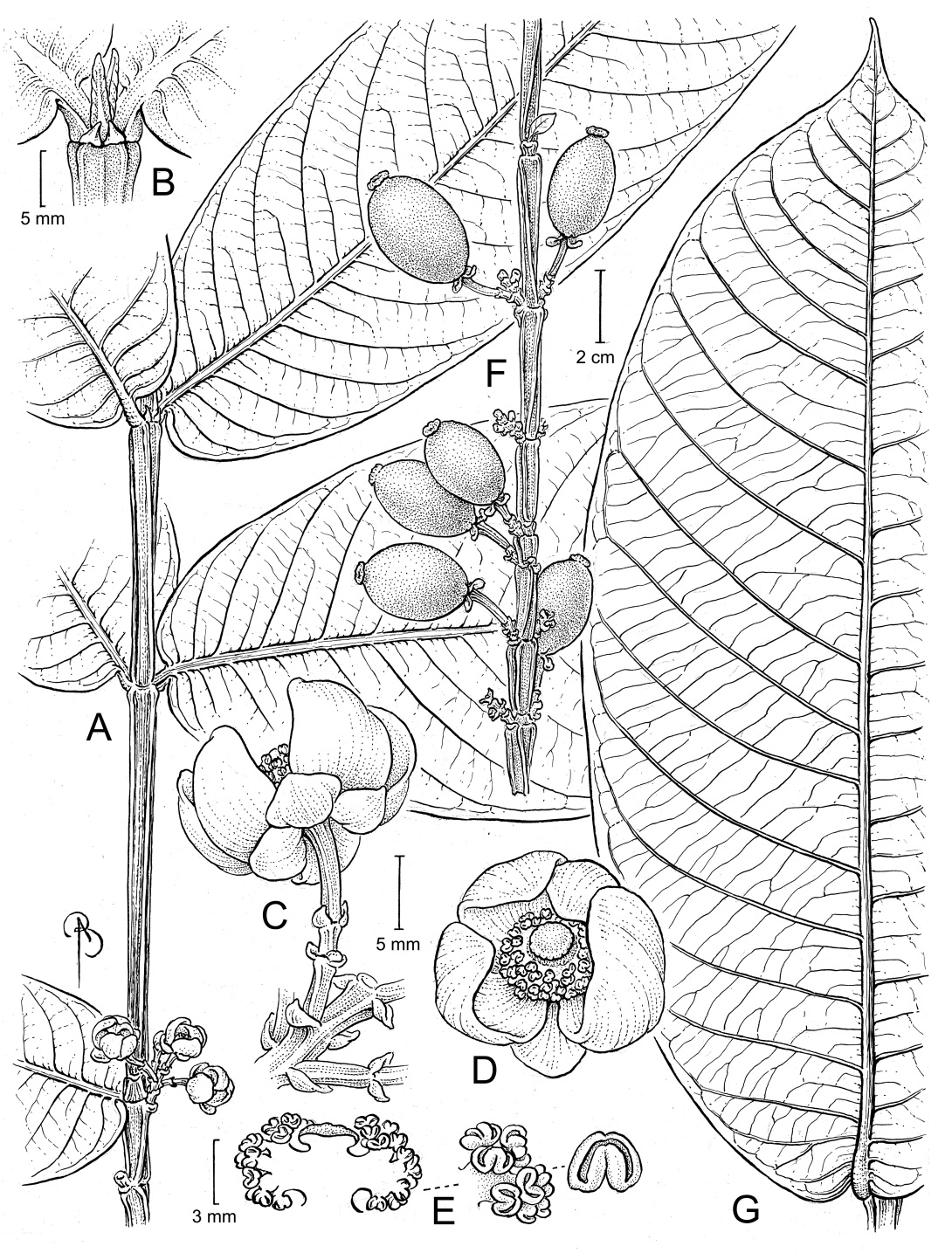
A. Branch with staminate flowers. B. Apex of branch showing leaf bases, young leaves, and stipuliform structures. C. Part of staminate infloresence. D. Staminate flower. E. Cross section of androecium and pistillode with close-up views of stamens and an anther. F. Branch with fruits. G. View of abaxial leaf surface.
 Illustration by Bobbi Angell.

Garcinia yaatapsap K. Armstr. & P.W. Sweeney, 
A. Apex of branch showing leaf bases, young leaves, and stipuliform structures (indicated by arrow). B. Staminate flowers. C. Branch with fruits. D. Branch with leaves.
Scale bars: A, B = 5 mm, C = 1 cm, D = 2 cm.

Garcinia yaatapsap K. Armstr. & P.W. Sweeney, sp. nov.

Type:—MYANMAR. Sagaing Region: Hkamti District, Hkamti Township, Htamanthi Wildlife Sanctuary, Just upstream from Nam Eizu camp 1,184 m. a.s.l., 25.537833°, 95.465861°, 11 September 2016, K. Armstrong, D. Daly, P. P. Hnin, T. Y. Nwe, L. Zaw, K. Z. Aung, H. Aung 1406 (holotype NY [NY02654830]!; isotypes E!, RAF!). 

Diagnosis:—Garcinia yaatapsap is similar to G. stipulata T.Anderson in Hooker (1874: 267) and G. nujiangensis C.Y.Wu & Y.H.Li in Li (1981: 494), but branchlets distinctly 4-sided and winged on angles (particularly distally) (vs. terete); leaf bases subcordate to cordate (vs. cuneate); leaves nearly sessile, petiole length to leaf blade length ratio smaller (ca. <1:25 vs. >1:16).

Distribution and Habitat:—Garcinia yaatapsap has only been collected four times in the vicinity of Htamanthi Wildlife Sanctuary (Fig. 3) and is likely to be endemic to this area of the upper Chindwin Basin. This species occurs from 123-184 m a.s.l. in the Kachin-Sagaing low elevation evergreen subtropical rainforest ecosystem (Armstrong et al. 2020; Murray et al. 2020), which is a lowland (ca. 100-300 m a.s.l.) evergreen closed forest ecosystem in northern Myanmar, where there is abundant rainfall (2,000+ mm) and generally moist conditions. 

Etymology:—The specific epithet “yaatapsap” is the Shan-ni (Red Shan) vernacular name for the plant, which translates as “medicine to join the liver [back together]”. This epithet is constructed as a noun in apposition. Locally, a tea made from Garcinia yaatapsap is used as tonic for repairing a damaged liver due to drinking excess alcohol.


Patrick W. Sweeney, Thet Yu Nwe and Kate E. Armstrong. 2022. Garcinia yaatapsap (Clusiaceae), A New Species from northern Myanmar. Phytotaxa. 545(2); 121-127. DOI: 10.11646/phytotaxa.545.2.1

Saturday, March 19, 2022

[Botany • 2022] Garcinia santisukiana (Clusiaceae) • A New Species from Thailand


Garcinia santisukiana Ngerns. & Suddee, 

in Ngernsaengsaruay & Suddee, 2022. 
ยางอึ่ง, นวลสันติสุข  ||  DOI: 10.1007/s12225-021-09979-8
 
Garcinia santisukiana Ngerns. & Suddee (Clusiaceae), a new species discovered from Pha Taem National Park, Ubon Ratchathani Province, eastern Thailand, is described. A detailed description and illustration of the species are provided, along with information on recognition, distribution, specimens examined, habitat, conservation status, phenology, etymology, vernacular name and uses.

Key Words: Edible fruits, Pha Taem National Park, species nova, taxonomy.


Garcinia santisukiana Ngerns. & Suddee

ETYMOLOGY. The specific epithet is in honour of the late Prof. Dr Thawatchai Santisuk (1944 – 2020), one of Thailand’s most widely respected plant taxonomists. He taught the botany components of courses in plant systematics and advanced plant taxonomy when the first author was an undergraduate student and a graduate student at Kasetsart University. He was the former co-advisor of the first author in his doctoral degree at Kasetsart University. He was a superb botanist and ecologist, as well as, a brilliant teacher, actively involved in many aspects of botanical science in Thailand.

VERNACULAR NAME. Nuan santisuk (นวลสันติสุข) (suggested here); yang ueng (ยางอึ่ง) (Ubon Ratchathani, local people around Dong Na Tham Forest).

 
Chatchai Ngernsaengsaruay and Somran Suddee. 2022. Garcinia santisukiana (Clusiaceae), A New Species from Thailand. Kew Bulletin. DOI: 10.1007/s12225-021-09979-8

นวลสันติสุข Garcinia santisukiana Ngerns. & Suddee  
วงศ์ Clusiaceae (Guttiferae) นวลสันติสุขเป็นไม้ต้นไม่ผลัดใบ สูง 5–18 ม. เส้นรอบวง 20–85 ซม. กิ่งเรียงตรงข้ามสลับตั้งฉากตามแนวนอน เป็นสี่เหลี่ยม เปลือกแตกเป็นสะเก็ด สีน้ำตาลอมเทาถึงสีน้ำตาลเข้ม เปลือกชั้นในสีเหลืองอ่อน ส่วนต่าง ๆ มีน้ำยางสีเหลืองอ่อน เหนียว 
.
ใบเดี่ยว เรียงตรงข้ามสลับตั้งฉาก รูปรีหรือรูปไข่กลับ กว้าง 1.5–4.3 ซม. 
ยาว 2.7–9.7 ซม. ปลายแหลม บางครั้งเว้าบุ๋ม โคนรูปลิ่ม ขอบเรียบ แผ่นใบกึ่งหนาคล้ายแผ่นหนัง ด้านบนสีเขียวเข้ม ด้านล่างสีเขียวอ่อน เกลี้ยงทั้ง 2 ด้าน เส้นแขนงใบข้างละ 9–14 เส้น ปลายโค้งจดกับเส้นถัดขึ้นไปเป็นวงรอบใกล้ขอบใบและเป็นเส้นขอบใน มีเส้นใบระหว่างเส้นแขนงใบ เส้นใบย่อยแบบร่างแห เห็นไม่ชัดทั้ง 2 ด้าน มีต่อมเป็นจุดสีดำทั้ง 2 ด้าน และมีเส้นลักษณะเป็นคลื่นเรียงเกือบขนานกับเส้นกลางใบ อยู่ระหว่างเส้นแขนงใบ ก้านใบยาว 0.5–1.3 ซม. ใบสดเปราะ เมื่อขยี้ ใบอ่อนสีแดงหรือสีน้ำตาลอมแดง แล้วเปลี่ยนเป็นสีเขียวอ่อน เป็นมัน
.
ดอกแยกเพศต่างต้น ช่อดอกแบบช่อกระจุกหรือดอกเดี่ยว ออกตามซอกใบที่ใบร่วงแล้ว ดอกบานมีกลิ่นหอมอ่อน เส้นผ่านศูนย์กลาง 4–7 มม. ก้านดอกสีเขียว ใบประดับ 4 ใบ สีเขียว กลีบเลี้ยงและกลีบดอกอย่างละ 4 กลีบ เรียงตรงข้ามสลับตั้งฉาก กลีบเลี้ยงสีเขียว กลีบดอกสีขาวนวลหรือสีเหลืองอ่อน ดอกเพศผู้ส่วนมากเป็นช่อดอกแบบช่อกระจุก แต่ละกระจุกมี 3–5 ดอก กลีบเลี้ยงรูปครึ่งวงกลม กว้าง 1–1.5 มม. ยาวประมาณ 1 มม. ปลายมนกลม กลีบดอกรูปไข่กลับ กว้าง 2.2–3.2 มม. ยาว 3–5 มม. ลักษณะเป็นแอ่ง ปลายมนกลม เกสรเพศผู้จำนวนมาก เชื่อมติดกันเป็น 4 กลุ่ม สีขาวนวล ก้านชูอับเรณูสั้นมาก อับเรณูขนาดเล็กมาก เกสรเพศเมียที่เป็นหมันรูปเห็ด ยาว 3–3.6 มม. ยอดเกสรเพศเมียสีเหลืองอ่อน ดอกเพศเมียเป็นดอกเดี่ยวหรือเป็นช่อดอกแบบช่อกระจุก แต่ละกระจุกมี 3–5 ดอก กลีบเลี้ยงขนาดเท่ากัน รูปครึ่งวงกลม กว้าง 1–2 มม. ยาว 1–1.5 มม. ปลายมนกลม กลีบดอกรูปค่อนข้างกลมหรือรูปไข่กลับ กว้าง 2.5–3.5 มม. ยาว 3–4 มม. ลักษณะเป็นแอ่ง ปลายมนกลม  เกสรเพศผู้ที่เป็นหมัน เชื่อมติดกันเป็น 4 กลุ่ม อยู่รอบโคนรังไข่ เกสรเพศเมียรูปเห็ด รังไข่สีเขียว รูปทรงค่อนข้างกลม กว้าง 1.8–2.2 มม. ยาว 1–2 มม. มี 4 ช่อง แต่ละช่องมีออวุล 1 เม็ด ไร้ก้านยอดเกสร
เพศเมีย ยอดเกสรเพศเมียสีเหลืองอ่อน รูปครึ่งทรงกลม เส้นผ่านศูนย์กลาง 2–2.2 มม. เป็นแฉกตื้น 4 แฉก มีปุ่มเล็ก
 
ผลแบบผลมีเนื้อหนึ่งถึงหลายเมล็ด รูปทรงค่อนข้างกลมหรือรูปทรงรูปไข่ กว้าง 1–2.5 ซม. ยาว 1.5–2.7 ซม. สีเขียว สุกสีแดง เกลี้ยง ผนังผลหนาประมาณ 0.8 มม. มีกลีบเลี้ยงติดทน ขนาดเล็ก ยอดเกสรเพศเมียติดทน
สีน้ำตาลอมดำ แบน เส้นผ่านศูนย์กลาง 2–2.2 มม. เป็นแฉกตื้น 4 แฉก 
ก้านผลยาว 1.5–2.5 มม. มีเมล็ด 1–2 เมล็ด มีลายสีน้ำตาลสลับกับสีน้ำตาลอ่อน ด้านหนึ่งแบน มีขั้วเมล็ดเห็นชัด อีกด้านหนึ่งนูนเล็กน้อย รูปรีหรือ
รูปขอบขนาน กว้าง 1–1.5 ซม. ยาว 1.5–2 ซม. ปลายมนกลมทั้ง 2 ด้าน เปลือกเมล็ดชั้นนอกเป็นเนื้อนุ่ม สีเหลือง อาจมีเมล็ดฝ่อ
 
นวลสันติสุขมีเขตการกระจายพันธุ์ในประเทศทางภาคตะวันออก พบตามป่าดิบแล้ง (บริเวณป่าดงนาทาม) และป่าเต็งรังบนหินทราย (บริเวณผาชนะได) อุทยานแห่งชาติผาแต้ม จังหวัดอุบลราชธานี [อ้างอิงตามการแบ่งเขตการกระจายพันธุ์ของพรรณพืชในประเทศไทย (Thailand floristic regions)] ที่สูงจากระดับทะเลปานกลางประมาณ 400 ม. ออกดอกเดือนกรกฎาคมถึงธันวาคม เป็นผลเดือนสิงหาคมถึงตุลาคม และกุมภาพันธ์ถึงเมษายน ในต่างประเทศคาดว่าพบที่ลาว