Showing posts with label Eriocaulaceae. Show all posts

Friday, December 27, 2024

[Botany • 2020] Paepalanthus fabianeae (Eriocaulaceae) • A New Microendemic Species from a Morphologically Coherent Clade


Paepalanthus fabianeae  Andrino & Sano, 

in Andrino, Simon, Quintino Faria, Moreira et Sano, 2020.

Abstract 
We describe and illustrate Paepalanthus fabianeae , a new species of Eriocaulaceae from the central portion of the Espinhaço Range in Minas Gerais, Brazil. Previous phylogenetic evidence based on analyses of nuclear (ITS and ETS) and plastid (trnL-trnF and psba-trnH) sequences revealed P. fabianeae as belonging to a strongly supported and morphologically coherent clade containing five other species, all of them microendemic, restricted to the Espinhaço range. Due to the infrageneric classification of Paepalanthus being highly artificial, we preferred not assigning P. fabianeae to any infrageneric group. Paepalanthus fabianeae is known from two populations growing in campos rupestres (highland rocky fields) in the meridional Espinhaço Range. The species is characterized by pseudodichotomously branched stems, small, linear, recurved, and reflexed leaves, urceolate capitula, and bifid stigmas. Illustrations, photos, the phylogenetic position, and a detailed description, as well as comments on habitat, morphology, and affinities with similar species are provided. The restricted area of occurrence allied with threats to the quality of the habitat, mainly due to quartzite mining, justifies the preliminary classification of the new species in the Critically Endangered (CR) category using the guidelines and criteria of the IUCN Red List.

Keywords: Campos rupestres; Poales; taxonomy

Paepalanthus fabianeae.
A, B. Habit. C, D. Involucral bracts, abaxial surface. C. External layers. D. Internal layers. E. Staminate flower. F. Staminate flower with sepals removed and the corolla margin rolled inwards G. Complete pistillate flower. H. Complete pistillate flower with detail of the gynoecium. (Faria, J. 8090, UB). 

Paepalanthus fabianeae.
 A. Flowering branch B. and C. Inflorescence detail. (Faria, J. 8090)
 
Paepalanthus fabianeae Andrino & Sano, sp. nov.


  Andrino, Caroline Oliveira; Simon, Marcelo Fragomeni; Quintino Faria, Jair Eustáquio; Luiz da Costa Moreira, André and Sano, Paulo Takeo. 2020. Paepalanthus fabianeae (Eriocaulaceae): A New Microendemic Species from a Morphologically Coherent Clade.  Systematic Botany. 45(4); 794-801. DOI: doi.org/10.1600/036364420X16033963649318

Saturday, June 15, 2024

[Botany • 2024] Paepalanthus magnus (Poales: Eriocaulaceae)A Missing Piece is Found: A New Species and the puzzling relations of the campos rupestres Mountaintop Floras of eastern Minas Gerais, Brazil


 Paepalanthus magnus L.H.Rocha, Gonella & Andrino,

et Rocha, Gonella et Andrino, 2024.

Abstract
Paepalanthus is a diverse genus characteristic of the campos rupestres, a megadiverse vegetation found on mountaintops of mainly quartzitic mountain ranges of central-eastern Brazil. Recent efforts on prospecting the biodiversity of Serra do Padre Ângelo, a small mountain complex in eastern Minas Gerais, yielded several new plant and animal species, highlighting the urgency of conservation actions towards this still unprotected area. Here, we describe yet another new species found in the campos rupestres of these mountains, Paepalanthus magnus, a mountaintop microendemic species morphologically similar to taxa found in the Espinhaço Range, over 200 km distant, a biogeographic pattern shared by several other species. The affinities of the new species are discussed, and we provide illustrations, photographs, and SEM photomicrographs of the seed. We also discuss the conservation status of the species, which is preliminarily assessed as Critically Endangered, reinforcing the urgent need to address the conservation of the unique biodiversity of Serra do Padre Ângelo.

Key words: Atlantic Forest, endemism, João Pinto Formation, Serra do Padre Ângelo, threatened species

Paepalanthus magnus
A habit B leaf apex C spathe, detail of the opening D capitula in dorsal (left) and ventral (right) view E involucral bract F floral bract G staminate flower in lateral view H staminate flower with sectioned corolla, exposing the stamens and pistillodes I pistillate flower in lateral view J pistillate flower with petals and sepals distended, exposing the gynoecium K seed with numerous appendices along the periclinal walls.
Illustration by Klei Souza based on the holotype (P.M. Gonella et al. 3402).

Paepalanthus magnus
A habitat at Pico do Pinhão, with the Pico da Bela Adormecida (Pico do Padre Ângelo) in the background B habit among grasses and quartzitic rocks C rosette in detail D leaves, showing ciliate margin and striate abaxial surface E the base of the leaves, showing the adaxial surface and a scape enclosed by a spathe emerging from a leaf axil F spathe opening G capitulum in posterior view evidencing the involucral bracts H capitulum, lateral view I capitulum, frontal view.
A by Lucian Medeiros B–I by Paulo Minatel Gonella.

 Paepalanthus magnus L.H.Rocha, Gonella & Andrino, sp. nov.

Diagnosis: The new species is most similar to Paepalanthus regelianus Körn., with which it shares the pilose abaxial surface of the leaves. However, P. regelianus presents scapes that are about twice as long as the leaves and tomentose (vs. scapes at least 3 times longer than the leaves, and glabrous in P. magnus) and involucral bracts with a glabrous abaxial surface and ciliated margin (vs. pilose in P. magnus). Furthermore, the spathes of P. regelianus are shorter than its leaves, approximately half as long as the leaves (vs. spathes about as long as the leaves), present uniformly distributed trichomes (vs. along longitudinal nerves), and possess a short opening, no longer than 1 cm long (vs. opening distinctly longer, 2.5–6.0 cm long).


Etymology: The epithet “magnus” derives from the Latin “great”, “large”. This epithet was selected to denote the characteristic of the species being large in size, contrasting with the majority of Eriocaulaceae species found in the region where it occurs but also a reference to its larger size compared to its putative closest taxa.


 Luiz Henrique Rocha, Paulo Minatel Gonella and Caroline Oliveira Andrino. 2024. A Missing Piece is Found: A New Species of Paepalanthus (Poales, Eriocaulaceae) and the puzzling relations of the campos rupestres Mountaintop Floras of eastern Minas Gerais, Brazil. PhytoKeys. 242: 317-332. DOI: 10.3897/phytokeys.242.122824

Resumo: Paepalanthus é um gênero característico dos campos rupestres, uma vegetação megadiversa encontrada no topo de montanhas de cadeias montanhosas, principalmente quartzíticas, do centro-leste do Brasil. Esforços recentes de inventariar a biodiversidade da Serra do Padre Ângelo, um pequeno complexo montanhoso no leste de Minas Gerais, resultaram na descoberta de várias novas espécies de plantas e animais, destacando a urgência de ações de conservação para esta área ainda não protegida. Aqui, descrevemos mais uma nova espécie encontrada nos campos rupestres dessas montanhas, Paepalanthus magnus, uma espécie microendêmica, morfologicamente semelhante a táxons encontrados na Serra do Espinhaço, a mais de 200 km de distância, um padrão biogeográfico repetido por várias outras espécies. As afinidades da nova espécie são discutidas e fornecemos ilustrações, fotografias da planta e de microscopia eletrônica de varredura (MEV) da semente. Também discutimos o status de conservação da espécie, que é preliminarmente avaliada como Criticamente Em Perigo, reforçando a necessidade urgente de abordar a conservação da biodiversidade única da Serra do Padre Ângelo.

Palavras-chave: Espécie ameaçada, endemismo, Formação João Pinto, Mata Atlântica, Serra do Padre Ângelo

Tuesday, May 7, 2024

[Botany • 2024] Giuliettia minimaA tiny rediscovery in the Land of Giants: A New Combination in Giuliettia (Poales: Eriocaulaceae) and other implications of finding Paepalanthus minimus again


 Giuliettia minima (Silveira) Andrino, L. H. Rocha & Gonella,

in Andrino, Rocha et Gonella, 2024. 

Abstract
Serra do Padre Ângelo, a quartzitic massif in eastern Minas Gerais, Brazil, was nicknamed “Land of Giants” due to the gigantism observed in some plant species found in its campos rupestres. During fieldwork for the floristic inventory of this Serra, a small Eriocaulaceae species was collected. Initially it was believed to be a new species, but a thorough revision of names and type specimens revealed that it was conspecific with Paepalanthus minimus. This taxon was known only from the type specimen collected over 100 years ago and more than 200 km distant from the new collections. It had been overlooked in previous studies dealing with the family in Brazil, which could be explained by its diminutive size and the poor conditions of the type specimen. Here we present the implications of this rediscovery, including the combination of P. minimus in Giuliettia, a genus recently proposed based on general habit, inflorescence and seed morphology. We also present information on distribution and ecology and briefly discuss the biogeographical pattern that could explain this rediscovery far away from the previous record. Considering its likely local extinction at the type locality and threats to the quality of its remaining habitat, the species is preliminarily assessed as Critically Endangered. This highlights the urgent need for conservation actions to protect Serra do Padre Ângelo and its unique biodiversity.

KEYWORDS: Campos rupestres, conservation, Eriocaulaceae, Giuliettia, monocots, Paepalanthus, Poales

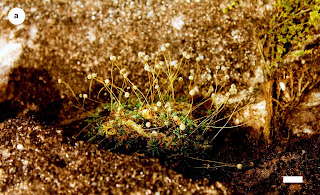
 Giuliettia minima. – A: habitat on shaded rock crevices, with some capitula presenting apparent vivipary; B: habitat under rocks in shade with mosses; C: close-up of plants in habitat; D: plants in a humid rock crevice with organic matter in more exposed site; E: collected specimen, P. M. Gonella 3474; F, G: capitula; F: posterior view, showing involucral bracts; G: front view.
– Photographs: A: Serra da Palha Branca, March 2023, by Júlio César Ribeiro; B, C: Serra da Palha Branca, June 2020, by Gabriele A. da Silva; D–G: Pico da Bela Adormecida, May 2022, by Paulo Minatel Gonella.


Giuliettia minima (Silveira) Andrino, L. H. Rocha & Gonella, comb. nov. 
Paepalanthus minimus Silveira, 
Floral. Mont. 1: 107, t. 66. 1928. 
 
Habitat of Giuliettia minima and conservation threats.
 A: Pico da Bela Adormecida, one of the highest peaks of Serra do Padre Ângelo and habitat of G. minima, May 2022; B: Serra da Palha Branca, part of Serra do Padre Ângelo, August 2022; C: habitat of Pico da Bela Adormecida population in June 2020, before the fire; D: same area as C in October 2020, immediately after the fire; E: invasion of molasses grass, Melinis minutiflora, in Pico da Bela Adormecida, with individuals of Vellozia gigantea in background, July 2017; F: area of Serra da Palha Branca invaded by bracken fern, Pteridium aquilinum, February 2021; G: pastures and degraded areas surrounding Pico da Bela Adormecida, April 2023.
 – All photographs by Paulo Minatel Gonella.


Proposed vernacular name —sempre-viva-mínima” (Portuguese). Following the suggestion of Marinho & Scatigna (2022), we propose a vernacular name for this species as a way to promote knowledge about it to the local communities and to address the urgency of promoting conservation actions to protect the species and its habitat. The proposed name considers the common name of many Eriocaulaceae species in Brazil (“sempre-viva” – Portuguese for “everlasting”) plus the specific epithet, which is easily relatable in Portuguese, meaning “minimal” or “very small”.


Caroline Oliveira Andrino, Luiz Henrique Rocha and Paulo Minatel Gonella. 2024. A tiny rediscovery in the Land of Giants: A New Combination in Giuliettia (Eriocaulaceae, Poales) and other implications of finding Paepalanthus minimus again. Willdenowia. 54(1):81-93. DOI: 10.3372/wi.54.54104

A Serra do Padre Ângelo, um maciço quartzítico no leste de Minas Gerais, Brasil, foi apelidada de “Terra de Gigantes” devido ao gigantismo observado em algumas espécies de plantas encontradas em seus campos rupestres. Durante o trabalho de campo para o inventário florístico desta Serra, uma pequena espécie de Eriocaulaceae foi coletada. Inicialmente, acreditava-se ser uma nova espécie, mas uma revisão minuciosa dos nomes e espécimes tipo revelou que ela era na verdade conspecífica com Paepalanthus minimus. Esse táxon era conhecido apenas pelo espécime tipo, coletado há mais de 100 anos e a mais de 200 km das novas coletas, tendo passado despercebido em estudos anteriores sobre a família no Brasil, o que pode ser explicado pelo seu tamanho diminuto e pelas condições precárias do espécime tipo. Aqui, apresentamos as implicações dessa redescoberta, incluindo a combinação de P. minimus em Giuliettia, um gênero recentemente proposto, com base em seu hábito geral, morfologia da inflorescência e da semente. Também fornecemos informações sobre a distribuição e ecologia, e discutimos brevemente o padrão biogeográfico que poderia explicar essa redescoberta tão distante do registro anterior. Considerando sua provável extinção local na localidade tipo e as ameaças à qualidade de seu habitat remanescente, a espécie é preliminarmente avaliada como Criticamente em Perigo. Isso destaca a necessidade urgente de ações de conservação para proteger a Serra do Padre Ângelo e sua biodiversidade única.
Campos rupestres, conservação, Eriocaulaceae, Giuliettia, Paepalanthus, Poales, monocotiledôneas, espécie ameaçada

Wednesday, May 1, 2024

[Botany • 2015] Paepalanthus magistrae (Eriocaulaceae) • A New Species from Northeastern Brazil

 
Paepalanthus magistrae  Sano, F.N. Costa, Trovó & Echtern., 

in Sano, Costa, Trovó et Echternacht, 2015. 

ABSTRACT
We describe and illustrate Paepalanthus magistrae, a remarkable new species of Eriocaulaceae from Northeastern Brazil. The species is placed into Paepalanthus subsect. Dichocladus by the presence of trimerous flower, elongated dichotomous branched stem, and small rigid leaves. Within the section it may be easily distinguished by its leaves with glabrescent adaxial surface and lanose abaxial surface. As the species is narrowly distributed and known from a few populations, it is considered endangered.

Key words: Caatinga; Paepalanthoideae; Serra das Confusões National Park; taxonomy


Paepalanthus magistrae – a. branch detail; b. leaf abaxial surface; c. leaf adaxial surface; d. involucral bract abaxial surface; e. floral bract abaxial surface; f. pistillate flower; g. gynoecium; h. staminate flower; i. staminate flower with sepals removed and opened corolla
(Drawings from the holotype by Klei Sousa).

Paepalanthus magistrae – a. habit; b. habit detail. 
Scale bars – a. 2.5cm; b. 1cm. (photos from CNCFlora) 


Paepalanthus magistrae Sano, F.N. Costa, Trovó & Echtern. sp. nov.

Diagnosis: Paepalanthus magistrae differs from all the other species of P. subsect. Dichocladus by its leaves with glabrescent adaxial surface and lanose abaxial surface. It is morphologically differentiated from Paepalanthus bonsai Trovó & Sano, the most closely related species, also by its leaves with round apex, spathe tip acute, longer scapes, spherical capitula, and involucral bracts completely glabrous.
 
Etymology: The epithet magistrae - belonging to the master - is a tribute to Prof. Ana Maria Giulietti Harley, who has guided three generations of specialists in Eriocaulaceae. As in this species, she has her roots in the Caatinga. To her we offer our gratitude and our acknowledgement.

Habitat, Distribution, and Conservation: Paepalanthus magistrae is known from a few populations growing on rock crevices in mountains of Serra das Confusões, Piauí (Fig. 1). The species occurs within the Capivara National Park and is considered endangered according to criteria B1a and B2a of IUCN (2011). Additional populations may be found in the vicinities, as the area is poorly sampled.


Paulo Takeo Sano, Fabiane Nepomuceno Costa, Marcelo Trovó and Lívia Echternacht. 2015. Paepalanthus magistrae (Eriocaulaceae), A remarkable New Species in honor of Ana Maria Giulietti-Harley.  Rodriguésia. 66(2);. DOI: 10.1590/2175-7860201566202 

Thursday, December 14, 2023

[Botany • 2021] Eriocaulon sanjappae (Eriocaulaceae) • A New Species from the southern Western Ghats, India


Eriocaulon sanjappae M. K. Akhil & Nampy, 

in Nampy et Akhil, 2021.

Abstract
A new species of Eriocaulaceae, Eriocaulon sanjappae is described from the southern Western Ghats, India. It is morphologically close to E. rajendrababui, in having glabrous, connate male sepals and non-appendaged seeds but differs by its smaller leaves and peduncles, hemispherical heads, oblong involucral bracts, hairy receptacles, non-glandular male petals, hairy female sepals and elliptic, brownish-yellow seeds. A detailed description, illustration and photographic images are provided. The morphological differences with relevant species are discussed. The status of the new species is provisionally assessed here as ‘Critically Endangered' (CR) according to IUCN Red List Categories and Criteria.

Keywords: Chandanathode, Critically Endangered, Eriocaulon rajendrababui, Eriocaulon sanjappae, Wayanad district


Eriocaulon sanjappae M. K. Akhil & Nampy sp. nov. 

Etymology: The specific epithet ‘sanjappae' is given in honour of Dr. M. Sanjappa, former Director of Botanical Survey of India, Kolkata for his valuable contributions to Indian Taxonomy.

 
Santhosh Nampy and Mannar Kandy Akhil. 2021. Eriocaulon sanjappae (Eriocaulaceae), A New Species from the southern Western Ghats, India. Nordic Journal of Botany. DOI: 10.1111/njb.03311


Saturday, July 31, 2021

[Botany • 2021] Paepalanthus mellosilvae (Eriocaulaceae) • A New Species from the Mantiqueira Range in Minas Gerais, Brazil


  Paepalanthus mellosilvae Trovó 

in Trovó, 2021.

Abstract
Paepalanthus mellosilvae is here described and illustrated as a new species of Eriocaulaceae from the Atlantic Forest domain in Minas Gerais state, Brazil. The new species is known from a single locality in the Mantiqueira Range, growing along trails through cloud forests. According to the IUCN criteria, it is suggested here as critically endangered. Paepalanthus mellosilvae is compared to P. harmsii, a morphologically similar species also growing in the Mantiqueira Range, being mainly distinguished by the presence of a rhizome, narrower leaves, more numerous scapes, narrower capitula, sparsely pilose involucral bracts, and obdeltate floral bracts. Additional comments on the taxonomy, morphology, and distribution of the species, along with illustrations are provided. The specific epithet is a tribute to Prof. Dr. Renato de Mello-Silva.

Keywords: Atlantic Forest, Endemism, Poales, Taxonomy, Tribute, Monocots

Figure 1. Paepalanthus mellosilvae Trovó.
A. Habit detail. B. Capitulum detail. C. Outer involucral bract, abaxial surface. D. Floral bract, abaxial surface. E. Staminate flower. F. Staminate flower with opened corolla and sepals removed. G. Pistillate flower. H. Pistillate flower with sepals removed, evidencing the gynoecium. (line drawing: Klei Sousa).

Paepalanthus mellosilvae Trovó, sp. nov.

Etymology:— The epithet “mellosilvae” is a tribute to Prof. Dr. Renato de Mello-Silva, who collected a very complete set of specimens of this new species, which was selected as the type collection. Renato was a tenacious botanist, an inspiring professor, and a good friend.


Marcelo Trovó. 2021. Paepalanthus mellosilvae (Eriocaulaceae), A New Species from the Mantiqueira Range in Minas Gerais, Brazil. Phytotaxa. 500(3); 248–252. DOI: 10.11646/phytotaxa.500.3.9 

Saturday, April 24, 2021

[Botany • 2021] Paepalanthus oreodoxusAn Escape from the Espinhaço Range: A New Species of Paepalanthus subg. Xeractis (Eriocaulaceae) from the campos rupestres of Serra do Padre Ângelo, Minas Gerais, Brazil


Paepalanthus oreodoxus Andrino & Gonella

in Andrino & Gonella, 2021. 

Abstract
Background and aims – Recent botanical discoveries have highlighted the occurrence of campos rupestres in the Serra do Padre Ângelo (SPA), eastern Minas Gerais, Brazil. Here, we introduce the first new species of Paepalanthus subg. Xeractis to be described in the last three decades. Discovered in the SPA, it belongs to an emblematic lineage endemic to the campos rupestres of Minas Gerais.

Material and methods – The new species is described based on herbarium material and in situ observations. A morphological phylogenetic analysis was carried out by including the new species in a previously published character matrix. Its spatial distribution is discussed based on the obtained topology.

Key results – The new species is endemic to the SPA, but its closest related taxa are endemic to the Espinhaço Range (ER), ca 200 km distant. Its placement in the phylogeny supports the inclusion in P. ser. Fuscati, representing an escape from the ER. We present a clear morphological differentiation between the new species and its closest related taxa. Other similar cases of disjunct distribution among these areas of campos rupestres (SPA vs ER) are reviewed and discussed.

Conclusion – Based on the restricted distribution, allied with threats to the habitat, the new species is inserted in the IUCN category of Critically Endangered (CR). This new discovery reinforces the singularity of the SPA and the relevance of biodiversity inventories and conservation studies in the easternmost campos rupestres, and their classification as a priority area for conservation.

Keywords: Atlantic Forest; Campos Rupestres; Critically Endangered; Disjunction; Paepalanthus oreodoxus; Serra do Padre Ângelo

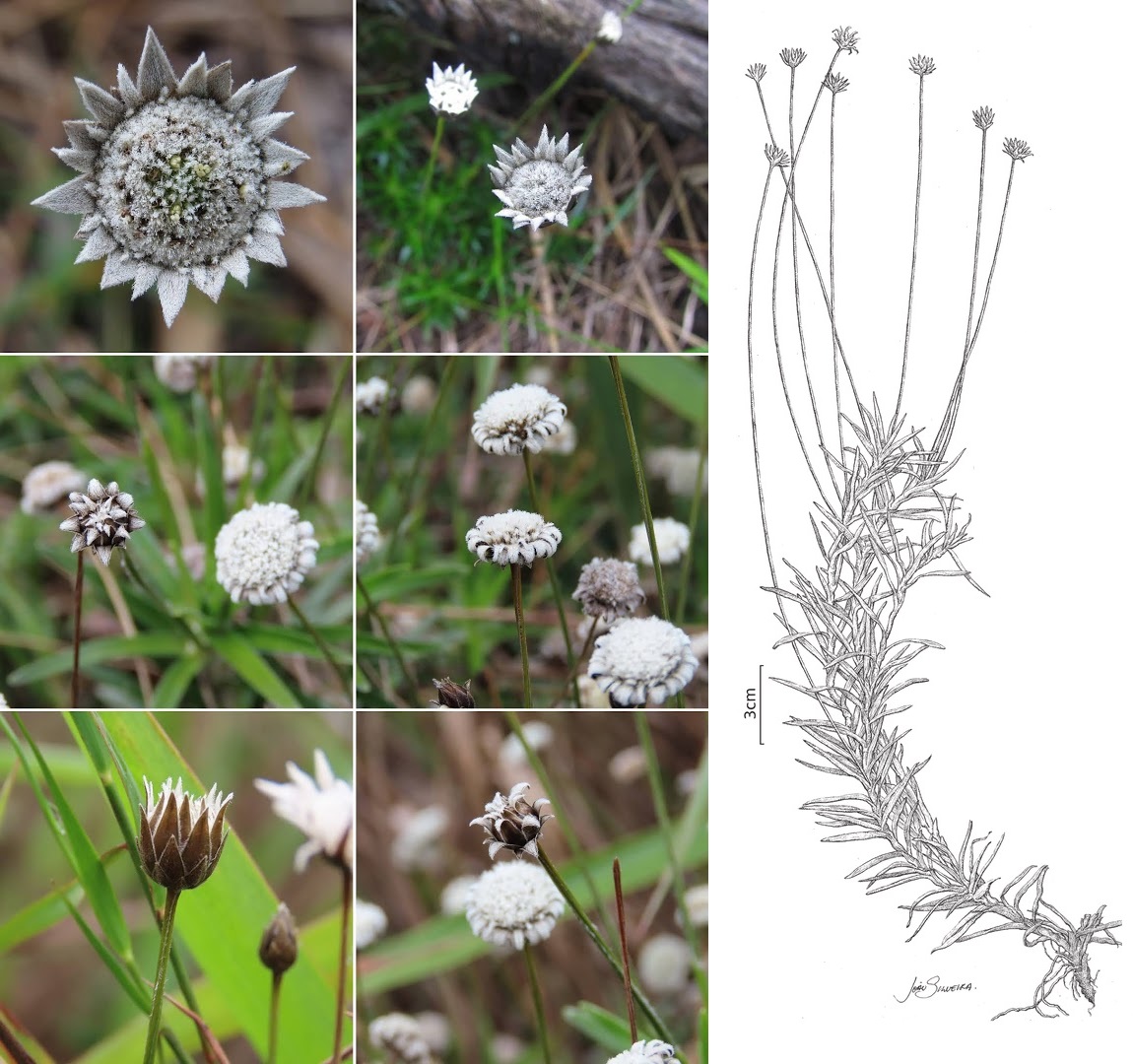
Figure 2: Paepalanthus oreodoxus Andrino & Gonella (based on Gonella et al. 1044).
 A. Habit. B. Capitulum detail, side view. C. Capitulum detail showing hygroscopic involucral bracts. D. Involucral bracts, abaxial surface, external series on the left side and internal ones on the right. E. Staminate flower with the floral bract. F. Staminate flower with sepals removed and open corolla. G. Floral bract. H. Pistilate flower. I. Petal of pistilate flower, adaxial surface. J. Gynoecium. K. Seed. Illustration by João Silveira.

Figure 3: A. View of the campos rupestres on the top of Pico do Padre Ângelo, habitat of Paepalanthus oreodoxus, with Pico do Sossego and Pico do Pinhão in the background. B. Paepalanthus oreodoxus among rocks. C. Exceptionally long specimen of P. oreodoxus growing pendulous in a shaded area with one of the authors for scale. D. Immature capitulum in dry weather, showing recurved involucral bracts. E. Side view of the capitulum with bracts opening after a wet night. F. Capitulum with hygroscopically bent bracts over the flower disc in wet weather. G. Capitula with recurved bracts in dry weather. H. Front view of capitula, showing the long involucral bracts characteristic of the species. I. Staminate flower with anthers cream-coloured with dark pigmentation in the dorsal portion.
A, D, F-H by Paulo M. Gonella; C by Danilo Pacheco Cordeiro; B, E, I by Andreas Fleischmann.


Paepalanthus oreodoxus Andrino & Gonella, sp. nov.

Diagnosis – The new species is morphologically most similar to Paepalanthus mollis Kunth, but differs in the stem branches loosely arranged (vs densely arranged in compact clumps), well-developed, longer and erect (rarely pendulous) stem 8–40(–230) cm long (vs decumbent and inconspicuous stem, rarely up to 12 cm long), leaves laxly arranged along the stem with conspicuous internodes (vs congested in a rosette with inconspicuous internodes), old stems with persistent dead leaves (vs caducous leaves on plants with elongated stems), scapes 3-costate (vs 4–5-costate), involucral bracts of the internal series narrower (0.7–2.2 mm wide vs 2.1–4.1 mm wide) and surpassing the floral disc in 4 to 6 mm (vs 1.5 to 4.5 mm), anthers dorsally brown and cream-coloured in the ventral portion (vs dark brown to light yellow brown), and floral bracts narrowly spatulate to subulate (vs linear to lance-linear or spatulate).

 Etymology – From the Greek oreo pertaining to mountains” and doxa glory”. This epithet was chosen as this gracious new species is exclusively found on the mountaintops of a recently discovered area of campos rupestres, representing an outstanding discovery that reinforces the singularity of the SPA flora and the importance of its conservation. 


Caroline Oliveira Andrino and Paulo Gonella. 2021. An Escape from the Espinhaço Range: A New Species of Paepalanthus subg. Xeractis (Eriocaulaceae) from the campos rupestres of Serra do Padre Ângelo, Minas Gerais, Brazil.  Plant Ecology and Evolution. 154(1); 137-149. DOI: 10.5091/plecevo.2021.1770

Monday, March 22, 2021

[Botany • 2021] Eriocaulon meenachilense (Eriocaulaceae) • A New Tuberous Species from the southern Western Ghats, India


Eriocaulon meenachilense Anoop & Robi 
in Anoop & Robi, 2021.


ABSTRACT
Eriocaulon meenachilense, a new species of the family Eriocaulaceae from the southern Western Ghats, India, is described and illustrated. The new species is similar to Eriocaulon idukkianum and E. tuberiferum but differs in its short, linear-subulate, stiff leaves, solitary 6-angled peduncle, inflexed involucral bracts, eglandular petals, and yellow anthers and seeds.

Keywords: Eriocaulon, India, Kerala, new species, pipewort, root tuber, Western Ghats


Eriocaulon meenachilense Anoop & Robi, sp. nov.
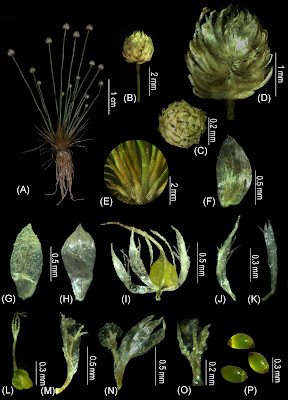
 A, Habit; B, root tubers; C, sheath; D, twisted peduncle; E, head (side view); F, head (lower view); G, involucral bract; H, floral bract; I, male flower; J, male sepal; K, anther; L, female flower; M, female sepal; N, female petal; O, light and scanning electron microscopic images of seed.
All from Anoop. P. B. & A. J. Robi 15934.

Eriocaulon meenachilense resembles E. tuberiferum A.R.Kulk. & Desai in its root tubers, short, linear leaves and free female sepals. However, the new taxon differs in its solitary, 6-angled peduncle, short sheath, white inflorescences, inflexed involucral bracts, free male sepals, eglandular petals, yellow anthers and unappendaged yellow seeds. It also similar to Eriocaulon idukkianum Manudev, Robi & Nampy, another tuberous species from the Western Ghats that has linear leaves, white inflorescences, male flowers with free sepals and unappendaged seeds, but differs from that species in the absence of a root stock, its hairy, not glabrous root tubers, its solitary, 6-angled peduncle, and its glabrous receptacle, eglandular petals and yellow anthers and seeds. 
– Type: India, Kerala, Kottayam District, Meenachil, Illikkal Hills, c.1000 m a.s.l., 7 x 2019, Anoop. P. B. & A. J. Robi 15934 (holotype MH!, isotype BAM!, MBGH!). Figures1, 2.

Etymology. The specific epithet refers to the type locality, Meenachil Taluk in Kottayam District, Kerala, India.

Habitat and ecology. Wet rocky grasslands in association with Eriocaulon thwaitesii Körn., Exacum sessile L., Impatiens stolonifera Robi & Manudev, Phyllocephalum scabridum (DC.) K.Kirkman, Smithia bigemina Dalzell, etc.

Distribution. Eriocaulon meenachilense is known only from the type locality, the Illikkal Hills in the southern Western Ghats, India.

 
P. B. Anoop and A. J. Robi. 2021. Eriocaulon meenachilense, A New Tuberous Species of Eriocaulaceae from the southern Western Ghats, India. Edinburgh Journal of Botany. 78; 1-8. DOI: 10.24823/EJB.2021.336

Wednesday, May 27, 2020

[Botany • 2020] Eriocaulon longibracteatum (Eriocaulaceae) กระดุมรัศมี • A New Species from Thailand and Cambodia


Eriocaulon longibracteatum Khorngton, Soulad. & Praj.

in Khorngton, Souladeth & Prajaksood, 2020. 
"กระดุมรัศมี" || DOI: 10.1007/s12225-020-9879-1 

Eriocaulon longibracteatum, a new species from Thailand and Cambodia is described here. A detailed description, recognition, distribution, habitat, conservation status, phenology and illustration of the species are provided. 


"กระดุมรัศมี"
Eriocaulon longibracteatum Khorngton, Soulad. & Praj. sp. nov. 


Sirinan Khorngton, Phetlasy Souladeth and Amornrat Prajaksood. 2020. Eriocaulon longibracteatum (Eriocaulaceae), A New Species from Thailand and Cambodia. Kew Bulletin. 75: 20. DOI: 10.1007/s12225-020-9879-1  

           กระดุมรัศมี เป็นพืชใบเลี้ยงเดี่ยวที่มีขนาดเล็ก ใบเรียงเวียนเป็นกระจุกแบบกุหลาบซ้อน ทำให้พืชนิดนี้ดูคล้ายพวกหญ้าหรือพวกกก ช่อดอกเหมือนเม็ดกระดุมเสื้อ และการที่พืชชนิดนี้มีใบประดับช่อดอกที่ยาวมาก จึงเป็นที่มาของชื่อ Eriocaulon longibracteatum พืชนี้ออกดอกในช่วงเดือนกันยายนถึงเดือนพฤศจิกายนของทุกปี พบได้ตามพื้นดินทรายบริเวณที่โล่ง ชุ่มน้ำ หรือพบในป่าดิบ ปัจจุบันทั่วโลกพบพืชชนิดนี้เพียง 3 แห่งใน 2 ประเทศ คือ ประเทศไทยพบที่จังหวัดชลบุรีและจังหวัดกาญจนบุรี และในประเทศกัมพูชา พบที่จังหวัด Mondulkiri ทำให้พืชชนิดนี้อยู่ในกลุ่มสิ่งมีชีวิตที่ใกล้การสูญพันธุ์ตาม IUCN Red List Categories (2012)


Thursday, October 6, 2016

[Botany • 2016] Paepalanthus multistellaris A Field Full of Green Stars: A New Species (Eriocaulaceae) from Minas Gerais, Brazil


Paepalanthus multistellaris 
 Andrino, Trovó & Sano, 2016

Abstract

We describe and illustrate Paepalanthus multistellaris, a remarkable new species of Eriocaulaceae from the northern Espinhaço Range in Minas Gerais, Brazil. The species is known from a single population growing between the campos rupestres and veredas in the municipality of Botumirim. This new species is placed into P. subsect. Actinocephaloides, and is characterized by its long, ascending stem, scapes arranged in a fasciculate, umbel-shaped inflorescence, and green involucral bracts surpassing the flowers. Illustrations, photos, and a detailed description, as well as comments on habitat, morphology, and affinities with similar species are provided. The species is considered Critically Endangered, according to the IUCN Red List categories and criteria.

Keywords: Endemism, Poales, campos rupestres, Critically Endangered species, Taxonomy, Eudicots


Caroline Oliveira Andrino, Marcelo Trovó and Paulo Takeo Sano. 2016. A Field Full of Green Stars: Paepalanthus multistellaris (Eriocaulaceae), A New Species from Minas Gerais, Brazil.   Phytotaxa. 278(1); 55–61. DOI:  10.11646/phytotaxa.278.1.6

Tuesday, June 14, 2016

[Botany • 2016] The Andean Paepalanthus pilosus complex (Eriocaulaceae): A Revision with Three New Taxa


DOI: 10.3897/phytokeys.64.6864

Abstract
A herbarium-based revision is provided for Paepalanthus pilosus and allies, five commonly confused species of cushion plants native to Andean paramo. These are placed in the recircumscribed Paepalanthus subsect. Cryptanthella Suess. The group includes P. pilosus, P. dendroides, and P. lodiculoides. An additional two species and one variety are newly described: Paepalanthus caryonauta, P. huancabambensis, and P. pilosus var. leoniae. The latter two are Peruvian endemics, while P. caryonauta is known from four countries, and has long been confused with other species. An additional, possibly undescribed taxon is noted from the Serrania de Perijá, Colombia. Five new synonyms and three lectotypes are proposed, and the common misapplication of some names is noted. Within the P. pilosus complex, species differences were found in timing of peduncle elongation, sex ratio, and leaf, perianth, diaspore and nectary morphology. Ecological differences are suggested by specimen data and a review of ecological literature. Descriptions, photographs and maps are provided for all species, as is a key to the groups of eriocaulaceous cushion plants from Andean South America.

Keywords: Andes, cushion plants, diaspores, leaf anatomy, nectaries, new species, paramo, taxonomy

Figure 1. Cushion habit of Paepalanthus pilosus var. pilosus in Venezuela, November 2012.
 A P. pilosus cushions with bunchgrasses, Páramo Batallón B Individual cushion, with graminoids emerging, Páramo Los Conejos.
 Photos by Serge Aubert, Station Alpine Joseph Fourier, France. www.cushionplants.eu.
DOI: 10.3897/phytokeys.64.6864

 Nancy Hensold. 2016. The Andean Paepalanthus pilosus complex (Eriocaulaceae): A Revision with Three New Taxa. PhytoKeys. 64: 1-57. DOI: 10.3897/phytokeys.64.6864