Showing posts with label Anthozoa. Show all posts

Sunday, June 28, 2026

[Cnidaria • 2026] Hemicorallium osmanthogemmum • A New Species of Hemicorallium (Anthozoa: Octocorallia: Coralliidae), along with a revised identification key to species of the genus


Hemicorallium osmanthogemmum
Koido, 2026 
 
 
Abstract
A new precious coral species, Hemicorallium osmanthogemmum sp. nov. (Scleralcyonacea, Coralliidae), retrieved from a depth of 550 m in Kochi Prefecture, Japan, is described, and an updated identification key for the genus Hemicorallium is provided. The new species is confirmed as belonging to the genus Hemicorallium based on the presence of nonretractile but contractile autozooids with an ovate-cylindrical shape and sclerites comprising elongated rods, 6–8-radiates and double clubs, with elongated rods present exclusively in the tentacles. Moreover, the species is distinct from all its congeners in that it has orange coenenchyme and a pink axis, with autozooids distributed only on the front side of the branch, forming clusters at the branch tips. These morphological features differ from those of all previously described species of Hemicorallium, and molecular analysis of mitochondrial sequences (16S, ND1, ND2, ND3, ND6, COI, MSH, and IGR1) further corroborates the validity of this new species. This is the first report of Hemicorallium off the coast of Kochi Prefecture, Japan.

Key words: Cnidaria, deep-sea corals, precious coral, Scleralcyonacea, Western Pacific
 
Hemicorallium osmanthogemmum sp. nov. (Holotype: KBF-OA-00436).
 A. ‘‘Front’’ and ‘‘back’’ of colony; B. Branch, showing autozooid (AZ); C. Exposed axis with the coenenchyme removed; D, E. Surface detail of branch, showing autozooid (AZ), siphonozooid (SZ), burrows (Bu), cluster of autozooids (CL), warts on coenenchyme surface (W), and commensal polychaete (Po).
 Scale bars: 50 mm (A); 10 mm (B–E).


Class Octocorallia Haeckel, 1866
Order Scleralcyonacea McFadden, van Ofwegen & Quattrini, 2022

Family Coralliidae Lamouroux, 1812

Genus Hemicorallium Gray, 1867
Hemicorallium osmanthogemmum sp. nov. 
 New Japanese name. Kinmokusei-mizo-sango.

Diagnosis. The colony branches in one plane, and anastomoses are present only where broken branches come into contact with other branches. Autozooids are contracted but not retracted, and they are distributed only on one side of the colony. Spacing is almost absent on the twigs, and clusters are formed at the tips. The axis has no pits beneath the autozooids and is pale pink to pink in colour. Sclerites are predominantly radiate, and double clubs are rare. Warty rods are present only in the tentacles.


Tatsuki Koido. 2026. A New Species of Hemicorallium (Anthozoa, Octocorallia, Coralliidae), along with a revised identification key to species of the genus. ZooKeys. 1277: 339-354.  DOI: doi.org/10.3897/zookeys.1277.184620 [20 Apr 2026]

Thursday, April 16, 2026

[Cnidaria • 2026] Chrysogorgia pugnioides, Iridogorgia acutisclerita, I. levisquama • Systematics and Biogeography of Chrysogorgiidae (Anthozoa: Octocorallia) from the Indian Ocean: discovery of New Species on Deep-sea Ridges


Iridogorgia acutisclerita Ge, Zhang & Xu,

in Ge, N. Xu, Hu, Tian, Li, Y. Xu, Wang, Zhang et Q. Xu, 2026. 

Abstract
Species of the family Chrysogorgiidae are distributed worldwide in deep-sea environments. However, most recorded species of this family were from the Atlantic and Pacific Oceans, with only a few reports from the Indian Ocean, particularly from ridge regions. This study describes three new species and reports two known species from Indian Ocean ridges, integrating morphological and molecular analyses (mtMutS and 28S rDNA). Chrysogorgia pugnioides Ge, Hu & Xu, sp. nov. is characterized by fist-like polyps; warty spindles in tentacles; flat and irregular spindles and elongate scales in the polyp body wall; and slender and smooth scales with toothed to irregular edges in the coenenchyme. Iridogorgia acutisclerita Ge, Zhang & Xu, sp. nov. resembles I. splendens but differs by possessing needles and pointed elongate scales in the polyp body wall. Iridogorgia levisquama Ge, Zhang & Xu, sp. nov. is differentiated from the congeneric I. squarrosa by slender and smooth scales with sharp ends in the polyp body wall and needles with fine wartiness in the tentacles. Parachrysogorgia chryseis and Metallogorgia melanotrichos are reported as new records for the Indian Ocean ridges. These findings expand the known biodiversity and biogeographic range of Chrysogorgiidae in the Indian Ocean ridges.

Key Words: Carlsberg Ridge, Chrysogorgiidae, Ninetyeast Ridge, phylogeny, taxonomy

Chrysogorgia pugnioides Ge, Hu & Xu, sp. nov.  

Iridogorgia acutisclerita Ge, Zhang & Xu, sp. nov. 
Iridogorgia levisquama Ge, Zhang & Xu, sp. nov.

The external morphology of Iridogorgia acutisclerita Ge, Zhang & Xu, sp. nov.
 A. Holotype FIO-IND72-JLBEN22309 in situ; B. Paratype FIO-IND72-JLBEN22402 in situ; C–E. Holotype FIO-IND72-JLBEN22309, paratype FIO-IND72-JLBEN22402, and FIO-IND72-JLBEN225511 after collection;
F. Single polyp under a light microscope; G. Single polyp under SEM; H. A part of the tentacle under SEM; I. A part of the branch under a light microscope; J. A part of the branch with epidermal tissue removed under SEM; K. A part of the branch with epidermal tissue under SEM.
Scale bars: 20 cm (C–E); 1 mm (F, I); 500 μm (G, K); 250 μm (H, J).


 Meiling Ge, Ningxia Xu, Xuying Hu, Xin Tian, Xinlong Li, Yu Xu, Zongling Wang, Xuelei Zhang and Qingzeng Xu. 2026. Systematics and Biogeography of Chrysogorgiidae from the Indian Ocean: discovery of New Species on Deep-sea Ridges. Zoosystematics and Evolution. 102(2): 621-647.  DOI: doi.org/10.3897/zse.102.182492 [07 Apr 2026]

Monday, April 6, 2026

[Cnidaria • 2026] Rhytisma acoronatum, R. calyaceum, R. karibu, ... • Phylogenomics-guided Revision of the Genus Rhytisma Alderslade, 2000 (Octocorallia: Malacalcyonacea: Lemnaliidae), with Descriptions of Six New Sspecies


(a, b) Rhytisma karibu sp. nov.
(c, d) R. acoronatum sp. nov. 
(e, f) R. oblongum sp. nov.
 (c) R. inaequale sp. nov., with expanded polyps 
(d) R. calyaceum sp. nov., with partially expanded polyps 
(e) R. sperkolae sp. nov.polyps partly expanded

Samimi-Namin, Benayahu, Durkin, Ekins, Quattrini & McFadden, 2026
Photographs by Y. Benayahu, and M. Ekins.
 
The genus Rhytisma Alderslade, 2000 (Octocorallia: Malacalcyonacea: Lemnaliidae), formerly comprising four nominal species (R. fulvum, R. fuscum, R. monticulum and R. rubiginosum), is revised using an integrative approach. We combine morphological and phylogenomic data for newly collected and historical specimens. A neotype is designated for R. fulvum and a lectotype for R. fuscum to stabilise the application of these names. Six new species are described from the Indo-Pacific: R. acoronatum sp. nov., R. calyaceum sp. nov., R. oblongum sp. nov., R. inaequale sp. nov., R. karibu sp. nov. and R. sperkolae sp. nov. Species delimitation is supported by discrete combinations of morphological characters – particularly those of the tentacle and polyp sclerites – as well as multi-locus DNA barcoding and phylogenomic analyses of conserved elements (UCE and exon loci). Our findings highlight the diagnostic value of tentacle sclerites and reveal extensive species-level diversity that was previously obscured by insufficient morphological examination. The revised genus currently comprises 10 valid species, many of which display restricted geographic distributions, reflecting patterns of regional endemism in Indo-Pacific octocoral assemblages. These results underscore the importance of integrative taxonomy in uncovering hidden biodiversity.
 
Keywords: biogeography, DNA barcoding, endemism, Indo-Pacific, integrative taxonomy, neotype, soft corals, species delimitation, taxonomic revision, ultraconserved elements

Underwater images of Rhytisma species in their respective type localities.
(a, b) Rhytisma fulvum yellow colour and grey colour morphs, polyps partly expanded
(c) R. inaequale sp. nov., with expanded polyps (d) R. calyaceum sp. nov., with partially expanded polyps
(e) R. sperkolae sp. nov., mat morphology reflects underlying irregular reef substrate, polyps partly expanded. (f) R. monticulum with expanded polyps.
Photographs by (a–c, e) Y. Benayahu, (d, f) M. Ekins.

Underwater images of Rhytisma species in their respective type localities.
(a, b) Rhytisma karibu sp. nov., growing on seagrass blades and reef substrate (c, d) R. acoronatum sp. nov. (e, f) R. oblongum sp. nov. 
Photographs by (a, b, e, f) Y. Benayahu, and (c, d) M. Ekins.

Rhytisma acoronatum sp. nov., R. calyaceum sp. nov., 
R. oblongum sp. nov., R. inaequale sp. nov., 
R. karibu sp. nov. and R. sperkolae sp. nov. 


Kaveh Samimi-Namin, Yehuda Benayahu, Kathleen M. Durkin, Merrick Ekins, Andrea M. Quattrini and Catherine S. McFadden. 2026. Phylogenomics-guided Revision of the Genus Rhytisma Alderslade, 2000 (Octocorallia: Malacalcyonacea: Lemnaliidae), with Descriptions of Six New Sspecies. Invertebr Syst. 40(3); IS25068. DOI: doi.org/10.1071/IS25068   [30 March 2026]

Sunday, February 15, 2026

[Paleontology • 2026] Paleocanna tentaculum • Thecate stem medusozoan polyp (Cnidaria: Anthozoa) from the Upper Ordovician of Québec, Canada


Paleocanna tentaculum  
 Ramirez-Guerrero, Alghaled, Bateman, Cournoyer & Cameron, 2026
 
 
Abstract
The fossil record of medusozoan cnidarians is relatively sparse and, in some cases, contentious. Here, we describe a new genus and species of a well-preserved, soft-bodied, tubicolous polyp, Paleocanna tentaculum n. gen. n. sp., from the Upper Ordovician (Katian) Neuville Formation in Québec. These fossils, preserved as carbonaceous compressions, were found in association with typical shelly assemblages. Fifteen slabs of shaly limestone containing ~ 135 specimens of Paleocanna tentaculum n. gen. n. sp. were examined. Individual polyps occupied upright tubes, which occur either solitarily or in clusters. Some tubes exhibit a striated periderm near their base. The polyp is elongated, with a rounded aboral end and a consistent ring of tentacles protruding distally from the tube. A phylogenetic analysis of 69 taxa and 236 discrete morphological characters indicated that the species is more closely related to the extant crown group than it is to the other stem-group medusozoans, e.g., conulariids and carinachitids. The uniform orientation of specimens on single slabs suggests rapid burial. Paleocanna tentaculum n. gen. n. sp. represents an exceptionally preserved member of an Ordovician deposit exhibiting Burgess Shale-type soft-tissue preservation.


Paleocanna tentaculum n. gen. n. sp., holotype, MPEP713.4.
 (1) General view of the organism taken under cross-polarized light; accompanying line drawing illustrates the outline of the tube and tentacles. (2) Detail of the left set of tentacles. (3) Detail of the basal part of the tube. (4) Detail of the tube. Scale bars = 1 cm (1, 3), 0.5 cm (2, 4).

Systematic paleontology
Phylum Cnidaria Verrill, Reference Verrill1865
Subphylum Anthozoa Ehrenberg, Reference Ehrenberg1834

Genus Paleocanna new genus

Etymology: Paleocanna: palaios, meaning old or ancient, plus canna, meaning flute or pipe.

 Paleocanna tentaculum new species

Diagnosis: Cylindrical tubicolous periderm with fine, parallel, transverse annulations; polyp with anterior tentacle crown extending from aperture.

Occurrence: Upper Neuville Formation of the Saint Lawrence Lowlands of Québec, Canada (Clark, Reference Clark1959).

 Interpretive drawings of Paleocanna tentaculum n. gen. n. sp. as living organisms.
(1) Oral view showing a circle of tentacles. (2) Lateral perspective of the tube, highlighting the tube aperture and annular striations. (3) Depiction of individuals living in single tubes, as well as clusters of two or three tubes attached together.


Greta Ramirez-Guerrero, Huda Alghaled, Louis-Philippe Bateman, Mario Cournoyer and Christopher B. Cameron. 2026. Thecate stem medusozoan polyp from the Upper Ordovician of Québec. Journal of Paleontology. First View. DOI: doi.org/10.1017/jpa.2025.10211 [13 February 2026]

Thursday, September 18, 2025

[Cnidaria • 2025] Iridogorgia curva & I. chewbacca • Unexpected Diversity of the Genus Iridogorgia in the tropical western Pacific with Descriptions of Two New Species [Studies on western Pacific Gorgonians (Anthozoa: Octocorallia: Chrysogorgiidae). Part 2]

 
Iridogorgia chewbacca 
Y. Xu, Watling, Zhan & K. Xu, 2025
  

Abstract
Species of the genus Iridogorgia Verrill, 1883 are typical deep-sea organisms, characterized by monopodial and spiral axis with a brilliant iridescence. Utilizing an integrated morphological-molecular approach, twelve specimens of Iridogorgia obtained from the tropical western and central Pacific were described as two new species I. curva sp. nov. and I. chewbacca sp. nov., and four known species. Additionally, I. fontinalis Watling, 2007 and I. splendens Watling, 2007 are two new recorded species in the Western Pacific Ocean. Iridogorgia verrucosa Xu, Zhan & Xu, 2021 and I. squarrosa Xu, Zhan, Li & Xu, 2020 are described again. There are currently fourteen species of Iridogorgia with twelve species in the Pacific. Among them, ten species were found in the tropical western Pacific, showing a high diversity. This study indicates the direction of growth (clockwise or counter-clockwise) is not a useful taxonomic character for Iridogorgia species identification. Phylogenetic analyses, based on both mtMutS-cox1 and 28S rDNA sequences, substantiated the taxonomic designation of the new species, I. chewbacca sp. nov. However, the mtMutS and mtMutS-cox1 showed very limited usefulness for species delimitation and inner relationship inference of most Iridogorgia species, while the 28S rDNA showed much higher level of genetic variation.

deep sea, morphology, phylogeny, seamount, taxonomy


Iridogorgia chewbacca 


YU XU, LES WATLING, ZIFENG ZHAN and KUIDONG XU. 2025. Studies on western Pacific Gorgonians (Anthozoa: Octocorallia: Chrysogorgiidae). Part 2: Unexpected Diversity of the Genus Iridogorgia in the tropical western Pacific with Descriptions of Two New Species. Zootaxa. 5689(3); 451-486. DOI: doi.org/10.11646/zootaxa.5689.3.3  [2025-09-04]

Chewbacca coral: New deep-sea species spotted in waters off Hawai‘i, Mariana Trench

Monday, September 8, 2025

[Crustacea • 2023] Lebbeus cultrirostris & L. kexuei • Integrative Taxonomy reveals Two New Species of Lebbeus (Decapoda: Thoridae) from Seamounts in NW Pacific, and Questions the Validity of the Genus Paralebbeus


 Lebbeus cultrirostris
Wang, Sha & Sun, 2023


Highlights: 
• Two new species were described.
• The validity of Paralebbeus was examined.
• Paralebbeus should be synonymized with Lebbeus.  

Abstract
During two expeditions to Caroline Plate seamounts and Zhenbei seamount in the NW Pacific, three Paralebbeus (we list Paralebbeus as a synonym of Lebbeus herein) specimens are sampled. Two of them are recognized as new to science herein after carefully morphological observations. L. cultrirostris sp. nov. collected with the keratoisidid coral at a depth of 866 m is characterized by the smooth rostrum, and the telson having three pairs of dorsolateral spines. L. kexuei sp. nov. collected at a depth of 796–1510 m is characterized by the rostrum only bearing two dorsal spines, and the carpus of pereopod 2 having two articles equal in length. Morphological characters and generic analysis of mitochondrial COI and 16 S rRNA genes using maximum likelihood, Bayesian inference, and pairwise uncorrected p-distances indicated that all species of Paralebbeus Bruce and Chace (1986 should be transferred into genus Lebbeus White, 1847.
 
Keywords: Decapoda, ParalebbeusLebbeus, New species, Deep sea


Superfamily Alpheoidea Rafinesque, 1815

Family Thoridae Kingsley, 1879

Genus Lebbeus White, 1847

 Lebbeus cultrirostris sp. nov., not ovigerous female holotype, cl 10.1 mm, pcl 7.6 mm, MBM 287552.
A, photographed immediately after sampling on Zhenbei seamount, by Wei Jiang; B, the keratoisidid coral collected by ROV “Faxian”, and the red arrow points to this new species.

  Lebbeus cultrirostris sp. nov.
 
 Etymology: From the Latin cultr (= knife) and rostr (= rostrum), referring to the shape of the rostrum of the species.

Lebbeus kexuei sp. nov. 

Etymology: The species name is derived from the oceanographic vessel “Kexue” of Institute of Oceanology, Chinese Academy of Sciences, which contributed substantially to biological studies of seamounts in Caroline Plate.


Yanrong Wang, Zhongli Sha and Shao'e Sun. 2023. Integrative Taxonomy reveals Two New Species of Lebbeus (Decapoda: Thoridae) from Seamounts in NW Pacific, and Questions the Validity of the Genus Paralebbeus. Deep Sea Research Part I: Oceanographic Research Papers. 197; 104044. DOI: doi.org/10.1016/j.dsr.2023.104044 

Monday, June 30, 2025

[Cnidaria • 2025] Neoanthomastus stellatus, Anthomastus sphaericus, Pseudoanthomastus ornatus, ... • Mushroom Soft Corals (Octocorallia: Coralliidae) From Seamounts in the Tropical Northwestern Pacific: Morphology and Phylogenetic Analysis Reveal a New Genus and Six New Species

 
Neoanthomastus stellatus gen. et sp. nov., N. elongatus gen. et sp. nov., 
Anthomastus sphaericus sp. nov., A. tongi sp. nov., 
Pseudoanthomastus ornatus sp. nov., 
and P. applanatus sp. nov.

Y. Li, J. Li & Xu, 2025 

Abstract
Mushroom soft corals in the subfamily Anthomastinae are among the most remarkable octocorals found in the deep sea, characterized by their capitate or mushroom-shaped red colonies and large autozooids. To date, their species diversity remains largely unknown due to limited research, and their phylogenetic relationships have yet to be explored. Based on samples collected from four seamounts in the tropical Northwestern Pacific, we establish a new genus and six new species within Anthomastinae: Neoanthomastus stellatus gen. et sp. nov., Neoanthomastus elongatus gen. et sp. nov., Anthomastus sphaericus sp. nov., Anthomastus tongi sp. nov., Pseudoanthomastus ornatus sp. nov., and Pseudoanthomastus applanatus sp. nov. We transfer four species of Anthomastus with the siphonozooids extending into the stalk to the new genus Neoanthomastus, and four additional species of Anthomastus to Pseudoanthomastus. A dichotomous key to all five known genera and 43 species of Anthomastinae is provided. Meanwhile, we utilize the concatenated nucleotides of 13 mitochondrial protein-coding genes (PCGs), the full-length coding regions of the mitochondrial MutS gene (mtMutS) and the barcodes of partial mtMutS to elucidate the phylogenetic relationships among all the five genera (Anthomastus, Bathyalcyon, Heteropolypus, Pseudoanthomastus, and Neoanthomastus gen. nov.) and available species of Anthomastinae. The phylogenetic trees constructed from the three types of sequences suggest a hierarchical relationship where Neoanthomastus gen. nov. and Pseudoanthomastus form a clade that clusters with Bathyalcyon, which in turn with Heteropolypus, and finally with Anthomastus, all with high nodal supports. We also identify a second species in octocorals that lack the unique mtMutS. The study reveals a high diversity of mushroom soft corals and underscores the need for further systematic and zoogeographic research.

Keywords: Anthomastus, Anthomastinae, deep sea, mitochondrial DNA, mtMutS, new taxa


Morphology of Neoanthomastus gen. nov. and six new species of Anthomastinae.
(A–C) A. sphaericus sp. nov., same specimen in situ (A) and in preservation (B, C). (D, E) A. tongi sp. nov. in situ and in preservation.
(F, G) N. stellatus gen. et sp. nov. in situ and in preservation. (H, I) N. elongatus gen. et sp. nov. in situ and in preservation.
(J–M) P. ornatus sp. nov., same specimen in situ (J) and in preservation (K–M), arrows indicate small autozooids of capitulum margin. (N–P) P. applanatus sp. nov., same specimen in situ (N, O) and in preservation (P). au, autozooids; o, oocytes; si, siphonozooids.
 Scale bars = 10 mm (B, C, E), 20 mm (G, I, K, M), 5 mm (L), and 50 mm (P).
 
Neoanthomastus stellatus gen. et sp. nov., N. elongatus gen. et sp. nov., 
Anthomastus sphaericus sp. nov., A. tongi sp. nov., 
Pseudoanthomastus ornatus sp. nov., and P. applanatus sp. nov. 


Yang Li, Junyuan Li, Kuidong Xu. 2025. Mushroom Soft Corals (Octocorallia: Coralliidae) From Seamounts in the Tropical Northwestern Pacific: Morphology and Phylogenetic Analysis Reveal a New Genus and Six New Species. Journal of Zoological Systematics and Evolutionary Research. DOI: doi.org/10.1155/jzs/4177670 [30 March 2025] 


Thursday, March 20, 2025

[Cnidaria • 2025] Parasphaerasclera mcfaddenae • A New Soft Coral Species (Octocorallia: Scleralcyonacea: Parasphaerascleridae) from the Gulf of Mexico


 Parasphaerasclera mcfaddenae
Quattrini, Morrissey & McCartin, 2025.  
 
 
Abstract
A new species of soft coral, Parasphaerasclera mcfaddenae (Octocorallia: Scleralcyonacea: Parasphaerascleridae), is described from mesophotic hardbottom habitats of the Gulf of Mexico, western North Atlantic Ocean. Previously, this family was only known from the tropical Indo-Pacific and South Africa; therefore, we extend the distribution of the family Parasphaerascleridae into the North Atlantic Ocean. This diminutive species differs from other parasphaerasclerids by a capitate growth form, non-retractile polyps, and presence of tuberculated spindles. Notably, this species was also detected in environmental (e)DNA samples from locations where it was not physically collected, highlighting the importance of both eDNA for biodiversity surveys as well as specimen collections for building comprehensive reference databases for eDNA analyses.

Coelenterata, Parasphaerasclera, Scleralcyonacea, North Atlantic Ocean, eDNA, mesophotic reef

 Parasphaerasclera mcfaddenae sp.  nov. 
A) in situ image of two colonies,  B) in situ image of  the holotype prior to ROV collection, and C) image of holotype under the microscope with a 1 cm scale bar.

Parasphaerasclera mcfaddenae sp. nov. 


Andrea M. QUATTRINI, Declan MORRISSEY and Luke J. MCCARTIN. 2025. A New Soft Coral Species from the Gulf of Mexico (Octocorallia: Scleralcyonacea: Parasphaerascleridae). Zootaxa. 5601(3); 545-557. DOI: doi.org/10.11646/zootaxa.5601.3.8 [2025-03-10]

Friday, October 11, 2024

[Cnidaria • 2024] Pseudopterogorgia nanjiensis • A New gorgonian (Octocorallia: Gorgoniidae) from the Nanji Islands, China


 Pseudopterogorgia nanjiensis Sun, Xu & Zhan,

in Sun, Y. Xu, K. Xu, Chen, Xie et Zhan, 2024.  

Abstract
Members of the genus Pseudopterogorgia Kükenthal, 1919 are widely distributed in shallow water of the Indo-West Pacific. During an investigation of benthic biodiversity in the subtidal zone surrounding the Nanji Islands in the East China Sea, two specimens of Pseudopterogorgia were collected and described as a new species based on an integrated morphological-molecular approach. Pseudopterogorgia nanjiensis sp. nov. is most similar to P. fredericki Williams & Vennam, 2001 in the irregular branching form and indistinct scaphoids, but differs by the coenenchymal sclerite content of distinct capstans and a few warty spindles and radiates (vs. mostly warty spindles and a few capstans), and a purplish colony (vs. white, pink to deep rose). Molecular phylogenetic analyses, based on the mtMutS-COI gene sequences, delineated a monophyletic clade encompassing all assessed Pseudopterogorgia species. Within this clade, P. nanjiensis sp. nov. showed a close phylogenetic affinity with both P. fredericki and P. australiensis Ridley, 1884.

Key words: Anthozoa, COI, Malacalcyonacea, morphology, mtMutS, new species, phylogeny, taxonomy, 28S rDNA

Phylum Cnidaria Hatschek, 1888
Subphylum Anthozoa Ehrenberg, 1834

Class Octocorallia Haeckel, 1866
Order Malacalcyonacea McFadden, van Ofwegen & Quattrini, 2022

Family Gorgoniidae Lamouroux, 1812

Genus Pseudopterogorgia Kükenthal, 1919

The external morphology and polyps of Pseudopterogorgia nanjiensis sp. nov.
  
A holotype in situ B holotype after collection C paratype after fixation D part of branch under a light microscope E single polyp aperture under a light microscope F sclerites under a light microscope G coenenchyme under SEM H single dissolved polyp aperture under a light microscope.
Scale bars: 2 cm (B); 3 cm (C); 2 mm (D); 0.2 mm (E); 0.1 mm (F, G, H).

 Pseudopterogorgia nanjiensis Sun, Xu & Zhan, sp. nov.
 
Diagnosis: Colony non-pinnate and purplish. Branches divided dichotomously and irregularly, nearly in one plane. Polyp retracted and forming a small and oval-shaped protrusion. Sclerites in polyps small flat rodlets, colorless and rare to absent in numbers. Sclerites in coenenchyme red, mostly capstans, a few radiates and warty spindles, and rare scaphoids. Capstans have two whorls of tubercles and blunt ends with irregular arrangements of complex tubercles. Radiates and immature sclerites with two whorls of projections, spindles with 4–8 whorls of tubercles, and scaphoids with similar ornamentation of tubercles on both convex and concave sides.


Tingzai Sun, Yu Xu, Kuidong Xu, Shun Chen, Shangwei Xie and Zifeng Zhan. 2024. A New gorgonian Pseudopterogorgia nanjiensis sp. nov. (Cnidaria, Octocorallia, Gorgoniidae) from the Nanji Islands, China. ZooKeys. 1213: 237-249. DOI: doi.org/10.3897/zookeys.1213.126841

Sunday, October 29, 2023

[Cnidaria • 2023] Bellactis lux • A New Sea Anemone (Anthozoa: Actiniaria: Aiptasiidae) from the Gulf of Mexico


Bellactis lux 
Delgado, Larson, Sheridan & Daly, 2023

 
Abstract
Here we describe a new species of sea anemone from the family Aiptasiidae based on specimens collected from the Gulf of Mexico (USA: Florida & Alabama). Accounts of this species have been known since the early 1990’s, primarily from an underwater field guide and hobbyist aquarium literature under the name “Lightbulb Anemone.” We describe it as a new species from the genus Bellactis based on anatomy, histology, and cnidom. Members of this species are small in size, with a smooth, typically contracted column divided into regions based on color and bearing rows of two or three elevated cinclides in the mid column. Their tentacles are distinctive, translucent, distally inflated and can be bulbous in shape, with sub annular rings. This description synthesizes information about Bellactis and contextualizes what is known about its diversity in light of other members of the Aiptasiidae.

Keywords: Coelenterata, Cnidaria, Anthozoa, Actiniaria, Aiptasiidae 


 Bellactis lux n. sp. 


Alonso Delgado, Paul Larson, Nancy Sheridan and Marymegan Daly. 2023. Bellactis lux n. sp. (Cnidaria: Anthozoa: Actiniaria: Aiptasiidae), A New Sea Anemone from the Gulf of Mexico.  Zootaxa. 5353(4); 379-392. DOI: 10.11646/zootaxa.5353.4.5


Tuesday, August 29, 2023

[Cnidaria • 2023] Macrodactyla fautinae • Taxonomy and Molecular Phylogeny of the Sea Anemone Macrodactyla (Haddon, 1898) (Hexacorallia: Actiniaria), with A Description of A New Species from Singapore


Macrodactyla fautinae Yap, Mitchell, Quek & Huang, 

in Yap, Mitchell, Quek, Tan, Tan et Huang, 2023.

Sea anemones (Cnidaria, Actiniaria) are a successful group of marine invertebrates found in a diverse range of environments globally. In spite of their ubiquity, identities for many sea anemones remain unverified, especially those from the Indo-West Pacific region. Here, we clarify the taxonomy of the poorly known Macrodactyla aspera, a shallow-water species first described from the Torres Straits in northern Australia. We re-describe M. aspera based on new morphological and molecular data gathered from the type specimen, other museum vouchers, and from fresh material collected from Singapore. We tested the monophyly of Macrodactyla using three mitochondrial (12S, 16S and cox3) and one nuclear (28S) marker based on three congeners, recovering this genus to be polyphyletic. As a consequence, we transferred M. doreensis to the genus Heteractis, and describe a new species, Macrodactyla fautinae sp. nov. While both M. aspera and M. fautinae sp. nov. share the same arrangement and number of complete mesenteries, a similar distribution of cnidae, and are not symbiotically associated with any other biota, M. fautinae sp. nov. has perforated, lobe-like verrucae on its column, and lacks nematocyst batteries on its tentacles, unlike M. aspera. These two species also occur in similar habitats in Singapore. Finally, because M. aspera strongly resembles Dofleinia armata, the latter species flagged as a danger to public health due to its ability to inflict painful stings, we tested the relationship between these species and found them not to be closely related. However, tentacles of M. aspera, like D. armata, are densely covered with nematocyst batteries and harbour large nematocysts; we infer that M. aspera may also be capable of delivering stings that endanger public health. This study builds upon a growing number of studies that aim to ascertain identities and systematics of sea anemones historically reported from the Indo-West Pacific. Our findings will facilitate accurate species identification, which is crucial for advancing research, formulating conservation measures, and protecting public health.

Key words: Actinioidea, Anthozoa, Intertidal, Integrative taxonomy, Southeast Asia.
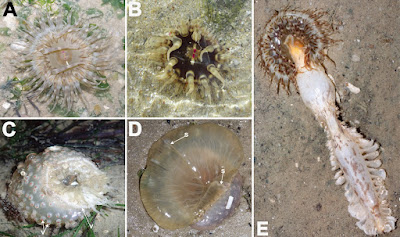

Living individuals of Macrodactyla fautinae sp. nov., external morphology, in situ, top view.
A, an expanded individual with a pale oral disc. B, another expanded colour morph with a dark-brown oral disc. Note that in both A and B, a pair of diametric bright pink dots marks the position of the siphonoglyphs. C, a contracted individual with adhesive, papillae-like verrucae at its distal end. Note that shell fragments are attached to the verrucae. D, an individual with much of its actinopharynx everted, obscuring the animal.
 E, a sea pen (Pteroeides sp.) being swallowed whole by a M. fautinae sp. nov. individual.
Abbreviation: s, siphonoglyph; v, verrucae. Photographs by R Tan.


Macrodactyla fautinae, sp. nov. Yap, Mitchell, Quek, and Huang

Natural history: Occurs as solitary individuals, at the middle intertidal in soft silty, sandy areas, and also found in seagrass meadows (Fig. 8A– E). Animal partially buried in substratum, distal end of animal exposed during the low tides, with small shell pieces, sand and/or rocks adhering to verrucae (Fig. 8C). Oral disc and tentacles typically expanded, with actinopharynx often everted and inflated outwards, in many instances obscuring the animal (Fig. 8D). This species has also been observed to swallow its prey whole (Fig. 8E). When disturbed, animal does not retract completely, tips of tentacles remaining partially exposed (Fig. 8C). In the process of contraction, water may also be expelled from verrucae-like structures, akin to a watering can.

Etymology: The name Macrodactyla fautinae sp. nov. honours the late Emeritus Professor Daphne Gail Fautin. Throughout her career, she had worked tirelessly to advance the knowledge of sea anemones.  
 

CONCLUSIONS: 
In this study, morphological and molecular evidence were integrated to re-diagnose the genus Macrodactyla and redescribe M. aspera. Furthermore, we provided historical, nomenclatural evidence to support the continued usage of the genus name. Since its first description by Haddon and Shackleton (1893), there have been very few published accounts of M. aspera, despite its wide geographical range across the Indo-West Pacific. The reason for this, we suspect, is that this species may have been misidentified as D. armata, due to its strong superficial resemblance. Museum vouchers we have examined support this assertion; some were indeed misidentified as D. armata. Herein, we provided molecular evidence to demonstrate that these two species are distantly related. 
Findings from this study add to a growing number of sea anemone species recorded from Singapore. Previous studies have already documented 37 species to occur on the shores and islands of this city-state (e.g., England 1987; Fautin et al. 2009; Yap et al. 2021). Affirming the identities of these sea anemones primes new avenues where more Indo-West Pacific species may be included in future research.


Nicholas Wei Liang Yap, Michela Lee Mitchell, Zheng Bin Randolph Quek, Ria Tan, Koh Siang Tan and Danwei Huang. 2023. Taxonomy and Molecular Phylogeny of the Sea Anemone Macrodactyla (Haddon, 1898) (Cnidaria, Actiniaria), with a Description of A New Species from Singapore. Zool Stud. 62:29. DOI:10.6620/ZS.2023.62-29 

Sunday, August 6, 2023

[Cnidaria • 2023] Aphanipathes puertoricoensis • A New Species of Black Coral (Anthozoa: Antipatharia: Aphanipathidae) from Puerto Rico


[A, B, F] Aphanipathes puertoricoensis Horowitz & Quattrini, 

[D, G] Anozopathes palauensis

in Horowitz, Opresko, González-García & Quattrini, 2023

Abstract
Black corals (Anthozoa: Antipatharia) are an anthozoan lineage in the class Hexacorallia that occur across a wide range of habitats from the tropics to the poles and from surface waters to depths deeper than 8000 m. A new species of black coral, Aphanipathes puertoricoensis sp. nov., collected with a remotely operated vehicle 357 m deep off Puerto Rico is recognized in the family Aphanipathidae. The new species is characterized by very long and loosely coiled primary branches and up to 0.5 mm tall spines with as many as 40 or more small conical tubercles. A phylogeny composed of 13 taxa that are closely related to the new species was reconstructed from 793 nuclear loci to show their systematic relationships. Our study integrated morphological and genomic data to show that this new species is distinct from other species in the genus Aphanipathes. Furthermore, our results add to the growing knowledge of black coral diversity, while further demonstrating the need for exploration in deep waters of the Caribbean Sea.

Key words: Aphanipathes, molecular phylogenetics, morphology, targeted capture, taxonomy, ultraconserved elements

Comparison of species of Aphanipathes and Anozopathes:
A Aphanipathes puertoricoensis sp. nov., yellow line indicates from where holotype fragment USNM 1660436 was collected B Aphanipathes puertoricoensis sp. nov. holotype collected fragment (USNM 1660436)
C Aphanipathes pedata holotype (NHMUK 1843.2.6.105) D Anozopathes palauensis holotype (USNM 1007104) E Aphanipathes sarothamnoides part of holotype (NHMUK 1890.4.9.5)
F polyps of Aphanipathes puertoricoensis sp. nov. holotype (USNM 1660436) G polyps of Anozopathes palauensis holotype (USNM 1007104).


Family Aphanipathidae Opresko, 2004

Genus Aphanipathes Brook, 1889

 Aphanipathes puertoricoensis Horowitz & Quattrini, sp. nov.

Type locality: Guayanilla Canyon, Puerto Rico, Caribbean Sea, 357 m depth.

Diagnosis: Tall, sparsely branched colony with two and rarely three orders of branches. Stem 0.2 m tall, first order branches over 1 m long, distally slightly curved or coiled, and arranged irregularly around stem; second order branches short and sparsely occurring; third order branches rare. Distal branch angles usually close to 90°. Spines form a distinct quincunx pattern with six axial rows of spines counted in one view. Polypar spines up to 0.5 mm tall, possess 20 to 40 or more small conical tubercles visible in lateral view that extend from the tip halfway to the base. Abpolypar spines up to 0.32 mm tall, possess 10 to 20 small conical tubercles visible in lateral view that extend from the tip halfway to the base. Polypar and abpolypar spines spaced 0.47 to 0.57 mm apart with three spines per mm in each row. Polyps 1.1 to 1.6 mm in diameter, arranged in a single series, with six to eight polyps per cm.


Jeremy Horowitz, Dennis M. Opresko, María del P. González-García and Andrea M. Quattrini. 2023. Description of A New Species of Black Coral in the Family Aphanipathidae (Anthozoa, Antipatharia) from Puerto Rico. ZooKeys. 1173: 97-110. DOI: 10.3897/zookeys.1173.104141