Showing posts with label Ansonia. Show all posts

Saturday, May 11, 2024

[Herpetology • 2024] Enduring the Earthquake: Rediscovery of the Critically Endangered Mesilau Stream Toad, Ansonia guibei Inger, 1966 (Anura: Bufonidae) and its Conservation Implications


Mesilau Stream Toad, Ansonia guibei Inger, 1966

in Quah, Imbun et Yek, 2024.
 
Abstract
The Mesilau Stream Toad (Ansonia guibei) is a species of bufonid endemic to Sabah, Borneo, and restricted to a single mountainous location above 1600m in elevation. The species is only known from the type locality, the Mesilau watershed on Mount Kinabalu. An earthquake in 2015 resulted in massive landslides, causing extensive damage to the species’ habitat at Mesilau. This event was expected to have caused significant population declines of at least 80% or even the potential extinction of the species. A survey in 2017 at Mesilau failed to locate any individuals, which resulted in it being listed as Critically Endangered by the IUCN. Surveys in late 2023 to reassess the status of the species and its habitat resulted in the rediscovery of a single subadult specimen of A. guibei. Tadpoles of the species were recorded in the main Mesilau River and one additional tributary, which indicates the species survives and is breeding. Studies are ongoing to collect more ecological data on the species and determine its current distribution. The data gathered will be used to construct a robust conservation plan for the species. Nevertheless, these preliminary observations bode well for the future of the species as it demonstrates that it is resilient and capable of recovering from the damages caused by the earthquake.

Amphibia, Amphibian, Borneo, endemism, IUCN Red List, Mount Kinabalu, Sabah 


Evan S.H. Quah, Paul Yambun Imbun and Sze Huei Yek. 2024. Enduring the Earthquake: Rediscovery of the Critically Endangered Mesilau Stream Toad, Ansonia guibei Inger, 1966 (Anura, Bufonidae) and its Conservation Implications.  Zootaxa. 5447(2); 253-262. DOI: 10.11646/zootaxa.5447.2.6


Sunday, July 24, 2022

[Herpetology • 2022] Ansonia infernalis • A New Species of Stream Toad of the Genus Ansonia Stoliczka, 1870 (Anura: Bufonidae) from Nakhon Si Thammarat Range in southern Thailand


Ansonia infernalis
Suwannapoom, Grismer, Pawangkhanant & Poyarkov, 2022

Infernal Stream Toad | คางคกห้วยนรก  ||  DOI: 10.11646/zootaxa.5168.2.2
 
Abstract
An integrative taxonomic analysis confirmed the new species status of a recently discovered upland population of Ansonia from Thongsong, Thongsong District, Nakhon Si Thammarat Province, Thailand from the sky island archipelago south of the Isthmus of Kra. Ansonia infernalis sp. nov. is a member of the Thai-Burmese clade within the more inclusive Thai-Malaya Peninsula clade of western and southern Thailand. It is separated from all other species of Ansonia by a unique combination of morphometric and discrete morphological and color pattern characteristics and is the sister species of a clade of eight other species found north of the Isthmus of Kra. Ansonia infernalis sp. nov. is the newest member of a long list of range-restricted endemics from the sky island archipelago of the Thai-Malay Peninsula and continues to underscore the unexplored nature of this region and its need for conservation.

Keywords: Amphibia, molecular phylogenetics, Nakhon Si Thammarat Province, Integrative taxonomy, Southeast Asia, stream toads 

Ansonia infernalis sp. nov.
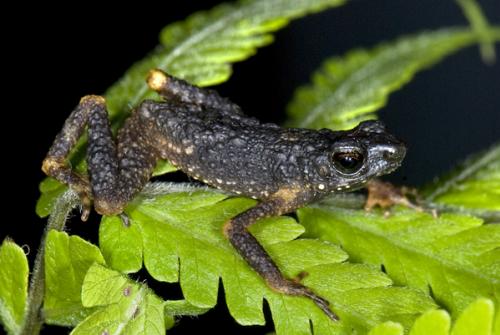
 Lateral view of male holotype (AUP-00327)
 Photographs by P. Pawangkhanant. 
 
Ansonia infernalis sp. nov. 
Male (not collected) in situ at the type locality
in Thungsong District, Nakhon Si Thammarat Provice, Thailand.
Photographs by P. Pawangkhanant.


Ansonia infernalis sp. nov.
Suggested Common Name: Infernal Stream Toad (English), 
คางคกห้วยนรก (Kang Kok Huay Narok) (Thai).

Etymology. The specific name “infernalis” is a Latin adjective meaning “infernal”, “hellish”, and “lower”. The specific name of the new species is in reference to the bright reddish orange coloration of the limbs and flanks that resemble the flames of hell, and also to the low elevation on which the new species can be found.
 

Chatmongkon Suwannapoom, L. Lee Grismer, Parinya Pawangkhanant and Nikolay A. Poyarkov. 2022. A New Species of Stream Toad of the Genus Ansonia Stoliczka, 1870 (Anura: Bufonidae) from Nakhon Si Thammarat Range in southern Thailand. Zootaxa. 5168(2); 119-136. DOI: 10.11646/zootaxa.5168.2.2

Tuesday, December 7, 2021

[Herpetology • 2021] Ansonia karen | คางคกห้วยกะเหรี่ยง • Hidden Tribe: A New Species of Stream Toad of the Genus Ansonia Stoliczka, 1870 (Anura: Bufonidae) from the poorly explored Mountainous Borderlands of western Thailand


 Ansonia karen  
Suwannapoom, Grismer, Pawangkhanant, Naiduangchan, Yushchenko, Arkhipov, Wilkinson & Poyarkov, 2021

คางคกห้วยกะเหรี่ยง | Karen Stream Toad || DOI: 10.3897/vz.71.e73529
 Photos by N. A. Poyarkov & M. Naiduangchan.

Abstract
The integrated results of morphological and molecular phylogenetic analyses confirmed the new species status of a recently discovered population of Ansonia from Suan Phueng District, Ratchaburi Province, Thailand. Ansonia karen sp. nov. is separated from all other species of Ansonia by a unique combination of mensural, discrete morphological, and color pattern characteristics and is the sister species of A. thinthinae from Tanintharyi Division, Myanmar. This discovery fills a geographic hiatus of 350 km between it and A. kraensis from Ranong Province, Thailand. Ansonia karen sp. nov. is the newest member of a long list of range-restricted endemics having been recently discovered in the northern Tenasserim Mountain region of western Thailand and continues to underscore the unexplored nature of this region and its need for conservation.

Key words: Ansonia karen sp. nov., Molecular phylogenetics, Ratchaburi Province, Southeast Asia, Tenasserim Mountains, Thai-Malay Peninsula, toads

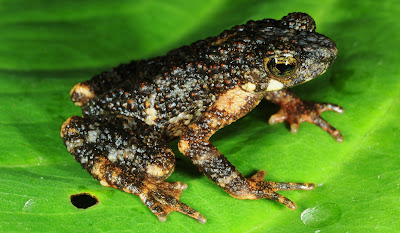
Holotype of  Ansonia karen sp. nov. (ZMMU A-7605)
from Suan Phueng District, Ratchaburi Province, western Thailand.
Photo by N. A. Poyarkov.

Ansonia karen sp. nov. 
Suggested Common Name: Karen Stream Toad 

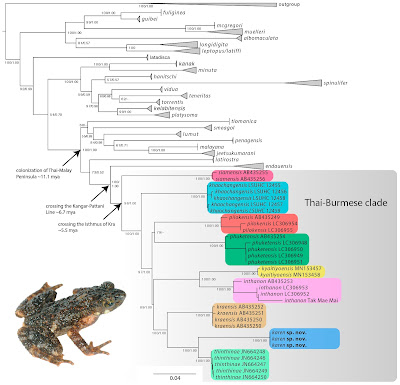
Diagnosis: Ansonia karen sp. nov. is recognized as a member of the genus Ansonia based on the results of the molecular phylogenetic analyses that recover it as the sister species of A. thinthinae (Fig. 2) as well as by a combination of the following morphological characters: small body size (maximum SVL 25.6 mm in males and 29.2 mm in females); long slender limbs bearing long slender digits with bulbous tips; absence of parotoid glands; weak subarticular tubercles; and membranous foot webbing (Inger 1960, 1966, 1992; Wilkinson et al. 2012; Chan et al. 2014; Grismer et al. 2016; Quah et al. 2019). It can be differentiated from all congeners by the following combination of characters: maximum SVL in males 25.4 mm and females 29.2 mm; snout projecting beyond lower jaw; tympanum visible; no interorbital or tarsal ridges; first finger shorter than second; finger tips bulbous, toe tips slightly dilated forming weak discs; approximately 2.5 phalanges free of web on fourth toe and 0.5 phalanges free of web on fifth toe; yellow rictal tubercles at angle of jaw; distinct, red-tipped, spiny tubercles on dorsum and flanks; abdomen coarsely granular; no oblique flaps of skin bordering vent; wide, light-colored patch below eye; light-colored, generally diamond-shaped interscapular spot; large, discrete, yellow, submandibular spots; no light-colored streaks on canthus rostralis; dorsum black, lacking an X-shaped marking surrounding interscapular spot; no dark-colored markings on rump; no dark dorsolateral stripe; iris yellow-gold; fore- and hind limbs bearing irregularly shaped, light-colored crossbars; venter and undersides of limbs dull-yellow bearing thick, grey-brown reticulations; palmar surfaces of hands and thenar surfaces of feet reddish-orange in life.

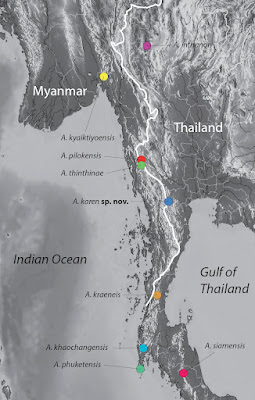
Distribution of the species of the Thai-Burmese clade of Ansonia.


Distribution: Ansonia karen sp. nov. is currently known only from the type locality and nearby locality in same forest stream in the environs of Khao Laem Mountain, in Suan Phueng District of Ratchaburi Province in western Thailand, less than 2.0 km from the international Thai–Myanmar border (Fig. 1). The new species likely inhabits the middle portion of the Northern Tenasserim Mountain range (between the Kanchanaburi and Prachuap Khiri Khan provinces), and is expected to occur in adjacent montane areas in the western part of Phetchaburi Province of Thailand and Thanintharyi Division of Myanmar.

 Natural history of Ansonia karen sp. nov.
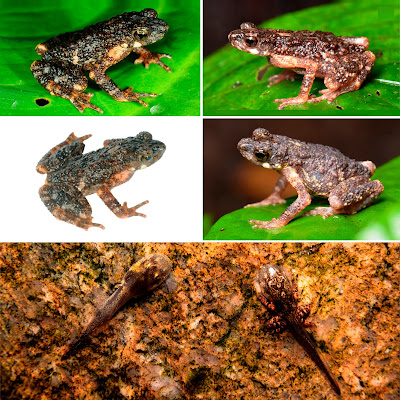
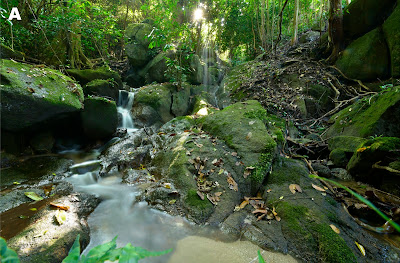
A. Breeding habitat in Suan Phueng District, Ratchaburi Province, western Thailand.
Photo by M. Naiduangchan.

 Ansonia karen sp. nov. 
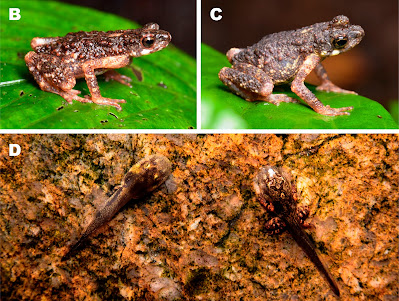
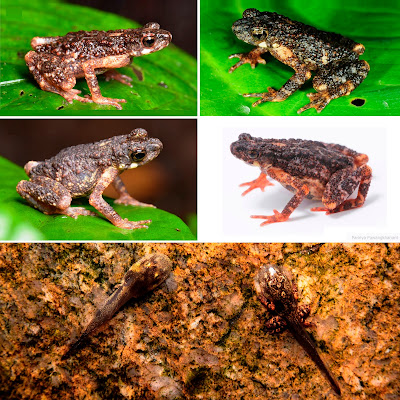
 B. Female of the new species in situ (not collected). C. Male of the new species in situ (not collected).
D. Tadpole at Gosner (1960) stage 38 (AUP-02091, left), and a metamorph at Gosner (1960) stage 44 (AUP-02092, right) in situ.
 Photos by M. Naiduangchan.

Natural history: 
The new species inhabits a polydominant montane tropical evergreen forest on Khao Laem Mountain at elevations from ca. 700 to 750 m a.s.l., where the adult specimens were observed at night perched on leaves or stones (Fig. 7B–C) along an approximately 1–3 m wide, slow-flowing mountain stream (Fig. 7A), or beneath stones along the stream’s edge. The multi-species polydominant tropical forest at the type locality has dense vegetation with tangles of giant bamboo Dendrocalamus asper (Schult.) Backer. Males were calling during our field observations from June to November throughout 2017–2019. The tadpoles of the new species were recorded in the same stream and were usually concentrated in pools under small waterfalls, hiding under gravel on the stream bottom, or sitting on the vertical surfaces of large submerged boulders to which they were attached by their oral discs (Fig. 7D).

The species of amphibians and reptiles recorded in sympatry with the new species at the type locality include: Leptobrachium tenasserimense Pawangkhanant, Poyarkov, Duong, Naiduangchan & Suwannapoom, L. smithi Matsui, Xenophrys cf. major (Boulenger), Leptobrachella melanoleuca (Matsui), L. fuliginosa (Matsui), Amolops panhai Matsui & Nabhitabhata, Alcalus tasanae (Smith), Limnonectes jarujini Matsui, Panha, Khonsue & Kuraishi, L. doriae (Boulenger), L. macrognathus (Boulenger), M. berdmorei (Blyth), Acanthosaura crucigera Boulenger, Pseudoxenodon macrops (Blyth), Trimeresurus popeiorum Smith, and Rhabdophis chrysargos (Schlegel).

Etymology: The specific name “karen” is given as a noun in apposition and refers to the name of the Karen people. Originally inhabiting wide areas in southern and southeastern Myanmar, many Karen have migrated to Thailand, having settled mostly on the Thailand–Myanmar border, including the Suan Phueng District, the type locality of the new species, due to the political turmoil during the end of XX – beginning of XXI centuries. We received significant help and assistance from the local Karen community in Suan Phueng during our field surveys and want to thank them for their permanent support. Nikolay A. Poyarkov also thanks Karen Sarkisian for his support and encouragement.


 Chatmongkon Suwannapoom, L. Lee Grismer, Parinya Pawangkhanant, Mali Naiduangchan, Platon V. Yushchenko, Dmitriy V. Arkhipov, Jeffery A. Wilkinson and Nikolay A. Poyarkov. 2021. Hidden Tribe: A New Species of Stream Toad of the Genus Ansonia Stoliczka, 1870 (Anura: Bufonidae) from the poorly explored Mountainous Borderlands of western Thailand. Vertebrate Zoology. 71: 763-779. DOI: 10.3897/vz.71.e73529 

Friday, August 30, 2019

[Herpetology • 2019] Ansonia kyaiktiyoensis • Discovery of the Westernmost Population of the Genus Ansonia Stoliczka (Anura, Bufonidae) with the Description of A New Species from the Shan Plateau of eastern Myanmar


Ansonia kyaiktiyoensis 
Quah, Grismer, Wood,  Thura, Oaks & Lin, 2019


Abstract
A new species of Ansonia is described from the Shan Plateau of Myanmar based on an integrative taxonomic analysis that differentiates it from all other congeners. Molecular phylogenetic analyses based on the mitochondrial genes 12S and 16S rRNA and tRNA-val recover Ansonia kyaiktiyoensis sp. nov. as the sister species to A. inthanon from Thailand but differs from it and other congeners by at least a 5.0% sequence divergence. It is further differentiated by the following combination of morphological characters: (1) maximum SVL 24 mm in males and females; (2) first finger shorter than second; (3) absence of interorbital and tarsal ridges; (4) presence of light-coloured interscapular spot; (5) presence of yellow rictal tubercle; (6) absence of wide, light-coloured patch below eye; (7) presence of large, discrete, bright-yellow submandibular spots along the underside of lower jaw; (8) iris yellow-gold; (9) presence of markings on the snout consisting of streaks below the eye to the lip, and on the canthus rostralis to the nostril; (10) dorsum grey-brown with orange-beige spots, a dark-brown X-shaped marking on the back surrounding the interscapular spot, and dark-coloured markings on rump; (11) fore- and hind limbs with orange-beige cross-bars; and (12) venter light-gray with yellow spotting, especially near flanks and underside of hind limbs. Ansonia kyaiktiyoensis sp. nov. is the westernmost known record for the genus and the only species west of the Salween Basin. Its discovery echoes the increasing number of herpetological discoveries being made in upland regions fringing the Ayeyarwady and Salween Basins.

Keywords: Amphibia, Burma, endemism, amphibian, phylogenetics, systematics, montane, Ayeyarwady Basin, Salween Basin


Ansonia kyaiktiyoensis sp. nov.
  

Evan S. H. Quah, L. Lee Grismer, Perry L. Jr. Wood,  Myint Kyaw Thura, Jamie R. Oaks and Aung Lin. 2019. Discovery of the Westernmost Population of the Genus Ansonia Stoliczka (Anura, Bufonidae) with the Description of A New Species from the Shan Plateau of eastern Myanmar.  Zootaxa. 4656(3); 545–571. DOI: 10.11646/zootaxa.4656.3.11

Thursday, September 29, 2016

[Herpetology • 2016] Out of Borneo, Again and Again: Biogeography of the Stream Toad Genus Ansonia Stoliczka (Anura: Bufonidae) and the Discovery of the First Limestone Cave-dwelling Species, Ansonia khaochangensis, from southern Thailand


 Ansonia khaochangensis  
Grismer, Wood, Aowphol, Cota, Grismer, Murdoch, Aguilar & Grismer, 2016 

Cave-dwelling Stream-Toad | คางคกห้วยถ้ำ
(เขาช้าง)พังงา
 
 DOI:  
10.1111/bij.12886 


Abstract

Subsequent to the Miocene (approximately 35 Mya), Borneo has served as an insular refuge and a source of colonization for a broad range of species emigrating to others parts of Sundaland. A phylogeny-based historical biogeographical hypothesis for the Stream Toad genus Ansonia supports multiple instances of an out-of-Borneo scenario. An ancestral range estimation indicates that in situ speciation of Ansonia on the island of Borneo during the Late Miocene and Pliocene (approximately 2–13 Mya) eventually resulted in an invasion of the Philippines, Sumatra, and two independent invasions of the Thai-Malay Peninsula. When collecting material for the biogeographical analysis, a new species of Ansonia, Ansonia khaochangensis sp. nov. was discovered in a limestone cave from the Khao Chang karst tower in Phangnga Province, in southern Thailand. Ansonia khaochangensis sp. nov. can be differentiated from all other species of Ansonia by having a unique combination of morphological and colour pattern characteristics. Phylogenetic evidence based on the mitochondrial genes 12S and 16S indicates that it is nested within a clade of other species distributed north of the Isthmus of Kra. The cave lifestyle of this new species is a unique and a significant departure from lotic environments common to most other species of Ansonia. The reproductive biology of this species is unknown.


Ansonia khaochangensis sp. nov.
Cave-dwelling Stream-Toad

Diagnosis. Ansonia khaochangensis sp. nov. can be differentiated from all other species of Ansonia by the combination of the following characters: maximum SVL of 35.5 mm (34.0–35.3 mm) for females and 32.0 mm (31.9–32.0 mm) for males; snout projecting beyond lower jaw; tympanum visible; vocal sac opening on right; no white or yellow tubercle at rictus; no tuberculate, interorbital ridges; finger and toe tips rounded, bulbous but not forming discs; first finger not reaching disc of second; webbing formula on foot I 1, II ½–2, III 1½–2, IV 2–2, V 1; tarsal ridge present; inner and outer metatarsal tubercles present; submandibular tubercles absent; dorsal tubercles present but small, low, and rounded; no dorsolateral row of enlarged tubercles on sides or back; no oblique flap of skin on either side of vent; abdomen and gular region coarsely granular; iris black; no light spots on the gular region or abdomen; no suborbital or postorbital white markings; no light interscapular spot; no light crossbars on hind limbs, no light vertebral stripe. These character states are scored across all species of Ansonia in Table 4.


Distribution. Ansonia khaochangensis sp. nov. is known only from the type locality at Takua Pa District, Phang Nga Province, southern Thailand (Fig. 1).

Natural history. Ansonia khaochangensis sp. nov. is only known from the Khao Chang tower karst formation that rises precipitously to an elevation of 125 m and frames the northwest border of the city of Phang Nga (Fig. 6). Along the southeast face of the karst formation is the massive Phung Chang Cave that has a subterranean water system that runs beneath the karst tower. This southeast face is also riddled with several smaller caves. Approximately 0.5 km southwest of the mouth of Phung Chang Cave is a very small opening at the base of the karst tower that winds its way inward for approximately 20 m wherein we found A. khaochangensis sp. nov. (Fig. 6). During the day, specimens were found only within the recesses of the cave on the vertical cave walls as high as 3 m above the cave floor. To escape, toads were able to move sideways up the cave walls in an attempt to wedge themselves into narrow cracks near the celling. Toads were also observed in the cave at night but would venture out to climb on the outside of the karst tower. Some specimens were found as high as 10 m above the forest floor both on the karst and sitting on the leaves of small plants growing out of the karst. The distinctive, virtually monochromatic, brown coloration of this species appears to be a result of substrate matching in that frogs are reasonably well-camouflaged on the limestone substrate. We interpret this as an indication that this microhabitat is not something that is occasionally utilized and that this genus, which has a lotic life style elsewhere, has adapted to this microhabitat over a long period of time in that it split off from its sister lineage approximately 5.5 Mya (Fig. 3).

The reproductive biology of this species is completely unknown. Most other Ansonia require fast-moving lotic systems and all require water for tadpole development. We assume that there are other sources of underground water that these toads must be using for reproduction because there are no above-ground systems nearby that we could find. Fieldwork is currently being planned to investigate this species’ presumably unique reproductive biology.

Etymology. The specific epithet khaochangensis is in reference to the type locality of this species in the Khao Chang tower karst formation.


L. Lee Grismer, Perry L. Wood Jr, Anchalee Aowphol, Michael Cota, Marta S. Grismer, Matthew L. Murdoch, Cesar Aguilar and Jesse L. Grismer. 2016. Out of Borneo, Again and Again: Biogeography of the Stream Toad Genus Ansonia Stoliczka (Anura: Bufonidae) and the Discovery of the First Limestone Cave-dwelling Species.
Biological Journal of the Linnean Society.  DOI:  10.1111/bij.12886 


Tuesday, June 24, 2014

[Herpetology • 2014] Ansonia vidua | Murud Black Slender Toad • Dressed in Black. A New Ansonia Stoliczka, 1870 (Anura: Bufonidae) from Gunung Murud, Sarawak, East Malaysia (Borneo)


Ansonia vidua Hertwig, Min, Haas & DAS, 2014
Adult female, Murud Black Slender Toad 

Abstract
A new species of stream toad of the genus Ansonia is described from Gunung Murud, Pulong Tau National Park, of northern Sarawak, Malaysia, Borneo. Ansonia vidua, sp. nov., is morphologically distinguished from its Bornean congeners by the following combination of characters: medium size (SVL of adult females 33.5–34.4 mm); body uniformly black-brown in life; absence of a visible pattern on dorsum or limbs; presence of two low interorbital ridges; shagreened skin on dorsum, sides and upper surfaces of the limbs with numerous homogeneously small, rounded warts; first finger shorter than second; reduced webbing between the toes and an absence of a sharp tarsal ridge. Uncorrected genetic distances between related taxa of > 4.3% in 16S rRNA gene support its status as a hitherto undescribed species.

Keywords: Amphibia, Ansonia vidua sp. nov., Pulong Tau National Park, systematics


Etymology. The species name vidua means ´widow´ and refers to the uniform brownish-black colouration in life of this species, which is traditionally the colour of choice by widows. We suggest the English vernacular name ‘Murud Black Slender Toad’ for the species.

Ecological notes: The type locality is situated between this unnamed small side stream [the edge of the summit trail to Gunung Murud, Pulong Tau National Park] and the Sugei Murud that runs eastward from near the summit of Gunung Murud down to the plateau of the Kelabit Highlands. The type locality is situated just below the summit ridge of the Gunung Murud massif. In this undisturbed montane mossy forest (Beaman 1999; Beaman & Anderson 1997; Mjöberg 1925), the following species of frogs have been recorded in sympatry: Limnonectes cf. kuhlii, Philautus mjobergi, P. cf. petersi, Pelophryne murudensis and Leptobrachium montanum. The amphibian fauna of Gunung Murud has been described by Das (2005, 2008). The discovery of a new and possibly endemic species from the Gunung Murud massif underlines the importance of the Pulong Tau National Park in the protection of the highly diverse montane amphibian fauna of Sarawak and that of Borneo.


Hertwig, Stefan T., Pui Y. Min, Alexander Haas & Indraneil DAS. 2014. Dressed in Black. A New Ansonia Stoliczka, 1870 (Lissamphibia: Anura: Bufonidae) from Gunung Murud, Sarawak, East Malaysia (Borneo). Zootaxa. 3814(3): 419–431.

Sunday, February 26, 2012

[Herpetology • 2007] Sabahphrynus | new genus from Borneo • Taxonomic relationshiops of Ansonia anotis and Pedostibes maculatus with a description of a new genus (Amphibia, Bufonidae)


Fig. 3. Views of living (A) Ansonia anotis (SP 26033 from Riou Hutan Simpan, Kiau, Mt. Kinabalu) and
(B) Pedostibes maculatus (KUHE 38505 [formerly BORNEENSIS 08681], from Trail 5 of Ulu Kimanis, Crocker Range). 

Genus Sabahphrynus 


Abstract
Examination of types and recently collected specimens revealed that Ansonia anotis Inger, Tan, and Yambun, 2001 and Pedostibes maculatus (Mocquard, 1890), both described from Kinabalu, Sabah, Malaysia, are hardly differentiated morphologically. Analyses of a total of 2,427 bp of the 12S rRNA, tRNAval, and 16S mitochondrial rRNA genes revealed that the two species are very close genetically. Thus A. anotis is regarded as conspecific and is synonymized with P. maculatus. Genetically, this species proved to form a lineage distinct from other bufonids from Southeast Asia, including species of Ansonia and Pedostibes. Because the species has also some unique morphological traits different from known bufonid genera, we propose to establish a new genus for Nectophryne maculata Mocquard, 1890.

Keywords: Malaysia, molecular phylogeny, new genus, Sabah, synonymy


Matsui, M., Yambun, P., and Sudin, A. 2007. Taxonomic relationshiops of Ansonia anotis Inger, Tan, and Yambun, 2001, and Pedostibes maculatus (Mocquard, 1890), with a description of a new genus (Amphibia, Bufonidae). Zoological Science, 24, 1159-1166. DOI: 10.2108/zsj.24.1159


Inger, R.F., Tan, F.L. and Yambun, P. 2001. A new species of toad of the genus Ansonia (Anura: Bufonidae) from Borneo. Raffles. Bull. Zool. 49: 35–37

Thursday, February 23, 2012

[Herpetology • 2009] Ansonia echinata • A New Species of Bufonid (Anura: Bufonidae) from Borneo


Ansonia echinata Inger & Stuebing, 2009


Ansonia echinata Inger & Stuebing, 2009
Type locality: "Bukit Kana, Bintulu Division, Sarawak (2°39.363′ N 112°54.219′ E) [Malaysia] ... specimen collected at night perched on dead leaves at the edge of a small stream (3 m wide) in primary rain forest."
Holotype: FMNH 272784.

Inger, R.F. & R.B. Stuebing. 2009: New Species and New Records of Bornean Frogs (Amphibia: Anura). Raffles Bulletin of Zoology. Singapore, 57: 527-535.: http://rmbr.nus.edu.sg/rbz/biblio/57/57rbz527-535.pdf

[Herpetology • 2008] Ansonia latiffi & A. jeetsukumarani • Two new species of torrent-dwelling toads Ansonia Stoliczka, 1870 (Anura: Bufonidae) from peninsular Malaysia


Abstract
Two new species of montane, torrent-dwelling toads of the genus Ansonia from Fraser’s Hill and Sungai Lembing, Pahang, West Malaysia are described based on morphological and color pattern characteristics. The new species from Sungai Lembing most closely resembles A. leptopus of Borneo but differs from it in numerous aspects of its mandibular asperites, degree of toe webbing, presence of warts at the angle of the jaw, size of tubercles around the tympanum, having an inner metatarsal tubercle, lacking rows of tubercles on the back, having paired vocal slits, and having a light dorsal spot between the scapulae. The new species from Fraser’s Hill most closely resembles A. malayana but differs from it in its greater degree of dorsal tuberculation, more webbing on the third and fifth toes and less webbing on the first and fourth toes, and various aspects of coloration. Finally, we express the importance of continuing to conduct montane surveys in remote areas as well as in those areas that are considered to be well-studied.

Key words: Ansonia; Banjaran Timur; Banjaran Titi Wangsa; Fraser’s Hill; Sungai Lembing; West Malaysia

FIG. 1.— Distribution of Ansonia on the Malay Peninsula. State boundaries are present only for Malaysia. Closed circles are the known localities for A. jeetsukumarani. Shaded circles are the known localities for A. latiffi.


Ansonia latiffi sp. nov.
Synonym: Ansonia leptopus Grandison 1972: 49
Ansonia sp. Dring 1979:188.
Holotype.— ZRC 1.12418, an adult female from the Sungai Lembing logging camp (3u 52.260 N; 103u 39 0.150 E), Pahang, West Malaysia, collected at 255 m on 1 August 2002 by J. A. McGuire, L. L. Grismer, J. L. Grismer, R. Escobar, Norsham, S. Y., and T. M. Youmans.

Natural history.— The Sungai Lembing specimens were collected between 2100 and 2300 h no more than 1 m above the ground from within rock cracks along a rock wall bordering a road cut at the edge of a closedcanopy hill dipterocarp forest. Small streams were within 100 m of the collection site but no tadpoles or calling males were observed. Additional specimens collected by Grandison (1972) from Gunung Benom were obtained in a 200 m stretch of a fast-flowing tributary of the River Krau about 500 m down stream from their base camp at 233 m bordering primary forest. Two more specimens were collected by Dring (1979) on the bank of the Sungai Kelebang at 43 m on Gunung Lawit.
Etymology.— The specific epithet honors Professor Dato’ Dr. Abdul Latiff Mohamad for his extensive contributions to the natural history of Malaysia and to the biologists studying Malaysian natural history.

Ansonia latiffi photo by http://iwana.com.my/


Ansonia jeetsukumarani sp. nov.
Figs. 7–11.
Synonym: Bufo penangensis, Smith, M. A. 1922:282.
Holotype.— ZRC 1.12413, a gravid female from a small stream along Bishop’s Trail (3u 43.2349 N; 101u 44.8919 E) at 1125 m on Fraser’s Hill, Pahang, West Malaysia collected on 26 August 2006 by L. Grismer, T. R. Szutz and T. M. Youmans.

Natural history.— All specimens were collected between 1930–2330 h on rocks and from small leaves approximately 0.5–1.5 m above the ground near small streams. All were found in closed canopy hill dipterocarp forest except for ZRC 1.12414, which was collected off a leaf above a roadside stream at the edge of a closed canopy forest. No tadpoles or calling males were observed at either locality.

Etymology.— The specific epithet honors Jeet Sukumaran for his past, present and future contributions to our knowledge of the biology of Malaysia’s amphibians and for his untiring and invaluable contributions as a
collaborator.


Ansonia jeetsukumarani photo by http://iwana.com.my/


Key to the Known Species of Ansonia 
from Thailand and Peninsular Malaysia

1. Large yellow wart at the angle of the jaw_ _ _ _ _  _ _ _ _ _ _ _ _  _ _ _ _ _ _ _ 2
Large yellow wart absent from the angle of the jaw_ _ _ _ _ _ _ _ _ _ _ _ _ _ _ _ _ 3
2. Dorsolateral row of enlarged tubercles present _ _ _ _ _  _ _ _ _ Ansonia latirostra
Dorsolateral row of enlarged tubercles absent_ _ _ _ _ _ _ _ _ _ _ Ansonia malayana
3. Maximum adult SVL $ 29 mm_ _ _ _ _ _ _ _ _ _ _ _ _ _ _ _ _ _ _ _ _ _ _ _ _ _ 4
Maximum adult SVL # 28 mm_ _ _ _ _ _ _ _ _ _ _ _ _ _ _ _ _ _ _ _ _ _ _ _ _ _ _ 5
4. First finger reaching the tip of the second_ _ _ _ _ _ _ _ _ _ _ _ _ _ _ Ansonia lattifi
First finger not reaching the tip of the second _ _ _ _ _ _ _ _ _ _ _ _ _ _ _ _ _ _ _ _ 6
5. Light interscapular spot absent_ _ _ _ _ _ _ _ _ _ _ _ _ _ _ _ _ Ansonia endauensis
Light spot interscapular present _ _ _ _ _ _ _ _ _ _ _ _ _ _ _ _ _ _ _ _ _ _ _ _ _ _ _ 8
6. First and second toes lacking phalanges free of webbing_ _ _ _Ansonia penangensis
First and second toes with all phalanges free of webbing_ _ _ _ _ _ _ _ _ _ _ _ _ _ _ 7
7. Body marked with greenish-yellow irregular lines_ _ _ _ _ _ _ _ _Ansonia siamensis
Body lacking greenish-yellow lines _ _ _ _ _ _ _ _ _ _ _ _ _ _ _ _ Ansonia tiomanica
8. Tubercle rows on back; gular spots present_ _ _ _ _ _ _ _ Ansonia jeetsukumarani
Rows of dorsal tubercles absent; gular spots absent_ _ _ _ _ _ _ _ _Ansonia kraensis

Wood, Perry L., Jr., L. Lee Grismer, Norhayati Ahmad and Juliana Senawi. 2008. Two new species of torrent-dwelling toads Ansonia Stoliczka, 1870 (Anura: Bufonidae) from peninsular Malaysia. Herpetologica. 64 (3): 321-340 : http://www.nhm.ku.edu/rbrown/Wood.etal08.jeetsukumarani.pdf

[Herpetology • 2006] Ansonia latirostra • A new species of Ansonia Stoliczka, 1870 from central Peninsular Malaysia and a revised taxonomy for Ansonia from the Malay Peninsula


Abstract
A new, montane species of Ansonia is described from the state of Pahang in central, peninsular Malaysia on the basis of having a unique combination of head, body, digit, and color pattern characteristics. This new species is similar to A. malayana, to which it is closest geographically, but differs greatly in aspects of head morphology and body tuberculation. A review of Ansonia from the Malay Peninsula demonstrates that the population of  A. malayana  from Tasan, Chumphon Province, Thailand is  A. kraensis  and  A. penangensis  from Ulu Tahan, Pahang in peninsular Malaysia is not conspecific with A. penangensis from Pulau Penang but an additional, undescribed species ranging throughout northwestern, peninsular Malaysia.
Key words: Bufonidae; Ansonia; Malaysia; Thailand; new species


Ansonia latirostra sp. n.
Holotype. ZRC 1.11559 (Fig. 2), an adult female from the Sungai Lembing logging camp (3° 52.26” N, 103° 3’.13” E), Pahang, Malaysia collected at 255 m elevation on 1 August 2002 by J. A. McGuire, J. L. Grismer, R. Escobar, P. L. Wood, Norsham, S. Y., and T. M. Youmans

Etymology. The specific epithet is in reference to this species’ wide snout.

Natural history. All individuals were collected during the evening from the same, small, rocky stream which runs through a closed-canopy portion of hill dipterocarp forest. All were perched no higher than two meters above the ground on leaves overhanging the streambed or on the tops of large rocks along the edge of the stream. No calling males were heard nor were any tadpoles observed.

FIGURE 1. Distribution of Ansonia on the Malay Peninsula and adjacent islands.

Grismer, L.L. 2006. A new species of Ansonia Stoliczka 1872 (Anura: Bufonidae) from central Peninsular Malaysia and a revised taxonomy for Ansonia from the Malay Peninsula. Zootaxa. 1327: 1-21.

Lee Grismer 2008. Ansonia latirostra. In: IUCN 2011. IUCN Red List of Threatened Species. Version 2011.2. <iucnredlist.org>. Downloaded on 23 February 2012.

[Herpetology • 2006] Ansonia endauensis • A new species of Ansonia Stoliczka, 1870 (Anura: Bufonidae) from a lowland rainforest in Southern Peninsular Malaysia


Ansonia endauensis 
photo from: http://amphibia.my/

Abstract
A new, lowland species of Ansonia is described from the Endau-Rompin National Park in southern peninsular Malaysia based on having a unique eye color and dual vocal slits, as well as a unique combination of head, body, digit, and color pattern characteristics. This new species is the southernmost member of the genus in continental Asia and emphasizes the importance for additional field work in southern Malaysia.
Key words: Ansonia; Bufonidae; Endau-Rompin; Malaysia


FIG. 1.— Distribution of Ansonia in the Malay Peninsula and adjacent islands.


L. Lee Grismer, 2006: A new species of Ansonia Stoliczka, 1870 (Anura: Bufonidae) from a lowland rainforest in Southern Peninsular Malaysia. Herpetologica, 62 4:466–475