Showing posts with label Stegosauria. Show all posts

Monday, April 1, 2024

[Paleontology • 2024] Thyreosaurus atlasicus • A New stegosaurian dinosaur (Ornithischia: Thyreophora) with A remarkable dermal armour from the Middle Jurassic of North Africa


Thyreosaurus atlasicus
Zafaty, Oukassou, Riguetti, Company, Bendrioua, Tabuce, Charrière & Pereda-Suberbiola, 2024

 
Highlights: 
Thyreosaurus atlasicus, a new stegosaur from the Middle Jurassic of North Africa is presented.
• The new taxon is characterised by an asymetric bizarre dermal armour, unique among stegosaurs.
Thyreosaurus is closely related to Dacentrurus among Dacentrurinae.
• The discovery is important in understanding the evolutionary history of thyreophorans.

Abstract
In recent years the Middle Atlas of Morocco has become an area of interest for the study of dinosaurs in northern Africa. The Boulahfa locality, near Boulemane, has produced a diverse dinosaur assemblage from the Middle Jurassic of the El Mers Group. Fossil remains of sauropods and thyreophorans, such as ankylosaurs (Spicomellus) and stegosaurs (Adratiklit), have been reported thus far in this region. Here, we describe a new partial thyreophoran skeleton found in the gray marls of the El Mers III Formation (Bathonian-? Callovian), which mainly consists of disarticulated dorsal vertebrae and ribs, and associated dermal armour elements. Axial characters (e.g., elongated pedicels of the dorsal neural arches; upturned transverse processes and dorsal ribs with straight axes suggesting a narrow ribcage) indicate that the specimen belongs to a medium to large-sized stegosaur. The dorsal vertebrae show differences with those of Adratiklit, whose material has been found at the same stratigraphic levels. Thyreosaurus atlasicus gen. et sp. nov. is characterized by a remarkable dermal armour, which consists of thick (up to 4 cm) subovate to subrectangular-shaped osteoderms. The asymmetrical texture of their sides, one roughly ornamented with small pits and fiber bundles, the other with a well-marked cross-hatched pattern, is clearly different from that observed to date in other stegosaurs (and ankylosaurs). The bone histology of these osteoderms is reminiscent of that of stegosaur tail spines. It is interpreted that these osteoderms were arranged in a recumbent position over the body of the animal, instead of an erect position. The holotype corresponds to an adult individual who did not reach its maximum body size (estimated body length 6 m). The phylogenetic analysis suggests that Thyreosaurus is closely related to Dacentrurus within Dacentrurinae. The recent discoveries of Adratiklit and Thyreosaurus provide insight into the early evolution of stegosaurs in the Middle Jurassic of Africa.


Thyreosaurus atlasicus gen. et sp. nov.


Omar Zafaty, Mostafa Oukassou, Facundo Riguetti, Julio Company, Saad Bendrioua, Rodolphe Tabuce, André Charrière and Xabier Pereda-Suberbiola. 2024. A New stegosaurian dinosaur (Ornithischia: Thyreophora) with A remarkable dermal armour from the Middle Jurassic of North Africa. Gondwana Research. In Press. DOI: 10.1016/j.gr.2024.03.009

Friday, March 4, 2022

[Paleontology • 2022] Bashanosaurus primitivus • New Stegosaurs (Ornithischia, Stegosauria) from the Middle Jurassic Lower Member of the Shaximiao Formation of Chongqing, China


Bashanosaurus primitivus
Dai, Li, Maidment, Wei, Zhou, Hu, Ma, Wang, Hu & Peng, 2022

 
ABSTRACT
Stegosaurs are a major clade of ornithischian dinosaurs, yet because of their fragmentary fossil record, their interrelationships and early evolution are poorly understood. Here, we describe a new stegosaur, Bashanosaurus primitivus, gen. et sp. nov., and some other indeterminate stegosaur materials. We provide new U-Pb detrital zircon ages for horizons bounding the holotypic quarry in the Lower Member of the Shaximiao Formation, Yunyang, Chongqing Municipality, China, which indicate a Middle Jurassic (Bajocian) age. Bashanosaurus represents the earliest record of stegosaurs in Asia and one of the earliest records of this clade in the world. The dorsal vertebrae, scapula, coracoid, femur, and plates of Bashanosaurus primitivus possess several unique characters among Stegosauria, including the elevation of the parapophyses of dorsal vertebrae on stalks at the base of the transverse processes, a flared distal end of the scapula, and a small acromial process. Among armored dinosaurs (thyreophorans), these features are reminiscent of the basally branching taxon Scelidosaurus, indicating that Bashanosaurus possesses a unique mosaic of plesiomorphic thyreophoran and derived stegosaur features. Phylogenetic analysis shows that Bashanosaurus primitivus is the earliest-diverging stegosaur, along with Chungkingosaurus, from the Upper Member of the Shaximiao Formation, consistent with the early age of the taxon.


DINOSAURIA Owen, 1842
ORNITHISCHIA Seeley, 1887
STEGOSAURIA Marsh, 1877

BASHANOSAURUS PRIMITIVUS, gen. et sp. nov.

Diagnosis—Bashanosaurus primitivus differs from all other stegosaurs by possession of the following autapomorphies: (1) the parapophyses of dorsal vertebrae are elevated on stalks at the base of the transverse process and are clearly visible in anterior and posterior views; (2) the scapula blade is slender and flares distally; (3) the acromial process of the scapula is small, triangular and poorly developed; (4) the 4th trochanter of the femur is positioned below the middle of the shaft; (5) the bases of plates are strongly convex and transversely thickened, and are separated from the anterior/posterior margins of the plates by a distinct groove.

Etymology—The generic name “Bashan” refers to the ancient name of Chongqing, and the specific name “primitivus” indicates that this newly named species represents the earliest-diverging stegosaur.

...

 CONCLUSIONS: 
Bashanosaurus primitivus is the earliest record of Stegosauria in Asia and represents one of the earliest records of this clade from anywhere in the world. Geochronological data and analysis support a Middle Jurassic (Bajocian) age for the Shaximiao Formation in the vicinity of Pu’an Township, China. Phylogenetic analysis indicates that Bashanosaurus primitivus is the earliest-diverging stegosaur along with Chungkingosaurus supporting an Asian origin for Stegosauria based on currently available data.

 
Dai Hui, Li Ning, Susannah C. R. Maidment, Wei Guangbiao, Zhou Yuxuan, Hu Xufeng, Ma Qingyu, Wang Xunqian, Hu Haiqian and Peng Guangzhao. 2022. New Stegosaurs from the Middle Jurassic Lower Member of the Shaximiao Formation of Chongqing, China. Journal of Vertebrate Paleontology.   e1995737. DOI: 10.1080/02724634.2021.1995737 

Friday, December 3, 2021

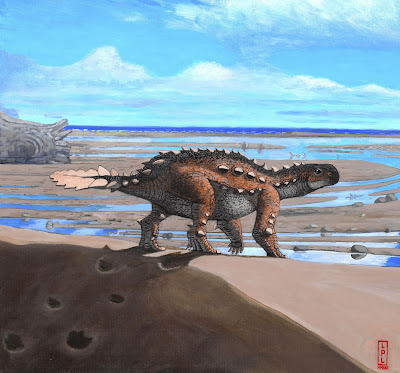
[Paleontology • 2021] Stegouros elengassen • Bizarre Tail Weaponry in A Transitional Ankylosaur (Thyreophora: Parankylosauria clade nov.) from Subantarctic Chile


Stegouros elengassen 
Soto-Acuña, Vargas, Kaluza, Leppe, Botelho, Palma-Liberona, Gutstein, Fernández, Ortiz, Milla, Aravena, Manríquez, Alarcón-Muñoz, Pino, Trevisan, Mansilla, Hinojosa, Muñoz-Walther & Rubilar-Rogers, 2021

Illustration: Luis Pérez López 

Abstract
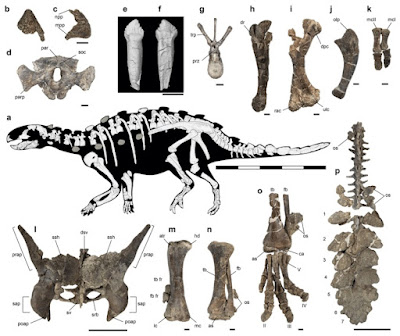
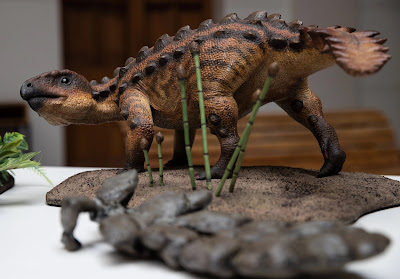
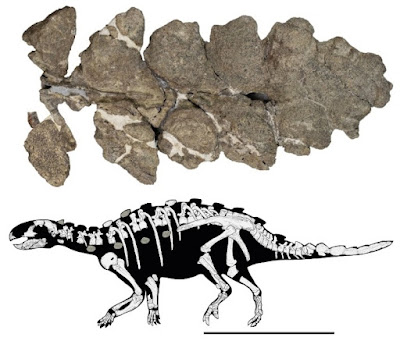
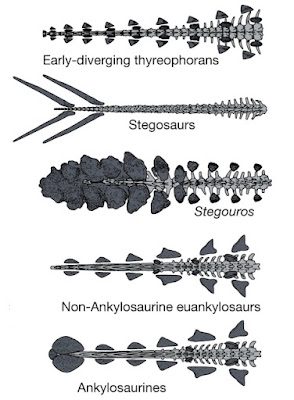
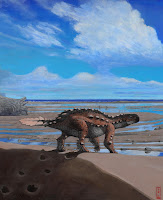
Armoured dinosaurs are well known for forms that evolved specialized tail weapons: paired tail spikes in stegosaurs, and heavy tail clubs in advanced ankylosaurs. Armoured dinosaurs from southern Gondwana are rare and enigmatic, but likely include the earliest branches of Ankylosauria. Here, we describe a mostly complete, semiarticulated skeleton of a small (about 2m) armoured dinosaur from the late Cretaceous of Magallanes in southernmost Chile, a region biogeographically related to West Antarctica. Stegouros elengassen gen. et sp. nov. evolved a large tail weapon unlike any dinosaur: A flat, frond-like structure formed by 7 pairs of laterally projecting osteoderms encasing the distal half of the tail. Stegouros shows ankylosaurian cranial characters, but a largely primitive postcranial skeleton, with some stegosaur-like characters. Phylogenetic analyses placed Stegouros in Ankylosauria, and specifically related to Kunbarrasaurus from Australia and Antarctopelta from Antarctica, forming a clade of Gondwanan ankylosaurs that split earliest from all other ankylosaurs. Large osteoderms and specialized tail vertebrae in Antarctopelta suggest it had a tail weapon similar to Stegouros. We propose a new clade, the Parankylosauria, to include the first ancestor of Stegouros but not Ankylosaurus, and all descendants of that ancestor.

KEYWORDS: dinosaurs, tail weapons, anylosaurus, stegosaurus


Dinosauria Owen, 1842 
Ornithischia Seeley, 1887 
 
Thyreophora Nopcsa 1928 
Ankylosauria Osborn, 1923 

Parankylosauria clade nov. 

Stegouros elengassen gen. et sp. nov. 

Etimology— Stegouros, after the Greek stego (roof) and the Greek uros (tail) in reference to the covered tailelengassen, after an armoured beast in the mythology of the local Aónik’enk people.

Locality and horizon—Río de las Chinas Valley, Estancia Cerro Guido, Magallanes Region, Chilean Patagonia (51°S). Lower section of Dorotea Formation (upper Campanian – lower Maastrichtian), between 71.7 ± 1.2 Ma and 74.9 ± 2.1 Ma10,11 (Supplementary Information section 2, Supplementary Fig. 2).

Armoured dinosaurs are the only amniotes to have evolved three different specialized tail weapons in Stegosauria, Stegouros and Ankylosaurinae.


Sergio Soto-Acuña, Alexander Vargas, Jonatan Kaluza, Marcelo Leppe, Joao Botelho, José Palma-Liberona, Carolina Gutstein, Roy Fernández, Hector Ortiz, Verónica Milla, Bárbara Aravena, Leslie Manríquez, Jhonatan Alarcón-Muñoz, Juan Pino, Christine Trevisan, Héctor Mansilla, Luis Hinojosa, Vicente Muñoz-Walther and David Rubilar-Rogers. 2021. Bizarre Tail Weaponry in A Transitional Ankylosaur from Subantarctic Chile. Nature. DOI: 10.1038/s41586-021-04147-1


Saturday, August 17, 2019

[Paleontology • 2019] Adratiklit boulahfa • North Africa's First Stegosaur: Implications for Gondwanan Thyreophoran Dinosaur Diversity


Adratiklit boulahfa 
Maidment, Raven, Ouarhache & Barrett, 2019


Highlights: 
• Adratiklit boulahfa is a new genus of stegosaur from Morocco.
• Adratiklit is the oldest definitive stegosaur and the first from north Africa.
• It is closely related to the European stegosaurs Dacentrurus and Mirigaia.
• The dinosaur fossil record of Gondwana is biased.
• Armoured dinosaurs may have been as diverse in Gondwana as they were in Laurasia.

Abstract
Eurypoda, the major radiation of armoured dinosaurs, comprises the ankylosaurs and their sister group, the stegosaurs. As the earliest-branching major clade of ornithischian dinosaurs, the evolutionary history of Eurypoda is significant for understanding both the palaeobiology of bird-hipped dinosaurs and the composition of middle Mesozoic ecosystems. Eurypodans were diverse and abundant throughout the Late Jurassic and Cretaceous in Laurasia; in contrast, their remains are extremely rare in Gondwana. Herein, we describe a new genus and species of stegosaur from the Middle Jurassic of Morocco, Adratiklit boulahfa. Adratiklit is the first eurypodan from north Africa and the oldest definitive stegosaur from anywhere in the world. The genus is more closely related to the European stegosaurs Dacentrurus and Miragaia than it is to the southern African taxa Kentrosaurus and Paranthodon. Statistically significant correlations between the number of dinosaur-bearing formations, dinosaur-bearing collections, and eurypodan occurrences in Gondwana indicates that their fossil record is biased by both geological and anthropogenic factors. Tantalizing but fragmentary remains and trackways suggest that eurypodan diversity in Gondwana may have been as rich as that of Laurasia, and the prospects for future discoveries of new genera across Gondwana are therefore very good.

Keywords: Stegosauria, Eurypoda, Morocco, Gondwana, Middle Jurassic, Diversity

 NHMUK PV R37366, holotype specimen of Adratiklit boulahfa.

NHMUK PV R37367, isolated cervical vertebra referred to Adratiklit boulahfa.

Systematic palaeontology: 
Dinosauria Owen, 1842
Ornithischia Seeley, 1887
Stegosauria Marsh, 1877

Adratiklit gen. nov.

Adratiklit boulahfa gen. et sp. nov.

Holotype: A dorsal vertebra, NHMUK PV R37366.


Locality and horizon: El Mers Group, probably El Mers II Formation (Bathonian), Boulahfa, south of Boulemane, Fès-Meknes, Morocco.

 Etymology: Generic name Adratiklit from ‘Adras’, Berber for ‘mountain’, and ‘tiklit’, a Berber word for lizard. The specific name, boulahfa, refers to the location where the specimen was found.

....

Conclusions:
Adratiklit boulahfa is the first eurypodan thyreophoran dinosaur from North Africa, and represents one of the earliest records of this clade from anywhere in the world. Based on currently available data, it is more closely related to a clade of European stegosaurs that it is to either of the known African genera, Kentrosaurus or Paranthodon. The paucity of eurypodan dinosaur material in Gondwana during the Jurassic and Cretaceous probably results from anthropogenic and geological sampling biases, and it is possible that eurypodans might have been as diverse and abundant in Gondwana as they were in Laurasia. The prospects for finding new thyreophorans on the continents that made up Gondwana are therefore stronger than previously supposed.


 Susannah C.R. Maidment, Thomas J. Raven, Driss Ouarhache and Paul M. Barrett. 2019. North Africa's First Stegosaur: Implications for Gondwanan Thyreophoran Dinosaur Diversity. Gondwana Research. In Press. DOI: 10.1016/j.gr.2019.07.007 


Friday, April 28, 2017

[Paleontology • 2017] A New Phylogeny of Stegosauria (Dinosauria, Ornithischia)


Abstract

The stegosaurs are some of the most easily recognizable dinosaurs, but are surprisingly rare as fossils. Consequently much remains unknown about their palaeobiology, and every new stegosaurian find contributes to our understanding of the evolution of the clade. Since the last attempt to examine the evolutionary relationships of Stegosauria, new specimens have come to light, including the most complete individual of Stegosaurus ever found, new taxa have been described and, perhaps most importantly, new methods for analysis of cladistic datasets have been produced. In the light of these new data and technological advances, the phylogenetic relationships of the stegosaurs and basal armoured dinosaurs are investigated. The inclusion of continuous data results in much better resolution than was previously obtained, and the resulting single most parsimonious tree supports re-erection of the genera Miragaia and Hesperosaurus, which had previously been synonymized with Dacentrurus and Stegosaurus respectively. The recently described genus Alcovasaurus is resolved as a basal thyreophoran, but this is most likely a consequence of a very high degree of missing data and the questionable ontogenetic stage of the specimen. Examination of the effects of continuous data on the analysis suggest that while it contains a phylogenetic signal congruent with that of discrete data and provides better resolution than discrete data alone, it can affect topologies in unpredictable ways, particularly in areas of the tree where there are large amounts of missing data. The phylogeny presented here will form the basis for future work on the palaeobiology of the plated dinosaurs.


Illustration: Davide Bonadonna 

Thomas J. Raven and Susannah C. R. Maidment. 2017. A New Phylogeny of Stegosauria (Dinosauria, Ornithischia).  Palaeontology. 60(3); 401–408. DOI: 10.1111/pala.12291 


Friday, April 24, 2015

[Paleontology • 2015] Evidence for Sexual Dimorphism in the Plated Dinosaur Stegosaurus mjosi (Ornithischia, Stegosauria) from the Morrison Formation (Upper Jurassic) of Western USA


Fig 4. Hypothetical silhouettes of male and female Stegosaurus mjosi.
  
The wide morph exhibits more overlap between adjacent plates than does the tall morph, leading to a more continuous display surface. Sexual dimorphism in the size and shape and plates might have also occurred with other sexual differences such as sexual dichromatism.


Abstract

Conclusive evidence for sexual dimorphism in non-avian dinosaurs has been elusive. Here it is shown that dimorphism in the shape of the dermal plates of Stegosaurus mjosi (Upper Jurassic, western USA) does not result from non-sex-related individual, interspecific, or ontogenetic variation and is most likely a sexually dimorphic feature. One morph possessed wide, oval plates 45% larger in surface area than the tall, narrow plates of the other morph. Intermediate morphologies are lacking as principal component analysis supports marked size- and shape-based dimorphism. In contrast, many non-sex-related individual variations are expected to show intermediate morphologies. Taphonomy of a new quarry in Montana (JRDI 5ES Quarry) shows that at least five individuals were buried in a single horizon and were not brought together by water or scavenger transportation. This new site demonstrates co-existence, and possibly suggests sociality, between two morphs that only show dimorphism in their plates. Without evidence for niche partitioning, it is unlikely that the two morphs represent different species. Histology of the new specimens in combination with studies on previous specimens indicates that both morphs occur in fully-grown individuals. Therefore, the dimorphism is not a result of ontogenetic change. Furthermore, the two morphs of plates do not simply come from different positions on the back of a single individual. Plates from all positions on the body can be classified as one of the two morphs, and previously discovered, isolated specimens possess only one morph of plates. Based on the seemingly display-oriented morphology of plates, female mate choice was likely the driving evolutionary mechanism rather than male-male competition. Dinosaur ornamentation possibly served similar functions to the ornamentation of modern species. Comparisons to ornamentation involved in sexual selection of extant species, such as the horns of bovids, may be appropriate in predicting the function of some dinosaur ornamentation.


Evan Thomas Saitt. 2015. Evidence for Sexual Dimorphism in the Plated Dinosaur Stegosaurus mjosi (Ornithischia, Stegosauria) from the Morrison Formation (Upper Jurassic) of Western USA.
PLoS ONE.  DOI: 10.1371/journal.pone.0123503

Tuesday, March 11, 2014

[Paleontology • 2014] Osteoderm Distribution has Low Impact on the Centre of Mass of stegosaurs


Abstract
It has been hypothesized that the pronounced differences of stegosaur humeral shapes, with large forms having more slender and small forms having more robust humeri, may be explained by a difference in relative centre of mass (COM) placement caused by differing distributions of osteoderms. To test this hypothesis, digital 3-D models of the bones and osteoderms of the Tanzanian stegosaur Kentrosaurus aethiopicus and of the North American stegosaur Stegosaurus armatus were used to create a 3-D computer-aided design life reconstruction. On these models osteoderm placement was varied drastically, recreating both existing and hypothetical forms. These models show that COM position varies somewhat with realistic osteoderm distributions, but insufficiently to explain major differences in humeral shape. The uniform weight distribution between forelimbs and hindlimbs found between the two taxa also casts doubt on the hypothesis that differences in relative COM position caused by other factors than osteoderm distribution can explain differences in humeral robustness.

H. Mallison. 2014. Osteoderm Distribution has Low Impact on the Centre of Mass of stegosaurs. Foss. Rec. 17, 33-39 doi: dx.doi.org/10.5194/fr-17-33-2014 | www.foss-rec.net/17/33/2014

Monday, February 25, 2013

[Paleontology • 2009] Miragaia longicollum ‘wonderful goddess of the Earth’ • A new long-necked 'sauropod-mimic' stegosaur and the evolution of the plated dinosaurs


Miragaia longicollum
Art: Davide Bonadonna |  http://davidebonadonna.it/?p=204

Stegosaurian dinosaurs have a quadrupedal stance, short forelimbs, short necks, and are generally considered to be low browsers. A new stegosaur, Miragaia longicollum gen. et sp. nov., from the Late Jurassic of Portugal, has a neck comprising at least 17 cervical vertebrae. This is eight additional cervical vertebrae when compared with the ancestral condition seen in basal ornithischians such as Scutellosaurus. Miragaia has a higher cervical count than most of the iconically long-necked sauropod dinosaurs. Long neck length has been achieved by ‘cervicalization’ of anterior dorsal vertebrae and probable lengthening of centra. All these anatomical features are evolutionarily convergent with those exhibited in the necks of sauropod dinosaurs. Miragaia longicollumis based upon a partial articulated skeleton, and includes the only known cranial remains from any European stegosaur. A well-resolved phylogeny supports a new clade that unites Miragaia and Dacentrurus as the sister group to Stegosaurus; this new topology challenges the common view of Dacentrurus as a basal stegosaur.

Keywords: Stegosaurian dinosaurs; Miragaia longicollum; Dacentrurus; neck elongation; niche partitioning; sexual selection


Miragaia skeleton. 
Image courtesy Octavio Mateus


Etymology: Miragaia, after the locality and geological unit of the same name; longicollum, after the Latin longus(long) and collum (neck), in reference to its long neck. In addition, the stem Mira- can be read as the feminine form of Latin mirus, meaning wonderful, while Gaia is the Greek goddess of the Earth, so the name also means ‘wonderful goddess of the Earth’.

Locality and horizon: Close to Miragaia at the municipality of Lourinhã (Portugal) in the Late Jurassic (Upper Kimmeridgian–Lower Tithonian) Miragaia Unit of the Sobral Formation (Lourinhã Group).

a family of Miragaia feeding
by ~EoFauna on @deviantART http://eofauna.deviantart.com/

http://jura.0forum.biz/t491-miragaia 


Mateus, Octávio; Maidment, Susannah C.R.; and Christiansen, Nicolai A. 2009. A new long-necked 'sauropod-mimic' stegosaur and the evolution of the plated dinosaurs. Proceedings of the Royal Society B: Biological Sciences. 276 (1663): 1815–1821. doi:10.1098/rspb.2008.1909

[Paleontology • 2001] Hesperosaurus mjosi • New Primitive Stegosaur from the Morrison Formation, Wyoming, northern America


Hesperosaurus 
(meaning "western lizard", from Classical Greek, ἕσπερο-/hespero- "western" and σαυρος/saurus "lizard") 

a herbivorous dinosaur from the Kimmeridgian to Tithonian epochs of the Jurassic period (approximately 150 million years ago), whose fossils are found in the state of Wyoming in the United States of America. It is from an older part of the Morrison Formation, and so a little older than other Morrison Stegosaurs.


Carpenter K, Miles CA, Cloward K 2001. New Primitive Stegosaur from the Morrison Formation, Wyoming. In Carpenter, Kenneth(ed). The Armored Dinosaurs. Indiana University Press. pp. 55–75.

[Paleontology • 1992] Gigantspinosaurus sichanensis • Discovery of Gigantspinosaurus and its scapular spine orientation


Gigantspinosaurus sichuanensis
by ~T-PEKC on @deviantART | http://t-pekc.deviantart.com

Gigantspinosaurus (meaning "giant-spined lizard")
a genus of herbivorous ornithischian dinosaur from the Late Jurassic. It was a stegosaur found in Sichuan, China.

The first fossil was found in 1985 by Ouyang Hui at Pengtang near Jinquan and was reported upon in 1986 by Gao Ruiqi and colleagues, mistaking it for a specimen of Tuojiangosaurus. The type species, Gigantspinosaurus sichuanensis, was described and named by Ouyang in 1992 in an abstract of a lecture. 

The generic name is derived from Latin gigas or giganteus, "enormous", and spina, "spine", in reference to the gigantic shoulder spines. The specific name refers to Sichuan.


Ouyang, H. 1992. Discovery of Gigantspinosaurus sichanensis and its scapular spine orientation. Abstracts and Summaries for Youth Academic Symposium on New Discoveries and Ideas in Stratigraphic Paleontology (in Chinese). 47–49.