Showing posts with label Cuba. Show all posts

Friday, October 10, 2025

[Botany • 2025] Pinguicula panfetiae (Lentibulariaceae) • A New Caribbean Butterwort from eastern Cuba


Pinguicula panfetiae Panco, P.Temple & Y.Domínguez,
  
in Pančo, Temple, Cobas, Lobaina, Matisova et Domínguez, 2025. 

Abstract
Background and aims – Pinguicula is a cosmopolitan genus of carnivorous plants with more than 100 species, most of them distributed in two centres of diversity: Europe and the Central American-Caribbean region. Fourteen species are reported for Cuba. During fieldwork to study Pinguicula populations in eastern Cuba, a white-flowered taxon, previously misidentified as Pinguicula albida or Pinguicula jaraguana, was collected in the mountainous regions of the Alejandro de Humboldt National Park. This taxon represents a new species for which we present a full description, a distribution map, illustrations, photographs, and a conservation status.

Material and methods – Living and preserved material of several populations of white-flowered Pinguicula from Cuba were analysed, measured, and described based on vegetative and reproductive characters. Statistical analyses were carried out to explore the differences among the collections. The preliminary conservation status of the new species was assessed based on the IUCN guidelines and criteria.

Key results – Pinguicula panfetiae is described as a new species endemic to eastern Cuba. It thrives on permanently wet, ferritic soils derived from serpentine bedrocks, on slopes above the banks of the River Toa in association with surrounding semi-arid montane serpentine shrubwood (charrascal). It differs from the closely related species, Pinguicula albida and Pinguicula jaraguana, primarily by its smaller rosettes with obovate, suberect to erect leaves, non-involute leaf margins, smaller flowers up to 1–1.3 cm including the spur, longer (0.6–0.7 mm) and wider (0.18–0.22 mm) seeds, and that it grows in full sun.

Conclusion – The newly described species increases the number of Pinguicula in the Cuban archipelago to 15. Pinguicula panfetiae is preliminarily assessed as Critically Endangered (CR) according to the IUCN Red List Categories and Criteria.

Keywords: butterwort, carnivorous plant, critically endangered, endemic, Pinguicula albidaPinguicula jaraguana, taxonomy

Pinguicula panfetiae based on type specimens (holotype HAJB [G 002601], isotypes B, BSC [22092]) and on living material.
A. Habit, perennial herb with details of the trichomes of the leaf and the inflorescence scape (circles). B. Emerging leaf with involute margin. C. Frontal view of the flower. D. Lateral view of the flower. E1. Internal trichomes of the outer part of the corolla tube. E2. Internal trichomes of the middle part of the corolla tube. E3. Internal trichomes of the inner part of the corolla tube. F. Dissected flower with the persistent calyx and lateral view of the stamens and gynoecium. G. Fruit with persistent calyx. H. Lateral view of the seed.
Illustration by Yoannis Domínguez.

Pinguicula panfetiae at the type locality in the Alejandro de Humboldt National Park, eastern Cuba.
A. Habit. B. Frontal view of the flower. C. Lateral view of the flower. D. Dissected flower showing the persistent calyx and stamens and gynoecium. E. Lateral view of the fruit. F. Habitat at the banks of the River Toa. G. Regular rosettes with suberect leaves. H. Calathiform rosettes with erect leaves.
Photos by Ivan Pančo (A–E, G–H) and Ivana Matisova (F).

Pinguicula panfetiae Panco, P.Temple & Y.Domínguez, sp. nov.

Diagnosis: Pinguicula jaraguana Casper affinis sed brevibus, foliis ovobatis, erectis suberectis, margine integerrima non involute, flores parvi 10–13 mm (calcari incluso), semina 0.6–0.7 mm longa (appendix incluso), 0.18–0.22 mm lata.

Distinct vegetative and reproductive morphological traits of related species.
 A. Pinguicula panfetiae. B. Pinguicula albida. C. Pinguicula jaraguana.
Photos by Ivan Pančo (A, C) and Yoannis Domínguez (B).

Etymology: Pinguicula panfetiae is named in honour of the late Cuban botanist, Prof. Dr Cristina Mercedes Panfet Valdés, to acknowledge her contributions to Cuban flora research, in particular, with regard to the carnivorous plant families for which she was the main Cuban specialist. Besides her research, Prof. Panfet dedicated most of her life to empowering many generations of Cuban botanists to achieve professional standing, which is also acknowledged herein.


 Ivan Pančo, Paul Temple, Geovanys Rodríguez Cobas, Noel Coutin Lobaina, Ivana Matisova and Yoannis Domínguez. 2025. Pinguicula panfetiae (Lentibulariaceae), A New Caribbean Butterwort from eastern Cuba. Plant Ecology and Evolution. 158(3): 382-391. DOI: doi.org/10.5091/plecevo.161641
 

Wednesday, May 7, 2025

[Entomology • 2020] Antillobinthus inexpectatus • A New Genus and Species of Cricket from eastern Cuba: the First Antillean True Eneopterinae (Orthoptera: Gryllidae: Eneopterinae)

 
Antillobinthus inexpectatus Yong & Desutter-Grandcolas,

in Yong, Desutter-Grandcolas, Teruel & Leguin, 2020. 

Abstract
The occurrence of true Eneopterinae in the Antilles is recorded herein for the first time, with the description of a new genus and species herein described from eastern Cuba (Greater Antilles): Antillobinthus inexpectatus Yong & Desutter-Grandcolas, n. gen. n. sp. It is described and illustrated in detail, including color photographs of habitus, morphologically diagnostic characters and habitat. The present finding revives a biogeographical debate, as no Eneopterinae was up-to-now known from the Antilles.

Orthoptera, cricket, taxonomy, new genus, new species, distribution, Cuba, Greater Antilles
 
Antillobinthus inexpectatus Yong & Desutter-Grandcolas n. sp.,
adult male holotype (1) and adult female allotype (2),
habitus: a) dorsal; b) lateral; c) ventral.
Scale bar in millimeters.

Antillobinthus inexpectatus Yong & Desutter-Grandcolas n. sp.,
adult male holotype (3) and adult female allotype (4),
close-ups: a) head and thorax, dorsal; b) head and thorax, lateral; c) head, frontal.


Sheyla YONG, Laure DESUTTER-GRANDCOLAS, Rolando TERUEL and Elise-Anne LEGUIN. 2020. A New Genus and Species of Cricket from eastern Cuba: the First Antillean True Eneopterinae (Orthoptera: Gryllidae: Eneopterinae). Zootaxa. 4858(2); 261–273. DOI: doi.org/10.11646/zootaxa.4858.2.7

Sunday, April 27, 2025

[Herpetology • 2025] Anolis torresfundorai • A Revision of the Anolis carolinensis subgroup (Squamata: Anolidae) supports three species in Cuba, including A New cryptic Species


Anolis torresfundorai 
Torres, Reilly, Nuñez-Penichet, Reynolds & Glor, 2025

 
Abstract
Cuba is the only landmass with more than one species in the Anolis carolinensis subgroup. We test the hypothesis that three rather than two distinct species occur on Cuba, based on substantial prior evidence of paraphyly. To test this hypothesis, we collected phenotypic data from all described species in the subgroup, including eastern and west-central Cuban populations of A. porcatus, and assessed phenotypic diagnosability using uni- and multivariate analyses. We also examined geographic isolation using all available occurrence records for Cuban lineages. Additionally, we conducted ecological niche modeling and niche overlap analyses, considering only Cuban lineages, to test for ecological differentiation. Finally, we reconstructed phylogenetic trees, incorporating all species from the subgroup for the first time. Our results support the recognition of three species in Cuba: A. allisoni and eastern and west-central A. porcatus as two distinct cryptic species, showing minimal phenotypic differentiation but clear geographic isolation, distinct ecological niches, and deep genetic divergence. We restrict the name A. porcatus to west-central Cuba, with Havana as the type locality, and formally describe the eastern Cuban populations as Anolis torresfundorai sp. nov., designating Baracoa, Guantánamo, as the type locality.

Keywords: Genetic divergence, geographic isolation, green anoles, niche modeling, species delimitation, sublabial scales


Life coloration of phenotypically alike Cuban green anoles.
 Left panel: adult males Anolis torresfundorai sp. nov. from Santiago de Cuba with dark brown and dark green paramedial stripes (top and bottom, respectively). The male in the top is in transition to dark phase.
Right panel: mating pair of A. porcatus from Havana with both individuals lacking the paramedian stripes. The female is in dark phase.
Photo credit: Alexis Callejas (A. torresfundorai sp. nov.) and Tomás M. Rodríguez-Cabrera (A. porcatus).

adult males Anolis torresfundorai sp. nov. from Santiago de Cuba with dark brown and dark green paramedial stripes (top and bottom, respectively). The male in the top is in transition to dark phase.
Photos by Alexis Callejas

Anolis torresfundorai sp. nov. 
Common name. Eastern Cuba Green Anole

Diagnosis. Anolis torresfundorai sp. nov. is diagnosable from all species of the A. carolinensis subgroup. Anolis torresfundorai sp. nov. was not unambiguously differentiated from A. porcatus in either of the uni- or multivariate analyses (Tables 1, 2; Figs 2, S1–S12). Ultimately, A. torresfundorai sp. nov. was diagnosable from its cryptic relatives, Cuban A. porcatus and continental A. carolinensis, based on one categorical character, keelation of sublabial scales. These scales are heavily keeled in the former species and smooth in A. torresfundorai sp. nov. with occasional weak keelation that does not go beyond the 4th scale (Fig. 1). Anolis torresfundorai sp. nov. differs from A. longiceps and A. maynardii in having a pink dewlap, yellow or pale yellow in the others. Anolis allisoni and A. brunneus have blue heads or torsos, green in A. torresfundorai sp. nov. Anolis smaragdinus has a more strongly keeled tail and is usually more homogeneous in coloration, with or without a faint mid-dorsal stripe or scapular spots. Additionally, only three members of the A. carolinensis subgroup occur in Cuba (A. allisoni, A. porcatus, and A. torresfundorai sp. nov.).
 
Etymology. The species epithet is a Latinized patronym honoring Emeritus Professor Orlando J. Torres Fundora, for a lifetime dedicated to the study and conservation of Cuban nature and the education of Cuban scientists at the University of Havana, Cuba.
   

Javier Torres, Dexter Reilly, Claudia Nuñez-Penichet, R. Graham Reynolds and Richard E. Glor. 2025. A Revision of the Anolis carolinensis subgroup supports three species in Cuba, including A New cryptic Species (Squamata: Anolidae). Vertebrate Zoology. 75: 107-126. DOI: doi.org/10.3897/vz.75.e152054

Wednesday, November 20, 2024

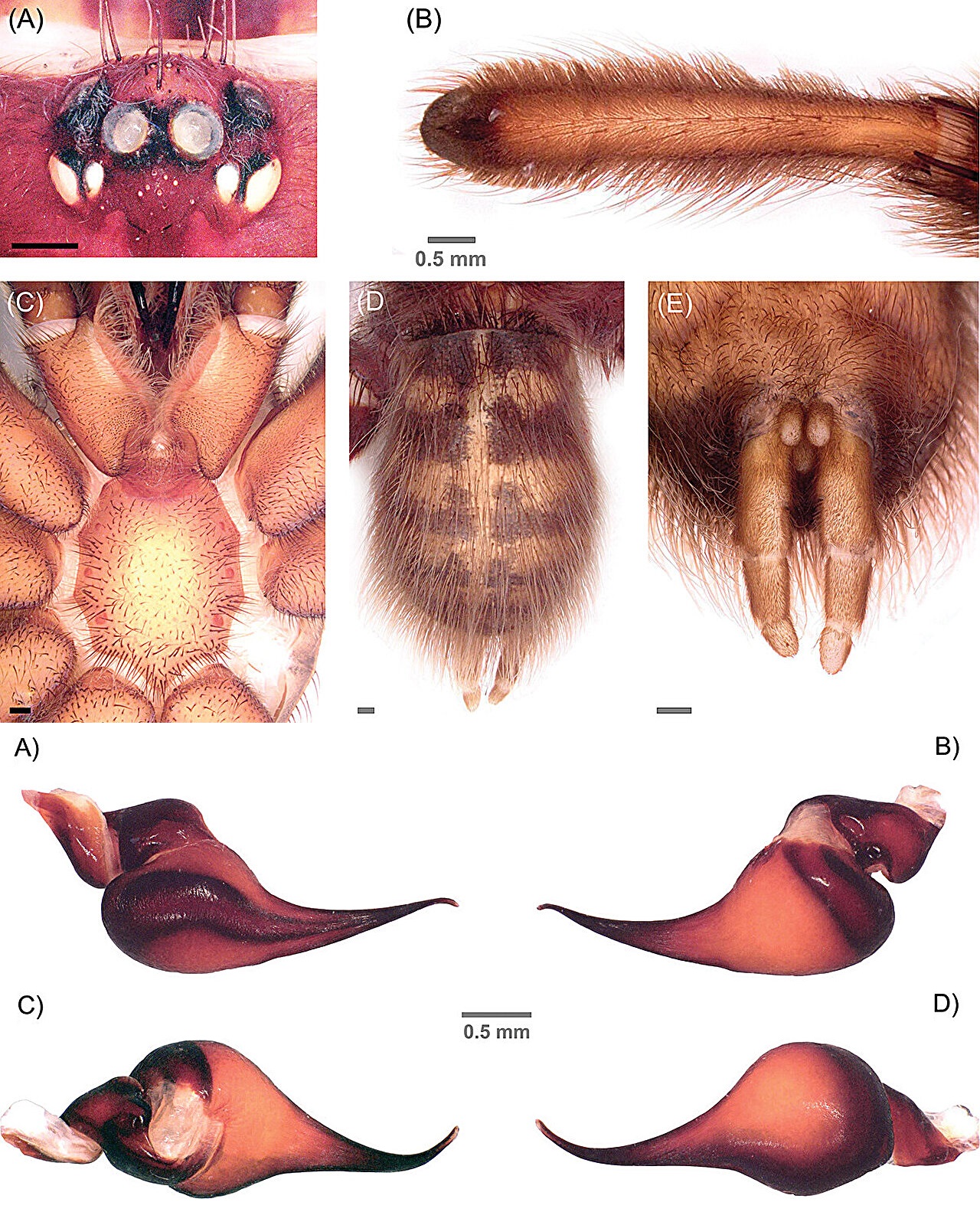
[Arachnida • 2024] Trichopelma grandeA hairy Giant among Dwarves: A distinct New Species of Tarantula (Araneae: Theraphosidae) from Cuba


Trichopelma grande
Ortiz & Fonseca, 2024
 

ABSTRACT
Large size, tropical climate, topographic complexity, and millions of years of isolation have turned the Greater Antillean islands into natural laboratories of evolution. Several groups have experienced explosive diversification across these islands, leading to highly diverse and endemic biotas and species experiencing unique adaptations. Here we describe a new tarantula species from the Viñales area, a biodiversity hotspot in western Cuba. Despite being a middle-sized species with large projected setae on the legs, reminiscent of those in arboreal tarantulas, phylogenomic analysis, diagnostic morphological features, and trap-door retreat building behaviour identifies it as the largest known representative of Trichopelma, and the only one with such hirsute legs. We provide mitochondrial barcoding data and a database of ultraconserved elements loci of the holotype of this species, which will help to include it in future phylogenetic studies of Theraphosidae. Given its limited distribution range, and its apparent absence in natural history collections despite its distinct appearance, this species might be scarce, positioning it as a potential conservation concern.
 
KEYWORDS: Gigantism, Greater Antilles, phylogenomics, rare species, Trichopelmatinae, UCE sequencing

Family Theraphosidae Thorell, 1869

Genus Trichopelma Simon, 1888


Trichopelma grande sp. n.


David Ortiz and Elier Fonseca. 2024. A hairy Giant among Dwarves: Trichopelma grande, A distinct New Species of Tarantula from Cuba (Araneae: Theraphosidae). Journal of Natural History. 58(45-48); 2189-2205. DOI: doi.org/10.1080/00222933.2024.2401921 

Saturday, October 16, 2021

[Herpetology • 2021] Arrhyton albicollum • A New Semifossorial Snake of the Genus Arrhyton (Serpentes: Dipsadidae) from eastern Cuba, with Taxonomic Comments on Other Species


Arrhyton albicollum
Díaz, Fong G., Salas & Hedges, 2021

 
Abstract
The genus Arrhyton is endemic to Cuba, with eight currently known species. A new species, Arrhyton albicollum sp. nov., is described from the karst areas of Gibara, Holguín Province. The new species is closely related to A. redimitum, another eastern species, according to morphology and molecular phylogeny. It differs from all other species of the genus by having a conspicuous, white nuchal band, a contrasting black pattern on the head, a gray-colored body with faint stripes, and a high number of ventral and subcaudal scales. Additional comments on other species include new locality records and information on morphology and relationships.

Keywords: Reptilia, Caribbean Islands, Serpentes, Colubroidea, phylogeny, species groups, Arrhyton albicollum sp. nov.

 Arrhyton albicollum sp. nov. unvouchered adult individual from the type locality. The mucronate rostral scale is evident in the lower photograph.
Photos: Diego Salas Pantoja.


Arrhyton albicollum sp. nov.

Etymology. The specific epithet is derived from the Latin words albus (white) and collum (neck), in reference to the conspicuous white neck band.
Proposed English name. Gibara White-collared Racerlet


Luis M. Díaz, Ansel Fong G., Diego Salas and S. Blair Hedges. 2021. A New Semifossorial Snake of the Genus Arrhyton (Squamata: Dipsadidae) from eastern Cuba, with Taxonomic Comments on other Species.  Zootaxa. 5052(3); 406-418. DOI: 10.11646/zootaxa.5052.3.6


Thursday, January 7, 2021

[PaleoOrnithology • 2020] Cathartes emsliei • A New Fossil Vulture (Cathartidae: Cathartes) from Quaternary Asphalt and Cave Deposits in Cuba


Cathartes emsliei 
 Suárez & Olson, 2020

 
Abstract
A new small fossil species of vulture from Quaternary asphalt and cave deposits in western Cuba is described herein. Some specimens of this taxon are the smallest known in the genus Cathartes, including the modern Lesser Yellow-headed Vulture C. burrovianus. The extinction of the Cuban megafauna, coupled with the loss of open habitats once dominated by grassland savannas, contributed to the population decline and final extinction of endemic vultures in Cuba during the Holocene.

Systematic paleontology
Class AVES Linnaeus
Order CATHARTIFORMES Coues
Family CATHARTIDAE Lafresnaye

Figure 3. Tarsometatarsi in two species of the genus Cathartes
in anterior (A–C, G–H) and posterior (D–F, I–J) views. 
Cathartes emsliei: paratype proximal right (A, D) WS 778, holotype proximal left (B, E) MNHNCu 75.4752, paratype distal left (G, I) MNHNCu 75.4751, paratype distal half of right (H, J) MNHNCu 75.4746 (images E, G and I are reversed to facilitate comparisons). 
C. burrovianus: right (C, F) USNM 622341.
 Scale = 1 cm (William Suárez)

Figure 4. Hypothetical reconstruction of Emslie's Vulture Cathartes emsliei 
Illustration: William Suárez

Genus Cathartes Illiger

The new species agrees with the genus Cathartes and differs from Coragyps by having tarsometatarsus with short and relatively wider shaft, more compressed anteroposteriorly, anterior metatarsal groove well extended distad, and trochleae shorter and flaring abruptly from shaft. It differs from Gymnogyps Lesson, 1842, which is known from the Cuban fossil record, and agrees with Cathartes, in characters described by Emslie (1988).

Cathartes emsliei sp. nov.
Emslie's Vulture; Aura de Emslie
  
Cathartes? sp.': Suárez (2000a: 120). ‘referable to Cathartes': Suárez (2001: 110).
‘a small species of vulture': Suárez (2004: 124).
Cathartes sp.': Suárez (2020: 14).

Diagnosis.—A small species of Cathartes differing from C. burrovianus by having coracoid with reduced glenoid facet, wider and deeper anterior intercondylar fossa of the tibiotarsus, and tarsometatarsus with base of throchlea II wider in posterior view.

Etymology.—Named for our esteemed colleague and friend, Dr Steven D. Emslie, University of North Carolina Wilmington, USA, in recognition of his contribution to the knowledge of New World vultures, including those from Cuba.

 
William Suárez and Storrs L. Olson. 2020. A New Fossil Vulture (Cathartidae: Cathartes) from Quaternary Asphalt and Cave Deposits in Cuba. Bulletin of the British Ornithologists’ Club. 140(3); 335-343. DOI: 10.25226/bboc.v140i3.2020.a6

Monday, August 3, 2020

[Ichthyology • 2020] Lucifuga gibarensis • A New Species of the Cave-fish Genus Lucifuga (Ophidiiformes, Bythitidae), from eastern Cuba


 Lucifuga gibarensis 
Hernández, Møller, Casane & García-Machado, 2020


Abstract
Recently, a barcoding study and a molecular phylogenetic analysis of the Cuban species of the cave-fish genus Lucifuga Poey, 1858 revealed the existence of different evolutionary lineages that were previously unknown or passed unnoticed by morphological scrutiny (i.e., cryptic candidate species). In the present study, Lucifuga gibarensis is described as a new species restricted to anchialine caves in the northeastern karst region of the main island. The species was earlier described as a variety of Lucifuga dentata, but since the name was introduced as a variety after 1960, it is deemed to be infrasubspecific and unavailable according to the International Code of Zoological Nomenclature Art. 15.2. The new species differs from L. dentata by pigmented eyes vs. eyes absent and lack of palatine teeth vs. present. Lucifuga gibarensis seems to be most similar to the Bahamian species L. lucayana by showing pigmented eyes, 13 or 14 precaudal vertebrae and ten caudal fin rays. However, differs from it by a larger size of the pigmented eye (1.1–1.9 vs. 0.9–1.0% SL) and number of posterior lateral line neuromasts (30–33 vs. 34–35).

Keywords: Anchialine caves, Gibara, Holguin, speleology, taxonomy, viviparous brotulas

Figure 3.  Lucifuga gibarensis sp. nov. in Cueva El Baga, Gibara municipality, northern Holguin province, Cuba;
 a unsampled specimen, 27 November 2014 b ZMUC P771732, 45.0 mm SL, male, photo taken immediately prior to collection.

Taxomomy
Family Bythitidae

Genus Lucifuga Poey, 1858
Type species: Lucifuga subterranea Poey, 1858 by subsequent designation of Jordan and Evermann, 1896, type locality: El Cajio cave, but not precisely stated for L. subterranea, which was referred originally from caves of San Antonio, middle-south Havana province, Cuba.

Diagnosis: 
Body moderately elongated and compressed mainly from the abdomen to the caudal end. Snout with two nostrils: anterior nostril tube-shape and smaller, placed near to the upper lip; posterior nostril is a larger hole, placed ca. midway between snout and eyes cavity. The mouth is subterminal with the lower jaw only slightly shorter than the upper. Opercular spines absent. Seven branchiostegal rays.

The entire body is covered with small, rounded cycloid scales; fins naked except for scales on pectoral fin basis. Predorsal area and operculum scaled. Branchiostegal membranes, entire underside of the head, snout, interorbital areas and entire course of the cavernous cephalic system are naked. Origin of dorsal fin approximately above the tip of pectoral fins. Pelvic fin is subjugular with a single ray reaching ca. 1/3 to halfway to the anus. Pectoral fin behind the operculum, peduncle short and narrow. Lateral line with two series of sensory neuromasts: upper and anterior series extends from the head to a point ca. midway between dorsal and anal fin origins; and lower and posterior series extends from a point under and slightly in advance of the end of the upper series to the mid side from the caudal base.
...


Lucifuga gibarensis sp. nov.
Common name: Gibara cave brotula (English)

Lucifuga dentatus variety holguinensis Díaz-Pérez et al., 1987b: 44.
Lucifuga dentatus var. holguinensis Hernández 2005: 15; García-Machado et al. 2011: 471.
Lucifuga holguinensis Proudlove 2019.

Diagnosis: Dorsal fin rays 72–90; anal fin rays 58–72; pectoral fin rays 15–17, caudal fin rays 10; palatine teeth absent; rakers on anterior gill arch 17–19 (long gill-rakers 3); occiput and area between lateral canal and preopercular canal scaled; diameter of pigmented eyes 1.1–1.9% SL; total vertebrae 50–53.


Etymology: The specific epithet refers to the village of Gibara, where the three caves inhabited by this species are located. We do not follow variety epithet used by Díaz-Pérez et al. (1987b), since the L. gibarensis better describes the narrow distribution of the species near the village Gibara instead of the entire region Holguin.


Damir Hernández, Peter Rask Møller, Didier Casane and Erik García-Machado. 2020. A New Species of the Cave-fish Genus Lucifuga (Ophidiiformes, Bythitidae), from eastern Cuba. ZooKeys. 946: 17-35. DOI: 10.3897/zookeys.946.51373

Tuesday, July 28, 2020

[Herpetology • 2020] Tropidophis steinleini • A New Species of Tropidophis (Squamata: Tropidophiidae) and Molecular Phylogeny of the Cuban Radiation of the Genus


Tropidophis steinleini  
 Díaz & Cádiz, 2020

Photos: L. M. Díaz. 

ABSTRACT
Cuba has the highest diversity of snakes in the genus Tropidophis, representing 53 % of all the known species. Tropidophis steinleini sp. nov. is described from the eastern region of Cuba, raising the number of species to 17 in this archipelago. The new species is most closely related to T. wrighti, T. spiritus and T. morenoi. We discuss the phylogenetic relationships of this new species and other species of the genus in Cuba, based on molecular data, and classified them within three species groups according to the obtained tree topology.

Keywords: Caribbean Islands, snakes, dwarf boas, DNA, classification, species groups

Figure 1. Tropidophis steinleini sp. nov., two different views of the female holotype MNHNCu 5079 in life. Photos: L. M. Díaz.

Maximum likelihood phylogeny of sampled snakes of the genus Tropidophis based in two mitochondrial and one nuclear gene, showing the three major Cuban clades and the position of Tropidophis steinleini sp. nov. The nominal, representative species of each group: T. pardalis, T. melanurus and T.  maculatus, are respectively illustrated. Voucher’s catalog numbers are listed in Appendix 1. Tree is rooted with T. haetianus (from Hispaniola). Black circles: bootstrap = 100; yellow circle: bootstrap 81–99; no circle: bootstrap ≤ 80. Photos by L. M. Díaz. 

Tropidophis steinleini sp. nov.

Diagnosis. Species in the Tropidophis pardalis species group as defined in the herein-presented molecular phylogeny (see  Fig. 3, also Fig. 6  for  species comparisons, and  the  Discussion). Body  slender  and  laterally compressed;  head  distinctive  from  neck;  6  rows  of  dark  blotches around body; some of the paravertebral and lateral blotches are longitudinally fused; 23 scale rows around midbody; 188 ventral scales; an evident groove above the supralabial scales; first supralabial slightly higher than second. Regarding morphology and the phylogenetic relationships, the new species is most similar to T. spiritus, T. morenoi and T. wrighti (Table I; Fig. 6 F, G, H, respectively). In the three species the first supralabial scale is much lower than second one; the head is gradually tapered in profile compared with the flat head top and a higher snout of the new species; a groove over the supralabial scales is absent (Fig. 2). T. wrighti has four rows of large blotches around body instead of 6, contrasting on a homogenous gray to white-colored background (Fig. 6H); some of the blotches are fused at the mid-dorsum but not in a distinctive longitudinal way; ventral scale counts (192–222) are higher than in Tropidophis steinleini sp. nov. T. morenoi and T.  spiritus have 183–200 ventral  scales, widely overlapping with Tropidophis steinleni sp. nov., and similar coloration considering that the three species have 6 rows of blotches around the midbody and pale lower flanks; however, the head shape is different (Fig. 2) as mentioned above. The snout is slightly shorter in available T. spiritus and T. morenoi (30–33 % of head length, x = 31 %, n = 7) compared with Tropidophis steinleini sp. nov. (34 %); paravertebral blotches are not longitudinally enlarged in T. spiritus and T. morenoi (Fig. 6 F, G), but instead some transversal fusion may exist, giving them a banded appearance (a condition not present in the new species); head is darker in T. spiritus and T. morenoi, with more evident and contrasting pattern of blotches and stripes which is somewhat diffuse or barely evident in Tropidophis steinleini sp. nov.

Etymology. The species is named with gratitude, after our German colleague Claus Steinlein, for his support of the authors’ herpetological research in Cuba.


 Figure 6. Cuban snakes of the Tropidophis pardalis species group. 
A,  T. pardalis, female, from Boyeros, La Habana Province; B, T.  pardalis, female, from Soroa, Candelaria, Artemisa Province; C, T. xanthogaster, male, from La Bajada, Guanahacabibes, Pinar  del  Río  Province;  D, T.  hardyi,  male,  from  Río  Jutía,  Guajimico,  Cienfuegos  Province; 
E, Tfuscus,  female, from Altiplanicie de El Toldo, Humboldt National Park, Holguín province; F, T. spiritus, female, from Alturas de Banao, Sancti Spiritus Province; G, T. cf. morenoi, male, from Jobo Rosado, Villa Clara Province; H, T. wrighti, from Altiplanicie de El Toldo, Humboldt National Park, Holguín Province. Photos: L. M. Díaz. 


 Luis M. Díaz and Antonio Cádiz. 2020. A New Species of Tropidophis (Squamata: Tropidophiidae) and Molecular Phylogeny of the Cuban Radiation of the Genus [Una nueva especie de Tropidophis (Squamata: Tropidophiidae) y filogenia molecular de la radiación cubana del género] Novitates Caribaea. 16; 1-19. DOI: 10.33800/nc.vi16.222 

Resumen: Cuba tiene la mayor diversidad de serpientes del género Tropidophis, lo cual representa 53 % de todas las especies conocidas. Tropidophis steinleini sp. nov. es descrita de la región oriental de Cuba, lo cual eleva a 17 el número de especies en este archipiélago. La nueva especie está más cercanamente emparentada con T. wrighti, T. spiritus y T. morenoi. Se discuten las relaciones filogenéticas de la nueva especie y otras del género en Cuba, sobre la base de datos moleculares, y se clasifican en tres grupos de acuerdo con la topología del árbol obtenido.


Thursday, August 23, 2018

[Arachnida • 2018] Antillobisium tomasi • A New Antillobisium Species (Pseudoscorpiones: Bochicidae) from Cuba, with Biogeographical and Ecological Remarks on the Genus


Antillobisium tomasi
 Díaz, Zaragoza & Iborra, 2018


Abstract
A new troglobitic species of the genus Antillobisium is described from Sancti Spiritus province, Cuba. Antillobisium tomasi n. sp. is the third known species of the genus and is well characterized by its large size and extremely slender appendages. Biogeographical and ecological considerations on the genus are given.

Keywords: Arachnida, Cave, hypogean, karst, pseudoscorpions, relict, troglobitic


 Superfamily Neobisioidea Chamberlin, 1930 
Family Bochicidae Chamberlin, 1930 
Subfamily Bochicinae Chamberlin, 1930 
Genus Antillobisium Dumitresco & Orghidan, 1977
A. vachoni Dumitresco & Orghidan, 1977 
A. mitchelli Dumitresco & Orghidan, 1977

 Antillobisium tomasi n. sp., male habitus.

Antillobisium tomasi n. sp.

Etymology. The species is named after the Cuban biospeleologist and arachnologist Tomás Michel Rodríguez, who collected the holotype.


 René Barba Díaz, Juan A. Zaragoza and Germán López Iborra. 2018. A New Antillobisium Species (Arachnida: Pseudoscorpiones: Bochicidae) from Cuba, with Biogeographical and Ecological Remarks on the Genus. Zootaxa. 4461(3); 399–410.  DOI: 10.11646/zootaxa.4464.3.5


Resumen: Se describe una nueva especie troglobia del género Antillobisium de la provincia de Sancti Spiritus, Cuba. Antillobisium tomasi n. sp. es la tercera especie conocida del género y está bien caracterizada por su gran tamaño y por sus artejos extremadamente esbeltos en comparación con las otras. Se dan consideraciones biogeográficas y ecológicas sobre el género.

Thursday, March 1, 2018

[Ornithology • 2018] Ara tricolor • The Phylogenetic Position of the Extinct Cuban Macaw based on Complete Mitochondrial Genome Sequences


Ara tricolor  (Bechstein, 1811)

 Johansson, Ericson, Blom & Irestedt, 2018. 
  DOI: 10.1111/ibi.12591  

Abstract
The Cuban Macaw Ara tricolor was a species of macaw native to Cuba and Isla de la Juventud in the Caribbean that became extinct in the 1860s. Morphologically it was similar to, but distinctively smaller than the large red macaws – Scarlet Macaw A. macao and Red-and-green Macaw A. chloropterus. A close affinity with the Scarlet Macaw has been suggested based on plumage similarities. In this study we use complete mitochondrial genome sequences to examine the phylogenetic position of the Cuban Macaw. Our results do not indicate a sister-species relationship with the Scarlet Macaw, but place the Cuban Macaw sister to the two red species and the two large green macaws, the Military Macaw A. militaris and the Great Green Macaw A. ambiguus. Divergence estimates suggests that the Cuban Macaw separated from this group approximately 4 million years ago.

commons.wikimedia.org 

Watercolour by Jacques Barraband (circa 1800) of a Cuban Red Macaw (Ara tricolor).

Painting of a specimen in Liverpool Museum by John Gerrard Keulemans, 1907


Ulf S. Johansson, Per G. P. Ericson, Mozes P. K. Blom and Martin Irestedt. 018. The Phylogenetic Position of the Extinct Cuban Macaw Ara tricolor based on Complete Mitochondrial Genome Sequences. Ibis.   DOI: 10.1111/ibi.12591

Guy M. Kirwan and James W. Wiley. 2013. The extinct macaws of the West Indies, with special reference to Cuban Macaw Ara tricolor.  Bulletin of the British Ornithologists' Club. 133(2); 125-156. 

Sunday, January 22, 2017

[Herpetology • 2017] Eleutherodactylus cattus • Cryptic within Cryptic: Genetics, Morphometrics, and Bioacoustics Delimitate A New Species of Eleutherodactylus (Anura: Eleutherodactylidae) from Eastern Cuba


Eleutherodactylus cattus 
 Rodríguez, Dugo-Cota, Montero-Mendieta, Gonzalez-Voyer, Bosch, Vences & Vilà, 2017

 
  DOI: 10.11646/zootaxa.4221.5.1 
  
Abstract

We studied the variation in genetics, bioacustics, and morphology in Eleutherodactylus glamyrus, a regionally endemic frog species restricted to high elevations in the Sierra Maestra Massif, Western Cuba that was originally described as a cryptic species hidden under the name E. auriculatus. Genetic analysis of mtDNA sequences of the 16S and cob genes identify two allopatric and strongly supported mitochondrial clades (phylogroups) which also showed no haplotype sharing in the nuclear Rag-1 gene. Bioacustic, and morphological comparisons concordantly identify these two phylogroups as independent evolutionary lineages. Therefore, we herein restrict the name Eleutherodactylus glamyrus Estrada and Hedges to populations represented in our analyses as the western phylogroup (Cordillera del Turquino to Pico La Bayamesa) and consider specimens from the eastern phylogroup (Sierra del Cobre) to represent a new species described and named as Eleutherodactylus cattus. Our results add to the growing list of Eleutherodactylus species endemic to Cuba and highlight the importance of combining different sources of evidence for obtaining robust assessments of species limits in amphibians.

Keywords: Amphibia, Terrarana, species delimitation, integrative taxonomy, Caribbean


Eleutherodactylus cattusMale (CZACC14.14153, paratype) calling
in the trail to Pico El Gato, Sierra del Cobre, 844m a.s.l.. 


Etymology. The species name is an invariable noun in apposition to the genus name, derived from Latin cattus cat. It refers to the type locality Loma del Gato (Cat Mountain Ridge) in the Sierra Maestra Mountains, a locality 

Distribution. This species is only known from the type locality but assuming it has specialized to high elevations like its sister taxon, Eleutherodactylus glamyrus, it could well be found in neighboring areas above 800 m a.s.l..


Ariel Rodríguez, Álvaro Dugo-Cota, Santiago Montero-Mendieta, Alejandro Gonzalez-Voyer, Roberto Alonso Bosch, Miguel Vences and Carles Vilà. 2017. Cryptic within Cryptic: Genetics, Morphometrics, and Bioacoustics Delimitate A New Species of Eleutherodactylus (Anura: Eleutherodactylidae) from Eastern Cuba.
  Zootaxa. 4221(5); 501–552.  DOI: 10.11646/zootaxa.4221.5.1