Showing posts with label Neogene. Show all posts

Tuesday, January 6, 2026

[PaleoMammalogy • 2025] Circamustela bhapralensis, Vishnuictis plectilodous, ... • Rare Carnivorous Mammals from A diverse Fossil Assemblage from the Middle Siwaliks of Haritalyangar area, Himachal Pradesh, North India


Circamustela bhapralensis
Sankhyan, Abbas, Jasinski, Khan & Mahmood, 2025
 
Artwork by Sergey Krasovskiy

Abstract
Newly collected fossil carnivoran material from the Haritalyangar and Nurpur Middle Siwalik sequences of Himachal Pradesh (India) include at least five taxa and two new species including Mustelidae (‘Martes’ lydekkeri, Circamustela bhapralensis sp. nov., Mustelidae indet.), Viverridae (Vishnuictis plectilodous sp. nov.), and Felidae (indeterminate basal Felinae). These findings include the first upper jaw material of ‘Marteslydekkeri, a rare mustelid known only from lower jaw specimens, suggesting potentially closer relationships with European mustelids. Additionally, we report the first identification of Circamustela from the Siwaliks of the Indian subcontinent, despite nearly two centuries of fossil collection in the region. This material represents a new species Circamustela bhapralensis sp. nov. Circamustela, originating in Europe, eventually migrated to the Indian subcontinent before its extinction, and the smaller body size of the new species may suggest a trend toward decreasing body size in this taxon. Fossil viverrid material also represents a new species, Vishnuictis plectilodous sp. nov., the youngest species yet known for the genus. This new material implies an increase in morphological complexity in the m1 of these viverrids, potentially also suggesting an increase in dietary diversity within this lineage. The new viverrid species may also represent the largest viverrid yet known. Mandibular material of a feline is also described, providing further information on the biodiversity of the fossil carnivorans in the region. These new specimens add important information to our knowledge of the ancient biodiversity of the region, the evolutionary history of several carnivoran mammals, and the carnivoran guild of southern Asia.

Keywords: Carnivora, Felidae, Haritalyangar, India, Mustelidae, Neogene, Siwaliks, Viverridae


Circamustela bhapralensis sp. nov.

Vishnuictis fossil comparisons.
a–c. Holotype m1 of Vishnuictis plectilodous sp. nov. (HTA-68), complete right m1 in occlusal (a), medial (lingual) (b), and lateral (labial) (c) views. d. Terminology for various features of the m1 of V. plectilodous sp. nov. (HTA-68).
e–g. Holotype right mandibular ramus containing p4 and m1 of V. hasnoti comb. nov. (HTA-135), modified from Pilgrim (1932: pl. II, figs. 18, 18a, 18b) in occlusal (e), medial (lingual) (f), and lateral (labial) (g) views. Scale bars equal 1 cm


Vishnuictis plectilodous sp. nov.


Anek Ram Sankhyan, Sayyed Ghyour Abbas, Steven E. Jasinski, Muhammad Akbar Khan and Khalid Mahmood. 2025. Rare Carnivorous Mammals from A diverse Fossil Assemblage from the Middle Siwaliks of Haritalyangar area, Himachal Pradesh, North India. Journal of Mammalian Evolution. 32; 14. DOI: doi.org/10.1007/s10914-025-09749-4 [22 March 2025]

Study on New Fossil Carnivorous Mammals from Himalayan Foothills 

Sunday, November 9, 2025

[PaleoIchthyology • 2025] Pochitaserra patriciacanalae & Dasyatis manuelcamposiDiving into the Past: A New Assemblage of Neogene elasmobranch Microfossils from the eastern Pacific of South America


Pochitaserra patriciacanalae 
 Dasyatis manuelcamposi

 Villafaña, Campos-Medina, Chávez-Hoffmeister, S. Araya, B. Araya, Ledezma, Hernandez, Ramos-Rojas, Bolomey, Tejo, Vera, Campoy, Arotaipe, Bugueño, Antiquera & Rivadeneira, 2025


Abstract
The fossil record of chondrichthyans from the Pacific coast of South America is rich and diverse, with the Bahía Inglesa Formation distinguished as one of the most important in the region. Despite the extensive fossil record of cartilaginous fish in the Bahía Inglesa Formation, studies focused on microremains of this group of fish are non-existent. This study describes for the first time a new locality of fossil microremains from the Upper Miocene of northern Chile. Over 300 kg of sediment was extracted at the study locality to examine and identify chondrichthyan fossils smaller than 1 cm. Here, 19 chondrichthyan taxa from the Upper Miocene of Bahía Inglesa are reported: five were identified at the species level, seven at the genus level, three at the family level, and four at the superorder level. Notably, this includes the first record of Sympterygia for the Americas, the first record of Dipturus for the Neogene, and the first mention of Rhinobatos for the Neogene of South America. At the species level, the first description of the basking shark Cetorhinus maximus for South America and the leopard shark Triakis semifasciata in any locality worldwide is provided. Additionally, a new species of ray from the genus Dasyatis and a new genus and species of sawshark from the family Pristiophoridae are proposed. In this research we present the largest number of chondrichthyan microremains collected and described from fossiliferous localities in Chile.

Keywords: shark, ray, teeth, Neogene, Bahía Inglesa, Chile

 Dasyatis manuelcamposi sp. nov. 


Pochitaserra gen. nov. 
 Pochitaserra patriciacanalae gen. et sp. nov. 


Jaime A. Villafaña, Jorge Campos-Medina, Martín F. Chávez-Hoffmeister, Selene Araya, Benjamin Araya, Leandro Ledezma, Yusse Hernandez, Héctor A. Ramos-Rojas, Jorge Bolomey, Matias Tejo, Francisca Vera, Ana N. Campoy, Rosmery Arotaipe, Yara Bugueño, Bianca Antiquera, Marcelo M. Rivadeneira. 2025. Diving into the Past: A New Assemblage of Neogene elasmobranch Microfossils from the eastern Pacific of South America. Papers in Palaeontology. DOI: doi.org/10.1002/spp2.70043 [07 November 2025]


Tuesday, December 5, 2023

[Paleontology • 2024] Paleoenvironment and Paleoecology associated with the early Phases of the Great American Biotic Interchange based on Stable Isotope Analysis of Fossil Mammals and new U–Pb Ages from the Pampas of Argentina


in Sanz-Pérez, Montalvo, Mehl, Tomassini, Fernández et Domingo, 2024. 
Artwork: Manuel Hernández Fernández  twitter.com/hdezfdez

Highlights: 
• First zircon dates from Neogene classic sites in central Argentina are provided.
• An increase of C4 plants values is recorded in mammal diets from Early Pliocene.
• The δ13C values of Lycopsis and Thylacosmilus suggest prey partitioning.

Abstract
The analysis of stable isotopes in fossil mammals is useful for reconstructing paleoenvironmental and paleoecological conditions, but has been rarely applied to the Neogene of South America. In this study, we perform an integrative analysis (including U–Pb zircon dates and mammalian stable isotopes data) for the Late Miocene–Early Pliocene of central Argentina. We provide radioisotopic ages for some classic fossiliferous localities in this region, including an age of 9.7 ± 0.3 Ma for Arroyo Chasicó and 4.5 ± 0.2 Ma for Farola Monte Hermoso, and address the interval covering the Chasicoan (Late Miocene), Huayquerian (Late Miocene–Early Pliocene), and Montehermosan (Early Pliocene) stages/ages. In the Chasicoan Stage/Age, taxa with mixed C3–C4 diets are recorded, suggesting the existence of favorable conditions for the C4 photosynthetic pathway before its full expansion. However, taxa represented across most of the Huayquerian Stage/Age show a preference for C3–based diets, which changes in the latest Huayquerian–Montehermosan stages/ages when an increase in the percentage of C4 plants in the diet of notoungulates, rodents, and xenarthrans is recorded, coinciding with the global expansion of C4 plants. For the first time, the dietary behavior of two South American endemic sparassodont metatherians (Lycopsis and Thylacosmilus) has been evaluated from using stable isotope; analysis of these hypercarnivores show differences in δ13C values, suggesting prey partitioning, partly due to the difference in body size. The fossiliferous sites studied, and the new isotopic and chronological information obtained, provide more detailed paleoecological and paleoenvironmental contexts for the Argentine Pampas during the last stages of the isolation of South America and the first pulses of the Great Biotic American Interchange. In addition, the new ages allow to better adjust the arrival of the first Holarctic immigrants in the region.
 
Keywords: Carbon, Oxygen, Radiometric dating, Miocene, Pliocene, South America


Dánae Sanz-Pérez, Claudia I. Montalvo, Adriana E. Mehl, Rodrigo L. Tomassini, Manuel Hernández Fernández and Laura Domingo. 2024. Paleoenvironment and paleoecology associated with the early phases of the Great American Biotic Interchange based on stable isotope analysis of fossil mammals and new U–Pb ages from the Pampas of Argentina. Palaeogeography, Palaeoclimatology, Palaeoecology. 634, 111917. DOI: 10.1016/j.palaeo.2023.111917

Sunday, October 8, 2023

[PaleoMammalogy • 2023] Plohophorus avellaneda • A New Species of Plohophorus Ameghino (Cingulata: Glyptodontidae) from the latest Pliocene–earliest Pleistocene of the Pampean Region (Argentina): the Last Survivor of A Neogene Lineage


Plohophorus avellaneda
 Quiñones, Cuadrelli, Reyes, Luna, Poiré & Zurita, 2023

 
Abstract
Within xenarthrans, two large groups are recognized, Pilosa (anteaters and sloths) and Cingulata (armoured xenarthrans). The latter contains Glyptodontidae, one of the most bizarre and enigmatic groups of animals that ever lived. Recent phylogenetic proposals show an early Miocene divergence into two clades, one of northern origin (Glyptodontinae) and the other with its oldest records in the early–middle Miocene of southern South America, which groups most of the recognized diversity. Although knowledge of the ‘austral clade’ has increased recently, several taxa need urgent taxonomic and phylogenetic studies to understand their evolutionary history. One case is represented by the ‘Plohophorini’, a tribe that traditionally included several genera (Plohophorus, Pseudoplohophorus, Phlyctaenopyga, Stromaphorus and Stromaphoropsis), from the late Miocene–Pliocene of the Pampean and North-Western regions of Argentina, and Uruguay. A new and terminal species of PlohophorusPlohophorus avellaneda sp. nov., coming from the El Polvorín Formation (Pampean region of Argentina) is here reported and described, and represents the first case of a Neogene genus of glyptodont crossing the Plio–Pleistocene boundary (c. 2.53 Ma). In addition, the palaeohistological analysis on the osteoderms (the first for ‘Plohophorini’) reveals some characters not observed in other glyptodonts, highlighting its potential phylogenetic importance. The phylogenetic analysis corroborates that the well-characterized species of ‘Plohophorini’ of Uruguay and the Pampean region of Argentina (‘eastern Plohophorini’) constitute a natural group within the austral clade, since both species of Plohophorus (P. avellaneda + P. figuratus) cluster together, and are the sister taxa of Ps. absolutus + Ps. benvenutti. Along the evolutionary history of Plohophorini an increase in body mass is observed, reaching its maximum with P. avellaneda sp. nov. (c. 471 ka). Despite the high frequency of late Pliocene records, Plohophorini disappear completely from the fossil record during the Pleistocene, suggesting that this character was negatively selected.
 
Keywords: glyptodonts, evolutionary history, ‘austral clade’, morphology, palaeohistology


Plohophorus avellaneda sp. nov.

 
Sofía Inés Quiñones, Francisco Cuadrelli, Martin de los Reyes, Carlos Alberto Luna, Daniel Gustavo Poiré and Alfredo Eduardo Zurita. 2023. A New Species of Plohophorus Ameghino (Cingulata, Glyptodontidae) from the latest Pliocene–earliest Pleistocene of the Pampean Region (Argentina): the Last Survivor of A Neogene Lineage. Journal of Systematic Palaeontology. 21(1); 2246963. DOI: 10.1080/14772019.2023.2246963

Thursday, September 21, 2023

[Paleontology • 2023] Borelis matsudai • A New Species of the larger porcelaneous Foraminifer Borelis provides Novel insights into Neogene to Recent western Pacific Palaeobiogeographical Dispersal Patterns


 Borelis matsudai 
Bassi, Iryu, Kinoshita, Fujita & Pignatti, 2023


Highlights: 
• Shell structures circumscribe a new Borelis species.
• The ancestor of the new species is Borelis pulchra.
• The new species appeared from the Middle Pleistocene in the southern Ryukyu Islands.
• The new species followed the northward Kuroshio dispersal route.
• This is the northernmost Borelis record in the western Indo-Pacific Warm Pool.

Abstract
Only three species of alveolinoidean larger foraminifera occur in present-day tropical shallow-water marine settings. Alveolinella quoyi thrives in the Central Indo-Pacific and Eastern Indo-Pacific, Borelis pulchra in the Central and Eastern Indo-Pacific and in the central Atlantic, whereas Borelis schlumbergeri inhabits the Indo-Pacific Ocean. The northernmost record is that of Alveolinella quoyi from the shallow-water settings in Okinawa (central Ryukyu Islands, Japan). A new porcelaneous larger foraminiferal speciesBorelis matsudai sp. nov. (Alveolinoidea, Borelinae), is established herein, based on specimens discovered in present-day shallow-water sediments from Sekisei Lagoon, southern Ryukyu Islands (Japan). This is the northernmost record of the genus in the western Indo-Pacific Warm Pool. The architectural characters of this species suggest its phylogenetic relationship with the Borelis pulchra group. A comprehensive literature survey of fossil and modern records of Borelis pulchra over the past 30 million years shows that the Middle Miocene constriction of the Indonesian Seaway and the Late Miocene–Early Pliocene restriction of the Indonesian Throughflow impacted the species-level dispersal of this species in the Indo-Australian Archipelago. Driven by the Kuroshio dispersal route Borelis matsudai sp. nov. likely appeared in the southern and central Ryukyu Islands at least from the Chibanian (Middle Pleistocene). This species represents a marginal part of a population in significant contact with its ancestor (B. pulchra), which is widespread southward since the Oligocene (Philippines). With ongoing global warming possible occurrences of Borelis matsudai sp. nov. in the northern Ryukyu Islands, where it has not yet been found, are expected. The Sekisei Lagoon represents, therefore, a biogeographical stepping stone relay station in northward migration of the shallow-water benthic organisms along the Kuroshio dispersal route.
 
Keywords: Biogeography, Kuroshio, Ryukyu Islands, Indo-Pacific Ocean, Oligocene–Miocene, Recent

SEM photos of Borelis matsudai sp. nov.; megalospheric specimens (A-forms), paratypes; Sekisei Lagoon, southern Ryukyu Islands; Recent. Institute of Geology and Paleontology, Graduate School of Science, Tohoku University (Sendai, Japan).
The apertural face is characterized by a single row of rimmed apertures (pr, peristomal rim) with upright masks (um). Septula (sept), dividing the chamberlets (cl), are aligned from chamber to chamber.

Borelis matsudai sp. nov.

 Borelis matsudai sp. nov.; holotype, megalospheric specimen (A-form); Sekisei Lagoon, southern Ryukyu Islands; Recent. Institute of Geology and Paleontology, Graduate School of Science, Tohoku University (Sendai, Japan); IGPS Coll. Cat. No. 112751. Micro-computed tomographic scanning 3-D rendered models with shell removed (rendering by S.K.).
A–E. The sub-ellipsoidal megalospheric shell showing the large proloculus (prol; prol-ap, proloculus aperture) enveloped by the flexostyle (flex). Note the thick columella (col) in the axial region. F–H. The first and second whorls (green) are strepstospiral. I–K. Chamberlets (cl) are aligned from chamber to chamber with apertures in a single row and only preseptal passage (p-sept) present. (For interpretation of the references to colour in this figure legend, the reader is referred to the web version of this article.)


 Davide Bassi, Yasufumi Iryu, Shunichi Kinoshita, Kazuhiko Fujita and Johannes Pignatti. 2023. A New Species of the larger porcelaneous Foraminifer Borelis provides Novel insights into Neogene to Recent western Pacific Palaeobiogeographical Dispersal Patterns. Palaeogeography, Palaeoclimatology, Palaeoecology. 628, 111764. DOI: 10.1016/j.palaeo.2023.111764

Researchers Discover a New Species of Larger Benthic Foraminifer from the Ryukyu Islands


Friday, December 9, 2022

[Paleontology • 2022] A 2-Million-year-old Ecosystem in Greenland uncovered by environmental DNA


the rich plant and animal assemblages of the Kap København Formation in North Greenland.

in Kjær, Pedersen, Sanctis, Cahsan, Korneliussen, ... et Willerslev, 2022. 
 — image: Beth Zaiken/bethzaiken.com

Abstract
Late Pliocene and Early Pleistocene epochs 3.6 to 0.8 million years ago had climates resembling those forecasted under future warming. Palaeoclimatic records show strong polar amplification with mean annual temperatures of 11–19 °C above contemporary values. The biological communities inhabiting the Arctic during this time remain poorly known because fossils are rare5. Here we report an ancient environmental DNA6 (eDNA) record describing the rich plant and animal assemblages of the Kap København Formation in North Greenland, dated to around two million years ago. The record shows an open boreal forest ecosystem with mixed vegetation of poplar, birch and thuja trees, as well as a variety of Arctic and boreal shrubs and herbs, many of which had not previously been detected at the site from macrofossil and pollen records. The DNA record confirms the presence of hare and mitochondrial DNA from animals including mastodons, reindeer, rodents and geese, all ancestral to their present-day and late Pleistocene relatives. The presence of marine species including horseshoe crab and green algae support a warmer climate than today. The reconstructed ecosystem has no modern analogue. The survival of such ancient eDNA probably relates to its binding to mineral surfaces. Our findings open new areas of genetic research, demonstrating that it is possible to track the ecology and evolution of biological communities from two million years ago using ancient eDNA.


Kurt H. Kjær, Mikkel Winther Pedersen, Bianca De Sanctis, Binia De Cahsan, Thorfinn S. Korneliussen, Christian S. Michelsen, Karina K. Sand, Stanislav Jelavić, Anthony H. Ruter, Astrid M. A. Schmidt, Kristian K. Kjeldsen, Alexey S. Tesakov, Ian Snowball, John C. Gosse, Inger G. Alsos, Yucheng Wang, Christoph Dockter, Magnus Rasmussen, Morten E. Jørgensen, Birgitte Skadhauge, Ana Prohaska, Jeppe Å. Kristensen, Morten Bjerager, Morten E. Allentoft, Eric Coissac, PhyloNorway Consortium, Alexandra Rouillard, Alexandra Simakova, Antonio Fernandez-Guerra, Chris Bowler, Marc Macias-Fauria, Lasse Vinner, John J. Welch, Alan J. Hidy, Martin Sikora, Matthew J. Collins, Richard Durbin, Nicolaj K. Larsen and Eske Willerslev. 2022. A 2-Million-year-old Ecosystem in Greenland uncovered by environmental DNA. Nature. 612; 283–291. DOI: 10.1038/s41586-022-05453-y
 https://phys.org/news/2022-12-discovery-world-oldest-dna-million.html
 
 
The lost world: The cover shows an artist’s impression of the rich ecosystem that existed in parts of northern Greenland some 2 million years ago. The ecosystem is reconstructed from ancient DNA in this week’s issue by Eske Willerslev and colleagues. Working at the Kap København Formation in Peary Land, the researchers gathered sediment samples rich in organic material from 5 different geological sites. By extracting and sequencing DNA from these samples, they were able to piece together a picture of the flora and fauna present around 2 million years ago. The team found evidence of open boreal forest mixed with Arctic species such as cedar, spruce and birch, as well as signs of animals including hares, mastodons, reindeer and geese. The evidence affirms that this part of Greenland, now a polar desert, was 11–17 °C warmer than it is today and suggests it was home to an ecosystem composition that no longer exists anywhere in the world.
 — Cover image: Beth Zaiken/bethzaiken.com twitter.com/BZaiken

Tuesday, February 1, 2022

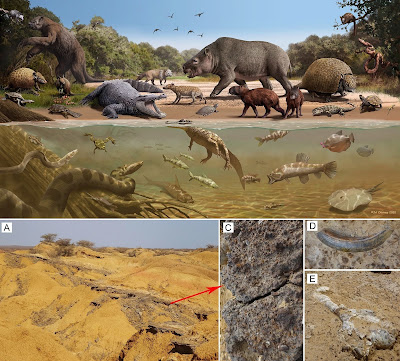
[Paleontology • 2021] A Pliocene–Pleistocene Continental Biota from Venezuela


Life reconstruction of the San Gregorio Formation faunal assemblage, Falcón Basin, Venezuela. 

[A] Norte Casa Chiguaje locality. [C] Close-up of the conglomeratic-fossiliferous layer.
Tooth (D) and humerus (E AMU-CURS-62) of mammals
 in situ.

in Carrillo-Briceño, Sánchez, Scheyer, ... et Sánchez-Villagra, 2021. 
Artist: Jaime Chirinos.

Abstract
The Pliocene–Pleistocene transition in the Neotropics is poorly understood despite the major climatic changes that occurred at the onset of the Quaternary. The San Gregorio Formation, the younger unit of the Urumaco Sequence, preserves a fauna that documents this critical transition. We report stingrays, freshwater bony fishes, amphibians, crocodiles, lizards, snakes, aquatic and terrestrial turtles, and mammals. A total of 49 taxa are reported from the Vergel Member (late Pliocene) and nine taxa from the Cocuiza Member (Early Pleistocene), with 28 and 18 taxa reported for the first time in the Urumaco sequence and Venezuela, respectively. Our findings include the first fossil record of the freshwater fishes Megaleporinus, Schizodon, Amblydoras, Scorpiodoras, and the pipesnake Anilius scytale, all from Pliocene strata. The late Pliocene and Early Pleistocene ages proposed here for the Vergel and Cocuiza members, respectively, are supported by their stratigraphic position, palynology, nannoplankton, and 86Sr/88Sr dating. Mammals from the Vergel Member are associated with the first major pulse of the Great American Biotic Interchange. In contrast to the dry conditions prevailing today, the San Gregorio Formation documents mixed open grassland/forest areas surrounding permanent freshwater systems, following the isolation of the northern South American basin from western Amazonia. These findings support the hypothesis that range contraction of many taxa to their current distribution in northern South America occurred rapidly during at least the last 1.5 million years.

Keywords: Neogene, Neotropics, Northern South America, Urumaco sequence, Paleodiversity, Megaleporinus, Amblydoras, Anilius, Camelidae, Chapalmalania


Fossiliferous localities of the San Gregorio Formation outcrops.
A–F Norte Casa Chiguaje locality. C Close-up of the conglomeratic-fossiliferous layer. D, E Tooth (D) and humerus (E AMU-CURS-62) of mammals in situ.

G, H San Gregorio Oeste del Pueblo locality. H Example of the conglomeratic layers were disarticulated continental vertebrates remains were found.
Pictures from authors J. D. Carrillo-Briceño (A–D, G, H) and E.-A. Cadena (F)

(Top) Life reconstruction of the San Gregorio Formation faunal assemblage, Falcón Basin, Venezuela. 
(Bottom) Key of the reconstruction. (1) cf. Didelphis sp. (2) cf. †Proeremotherium sp. (3) aff. †Holmesina floridanus. (4) †Pliodasypus vergelianus. (5) Podocnemididae indet.(6) Anilius scytale. (7) Chelus sp. (8) †Crocodylus falconensis. (9) †Cyonasua sp. (10) †Interatheriidae indet. (11) Podocnemididae indet. (12) †Falcontoxodon sp.
(13) †?Hydrochoeropsis wayuu. (14) aff. †Boreostemma sp. (15) Tupinambis s.l. (16) †Marisela gregoriana. (17) Corallus sp. (18) Chelonoidis sp. (19) Lizard. (20) Mylossoma sp. (21) Potamotrygon sp. (22) Hoplias sp. (23) Schizodon cf. S. corti. (24) cf. Amblydoras sp.
(25) Cichlidae indet. (26) Caimaninae indet. (27) cf. Megaleporinus sp. (28) cf. Sciades sp. (29) Callichthyidae indet. (30) Eunectes sp. (31) cf. Pipa sp. (32) Synbranchus sp. (33) Suckermouth catfish (Hypostominae)

Artist: Jaime Chirinos.


Conclusions: 
A late Pliocene age is here suggested for the Vergel Member based on its stratigraphical position, palynological content, and the presence of the pampatheriid Plaina. A Pleistocene age (Calabrian) is suggested for the Cocuiza Member based on its nannoplankton content and the 86Sr/88Sr dating.

There are fossils of at least 55 aquatic and terrestrial taxa from two different localities of the San Gregorio Formation: 49 taxa from the Vergel Member and 9 taxa from the Cocuiza Member. From the overall paleodiversity, 28 and 18 fossil taxa are reported for the first time in the fossil record of the Urumaco sequence and Venezuela, respectively. Among them are the first fossil records of the freshwater taxa cf. Megaleporinus, Schizodon, cf. Amblydoras, cf. Scorpiodoras, and the pipesnake Anilius scytale, all from Pliocene strata of the Vergel Member.

The San Gregorio Formation preserves a diverse assemblage of taxa that lived in the Falcón region after the isolation of northern South American and western Amazon basins. Mixed open grassland/forest areas were surrounded by permanent freshwater systems, contrasting with the current dry environments in the Falcón region. The presence of the cis-Andean freshwater catfishes cf. Amblydoras, cf. Scorpiodoras, podocnemidid and Chelus sp. turtles, the Eunectes (anaconda) and pipesnake Anilius scytale snakes, as well as some caviomorph neoepiblemid rodents supports the hypothesis that geographical contraction to their extant distribution in northern South America occurred rapidly during at least the last 1.5 Ma. This could suggest marked environmental changes in the region during the early Quaternary and a subsequent extinction/extirpation process related to major climatic drying.

The rodent fauna from San Gregorio Formation (NCC locality) is the only Neogene unit from northern South America documenting the coexistence of caviomorphs (Hydrochoerinae, Neoepiblemidae, and Octodontoidea) and cricetids. This fauna shows the last appearance datum of Neoepiblemidae. To date, no dinomyids were found in such strata, a group quite diverse and abundant during the middle-late Miocene, which suggests that they were possibly in decline when the fossiliferous levels of the Vergel Member were accumulated. Cingulate and pilosan (Phyllophaga) xenarthrans from the Vergel Member are more closely related to the earliest South American immigrant taxa in Central and North America around the time when the Panamá Isthmus was fully established. Carrillo et al. (2018) overlapped the mammalian assemblage of the Vergel Formation with the second and third migratory GABI pulse. However, with the late Pliocene age proposed here for the Vergel Member, this assemblage would have to be reinterpreted within GABI 1.

The occurrence of interatheriids in Pliocene sediments of the San Gregorio Formation could suggest that this mammalian group survived early Neogene climate change inhabiting patchy, likely forested areas in tropical South America. This longer persistence time for basal notoungulates might confirm that tropical areas of northern South America could have been "cradles and museums" of biodiversity (e.g., Jablonski et al. 2006). However, confirmation of these paleobiogeographic patterns requires intensive fieldwork in order to (1) collect, more complete and better-preserved specimens, (2) to increase drastically the sampling effort in the highly vegetated tropics, and (3) for isotaphonomic analysis to rule out any sampling biases in the Neotropics. Based on data from these suggested studies, we will be able to determinate whether the tropics were indeed refugia for different clades that inhabited South America.

 
Jorge D. Carrillo-Briceño, Rodolfo Sánchez, Torsten M. Scheyer, Juan D. Carrillo, Massimo Delfino, Georgios L. Georgalis, Leonardo Kerber, Damián Ruiz-Ramoni, José L. O. Birindelli, Edwin-Alberto Cadena, Aldo F. Rincón, Martin Chavez-Hoffmeister, Alfredo A. Carlini, Mónica R. Carvalho, Raúl Trejos-Tamayo, Felipe Vallejo, Carlos Jaramillo, Douglas S. Jones and Marcelo R. Sánchez-Villagra. 2021. A Pliocene–Pleistocene Continental Biota from Venezuela. Swiss Journal of Palaeontology. 140: 9. DOI: 10.1186/s13358-020-00216-6

Tuesday, January 11, 2022

[PaleoIchthyology • 2021] Rare Evidence of Shark-on-shark Trophic Interactions in the Fossil Record


One possible way in which the shark centra (CMM-V-2700) could have been bitten. This illustration depicts an active predatory encounter between two requiem sharks (aff. Carcharhinus sp.).

in Perez, Godfrey & Chapman, 2021. 

Original drawing by Tim Scheirer (formerly CMM). 
Coloration added by Clarence Schumaker (CMM).

Direct evidence of chondrichthyan trophic interactions in the fossil record is largely limited to bite traces on prey items but may also be found within the gut contents of exceptionally well-preserved individuals or as inclusions within coprolites. Shark bite traces are typically observed on durable, bony skeletal elements. Previous publications have shown shark bite traces on skeletal elements of fossil fishes, marine mammals, marine reptiles, and even a pterosaur, offering direct evidence of active predation, failed predation, and/or scavenging. Herein, we describe the first evidence of shark bite traces preserved on cartilaginous vertebral centra of other sharks. Four carcharhiniform centra have been identified from the Neogene Atlantic Coastal Plain, bearing chondrichthyan bite traces, of which two have partial teeth still embedded within them. In one specimen, CMM-V-2700, CT scans showed remodeling of the tissue around two partial teeth embedded in the centrum, indicating that the bitten individual survived the encounter. While shark-on-shark predation is common among living taxa, capturing evidence of these interactions in the fossil record is exceptionally rare.

Key words: Chondrichthyes, Carcharhinidae, trophic interaction, shark predation, shark-on-shark, bite traces, trace fossils, Neogene.

Centrum of Carcharhinidae indet. (CMM-V-2700) from the Miocene Calvert Formation in Chesapeake Beach, MD, USA.
 Centrum in articular cross-sectional (A), lateral (B), and articular (C) views; CT-scan in articular view (D); CT-scan in lateral view (E). Arrows indicate the two shark teeth embedded in and protruding from the upper quadrant of the centrum.
Scale bars 10 mm.


One possible way in which the shark centra (CMM-V-2700) could have been bitten. This illustration depicts an active predatory encounter between two requiem sharks (aff. Carcharhinus sp.).
Original drawing by Tim Scheirer (formerly CMM). 
Coloration added by Clarence Schumaker (CMM).


Victor J. Perez, Stephen J. Godfrey, and Phillip F. Chapman. 2021. Rare Evidence of Shark-on-shark Trophic Interactions in the Fossil Record. Acta Palaeontologica Polonica. 66(4); 847-856. DOI: 10.4202/app.00911.2021

Friday, November 1, 2019

[Paleontology • 2019] The First Tertiary Fossils of Mammals, Turtles, and Fish from Canada's Yukon


Tertiary Paleoenvironment in Yukon, Canada.
Rhinocerotidae, Chrysemys pond turtleHesperotestudo tortoise, and Esox pike

in Eberle, Hutchison, Kennedy, et al., 2019. 
Illustration: Julius Csotonyi digitallibrary.amnh.org

Abstract
Despite over a century of prospecting and field research, fossil vertebrates are exceedingly rare in Paleogene and Neogene rocks in northern Canada's Yukon Territory. Here, we describe the first records of probable Neogene vertebrate fossils from the territory, including tooth fragments of a rhinocerotid, a partial calcaneum of an artiodactyl, shell fragments of the pond turtle Chrysemys s.l. and tortoise Hesperotestudo, and a fragment of a palatine of Esox (pike). Although the tooth fragments cannot be identified solely by traditional paleontological means, we use tooth enamel microstructure, and primarily the presence of vertical Hunter-Schreger bands, to refer them to the Rhinocerotidae. As the only known record of the Rhinocerotidae in North America's western Arctic, the tooth fragments from the Wolf Creek site support the hypothesis that the clade dispersed between Asia and North America across Beringia. The fossils are consistent with a Miocene age for the Wolf Creek site that is inferred from radiometric dates of the Miles Canyon basalt flows in the vicinity of the fossil locality. Further, the tortoise and pond turtle fossils indicate a mild climate in the Yukon at the time, consistent with the vegetation reconstructions of others that indicate a warmer, wetter world in the Miocene than today.

FIGURE 9. A–B. Tangential section of YG514.12 (uncoated) viewed under a light microscope showing the bifurcating vertical HSB. A. Light source from top. B. Light source from bottom. C. SEM image of tangential section. D. Magnified bifurcation in region encompassed by white square in C, showing the steeply angled prisms comprising the HSB; transitional zones are the light-colored edges of the bifurcation. E. Magnified SEM image showing narrow transitional zone of horizontal prisms flanked by the steeply angled prisms that make up the vertical HSB. F. Vertical section of outer enamel showing the radial enamel wherein the prisms rise at a shallow angle toward the OES. Abbreviation: OES, outer enamel surface.


an ancient relative of today's rhinoceroses splashing through a stream next to turtles and fish in the Yukon.
Illustration: Julius Csotonyi


Jaelyn Eberle, J. Howard Hutchison, Kristen Kennedy, Wighart Von Koenigswald, Ross D.E. MacPhee and Grant Zazula. 2019. The First Tertiary Fossils of Mammals, Turtles, and Fish from Canada's Yukon. American Museum Novitates. (3943); 1-28. DOI: 10.1206/3943.1 

Ancient rhinos roamed the Yukon phys.org/news/2019-10-ancient-rhinos-roamed-yukon.html via @physorg_com

Wednesday, July 27, 2016

[PaleoMammalogy • 2013] The Most Basal Beaked Whale Ninoziphius platyrostris Muizon, 1983: Clues on the Evolutionary History of the Family Ziphiidae (Cetacea: Odontoceti)


Figure 15. Life reconstruction of an adult male of Ninoziphius platyrostris preying upon medium-size benthic gadiform fish along the sea floor off the southern Peruvian coast during the late Neogene. 
scientific artist: C. Letenneur, MNHN, Paris || CharleneLetenneur.ultra-book.com
  
DOI: 10.1111/zoj.12018 

Abstract
Ninoziphius platyrostris, from the late Neogene of Peru, is one of the best-known fossil beaked whales (Odontoceti: Ziphiidae), with a holotype including the skull with ear bones, mandibles, teeth, and postcranial elements. Furthermore, based on several characters, including a complete functional upper and lower dentition, it is usually considered as one of the most archaic ziphiids. However, the poorly preserved dorsal portion of the holotype skull has led to unresolved phylogenetic relationships. With the addition of two newly prepared skulls from the same Peruvian locality we redescribed N. platyrostris. In the light of recent ziphiid discoveries, an emended diagnosis of the species is proposed here. In our cladistic analysis Ninoziphius is the most basal stem ziphiid. Newly observed or reassessed morphological traits allow functional and ecological considerations. The morphology of the oral apparatus suggests that Ninoziphius was less specialized for suction feeding than most extant ziphiids. Tooth wear in the holotype may indicate benthic feeding. Although the vertebral column of Ninoziphius corresponds to less developed locomotor abilities for deep dives, its cranial morphology does not provide definitive arguments for an echolocation system less efficient than in deep diving extant ziphiids. Finally, the phylogenetic tree produced was used to detail the evolutionary history of several major ziphiid features (dental reduction, development of mandibular tusks, and increased body size).

 Keywords: body size; deep diving; echolocation; feeding strategy; late Neogene; Peru; phylogeny


Figure 15. Life reconstruction of an adult male of Ninoziphius platyrostris preying upon medium-size benthic gadiform fish along the sea floor off the southern Peruvian coast during the late Neogene.
scientific artist: C. Letenneur, MNHN, Paris || CharleneLetenneur.ultra-book.com


Olivier Lambert, Christian de Muizon and Giovanni Bianucci. 2013. The Most Basal Beaked Whale Ninoziphius platyrostris Muizon, 1983: Clues on the Evolutionary History of the Family Ziphiidae (Cetacea: Odontoceti). Zoological Journal of the Linnean Society. 167(4); 569–598. DOI: 10.1111/zoj.12018

Tuesday, July 26, 2016

[PaleoOrnithology • 2016] Mioneophron longirostris • A New Old World Vulture from the late Miocene of China sheds light on Neogene shifts in the past Diversity and Distribution of the Gypaetinae


Mioneophron longirostris 
 Li, Clarke, Zhou & Deng, 2016
 
 DOI: 10.1642/AUK-15-240.1 

ABSTRACT
Neogene fossils of Old World vultures (Aegypiinae and Gypaetinae) are known from both Old World and New World records. There are no extant Old World vultures in the Americas today, although a large diversity of Gypaetinae is known from Miocene to late Pleistocene records. Despite a comparatively large number of North American gypaetine fossils, complete specimens have rarely been reported from Eurasia and Africa. We describe the exceptional skeleton of a new gypaetine vulture from the late Miocene deposits of the Linxia Basin in northwestern China. The specimen is the oldest record of Gypaetinae from Eurasia or Africa. A reexamination of the geographic and temporal distribution of most Old World vultures from Neogene deposits indicates a diverse radiation, coincident with early- to mid-Miocene grassland expansion for Gypaetinae. Although the diversification of Aegypiinae has been linked to the transition from C3 to C4 grassland, Gypaetinae diversification predates that transition in both North America and Asia. A shift in the known latitudinal distribution is also noted. Neogene records of Old World vultures are found primarily in mid- and high-latitude regions of North America and Eurasia as well as in the middle and low latitudes of Eurasia and Africa. With very few records in the middle to late Miocene, a latitudinal distribution similar to that of extant species is first seen in the early Pliocene. The new fossil provides further temporal constraints on avian subclade diversification. It is also consistent with an emerging pattern of profound recent shifts in avian diversity and distribution more generally.

Keywords: extinction, fossil, Gypaetinae, Linxia, Old World vulture


SYSTEMATIC PALEONTOLOGY

AVES Linnaeus, 1758
ACCIPITRIDAE Vieillot, 1816
Gypaetinae Vieillot, 1816

Mioneophron longirostris, gen. et sp. nov. (Figures 1–4)


Holotype: HMV 1877: A nearly complete skeleton (Figure 1) preserved in yellow-brownish siltstone with carbonate cementation. The proximal right tarsometatarsus and distal left tarsometatarsus have been rearranged after collection (illustrated as dark gray regions in Figure 1). Some bones have been fabricated and others recomposed in a wrong position (e.g., pedal digits). The left distal humerus is reconstructed with plaster and the proximal right tarsometatarsus appears to be a proximal tibiotarsal fragment, without any definite clue to its affinity. The position of the hallux opposite of where it should be in the right pes is one indication that the pedal digits were recomposed.

Locality and horizon: The holotype was collected from Baihua Village, Zhuangheji Town, Guanghe County, in Gansu Province, northwestern China (Figure 5: star), in the Upper Miocene Liushu Formation, Linxia Basin. All currently known fossil birds in the Linxia Basin are from the same unit, which is characterized by a distinct matrix lithology (Deng et al. 2013). The bird fossils have been acquired from local farmers and collectors. The holotype specimen is archived in the Hezheng Paleozoological Museum, Gansu Province, China.

Etymology: The genus name, “Mioneophron,” references the Miocene age and the proposed affinity of the new specimen with Neophron. The adjectival species name, longirostris, references an elongate rostrum.

Diagnosis: Mioneophron longirostris can be differentiated from all other gypaetine and aegypiine vultures by the unique presence of a combination of the following features: a long and narrow rostrum with small oval-shaped nares (Figure 1), a well-projected and globose humeral head and distinct caudal ridge on the margin of the deltopectoral crest, a much longer ulna than tibiotarsus (ratio = 1.45), and a distinct groove between the dorsal iliac ridges (Figure 2).


Systematic placement of the new species

The new species shares several features with gypaetine vultures, including the relatively weakly projected transverse nuchal crest on the basicranium as well as the broad humeral deltopectoral crest. It also has fewer cervical vertebrae (14, vs. 15–17 in Aegypiinae; Rich 1980, Holdaway 1994), and the postacetabular ilia are incompletely fused to the sacrum (Figure 4; Jollie 1976, 1977a, 1977b, 1977c), both of which are features consistent with gypaetine vultures. However, Mioneophron has a wider deltopectoral crest than aegypiine vultures, a deeper humeral capital incisure, a gentler bicipital crest, and a shorter mandibular symphysis. Furthermore, unlike in aegypiine vultures, no pneumatic foramina are present on the proximal surface of the pisiform process of the carpometacarpus (Manegold et al. 2014). The medial hypotarsal crest is slightly higher than that of the lateral one in the cranial view, whereas in Aegypius, Trigonoceps, and Torgos the 2 hypotarsal crests are very similar in height.


 Zhiheng Li, Julia A. Clarke, Zhonghe Zhou and Tao Deng. 2016. A New Old World Vulture from the late Miocene of China sheds light on Neogene shifts in the past diversity and distribution of the Gypaetinae.  The Auk. 133(4); 615-625. DOI: 10.1642/AUK-15-240.1


RESUMEN: Los fósiles del Neógeno de buitres del Viejo Mundo (Aegypiinae y Gypaetinae) se conocen de localidades en el Viejo y el Nuevo Mundo. Actualmente no existen buitres del Viejo Mundo en las Américas, aunque se conoce una gran diversidad de Gypaetinae a partir de registros del Mioceno al Pleistoceno tardío. A pesar de un número comparativamente grande de fósiles de Gypaetinae en Norte América, los reportes de especímenes completos en Eurasia y África son raros. En este trabajo describimos el esqueleto excepcional de un nuevo buitre gypaetino de los depósitos del Mioceno tardío de la cuenca Linxia en el noreste de China. El espécimen es el registro más viejo de Gypaetinae de Eurasia o África. La reevaluación de la distribución geográfica y temporal de la mayoría de los buitres del Viejo Mundo en depósitos del Neógeno indica una radiación diversa que coincide con la expansión de las praderas durante el Mioceno temprano a medio. Aunque la diversificación de Aegypiinae ha sido relacionada con la transición de praderas C3 a praderas C4, la diversificación de Gypaetinae precede esa transición en Norte América y Asia. También notamos un cambio en la distribución latitudinal. Los registros del Neógeno de buitres del Viejo Mundo se encuentran principalmente en regiones de latitud media y alta en Norte América y Eurasia, y también en regiones de latitud media y baja en Eurasia y África. Con tan pocos registros en el Mioceno medio a tardío, una distribución latitudinal similar a la de las especies actuales sólo se ve inicialmente en el Plioceno temprano. El nuevo fósil impone más restricciones temporales en la diversificación de subclados de aves. También es consistente con un patrón emergente de cambios profundos recientes en la diversidad y distribución de las aves en general.

Palabras clave: buitres del Viejo Mundo, extinción, fósil, Gypaetinae, Linxia