Showing posts with label MSU. Show all posts

Monday, January 12, 2026

[Botany • 2025] Boesenbergia burmanica (Zingiberaceae) • A New Species from Myanmar

 
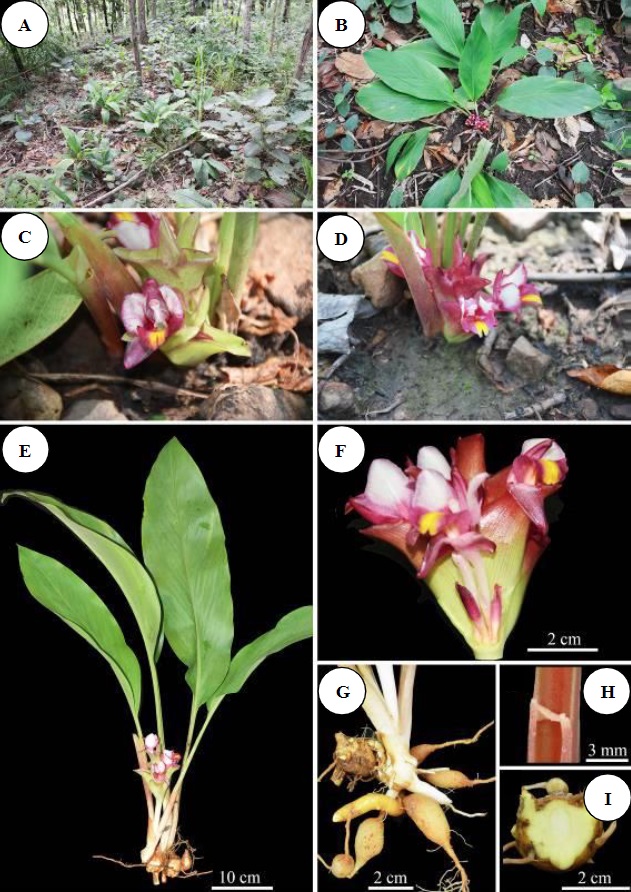
  Boesenbergia burmanica Boonma, P.Saensouk & Saensouk:
 
in P. Saensouk, S. Saensouk, Boonma, Htway, Oo, Naing et Junsongduang, 2025. 

Abstract
Boesenbergia burmanica Boonma, P.Saensouk & Saensouk, a new species from Naypyidaw Union Territory, Myanmar, is described based on morphological examination of specimens collected during field surveys in 2024–2025. The genus Boesenbergia is taxonomically complex, and ongoing botanical exploration in Southeast Asia continues to reveal undescribed taxa. Comparative analyses of living plants, herbarium materials, and published descriptions were conducted to determine diagnostic features. Boesenbergia burmanica is closely related to B. meghalayensis Aishwarya & M.Sabu but differs in having ovoid, branched rhizomes, a pubescent lamina on both surfaces, and an oblanceolate labellum with bright red markings. It grows in shady, sandy-loam habitats at 140–145 m elevation and flowers from August to September, producing inflorescences with nine to ten flowers. Species of Boesenbergia are traditionally used in Myanmar and neighboring regions as medicinal and ornamental plants, and notes on local ethnobotanical knowledge are provided. The new species exhibits high ornamental potential due to its compact clumping habit and attractive floral coloration. Cultivation guidelines are provided to support ex situ conservation and horticultural development for sustainable use. This discovery increases the number of Boesenbergia species recorded in Myanmar to 14 and highlights the importance of continued field-based taxonomic and conservation research on regional Zingiberaceae diversity.

Keywords: Boesenbergia; conservation; ethnobotany; Myanmar flora; new species; plant diversity; taxonomy; Zingibereae 

  Boesenbergia burmanica Boonma, P.Saensouk & Saensouk:
(a) Top view of habits. (b) Front view of flower. (c) Abaxial of leaf. (d) Rhizome dissected to show the internal coloration. (g) Side view of pseudostems.
(e) Parts of flower of B. burmanica from left to right: side view of anther, epigynous glands with ovary, calyx, dorsal corolla lobe, lateral corolla lobes, staminodes and labellum.
(f) Parts of flower of B. meghalayensis from left to right: side view of anther, epigynous glands with ovary, calyx, dorsal corolla lobe, lateral corolla lobes, staminodes, and labellum. 


  Boesenbergia burmanica Boonma, P.Saensouk & Saensouk sp. nov.:
 (a) Front view of anther. (b) Back view of anther. (c) Side view of flower. (d) Side view of anther with floral tube, calyx, and ovary. (e) Bract. (f) Calyx. (g) Habit. (h) Dorsal corolla lobe. (i) Lateral corolla lobes. (j) Staminodes. (k) Epigynous glands and ovary. (l) Labellum.
Illustration drawn by Thawatphong Boonma.

Boesenbergia burmanica Boonma, P.Saensouk & Saensouk sp. nov.

Diagnosis. Boesenbergia burmanica is similar to B. meghalayensis Aishwarya & M.Sabu, but differs in having ovoid, branched rhizomes (vs. running); ovoid tuberous roots (vs. cylindrical); ligule 3–5 mm long (vs. 1–2 mm); lamina narrowly elliptic, pubescent on both surfaces (vs. elliptic, glabrous); bracts pale green, puberulent (vs. white, glabrous); bracteole puberulent (vs. glabrous); rachis elongate with 9–10 flowers (vs. 4–5 flowers); labellum oblanceolate, not saccate, apex incised, white with bright red towards the apex and reddish spots on the mid-lobe (vs. ovate, saccate, apex acute, white with maroon towards the tip, maroon spots in the throat, and pale yellow along the mid-lobe); and larger anther (7.5–7.7 × 3.4–3.6 mm) with smaller crest not touching the anther backside (vs. 5–6 × 2 mm, crest 2.5 × 2 mm, tip touching backside) (Table 1, Figure 2 and Figure 3).

Etymology: The specific epithet “burmanica” refers to Myanmar (formerly Burma), the country where the species was discovered.


Piyaporn Saensouk, Surapon Saensouk, Thawatphong Boonma, Nyi Nyi Htway, Win Paing Oo, Min Khant Naing and Auemporn Junsongduang. 2025. A New Species of Boesenbergia Kuntze (Zingiberaceae) from Myanmar, with Notes on Diversity, Utilization, Conservation, and Horticultural Potential. Taxonomy. 5(4), 70; DOI: doi.org/10.3390/taxonomy5040070 [17 December 2025]
Researchgate.net/publication/398772402_A_New_Species_of_Boesenbergia_from_Myanmar

Thursday, November 20, 2025

[Diplopoda • 2025] Coxobolellus sirindhornae • A New Thai Millipede Species of the Genus Coxobolellus (Spirobolida: Pseudospirobolellidae) from northern Thailand


Coxobolellus sirindhornae 
Pimvichai, Prasankok & Backeljau, 2025
 
กิ้งกือกระบอกหางมนสิรินธร || DOI: doi.org/10.58837/tnh.25.8.266861 

Abstract
A new millipede species of the genus Coxobolellus is described from Mae Hong Son Province, Thailand: Coxobolellus sirindhornae sp. nov. The new species is defined by its gonopod morphology and COI DNA barcodes. These latter place the new species within the well-supported Coxobolellus clade. The new species exhibits four gonopod synapomorphies that are diagnostic for the genus: (1) a protruding process on the coxae of the 3rd (and sometimes 4th) pair of male legs, (2) large, triangular coxae on the 4th and 5th pairs of legs, (3) a short process on the preanal ring extending to or slightly beyond the anal valves, and (4) the posterior gonopod telopodite divided into two parts, with a conspicuous pore opening at the mesal margin at the end of the coxal part. The new species is included in an updated morphological identification key for all currently recognized Coxobolellus species.

Keywords: DNA barcoding, gonopod morphology, identification key, phylogeny


Live Coxobolellus sirindhornae sp. nov., holotype, (CUMZ-D00156) from Mae Hong Son Province (Photos by P. Pimvichai).

Coxobolellus sirindhornae sp. nov. 
กิ้งกือกระบอกหางมนสิรินธร


Piyatida Pimvichai, Pongpun Prasankok and Thierry Backeljau. 2025. A New Thai Millipede Species of the Genus Coxobolellus Pimvichai, Enghoff, Panha & Backeljau, 2020 (Diplopoda: Spirobolida: Pseudospirobolellidae). Tropical Natural History. Supplement 8 (2025): 38-51. DOI: doi.org/10.58837/tnh.25.8.266861 


Tuesday, June 24, 2025

[Botany • 2025] Typhonium cucullatum • A New Species from Sakon Nakhon Province, Northeastern Thailand [Studies on Typhonium (Araceae) of Thailand III]


Typhonium cucullatum K.Z.Hein, P.Saensouk & Saensouk, 

in P. Saensouk, S. Saensouk, Hein, Boonma, Rakarcha et Naive. 2025. 

Abstract
Typhonium cucullatum, a new species from Sakon Nakhon Province, Northeastern Thailand, is described and illustrated. A detailed description, color plates, a discussion of similar taxa, phenology, distribution, and a conservation status assessment are provided.

Keyword: Areae, Aroideae, Cretaceous sandstone, Indochina, spathe movement, Typhonium laoticum

Typhonium cucullatum sp. nov.
A. Excavated flowering individual showing adaxial surface of leaf blades, B. Side view of inflorescence at post-pistillate anthesis, C. Detail of spadix showing pistillate zone, sterile interstice, and staminate zone (nearside of spathe artificially removed), D. Spadix at post-pistillate anthesis (nearside of spathe artificially removed), E. Excavated flowering individual showing abaxial surface of leaf blades.  
Spathe movement of Typhonium cucullatum sp. nov. during anthesis. A. & B. Inflorescence at early pistillate anthesis, spathe limb erect, gaping and expanding to reveal the staminate zone, C. & D. Inflorescence at middle pistillate anthesis, spathe limb reflexing and curling strongly backward, E. & F. Inflorescence at post-pistillate anthesis, spathe limb gradually curving forward, with the lower part of the spathe limb margins strongly convolute, closing over the staminate zone, G. & H. Inflorescence at staminate anthesis, forward curvature of the spathe limb most prominent. (A., C., E., G. Front view of inflorescence, B., D., F., H. Side view of inflorescence)
 Photos by: Khant Zaw Hein.
 

Typhonium cucullatum K.Z.Hein, P.Saensouk & Saensouk, sp. nov. 

Diagnosis: Typhonium cucullatum is unique within the genus in having a spathe limb that curves strongly forward, forming a hood-like shape at the end of pistillate anthesis and remaining intact through post-staminate anthesis despite signs of withering. In overall morphology, T. cucullatum is most similar to T. laoticum (Gagnepain, 1942), but can be readily distinguished by its spathe limb curving strongly forward (vs. the spathe limb reflexed backward in T. laoticum), a shorter staminate zone with 4–6 whorls of stamens (vs. 12–15 whorls of stamens in T. laoticum), and a stipitate appendix (vs. a sessile appendix in T. laoticum).

Etymology: The specific epithet is derived from the Latin cucullatus, meaning ‘hooded’, referring to the spathe limb becoming forwardly curved and hood-like.


Piyaporn Saensouk, Surapon Saensouk, Khant Zaw Hein, Thawatphong Boonma, Sarayut Rakarcha and Mark Arcebal K. Naive. 2025. Studies on Typhonium Schott (Araceae) of Thailand III: Typhonium cucullatum, A New Species from Sakon Nakhon Province, Northeastern Thailand. Taiwania. 70(3); 398-402.  DOI: 10.6165/tai.2025.70.398 [2025 June 18]   taiwania.ntu.edu.tw/abstract/2087

Thursday, February 27, 2025

[Botany • 2025] Cornukaempferia puangpeniae & C. aurantiiflora var. vespera (Zingiberaceae) • New Taxa from northern Thailand


Cornukaempferia puangpeniae P. Saensouk, Saensouk, Boonma & Techa, 

in P. Saensouk, S. Saensouk, Boonma, Techa, Rakarcha, Ragsasilp et Nguyen, 2025. 
เปราะทองอาจารย์พวงเพ็ญ  ||  DOI: doi.org/10.1016/j.heliyon.2024.e41603  

Abstract
Thailand hosts a diverse array of plants in the Zingiberaceae family, with over 150 endemic species, highlighting its significance in global biodiversity. The genus Cornukaempferia stands out for its ornamental and medicinal value. During a research expedition in Northern Thailand, a previously unknown Cornukaempferia species was discovered in Sukhothai province, expanding the known distribution range. It was confirmed through comprehensive taxonomic analysis as a new species, Cornukaempferia puangpeniae. Additionally, a new variety, C. aurantiiflora var. vespera, was identified in Uttaradit Province. The genus now encompasses eight species and two varieties with the addition of these taxa, exhibiting a notable prevalence in Thailand and highlighting its significant endemism. Particularly, C. larsenii is noteworthy for being native to Thailand and Laos. Detailed morphological descriptions, including diagnoses with related taxa, were provided. The species' ecological characteristics, pollen morphology, traditional uses, and conservation status were documented. A revised key to species and varieties in the genus Cornukaempferia, including a UPGMA cluster analysis dendrogram elucidating morphological relationships within the genus, was presented. These discoveries contribute to the botanical knowledge of the region, underscoring the importance of continued exploration and conservation efforts in preserving its rich flora.
 
Keywords: Cornukaempferia, new species, Sukhothai, Taxonomy, Uttaradit, Zingiberaceae

Cornukaempferia puangpeniae P. Saensouk, Saensouk, Boonma & Techa sp. nov.;
 (A) young leaf is rolled and erect before unfurling; (B) flower; (C) habit; (D) habitat
 (Photographs: A–B by T. Boonma, C by S. Saensouk, D by C. Techa).

 Cornukaempferia puangpeniae P.Saensouk, Saensouk, Boonma & Techa sp. nov

Diagnosis: Similar to C. kamolwaniae Picheans., Yupparach & Wongsuwan, but differs, particularly in dormancy characteristics, in having a tuberous root with two layers: a light brown core and an outer yellow layer (vs. C. kamolwaniae, which have a brownish inner core, followed by an orange-brownish middle layer, and finally an outer layer in yellow-oak); leaf sheath 5–7 cm long (vs. 3.5–4 cm long); lamina adaxially dark green with a dark reddish-purple tinge (vs. dark green without a dark reddish-purple tinge); bracts pubescent (vs. glabrous with a pubescent apex); floral tube sparsely hairy (vs. glabrous); staminodes apex acute (vs. apex rounded); labellum apex acute without incision (vs. apex rounded with an incision 2–3 mm long); filament 4.5–5 mm long, sparsely hairy (vs. 7–9 mm long, glabrous); anther 2.5–2.8 cm long (vs. 1.5–1.8 cm long); epigynous glands measure approximately 4 mm in length (vs. 1–2 mm in length).

Etymology: The specific epithet “puangpeniae” is a tribute to Prof. Dr. Puangpen Sirirugsa, a renowned botanist with expertise in Zingiberaceae. She holds the distinction of being the first Thai researcher to conduct extensive studies on the Zingiberaceae family in Thailand.

Cornukaempferia aurantiiflora var. vespera P. Saensouk, Saensouk & Boonma var. nov.;
(A) habit in natural habitat; (B) top view of flower; (C) top view of habit
(Photographs: A by T. Boonma, B–C by S. Saensouk).

 Cornukaempferia aurantiiflora var. vespera P.Saensouk, Saensouk & Boonma var. nov

Etymology: vespera” is derived from the Latin word “vesperum”, meaning “evening”, which refers to its flower blooming in the evening.


Piyaporn Saensouk, Surapon Saensouk, Thawatphong Boonma, Chainarong Techa, Sarayut Rakarcha, Areerat Ragsasilp and Danh Duc Nguyen. 2025. Cornukaempferia puangpeniae sp. nov. and C. aurantiiflora var. vespera var. nov. (Zingiberaceae) from Northern Thailand.  Heliyon. 11(2), e41603. DOI: doi.org/10.1016/j.heliyon.2024.e41603  
  facebook.com/SaensoukLab/posts/122203363100172160


Thursday, January 16, 2025

[Botany • 2025] Hayarum mirispathum (Araceae: Aroideae) • A New Genus and Species from Thailand


Hayarum mirispathum K.Z.Hein, Prehsler, Saensouk & S.L.Low,  

in Hein, Prehsler, Saensouk et Low, 2025. 

Abstract
The new monotypic genus Hayarum K.Z.Hein, Prehsler, Saensouk & S.L.Low from Thailand, with the sole species Hayarum mirispathum K.Z.Hein, Prehsler, Saensouk & S.L.Low, is described based on comprehensive morphological and phylogenetic evidence. A detailed taxonomic account of the new genus, morphological comparisons with related genera, and brief observations on its flowering biology and spathe movement are provided.

Keyword: Areae, Arisaemateae, Indochina, insect-trapping mechanism, Pinellia, spathe movement, Typhonium

Hayarum mirispathum gen. nov. et sp. nov.
A. Cultivated flowering plant, B. Inflorescence at pistillate anthesis (spathe limb strongly reflexed and curled), C.–D. Inflorescence at post pistillate anthesis (spathe limb beginning to uncurl and gradually becoming erect), E. Inflorescence at post staminate anthesis (pollen released, spathe limb closing, partly leaving the appendix visible and remaining erect, spathe base margins recurve and gaping, revealing the staminate zone), F. Detail of spadix showing pistillate zone, sterile zone, staminate zone, supra-staminal sterile zone, and base of the appendix (nearside spathe artificially removed), G. Longitudinal section of pistil with with a single erect, sessile ovule on a basal placenta.
Scale bars: A=2 cm, B–E=1 cm, F=5 mm. 
Photos by D. Prehsler.

Hayarum K.Z.Hein, Prehsler, Saensouk & S.L.Low, gen. nov. 

Diagnosis: Hayarum, with its sole species H. mirispathum, is uniquely defined by the combination of its remarkable spathe movement during anthesis, a pistillate zone of the spadix free from the spathe, a short sterile zone between the pistillate and staminate zones which is completely covered with a single whorl of subglobose staminodes, a staminate zone wholly contained within the spathe base and a unilocular ovary with a single erect, sessile ovule on a basal placenta. Hayarum shares certain morphological features with the genus Pinellia, notably the unilocular ovary with a single erect, sessile ovule on a basal placenta, and the gaping of spathe base margins during late staminate anthesis. However, in Pinellia, the spathe is mostly with a transverse septum between the pistillate and staminate zone, and its pistillate zone is adnate to the spathe. In contrast, Hayarum lacks this transverse septum and its pistillate zone is entirely free from the spathe. The inflorescence of Hayarum resembles that of the genus Typhonium, but the latter differs by having non-opening spathe base throughout anthesis, ovaries with a single ovule held obliquely on a funicle on a basal placenta, and a staminate zone which is completely exserted from the spathe base. 

Etymology: The generic name Hayarum honors British botanist Alistair Hay (+ ‘arum’, from the Greek αρου, an ancient name for Arum). Alistair Hay is an expert on Asian Araceae and the former Director of the Sydney Botanical Garden in Australia. In recognition of his outstanding contributions to aroid research, he was awarded the H.C. Schott Award for excellence in aroid research in 2023. Hay is regarded as the world authority on the subfamily Lasioideae (Araceae) and has conducted extensive research on the Malesian and Australian Araceae. He also inspired the first author (KZH) to pursue the study of aroids and has always kindly suggested and guided throughout his aroid research. 

Hayarum mirispathum K.Z.Hein, Prehsler, Saensouk & S.L.Low, sp. nov. 

Diagnosis: Hayarum mirispathum bears the closest morphological resemblance to Pinellia and Typhonium. Hayarum mirispathum differs from Pinellia in several key morphological traits. It has a pistillate zone of the spadix that is free from the spathe, a short sterile zone between the pistillate and staminate zones that is completely covered with a single whorl of staminodes, and a spadix shorter than the spathe. In contrast, Pinellia exhibits a pistillate zone adnate to the spathe, a longer prominent sterile zone between the pistillate and staminate zones that is entirely naked, and a spadix much longer than the spathe. Hayarum mirispathum differs from Typhonium, to which it bears the closest resemblance, in having gaping spathe base margins during late staminate anthesis, a unilocular ovary with a single erect, sessile ovule on a basal placenta, and a staminate zone that is fully contained within the spathe base. Typhonium possess non-gaping spathe base margins throughout anthesis, a unilocular ovary with a single obliquely positioned ovule on a funicle on a basal placenta, and a staminate zone fully exserted from the spathe base.

Etymology: The specific epithet mirispathum is derived from the Latin ‘mirus’ (wonderful or marvelous) and ‘spathus’ (spathe) referring to the remarkable spathe movement observed during anthesis in this species.


Khant Zaw Hein, David Prehsler, Surapon Saensouk and Shook Ling Low. 2025. Hayarum mirispathum (Araceae —Aroideae): A New Genus and Species from Thailand. Taiwania. 70(1); 65 - 74. DOI: 10.6165/tai.2025.70.65  taiwania.NTU.edu.tw/abstract/2048

Thursday, December 26, 2024

[Botany • 2024] Curcuma sumonii & C. wanchaii (Curcuma subg. Curcuma, Zingiberaceae: Zingibereae) • A New Taxa from Thailand

 
Curcuma sumonii Saensouk, P.Saensouk, Boonma & Techa 
C. wanchaii Saensouk, P.Saensouk, Maknoi & Boonma, 

in P. Saensouk, S. Saensouk, Boonma, Ragsasilp, Maknoi, Techa, Srisuk et Souladeth, 2024. 
(Photographs by T. Boonma).

Abstract 
This research presents the discovery of two novel taxaCurcuma sumonii Saensouk, P.Saensouk, Boonma & Techa, and C. wanchaii Saensouk, P.Saensouk, Maknoi & Boonma, belonging to the Curcuma subgenus CurcumaCurcuma sumonii was collected in Sukhothai Province, Northern Thailand, while C. wanchaii was found in Kanchanaburi Province, Southwestern Thailand. Our study provides a comprehensive documentation of their morphological attributes, including detailed descriptions supported by visual aids. In addition to morphological data, we offer insights into vernacular names, ecological characteristics, phenology, traditional uses, conservation status, and distribution maps. Morphological comparison Tables 1 and 2 are provided to differentiate between these newly discovered taxa and their allied species. Furthermore, we present an identification key to facilitate the differentiation of these taxa from their allied species. The findings of this study contribute to the understanding of biodiversity within the Curcuma genus and offer valuable information for further conservation efforts and taxonomic research.

Keywords: Curcuma, Critically endangered, Kanchanaburi, Sukhothai, Taxonomy, Zingiberales 

Curcuma sumonii Saensouk, P.Saensouk, Boonma & Techa sp. nov.
 (A) habit in natural habitat, and (B) side view of inflorescence with flowers.
(Photographed by Surapon Saensouk).

 Curcuma sumonii Saensouk, P.Saensouk, Boonma & Techa, sp. nov. 

Curcuma wanchaii Saensouk, P.Saensouk, Maknoi & Boonma sp. nov.
(A) inflorescences, (B) flower, (C) side and front view of anther, (D) habits in the natural habitat, growing along with Globba substrigosa King ex Baker.
(Photographs by Thawatphong Boonma).

C. wanchaii Saensouk, P.Saensouk, Maknoi & Boonma, sp. nov. 

  
Piyaporn Saensouk, Surapon Saensouk, Thawatphong Boonma, Areerat Ragsasilp, Charan Maknoi, Chainarong Techa, Pathomthat Srisuk and Phetlasy Souladeth. 2024.  Curcuma sumonii sp. nov., and C. wanchaii sp. nov. (Zingiberaceae), Two New Taxa of Curcuma subgen. Curcuma from Thailand. Scientific Reports. 14: 27541. DOI: doi.org/10.1038/s41598-024-79261-x 
 

Wednesday, November 6, 2024

[Botany • 2022] Curcuma lampangensis & C. sabhasrii (Curcuma subg. Ecomatae, Zingiberaceae: Zingibereae) • Two New Species from northern Thailand


Curcuma sabhasrii Saensouk, Maknoi, Wongnak & Rakarcha, 

in Rakarcha, S. Saensouk, Maknoi, Wongnak, Thammarong et P. Saensouk, 2022. 
Photographed by S. Rakarcha

Abstract
Curcuma lampangensis Saensouk, Maknoi & Rakarcha and C. sabhasrii Saensouk, Maknoi, Wongnak & Rakarcha, two new species of ginger family (Zingiberaceae) from northern Thailand, are described, illustrated and photographed. Additionally, the authors provide their detailed morphological descriptions, as well as illustrations, color photographs, distributions, ecology, etymology, phenology, vernacular, conservation status and its closely related species. The two new species are assignable to the Curcuma subgenus Ecomatae. Curcuma lampangensis and C. sabhasrii are endemic to Lampang and Phitsanulok provinces of northern Thailand, respectively. The morphological characteristics of C. lampangensis are compared to C. rhomba J. Mood & K. Larsen while C. sabhasrii is compared to C. peramoena Souvann. & Maknoi. Curcuma lampangensis is recognized by its glabrous on nearly all parts of the plant, creeping rhizome and the inflorescence usually arises from a new rhizome branch next to the existing pseudostem, flowers that are white to pale pink and white to pale yellow labellum with 2 dark yellow bands at the center and reddish tinge at the base. Curcuma sabhasrii is recognized by having 8-15 greenish to reddish-purple bracts, reddish-purple corolla lobes, white with reddish-purple mottling to reddish-purple staminodes and labellum which is reddish-purple with an embossed yellow path along the midrib from base to apex and reddish-purple mottling on yellow mid-band of lower half. A key to 24 species of Curcuma subgenus Ecomatae in Thailand is presented.


Curcuma sabhasrii Saensouk, Maknoi, Wongnak & Rakarcha:
A.–B. habitat; C.–D. inflorescences; E. habit; F. cincinnus with 4 flowers; G. rhizome and root tubers; H. ligule; I. colour of rhizome.
Photographed by S. Rakarcha


Curcuma lampangensis Saensouk, Maknoi & Rakarcha  
กระเจียวลำปาง

Curcuma sabhasrii Saensouk, Maknoi, Wongnak & Rakarcha,
 กระเจียวสรรพศรี


 Sarayut Rakarcha, Surapon Saensouk, Charun Maknoi, Mathee Wongnak, Woranart Thammarong and Piyaporn Saensouk. 2022.  Curcuma lampangensis and C. sabhasrii, Two New Species of the Family Zingiberaceae from northern Thailand. Biodiversitas. 23: 4448-4459. https://smujo.id/biodiv/article/view/11720

Wednesday, October 23, 2024

[Botany • 2024] Zingiber baumii (Zingiberaceae) • A New Species from northeastern Thailand


Zingiber baumii Chatan & Promprom, 

in Promprom, Munglue aet Chatan, 2024.

ABSTRACT
Zingiber baumii Chatan & Promprom, a new species from the Zingiberaceae family, is described from Sakon Nakhon Province in northeastern Thailand. This species was identified during field expeditions conducted between 2018 and 2024 in Phu Pha Yol National Park. The morphological characteristics of Z. baumii, such as red or pinkish-red leaf sheaths, leaf blades (1.5−) 2.0–3.0 cm wide, pink petioles, and bright yellow corolla with a red patch, distinguish it from closely related species such as Z. isanense Triboun & K. Larsen. Zingiber baumii grows in slightly shaded dry dipterocarp forests at elevations of 300–380 m. The preliminary conservation assessment indicates that this species should be classified as Endangered (EN) according to IUCN criteria due to its limited distribution and small population size. Detailed morphological comparisons with related species are provided, along with illustrations and habitat descriptions.

Keywords: conservation assessment, dry dipterocarp forest, Endangered species, flowering plant, northeastern Thailand, plant diversity

Zingiber baumii Chatan & Promprom
(A) habit and habitat; (B) pseudostem and a group of inflorescences in natural habit; (C) inflorescence pulled from the ground; (D) one inflorescence (zoom out) and bracts, corolla, and staminodes.
Photographed by Wilawan Promprom. 


Zingiber baumii Chatan & Promprom
 (A) Habit, rhizome, pseudostem, leaves, and inflorescences; (B) bract; (C) bracteole; (D) floret; (E) ovary and calyx; (F) dorsal lobe of corolla; (G) lateral lobes of corolla; (H) labellum and side lobes; (I) anther; (J) ovary and stylode.
Drawn by Wannachai Chatan from the type specimen (W. Chatan 2879).


Zingiber baumii Chatan & Promprom, sp. nov.

  Diagnosis: Based on its morphology, Zingiber baumii is most similar to Z. isanense Triboun & K. Larsen as described in Triboun, Larsen, and Chantaranothai (2014), but it has distinct morphological differences from Z. isanense as follows: Z. baumii has a rhizome without a malodorous (bug-like) smell when crushed, larger leafy shoots (4.5–5.2 mm in diameter), leaf sheaths that are always red or pinkish-red in the lower part and purplish-red or blackish-red in the upper part, lanceolate leaf blades with (1.5−) 2.0–3.0 cm wide that are sparsely hairy on the abaxial surface, narrowly ovoid or ellipsoid spikes, bracts that are pale pink to moderately pink with purplish-red to black-red at the upper part, and have an acute or acuminate apex. Additionally, Z. baumii features a labellum that is always bright yellow with red patches, a corolla that is always bright yellow, and all staminodes are also bright yellow. The flowering period occurs in the middle of the rainy season, from July to August.

Etymology: The specific epithet of Zingiber baumii refers to Dr. Bernard R. Baum, coadvisor of WP during PhD studies, from Agriculture and Agri-Food Canada, Eastern Cereal and Oilseed Research Centre, Ottawa, Ontario, Canada. He is an expert in both classical and advanced plant taxonomy. He has dedicated his entire life to the field of plant taxonomy.


Wilawan Promprom, Phukphon Munglue and Wannachai Chatan. 2024. Zingiber baumii Chatan & Promprom: A New Species of Zingiberaceae from Thailand. Ecology and Evolution.  14(10); e70449. DOI: doi.org/10.1002/ece3.70449
 

Tuesday, October 22, 2024

[Botany • 2024] Alocasia sakonakhonensis (Araceae) • A New Species from northeastern Thailand


Alocasia sakonakhonensis Chatan & Promprom, 

in Promprom, Munglue et Chatan. 2024. 

Abstract
Alocasia sakonakhonensis Chatan & Promprom (Araceae), a new species from northeastern Thailand, is described and illustrated. It is clearly different from other previously known species by leaves, spathe, ovary, sterile interstice, synandria, and appendix. Color illustrations, and a distribution map are provided, as well as comparative morphological characters about its similar species. The preliminary conservation status assessment of the new species was presented.

Keywords: aroid, Aroideae, biodiversity, flowering plant, Monocots, new taxa
 
Alocasia sakonakhonensis Chatan & Promprom
 (a). habit; (b). whole plant; (c). rhizome and leaf sheath; (d). leaf blade.
All are photographed by Wilawan Promprom.

Alocasia sakonakhonensis Chatan & Promprom
 (a). inflorescence before the spathe limb bending downward; (b). inflorescence during the spathe limb bending downward; (c). spadix; (d). synandria (top view); (e). synandria (lateral view); (f). pistillate flower.
All are photographed by Wilawan Promprom.

Alocasia sakonakhonensis Chatan & Promprom, sp. nov.

 Diagnosis: Alocasia sakonakhonensis Chatan & Promprom is most similar to Alocasia acuminata Schott (Boyce, 2008; Boyce & Sookchaloem, 2012), but the former is readily distinguishable by the presence of moderately green with numerous dirty mottled dark brown 1–3 mm lines or areas (vs bright green without these dirty mottled dark brown 1–3 mm lines or areas); longer peduncle, spathe, spathe limb, spadix, sterile interstice, and appendix; mostly distinctly 2–4 lobed or rarely unlobed stigma (vs unlobed or very slightly lobed stigma; opened petiolar sheath (vs closed in A. acuminata); dull yellow-brown appendix (vs white one found in A. acuminata).

Etymology: The specific epithet of Alocasia sakonakhonensis refers to the type locality, the Sakon Nakhon province in the northeast of Thailand.


Wilawan Promprom, Phukphon Munglue and Wannachai Chatan. 2024. Alocasia sakonakhonensis (Araceae), A New Species from northeastern Thailand. Ecology and Evolution. 14(5); e11462. DOI: doi.org/10.1002/ece3.11462     Researchgate.net/publication/380824363_Alocasia_sakonakhonensis_a_new_species_from_NE_Thailand

Sunday, October 20, 2024

[Botany • 2024] Typhonium fornicatum • A New Species from Bueng Kan Province, Northeastern Thailand [Studies on Typhonium (Araceae) of Thailand II]


Typhonium fornicatum P.Saensouk, K.Z.Hein & Saensouk,  

in P. Saensouk, S. Saensouk, Hein, Boonma, Sengthong, Rakarcha et Warseno, 2024.

Abstract
Typhonium fornicatum from Bueng Kan Province (Northeastern Thailand) is described and illustrated as a species new to science. Detailed description, color plates, discussion of similar taxa, phenology, distribution, and conservation status assessment are provided.

Keyword: Aroideae, Areae, Indochina, plant taxonomy, Typhonium circinnatum, Typhonium khonkaenense

Typhonium fornicatum sp. nov.
A. Excavated flowering and fruiting plant, B. Hastate leaf (left showing adaxial surface; right showing abaxial surface), C. Narrowly ovate leaf (left showing adaxial surface; right showing abaxial surface), D. Front view of inflorescence, E. Side view of inflorescence, F. Spadix at pistillate anthesis, nearside spathe artificially removed, G. Spathe (left showing front view; right showing back view), H. Detail of spadix showing pistillate zone, sterile interstice and staminate zone (nearside spathe artificially removed) & I. Berries.
Scale bars: A.=3 cm, B., C., D., E. & F.=2 cm, G.=1 cm, H. & I.=5mm. 
Photos by: Khant Zaw Hein.

 Detail of spadices showing pistillate zone, sterile interstice and staminate zone (nearside spathe artificially removed).
A. Typhonium fornicatum sp. nov., B. T. khonkaenense & C. T. circinnatum.
Photos by: Khant Zaw Hein (A & B) and Wilbert Hetterscheid (C).

Typhonium fornicatum P.Saensouk, K.Z.Hein & Saensouk, sp. nov. 

Diagnosis: This new species differs from all other Typhonium species by having the fewest staminodes (only three) covering the lower portion of the sterile interstice. Typhonium fornicatum is most similar to T. khonkaenense A. Galloway & Charoenwong (Galloway, 2015) (Fig. 2B), but can be readily distinguished by its fornicate spathe limb (vs. recurved spathe limb), much shorter spadix (ca. 7 cm vs. ca. 15 cm), fewer staminodes on the lower portion of the sterile interstice (3 vs. 8–10), and a spreading-declinate appendix (vs. erect appendix).

Etymology: The specific epithet is derived from the Latin "fornicatus" (arched), referring to the shape of the spathe limb.

Typhonium fornicatum sp. nov. Plants in habitat.
Photo by: Khant Zaw Hein.


Piyaporn Saensouk, Surapon Saensouk, Khant Zaw Hein, Thawatphong Boonma, Anousone Sengthong, Sarayut Rakarcha and Tri Warseno. 2024. Studies on Typhonium (Araceae) of Thailand II: Typhonium fornicatum, A New Species from Bueng Kan Province, Northeastern Thailand. Taiwania. 69(4); 487-490. DOI: 10.6165/tai.2024.69.487  taiwania.ntu.edu.tw/abstract/2027

Friday, January 20, 2023

[Botany • 2022] Curcuma pulcherrima (Curcuma subg. Ecomata, Zingiberaceae: Zingibereae) • A New Species from eastern Thailand


 Curcuma pulcherrima Boonma, Saensouk & P. Saensouk, 

in Saensouk, Boonma & Saensouk, 2022. 
กระเจียวบุณฑริก  ||  DOI: 10.13057/biodiv/d231262  
 
Abstract
 Curcuma pulcherrima Boonma, Saensouk & P. Saensouk sp. nov. (Zingiberaceae: Zingibereae, belonging to Curcuma subgenus Ecomata) distributed in Ubon Ratchathani Province, the eastern part of Thailand. The morphological characteristic of this species causes it to fall into Curcuma subgenus Ecomata due to the presence of epigynous glands, lack of coma bracts, bracts fused only at the base, and production of open-form flowers. Furthermore, this species is similar to Curcuma pierreana Gagnep., due to its similar color flowers with a pink tinge, but lighter (vs. C. pierreana maroon tip), and similar to Curcuma siamensis Saensouk & Boonma due to its characteristics of the anther and spurs. Nevertheless, after careful morphological examination and comparison of all allied species in the Curcuma genus, especially in subgenus Ecomata, it was found that this plant did not match any existing species. Therefore, we describe it here as a new species to science with the name of Curcuma pulcherrima, according to this species's very beautiful inflorescences and flowers. In contrast, its morphological characteristics description, illustrations, vernacular name, ecology, phenology, distribution, utilization, conservation status, map of distribution, and comparison table of the new species and its ally species, including a revised key to the species of Curcuma subgenus Ecomata are provided.

Keywords: Curcuma pierreana, C. siamensis, taxonomy, Ubon Ratchathani, Zingiberales

   Curcuma pulcherrima Boonma, Saensouk & P. Saensouk sp. nov.
 (A) side and front views of anther with filament, (B) side view of flower, (C) dorsal corolla lobe, (D) lateral corolla lobe, (E) lateral staminode, (F) labellum, (G) habit, (H) front view of stigma, (I) epigynous glands with ovary, (J) calyx, and (K) bract.
 Drawn by Thawatphong Boonma

  Curcuma pulcherrima Boonma, Saensouk & P. Saensouk sp. nov.
 (A) young inflorescence in side view, (B) side view of mature inflorescence with flowers, (C) front view of flowers to show a front view of the anther, (D) side view of inflorescence with flowers to show green bracts variant, (E) adaxially side of lamina green with red patch along the midrib, (F) abaxial side of lamina reddish with green midrib.  

Curcuma pulcherrima Boonma, Saensouk & P. Saensouk sp. nov. 
(A) young inflorescence in side view, (B) side view of mature inflorescence with flowers, (C) front view of flowers to show a front view of the anther, (D) side view of inflorescence with flowers to show green bracts variant, (E) adaxially side of lamina green with red patch along the midrib, (F) abaxial side of lamina reddish with green midrib,
(G) C. cochinchinensis Gagnep., (H) C. siamensis Saensouk & Boonma, and (I) C. pierreana Gagnep.
Photographs A-F by Anuphong Sukpheng; 
G-I, and figures designed by Thawatphong Boonma
 

 Curcuma pulcherrima Boonma, Saensouk & P. Saensouk sp. nov.

The new species is similar to C. siamensis but different in having pubescent sheathing bracts, leaf-sheaths, petiole, peduncle, and ovary (vs. C. siamensis has glabrous), ligule 5-8 mm long (vs. 3-4 mm long), leaf blade with base cuneate to slightly rounded, abaxially tinged with various shades of brownish-red, glabrous except hairy at margin, tip, and sparsely hairy at midrib (vs. base attenuate, abaxially pale green, glabrous on both sides), floral tube3.6-3.8 cm long, white (vs. 3.28-3.3 cm long, pale yellow),lateral staminodes asymmetrical narrowly elliptic, apex acute, margin slightly undulate, white with pinkish tinge, inner side with pale yellow middle line along mid lobe from base to about 1/3 of length of staminodes, outer white with pinkish tinge, and white midrib (vs. uniquely obovate-rhombic, apex obtuse, margin entire, yellow at base gradually fading to whitish-yellow at margin and distal part or with various shades of pale yellow on both sides),labellum obovate (vs. ovate-trullate), epigynous glands 7.0-7.2 mm long (vs. 4.2 mm long), and ovary ellipsoid (vs. obovoid). 

Etymology: The specific epithet name "pulcherrima" is a Latin word meaning "prettiest" referring to its spectacular and sweet-smelling flowers and inflorescences.
ว่านมหาอุดม

  
Piyaporn Saensouk, Thawatphong Boonma and Surapon Saensouk. 2022. Curcuma pulcherrima (Zingiberaceae), A New Rare Species of Curcuma subgen. Ecomata from eastern Thailand. Biodiversitas. 23: 6635-6644. DOI: 10.13057/biodiv/d231262