Showing posts with label Resurrection. Show all posts

Wednesday, April 8, 2026

[Herpetology • 2026] Back to Basics: Resurrecting Rhacophorus namdaphaensis Sarkar & Sanyal, 1985 (Anura: Rhacophoridae) from India


Rhacophorus namdaphaensis Sarkar & Sanyal, 1985

in Sengupta, Boruah, Jithin, Hussain, Purkayastha, Dutta et Das, 2026. 

Abstract 
The present study evaluates the taxonomic status of “Rhacophorus namdaphaensis” sensu stricto using morphology, molecular and acoustic tools. Our phylogenetic analyses based on the mitochondrial 16S rRNA gene, morphological examination of type collections, and freshly collected topotypes, along with bioacoustics information, suggest that “Rhacophorus namdaphaensis” sensu stricto is a valid species. We provide the redescription for the species, describe the tadpole morphology and discuss the extended geographical distribution.

Keywords: Bioacoustics, Northeast India, phylogeny, redescription, synonym

Topotypes of Rhacophorus namdaphaensis in live condition.
(A-C) WII-ADA1312, (A) lateral view, (B) dorsal v i e w, (C) front view;
(D-F) WII-ADA1319, (D) dorsolateral view, (E) ventral view with granular belly skin in the inset, (F) lateral view showing groin and flank;
(G & H) WII-ADA1359, (G) lateral view, (H) ventral view; (I) dorsal view of WII-ADA3104.

Rhacophorus namdaphaensis in natural habitat.
(A-D) uncollected males from Namdapha Tiger Reserve; (E, F) uncollected males from Kamlang Tiger Reserve; (G) uncollected male from Tinkupani, Assam; (H) dorsal colour change under stress condition of the individual depicted in (E).


  Saibal Sengupta, Bitupan Boruah, Vijayan Jithin, Bakhtiar Hussain, Jayaditya Purkayastha and Sourav Dutta, Abhijit Das. 2026. Back to Basics: Resurrecting Rhacophorus namdaphaensis Sarkar and Sanyal, 1985 (Anura, Rhacophoridae) from India. Rec. zool. Surv. India. 126(1); 51-74. DOI: doi.org/10.26515/rzsi/v126/i1/2026/173045

Friday, January 16, 2026

[Ichthyology • 2025] Aepysomanthias & Poroanthias gen. nov., Pelontrus, Zalanthias, ... • A 40-year Taxonomic Enigma: Multigene Phylogeny Resolves the Polyphyly of Plectranthias (Perciformes: Anthiadidae) and supports A Revised Taxonomy


PlectranthiasPelontrusSayonaraXenanthiasZalanthias
 Aepysomanthias and Poroanthias Tang & Chen gen. nov. 

in Tang et Chen, 2025.  
 
Abstract
Anthiadidae, a family of shallow and deep-water reef-associated fishes, include about 250 species distributed widely from tropical to temperate regions, with the majority found in the tropical Indo-West Pacific (IWP). Despite their broad distribution, the phylogeny and taxonomy of this family remain unresolved, particularly at the generic level, due to challenges in sampling from deep-water zones. Plectranthias, the most species-rich genus, has been suspected of non-monophyly since its last revision over 40 years ago. In this study, we explore the phylogenetic relationships of anthiadids using a multigene dataset (one mitochondrial and four nuclear genes) from 103 specimens across 19 genera, with a focus on IWP Plectranthias. Our results confirm the polyphyly of Plectranthias, revealing seven distinct clades. Based on this new phylogenetic framework and morphological re-examinations, we propose a taxonomic revision, including the resurrection of the genera PelontrusSayonaraXenanthias, and Zalanthias, and the establishment of Aepysomanthias and Poroanthias Tang and Chen gen. nov. The revised taxonomy restricts Plectranthias to 20 currently recognized species.
 
systematics, taxonomic revision, anthias, Indo-West Pacific, Tropical Deep-Sea Benthos, osteology, diagnostic characters, Serranidae, new genus


Chi-Ngai Tang and Wei-Jen Chen. 2025. A 40-year Taxonomic Enigma: Multigene Phylogeny Resolves the Polyphyly of Plectranthias (Perciformes: Anthiadidae) and supports A Revised Taxonomy. Zoological Journal of the Linnean Society. 205(3); zlaf148. DOI: doi.org/10.1093/zoolinnean/zlaf148 [11 November 2025]  

Tuesday, July 8, 2025

[Entomology • 2025] Chremistica doiluangensis, Pomponia bimaculosalaria, Megapomponia isanensis, Muda songkhlensis, ... • Thirteen New cicada Species (Hemiptera: Cicadidae) from Thailand with the Resurrection of Pomponiini Kato, 1932, A New Combination, and A New Tribal Assignment for Muda Distant, 1897


Abstract
The species Chremistica doiluangensis sp. nov., Chremistica kalasinensis sp. nov., Pomponia bimaculosalaria sp. nov., Aetanna lannensis sp. nov., Vietanna oresbia sp. nov., Metapurana phuruensis sp. nov., Minipomponia doiinthanonensis sp. nov., Megapomponia isanensis sp. nov., Meimuna chiangmaiensis sp. nov., Meimuna maehongsonensis sp. nov., Muda songkhlensis sp. nov., Muda phetchabunensis sp. nov., and Muda chanthaburensis sp. nov. are described as new clarifying the taxonomy of undescribed species in a previous publication on Thailand cicadas. In addition, Pomponiini Kato, 1932 rev. stat. is resurrected from junior synonymy of Psithyristriini Distant, 1905, Pomponia adusta (Walker, 1850) is reassigned to become Megapomponia adusta (Walker, 1850) comb. nov., and Muda Distant, 1897 is reassigned from Chlorocystini Distant, 1905 to Katoini Moulds & Marshall, 2018 (in Marshall et al., 2018).

Hemiptera, Taxonomy, Cicadinae, Tacuini, Dundubiini, Cicadettinae, Chlorocystini, Katoini
   

Allen F. SANBORN. 2025. Thirteen New cicada Species (Hemiptera: Cicadidae) from Thailand with the Resurrection of Pomponiini Kato, 1932, A New Combination, and A New Tribal Assignment for Muda Distant, 1897. Megataxa. 17(1); 41-90. DOI: doi.org/10.11646/megataxa.17.1.2 [2025-06-05]
 

Monday, April 28, 2025

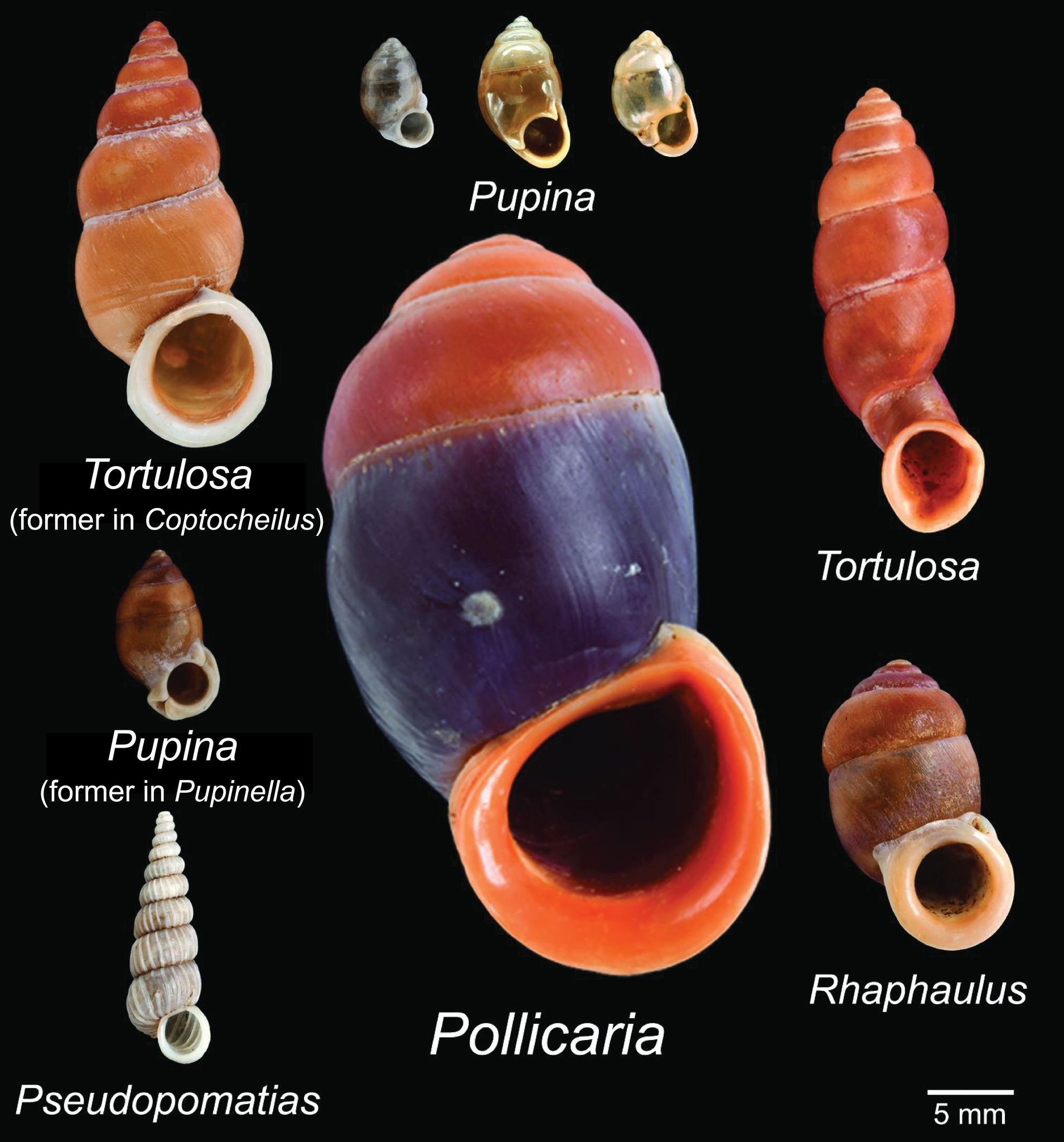
[Mollusca • 2025] Molecular Phylogeny of the Operculated Land Snail Family Pupinidae (Caenogastropoda: Cyclophoroidea) in mainland Southeast Asia


Molecular Phylogeny of the Family Pupinidae

in Jirapatrasilp, Tongkerd, Páll-Gergely, Lee, Panha, Becher, Hausdorf et Sutcharit, 2025.

Abstract
The operculated land snail family Pupinidae from mainland Southeast Asia has been systematically revised based on shell morphology. Despite previous morphological studies, the evolutionary relationships within this family remained unclear. This study represents the first comprehensive molecular phylogeny of this snail group, utilising two mitochondrial (COI and 16S rRNA) and two nuclear (5.8S rRNA + ITS2 and 28S rRNA) genetic markers. Additionally, we conducted phylogenetic analyses of Pupina species from 1106 loci generated through double-digest restriction site-associated DNA sequencing (ddRADseq). It turned out that Southeast Asian Pollicaria emerged as a sister clade to Central American Aperostoma of the Megalomastomatidae, leading to the resurrection of the Pollicariidae. Among the remaining pupinid genera, Tortulosa was nested within the Coptocheilus clade, while Pupina and Pupinella were not monophyletic. The previously recognised Pupina arula species group was found to be monophyletic and was reclassified into Tylotoechus (formerly a Pupina subgenus), based on distinctive conchological characters such as an extending parietal tooth from a parietal callus and a wide, outward-curving posterior canal. However, some Pupina and Tylotoechus species were not retrieved as monophyletic, suggesting the presence of multiple ‘cryptic species’. Divergence time estimation indicated that the Pupinidae split could date back to the Late Triassic to Early Cretaceous, with the first diversification of pupinid genera occurring during the Middle Jurassic and Early Cretaceous. This successful reconstruction of a robust phylogeny using ddRADseq loci demonstrates the significant potential of RADseq techniques in elucidating the evolutionary relationships of deeply divergent taxa. Further studies incorporating the type species Tylotoechus destructus and Pupina keraudrenii are necessary to justify the usage of these genera.

Keywords: cryptic species, ddRADseq, divergence time estimation, Pollicariidae, systematics


A-C Pollicaria [Pollicariidae]
Tortulosa [Pupinidae] E-H Pupina [Pupinidae]
 Jirapatrasilp et al. (2022)

Jirapatrasilp et al. (2022)


 Parin Jirapatrasilp, Piyoros Tongkerd, Barna Páll-Gergely, Chi-Tse Lee, Somsak Panha, Elisa Becher, Bernhard Hausdorf and Chirasak Sutcharit. 2025. Molecular Phylogeny of the Operculated Land Snail Family Pupinidae (Caenogastropoda, Cyclophoroidea) in mainland Southeast Asia. Zoologica Scripta. DOI: doi.org/10.1111/zsc.12727 [07 April 2025]

 A-C หอยหูช้างสกุล Pollicaria D หอยเกลียวเชือกฝาสปริงสกุล Tortulosa E-H หอยเปลือกมันสกุล Pupina 

Wednesday, March 5, 2025

[Entomology • 2025] Microdera abdullohi & M. uzbekistanica • A Review of the Genus Microdera Eschscholtz, 1831 (Coleoptera: Tenebrionidae) of Uzbekistan


 Microdera abdullohi N. Bekchanov et Nabozhenko, sp. nov. 
M. uzbekistanica N. Bekchanov et Nabozhenko, 

in N. Kh. BekchanovNabozhenko, Kh. U. Bekchanov et M. Kh. Bekchanova, 2025.
 
Abstract
A review of darkling beetles of the genus Microdera Eschscholtz, 1831 from Uzbekistan is presented. In total, 12 species are known in this country. Two new species are described: M. abdullohi N. Bekchanov et Nabozhenko, sp. nov. (Sulton Uvays Mts.) and M. uzbekistanica N. Bekchanov et Nabozhenko, sp. nov. (Kuldzhuktau Mts.). The following new synonym is introduced: Microdera globulicollis Ménétriés, 1849 = Microdera extabesa Skopin, 1961, syn. nov. The species M. ferghanensis Kaszab, 1957 is resurrected from the synonymy of M. globulicollis Ménétriés, 1849. In describing the ranges of the species mentioned in the paper, we corrected some errors in previous publications and clarified the distribution, including as a result of taxonomic changes. A species rank status is restored for Microdera kaszabi Skopin, 1961, stat. resurr. (from a subspecies of M. convexa (Tauscher, 1812)), as a consequence the range of this species does not include southeastern Kazakhstan, and limited by Kazakh Hummocks in the east. Microdera deserta deserta (Tauscher, 1812) is recorded for Uzbekistan for the first time, and M. shasenema Medvedev & Nepesova, 1985 is firstly recorded for Tajikistan. The following species are removed from faunistic lists of different countries: M. laevigatula Reitter, 1915 from the list of Uzbekistan, M. heydeni Kraatz, 1882 from the list of Turkmenistan, Mminax Reitter, 1887 from the list of Kyrgyzstan, M. transversicollis Reitter, 1887 from the list of Armenia. Lectotypes for Tentyria deplanata Gebler, 1841 and Microdera semenoviana Bogatchev, 1947 are designated.

Coleoptera, taxonomy, darkling beetles, Tentyriini, deserts, Central Asia


Microdera abdullohi N. Bekchanov et Nabozhenko, sp. nov. (Sulton Uvays Mts.) 
 M. uzbekistanica N. Bekchanov et Nabozhenko, sp. nov. (Kuldzhuktau Mts.). 


Norbek Kh. BEKCHANOV, Maxim V. NABOZHENKO, Khudaybergan U. BEKCHANOV and Mokhira Kh. BEKCHANOVA. 2025. A Review of the Genus Microdera Eschscholtz, 1831 (Coleoptera: Tenebrionidae) of Uzbekistan.  Zootaxa. 5590(4); 451-480. DOI: doi.org/10.11646/zootaxa.5590.4.1 [2025-02-25] 

Tuesday, January 14, 2025

[Herpetology • 2025] Urkuphryne merinoi, Phyllonastes macuma, P. ecuadorensis, etc. • Systematics of Minute strabomantid Frogs allocated to the Genus Noblella (Anura: Strabomantidae) with Description of A New Genus, Seven New Species, and insights into historical Biogeography


  Urkuphryne merinoi 
Phyllonastes cerrogolondrinasP. macuma, P. ecuadorensis

 in Ortega, Cisneros-Heredia, Camper, Romero-Carvajal, Negrete et Ron, 2025. 
 
Abstract
Noblella is a genus of 17 recognized nominal species of ground-dwelling, direct-developing frogs. It consists of two clades that do not form a monophyletic group: a northern clade from northern Peru, Ecuador, Colombia, and Brazil and a southern clade from southern Peru and Bolivia. Herein, we present a systematic review of Noblella with emphasis on the northern clade, including a new phylogeny based on DNA sequences of mitochondrial and nuclear genes. We also describe the osteology of five species from the northern clade using X-ray computed tomography. Based on our results, we resurrect the genus Phyllonastes for species of the northern clade (i.e. eight described species plus six new species described herein) and restrict the genus Noblella to the southern clade. We describe a new genus of Holoadeninae, sister to PhyllonastesUrkuphryne gen. nov., from northern Ecuador. The new genus is distinguished by unique morphological characteristics that are diagnostic of different genera in Strabomantidae. We describe seven new species diagnosable based on morphology. Phyllonastes has five morphological synapomorphies, including the absence of vomerine teeth. Phyllonastes originated in the Pacific basin, Chocó region, ~21 Mya.


Urkuphryne gen. nov.,
Urkuphryne merinoi sp. nov.,

Phyllonastes cerrogolondrina sp. nov.,
Phyllonastes dicaprioi sp. nov.,
Phyllonastes ecuadoriensis sp. nov.,
Phyllonastes macuma sp. nov.,
Phyllonastes plateadensis sp. nov.,
Phyllonastes sardinayacu sp. nov.


Jhael A. Ortega, Diego F. Cisneros-Heredia, Jeffrey D. Camper, Andrés Romero-Carvajal, Leonardo Negrete and Santiago R. Ron. 2025. Systematics of Minute strabomantid Frogs allocated to the Genus Noblella (Amphibia: Anura) with Description of A New Genus, Seven New Species, and insights into historical Biogeography. Zoological Journal of the Linnean Society. 203(10; zlae162, DOI: doi.org/10.1093/zoolinnean/zlae162


Monday, December 9, 2024

[Crustacea • 2024] Cryptione grandis • Resurrection of the parasitic isopod genus Cryptione Hansen, 1897 (Epicaridea: Bopyridae) and Description of A New Species of parasitic isopod (Epicaridea: Bopyridae) from the deep-sea shrimp Notostomus gibbosus (Caridea: Acanthephyridae) with an analysis of its phylogenetic position based on molecular data


Cryptione grandis sp. nov. from Notostomus gibbosus

 Williams, Horch, Ceballos & Bracken-Grissom, 2024

Abstract
A new species of pseudionine parasite is described from the deep-sea shrimp Notostomus gibbosus A. Milne-Edwards, 1881, collected in the Gulf of Mexico, the first record of a bopyrid parasitizing any member of the family Acanthephyridae Spence Bate, 1888. Morphological and molecular data are provided to support the inclusion of the new species and 12 other branchial ectoparasites of caridean shrimps in the genus Cryptione Hansen, 1897 that is resurrected herein. Cryptione is sister to the genus Pseudione sensu stricto, ectoparasites of axiid and callianassid shrimps as well as nephropid lobsters. The new species Cryptione grandis can be distinguished from its closest congeners including C. parviramus (Adkison, 1988) from the Gulf of Mexico by several female and male characters. The epicaridium larvae of C. grandis were examined with scanning electron microscopy (SEM), only the second description of this stage for any species in the genus. A table listing all species in Cryptione and taxonomic notes on some species are provided.

Keywords: Bopyrid, Ectoparasite, Epicaridium larva, New species, Pseudioninae

Systematics
Order Isopoda Latreille, 1816
Suborder Epicaridea Latreille, 1825

Superfamily Bopyroidea Rafinesque, 1815
Family Bopyridae Rafinesque, 1815
Subfamily Pseudioninae Codreanu, 1967

Cryptione Hansen, 1897

Cryptione grandis sp. nov. from Notostomus gibbosus
(a–d female holotype (USNM 1716194); e male allotype (USNM 1716195)).
 a Lateral view of N. gibbosus with C. grandis sp. nov. extending from right branchial chamber (ventral view of female with larvae in brood chamber shown); b lateral view of N. gibbosus with C. grandis sp. nov. removed and positioned dorsal side up (male attached to posterior pleon, shown with arrow); c female dorsal view; d female ventral view; e male dorsal view.
Scale bars: a–d = 5 mm; e = 1.5 mm

Cryptione grandis sp. nov.

Etymology: The species epithet grandis is Latin for large or great, denoting the size of the female parasite.

Type locality: Northern Gulf of Mexico ...; type host: Notostomus gibbosus.


Jason D. Williams, Amanda P. Horch, Angela Ceballos and Heather Bracken-Grissom. 2024. Resurrection of the parasitic isopod genus Cryptione Hansen, 1897 (Epicaridea: Bopyridae) and Description of A New Species of parasitic isopod (Epicaridea: Bopyridae) from the deep-sea shrimp Notostomus gibbosus (Caridea: Acanthephyridae) with an analysis of its phylogenetic position based on molecular data. Marine Biodiversity. 54, 86. DOI: doi.org/10.1007/s12526-024-01475-z 
 

Wednesday, May 8, 2024

[Botany • 2020] Meriania baumgratziana (Melastomataceae) • Taxonomic Notes in Meriania from the Brazilian Atlantic Forest, including A New Species, a resurrected one and a new synonym


Meriania baumgratziana  R.Goldenb. & Michelang., 

in Goldenberg, Meyer et Michelangeli, 2020. 

Abstract
We present a new species, a new synonym, the resurrection of a species that has been synonymized before, updates on the distribution of three species, and lectotypifications for two species of Meriania from the Brazilian Atlantic Forest. Meriania baumgratziana is a new species apparently restricted to montane areas in the western portion of the state of Rio de Janeiro. It can be recognized by the sessile to subsessile leaves, these lanceolate, elliptic lanceolate or oblong-lanceolate, with cordate to cordulate, amplexicaul bases (seldom narrowly round), the abaxial surface in young leaves with the union of the primary and the inner pair of secondary veins with a membrane forming pocket domatia, these with trichomes emerging from the inside, then in older leaves the membranes frequently enlarged, globular, these hypertrophied structures sometimes caducous, or easily removed by friction, and by the pendulous inflorescences with 4-merous flowers. Meriania paratyensis Chiavegatto & Baumgratz is synonymized under M. sanchezii R.Goldenb., which in turn is resurrected from what we understand as a mistaken synonymy under M. paniculata DC. We present a discussion and illustrations of leaves and fruits, in order to explain these changes and compare all these three species, plus a fourth similar species, M. glabra (DC.) Naudin. The distributions of Meriania calyptrata (Naudin) Triana and M. sanchezii are updated, the former with the inclusion of specimens collected in the western tip of the state of Rio de Janeiro (it was previously recorded only for eastern São Paulo), and the latter in the exactly opposite way, with new records from Rio de Janeiro added to the previously known specimens from São Paulo. Finally, lectotypes are designated for Meriania calyptrata and M. glabra (DC.) Naudin (this superseding a previous, unnecessary designation of a neotype).

Keywords: Eudicots, Melastomataceae, Meriania, Taxonomy, Atlantic Forest


Photos of living plants of Meriania baumgratziana.
 A. Fertile branch with the pendulous infrutescence. B. Leaves, adaxial surfaces. C. Leaves, abaxial surfaces D. Partial infrutescence. E. Flowers
 (A–E by Fabian Michelangeli, from Goldenberg 2660; 
F by Fernando Costa Pinheiro, from Pinheiro 367).


Renato Goldenberg, Fabrício S. Meyer and Fabián A. Michelangeli. 2020. Taxonomic Notes in Meriania (Melastomataceae) from the Brazilian Atlantic Forest, including A New Species, a resurrected one and a new synonym. Phytotaxa. 453(3); 218–232. DOI: 10.11646/phytotaxa.453.3.4

Saturday, March 30, 2024

[Crustacea • 2024] Petrolisthes coeruleus • A New Species of the Petrolisthes galathinus complex (Anomura: Porcellanidae) from the Caribbean Sea, and Resurrection of Petrolisthes occidentalis from the East Pacific


 Petrolisthes coeruleus Hiller & Werding, 2024
  

Abstract
The Petrolisthes galathinus complex currently consists of six American species distributed in the West Atlantic, including the amphi-American P. galathinus. All species in the complex are similar in their adult morphology but differ in colour, size, larval morphology, and shape of the adult sternal plate. The West Atlantic species have different geographic ranges, which overlap in the southern Caribbean. Previously published molecular data support the monophyly of the complex, and the reciprocal monophyly of each described species and further clades corresponding to different colour morphs. Here, the morph P. caribensis “Blue” is described as Petrolisthes coeruleus sp. nov., and Petrolisthes occidentalis is formally resurrected for the Pacific individuals of P. galathinus. By adding these two species to the P. galathinus complex, this now consists of eight species. Colour illustrations of all species and colour morphs are provided and their geographic distributions and ecological ranges are discussed and updated.

Key words: Caribbean, colour morphs, ecological range, geographical range, Petrolisthes coeruleus sp. nov., Petrolisthes occidentalis

Dorsal view of Petrolisthes coeruleus sp. nov., male, Punta Galeta, Colón, Panamanian Caribbean. Setae on outer margin of cheliped manus omitted to depict spines. Scale bar: 0.4 cm.
 
Dorsal view of Petrolisthes coeruleus sp. nov.
a male, Islas del Rosario, Colombian Caribbean b male, Islas del Rosario, Colombian Caribbean c Bocas del Toro, Panamanian Caribbean, photograph courtesy of T. Deuss.
Scale bars: 0.5 cm (a); 0.65 cm (b).

Family Porcellanidae Haworth, 1825: 184.

Genus Petrolisthes Stimpson, 1858: 227.

 Petrolisthes coeruleus sp. nov.
 
Etymology: The name coeruleus alludes to the blueish tone of carapace and extremities, which comprises a reliable diagnostic character to distinguish this species from P. caribensis.


 Alexandra Hiller and Bernd Werding. 2024. Description of A New Species of the Petrolisthes galathinus complex from the Caribbean Sea, and Resurrection of Petrolisthes occidentalis from the East Pacific (Crustacea, Anomura, Porcellanidae). ZooKeys 1191: 391-407. DOI: 10.3897/zookeys.1191.111570


Wednesday, February 14, 2024

[Botany • 2023] Resurrection of Perilimnastes (Melastomataceae: Sonerileae) with Description of A New Species P. nana


Perilimnastes nana C.Y.Zou & Ying Liu,

in Liu, Dai, Zhuang, Zou et Ma, 2024. 

Abstract
Recent research has indicated that the Phyllagathis (raphides) clade (Sonerileae, Melastomataceae) is only distantly related to the type of Phyllagathis and should be separated as a distinct genus. Phylogeny of this clade is here reconstructed with expanded taxon sampling. Four strongly supported subclades have been identified. The possible affinities of taxa that were not sampled in the analysis are discussed, based on morphological data. Perilimnastes is resurrected as the generic name of the Phyllagathis (raphides) clade. A generic description, colour figures, map of distribution, a list of included species and a key are provided for Perilimnastes. Fifteen new combinations are made plus the description of a new species. As interpreted here, Perilimnastes consists of twenty species and two varieties.

Key words: Melastomataceae, Perilimnastes, Phyllagathis, taxonomy

Perilimnastes nana
A habitat B habit C close-up of a branchlet D adaxial leaf surfaces E abaxial leaf surfaces F a flowering branch showing an inflorescence with a single flower and two large bracts G lateral view of a flower H longitudinal section of a flower showing stamen morphology I lateral view of an old capsule with one persistent bract removed J longitudinal section of an old capsule showing enlarged ovary crown and morphology of the placental column and placentas.
Scale bars: 5 mm (G–I); 3 mm (J). All from Chun-yu Zou 3608 (IBK, PE).

 Perilimnastes nana C.Y.Zou & Ying Liu, sp. nov.

Diagnosis: Resembles P. stenophylla in leaf morphology, but differs in height (to 0.15 m vs. 0.8 m tall), number of flowers per inflorescence (1 vs. 2–3-flowered), length of the peduncle (10–22 mm vs. 4 mm) and the shape of calyx lobes (broadly obovate vs. narrowly triangular). Resembles P. setotheca in having 4-sided branchlets, large and persistent bracts below flower and stamen morphology, but differs in plant size (to 0.15 m vs. 1 m tall), leaf shape and size (oblong-lanceolate or obovate-lanceolate, 1.7–7 × 0.73–2.2 cm vs. oblong-lanceolate, elliptic or obovate, 10–20 × 3–8 cm) and number of flowers per inflorescence (1-flowered vs. 3 to more than 20-flowered).

Etymology: The specific epithet is based on the habit of this species, viz. dwarf shrubs to 15 cm tall.

Distribution: Perilimnastes nana is currently known from Taishan County, Guangdong Province, China (Fig. 8). It grows amongst rocks along streams in the forest, at 200–300 m elevation.


Ying Liu, Jin-Hong Dai, Qi-Yuan Zhuang, Chun-Yu Zou and Kai-Nan Ma. 2024. Resurrection of Perilimnastes (Sonerileae, Melastomataceae) with Description of A New Species P. nanaPhytoKeys. 238: 11-31. DOI: 10.3897/phytokeys.238.116168


Monday, November 6, 2023

[Ichthyology • 2023] Spectrunculus stenostio • The Systematics of the Ophidiid Genus Spectrunculus (Ophidiiformes: Ophidiidae) Revisited with Description of A New Species and Resurrection of S. radcliffei


Spectrunculus stenostio 
Uiblein, Møller & Nielsen, 2023

photos by F. Uiblein & P. R. Møller
 
Abstract
After a preceding revision based on 87 specimens, the systematics of the abyssal giant cuskeel genus Spectrunculus Jordan and Thompson, 1914 has been revisited, based on the examination of 34 additional specimens and new otolith shape data of the holotype of S. grandis. From the latter, a clear distinction in otolith ostium width could be found in specimens from the Atlantic, Southern Indian Ocean, and Southwest Pacific, which were formerly identified as S. grandis. Consequently, the new species, S. stenostio, is described, which has a narrower ostium when related to its length or to sulcus length and differs also in the combination of three body shape characters, three meristic characters, and maximum size from the three other congeners, S. crassus (Atlantic, East Pacific), S. grandis (Pacific), and the previously synonymized S. radcliffei (Pacific, Southern Indian Ocean, Southeast Atlantic). The latter species is here resurrected based on a rather short pre-anal length and additional morphometric as well as meristic and maximum size differences. An identification key for the four species of Spectrunculus is provided.

(A–C) Spectrunculus stenostio: (A) HT, ZMUB 18493, 825 mm SL, N Atlantic (F. Uiblein); (B) SAIAB 11892, 706 mm SL, S Indian Ocean (F. Uiblein); (C) NMNZ P.033111, 1030 mm SL, SW Pacific (P. R. Møller).
(D–F) S. crassus: (D) ZMUB 18355, 187 mm SL, N Atlantic (MAR-ECO cruise); (E) HT, MNHN 1886-0552, 284 mm SL, N Atlantic (J. Pfliger); (F) ZMUB 18463, 500 mm SL, N Atlantic (MAR-ECO cruise);
(G–I) S. grandis: (G) HT, BMNH 1887, 675 mm SL (F. Uiblein); (H) NMNZ P.041204, 840 mm SL, SW Pacific (P. R. Møller); (I) CAS 25724, 1270 mm SL, NE Pacific (Moulin Studios, San Francisco, used with permission);
(J–M) S. radcliffei: (J) HT (postlarva), FMNH 57123, 56 mm SL, NW Pacific (FMNH Zoological Collections, used with permission); (K) SAM 47240, 541 mm SL, S Atlantic (F. Uiblein); (L) ZMUC P2397445, 945 mm SL, NW Pacific (M. A. Krag); (M) ZMUC P2397724, 1020 mm SL, NW Pacific (M. A. Krag). Length of black or white scale bars is 5 cm.

Spectrunculus stenostio: (A) HT, ZMUB 18493, 825 mm SL, N Atlantic (F. Uiblein); (B) SAIAB 11892, 706 mm SL, S Indian Ocean (F. Uiblein); (C) NMNZ P.033111, 1030 mm SL, SW Pacific (P. R. Møller).

Spectrunculus stenostio, new species

Diagnosis.—Number of dorsal-fin rays 137–148, anal-fin rays 102–112, total vertebrae 80–88, pre-anal length 47–55% in SL, pelvic- to anal-fin origin 34–44% in SL, orbit length 9.9–12 in % HL, otolith ostium width 15–21 in % sulcus length and 19–29 in % ostium length; maximum size to 110 cm SL.


Etymology.—The new species name is composed of the Greek word for narrow stenós” and the otolith structure “ostium.” The ablative of the combined term is “stenostio,” meaning “with a narrow ostium.”

Distribution.—This species is distributed in the North Atlantic and Southern Indian Ocean to the Southwest Pacific (1694 to 3050 m depth). There are no records from the South Atlantic.


Franz Uiblein, Peter R. Møller and Jørgen G. Nielsen. 2023. The Systematics of the Ophidiid Genus Spectrunculus (Teleostei, Ophidiiformes) Revisited with Description of A New Species and Resurrection of S. radcliffeiIchthyology & Herpetology. 111(3):467-485 (2023). DOI: 10.1643/i2023005 

Friday, February 17, 2023

[Herpetology • 2023] Pareas tigerinus • Resurrection of Pareas yunnanensis (Vogt, 1922) (Serpentes: Pareidae) with Description of A New Species of Pareas from Yunnan Province, China


Pareas tigerinus
Liu, Zhang, Poyarkov, Hou, Wu, Rao, Nguyen & Vogel, 2023 

Tiger Slug-eating Snake | 虎纹钝头蛇  ||  DOI: 10.5852/ejt.2023.860.2045
 Photos by S. Liu.

ABSTRACT
Based on molecular and morphological data of four specimens of Pareas Wagler, 1830 collected from the type locality of P. yunnanensis (Vogt, 1922), along with examination of the type specimens of P. yunnanensis, we revalidate this poorly known, secretive species. Furthermore, based on molecular and morphological lines of evidence we also describe a new species of Pareas from Xishuangbanna Prefecture, Yunnan Province, China. Morphologically, the new species closely resembles its sister species P. nigriceps Guo & Deng, 2009. However, the new species is divergent from the latter in cytochrome b mtDNA gene sequences, and can be distinguished from all congeners by the following combination of morphological characteristics: single preocular, postocular fused with subocular, loreal not bordering orbit, vertebral scales enlarged, 3–5 rows of mid-dorsal scales keeled at the middle of the body, ventral scales 160–171; subcaudals 62–64, dorsal surface of head solid black or reddish-brown, dark nuchal band present, iris brownish-black or reddish-brown.

Keywords: Dali, Menghai, slug-eating snakes, synonymy, taxonomy

Pareas tigerinus sp. nov. in life.
A. Holotype, ♀ (KIZ 20210705). B. Paratype, ♂ (KIZ 20210703)
C. Paratype, ♀ (KIZ 20210704) . D. Habitat at the type locality.
 Photos by S. Liu.

Pareas (Eberhardtia) tigerinus sp. nov.

Diagnosis: This species differs from Pareas nigriceps by having a relatively shorter tail, more infralabials, fewer ventral scales, fewer subcaudals, and fewer maxillary teeth; it differs from P. kaduri Bhosale, Phansalkar, Sawant, Gowande, Patel & Mirza, 2020 by having relatively smaller body size, keeled mid-dorsal scales in females, fewer temporals, and fewer maxillary teeth.

Etymology: The species epithet “tigerinus” is attributed to this species due to the similarity of the species colour pattern to the prominent lateral stripes in tigers. We propose “Tiger Slug-eating Snake” for the common English name and “虎纹钝头蛇”(Hǔ Wén Dùn Tóu Shé) for the common Chinese name.


Shuo Liu, Dongru Zhang, Nikolay A. Poyarkov, Mian Hou, Li Wu, Dingqi Rao, Tan Van Nguyen and Gernot Vogel. 2023. Resurrection of Pareas yunnanensis (Vogt, 1922) with Description of A New Species of Pareas from Yunnan Province, China (Squamata, Pareidae). European Journal of Taxonomy. 860: 1–26. DOI: 10.5852/ejt.2023.860.2045


Tuesday, January 31, 2023

[Herpetology • 2023] Taxonomic Revision and Re-description of Ateuchosaurus pellopleurus (Hallowell, 1861) (Reptilia: Squamata: Scincidae) with Resurrection of A. okinavensis (Thompson, 1912)


 Ateuchosaurus okinavensis (Thompson, 1912)

in Makino, Nakano, Okamoto & Hikida, 2023.

Abstract
The scincid lizard Ateuchosaurus pellopleurus (Hallowell, 1861) has been recognized as a single species widely distributed in the Osumi, Tokara, Amami, and Okinawa Groups of the Ryukyu Archipelago, southern Japan. However, a recent molecular phylogenetic study suggested that this skink should be divided into two species: one distributed in the Osumi to Amami Groups, and another distributed in the Okinawa Group. For A. pellopleurus, two extant syntypes collected from an island of the Amami Group were confirmed. Therefore, we identified the species in the Osumi to Amami Groups as A. pellopleurus sensu stricto by designating one of the syntypes as the lectotype for this species. For the species in the Okinawa Group, we resurrected A. okinavensis (Thompson, 1912), of which the type locality is on Okinawajima Island in the Okinawa Group. Ateuchosaurus pellopleurus and A. okinavensis can be differentiated by the following characteristics: usually separated frontonasal and frontal, 8–14 subdigital scales on the fourth toe (mode = 11), and usually two or three pairs of dorsal median scale rows with black stripes in A. pellopleurus; usually fused frontonasal and frontal, 10–16 subdigital scales on the fourth toe (mode = 13), and usually no stripe on the dorsal scales or a pair of dorsal median scale rows with black stripes in A. okinavensis.

Key Words: lectotypification, morphological diagnosis, Ryukyu Archipelago, scalation

Dorsal, lateral, and ventral views of head scalation of Ateuchosaurus okinavensis (KUZ R77462). See Fig. 4 legend for abbreviations of scale names.

Photograph of a live individual of Ateuchosaurus okinavensis collected at Urasoe Park in Urasoe City, Okinawajima Island (38 m above sea level).

Ateuchosaurus okinavensis (Thompson, 1912)
  Suggested Japanese name: Okinawa-Hime-Tokage

Emended diagnosis: An Ateuchosaurus species characterized by the following: usually fused FrNa and frontal; a pair of frontoparietals that do not contact each other; eight SuCis; anteroposteriorly reduced parietals separated from SuO and pretemporal by EcP; no distinct nuchals; usually six InLas; body size medium (SVL ca. 42–70 mm); widely separated forelimb and hindlimb when appressed; usually 26 or 28 MSRs (mode = 28, 25–28); 54–64 (mode = 59) and 55–67 DMSs (mode = 58) in male and female, respectively; 10–16 TIVs (mode = 13); 10 preanals not enlarged; usually no black stripe on dorsal scale row or one pair of DSRBS; a karyotype of 2n = 28 (Ota et al. 1998).


Tomohisa Makino, Takafumi Nakano, Taku Okamoto and Tsutomu Hikida. 2023. Taxonomic Revision and Re-description of Ateuchosaurus pellopleurus (Hallowell, 1861) (Reptilia, Squamata, Scincidae) with Resurrection of A. okinavensis (Thompson, 1912). Zoosystematics and Evolution. 99(1): 77-91. DOI: 10.3897/zse.99.95923