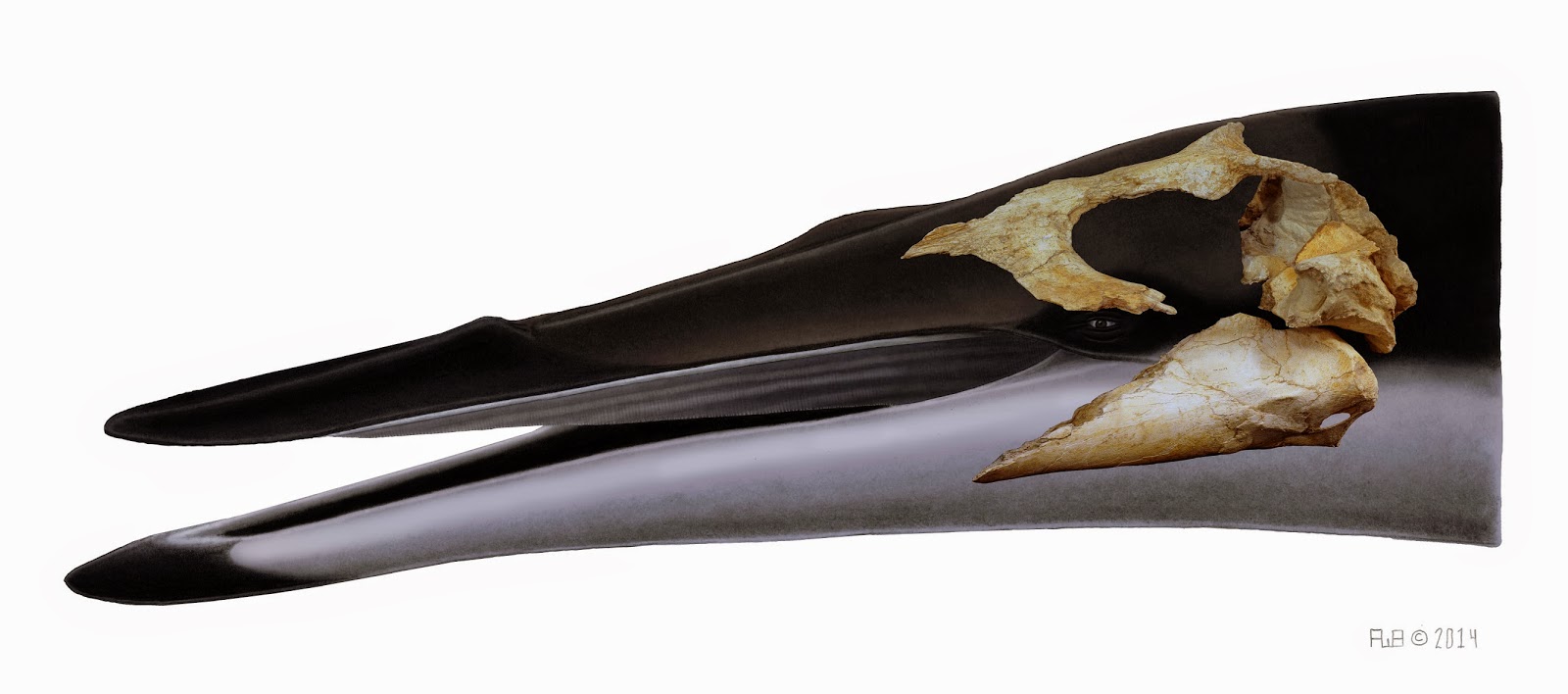
Showing posts with label Eomysticetidae. Show all posts

Wednesday, April 18, 2018

[PaleoMammalogy • 2018] Toipahautea waitaki • A New Archaic Baleen Whale (early-Late Oligocene, New Zealand) and the Origins of Crown Mysticeti


Toipahautea waitaki   Tsai & Fordyce, 2018

Burial in the ancient sea of Zealandia: a Toipahautea whale skeleton is slowly covered by sand 27-28 million years ago, on its path to becoming a fossil 

 Reconstruction by Chris Gaskin, Geology Museum, University of Otago 

A new genus and species of extinct baleen whale, †Toipahautea waitaki (Late Oligocene, New Zealand) is based on a skull and associated bones, from the lower Kokoamu Greensand, about 27.5 Ma (local upper Whaingaroan Stage, early Chattian). The upper jaw includes a thin, elongate and apparently toothless maxilla, with evidence of arterial supply for baleen. Open sutures with the premaxilla suggest a flexible (kinetic) upper jaw. The blowhole is well forward. The mandible is bowed laterally and slightly dorsally; unlike the Eomysticetidae, there are no mandibular alveoli, and the coronoid process is tapered and curved laterally. Jaw structure is consistent with baleen-assisted gulp-feeding. The age of early Chattian makes †Toipahautea a very early, if not the oldest named, toothless and baleen-bearing mysticete, suggesting that the full transition from toothed to baleen-bearing probably occurred in the Early Oligocene. Late Oligocene mysticetes vary considerably in jaw form and kinesis, tooth form and function, and development of baleen, implying a wide range of raptorial, suctorial and filter-feeding behaviour. More study may elucidate the function of jaws, teeth and baleen in terms of opportunist/generalist feeding, as in modern gray whales, versus specialized feeding. We here propose that early mysticetes, when transitioned from toothed to baleen-bearing, were generalists and opportunists instead of specializing in any forms of feeding strategies. In addition, two different phylogenetic analyses placed †Toipahautea either in a polytomy including crown Mysticeti, or immediately basal to the crown, and above †Eomysticetidae in both cases. Because the †Toipahautea waitaki holotype is an immature individual, it may plot more basally in phylogeny than its true position.

Keywords: Cetacea, mysticete, feeding strategy, filter-feeding, specialist/generalist, opportunist


  initial preparation of †Toipahautea waitaki OU 21981 by A. Grebneff
 (photo: R.E. Fordyce)

Burial in the ancient sea of Zealandia: a Toipahautea whale skeleton is slowly covered by sand 27-28 million years ago, on its path to becoming a fossil

 Reconstruction by Chris Gaskin, Geology Museum, University of Otago 

Cetacea Brisson, 1762
Mysticeti Gray, 1864

Incertae familiae

Toipahautea waitaki gen. et. sp. nov 

Etymology. Toi means origin and pahautea refers to whalebone/baleen in Maori, alluding to the origin of the early toothless and baleen-bearing mysticetes. Waitaki is a name for the wider region, including the Waitaki River (wai, water or river; taki, tears) into which the smaller Hakataramea River drains.


 Holotype. Toipahautea waitaki is known only from the holotype, OU 21981: a disarticulated partial skull (parts of the maxillae and premaxillae, left nasal, frontals, squamosals, exoccipitals, basioccipital and supraoccipital), incomplete mandibles, left tympanic bulla and periotic, hyoid(?), atlas, axis, two thoracic vertebrae, two scapulae, a partial humerus, two radii and ribs. Most of the elements were disarticulated but associated when excavated.

Diagnosis. Toipahautea waitaki is interpreted as a chaeomysticete based on the presence of ‘baleen’ sulci on the ventral surface of the maxilla and lack of mandibular alveoli. †Toipahautea waitaki has a unique combination of: massive size of periotic; well-developed superior process of the periotic; prominent elongation of dorsomedial margin of the internal acoustic meatus; prominent fissure between the fenestra rotunda and the aperture for the cochlear aqueduct; small medial posterior sulcus; the presence of the anteroexternal foramen; the presence of the sigmoidal cavity; the presence of the elliptical foramen; horizontal sigmoidal cleft far anterior than the anterior margin of the sigmoidal process; posteromedial margin of the bulla orienting slightly anteromedially.

Locality and horizon. OU 21981 (field number REF-28.1.88.2) was recovered from the Hakataramea Valley, South Canterbury, South Island, New Zealand (figure 1). ....

....


Cheng-Hsiu Tsai and R. Ewan Fordyce. 2018. A New Archaic Baleen Whale,Toipahautea waitaki (early-Late Oligocene, New Zealand) and the Origins of Crown Mysticeti.   R. Soc. Open Sci. 5: 172453.  DOI: 10.1098/rsos.172453

Whale of a discovery: NZ's ancient (and extinct) ocean mammal, via @nzherald nzherald.co.nz/nz/news/article.cfm?c_id=1&objectid=12034869

Friday, September 11, 2015

[PaleoMammalogy • 2015] Tokarahia kauaeroa • A New Genus and Species of Eomysticetid (Cetacea: Mysticeti) and A Reinterpretation of ‘MauicetuslophocephalusMarples, 1956: Transitional Baleen Whales from the upper Oligocene of New Zealand


Tokarahia kauaeroa  Boessenecker & Fordyce, 2015
Life restoration of Tokarahia kauaeroa gen. et sp. nov.
Artwork by Christopher Gaskin || DOI: 10.1111/zoj.12297

The early evolution of toothless baleen whales (Chaeomysticeti) remains elusive, despite a robust record of Eocene–Oligocene archaeocetes and toothed mysticetes. Eomysticetids, a group of archaic longirostrine and putatively toothless baleen whales, fill in a crucial morphological gap between well-known toothed mysticetes and more crownward Neogene Mysticeti. A historically important but perplexing cetacean is ‘Mauicetuslophocephalus (upper Oligocene South Island, New Zealand). The discovery of new skulls and skeletons of eomysticetids from the Oligocene Kokoamu Greensand and Otekaike Limestone permit a redescription and modern reinterpretation of ‘Mauicetuslophocephalus, and indicating that this species may have retained adult teeth. Tokarahia kauaeroa gen. et sp. nov. is erected on the basis of a well-preserved subadult to adult skull with mandibles, tympanoperiotics, and cervical and thoracic vertebrae, ribs, sternum, and forelimbs from the Otekaike Limestone (> 25.2 Mya). ‘Mauicetuslophocephalus is relatively similar and recombined as Tokarahia lophocephalus. Phylogenetic analysis supports the inclusion of Tokarahia within the Eomysticetidae, alongside Eomysticetus, Micromysticetus, Yamatocetus, and Tohoraata, and strongly supports the monophyly of Eomysticetidae. Tokarahia lacked extreme rostral kinesis of extant Mysticeti, and primitively retained a delicate archaeocete-like posterior mandible and synovial temporomandibular joint, suggesting that Tokarahia was capable of, at most, limited lunge feeding in contrast to extant Balaenopteridae, and used an alternative as-yet unspecified feeding strategy.

Keywords: Baleen whales; Oligocene; cetacea; Mysticeti; Eomysticetidae


Figure 2. Excavation of the Tokarahia kauaeroa gen. et sp. nov. holotype skull and skeleton:
  A, exposure of the skull and mandibles in a ventral-up position; B, removal of the large jacket containing the skull.


Figure 4. Holotype (OU 22235) skull, mandibles, vertebrae, and sternum of Tokarahia kauaeroa gen. et sp. nov.
A, orthogonal image derived from photogrammetry. B, interpretive line drawing.

Figure 34. Life restoration of Tokarahia kauaeroa gen. et sp. nov.
Artwork by Christopher Gaskin, ©Geology Museum, University of Otago.

Systematic Palaeontology
CETACEA Brisson, 1872
MYSTICETI Gray, 1864
CHAEOMYSTICETI Mitchell, 1989

Family EOMYSTICETIDAE Sanders & Barnes, 2002b

Type species: Eomysticetus whitmorei.

Included genera: Eomysticetus, Micromysticetus, Tohoraata, Tokarahia, and Yamatocetus.

TOKARAHIA new genus

Etymology: Named after the Tokarahi township, located near Island Cliff, North Otago, the type locality of T. kauaeroa gen. et sp. nov., meaning large (or panoramic) rock, referring to a mesa-like geographic feature. From the Māori ‘toka’ (rock) plus ‘rahi’ (large). Pronunciation: To-kah-rah-hi-ah, with o as in English ‘toe’, a as in ‘far’, and i as in ‘we’.

Type species: Tokarahia kauaeroa gen. et sp. nov.
Included species: Tokarahia kauaeroa gen. et sp. nov. and Tokarahia lophocephalus Marples, 1956.

TOKARAHIA KAUAEROA gen. et sp. nov.
Etymology: Kauaeroa, meaning long jaw (referring to the elongate, delicate mandibles and rostrum of the holotype), from the Māori ‘kauae’ (jaw) and ‘roa’ (long). Pronunciation: Kau-ae-roa, with au as in English ‘hoe’, ae as in ‘I’, o as in ‘toe’, and a as in ‘far’.

Figure 3. Silhouetted skeletal reconstructions of the three primary specimens of Tokarahia described in this study, with a human figure shown for scale. Skeletal reconstruction based in part on Eomysticetus whitmorei and Yamatocetus canaliculatus.

Figure 33. Comparison of skeletal reconstructions, crania, and tympanic bullae of the protocetid Georgiacetus vogtlensis, the basilosaurid Dorudon atrox, the aetiocetid Aetiocetus weltoni, Tokarahia kauaeroa, and extant Balaenoptera edeni.
Sources for illustrations include Emlong (1966), Barnes et al. (1995), Hulbert et al. (1998), Uhen (2004), Deméré & Berta (2008), and photographs courtesy F.G. Marx and C.H. Tsai.

Conclusion
New fossil material, including a well-preserved skull, tympanoperiotics, mandibles, and postcrania, is described as a new genus and species T. kauaeroa gen. et sp. nov. within the archaic chaeomysticete family Eomysticetidae. The problematic taxon ‘Mauicetuslophocephalus is transferred to this new genus and recombined as T. lophocephalus, resolving decades of uncertainty regarding the taxonomic affinities and phylogenetic significance of this historically puzzling taxon. Referred material suggests that both species existed at the same time from at least 27.3–25.2 Mya, and were perhaps sympatric. Phylogenetic analysis using a large and exhaustive data set of extant and extinct Mysticeti places both species of Tokarahia within Eomysticetidae, and robustly confirms the monophyly of Eomysticetidae. Micromysticetus is also confirmed as an eomysticetid and removed from the Cetotheriopsidae, which is not possible to diagnose and at present is restricted to the holotype of Cetotheriopsis lintianus. Incipient rostral fusion and a delicate and synovial tempromandibular joint seem to preclude lunge feeding in Tokarahia and other eomysticetids, but the uniquely elongate rostrum and comparatively enormous temporal fossae and crests for temporalis attachment suggest an uncertain but highly specialized adaptation for an as-yet unidentified feeding strategy.


Robert W. Boessenecker and R. Ewan Fordyce. 2015. A New Genus and Species of Eomysticetid (Cetacea: Mysticeti) and A Reinterpretation of ‘Mauicetuslophocephalus Marples, 1956: Transitional Baleen Whales from the upper Oligocene of New Zealand. Zoological Journal of the Linnean Society. DOI: 10.1111/zoj.12297

[PaleoMammalogy • 2015] Horopeta umarere • The Earliest Gulp-feeding Mysticetes (Cetacea: Mysticeti) from the Oligocene of New Zealand


Horopeta umarere  Tsai & Fordyce, 2015
Fig. 1 Excavation of Horopeta umarere OU21982.   b, excavation site, Craig Jones with recovered skull block; c, initially prepared skull block, from underside.
photos: R Ewan Fordyce || DOI: 10.1007/s10914-015-9290-0

Abstract
Horopeta umarere is a new genus and species of extinct baleen whales from the Kokoamu Greensand (early Chattian, Oligocene, in the range 25–27 Ma), Hakataramea Valley, New Zealand. The geological age makes Horopeta umarere one of the earliest named baleen whales. Phylogenetic analysis indicates that Horopeta umarere may be the earliest crown Mysticeti (the sister taxon to Cetotheriidae), or the sister species to the crown Mysticeti; it is clearly not a species of Eomysticetidae. Estimated skull and body length of Horopeta umarere are 1.5-1.6 m and 6.5-7.5 m, respectively. Horopeta umarere shows some features that are linked to gulp feeding as seen in living humpback and rorquals: laterally bowed and robust mandible, D-shaped to teardrop-shaped mandible in cross-section, and posterolaterally deflected triangular coronoid process of the mandible. The sternum of Horopeta umarere is elongate, rod-shaped, and dorsoventrally stout with bilateral anterior and posterior rugose protrusions, indicating the presence of at least two pairs of ribs or costal cartilages. The structure of the skull and mandible are consistent with the use of gulp feeding, but the sternal morphology and rib attachments suggest an early evolutionary stage in gulp feeding employment, where more complex rib attachment may restrict the volume of water and food taken in one gulp compared to living humpback and rorquals. Thus, the morphology of Horopeta umarere has implications for the emergence of gulp feeding in baleen whale evolution as well as the emergence of the crown Mysticeti.

Keywords: Baleen whale, Rorqual, Skull, Fossil, Evolution

Fig. 2 Preserved material of Horopeta umarere OU21982.
Disarticulated rostral elements are interpreted as: i, right premaxilla; ii, right maxilla; iii, left maxilla; iv, left premaxilla; v, left maxilla; vi, left maxilla; vii, right maxilla. Asterisk sign (*) indicates the cross -section of rib shown in Fig. 11. The size of humerus is estimated from an undescribed Oligocene mysticete, ZMT 67.

 Systematic Paleontology
Cetacea Brisson, 1762
Mysticeti Gray, 1864

Incertae familiae
Horopeta umarere, gen. et. sp. nov.
(Figs. 2–13)
Zoobank: http://​zoobank.​org/​References/​43A7AAD3-1E12-4648-A4A2-38C7B605048D 
LSID (Life Science Identifiers) LSID: urn:lsid:zoobank.org:pub:43A7AAD3-1E12-4648-A4A2-38C7B605048D

Holotype: Horopeta umarere is known only from the holotype (Fig. 2, OU21982, Geology Museum, University of Otago, Dunedin, New Zealand), which preserves a partial skull, including parts of the maxillae and premaxillae, the dorsal braincase (partial parietal and supraoccipital), exoccipitals, and squamosals, as well as the mandibles, both tympanoperiotic complexes, forelimbs (scapulae, radii, and ulnae), all cervical vertebrae, ten thoracic vertebrae, and two possible lumbar vertebrae, 16 identifiable ribs (eight left, eight right), and sternum.

Locality: OU21982 was recovered by R.E. Fordyce, A. Grebneff, and C.M. Jones, 28 January 1988, from the Hakataramea valley, South Canterbury, South Island, New Zealand (Fig. 1). The locality is an active quarry, variously known as Hurstlea Quarry or Haughs’ Quarry or Haka Lime, currently operated by Transport Waimate Limited. The grid reference is I40: 236137; latitude and longitude are 44°39′41″S and 170°39′00″E. New Zealand Fossil Record locality number for OU21982 is I40/f177.
Horizon: OU21982 was recovered by tunneling (the specimen was originally discovered in section in a steep cliff from the middle Kokoamu Greensand, Duntroonian Stage (in the range 25.2-27.3 Ma; Raine et al. 2012), Chattian, late Oligocene. The lithology is a massive bioturbated to slightly bedded, slightly cemented calcareous greensand with sparse macroinvertebrates (pectinid bivalves, brachiopods). The Kokoamu Greensand is 7 to 8 m thick, and above the cetacean horizon grades up over several meters into the overlying Otekaike Limestone. The exact excavation site of OU21982 (Fig. 1) is about 1 m above a diffuse but distinctive brachiopod- and pectinid-rich shellbed, which is a distinctive regional marker for the base of the Duntroonian Stage in the lower to middle of the Kokoamu Greensand.

Etymology: Horopeta means “gulp or swallow” in Maori, alluding to possible gulp feeding habits. Umarere means unusual or different sternum in Maori. Uma- means sternum or chest bone, and rere stands for unusual or different.


Conclusions:
The late Oligocene (early Chattian, 25–27 Ma) Horopeta umarere from New Zealand is described. Horopeta umarere adds to the named baleen whales from the poorly documented Oligocene epoch. Morphological combinations (e.g. mandibular and sternal morphologies) of H. umarere imply an early stage of gulp feeding in baleen whale evolution. We interpret H. umarere as representing the currently earliest described crown Mysticeti.


Cheng-Hsiu Tsai and R. Ewan Fordyce. 2015. The Earliest Gulp-feeding Mysticetes (Cetacea: Mysticeti) from the Oligocene of New Zealand. Journal of Mammalian Evolution. doi: 10.1007/s10914-015-9290-0
【鯨彩一生】藍鯨祖先初登場:烏瑪鯨的發現
http://e-info.org.tw/node/108203

[PaleoMammalogy • 2015] Waharoa ruwhenua • Anatomy, Feeding Ecology, and Ontogeny of A Transitional Baleen Whale: A New Genus and Species of Eomysticetidae (Mammalia: Cetacea) from the Oligocene of New Zealand


Waharoa ruwhenua  Boessenecker & Fordyce, 2015
Alternative life restorations of with erupted permanent dentition
Holotype cranium (OU 22044) in dorsal view and ventral view: (A) photograph; (B) interpretive line drawing.

Abstract

The Eocene history of cetacean evolution is now represented by the expansive fossil record of archaeocetes elucidating major morphofunctional shifts relating to the land to sea transition, but the change from archaeocetes to modern cetaceans is poorly established. New fossil material of the recently recognized family Eomysticetidae from the upper Oligocene Otekaike Limestone includes a new genus and species, Waharoa ruwhenua, represented by skulls and partial skeletons of an adult, juvenile, and a smaller juvenile. Ontogenetic status is confirmed by osteohistology of ribs. Waharoa ruwhenua is characterized by an elongate and narrow rostrum which retains vestigial alveoli and alveolar grooves. Palatal foramina and sulci are present only on the posterior half of the palate. The nasals are elongate, and the bony nares are positioned far anteriorly. Enormous temporal fossae are present adjacent to an elongate and narrow intertemporal region with a sharp sagittal crest. The earbones are characterized by retaining inner and outer posterior pedicles, lacking fused posterior processes, and retaining a separate accessory ossicle. Phylogenetic analysis supports inclusion of Waharoa ruwhenua within a monophyletic Eomysticetidae as the earliest diverging clade of toothless mysticetes. This eomysticetid clade also included Eomysticetus whitmorei, Micromysticetus rothauseni, Tohoraata raekohao, Tokarahia kauaeroa, Tokarahia lophocephalus, and Yamatocetus canaliculatus. Detailed study of ontogenetic change demonstrates postnatal elaboration of the sagittal and nuchal crests, elongation of the intertemporal region, inflation of the zygomatic processes, and an extreme proportional increase in rostral length. Tympanic bullae are nearly full sized during early postnatal ontogeny indicating precocial development of auditory structures, but do increase slightly in size. Positive allometry of the rostrum suggests an ontogenetic change in feeding ecology, from neonatal suckling to a more specialized adult feeding behaviour. Possible absence of baleen anteriorly, a delicate temporomandibular joint with probable synovial capsule, non-laterally deflected coronoid process, and anteroposteriorly expanded palate suggests skim feeding as likely mode of adult feeding for zooplankton. Isotopic data in concert with preservation of young juveniles suggests the continental shelf of Zealandia was an important calving ground for latitudinally migrating Oligocene baleen whales.

Figure 1: Geologic and geographic context of Waharoa ruwhenua localities.
(A) map of South Island, New Zealand; (B) map of Waitaki Valley Regions showing location of Hakataramea Quarry, “The Earthquakes,” and Springside; (C), stratigraphic column of “The Earthquakes,” modified from Fordyce (1994); (D), stratigraphic column of Hakataramea Quarry, modified from (Gottfried, Fordyce & Rust, 2012).

Systematic Paleontology

MAMMALIA Linneaus, 1758
CETACEA Brisson, 1762
MYSTICETI Gray, 1846

EOMYSTICETIDAE Sanders & Barnes, 2002

Waharoa new genus
LSID: urn:lsid:zoobank.org:act:3601D851-F9D2-4364-83F5-7A466DC432F3

Type and only species: Waharoa ruwhenua.
Diagnosis of Genus: same as for the type and only known species.

Etymology: Waharoa, meaning long mouth; from the Māori waha (mouth) plus roa (long).

Waharoa ruwhenua new species
LSID: urn:lsid:zoobank.org:act:2FC4AC75-2378-4FFA-801A-2A3475BFDF31

Etymology: Ruwhenua, from the Maori for ru (shaking) and whenua (land), a translation of the “The Earthquakes” locality.
Type locality: “The Earthquakes,” 5 km east southeast of Duntroon, North Otago, South Island, New Zealand (Figs. 1 and 2A).


Figure 3: Holotype cranium (OU 22044) of Waharoa ruwhenua in dorsal view. 
(A) photograph; (B) interpretive line drawing. Stippling denotes matrix, cross-hatching denotes broken surfaces.

Figure 4: Holotype cranium (OU 22044) of Waharoa ruwhenua in ventral view.
(A) photograph; (B) interpretive line drawing. Stippling denotes matrix, cross-hatching denotes broken surfaces.

Figure 5: Holotype cranium (OU 22044) of Waharoa ruwhenua.
(A) right lateral view; (B) interpretive line drawing; (C) left lateral view; (D) interpretive line drawing; (E) detail of basicranium in ventral view.

Conclusions
The new eomysticetid Waharoa ruwhenua is the first stem mysticete, and the first early neocete, for which an ontogenetic series of fossils is available for study. Amongst eomysticetids, Waharoa has a gracile skull, anteriorly oriented zygomatic processes, small periotics with a short anteroposteriorly directed and smooth posterior bullar facet, narrow and dorsoventrally shallow tympanic bullae, transversely wide atlases and axes and posterior cervicals with dorsoventrally deep vertebral foramina. External morphology, suture development, and osteohistology clearly identifies the smallest specimen (OU 22075) as a young juvenile, a slightly larger specimen as mature juvenile (OU 22163), and the holotype as an old adult. Several craniomandibular changes are noted through ontogeny, including anteroposterior lengthening of the rostrum, nasals, and mandibles, decrease in the size of the symphyseal groove, elaboration of the sagittal and nuchal crests, lengthening of the tympanic bulla, and increase in diameter of the facial canal of the periotic. Postnatal growth of the feeding apparatus is more extreme even than within modern rorquals, indicating that the long rostrum of eomysticetids is not simply a primitively inherited condition but that an elongate feeding apparatus was positively selected for. Distinct glenoid fossae indicate the presence of synovial craniomandibular joints, and in concert with the delicate posterior mandible indicate that Waharoa was likely not capable of rapid lunge feeding like rorquals. The lack of lateral palatal sulci from the anterior third of the palate may suggest the absence of baleen from the rostral terminus, perhaps forming a subrostral gap functionally analogous to that of balaenids and permitting skim feeding behavior. Osteohistology indicates that Waharoa primitively retained dense osteosclerotic ribs but lost localized pachyosteosclerosis characteristic of archaeocetes. Discovery of several juvenile Waharoa from New Zealand suggests that the continental shelf of Zealandia served as a calving ground for some of the earliest toothless mysticetes, perhaps serving as a warm-water winter habitat prior to a latitudinal migration to productive Antarctic waters. The radiation of early skim feeders such as putative late Oligocene balaenids may have contributed to the demise of Waharoa and other eomysticetids at the end of the Oligocene.

Figure 29: Alternative life restorations of Waharoa ruwhenua.
(A) with erupted permanent dentition; (B) without dentition.
Boessenecker, R,W, and Fordyce, R.E. 2015. Anatomy, Feeding Ecology, and Ontogeny of A Transitional Baleen Whale: A New Genus and Species of Eomysticetidae (Mammalia: Cetacea) from the Oligocene of New Zealand. PeerJ 3:e1129 10.7717/peerj.1129

Sunday, November 23, 2014

[PaleoMammalogy • 2014] Tohoraata raekohao • A New Eomysticetid (Mammalia: Cetacea) from the Late Oligocene of New Zealand and a re-evaluation of ‘Mauicetuswaitakiensis


Tohoraata raekohao
Boessenecker & Fordyce, 2014

Abstract
The published Oligocene record of mysticetes (baleen whales) is dominated by toothed mysticetes in addition to the Eomysticetidae, the earliest known chaeomysticetes known only from the Oligocene. Formally recognized eomysticetids include examples from the Oligocene of South Carolina, USA (Eomysticetus), and Japan (Yamatocetus). A new fossil from the upper Oligocene Otekaike Limestone including a partial skull, periotic, tympanic bulla, mandible and some postcrania is here described as Tohoraata raekohao gen. et sp. nov. Tohoraata confirms the presence of an eomysticetid in New Zealand. Tohoraata raekohao is characterized by delicate frontal with numerous supraorbital foramina and sulci, relatively long exposure of the frontal and parietal along a transversely narrow intertemporal region, greatly enlarged temporal fossa, massive and anteriorly directed zygomatic process lacking a supramastoid crest, and a periotic with superior process reduced to a low ridge with anterior and posterior apices. Cranial and postcranial fusion of elements, development of muscle attachments and osteohistology demonstrate that the T. raekohao holotype is an adult or possible subadult. Features of the tympanic bulla including a relatively wide bulla with a medial lobe that is transversely much wider than the lateral lobe, and a slightly posterolaterally facing exoccipital, permit referral of the fragmentary ‘Mauicetus’ waitakiensis of Marples into the genus Tohoraata, resulting in Tohoraata waitakiensis comb. nov. Description of T. raekohao and resolution of the relationships of the hitherto problematic Tohoraata waitakiensis indicates that several eomysticetids were present in the Southern Ocean during the Late Oligocene.


Keywords: Eomysticetidae; Mysticeti; Cetacea; Oligocene; New Zealand


Robert W. Boessenecker and R. Ewan Fordyce. 2014. A New Eomysticetid (Mammalia: Cetacea) from the Late Oligocene of New Zealand and a re-evaluation of ‘Mauicetuswaitakiensis. Papers in Palaeontology. in press. doi: 10.1002/spp2.1005

The scientists, from the University of Otago, have named the new genus Tohoraata, which translates as ‘Dawn Whale’ in Maori.