Showing posts with label Mekong. Show all posts

Sunday, August 13, 2017

[Ichthyology • 2017] Schistura colossa & S. klydonion, Two New Species of Loaches (Teleostei: Nemacheilidae) from Bolaven Plateau, southern Laos


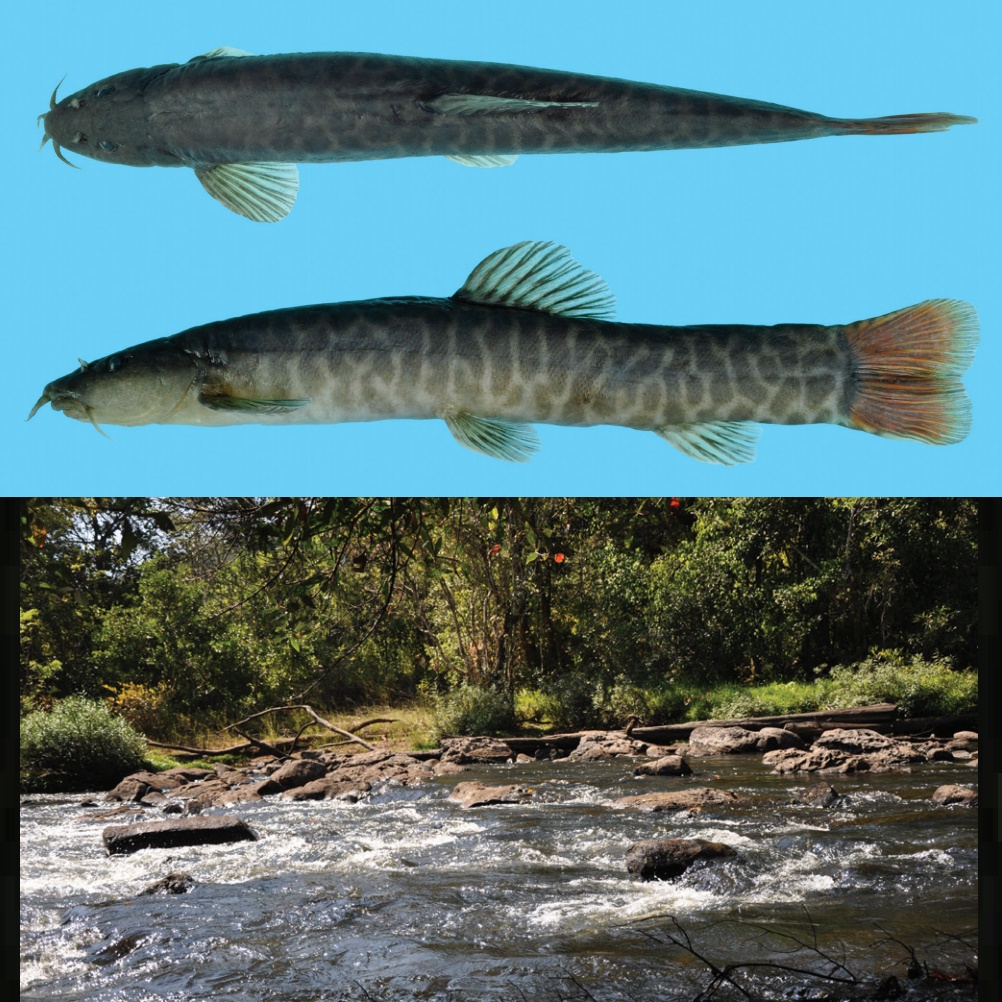
 Schistura colossa  Kottelat, 2017

 RAFFLES BULLETIN OF ZOOLOGY. 65; 341–356. 

Abstract
 Schistura colossa, new species, is described from the Xe Pian, Xe Set and Houay Champi on Bolaven Plateau in southern Laos. It is distinguished by its large size (up to at least 98 mm SL); the body has 16–21 bars, quite regularly shaped in juveniles and with increasing size becoming more irregular; in the largest individuals the bars on the caudal peduncle are broken up in irregular blotches. Schistura klydonion, new species, is described from the Xe Namnoy, also on Bolaven Plateau. It is distinguished by its relatively large size (up to at least 76 mm SL); the body has a midlateral row of 12–21 bars that do not reach the dorsal midline and that alternate with a middorsal row of saddles or small blotches, leaving a pale zigzag line between the two rows; the lips have a few sparsely-set pointed papillae. The topography of the plateau and the distribution of the endemic species suggest an earlier connection of the Houay Makchang Gnai and the Xe Katam with the Xe Pian instead of the Xe Namnoy. Both species are endemic to the Bolaven Plateau, have a limited distribution and are impacted by hydropower and agricultural activities.

 Key words. Cobitoidei, Schistura, Mekong basin, stone loach


Fig. 2. Schistura colossa, MHNG 2767.084, holotype, 98.0 mm SL; Laos: Xe Pian River on Bolaven Plateau.

Schistura colossa, new species

Distribution. Schistura colossa has been collected on Bolaven Plateau in the Xe Pian drainage, a tributary of the Xe Kong, in southern Laos (Fig. 9). A single specimen caught in the Champi and one caught in the Xe Set, both on Bolaven Plateau, cannot be distinguished from the samples from the Xe Pian.

 Etymology. The Latin adjective colossus (-a, -um) means giant. Allusion to the size of the species, a giant among Southeast Asian nemacheilids. 


Fig. 13. Schistura klydonion, MHNG 2767.085, 75.8 mm SL, holotype; Laos: Xe Namnoy on Bolaven Plateau (right side, reversed).

Schistura klydonion, new species

Distribution. Schistura klydonion has been observed only in the Xe Namnoy on the Bolaven Plateau, southern Laos. 

Etymology. From the classical Greek κλυδώνιον (klydonion) meaning small wave, ripple, undulation; allusion to the wavy stripe running along the flank between the row of saddles and the row of bars. A noun in apposition. 


Maurice Kottelat. 2017. Schistura colossa and S. klydonion, Two New Species of Loaches from Bolaven Plateau, southern Laos (Teleostei: Nemacheilidae).
 RAFFLES BULLETIN OF ZOOLOGY. 65; 341–356.

Wednesday, December 14, 2016

[Botany • 2016] Nervilia mekongensis | ว่านแผ่นดินเย็นแม่โขง • Studies in Asian Nervilia (Nervilieae, Epidendroideae, Orchidaceae) VI: A New Species from Thailand, Cambodia, Laos and Vietnam


Nervilia mekongensis S.W.Gale, Schuit. & Suddee, sp. nov. 

B. Flowering plant in habitat. D and E. Close-up of flower.

Photo C taken by T. Sando at the type locality in eastern Thailand, photo B taken by N. Karnsunthad in Mae Ping National Park, Lamphun Province, northern Thailand, and photo E taken by K. Souvannakhoummane in Luang Prabang Province, northern Laos.

Nervilia mekongensis S.W.Gale, Schuit. & Suddeesp. nov. 
 A. Inflorescence emerging above ground. B and C. Flowering plant in habitat. D and E. Close-up of flower. F. Seed capsules. G. Plants in leaf emerging above ground. H. Large colony of plants in leaf.


Photos A, C, D and F–H taken by T. Sando at the type locality in eastern Thailand, photo B taken by N. Karnsunthad in Mae Ping National Park, Lamphun Province, northern Thailand, and photo E taken by K. Souvannakhoummane in Luang Prabang Province, northern Laos.


Abstract

A new species of the terrestrial orchid genus Nervilia is described and illustrated from material collected at several localities in the Greater Mekong region of Southeast Asia. The multi-flowered inflorescence bearing relatively large flowers with a pubescent lip, and the many-veined, cordate-reniform leaf blade that is held well above ground level, place Nervilia mekongensis in section Nervilia. Despite being superficially similar to N. aragoana, a widespread species of tropical Asia and Australasia, it is most closely affiliated to N. fordii, a species known from southern China and Thailand. It is distinguished by its stout inflorescence and lip that is broadest midway along the hypochile and which has acute, forward-projecting side-lobes and a short, ovate mid-lobe. A conservation assessment plus taxonomic notes are provided.

Keywords: Nervilieae, Epidendroideae, Orchidaceae, Monocots, Asia


Distribution:— We confirmed herbarium material of Nervilia mekongensis from eastern and northern Thailand, northern Laos, eastern Cambodia, and northern and southern Vietnam. Plants photographed by Naruemol Karnsunthad in Mae Ping National Park in Lamphun Province, northern Thailand, were also verified as belonging to this species (Fig. 1B).

Ecology:— At the type locality in eastern Thailand, Nervilia mekongensis grows in dry deciduous forest dominated by Shorea siamensis. In northern Thailand and Laos, it occurs in dry deciduous forest on limestone, and in Cambodia it is found in open deciduous forest, growing together with the terrestrial orchids Eulophia spectabilis (Dennst.) Suresh and Geodorum siamense Rolfe ex Downie. In Vietnam, it grows in open secondary scrub and grasslands at the edge of disturbed forest on eroded limestone ridges. It is known throughout an elevational range of 250–1,000 m.

Phenology:— Flowering April to June, in leaf from July until November. 


Etymology:— Named for the Mekong River, which flows through all four range countries and supports the enormous biodiversity of the region.

Vernacular name:— Thai: ว่านแผ่นดินเย็นแม่โขง (Wan phaen din yen mekong).


Stephan W. Gale, André Schuiteman, Santi Watthana, Tomoki Sando, Keooudone Souvannakhoummane, Leonid Averyanov and Somran Suddee. 2016. Studies in Asian Nervilia (Nervilieae, Epidendroideae, Orchidaceae) VI: Nervilia mekongensis, A New Species from Thailand, Cambodia, Laos and Vietnam.
 Phytotaxa. 247(4); 267–273. DOI:  10.11646/phytotaxa.247.4.4


Sunday, August 7, 2016

[Ichthyology • 2015] Mahseers Genera Tor and Neolissochilus (Teleostei: Cyprinidae) from southern Vietnam


 Tor mekongensis 
Hoàng, Phạm, Durand, Trần & Phan, 2015


Abstract

Two new species and two new basin records of mahseers in the genera Tor and Neolissochilus are described from the upper Krong No and middle Đồng Nai drainages of the Langbiang Plateau in southern Vietnam. These new species and new records are known from streams and rivers in montane mixed pine and evergreen forests between 140 and 1112 m. Their populations are isolated in the Sre Pok River of the Mekong basin, the middle of the Đồng Nai basin, and the An Lão River. Both new species are differentiated from their congeners by a combination of the following characters: 23–24 lateral scales, 9–10 predorsal scales, 2/7 or 1/8 pelvic-fin rays, mouth position, median lobe of lower lip, rostral hood, colour in life and by divergent mitochondrial DNA. Tor mekongensis sp. nov. is differentiated from Tor dongnaiensis sp. nov. by the number of transverse scale rows (3/1/2 vs. 4/1/2), number of pelvic-fin rays (2/7 vs. 1/8), a blunt rostral hood vs. pointed, caudal-fin lobes that are equal vs. unequal, and by mitochondrial DNA (0.7% sequence divergence). Molecular evidence identifies both species as members of the genus Tor and distinct from all congeners sampled (uncorrected sequence divergences >1.9% for all Tor species for which homologous COI sequences are available). Tor sinensis is recorded in the Krong No and the Sre Pok rivers, further south of its known distribution. Polymorphism is described in Neolissochilus stracheyi with a Tor-like morph and a Neolissochilus-like morph.

Keywords: Pisces, Langbiang Plateau, Tor dongnaiensis sp. nov., Tor mekongensis sp. nov., Tor sinensis, Neolissochilus stracheyi, southern Vietnam

Tor dongnaiensis 
Hoàng, Phạm, Durand, Trần & Phan, 2015

Tor dongnaiensis sp. nov. Hoàng, Phạm, Durand, Trần & Phan

Etymology. Specific epithet is in reference to the type locality of Đồng Nai drainage.
Suggested common name. Cá ngựa xám Đồng Nai (Vietnamese), Dongnai mahseer (English).


Tor mekongensis sp. nov.

Etymology. Specific epithet is in reference to the type locality of Mekong drainage.
Suggested common names. Cá ngựa xám Mê Kông (Vietnamese), Mekong mahseer (English).


Huy Đức Hoàng, Hùng M. Phạm, Jean-Dominique Durand, Ngân T. Trần and Phúc Đ. Phan. 2015. Mahseers Genera Tor and Neolissochilus (Teleostei: Cyprinidae) from southern Vietnam. Zootaxa. 4006(3): 551–568. DOI: 10.11646/zootaxa.4006.3.8

Wednesday, September 30, 2015

[Herpetology • 2015] Japalura vela • A New Species of Japalura (Squamata: Agamidae) from upper Lancang (Mekong) Valley of Eastern Tibet, China


Japalura vela   Wang, Jiang & Che, 2015
Sail Moutain Lizard or Sail Japalura | 帆背攀蜥 (Fan Bei Pan Xi)

Figure 1: Dorsolateral close-ups, dorsolateral overviews, and ventral overviews of Japalura vela sp. nov.:
The male holotype KIZ013801 (A, B, and C) and the female paratype KIZ013802 (D, E, and F) in life.
Images not to scale. ||  Photos by Kai WANG.
Figure 7: The microhabitat (A) and macrohabitat (B) of Japalura vela sp. nov.
at the type locality, Quzika, Tibet.  || Photos by Duan YOU.

ABSTRACT
A new species of the agamid genus Japalura is described based on 15 specimens from the upper Lancang (Mekong) Valley of eastern Tibet, PR China. Populations of the new species, Japalura vela sp. nov., were previously recognized as J. flaviceps. The new species is morphologically most similar to J. batangensis, J. micangshanensis, J. variegata, and J. zhaoermii, but is distinguished from the four species and all remaining congeners by the following combination of morphological characters: 1) small adult size (SVL 56–69 mm in males, 59–66 mm in females); 2) ratio of tail TAL/SVL 1.85–2.06; 3) ratio of hind limb HLL/SVL 0.72–0.81; 4) T4S 24 or 25; 5) concealed tympanum; 6) transverse gular fold present; 7) gular pouch present; 8) axillary fold present; 9) a pronounced, continuous, sail-like vertebral crest along length of body in males; 10) ground dorsal coloration black in males; 11) distinct gray transverse streaks on dorsal surface of head; 12) black radiated streaks around eyes; 13) distinct, black vermiculate stripes on ventral surface of head in both sexes; 14) a strongly jagged dorsolateral stripe from neck to base of tail on each side of vertebral crest in males; and 15) absence of gular spots in both sexes. General distribution patterns of the genus in the Hengduan Mountains region are also discussed.

Keywords:  distribution, Hengduan Mountains, Japalura, J. flaviceps, species complex


Japalura vela sp. nov. Wang, Jiang, Che (Figures 1–6)
Synonymies: Japalura yunnanensis Vogt, 1924: 338 
Japalura flaviceps Hu et al., 1987: 112 
Japalura flaviceps Pope, 1935: 467 
Japalura flaviceps Zhao and Jiang, 1977: 293 –298 
Japalura flaviceps Zhao et al., 1999: 111–115 
Japalura flaviceps Li et al., 2010: 115 
Japalura sp. A Manthey et al., 2012

Distribution and Ecology:  The new species is currently known only from the type locality (Figures 7–8), but it may be found in valleys of adjacent reaches along Lancang Rivers. As a terrestrial species, individuals were observed commonly in rocky areas or steppe-shrub habitat along the arid river valley (Figure 7). Adult males usually basked on high rocks, while adult females and juveniles stayed lower in the rock piles, suggesting possible niche partitioning among different age-groups and between different sexes. Males are territorial, in which the territory holder will perform vertical head-nodding movements and display gular pouch toward the invader, and physical contacts (biting and chasing) will happen if the invader refuses to leave. No territorial behaviors were seen among females or juveniles. Possible predations may come from snakes (Chinese Beauty Snake, Orthriophis taeniurus, KIZ013803, was collected from the same locality) and large birds ( Corvus sp., also commonly observed at this locality).

Etymology:  The Latin word vela means “sail”, which describes the shape of the pronounced and continuous vertebral crest as the diagnostic morphology of the males of the new species. Hence according to the Latin name, we suggest Sail Moutain Lizards or Sail Japalura as its English common name, and Fan Bei Pan Xi (帆背攀蜥 ) as its Chinese common name.


 Kai Wang, Ke Jiang, Gang Pan, Mian Hou, Cameron D. Siler and Jing Che. 2015. A New Species of Japalura (Squamata: Sauria: Agamidae) from upper Lancang (Mekong) Valley of Eastern Tibet, China. ASIAN HERPETOLOGICAL RESEARCH. 6(3):159-168.

Friday, July 10, 2015

[Herpetology • 2015] The Systematics and Independent Evolution of Cave Ecomorphology in Distantly related Clades of Bent-toed Geckos (Genus Cyrtodactylus Gray, 1827) from the Mekong Delta and Islands in the Gulf of Thailand


Distribution of species with the Cyrtodactylus condorensis and C. intermedius species complexes
FIGURE 2. General differences in body stature between the general scansorial ecomorphs (figures on the upper and lower left) and the cave-dwelling ecomorphs (figures on the upper, middle and lower right).
Upper left: Cyrtodactylus leegrismeri (LSUDPC 8228) from Hon Khoai Island, Ca Mau Province, Vietnam.
Middle left
C. leegrismeri (LSUDPC 9446) from Tho Chu Island, Kien Giang Province, Vietnam. Lower left: C. condorensis (LSUDPC 8202) from Con Dao Island, Con Dao Province, Vietnam. 
Upper right: C. hontreensis (LSUDPC 3062) from Hon Tre Island, Kien Giang Province, Vietnam.
Middle right: C. grismeri (LSUDPC 3162) from Tuc Dup Hill, An Giang Province, Vietnam.
Lower right: C. eisenmani (LSUDPC 8760) from Hon Son Island, Kien Giang Province, Vietnam.
Grismer, Wood, Tri & Murdoch, 2015 || DOI: 10.11646/zootaxa.3980.1.6

FIGURE 3. Hypothesized ancestral-descendant relationships depicting the independent evolution of the cave-dwelling ecomorph from the general scansorial ecomorph.
Grismer, Wood, Tri & Murdoch, 2015

Abstract

An integrative taxonomic analysis of the distantly related Cyrtodactylus condorensis and intermedius species complexes of the Mekong Delta revealed that C. paradoxus is a junior synonym of C. condorensis and that C. thochuensis is a junior synonym of C. leegrismeri. Additionally, the analysis revealed that a cave-dwelling ecomorpholgy has evolved independently early on in the evolution of both complexes (represented by C. hontreensis in the intermedius complex and C. grismeri and C. eisenmani in the condorensis complex) and cave ecomorphs exist in sympatry—but not syntopy—with general scansorial ecomorphs. Multiple, recent, cyclical, glacioeustatic driven changes in sea levels across the Sunda Shelf are hypothesized to account for the evolution and distribution of the widely separated, conspecific insular populations of C. condorensis and C. leegrismeri. The independent evolution of cave ecomorphology is proposed to have been driven by competition avoidance. Habitat islands across the Mekong Delta are an important source of endemism and in need of protection.

Keywords: Reptilia, ecomorphology, Cyrtodactylus, habitat islands, Mekong Delta, Vietnam, systematics

Distribution of species with the Cyrtodactylus condorensis and Cintermedius species complexes
Grismer, Wood, Tri & Murdoch, 2015 || DOI: 10.11646/zootaxa.3980.1.6


Grismer, L. L., P. L. Wood, Jr., Ngo V. Tri and Matthew Murdoch. 2015. The Systematics and Independent Evolution of Cave Ecomorphology in Distantly related Clades of Bent-toed Geckos (Genus Cyrtodactylus Gray, 1827) from the Mekong Delta and Islands in the Gulf of Thailand. Zootaxa, 3980(1): 106–126. DOI: 10.11646/zootaxa.3980.1.6

Thursday, May 29, 2014

[Ichthyology • 2007] ปลาหางไหม้ | Balantiocheilos ambusticauda | Burnt-tailed Barb • A New and Possibly Extinct Species of cyprinid Fish (Cypriniformes: Cyprinidae) from the Mekong and Chao Phraya river drainages in Indochina (mainland Southeast Asia)


ปลาหางไหม้ Balantiocheilos ambusticauda
Ng & Kottelat 2007
via siamensis.org

Abstract
Balantiocheilos ambusticauda sp. nov. is described from the Mekong and Chao Phraya river drainages in Indochina (mainland Southeast Asia). It can be distinguished from its only congener, B. melanopterus, in having a shorter snout (27.5–33.9% HL vs. 33.2–39.1), posteriorly directed grooves at rictus curved (vs. straight), and narrower black margins on the pelvic and anal fins (on distal third or less vs. on distal half or more). The possibility that B. ambusticauda is extinct is also discussed.

Key words: Mekong, Chao Phraya, Systomini, Osteobramae


ปลาหางไหม้
by Luang 
Masya Chitarkarn (หลวงมัศยจิตรการ) | siamensis.org


นณณ์ ผาณิตวงศ์. 2554. ปลาหางไหม้สายพันธุ์ไทย ก่อนที่จะไม่เหลือแม้แต่ความทรงจํา.  
http://siamensis.org/article/4880


Ng, H. H.  and M. Kottelat.  2007. Balantiocheilos ambusticauda, A New and Possibly Extinct Species of cyprinid Fish from Indochina (Cypriniformes: Cyprinidae). Zootaxa. 1463: 13-20. 

นณณ์ ผาณิตวงศ์. 2554. ปลาหางไหม้สายพันธุ์ไทย ก่อนที่จะไม่เหลือแม้แต่ความทรงจํา http://siamensis.org/article/4880
สิริวรรณ สุขศรี. 2554. ปลาหางไหม้ไทย (Balantiocheilos ambusticauda Ng & Kottelat, 2007) ความแตกต่างระหว่างชนิดและการสูญพันธุ์จากประเทศไทย  http://www.fisheries.go.th/if-center/web2/images/diversity/balan.pdf

Mekong

Monday, March 17, 2014

[Ichthyology • 2010] Microcobitis • a New Genus Name for Cobitis misgurnoides Rendahl, 1944 (Teleostei: Cobitidae) from river basins in Central Vietnam


Microcobitis, new genus, is established with Cobitis misgurnoides Rendahl, 1944 as type species. It is diagnosed by having the lower lip developed into four barbel-like lobes, adult males bearing a lamina circularis at the base of the second pectoral-fin ray, suborbital spine in a groove under the eye and not covered by skin, a pre-epiphysal fontanel between the frontal bones, a cartilaginous epiphysal bar, and the absence of body swellings in males.

Etymology. The name is derived from the Greek word ‘micros’, small, used as prefix here, and the generic name Cobitis, the type genus of Cobitidae, in which Microcobitis was originally placed due to the similar shape of the lamina circularis in males. Gender feminine.

Distribution. Presently reported from river basins in Central Vietnam. Microcobitis has also been reported to occur in some tributaries of the Mekong in Laos on the western slope of the Annamite range (M. Kottelat, pers. comm.).

Bohlen, J. and Harant, R. 2010. Microcobitis, a New Genus Name for Cobitis misgurnoides (Teleostei: Cobitidae). Ichthyological Exploration of Freshwaters 21(4): 295-300.

Tuesday, November 12, 2013

[Ichthyology • 2013] Tetraodon barbatus | ปลาปักเป้าปากดำ • Validation of Tetraodon barbatus Roberts, 1998, a Freshwater Pufferfish (Family Tetraodontidae) from the Mekong River


Abstract
 The freshwater pufferfish, Tetraodon barbatus Roberts, 1998, previously considered as a synonym of Tetraodon cambodgiensis Chabanaud, 1923, is validated. It differs distinctly from T. cambodgiensis by the combination of characters of that its caudal peduncle is smooth without small spinules and the head is broader (head width at preorbital, post orbital and nape: 54.1–59.8, 69.1–77.8 and 76.5–86.8 % head length (HL), respectively, in T. barbatus vs. 48.7–53.3, 60.2–64.3 and 68.5–74.3 %HL, respectively, in T. cambodgiensis). 

Key words: Tetraodon barbatus, valid species, Mekong River 

Geographic distribution.– T. barbatus is only known from the middle and lower Mekong basin (Roberts, 1998). The data from the field trips in Mekong basin of Thailand revealed that T. barbatus is not only found in Mekong mainstream but also in its larger tributaries, especially in places with rocky, sandy or muddy substrate. Moreover, T. barbatus inhabits rapids and is often found in the same habitat as T. suvattii and T. baileyi.


Pasakorn Saenjundaeng, Chaiwut Grudpun and Chavalit Vidthayanon. 2013. Validation of Tetraodon barbatus Roberts, 1998, a Freshwater Pufferfish (Family Tetraodontidae) from the Mekong River. Tropical Natural History. 13(2): 77-85

Sunday, November 10, 2013

[News • 2013] New populations of Indochina’s Rarest Deer, Endangered Hog Deer Axis porcinus annamiticus (or Hyelaphus annamiticus), discovered in Cambodia


New populations of Indochina’s rarest deer discovered in Cambodia
Surveys confirm three populations of the Endangered hog deer in Cambodia

A joint team from the Royal University of Phnom Penh’s Centre for Biodiversity Conservation (CBC) and Fauna & Flora International (FFI) have found three previously unknown populations of the Endangered hog deer in Cambodia.

The hog deer, today listed as Endangered on The IUCN Red List of Threatened Species, once ranged throughout large areas of South and mainland Southeast Asia, but has suffered regional population decimations due to hunting, habitat loss and degradation. Cambodia is home to the only known wild populations of the Axis porcinus annamiticus (or Hyelaphus annamiticus) subspecies of the deer.

A field team, funded by the Critical Ecosystem Partnership Fund, conducted interview surveys in local villages, following up on hog deer reports with rapid field surveys looking for tracks or dung.

...........


Friday, July 12, 2013

[Ichthyology • 2013] Tetraodon palustris | ปลาปักเป้าบึง • a new freshwater pufferfish (Tetraodontiformes: Tetraodontidae) from the Mekong Basin of Thailand


 Tetraodon palustris Saenjundaeng, Vidthayanon & Grudpun. 2013

Abstract
Tetraodon palustris, new species, is described from the Mekong basin of Thailand. Tetraodon palustris differs from T. cochinchinensis and T. fangi in having no ocellus on the flank and spinules dorsally from the interorbital region to the end of the dorsal-fin base. Tetraodon cochinchinensis is distinguished from T. fangi by having a longer snout (43.5–49.2% HL in T. cochinchinensis vs. 37.9–41.1% HL in T. fangi) and is covered with spinules dorsally from the front of the nasal organs to the end of the dorsal-fin base (vs. from the front of the eyes to the end of the dorsal-fin base in T. fangi).

Key words: Tetraodon, new species, Mekong basin


Saenjundaeng, Pasakorn, Chavalit Vidthayanon & Chaiwut Grudpun. 2013. Tetraodon palustris, a new freshwater pufferfish (Tetraodontiformes: Tetraodontidae) from the Mekong Basin of Thailand. Zootaxa. 3686(1): 77–84. 

Wednesday, June 26, 2013

[Ornithology • 2013] Orthotomus chaktomuk | Cambodian Tailorbird | นกกระจิบจตุมุข หรือ นกกระจิบคอดำกัมพูชา • A New Species of Lowland Tailorbird (Passeriformes: Cisticolidae: Orthotomus) from the Mekong floodplain of Cambodia


'Cambodian Tailorbird' Orthotomus chaktomuk
Mahood, John, Eames, Oliveros, Moyle, Chamnan, Poole, Nielsen & Sheldon 2013
photo: James Eaton / Birdtour Asia

Based on distinctive morphological and vocal characters we describe a new species of lowland tailorbird Orthotomus from dense humid lowland scrub in the floodplain of the Mekong, Tonle Sap and Bassac rivers of Cambodia. Genetic data place it in the O. atrogularis–O. ruficeps–O. sepium clade. All data suggest that the new species is most closely related to O. atrogularis, from which genetic differences are apparently of a level usually associated with subspecies. However the two taxa behave as biological species, existing locally in sympatry and even exceptionally in syntopy, without apparent hybridisation. The species is known so far from a small area within which its habitat is declining in area and quality. However, although birds are found in a number of small habitat fragments (including within the city limits of Phnom Penh), most individuals probably occupy one large contiguous area of habitat in the Tonle Sap floodplain. We therefore recommend it is classified as Near Threatened on the IUCN Red List. The new species is abundant in suitable habitat within its small range. Further work is required to understand more clearly the distribution and ecology of this species and in particular its evolutionary relationship with O. atrogularis. 


Figure 1. Distribution of records of Orthotomus chaktomuk and O. atrogularis
within and close to the floodplain of the Mekong, Tonle Sap and Bassac rivers.

Introduction
After a hiatus of over half a century owing to the intense human conflicts in the area, the last two decades have witnessed the discovery of a flush of novel bird taxa in Indochina. These recent discoveries have been facilitated by better sampling of remote micro-habitats and to a much lesser degree the greater use of nonmorphological characters in delimiting species. Most of these discoveries concerned babblers (Timaliidae) from isolated montane areas in Vietnam (Eames et al. 1994, Eames et al. 1999a,b, Eames & Eames 2001, Eames 2002). A smaller wave of discoveries involving a diverse range of taxa took place in forested limestone karst in Lao PDR, Vietnam and adjacent areas of China (Zhou Fang & Jiang Aiwu 2008, Woxvold et al. 2009, Alström et al. 2010). Only one new species, Mekong Wagtail Motacilla samveasnae, was named from Cambodian specimens, but it also occurs in Lao PDR, Thailand and Vietnam in ‘channel mosaic’ habitat on the Mekong and its major tributaries (Duckworth et al. 2001, Le Trong Trai & Craik 2008). Here we describe a new species of lowland tailorbird Orthotomus, confined to low elevation humid evergreen scrub in the floodplain of the Mekong and associated large rivers, in Cambodia

..........

Etymology
The specific epithet ‘chaktomuk’ is a Khmer word meaning ‘four faces’. It is used in reference to the low-lying area at which the Tonle Sap, Bassac and Mekong rivers come together to form an ‘X’ centred on Phnom Penh, itself historically known as ‘Krong Chaktomuk’ (literally ‘City of Four Faces’). Based on current knowledge, the global distribution of the new species is restricted to scrub within the dynamic floodplain created by the confluence of these waters. We use chaktomuk as a noun in apposition to the genus name, and it is thus invariable.


Distribution
The distribution of O. chaktomuk is incompletely known. It is apparently constrained by the distribution of seasonally flooded dense scrub within the floodplain of the Tonle Sap, Mekong and Bassac rivers in Cambodia (Figure 1). However, based on current data it is absent from part of this floodplain. Searches at various locations in apparently suitable habitat in the Tonle Sap floodplain have thus far only found the species in the south-east (see Table SOM 1 for a list of all locations in the floodplain of the Mekong, Tonle Sap and Bassac rivers where searches for O. chaktomuk have been conducted). In the north of the Tonle Sap floodplain (where we have searched for and not found O. chaktomuk), O. atrogularis is abundant in habitat that is superficially structurally similar to habitat in the south-east, and it is unclear how far north and west along the lakeshore the distribution of O. chaktomuk extends. There is no biogeographic reason why O. chaktomuk should be absent from parts of the Tonle Sap floodplain, and the causes of its absence are unknown; O. atrogularis is scarce or absent at sites where O. chaktomuk was recorded (Table SOM 1). 

Orthotomus chaktomuk was not found in seemingly appropriate small seasonally flooded scrub patches at the northern limit of the Mekong floodplain (12°36’27.52”N 106°01’36.06”E) in Kratie province (Table SOM 1, J. A. Eaton verbally 2012). Satellite data indicate that there is little, if any, suitable habitat for O. chaktomuk in the Mekong floodplain in Vietnam and it is currently unrecorded there (although no specific searches have been conducted). As might be expected, we have located only O. atrogularis in scrub habitats outside of the Mekong, Tonle Sap and Bassac floodplain (where these records were within 10 km of superficially suitable habitat for O. chaktomuk they are mapped on Figure 1). Based on current knowledge of its range, the distribution of O. chaktomuk covers less than c.10,000 sq.km. (Figure 1); it therefore can be considered a restricted-range species (sensu Stattersfield et al. 1998).


Mahood, Simon P., Ashish J. I. John, Jonathan C. Eames, Carl H. Oliveros, Robert G. Moyle, Hong Chamnan, Colin Poole, Howie Nielsen & Frederick H. Sheldon. 2013. A New Species of Lowland Tailorbird (Passeriformes: Cisticolidae: Orthotomus) from the Mekong floodplain of Cambodia. Forktail. The Journal of Asian Ornithology. 29: 1-14.
http://orientalbirdclub.org/wp-content/uploads/2013/06/TAILORBIRD_Forktail_29pp1-14.pdf


 นักวิทยาศาสตร์ทึ่ง พบนกกระจิบพันธุ์ใหม่ในกรุงพนมเปญ | นกกระจิบกัมพูชา หรือ Orthotomus chaktomuk http://astv.mobi/AR1tnVm via @ASTVManager

Friday, June 21, 2013

[Conservation • 2013] A Mekong Giant - Current Status, Threats And Preliminary Conservation Measures For The Critically Endangered Mekong Giant Catfish Pangasianodon gigas (Chevey 1930)


A Mekong Giant - Current Status, Threats And Preliminary Conservation
Measures For The Critically Endangered Mekong Giant Catfish


Dams could signal death knell for Mekong giant catfish 

– Damming the mainstream of the lower Mekong River would represent a significant new threat to the survival of the Mekong giant catfish, one of the world’s largest and rarest freshwater fish, according to a new study commissioned by WWF. 

The study sheds new light on the status of this elusive species, including data on its numbers, distribution, threats and measures needed to prevent its disappearance. While the exact population size is unknown, there could be as few as a couple of hundred adult Mekong giant catfish fish left.

According to the study, the Xayaburi dam on the Mekong mainstem in northern Laos would prove an impassable barrier for the migratory giant catfish – which are capable of reaching up to three metres in length and weighing as much as 300kg – and risks sending the species to extinction.

“A fish the size of a Mekong giant catfish simply will not be able to swim across a large barrier like a dam to reach its spawning grounds upstream,” said the study’s author and associate research professor at the University of Nevada, Dr. Zeb Hogan. 

“These river titans need large, uninterrupted stretches of water to migrate, and specific water quality and flow conditions to move through their lifecycles of spawning, eating and breeding.” 

................


photo: Zeb Hogan 


Executive Summary 
Conservation Status: The Mekong giant catfish, Pangasianodon gigas (Chevey 1930), is one of the most endangered fish in Southeast Asia. It is listed on the IUCN Red List of Threatened Species as Critically Endangered A4abcd (IUCN 2011). The Mekong giant catfish is listed on Appendix I of the Convention on International Trade in Endangered Species of Wild Fauna and Flora (CITES) and Appendix I of the Convention on Migratory Species (CMS).

Distribution: P. gigas is a Mekong endemic. Historically, Mekong giant catfish occurred throughout the large rivers of the Mekong River Basin in Vietnam, Cambodia, Lao PDR, Thailand, and possibly Burma and southwestern China (Smith 1945, Lenormand 1996, Roberts and Vidthayanon 1991). There is some evidence that Mekong giant catfish were very widely distributed and relatively abundant in the 1800’s and early 1900’s. Mekong giant catfish now appear limited to the Mekong and its tributaries in Cambodia, Lao PDR, and Thailand. The species has also been introduced into reservoirs and rivers in Thailand but these introductions have failed to result in self-sustaining populations (Hogan et al. 2001). 

Population size: Evidence suggests that populations of Mekong giant catfish have been declining throughout the basin for the last several decades (Pavie 1904, Giles 1935, Smith 1945, Hogan et al. 2001, Hartmann et al. 2008). P.gigas is now very rare throughout its range and no significant catch has been reported from northeast Thailand, southern Lao PDR, or Vietnam since 1980. In northern Thailand, the catch of Mekong giant catfish has been declining steadily for the past 20 years (Hogan 1998). Basinwide catch numbers are difficult to ascertain but appear to have dropped from thousands of fish in the late 1880’s (Pavie 1904), to hundreds of fish in the 1920’s and 1930’s (Giles 1935), to dozens of fish in the 1990’s (Hogan et al. 2004), to less than 10 fish in recent times (Stone 2007).

Habitat and ecology: The ecology of the Mekong giant catfish is poorly understood. Most available information comes from catch records which indicate that Mekong giant catfish use a broad range of habitats throughout their life cycle. Juvenile fish have been reported from the Mun and Songkhram Rivers in Thailand and the Tonle Sap Lake in Cambodia. Adult fish are believed to inhabit deep water areas of the Mekong River especially during the dry season (Mattson et al. 2002). P. gigas is migratory, but the extent of migrations is unknown. Migrating adults have been recorded moving out of the flooded habitats of Tonle Sap Lake and into the Mekong at the end of the rainy season (October-December), moving over the Khone Falls in July and August (Mollot unpublished data), and making spawning migrations in northern Thailand and Lao PDR in late May and early June (Hogan et al. 2004). Genetic data indicate that all P. gigas in the basin may be part of one, panmictic population (Ngamsiri et al. 2007). 


A Mekong Giant - Current Status, Threats And Preliminary Conservation 
Measures For The Critically Endangered Mekong Giant Catfish

Dams could signal death knell for Mekong giant catfish 

Thursday, May 2, 2013

[Conservation • 2013] Ecosystems in the Greater Mekong: past trends, current status, possible futures


Freshwater Ecosystems of the Mekong river system in a connectivity tree with Ecosystem Characteristics of the Main stem and main tributaries.

The Greater Mekong subregion in Southeast Asia risks losing more than a third of its remaining forest cover within the next two decades if regional governments fail to boost protection, value and restore natural capital, and embrace green growth, warns a new WWF report. 

WWF’s analysis reveals the Greater Mekong has retained about 98 million hectares of natural forest, just over half of the region’s land area, but further rapid loss is expected if current deforestation rates persist.

Between 1973 and 2009, the five countries of the Greater Mekong lost just under one-third of their remaining forest cover. During this period, Cambodia lost 22 per cent of its 1973 forest cover, Laos and Myanmar lost 24 per cent, and Thailand and Vietnam lost 43 per cent.

Large connected areas of core forest also declined significantly across the region, from over 70 per cent in 1973 to about 20 per cent in 2009. 


Core forest is defined as an area of at least 3.2km2 of uninterrupted forest. If current trends continue, WWF predicts that by 2030 only 14 per cent of the Greater Mekong’s remaining forest will consist of contiguous habitat capable of sustaining viable populations of many wildlife species.

“The Greater Mekong is at a crossroads,” said Peter Cutter, Landscape Conservation Manager with WWF-Greater Mekong. “One path leads to further declines in biodiversity and livelihoods, but if natural resources are managed responsibly, this region can pursue a course that will secure a healthy and prosperous future for its people.” 

The report, Ecosystems in the Greater Mekong: past trends, current status, possible futures,” provides new analysis on the current status and potential future of the region’s principal forest and freshwater ecosystems, and some of the most endangered species these ecosystems support. 

The report offers two scenarios for the region’s ecosystems, one predicts what will likely happen by 2030 under an unsustainable growth model in which the deforestation and degradation observed over the past decade persists, while the other scenario assumes a 50 per cent cut in the annual deforestation rate and offers a future based on green growth. Under the green economy scenario, core forest areas extant in 2009 across the five Greater Mekong countries would remain intact.

“The green economy approach is the choice for a viable future in the Greater Mekong,” added Cutter. “Regional leaders have already affirmed that healthy economic growth goes hand in hand with healthy and productive ecosystems, but fast and effective responses are needed now to avoid permanent environmental degradation.”


The report highlights the Xayaburi dam development as a key threat to the health and productivity of the Mekong river and delta. 

The Mekong basin hosts 13 unique, yet connected, freshwater ecosystems, but the controversial Xayaburi project will sever the mainstem of the lower Mekong river, blocking migratory fish and sediment flow with devastating consequences for livelihoods and food security for 60 million people. 

The report also maps the enormous decline in the range of several important and iconic species of the region, including the tiger, Asian elephant, Irrawaddy dolphin and the endemic saola. 

The survival of many species in the Greater Mekong depend on the existence of effectively managed protected area systems, and while protected areas have expanded dramatically since 1970, many are not well managed.

“Many protected areas exist in name only,” added Cutter. “Even relatively secure protected areas are under intense pressure from poaching and timber theft, while others have been reduced in size by government’s eager to cash in on land concessions to mining companies or plantation owners.”

Despite documenting the degradation of ecosystems over the past 50 years, the report also emphasizes the region is still rich in natural resources and the value of its ecosystem services, including food, water and fibre, is among the highest in the world. 

The Greater Mekong’s vast natural wealth provides a significant opportunity for sustainable development, and WWF believes building greener economies is well within reach. 

“Given that the majority of the region’s biological heritage and supporting ecosystems occur in landscapes that cross borders, regional collaboration is critical,” concluded Cutter. “Increased and more sustainable investment in maintaining ecosystem integrity must also be a priority at landscape, national, and regional scales."


__________________________

New forest loss figures highlight need for green growth in the Greater Mekong
Ecosystems in the Greater Mekong: past trends, current status, possible futures


Greater Mekong countries 'lost one-third of forest cover in 40 years'
Cambodia, Laos, Burma, Thailand and Vietnam have lost nearly 40m ha of forest cover since 1980, a new report shows  ..... http://gu.com/p/3fh99/tw via @guardian