Showing posts with label Palaemonidae. Show all posts

Friday, March 27, 2026

[Crustacea • 2026] Alpheopsis gorei • A mesophotic alpheid Shrimp (Decapoda: Caridea: Alpheidae) from the western Atlantic


Alpheopsis gorei  Anker, 2026

Papéis Avulsos De Zoologia. 66;  
 Photograph by Sarah Tweedt. 

Abstract
A new mesophotic alpheid shrimp, Alpheopsis gorei sp. nov., is described from several offshore localities in the northern and north-eastern Gulf of Mexico off Texas, Louisiana and western Florida. However, the distribution range of the new species extends to the Atlantic coast of Florida, with a previous record from deep-water reefs off Key Largo, under A. trispinosa Stimpson, 1860. The presently known bathymetric range of A. gorei sp. nov. is 42.1-126.2 m and the species appears to be free-living, mainly among coralline nodules and in crevices of deep coral rubble. The new species is morphologically closest to the eastern Altantic A. africana Holthuis, 1952 and A. azorica Anker, Poddoubtchenko & d’Udekem d’Acoz, 2005, the eastern Pacific A. equidactylus Lockington, 1877, and the Indo-West Pacific A. trispinosa, A. garricki Yaldwyn, 1971 and A. keijii Anker, 2007, differing from each of them by at least two morphological characters.

Keywords: Atlantic Ocean, USA, Gulf of Mexico, Florida, Crustacean, Deep-water shrimp, Alpheidae, ROV, ARMS

Alpheopsis gorei sp. nov., paratype, ov. female, cl 3.5 mm, off Louisiana, USA (USNM 1745065), shrimp alive, dorsal. Photograph by Sarah Tweedt.  

Alpheopsis gorei sp. nov.

Etymology: The new species is named after the decapod taxonomist, marine ecologist and biogeographer, Dr. Richard H. Gore, who first reported it from Florida (Gore, 1981, as A. trispinosus). 


Arthur Anker. 2026. Description of Alpheopsis gorei sp. nov., A mesophotic alpheid Shrimp from the western Atlantic (Decapoda: Caridea). Papéis Avulsos De Zoologia. 66; e202666006. DOI: 10.11606/1807-0205/2026.66.006 [2026-03-03]

Monday, February 23, 2026

[Crustacea • 2026] Palaemon bijagosensis • A New Species of Palaemon (Decapoda: Caridea: Palaemonidae) from the tropical eastern Atlantic


Palaemon bijagosensis
Fransen & Wirtz, 2026


Abstract
Fieldwork in the Bijagos Islands, Guinea-Bissau, in 2023, yielded specimens of a species of Palaemon new to science. The specimens are herein described, illustrated, and compared with related species. We obtained sequences of the mitochondrial markers 16S and COI, as well as of the nuclear marker H3 of the Palaemon specimens from the Bijagos Islands. We used these sequences to analyse the phylogenetic position of the new species within the genus Palaemon. The new species is most closely related to P. floridanus and P. northropi from the tropical western Atlantic.

Keywords: Decapoda; Caridea; Palaemon; new species; phylogeny; East Atlantic

Palaemon bijagosensis spec. nov., live specimen. Photo credit Peter Wirtz.

Taxonomy 
Family Palaemonidae Rafinesque, 1815 
Genus Palaemon Weber, 1795 

Palaemon bijagosensis spec. nov.  

Etymology.— The specific name is after the archipelago where the type material was collected.


 Charles H.J.M. Fransen and Peter Wirtz. 2026. A New Species of Palaemon (Decapoda, Caridea, Palaemonidae) from the tropical eastern Atlantic. Crustaceana. 1–36. DOI: doi.org/10.1163/15685403-bja10509 [30 Jan 2026]

Thursday, November 27, 2025

[Crustacea • 2025] Macrobrachium debaratae • Morphology and Molecular Phylogeny of A New Species of the Genus Macrobrachium (Caridea: Palaemonidae) from Songkhram River, Northeast Thailand


Macrobrachium debaratae Siriwut, 

in Siriwut, Chaowvieng, Jeratthitikul, Chanabun, Panha et Sutcharit, 2025. 
Tropical Natural History. Suppl. 8; 
กุ้งเทพรัตน์  ||  https://li01.tci-thaijo.org/index.php/TNH 

Abstract
The recognized diversity of Macrobrachium prawns in Thailand has increased recently due to taxono-mic investigation using integrative approaches, i.e. from morphology and DNA barcoding. The freshwater habitats in northeast Thailand such as riparian wetland ecosystems provide diverse ecological conditions that promote adaptive diversification among organisms. The varying condition of the freshwater bodies can support the existence of cryptic species among the aquatic animal fauna, including in prawns of the genus Macrobrachium. Several Macrobrachium species have previously been reported in association with the vast network of tributaries that form the Mekong River basin. Newly described species and unidentified morphospecies have particularly been reported from this area in previous systematic studies, which indicates that the current known diversity of the aquatic fauna is likely to be largely incomplete. In this study, a new species of the genus Macrobrachium from the Songkhram River, one of the Mekong tributaries, is described and named as Macrobrachium debaratae Siriwut, sp. nov. This new species contains several distinct morphological characters from its congeneric and co-existing species group, such as the rostral teeth formula, the size and the shape of second pereiopods, and the tooth present on the cutting edge of the fingers of the chelae of the second pereiopods. Genetic distance analysis among the known Macrobrachium species supported this morphological classification as a new species with an interspecific COI divergence of 13%. The COI phylogenetic tree indicated that M. debaratae Siriwut, sp. nov. was monophyletic and was placed close to M. sirindhorn, a member within the M. pilimanus species group. This study highlights the need for a detailed morphological inspection to examine the variability in the taxonomic characters of Macrobrachium, particularly in the M. pilimanus species group found in mainland Southeast Asia tributaries. Further taxonomic review based on intensive sampling is required to provide a more adequate understanding of the diversity of Macrobrachium in the Mekong basin.
 
Keywords: Macrobrachium, Thailand, Songkhram River, New species, COI barcode

Morphological characteristics and chromatophore pattern variation in Macrobrachium debaratae sp. nov.
 A, B, D, E.Colouration and morphology of male specimens. C.Colouration and morphology of female specimen. Scale bar indicates 5 mm.

Macrobrachium debaratae Siriwut, sp. nov. 

Etymology.–The specific name “debaratae”derives from “Debaratana”, which means the insignia gem of goddess.The name is given in honor of Her Royal Highness Princess Maha Chakri Sirindhorn as a token of recognition. Her Royal Highness has been devoted to supporting and kindly participating in several pioneer projects studying Thai biodiversity and conservation led by government and private sectors.

Habitat of Macrobrachium debaratae sp. nov.  
A. Location of type locality. B.Aquatic plant (Potamogeton crispus L.) found dominantly in type locality. C, D. Habitat characteristics of middle Songkhram River.


Warut Siriwut, Apisara Chaowvieng, Ekgachai Jeratthitikul, Ratmanee Chanabun, Somsak Panha and Chirasak Sutcharit. 2025. Morphology and Molecular Phylogeny of A New Species, Macrobrachium debaratae sp. nov. (Caridea, Palaemonidae) from Songkhram River, Northeast Thailand. Tropical Natural History. Suppl. 8;  493-511. 

Saturday, March 15, 2025

[Crustacea • 2025] Paraclimenes frigo • A New Species of Paraclimenes (Decapoda: Palaemonidae) from New Zealand Waters


Paraclimenes frigo 
De Grave & Forman, 2025

 
Abstract
A new species of the palaemonid genus Paraclimenes is described from relatively deep water in New Zealand. The new species can easily be distinguished from the only other two known species in the genus by the non-spatulate chela of the first pereiopod, the size of the uropods and the produced distal telson margin.

Crustacea, New species, New Zealand, Palaemonidae


Paraclimenes frigo sp. nov. 


Sammy De GRAVE and Jeff FORMAN. 2025. A New Species of Paraclimenes from New Zealand Waters (Crustacea: Decapoda: Palaemonidae).  Zootaxa. 5590(1); 124-132. DOI: doi.org/10.11646/zootaxa.5590.1.7 [2025-02-20]

Wednesday, November 20, 2024

[Crustacea • 2023] Polkamenes gen. nov. & Tympanicheles gen. nov. • Polka-dotted Treasures: Revising A Clade of Ascidian- and Bivalve-associated Shrimps (Caridea: Palaemonidae)


Polkamenes pycnodontae (Bruce, 1978),
  Tympanicheles ornatus (Holthuis, 1952),

 B) Anchistus australis, 
D) A. demani,  
F, H) A. miersi,

in de Gier et Fransen. 2023.  
photographs by C.H.J.M Fransen

Abstract
Most marine shrimp species of the family Palaemonidae are characterized by symbiotic associations with hosts that belong to a wide range of invertebrate phyla. One clade of related endosymbiotic species has evolved to live inside the branchial chambers of ascidians and the mantle cavities of bivalve molluscs. The phylogeny of this clade (comprising 15 bivalve-associated species in the genera Anchistus, Neoanchistus, and Paranchistus, and three species of ascidian-associated species in the genus Dasella) is the topic of the present study, which is based on both morphological and molecular data. A concatenated phylogeny reconstruction was built by using the markers coi and 16S. With the help of a total evidence approach (with a scored morphological datamatrix), species could be added for which no molecular data were available. An ancestral character state analysis was performed to detect host switches. In contrast to another endosymbiotic clade, the ancestral host state was found to be slightly in favour of bivalves. The phylogenetic relevance of morphological features is discussed with a focus on a tympanal organ located in the major chelipeds of some bivalve-associated shrimp species. This little-known anatomical structure is illustrated by sem and µCT scans. Its possible function is discussed. In the phylogeny reconstructions, both Anchistus and Paranchistus were found to be polyphyletic. They were reclassified to obtain a more natural classification: Anchistus custoides and Anchistus custos were transferred to the resurrected genus Ensiger. Paranchistus liui, P. nobilii, P. pycnodontae, and P. spondylis were transferred to Polkamenes gen. nov. Anchistus pectinis and P. ornatus were transferred to Tympanicheles gen. nov. Per genus, a key to the species is provided.
 
Keywords: commensal shrimp, host switching, symbiosis, taxonomic revision, total evidence

A) Anchistus australis Bruce, 1977, RMNH.CRUS.D.58048, stn ber.28, in Tridacna squamosa Lamarck, 1819; B) A. australis, RMNH.CRUS.D.53540, stn ter.12, in T. squamosa;
C) Anchistus demani Kemp, 1922, RMNH.CRUS.D.42792, stn sey.792, in Tridacna maxima (Röding, 1798); D) A. demani, RMNH.CRUS.D.58049, stn thu.07, in T. maxima;
E) Anchistus gravieri Kemp, 1922, RMNH.CRUS.D.58052, stn FR15, in Hippopus hippopus (L., 1758);
F) Anchistus miersi (De Man, 1888), RMNH.CRUS.D.42970, stn sey.720, in T. squamosa: G) A. miersi, RMNH.CRUS.D.46473, sw Sulawesi, in T. squamosa; H) A. miersi, RMNH.CRUS.D.53568, stn ter.19, in T. squamosa. 
photographs by C.H.J.M Fransen

Polkamenes pycnodontae (Bruce, 1978) RMNH.CRUS.D.48261, from Hyotissa hyotis (L., 1758)

 Genus Polkamenes gen. nov.

Etymology. ‘Polkamenes’: named after the characteristic blue-, red-, and orange-dotted pattern seen on the species’ carapace, abdomen, and appendages ‘Polka dots’ (English, in combination with the common palaemonid suffix ‘-menes’; see e.g., Ancylomenes Okuno & Bruce, 2010, Laomenes Clark, 1919, Periclimenes). Gender: masculine.

recognize four species: Polkamenes liui (Li, Bruce & Manning, 2004); Polkamenes nobilii (Holthuis, 1952); Polkamenes pycnodontae (Bruce, 1978); and Polkamenes spondylis (Suzuki, 1971).

Distribution. Shiraiso, Manazura-Machi, Kanagawa Prefecture, Japan, (cf. Suzuki, 1971, Hayashi, 2005, 2006); South China Sea (Li et al., 2004).


  Tympanicheles ornatus (Holthuis, 1952), RMNH.CRUS.D.42794, from Atrina vexillum (Born, 1778) 

Genus Tympanicheles gen. nov.

Etymology. ‘Tympanicheles’: named after the ‘drum-like’ veil on the species’ major chela. Built from ‘Tympani-’, a suffix for drum in Latin (‘Tympanum’), and ‘-cheles’ for claws in Latin. Gender: masculine.
 
  recognize two species: Tympanicheles ornatus (Holthuis, 1952), and Tympanicheles pectinis (Kemp, 1925).
 

 Werner de Gier and Charles H.J.M. Fransen. 2023. Polka-dotted Treasures: Revising A Clade of Ascidian- and Bivalve-associated Shrimps (Caridea: Palaemonidae). Contributions to Zoology. 92(3); 179-282. DOI: doi.org/10.1163/18759866-bja10042

Thursday, July 4, 2024

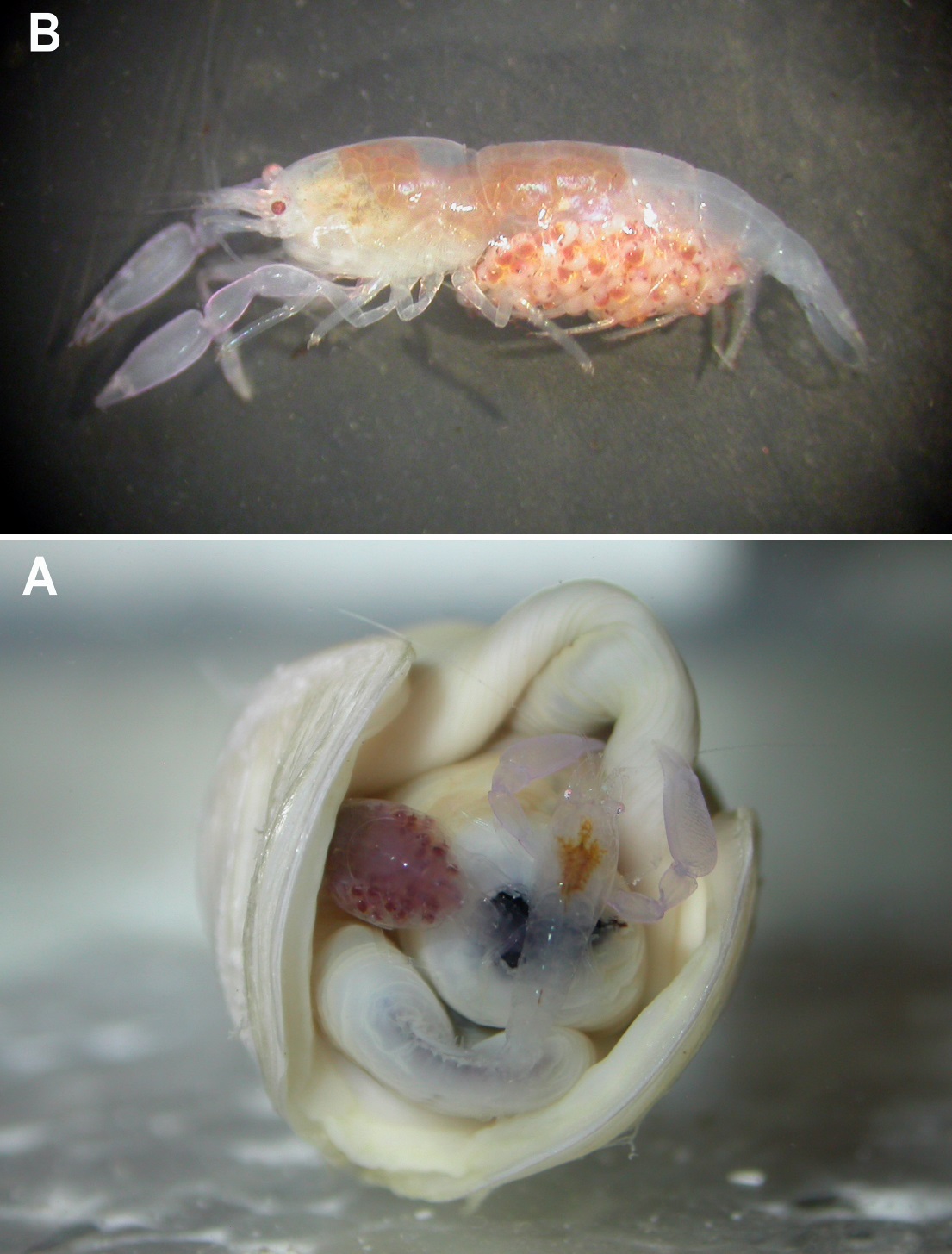
[Crustacea • 2024] Platypontonia ngae • A New symbiotic Shrimp (Decapoda: Palaemonidae) living inside a boring gastrochaenid bivalve mollusk from the Philippines


Platypontonia ngae  Fransen, 2024
ovigerous female holotype & male-female pair in gastrochaenid bivalve

 
Abstract
A new symbiotic palaemonid shrimp Platypontonia ngae sp. nov., is described based on a male-female pair found inside the mantle cavity of a gastrochaenid bivalve mollusk collected on a coral slope on the island Panglao, Philippines. The new species constitutes the third member of the genus Platypontonia Bruce, 1968. The new species is described, figured and compared with its congeners.

Crustacea, Malacostraca, Caridea, Symbiosis, Mollusca, Gastrochaenidae, Philippines


Platypontonia ngae sp. nov.:
A, male-female pair in gastrochaenid bivalve; B, ovigerous female holotype, RMNH.CRUS.D.58061.
Photographs by Stefano Schiaparelli.


Charles H.J.M. Fransen. 2024. Platypontonia ngae sp. nov., A New symbiotic Shrimp (Decapoda: Palaemonidae) living inside a boring gastrochaenid bivalve mollusk from the Philippines.  Zootaxa. 5476(1); 89-98. DOI: 10.11646/zootaxa.5476.1.11

Wednesday, May 15, 2024

[Crustacea • 2024] Palaemon parvibrachium • A New shallow water Species of the palaemonid shrimp Genus Palaemon Weber, 1795 (Decapoda: Caridea) from Japan


Palaemon parvibrachium 
Komai & Hanai, 2024

 
Abstract
During a survey of the shallow water decapod fauna in the Miura Peninsula, Kanagawa Prefecture, central Japan, four specimens of a new palaemonid shrimp, Palaemon parvibrachium n. sp., were collected from sea grass beds of Nanozostera japonica (Ascherson & Graebner) Tomlinson & Posluszny, 2001. The new species appears morphologically similar to P. serrifer (Stimpson, 1860), one of the most common representatives of Palaemon Weber, 1795 in Japanese waters, but the short carpus of the second pereopod and the different live colouration readily differentiate the new species from the latter. A DNA barcode (a partial fragment of the mitochondrial CO1 gene), as well as a partial fragment of the mitochondrial 16S rRNA gene, are provided to genetically characterize the new species.

 16S rRNA, COI, Ena Bay, Palaemon parvibrachium, sea grass beds, Nanozostera japonica, Caridea 


Palaemon parvibrachium n. sp.


Tomoyuki Komai and Motoya Hanai. 2024. A New shallow water Species of the palaemonid shrimp Genus Palaemon Weber, 1795 (Decapoda: Caridea) from Japan. Zootaxa. 5443(3); 417-430. DOI: 10.11646/zootaxa.5443.3.6

Thursday, February 15, 2024

[Crustacea • 2024] Macrobrachium panhai & M. rostrolevatus • Molecular Phylogeny and Taxonomic Position of Macrobrachium lanchesteri (De Man, 1911) (Decapoda: Caridea: Palaemonidae), with Descriptions of Two New Species from Thailand


 C, D Macrobrachium rostrolevatus Chaowvieng & Siriwut, sp. nov. 
from Bueng Khong Long, Bueng Kan, Thailand

E M. panhai Chaowvieng & Siriwut, sp. nov. 
from Sri Nakarin Dam, Tha Kradan, Si Sawat, Kanchanaburi, Thailand.

in Chaowvieng, Sutcharit, Chanabun, Srisonchai, Jeratthitikul et Siriwut, 2024. 
Scale bars: 1 cm.

Abstract
Macrobrachium lanchesteri (De Man, 1911), a translucent freshwater prawn has a wide distribution range throughout mainland Southeast Asia. A high morphological variation and genetic divergence between different geographical M. lanchesteri populations in Thailand have peculiarly extended the uncertainty of species boundaries and blended confusingly with several Macrobrachium species. To clarify these circumstances, broad sample examinations of the morphological variation, including topotype specimens, and phylogenetic reconstruction based on the concatenated mitochondrial dataset (16s rRNA and COI genes) were performed. Broad morphological examination of M. lanchesteri has shown congruency with phylogenetic analyses by revealing prominent lineages of M. lanchesteri sensu stricto and two new sibling lineages with interspecific variation between 6.48–8.76% for COI and 3.06–4.23% for 16S. Descriptions of two new species, named herein as M. panhai Chaowvieng & Siriwut, sp. nov. and M. rostrolevatus Chaowvieng & Siriwut, sp. nov. are provided. Morphological investigation of rostral form suggested plasticity in M. rostrolevatus populations showing the morphological trait associated with their habitat preferences. Furthermore, phylogenetic positions of the three taxa affirmed the hidden diversity of Thai freshwater Macrobrachium fauna correlated with the river network in the Mekong and Chao Phraya basins, Thailand. The genetic data and distribution records obtained in this study may also assist future river conservation plans as well as the sustainable management of freshwater prawn diversity.

Key words: Edible prawns, Lower Mekong Basin, morphological plasticity, new species

Living habit of specimens of three Macrobrachium species
A, B M. lanchesteri from Bang Khiat, Singhanakhon, Songkhla, Thailand
C, D M. rostrolevatus sp. nov. from Bueng Khong Long, Bueng Kan, Thailand
E M. panhai sp. nov. from Sri Nakarin Dam, Tha Kradan, Si Sawat, Kanchanaburi, Thailand.
Scale bars: 1 cm.


 Apisara Chaowvieng, Chirasak Sutcharit, Ratmanee Chanabun, Ruttapon Srisonchai, Ekgachai Jeratthitikul and Warut Siriwut. 2024. Molecular Phylogeny and Taxonomic Position of Macrobrachium lanchesteri (De Man, 1911), with Descriptions of Two  New Species from Thailand (Decapoda, Caridea, Palaemonidae). ZooKeys. 1190: 163-193. DOI: 10.3897/zookeys.1190.113898

Tuesday, November 28, 2023

[Crustacea • 2023] Palaemonella sandyi • A New Species of Palaemonella (Decapoda: Caridea: Palaemonidae) associated with scleractinian Corals of the Genus Euphyllia


Palaemonella sandyi 
Fransen, Van der Veer & Ďuriš, 2023

Photographs by C.H.J.M. Fransen.
  
Abstract
A new species of Palaemonella, P. sandyi sp. nov., is described on the basis of specimens collected in association with euphylliid scleractinian corals, Euphyllia glabrescens and E. cristata. Material was collected from the Maldives, Cebu in the Philippines, Semporna in Malaysia, and from Java, Bali, Sulawesi, Kalimantan, Ternate and Raja Ampat in Indonesia. The new species is similar to P. colemani and P. euphyllius, which are associated with euphylliid corals of the genus Fimbriaphyllia. The new species can be distinguished from P. colemani and P. euphyllius, as well as from the species P. philippinensis and P. smiti, which are both symbionts with plerogyrid scleractinians, on the basis of morphological characters in the rostrum and ambulatory pereiopods, colouration, and molecular data.

Keywords: Crustacea; Decapoda; Caridea; Palaemonidae; Palaemonella; new species; coral symbiont; 
Crustacea; Decapoda; Caridea; Palaemonidae; Palaemonella; nouvelle espèce; symbionte de coraux


Palaemonella sandyi sp. nov.
A, Ovigerous female, pocl. 4.3 mm, RMNH.CRUS.D.53060; B, male, pocl. 2.4 mm, RMNH.CRUS.D.53097.
 Photographs by C.H.J.M. Fransen.

 Palaemonella sandyi 

Palaemonella sandyi sp. nov., on Euphyllia glabrescens (Chamisso & Eysenhardt, 1821).
A, Stn. RAJ.29; B, stn. TER.06, RMNH.CRUS.D.53516;
 C, stn. SEM.28, RMNH.CRUS.D.53830; D, stn. MAL.03, RMNH.CRUS.D.58052;
E, stn. LEM.36, RMNH.CRUS.D.58050; F, LEM.01.
Photographs by C.H.J.M. Fransen.


Charles H. J. M. Fransen, Eva Van der Veer and Zdeněk Ďuriš. 2023. A New Species of Palaemonella (Decapoda, Caridea, Palaemonidae) associated with scleractinian Corals of the Genus Euphyllia Dana. Crustaceana. 345–381. DOI: 10.1163/15685403-bja10289


Monday, April 18, 2022

[Crustacea • 2022] Actinimenes koyas • A New Species of the Genus Actinimenes Ďuriš & Horká, 2017 (Decapoda: Palaemonidae) from the Arabian Sea, Lakshadweep Islands, India


 Actinimenes koyas 
Paramasivam, Dhinakaran, Kumar & Lal, 2022


Abstract
A new species, Actinimenes koyas sp. nov. (Decapoda: Palaemonidae) was collected at a depth of 1.0-2.0 m from the coral atoll of Agatti Island, Lakshadweep, Arabian Sea. The species was associated with the sea anemone, Heteractis magnifica (Quoy and Gaimard, 1833). It is the second representative of the genus Actinimenes Ďuriš and Horká, 2017 described from the Arabian Sea. Actinimenes koyas sp. nov. is closely related to A. ornatellus in terms of morphological traits. Actinimenes koyas sp. nov. is distinguished from Actinimenes ornatellus (Bruce, 1979) by the presence of a biramous outer antennular flagellum with three proximal segments fused, a shorter free ramus consisting of 7 to 8 segments with 12-14 groups of aesthetascs, a fourth thoracic sternite with V-shaped median incision and features of the telson and third maxilliped. The present new species is easily distinguished from the other three described species in the genus Actinimenes by the structural variation in the fourth sternal plate with a median notch. Additionally, a phylogenetic analysis inferred by Maximum Likelihood using the mitochondrial genes COI and 16S rRNA shows a close relationship of Actinimenes koyas sp. nov. with Actinimenes inornatus (Kemp, 1922). Pairwise genetic distances estimated using the COI and 16S data provided divergences between A. koyas sp. nov. and other congeneric species.

Keywords: Actinimenes koyas sp. nov.; anemone associated fauna; Arabian Sea; Lakshadweep; morphology; phylogenetic tree

SYSTEMATICS
Order Decapoda Latreille, 1802
Infraorder Caridea Dana, 1852

Superfamily Palaemonoidea Rafinesque, 1815
Family Palaemonidae Rafinesque, 1815

Genus Actinimenes Ďuriš and Horká, 2017

 Actinimenes koyas sp. nov. from Agatti island, India.
(a) Holotype: ovigerous female (CL 3.5 mm, NBFGR/PALAKOY─01);
(b) paratype, male (CL 3.2 mm, NBFGR: DBTLDA62, Ethanol preserved).

Collection site, assemblages of Heteractis magnifica at Agatti Island, Lakshadweep, India
with live coloration of Actinimenes koyas sp. nov. (Depth 1-2 m).

Actinimenes koyas sp. nov.

Etymology. Koyas are an important ethnic community of Lakshadweep. Koyas have made a significant contribution to the development and preservation of the heritage of the society at Lakshadweep. The present species is named “Koyas” to honor the local community at Lakshadweep.
 
Map showing (a-d) location of Agatti Island, Lakshadweep, India, the type locality of  Actinimenes koyas sp. nov.

CONCLUSION: 
A new symbiotic species from the palaemonid shrimp genus Actinimenes is described and illustrated from Lakshadweep, India. Actinimenes koyas sp. nov. was obtained from the magnificent sea anemone Heteractis magnifica (Actiniaria). Sea anemone-associated species of the genus Actinimenes are widely distributed in the tropical regions of the Indo-West Pacific, and A. koyas sp. nov. is reported for the first time from the Arabian Sea. Additionally, molecular information from mitochondrial markers (COI and 16S) are provided and the ML tree suggests that A. koyas sp. nov. is sister to a clade of A. inornatus.


Purushothaman Paramasivam, A. Dhinakaran, T. T. Ajith Kumar and Kuldeep K. Lal. 2022. A New Species of the Genus Actinimenes Ďuriš and Horká, 2017 (Crustacea: Decapoda: Palaemonidae) from the Arabian Sea, Lakshadweep Islands, India.  Nauplius. 30. DOI: 10.1590/2358-2936e2022008  


Saturday, March 19, 2022

[Crustacea • 2021] Periclimenaeus karantina & P. apomonosi • Two New Species and A Further Country Record of the Caridean Shrimp Genus Periclimenaeus Borradaile, 1915 (Decapoda: Palaemonidae) from Korea


Periclimenaeus karantina sp. nov. and host colonial didemnid ascidian Leptoclinides sp.

Park & De Grave, 2021
Photos: J.H. Park.

Two new species of the palaemonid genus Periclimenaeus are described and illustrated from Korea; additionally, a third species is recorded from Korea for the first time. Periclimenaeus karantina sp. nov. was obtained from ascidian hosts. The species has a denticulate dactylus on both second pereiopods, considered to be typical for ascidian associates. It can be separated from related species by the combination of the following characters: the carpocerite overreaching the anterior margin of the scaphocerite; the distolateral tooth of the scaphocerite exceeding the anterior margin of the lamella; the dactylus of the minor chela exceeding the fixed finger; and the ambulatory dactyli furnished with a minute proximal tooth. Periclimenaeus apomonosi sp. nov. was obtained from sponge hosts, and belongs to the P. robustus species-group, on account of the developed anterior median lobe on the tergite of the first abdominal somite. It can be distinguished from related species by the combination of the presence of a supraorbital tooth; the presence of a pointed process on the inferior orbital angle; the distolateral tooth of the scaphocerite terminating level with the anterior margin of the lamella; the antennal carpocerite reaching about 0.6 of the scaphocerite; the first and second chelae with non-serrated cutting edges; the ischium and merus of the second pereiopods harbouring tubercles on the ventral margin; and the ambulatory dactyli with a distal accessory tooth and the corpus furnished with denticles, ventrally. The sponge associated species, Periclimenaeus djboutensis, relatively widespread across the Indo-Pacific, is reported for the first time from Korea in Geomundo Island. Asides from a morphological description of all three species, molecular information of two genetic markers (16S + COI) is provided to aid in future phylogenetic reconstructions of the genus.

Key words: Caridea, Periclimenaeus spp. nov., Jejudo Island, Korea, Indo-West Pacific.


Periclimenaeus karantina sp. nov. and host colonial didemnid ascidian Leptoclinides sp.
A, paratype, non-ovigerous female, pocl 3.5 mm (NIBRIV0000877272), colour pattern;
B, specimen (either OUMNH.ZC.2018-03-027 or 028) in the atrium of host ascidian from Museom Island;
C, habitat and host ascidian of a pair of P. karantina sp. nov. (NIBRIV0000877282 and 877283) in Seopseom Island.
Photos: J.H. Park.

Periclimenaeus karantina sp. nov. Park and De Grave

Etymology: From the Greek karantina (καραντίνα, quarantine), referring to the lifestyle of the new species within the host ascidian species (Fig. 9B). It also alludes to the quarantine of human society due to the coronavirus pandemic (COVID-19), during which time this paper was written. Used as a noun in apposition.

Host: The shrimp specimens were found inside the common cloacal system of an colonial didemnid ascidian Leptoclinides sp. (Ascidiacea: Aplousobranchia: Didemnidae) (Fig. 9B, C). 

Distribution: Presently only known from the type locality in Jejudo Island, Korea (Fig. 1A, B). 

Remarks: The species is considered to be typical for ascidian associates due to the presence of a denticulate dactylus on the minor second pereiopod. Periclimenaeus karantina sp. nov. appears morphologically close to seven species: P. colemani Bruce, 2014, P. dactylodon Bruce, 2012a, P. devaneyi Bruce, 2010, P. diplosomatis Bruce, 1980, P. kottae Bruce, 2005a, P. myora Bruce, 1998, P. orbitocarinatus Fransen, 2006; and possibly P. zarenkovi Ďuriš, 1990. All these species share the following characters: 1) first abdominal tergite without anterodorsal medial lobe; 2) major and minor second chela with denticulate cutting edges on dactylus; and 3) the dactyli of the ambulatory pereiopods having a proximal ventral tooth, but no distoventral accessory tooth.
...


Periclimenaeus apomonosi sp. nov., paratype, male (pocl 2.6 mm) from Jejudo Island, Korea (NIBRIV0000862975).
A, dorsal view of specimen; B, specimen on dissected host sponge.
Photos: J.H. Park.

 Periclimenaeus apomonosi sp. nov. Park and De Grave

 Etymology : From the Greek apomonosi (απομόνωση, isolation and seclusion), referring to the lifestyle of the new species within the host sponge species. It also alludes to the seclusion of human society due to the coronavirus pandemic (COVID-19), during which time this paper was written. Used as a noun in apposition. 

Host: The specimens were collected from an unidentified sponge (Fig. 15B).

Distribution: Presently only known from the type locality in Jejudo Island, Korea (Fig. 1A, B). 

Remarks: Periclimenaeus apomonosi sp. nov. appears morphologically close to P. hebedactylus Bruce, 1970 and P. nufu Ďuriš, Horká & Hoc, 2009, sharing with those species the presence of a supraorbital tooth or ridge, the non-denticulate cutting edges of the dactyli of the first and second pereiopods, and a distal accessory tooth as well as the corpus with ventral denticles on the ambulatory dactyli. Periclimenaeus tuamotae Bruce, 1969 and P. bidentatus Bruce, 1970 also resemble the species in having a supraorbital tubercle and nontuberculate cutting edges. However, the presence of the anterodorsal medial lobe of the first abdominal tergite is not clear in the type (and only) descriptions (Bruce 1969 1970). 


CONCLUSIONS:
Two new symbiotic species in the palaemonid genus Periclimenaeus are described and illustrated from Korea. Periclimenaeus karantina sp. nov. and P. apomonosi sp. nov. were obtained from ascidian and sponge hosts, respectively. In addition, the sponge associated species, Periclimenaeus djiboutensis, relatively widespread across the Indo-Pacific, is reported for the first time from Korea. Along with a morphological description of all three species, molecular information from two genetic markers (16S + COI) is provided to aid in future phylogenetic reconstructions of the genus.


Jin-Ho Park and Sammy De Grave. 2021. Two New Species and A Further Country Record of the Caridean Shrimp Genus Periclimenaeus Borradaile, 1915 from Korea (Decapoda: Palaemonidae). Zoological Studies. 60; DOI: 10.6620/ZS.2021.60-01
 zoolstud.sinica.edu.tw/Journals/60/60-01.html 

Tuesday, December 14, 2021

[Crustacea • 2021] Odontonia kerangcaris • A New Bivalve-associated Shrimp (Decapoda, Palaemonidae) from East Kalimantan, revealing Intrageneric Host Switching


Odontonia kerangcaris 
 Fransen, Groenhof & de Gier, 2021


Abstract
A new species of bivalve mollusk dwelling palaemonid shrimp of the genus Odontonia is described from the Berau Islands, East Kalimantan, Indonesia. This is the only Odontonia species recorded as a symbiont of a bivalve mollusk, all other congeners are known to associate with solitary ascidians. The new species belongs to the group wherein the dactylus of the ambulatory pereiopods has an accessory tooth. It differs from these species in the absence of a forward directed proximal tooth on the flexor margin of the corpus of the ambulatory dactyli. It also lacks the small denticles posterior to the distoventral accessory tooth on the dactylar corpus.

Keywords: Crustacea, new species, Indonesia, intrageneric host switching


 Charles H.J.M. Fransen, Mike Groenhof and Werner de Gier. 2021. Odontonia kerangcaris sp. nov., A New Bivalve-associated Shrimp (Crustacea, Decapoda, Palaemonidae) from East Kalimantan, revealing Intrageneric Host Switching.  Zootaxa. 5081(2); 275-285. DOI:  10.11646/zootaxa.5081.2.6