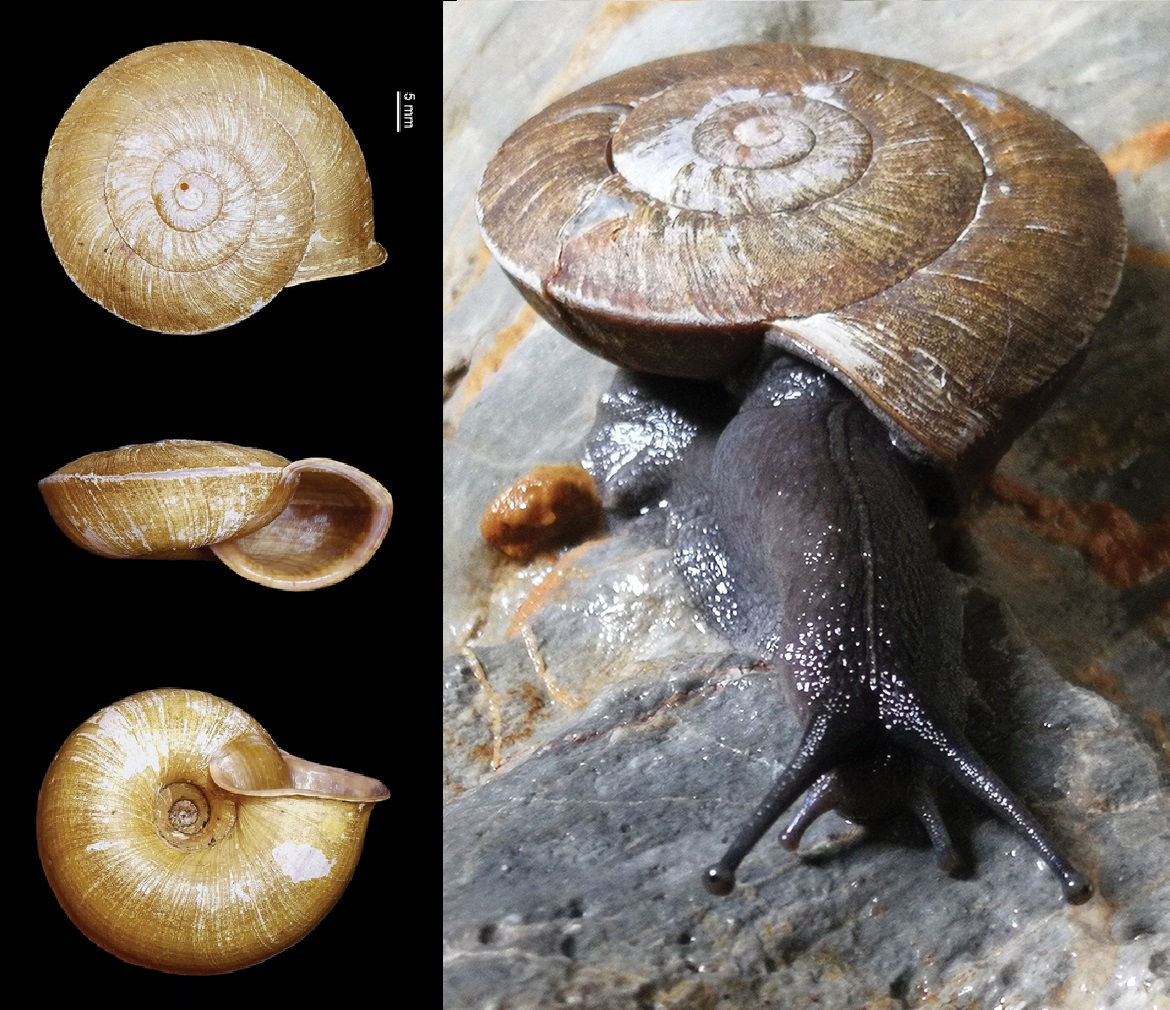
Showing posts with label Camaenidae. Show all posts

Tuesday, August 4, 2026

[Mollusca • 2026] Fansipanica milae, Vinatachea porcellana, ... • New taxa of Camaenidae (Gastropoda: Stylommatophora) from northern Vietnam


Fansipanica milae Páll-Gergely & Dedov,
   
in Páll-Gergely, Gojšina et Dedov, 2026.
 
Abstract
The following new taxa are described from northern Vietnam: Fansipanica milae Páll-Gergely & Dedov, gen et sp. nov., Ducanhia Páll-Gergely, gen. nov. (type species: Helix balansai Morlet, 1886), Vinatachea porcellana Páll-Gergely, sp. nov. The reproductive anatomy of all three species is described. Helix (Chloritis) gereti Bavay & Dautzenberg, 1900 is moved to Fansipanica gen nov., and Camaena delsaerdti Thach & F. Huber, 2018 is moved to Vinatachea.

Key words: Anatomy, Fansipan Mountains, new species, systematics, taxonomy

Fansipanica milae gen. et sp. nov. 
A–C. Living specimen, D. Habitat. 
 
Fansipanica milae Páll-Gergely & Dedov, gen et sp. nov.

Ducanhia Páll-Gergely, gen. nov. 
(type species: Helix balansai Morlet, 1886), 

Vinatachea porcellana Páll-Gergely, sp. nov. 


Barna Páll-Gergely, Vukašin Gojšina and Ivailo Dedov. 2026. New taxa of Camaenidae from northern Vietnam (Gastropoda, Stylommatophora). ZooKeys. 1280: 365-392. DOI: doi.org/10.3897/zookeys.1280.185160 [28 May 2026]

Monday, May 4, 2026

[Mollusca • 2026] Landouria tumpeesuwanorum & L. flagellolonga • Molecular Phylogeny of recognised Thai Landouria Species (Gastropoda: Camaenidae), with Descriptions of Two New Species


Landouria tumpeesuwanorum L. flagellolonga  
 Nahok & K. Tanmuangpak, 

in Nahok, Chanlabut et Tanmuangpak, 2026. 

Abstract
The molecular phylogeny and morphological–anatomical characteristics of the terrestrial snail genus Landouria Godwin-Austen, 1918 from Thailand are investigated, and we describe two new species. Phylogenetic analysis of 11 recognised Thai Landouria species reveal that these species are phylogenetically well separated from each other by mtDNA phylogeny and COI sequence divergences of 0.048–0.192. Landouria tumpeesuwanorum sp. nov. is described from a limestone hill in Nong Bua Lamphu Province, northeastern Thailand; it is characterised by its angulated whorls, a strongly keeled shell, and small flagellum with curved ends. The second new species, Landouria flagellolonga sp. nov. is described from a limestone hill in Sa Kaeo Province, eastern Thailand. It has a conical-lenticular, sharply keeled shell, and a very long, slender flagellum.

Key words: 16S rRNA, Camaenidae, COI, genitalia, integrative systematics, phylogeny, taxonomy, terrestrial snail, Thailand

Systematics
Family Camaenidae Pilsbry, 1895
Subfamily Bradybaeninae Pilsbry, 1934

Tribe Aegistini Kuroda & Habe, 1949

Genus Landouria Godwin-Austen, 1918
 
Living adults of two Landouria new species.
A. Landouria tumpeesuwanorum sp. nov. (paratype: NHLRU027); B. L. flagellolonga sp. nov. (paratype: ZCPRU-0050).

Landouria flagellolonga Nahok & K. Tanmuangpak, sp. nov.

Etymology. Specific epithet derived from Latin word longus, meaning “long” and referring to the elongated flagellum of this species.

Diagnosis. Shell small, light brown-corneous, sharply keeled. Flagellum very long, epiphallus long and slender; penis long, cylindrical, dilated at its middle part; vagina and free oviduct short. Radula with lanceolate central and lateral teeth.


Landouria tumpeesuwanorum Nahok & K. Tanmuangpak, sp. nov.

Diagnosis. Shell large, brownish-corneous, angulated whorls, strongly keeled. Flagellum small with blunt ends; epiphallus cylindrical and abruptly tapering at its distal part; penis swollen at its basal; vagina large and bulged. Radula with triangular central and lateral teeth.

Etymology. In honour of Assoc. Prof. Chanidaporn Tumpeesuwan and Sakboworn Tumpeesuwan, Thai malacologists and our beloved advisor and co-advisor, respectively, who initiated the taxonomic study of Landouria in Thailand and whose inspiration has led to our study of molluscs.


 Benchawan Nahok, Utain Chanlabut and Kitti Tanmuangpak. 2026. Molecular Phylogeny of recognised Thai Landouria Species (Gastropoda, Camaenidae), with Descriptions of Two New Species. ZooKeys. 1278: 181-200. DOI: doi.org/10.3897/zookeys.1278.172545 [28 Apr 2026]

Tuesday, October 14, 2025

[Mollusca • 2025] Pseudobuliminus beijingensisPolyphyly in A Morphologically defined Genus: Phylogeny and Morphology of Pseudobuliminus (Eupulmonata: Camaenidae) from eastern and northern China, with A Checklist of Species from mainland China


Pseudobuliminus beijingensis  X.-X. Wang,

in Zhang & Wang, 2025  
 
ABSTRACT  
Pseudobuliminus (Eupulmonata: Camaenidae) has traditionally been delimited to exclusively contain species with conoidal shells, but questions regarding its monophyly have remained. Extensive morphometric analyses conducted on almost all Pseudobuliminus species from China indicate that possessing a conoidal shell alone is not a sufficient character to establish genus membership. It was previously shown that Pseudobuliminus species from Shandong Province lack a dart sac and possess a flagellum. We found the same reproductive characteristics in additional species from eastern and northern China, such as P. buliminoides from Nanjing, Jiangsu Province, and Pseudobuliminus beijingensis n. sp., described herein from Fangshan, Beijing Province. In contrast, species from western China differ from this configuration by having a dart sac but lacking a flagellum. Based on partial sequences of the mitochondrial 16S rRNA and the nuclear spacer ITS2, our molecular phylogeny demonstrates that the species from eastern and northern China form a clade. We conclude that the combination of lack of a dart sac and presence of a flagellum is a morphological synapomorphy shared by the members of this taxonomic lineage.  
 
KEYWORDS: Beijing, Bradybaeninae, cladistics, Yanshan Mountains, synapomorphy


Shells of Pseudobuliminus beijingensis n. sp. type specimens.
A  Aperture, umbilicus and apex views of holotype. B Aperture, umbilicus and apex views of paratype SDNU.Gas.0397.01.02. C View of protoconch, smooth.
  
  Photographs of live specimens of Pseudobuliminus beijingensis n. sp. and its habitat.
A The mountain habitat where the species is found. B–C Living individuals on the tree. D The mating. E The probable host.

Pseudobuliminus beijingensis n. sp.

Distribution: Only known from the type locality, Bejing.

Etymology: The name is after Beijing, capital of the P.R. China.

Remarks: This species resembles Pseudobuliminus piligerus, P. buliminus buliminus and P. conoidius from western China. P. piligerusP. buliminus and P. beijingensis n. sp. do not cluster together in molecular phylogeny, highlighting the homoplasy in shell shapes.


Guoyi Zhang and Xing-Xiao Wang. 2025. Polyphyly in A Morphologically defined Genus: Phylogeny and Morphology of Pseudobuliminus (Eupulmonata: Camaenidae) from eastern and northern China, with A Checklist of Species from mainland China. Molluscan Research. DOI: doi.org/10.1080/13235818.2025.2494894  [14 May 2025]
https://x.com/uiharunagaame/status/1922958536134287619


Tuesday, November 5, 2024

[Mollusca • 2024] Landouria bella & L. monodon • Two New Species of Landouria Godwin-Austen, 1918 (Gastropoda: Camaenidae) from Thailand, with A Key to Thai Species


Landouria bella
Nahok, Chanlabut, S. Tumpeesuwan & C. Tumpeesuwan, 2024 

 
Abstract
The present work contains descriptions of two new species of Landouria and a key to Thai species of this genus. Landouria bella sp. nov. is described from isolated limestone hills in Ratchaburi and Phetchaburi provinces, western Thailand. This new species is characterized by its small depressed-globose shell without a peripheral keel, the presence of a small, thin lamella on the columellar side of the inner aperture, a long, cylindrical distally bent flagellum, a short penis with a rounded verge, and a short, thick free oviduct and vagina. The second new species, Landouria monodon sp. nov. is described from sandstone hills in Kalasin Province, northeastern Thailand. This species has a depressed-conic shell with a blunt peripheral keel, a thick prominent lamella on the columellar side of the inner aperture, a short, finger-shaped, distally bent flagellum, and a long penis with a small, short verge.
 
Key words: Aegistini, Bradybaeninae, radula, reproductive anatomy, shell morphology

Landouria bella sp. nov. A holotype (NHMSU-00056) B paratype (ZCPRU-0042) C, D empty shell from Khao Nang Panthurat Forest Park, Phetchaburi Province (NHMSU-00058).


Benchawan Nahok, Utain Chanlabut, Sakboworn Tumpeesuwan and Chanidaporn Tumpeesuwan. 2024. Two New Species of Landouria Godwin-Austen, 1918 (Gastropoda, Camaenidae) from Thailand, with A Key to Thai Species. ZooKeys. 1208: 347-362. DOI: doi.org/10.3897/zookeys.1208.117056

Thursday, June 6, 2024

[Mollusca • 2023] Laeocathaica, qiminglii, L. qingchuanensis, L. qishilii, ... • Land Snail Diversity in central China: Revision of Laeocathaica Möllendorff, 1899 (Gastropoda: Camaenidae), with Descriptions of Seven New Species


A, B Laeocathaica qishilii Wu, sp. nov., border of Jiuzhaigou County and Wen County 
L. nordsiecki Wu, sp. nov., Guoyuanxiang, Jiuzhaigou 
L. qiminglii Wu, sp. nov., an indoor photograph
L. qingchuanensis Wu, sp. nov., Dagou Nature Reserve, Qingchuan County F L. cheni Wu, sp. nov., Hengdan, Wenxian.
in Wu, Shen et Chen, 2023.

Abstract
Central China harbors the native dart-sac-bearing camaenids Laeocathaica. The genus is revised and seven new species are proposed based on museum material and newly collected specimens. This work confirmed that most Laeocathaica species have restricted habitats. The comparison of the dart sac apparatus among the dart-sac-bearing camaenid genera indicated the importance of the presence of the proximal accessory sac that might be analogous to the membranous/muscular sac surrounding the proximal dart sac and/or the distal region of the vagina near the atrium, which also plays a significant role in the diagnosis of Laeocathaica species based on its number, symmetry and position on the dart sac. Species with similar shell morphology were studied using geometric morphometric methods to detect variations in shell shape. A molecular phylogenetic analysis based on 16S and ITS2 sequence data of partial Laeocathaica species and many other dart-sac-bearing taxa suggested that Laeocathaica might be monophyletic. Furthermore, the present phylogeny indicated that Stilpnodiscus, Cathaica, Bradybaena, and Pseudobuliminus might be polyphyletic and therefore the taxonomy of dart-sac-bearing camaenids in this region requires a thorough revision. This work reconfirms that the Southern Gansu Plateau is important as a hotspot for malacodiversity conservation on the Chinese mainland.

Keywords: Anatomy, Central China, Helicoidea, molecular phylogeny, morphology, taxonomy


Habitats (excluding D)
A, B Laeocathaica qishilii Wu, sp. nov., border of Jiuzhaigou County and Wen County 
L. nordsiecki Wu, sp. nov., Guoyuanxiang, Jiuzhaigou D L. qiminglii Wu, sp. nov., an indoor photograph
L. qingchuanensis Wu, sp. nov., Dagou Nature Reserve, Qingchuan County F L. cheni Wu, sp. nov., Hengdan, Wenxian.


Min Wu, Wang Shen and Zhong-Guang Chen. 2023. Land Snail Diversity in central China: Revision of Laeocathaica Möllendorff, 1899 (Gastropoda, Camaenidae), with Descriptions of Seven New Species. ZooKeys. 1154: 49-147.  DOI: 10.3897/zookeys.1154.86237

Sunday, May 26, 2024

[Mollusca • 2024] Moellendorffia gulinensis, M. wuchaoi, & Moellendorffiella yifengi • New Species of Moellendorffia Ancey, 1887 and Moellendorffiella Pilsbry, 1905 (Gastropoda: Eupulmonata: Camaenidae) from China


A, B, Moellendorffia gulinensis sp. nov., living holotype and its type locality, Zhicaogou, Gulin, Sichuan.
 C, D, M. wuchaoi sp. nov., living snail from Jianfengling, Hainan (D was photographed under ultraviolet light to show the snail’s bristles).

 Moellendorffiella erdmanni and habitat at Wulong, Chongqing;
type locality of Moellendorffiella yifengi sp. nov., Kaihua, Wenshan, Yunnan.

 Lin & Qiu, 2024. Journal of Conchology. 45(1)
Photos by Lu Qiu, Chao Wu, Chen-Yu Fei and Yi-Feng Liu

Abstract
Two new species of Moellendorffia Ancey, 1887 and one new species of Moellendorffiella Pilsbry, 1905 are described from China, namely Moellendorffia gulinensis sp. nov. from southeastern Sichuan Province, Moellendorffia wuchaoi sp. nov. from eastern Hainan Island, and Moellendorffiella yifengi sp. nov. from southeastern Yunnan Province. Shell characters and habitats are illustrated, and a distribution map of the new species is provided. Moellendorffia trisinuata trisinuata and Moellendorffiella erdmanni are re-examined and illustrated using newly collected specimens. The generic diagnosis of Moellendorffiella is supplemented.

 Key words. China, taxonomy, new species, systematics, snail

 Protoconch and apertural characters.
A, B, Moellendorffia gulinensis sp. nov., holotype MYNU-00034.
C, D, Moellendorffia wuchaoi sp. nov., holotype MYNU-00038.
E, F, Moellendorffiella yifengi sp. nov., holotype MYNU-00036.
Red dot: prominent nodule, green dot: columellar lamella, yellow dot: palatal lamella. Not to scale.

 Living snails and habitat of Moellendorffia species.
A, B, M. gulinensis sp. nov., living holotype and its type locality, Zhicaogou, Gulin, Sichuan. 
C, D, M. wuchaoi sp. nov., living snail from Jianfengling, Hainan (D was photographed under ultraviolet light to show the snail’s bristles).
Photo credit: Lu Qiu (A, B) and Chao Wu (C, D).

  Living snail and habitats of Moellendorffiella species.
A, B, Mo. erdmanni and habitat at Wulong, Chongqing. C, type locality of Mo. yifengi sp. nov., Kaihua, Wenshan, Yunnan.
Photo credit: Chen-Yu Fei (A, B) and Yi-Feng Liu (C).

 
Ran-Xi Lin and Lu Qiu. 2024. New Species of Moellendorffia Ancey, 1887 and Moellendorffiella Pilsbry, 1905 from China (Gastropoda: Eupulmonata: Camaenidae). Journal of Conchology. 45(1)

Tuesday, May 21, 2024

[Mollusca • 2024] Sinocamaena cheni • New camaenid Genus and Species (Eupulmonata: Helicoidea) from Zhejiang, East China


Sinocamaena cheni Wu, 

in Wu, Chen et Shen, 2024.
陈氏中华坚螺  ||  DOI: 10.3897/zookeys.1202.118964
 
Abstract
We report a new land snail species representing a new genus from the mountainous area of Zhejiang, China. The snail has a depressed shell with granules all over the surface. The soft part of the new taxon is characterized by the presence of a mantle lobe whose form is reviewed herein across a wide range of helicoid snails, the presence of a developed epiphallic papilla, and the absence of a penial sheath, a dart sac apparatus and a flagellum. As indicated by a molecular-based phylogeny (16S + ITS2), the new taxon is deeply nested in the eastern Asian camaenid genera and shows a close relationship with the camaenids distributed in Central China.

Key words: Anatomy, Camaenidae, mantle lobe, molecular phylogenetics, new genus, new species, taxonomy

Sinocamaena cheni Wu, gen. et sp. nov.
 A holotype, HBUMM08381-spec. 1 B paratype, HBUMM08382-spec. 1, reared to maturity in laboratory
C, D HBUMM08381, holotype C shell apex D shell surface. Upper scale for A, B; lower scale for C, D.


Helicoidea Rafinesque, 1815
Camaenidae Pilsbry, 1895

 Sinocamaena Wu, gen. nov.
 Chinese name: 中华坚螺属.

Diagnosis: Shell depressed. Protoconch and teleoconch granulate. Protoconch strongly sculptured. Peristome expanded. Head wart low and tiny. Between the ommatophore insertions, a gland pore present. A mantle lobe present. Penial sheath absent. Epiphallus very short. Epiphallic papilla well developed. Flagellum absent.

Etymology: This new genus is named after “sino” (= China) and “camaena” which is a camaenid genus that includes many large-sized helicoid species.

Sinocamaena cheni Wu, gen. et sp. nov., paratype, HBUMM08382-spec. 1, a specimen reared to maturity in laboratory.

 Sinocamaena cheni Wu, gen. et, sp. nov.
 Chinese name: 陈氏中华坚螺.

Etymology: This new species is named in memory of Professor Chen De-Niu [陈德牛 Nov 1939 – March 2024], a known malacologist working on Chinese land molluscs. Prof. Chen was one of the doctoral supervisors for Wu M.

Distribution: Zhejiang (only from type localities: Yunhe, Longquan).


Min Wu, Tian Chen and Wang Shen. 2024. New camaenid Genus and Species from Zhejiang, East China (Eupulmonata, Helicoidea). ZooKeys. 1202: 135-154. DOI: 10.3897/zookeys.1202.118964

Monday, April 22, 2024

[Mollusca • 2024] Figuladra finlaysoni, F. robertirwini, F. bromileyorum & F. vidulus • Systematic Revision of the eastern Queensland Land Snail Genus Figuladra Köhler & Bouchet, 2020 (Eupulmonata,: Camaenidae) based on mitochondrial phylogenetics and comparative morpho-anatomy


Figuladra robertirwini sp. nov.F. vidulus sp. nov., etc.
L. Stanisic, J. Stanisic &  Köhler, 2024


ABSTRACT
The current study revises the systematic taxonomy of Figuladra, a genus of camaenid land snails endemic to eastern Queensland, based on the investigation of many recently collected ethanol-preserved samples as well as historic museum material, including types. We employed comparative analyses to investigate the variation in morphological features (shell, penial anatomy) and performed phylogenetic analyses of mitochondrial 16S rDNA sequences to test species hypotheses. Phylogenetic analyses recovered three principal mitochondrial clades, one occurring in mid-east Queensland, one in south-east Queensland, and another in the upland areas of south-east Queensland. We recognise altogether 15 accepted species, including four that are newly described herein (i.e., Figuladra finlaysoni sp. nov., F. robertirwini sp. nov., F. bromileyorum sp. nov. and F. vidulus sp. nov.). The status of 11 previously described species has been assessed and revised diagnoses are provided for each of these. Species of the south-east Queensland clade revealed comparatively low levels of genetic and morphological differentiation and may represent examples of more recent, conceivably ongoing, speciation. Figuladra species have allopatric distributions with their ranges being separated by altitudinal or riverine barriers. Particularly the St Lawrence Gap dry corridor has been identified as a major biogeographic barrier separating two principal clades of Figuladra.

KEYWORDS: Biogeography, gastropoda, new species, phylogeny, systematics, taxonomy


Lorelle Stanisic, John Stanisic and Frank Köhler. 2024. Systematic Revision of the eastern Queensland Land Snail Genus Figuladra Köhler and Bouchet, 2020 based on mitochondrial phylogenetics and comparative morpho-anatomy (Eupulmonata, Camaenidae). Molluscan Research. 44(2); 160-208. DOI: 10.1080/13235818.2024.2321650  


Tuesday, January 23, 2024

[Mollusca • 2021] Landouria circinata, L. elegans, L. trochomorphoides, etc. • Five New Species of the Land Snail Genus Landouria Godwin-Austen, 1918 (Gastropoda: Camaenidae) from northeastern Thailand, with Note on Genitalia and Radula Morphology of Landouria diplogramma


A. Landouria circinata sp. nov. B. L. tuberculata sp. nov. C. L. trochomorphoides sp. nov. D. L. chloritoides sp. nov. E. L. elegans sp. nov. 
Nahok, S. Tumpeesuwan & C. Tumpeesuwan, 2021

F. L. diplogramma (Möllendorff, 1902) comb. nov.


ABSTRACT
Five new species of the terrestrial snail genus Landouria Godwin-Austen, 1918 (Camaenidae) are described from northeastern Thailand, based on shell features, radular morphology, genital anatomy, and DNA sequence data: Landouria circinata sp. nov., L. tuberculata sp. nov., L. trochomorphoides sp. nov., L. chloritoides sp. nov., and L. elegans sp. nov. These species are phylogenetically well separated from each other by mtDNA phylogeny and COI sequence divergences of 0.073–0.156. The record of Thaitropis Schileyko, 2004 (currently synonymized with Landouria) in Thailand is re-interpreted as referring to L. diplogramma (Möllendorff, 1902) comb. nov.

Keywords: Camaenidae, Landouria, Thailand, systematics, phylogeny

External shell morphology of Landouria spp. from northeastern Thailand.
A. Landouria circinata sp. nov., holotype (NHMSU-00023). B. L. tuberculata sp. nov., holotype (NHMSU-00025). C. L. trochomorphoides sp. nov., holotype (NHMSU-00027). D. L. chloritoides sp. nov., holotype (NHMSU-00029). E. L. elegans sp. nov., holotype (NHMSU-00032). F. L. diplogramma (Möllendorff, 1902) comb. nov. (NHMSU-00034).
Scale bar = 10 mm.

Living adults of Landouria spp. from northeastern Thailand.
 A. Landouria circinata sp. nov. B. L. tuberculata sp. nov. C. L. trochomorphoides sp. nov. D. L. chloritoides sp. nov. E. L. elegans sp. nov. F. L. diplogramma (Möllendorff, 1902) comb. nov.
 Scale bars = 10 mm.


Benchawan Nahok, Sakboworn Tumpeesuwan and Chanidaporn Tumpeesuwan. 2021. Five New Species of the Land Snail Genus Landouria Godwin-Austen, 1918 (Gastropoda, Camaenidae) from northeastern Thailand, with Note on Genitalia and Radula Morphology of Landouria diplogramma (Möllendorff, 1902). European Journal of Taxonomy. 767(1); 142–166. DOI: 10.5852/ejt.2021.767.1495