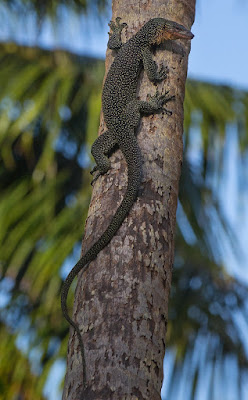
Showing posts with label Varanidae. Show all posts

Saturday, February 14, 2026

[Herpetology • 2026] Varanus iridis, V. umbra & V. phosphoros • Three New Species reveal an unrecognized Clade of Rock Monitors (Varanidae: Varanus) from the eastern Australian Savannas


Varanus iridisVaranus umbra & Varanus phosphoros 

Zozaya, Read, Macor, Pavón-Vázquez, Gale, Wright & Broady, 2026 

Abstract
Monitor lizards (Varanus) are among the most iconic reptiles in the world and reach peak diversity in Australia, yet species diversity on the continent remains incompletely documented. We describe three new species of small-bodied, rock-adapted Varanus from north-eastern Australia (Varanus phosphoros sp. nov., Varanus iridis sp. nov., and Varanus umbra sp. nov.) that form a previously unrecognized and deeply divergent (∼7 Mya) clade within the subgenus Odatria. Despite their distinctive coloration, occurrence near major towns, and informal recognition of one species, these lineages have remained undescribed until now. Through targeted fieldwork, we collected voucher specimens to generate genomic and morphological data clarifying evolutionary relationships. We applied a reference-based framework for species delimitation, using sympatric species with evidence of reproductive isolation to calibrate thresholds of genetic divergence and inform taxonomic decisions. All three taxa are strongly supported as evolutionarily independent lineages based on genetic divergence, sympatry with congeners, and morphological differentiation. These are the first scansorial, rock-adapted Varanus described from east of the Carpentarian Gap (a major biogeographical barrier) and add to a growing list of endemic reptiles from the eastern savannas of Australia. Our findings underscore the value of rocky habitats in generating endemic diversity and highlight the utility of calibrated genetic benchmarks in species delimitation.

Odatria, Queensland, species delimitation, Varanus iridis, Varanus umbra, Varanus phosphoros


Photographs in life of Varanus iridis (A, B), Varanus umbra (C, D), Varanus phosphoros (E, F), and Varanus orientalis (G, H). 
 A, paratype QM J99219 from Talaroo Station; B, unvouchered individual from Talaroo Station (tissue sample JNW4);
C, paratype QM J99224 from Gilberton Station; D, unvouchered individual from Gilberton Station;
E, paratype QM J99227 from Isabella Falls; F, unvouchered individual from Mount Molloy;
G, unvouchered individual from Gilberton Station (tissue sample JNW6); and H, unvouchered individual from Magnetic Island.
Photographs: A–B, D, W. Read; C, E, S. Zozaya; F, J. Meney; G, J. Wright; and H, B. Schembri.
 
Varanus phosphoros sp. nov. 
Varanus iridis sp. nov. 
Varanus umbra sp. nov.


Stephen M Zozaya, Wesley J Read, Scott A Macor, Carlos J Pavón-Vázquez, Nicholas P Gale, Justin M Wright and Elizabeth S Broady. 2026. Three New Species reveal an unrecognized Clade of Rock Monitors (Varanidae: Varanus) from the eastern Australian savannas. Zoological Journal of the Linnean Society, 206(2); zlaf192. DOI: doi.org/10.1093/zoolinnean/zlaf192 [12 February 2026]


Tuesday, March 4, 2025

[Herpetology • 2023] Varanus varius • Using Crowdsourced Photographic Records to explore Geographical Variation in Colour Polymorphism


Colour pattern variation in the Lace monitor Varanus varius 

in Farquhar, Pili et Russell, 2023.  

Abstract
Aim: In wide-ranging taxa occupying broad climate gradients, alternative colour pattern variants (i.e. morphs) may emerge as an adaptive response to local climatic regimes. We explore the patterns of geographical segregation among colour morphs of the Lace monitor and determine whether morphs occupy divergent climatic niches along a mesic–arid gradient.

Location: Eastern and south-eastern Australia.
Taxon: Varanus varius.

Methods: We compiled a dataset of crowdsourced, georeferenced photographic records (n = 1637) of V. varius and scored each photographed lizard as one of two discrete colour pattern phenotypes—Lace morph (mostly dark with fine pale patterning) or Bell's morph (broad yellow and black bands). We then analysed the geographical segregation of colour morphs under an exploratory point-pattern process analysis framework. Finally, we quantified similarities and differences between each colour morphs' realised climatic niche in univariate and multivariate (i.e. Centroid shift, Overlap, Unfilling, and Expansion and n-dimensional hypervolume frameworks) environmental space.

Results: While both morphs co-occur over much of the species' range, there is a coastal–inland clinal transition in the relative densities of the morphs' occurrences—the Bell's morph becomes the more prevalent phenotype towards inland locations and is rare or absent towards coastal regions. Analysis of the realised climatic niches shows that the Bell's morph exploits areas that are relatively more arid, receive more solar irradiation and experience a broader range of thermal extremes than those occupied by the Lace morph.

Main conclusions: 
The mesic–arid transition zone in eastern Australia is a primary axis of environmental variation over which geographical variation in colour polymorphism has emerged in V. varius. More broadly, this study demonstrates how photographs from citizen science platforms can be used to explore geographical variation in colour polymorphisms without needing to conduct expensive, time-consuming field studies on wild organisms.

Keywords: climatic niche divergence, colour pattern polymorphism, COUE, iNaturalist, Lace monitor, mesic-arid gradient, n-dimensional hypervolume, point-pattern process, varanid, Varanus varius


Colour pattern variation in the Lace monitor Varanus varius showing the two discrete, heritable morphs:
(a) Lace morph individual observed near Sydney, New South Wales; (b) Bell's morph individual observed in Glenmorgan, Queensland; (c) males of each morph engaged in combat observed at Woodgate, Queensland.
Photographs by (a) Ken Griffiths, (b) Peter feats and (c) Steve Wilson.


 Jules E. Farquhar, Arman Pili and Wyn Russell. 2023. Using Crowdsourced Photographic Records to explore Geographical Variation in Colour Polymorphism. Journal of Biogeography. 50(8); 1409-1421. DOI: doi.org/10.1111/jbi.14500  [5 October 2022] 


Wednesday, January 10, 2024

[Paleontology • 2024] Varanosuchus sakonnakhonensis • New Cretaceous neosuchians (Crocodylomorpha) from Thailand bridge the evolutionary history of atoposaurids and paralligatorids


Varanosuchus sakonnakhonensis 
Pochat-Cottilloux, Lauprasert, Chanthasit, Manitkoon, Adrien, Lachambre, Amiot & Martin, 2024

วาราโนซูคัส สกลนครเอนซิส  || DOI: 10.1093/zoolinnean/zlad195


Abstract
The origin of modern crocodylians is rooted in the Cretaceous, but their evolutionary history is obscure because the relationships of outgroups and transitional forms are poorly resolved. Here, we describe a new formVaranosuchus sakonnakhonensis gen. nov., sp. nov., from the Early Cretaceous of Thailand that fills an evolutionary gap between Paralligatoridae and Atoposauridae, two derived neosuchian lineages with previously unsettled phylogenetic relationships. Three individuals, including a complete skull and associated postcranial remains, allow for a detailed description and phylogenetic analysis. The new taxon is distinguished from all other crocodylomorphs by an association of features, including a narrow altirostral morphology, a dorsal part of the postorbital with an anterolaterally facing edge, a depression on the posterolateral surface of the maxilla, and fully pterygoid-bound choanae. A phylogenetic analysis confirms the monophyly and taxonomic content of Atoposauridae and Paralligatoridae, and we underline the difficulty in reaching a robust definition of Eusuchia. Furthermore, we put forward further arguments related to the putative terrestrial ecology with semi-aquatic affinities of atoposaurids based on their altirostral snout morphology and osteoderm ornamentation.

Atoposauridae, CT scan, Neosuchia, Phu Sung, Sao Khua, Thailand

Varanosuchus sakonnakhonensis gen. nov., sp. nov.


Yohan Pochat-Cottilloux, Komsorn Lauprasert, Phornphen Chanthasit, Sita Manitkoon, Jérôme Adrien, Joël Lachambre, Romain Amiot and Jeremy E Martin. 2024. New Cretaceous neosuchians (Crocodylomorpha) from Thailand bridge the evolutionary history of atoposaurids and paralligatorids. Zoological Journal of the Linnean Society. zlad195. DOI: 10.1093/zoolinnean/zlad195

วาราโนซูคัส สกลนครเอนซิส  🐊🐊
จระเข้ทรงเหี้ย จระเข้ดึกดำบรรพ์ชนิดใหม่ชนิดที่ 12 ของประเทศไทย  
 จากหมวดหินเสาขัว ต้นยุคครีเทเชียส จ.สกลนคร 


Tuesday, August 8, 2023

[Herpetology • 2023] Varanus louisiadensis & V. tanimbar • Two New Species of Monitor Lizards (Squamata: Varanidae) endemic to the Louisiade and Tanimbar Archipelagos with A Key to the Subgenus Euprepiosaurus


[Juvenile & Adult] Varanus tanimbar
Weijola & Kraus, 2023

(photos by Valter Weijola, Richard How).

ABSTRACT
We describe two new species of Varanus, one each endemic to the Louisiade and Tanimbar Archipelagos in Papua New Guinea and Indonesia, respectively. The new species belong to the subgenus Euprepiosaurus and, therein, to the widely distributed and relatively species-rich Varanus indicus group. They can be distinguished from all other recognised species by scalation, colour-pattern and genetic differences. The new species from Tanimbar is most closely related to V. indicus and V. melinus, from which it can be distinguished by its dark blue/grey tongue and higher middorsal and midventral scale counts. The new species from the Louisiades can be distinguished from its phylogenetically and geographically nearest relative, V. chlorostigma, by the presence of dorsal crossbands, the mostly pink tongue mottled with grey, and higher midbody scale count. The Louisiades constitute the easternmost archipelago of Milne Bay Province in eastern Papua New Guinea, and they host a diverse herpetofauna with a high degree of endemism; Varanus louisiadensis sp. nov. increases the known number of herpetofaunal endemics in that archipelago to 60. The Tanimbar Islands are situated in the southern part of Maluku Province (Moluccas), Indonesia, and are a minor centre of vertebrate endemism; Varanus tanimbar sp. nov. increases the number of known herpetofaunal endemics there to six.
 
KEYWORDS: Melanesia, Wallacea, endemic, reptile, lizard, taxonomy

 The holotype (ZMUT Sa197) of Varanus louisiadensis sp. nov. on Misima Island (photo Valter Weijola).

Varanus louisiadensis sp. nov.

Diagnosis: Varanus louisiadensis sp. nov. is a member of the subgenus Euprepiosaurus, which is defined by having the unique combination of an asymmetric sperm groove on the hemipenis and a laterally compressed tail (Ziegler et al. Citation2007). Molecular phylogenetic analyses place it within the V. indicus species group defined by the unilateral paryphasmata ornamentation of the hemipenis and lack of blue pigmentation on the tail (Ziegler et al. Citation2007; Weijola et al. Citation2019). It can be distinguished from all other species of Euprepiosaurus by its unique combination of: (1) dorsum black with more-or-less well-defined crossbands composed of yellow ocelli and/or dots, better defined in juveniles and subadults than adults; (2) tail black with distinct yellow bands, better defined in juveniles and subadults than adults; (3) tongue tines and a variable section of the mid-dorsal tongue surface dark grey, the remainder being pink; (4) pink-orange pigmentation usually present on cheeks and sides of neck; (5) venter pale yellow; (6) mid-body scale rows (S) 142–163; (7) mid-dorsal scale rows (XY) 139–169; (8) ventral scale rows (T) 101–113; (9) scales around neck (m) 101–118.

Etymology: The specific epithet refers to the Louisiade Archipelago of Milne Bay Province, Papua New Guinea, where this species is endemic.


  Juvenile Varanus tanimbar sp. nov. caught by local hunters at Saumlaki, Yamdena (photo Valter Weijola).
Adult V. tanimbar sp. nov. (WAM 109896) Lorulun, Yamdena Island (photo Richard How).

Varanus tanimbar sp. nov.

Diagnosis: Varanus tanimbar sp. nov. is a member of the subgenus Euprepiosaurus, which is defined by having the unique combination of an asymmetric sperm groove and laterally compressed tail (Ziegler et al. Citation2007). Molecular phylogenetic analyses place it within the V. indicus species group defined by the unilateral paryphasmata ornamentation of the hemipenis and lack of blue pigmentation on the tail (Ziegler et al. Citation2007; Weijola et al. Citation2019). It can be distinguished from all other species of Euprepiosaurus by its unique combination of: (1) dorsum black with more or less well-defined crossbands composed of lemon-yellow ocelli and/or dots; (2) tail black with distinct yellow bands; (3) dorsal aspect of tongue blue-grey; (4) temporal region typically ornamented with a dark temporal band and a lemon-yellow postocular stripe; (5) venter pale yellow; (6) mid-body scale rows (S) 145–161; (7) mid-dorsal scale rows (XY) 159–170; (8) ventral scale rows (T) 107–109; (9) scales around neck (m) 109–119.

Etymology: The specific epithet tanimbar is a noun in apposition and refers to the Tanimbar Archipelago of Maluku, Indonesia, to which this species is endemic.

 
Valter Weijola and Fred Kraus. 2023. Two New Species of Monitor Lizards (Squamata: Varanus) endemic to the Louisiade and Tanimbar Archipelagos with A Key to the Subgenus EuprepiosaurusJournal of Natural History. 57(13-16);  947-975. DOI: 10.1080/00222933.2023.2218574   

Wednesday, May 18, 2022

[Herpetology • 2022] Varanus citrinus Between A Rock and A Dry Place: Phylogenomics, Biogeography, and Systematics of Ridge-tailed Monitors (Varanidae: Varanus acanthurus complex)


 Varanus citrinus
Pavón-Vázquez, Esquerré, Fitch, Maryan, Doughty, Donnellan & Scott Keogh, 2022

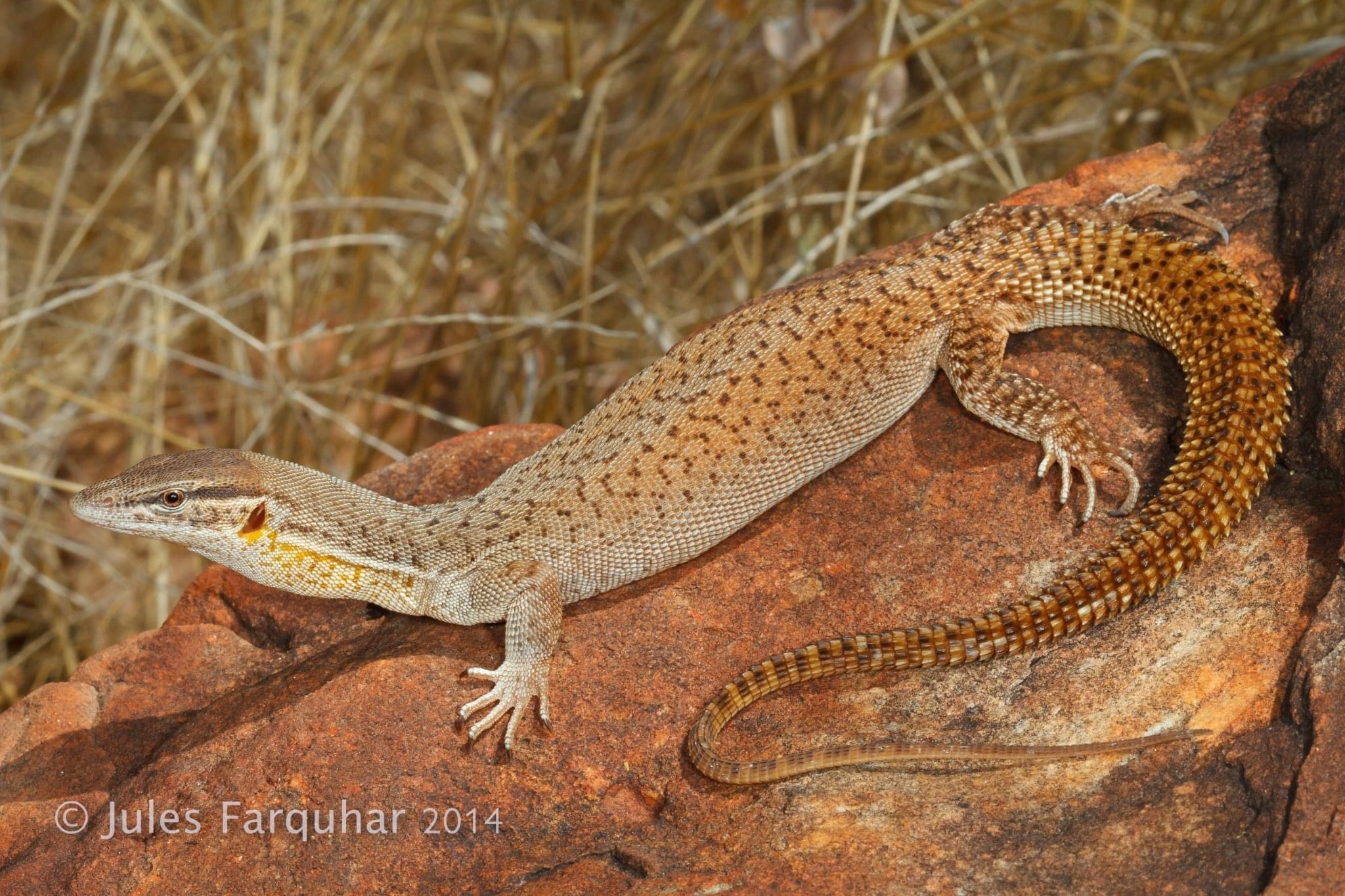
photo by Jules E. Farquhar.  twitter.com/FarquharJules

 Highlights
• We used single nucleotide polymorphisms mitochondrial sequences, and morphological data to infer the evolutionary history of ridge-tailed monitor lizards.
• We identified nine populations which we propose belong to four species.
• The geographic distribution of the populations and admixture patterns reflect the aridification of Australia and highlight the importance of rocky escarpments as mesic refugia.
• We identified and described a new species from a region that has been recognized as a historical refugium in northern Australia.

Abstract
Genomic data are a powerful tool for the elucidation of evolutionary patterns at the population level and above. The combined analysis of genomic and morphological data can result in species delimitation hypotheses that reflect evolutionary history better than traditional taxonomy or any individual source of evidence. Here, we used thousands of single nucleotide polymorphisms, mitochondrial sequences, and comprehensive morphological data to characterize the evolutionary history of the ridge-tailed monitors in the Varanus acanthurus complex (V. acanthurus, V. baritji, and V. storri), a group of saxicolous lizards with a wide distribution in Australia, the driest vegetated continent. We found substantial genetic structure in the group and identify nine geographically clustered populations. Based on admixture patterns and species delimitation analyses we propose a taxonomic scheme that differs from current taxonomy. We consider V. acanthurus as monotypic, synonymize V. baritji with V. a. insulanicus (as a redefined V. insulanicus), elevate the subspecies of V. storri to full species (V. storri and V. ocreatus), and describe a new species from a previously identified center of endemism. The relationships among the species remain unresolved, likely as a result of fast speciation. Our study highlights the capability of large datasets to illuminate admixture patterns, biogeographic history, and species limits, even when phylogeny is not completely resolved. Furthermore, our results highlight the impact that the Cenozoic aridification of Australia had on saxicolous taxa and the role of mesic rocky escarpments as refugia. These habitats apparently allowed the persistence of lineages that became sources of colonization for arid environments.

Keywords: Aridification, Australia, morphometrics, phylogeography, refugia, species delimitation

Geographic distribution of species in the Varanus acanthurus complex. Only localities with sequenced or morphologically examined individuals are mapped. Lines indicate state/territory borders.
Photographs by Stephen M. Zozaya.

Varanus citrinus 
probably female from Cape Crawford, NT.
photo by Jules E. Farquhar.

Morphological variation in Varanus citrinus.
 A–B) Cape Crawford, Northern Territory (NT). C) McArthur River Station, NT. D) Cape Crawford, NT. E–F) McArthur, NT.
A–C are probably male, while D–F are probably female.
A, by Stephen M. Zozaya. B by Brendan Schembri. C by Nic Gambold. 
D by Jules E. Farquhar. E and F by Ross McGibbon.

 Varanus citrinus sp. n.

Etymology. The Latin specific epithet is treated as an adjective. Citrinus means “related to lemon trees”, and refers to the bright yellow throats of males of the new species. We propose the common names “Gulf Ridge-tailed Monitor” or “Gulf Ridge-tailed Goanna”.


Carlos J. Pavón-Vázquez, Damien Esquerré, Alison J. Fitch, Brad Maryan, Paul Doughty, Stephen C. Donnellan and J. Scott Keogh. 2022. Between A Rock and A Dry Place: Phylogenomics, Biogeography, and Systematics of Ridge-tailed Monitors (Squamata: Varanidae: Varanus acanthurus complex). Molecular Phylogenetics and Evolution. In Press, 107516. DOI: 10.1016/j.ympev.2022.107516
 twitter.com/NicholasWuNZ/status/1526468712739377152


Thursday, February 10, 2022

[Paleontology • 2022] Archaeovaranus lii • A New Stem-varanid Lizard (Reptilia: Varanidae) from the early Eocene of China


Archaeovaranus lii 
 Dong, Wang, Zhao, Vasilyan, Wang & Evans, 2022.
 
Illustration by Xiaocong Guo.

Abstract
Monitor lizards (genus Varanus) are today distributed across Asia, Africa and Australasia and represent one of the most recognizable and successful lizard lineages. They include charismatic living species like the Komodo dragon of Indonesia and the even larger extinct Varanus prisca (Megalania) of Australia. The fossil record suggests that living varanids had their origins in a diverse assemblage of stem (varaniform) species known from the Late Cretaceous of China and Mongolia. However, determining the biogeographic origins of crown-varanids has proved problematic, with Asia, Africa and Australia each being proposed. The problem is complicated by the fragmentary nature of many attributed specimens, and the fact that the most widely accepted, and most complete, fossil of a stem-varanid, that of Saniwa ensidens, is from North America. In this paper, we describe a well-preserved skull and skeleton of a new genus of stem-varanid from the Eocene of China. Phylogenetic analysis places the new genus as the sister taxon of Varanus, suggesting that the transition from Cretaceous varaniform lizards to Varanus occurred in East Asia before the origin and dispersal of Varanus to other regions. The discovery of the new specimen thus fills an important gap in the fossil record of monitor lizards. The similar lengths of the fore- and hindlimbs in this new taxon are unusual among the total group Varanidae and suggest it may have had a different lifestyle, at least from the contemporaneous North American S. ensidens.

Keywords: China, evolution, early Eocene, Varanidae

In the early Eocene, two adults of Archaeovaranus lii stand by a river among trees. The front lizard is searching for prey. In the front right is a Rhombomylus (a species of Glires).
 Illustration by Xiaocong Guo.

Systematic palaeontology

Squamata Oppel, 1811
Anguimorpha Fürbringer, 1900

Varanidae Merrem, 1820

Archaeovaranus lii gen. et sp. nov.

Etymology. The generic name Archaeo- reflects the primitive phylogenetic position of this lizard in the evolution of Varanidae, and -varanus suggests the close relationship with the genus Varanus, whereas the specific name lii honours the late Prof. Chuankui Li for his important work on Palaeogene mammals, including some from the same locality as the holotype lizard described herein.

Holotype. IVPP V 22770, a nearly complete skeleton with an intact skull and associated but mostly disarticulated postcranial elements (figure 1a).

Locality and horizon. Dajian locality (IVPP fossil site catalogue number 76006, ...) (...), about 35 km northwest of Danjiangkou City, Hubei Province, China; Middle Member, Yuhuangding Formation (early Eocene; 52–56 Ma; the palaeomagnetic study suggesting a precise age of 53 Ma for the fossil-bearing horizon).

Diagnosis. The new genus and species is a medium-sized stem-varanid that resembles S. ensidens and Varanus and differs from helodermatids, palaeovaranids, lanthanotids and the Late Cretaceous stem-varanids in combining the following characters: posteriorly extended (retracted) external narial openings that reach frontals; a single median nasal; two lacrimal foramina, the ventral of which is fully enclosed by the lacrimal; elongated vomers; a U-shaped palatine; a short maxillary tooth row mostly confined to preorbital region, bearing well-spaced recurved teeth with basal plicidentine; intramandibular joint; splenial positioned anterior to level of dorsal prominence of the coronoid; anterior process of coronoid long; and distinct precondylar constriction on the vertebral centra. Archaeovaranus resembles S. ensidens and differs from Varanus in having cristae cranii of frontal separated in ventral midline, separate postfrontal and postorbital, a complete bony postorbital bar, teeth on palatine and pterygoid, posterolaterally placed basal tubera on basioccipital and a single coracoid emargination. It differs from S. ensidens in having a longer rostrum, two pterygoid tooth rows (versus a single row), and resembles Varanus but not Saniwa in having a dorsal lacrimal foramen enclosed by the prefrontal and lacrimal (rather than being restricted to the lacrimal). Archaeovaranus differs from both S. ensidens and known species of Varanus in having the forelimb and hindlimb, and the humerus and femur, of near equal length.

  
Liping Dong, Yuan-Qing Wang, Qi Zhao, Davit Vasilyan, Yuan Wang and Susan E. Evans. 2022. A New Stem-varanid Lizard (Reptilia, Squamata) from the early Eocene of China. Philosophical Transactions of the Royal Society B: Biological Sciences. 377(1847)‘The impact of Chinese palaeontology on evolutionary research’. compiled and edited by Xiaoya Ma, Guangxu Wang and Min Wang. DOI: 10.1098/rstb.2021.0041

Wednesday, June 24, 2020

[Herpetology • 2020] Phylogenomics of Monitor Lizards and the Role of Competition in Dictating Body Size Disparity


Varanus spp.

in Brennan, Lemmon, Lemmon, Portik, et al., 2020. 

Abstract
Organismal interactions drive the accumulation of diversity by influencing species ranges, morphology, and behavior. Interactions vary from agonistic to cooperative and should result in predictable patterns in trait and range evolution. However, despite a conceptual understanding of these processes, they have been difficult to model, particularly on macroevolutionary timescales and across broad geographic spaces. Here we investigate the influence of biotic interactions on trait evolution and community assembly in monitor lizards (Varanus). Monitors are an iconic radiation with a cosmopolitan distribution and the greatest size disparity of any living terrestrial vertebrate genus. Between the colossal Komodo dragon Varanus komodoensis and the smallest Australian dwarf goannas, Varanus length and mass vary by multiple orders of magnitude. To test the hypothesis that size variation in this genus was driven by character displacement, we extended existing phylogenetic comparative methods which consider lineage interactions to account for dynamic biogeographic history and apply these methods to Australian monitors and marsupial predators. Incorporating both exon-capture molecular and morphological datasets we use a combined evidence approach to estimate the relationships among living and extinct varaniform lizards. Our results suggest that communities of Australian Varanus show high functional diversity as a result of continent-wide interspecific competition among monitors but not with faunivorous marsupials. We demonstrate that patterns of trait evolution resulting from character displacement on continental scales are recoverable from comparative data and highlight that these macroevolutionary patterns may develop in parallel across widely distributed sympatric groups.

Keywords: comparative methods, phylogenetics, Varanus, trait evolution, character displacement


Figure 2. Body size among Varanus species varies across multiple orders of magnitude. Bar plots at tips of the tree show total length of sampled monitor lizards broken down into snout-vent length (SVL) and tail length. The smallest monitor species Varanus sparnus reaches just over 200 mm long from snout to tail tip and may weigh only 20 g, while the largest living species Varanus komodoensis can reach well over 2 meters long (2000+ mm) and top the scales at 100 kg (100,000 g). By all accounts, the recently extinct Varanus priscus was even larger than the Komodo dragon and may have reached over 4 m long (Wroe 2002; Conrad et al. 2012). Inset map shows a rough global distribution of monitor lizards and the extinct relative Saniwa ensidens. Colored circles at nodes indicate primary distribution of the major clades of Varanus and correspond to distributions on the map (blue–North America; green–Africa and the Middle East; light orange–Indian Subcontinent; dark orange–Indochina and China; red–Sundaland and Wallacea; purple–AustraloPapua).


Ian G. Brennan, Alan R. Lemmon, Emily Moriarty Lemmon, Daniel M. Portik, Valter Weijola, Luke Welton, Stephen C. Donnellan and J.Scott Keogh. 2020. Phylogenomics of Monitor Lizards and the Role of Competition in Dictating Body Size Disparity. Systematic Biology. syaa046. DOI: 10.1093/sysbio/syaa046  

Wednesday, May 13, 2020

[Herpetology • 2020] Varanus bennetti & V. tsukamotoi • Taxonomy of Micronesian Monitors (Reptilia: Squamata: Varanus): Endemic Status of New Species argues for Caution in Pursuing Eradication Plans


Varanus bennetti  
Weijola, Vahtera, Koch, Schmitz & Kraus, 2020

‘Bennett's Long-tailed Monitor’  DOI: 10.1098/rsos.200092

Abstract
In the light of recent phylogenetic studies, we re-assess the taxonomy and biogeography of the Varanus populations distributed in the Micronesian islands of Palau, the Western Carolines and the Marianas. Whether these populations are of natural origin or human introductions has long been contentious, but no study has fully resolved that question. Here, we present molecular and morphological evidence that monitor lizards of the Varanus indicus Group reached both Palau and the Mariana Islands sometime in the late Pleistocene and subsequently differentiated into two separate species endemic to each geographical region. One species is confined to the Mariana Islands, and for these populations, we revalidate the name V. tsukamotoi Kishida, 1929. The other species has a disjunct distribution in Palau, the Western Carolines and Sarigan Island in the Northern Marianas and is herein described as Varanus bennetti sp. nov. Both species are most closely allied to each other, V. lirungensis and V. rainerguentheri, suggesting that colonization of Micronesia took place from the Moluccas. We discuss the biogeographic distributions of both species in the light of the likely colonization mechanism and previous arguments for human introduction, and we argue that bounties for Palauan populations are ill-advised and plans for eradication of some other populations must first demonstrate that they are, in fact, introduced and not native.

Keywords: eradication, alien species, Caroline Islands, Mariana Islands, trans-marine dispersal


Figure 9. Varanus bennetti sp. nov., Rock Islands, Palau
(photo by Thibaud Aronson).

Figure 10. Varanus bennetti sp. nov., Ngarchelong, Palau
 (photo by Thibaud Aronson).

Figure 11. Subadult Varanus bennetti sp. nov., Losiep Island, Federated States of Micronesia
(photo by James Reardon).

Figure 12. Adult Varanus bennetti sp. nov., Losiep Island, Federated States of Micronesia
 (photo by James Reardon).

Varanus bennetti sp. nov. 

Diagnosis: Varanus bennetti can be distinguished from all other members of Euprepiosaurus by its unique combination of (i) dorsum black and evenly speckled with yellow scales, sometimes arranged in small groups of yellow scales, (ii) tongue dark blue/grey, (iii) venter cream coloured with pale grey cross-bands, (iv) tail exceptionally long (F/SVL mean = 1.76, range = 1.60–1.89), high XY scale counts (148–160), (v) a clear yellow temporal stripe present in about half of the studied specimens, and (vi), in life, peach colouring on the throat.

 Etymology: The specific epithet is a genitive singular patronym in commemoration of the late Dr Daniel Bennett, 1966–2020, and his life-long commitment to the study and conservation of monitor lizards in Africa and Southeast Asia. As a vernacular name we suggest ‘Bennett's Long-tailed Monitor’.

  Distribution: We have examined specimens of V. bennetti from Koror, Ngeaur and Ngcheangel islands in the Palau archipelago, from Yap and Losiep islands in the Federated States of Micronesia (FSM), and from Sarigan Island in the Commonwealth of the Northern Mariana Islands (CNMI) (figure 1). Crombie & Pregill [1999] also list this species (as Varanus cf. indicus) from an additional two islands in the Palau group: Ngeriungs and Babeldaob.

Ecology: Crombie & Pregill [1999] remarked that the monitors on Palau are decidedly terrestrial and prefer, when possible, to take refuge in terrestrial refuges rather than in trees. On Ngeaur, they are reportedly most common in the rugged limestone interior of the island [1999]. Both features are atypical for species in the V. indicus Group, which usually seek refuge in trees and attain their highest densities in coastal habitats [Weijola, 2010]. On Sarigan Island, the most common food items found in dissected lizards (n = 16) were rats (Rattus exulans), insects and lizards [Vogt, 2008]. In addition, that author found a high proportion of males among the specimens examined by him: only four of 16 specimens were females.

Figure 1. Map of the Pacific region showing the distribution of
Varanus tsukamotoi (white dots), Varanus bennetti sp. nov. (red dots),
  V. lirungensis (yellow dot) and V. rainerguentheri (green dot).

 Figure 7. Mature Varanus tsukamotoi on Guam
(photo by Peter Xiong). 

 Varanus tsukamotoi Kishida, 1929 

 Diagnosis: Varanus tsukamotoi can be distinguished from all other members of the V. indicus group by its unique combination of: (i) dorsum black and covered with evenly distributed yellow scales, (ii) tongue dark blue/grey, (iii) yellow temporal stripe usually absent, (iv) low scale counts around the head (P: 31–40), tail base (Q: 54–74) and midbody (S: 101–126), and (v) usually prominent dark pigmentation in the gular region.


 Etymology: Kishida named this species in honour of Dr Iwasaburo Tsukamoto, who supported his expedition to the South Sea Islands, and proposed ‘Saipan monitor’ and ‘Tsukamoto Ohtokage’ as the English and Japanese vernacular names. We suggest the common name ‘Mariana monitor’ as it more accurately describes the distribution of this species.

 Ecology: Dryden [1965] examined the stomach contents of 84 animals dissected on Guam. The prey items found (in order of frequency) were giant African snails (Achatina sp.), miscellaneous arthropods (insects, insect larvae and millipedes), rats (Rattus mindanensis and R. exulans), shrews (Suncus murinus), hermit crabs, earthworms, slugs, bird eggs, skink (1) (Emoia cyanurum), gecko (1) (Hemidactylus frenatus), blind snake (1) (Indotyphlops braminus), and a skink egg. Specimens removed from Cocos Island foraged at the island's dump and frequently included chicken bones in their stomachs (FK, personal observation). Wikramanayake & Dryden [1988] studied the reproductive biology of Varanus on Guam and considered males to be sexually mature at 320 mm and females at 275 mm SVL. Mature males averaged almost three times the mass of mature females. Reproduction appeared to be seasonal, with mating taking place during the early dry season (December–April) and eggs presumably hatching during the wet season (April–December).

Figure 6. Hatchling Varanus tsukamotoi on Cocos Island
(photo by Björn Lardner). 


Valter Weijola, Varpu Vahtera, André Koch, Andreas Schmitz and Fred Kraus. 2020. Taxonomy of Micronesian monitors (Reptilia: Squamata: Varanus): Endemic Status of New Species argues for Caution in Pursuing Eradication Plans. Royal Society Open Science. 7(5) DOI: 10.1098/rsos.200092


Wednesday, May 3, 2017

[Herpetology • 2017] Reinstatement of Varanus douarrha Lesson, 1830 As A Valid Species with Comments on the Zoogeography of Monitor Lizards (Squamata : Varanidae) in the Bismarck Archipelago, Papua New Guinea


Varanus douarrha Lesson, 1830 

Weijola, Kraus, Vahtera, Lindqvist & Donnellan, 2017 
Reinstatement of Varanus douarrha as a valid species ....  DOI: 10.1071/ZO16038 

Abstract

The distribution and taxonomy of varanid lizards occurring in the Bismarck Archipelago is revised on the basis of field surveys, examination of museum vouchers and molecular phylogenetic analyses. A total of four species is recorded: Varanus indicus and Varanus finschi on New Britain and some of its offshore islands, Varanus douarrha on New Ireland, Lavongai and Djaul, and Varanus semotus on Mussau Island. V. douarrha, previously mistaken for both V. indicus and V. finschi, is shown to be the only species represented on New Ireland and is here resurrected as a valid taxon based on an integrated approach combining morphological and molecular evidence. Phylogenetic analyses of two mitochondrial genes suggest that V. indicus is a relatively recent immigrant to the Bismarck Islands, whereas V. douarrha, V. finschi and V. semotus have significantly longer histories in the island group. Together with the recently described V. semotus the revalidation of V. douarrha doubles the number of species known to occur in the Bismarck region and highlights an important component of both local and regional endemism.

 Keywords: endemism, neotype, New Ireland, taxonomy, Varanus indicus, Varanus finschi.


Etymology: According to Lesson, the specific name douarrha was the local word for this species in Port Praslin. During fieldwork on New Ireland in 2012 VW interviewed a native speaker of the Siar-Lak language, which is what is spoken at Port Praslin. According to this local informant, the Siar-Lak word for ‘monitor’ is ‘kailam’. The word for the emerald tree skink, Lamprolepis smaragdina, is ‘dawar’, and it is possible that the words for these different species were confused by Lesson or that the application of local names has changed since his visit. Given current orthography for Siar-Lak (see en.wikipedia.org/wiki/Siar-Lak_language), it is clear that Lesson’s name was intended as a translitteration into French of the Siar-Lak name as he heard it.Words in Siar-Lak have the accent placed on the final syllable; hence, the name should be pronounced ‘dwah-rah’.


Valter Weijola, Fred Kraus, Varpu Vahtera, Christer Lindqvist and Stephen C. Donnellan. 2017. Reinstatement of Varanus douarrha Lesson, 1830 As A Valid Species with Comments on the Zoogeography of Monitor Lizards (Squamata : Varanidae) in the Bismarck Archipelago, Papua New Guinea. Australian Journal of Zoology.  DOI: 10.1071/ZO16038

  Long lost monitor lizard 're-discovered' on Papua New Guinean island http://phy.so/412940372 @physorg_com