Showing posts with label Eastern Thailand. Show all posts

Thursday, February 27, 2025

[Botany • 2025] Kaempferia chonburiensis (Zingiberaceae) • A New Species from Thailand based on morphological and molecular evidence


Kaempferia chonburiensis Picheans., Sukrong & Wongsuwan,

in Wongsuwan, Phokham, Rattanakrajang, Picheansoonthon et Sukrong, 2025. 
เปราะเมืองชล  ||  DOI: doi.org/10.7717/peerj.18948

Background
Kaempferia is a genus belonging to the ginger family. Currently, this genus is comprised of about 63 species, mainly distributed from India to Southeast Asia. During our fieldwork, a new species of Kaempferia was found in Chon Buri Province, Thailand. The objective of this article was to provide morphological evidence and confirm its relationships in Kaempferia through molecular phylogenetic analysis.

Methods: Plant samples were collected from field sites and investigated by conventional taxonomy and molecular techniques. The phylogenetic trees were reconstructed using the maximum likelihood criterion and Bayesian inference. The morphological evolution was also examined to elaborate the relationships among representative Kaempferia taxa.

Results: Kaempferia chonburiensis from southeastern Thailand is described and illustrated based on morphological features and its taxonomic placement was confirmed by molecular phylogenetic analyses and morphological evolution. An identification key is provided for the new Kaempferia species occurring in Thailand.

Conclusion: Kaempferia chonburiensis is a new enumerated species of Kaempferia from Thailand.

Drawing of Kaempferia chonburiensis.
 (A) Whole plant. (B) Ligule. (C, D) Bracts. (E, F) Bracteoles. (G) Flower with calyx tube and ovary. (H) Flower (top view). (I) Dorsal corolla lobe. (J, K) Lateral corolla lobes. (L) Labellum. (M, N) Lateral staminodes. (O) Corolla tube with anther and anther crest. (P, Q, R) Anther and anther crest (front, side, and rear views). (S) Ovary, stylodial glands, and lower part of the style. (T) Immature fruit with persistent calyx. (U) Mature fruit with persistent calyx and bracteoles. (V) Seeds.
 Illustration based on the holotype (PW 240621–1) (drawn by Pantamith Rattanakrajang).

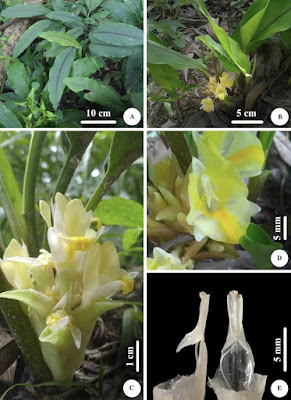
Kaempferia chonburiensis
(A) Whole plant. (B) Bract. (C) Bracteoles. (D) Flower with calyx tube and ovary. (E) Calyx tube. (F) Flower (top view). (G) Dorsal corolla lobe. (H) Lateral corolla lobes. (I) Lateral staminodes. (J) Labellum. (K) Corolla tube with ovary and anther. (L) Anthers and anther crests (front, side and rear views). (M) Ovary, stylodial glands, and lower part of the style. (N) Fruit and persistent calyx. (O) Seeds.
 Photographs based on the holotype (PW 240621–1) (photos by Pornpimon Wongsuwan).

Kaempferia chonburiensis in situ.
 (A) Natural habit in flowering stage. (B, C, D) Variation of flowers (labellum patch with or without violet). Photographs based on the holotype (A, B: PW 240621–1) and paratypes (C: PW 120721–1 and D: PW 100622–1)
(photos by Pornpimon Wongsuwan).

Kaempferia chonburiensis Picheans., Sukrong & Wongsuwan, sp. nov. 

Diagnosis: This new species is similar to Kaempferia koratensis, but differs in the following characters: (1) longer ligule (0.6–1 cm vs. ca. 3 mm), (2) longer peduncle (0.8–1.2 cm long vs. ca. 5 mm long), (3) glabrous bract, (4) white with yellow spot at the base, with or without violet patch on labellum, (5) pubescent at the uppermost part of ovary.

 
Etymology: The specific epithet ‘chonburiensis’ refers to the province of the type locality.

Vernacular name: Pro (เปราะ), Wan Pro (ว่านเปราะ), Pro Mueang Chon (เปราะเมืองชล).


Pornpimon Wongsuwan, Boonmee Phokham, Pantamith Rattanakrajang, Chayan Picheansoonthon and Suchada Sukrong. 2025. Kaempferia chonburiensis (Zingiberaceae), A New Species from Thailand based on morphological and molecular evidence. PeerJ. 13:e18948. DOI: doi.org/10.7717/peerj.18948


Wednesday, February 19, 2025

[Herpetology • 2025] Gekko shiva • A New limestone-dwelling Gecko (Squamata: Gekkonidae) from Sa Kaeo Province, eastern Thailand


Gekko (Gekkoshiva 
Pauwels, Meesook, Donbundit, Jindamad, Topai & Sumontha, 2025


Abstract
We describe Gekko shiva sp. nov. from limestone cave and hills in Khlong Hat District, Sa Kaeo Province, eastern Thailand, near the border with Cambodia. The new species, a member of the subgenus Gekko, differs from all currently recognized Gekko species by the following combination of morphological characters and pattern: maximal known snout-vent length of 131.9 mm, lack of contact between nostrils and rostral, 28 or 29 interorbital scales between supraciliaries, 80–86 scale rows around midbody, 18 dorsal tubercle rows at midbody, 35–37 ventral scale rows at midbody, 9–12 precloacal pores in males, one or two postcloacal tubercles on each side of the base of the tail, 13–15 subdigital lamellae on 1st toe and 18 or 19 on 4th toe, no Y-shaped mark on head, white spots on head, brown dorsal background with irregular bands of white spots on dorsum, yellow venter, and greenish golden iris.

Reptilia, Gekko shiva sp. nov., taxonomy, karst, limestone, cave, Cardamom Mountains


Gekko shiva sp. nov. 
ตุ๊กแกศิวะ


Olivier S. G. PAUWELS, Worawitoo MEESOOK, Nattasuda DONBUNDIT, Tanasak JINDAMAD, Nittaya TOPAI and Montri SUMONTHA. 2025. Gekko (Gekkoshiva, A New limestone-dwelling Gecko from Sa Kaeo Province, eastern Thailand (Squamata, Gekkonidae).  Zootaxa. 5588(2);  305-322. DOI: doi.org/10.11646/zootaxa.5588.2.6 

Saturday, February 15, 2025

[Herpetology • 2025] Gehyra shiva • A New limestone-dwelling Four-clawed Gecko (Squamata, Gekkonidae: Gehyra) from Sa Kaeo Province, eastern Thailand


Gehyra shiva
Meesook, Donbundit, Jindamad, Topai, Kunya, Suthanthangjai, Chotjuckdikul, Chonkamnord, Sumontha & Pauwels, 2025

จิ้งจกหินศิวะ  ||  DOI: doi.org/10.11646/zootaxa.5588.2.12 
 
Abstract
We describe Gehyra shiva sp. nov. from limestone cave and hills in Khlong Hat District, Sa Kaeo Province, eastern Thailand, near the border with Cambodia. The new species differs from all currently recognized Southeast Asian Gehyra by the following combination of morphological characters and dorsal color pattern: maximal known snout–vent length of 53.8 mm, 8–10 supralabials, 54–67 dorsal and 46–56 ventral scale rows around midbody, absence of skin folds on limbs, 34–37 preanofemoral pores in males in a continuous series extending along the whole length of the femur (pores absent in females), tail not to moderately widened behind vent in adults, a single row of widened subcaudals, digits and toes unwebbed, 7 or 8 divided subdigital lamellae on 4th toe, and a dorsal pattern with five regular dark brown bands between limb insertions, separated or not by pairs of large, white round paravertebral spots.

Reptilia, Gehyra shiva sp. nov., taxonomy, morphology, karst, cave


Gehyra shiva sp. nov.


Worawitoo MEESOOK, Nattasuda DONBUNDIT, Tanasak JINDAMAD, Nittaya TOPAI, Kirati KUNYA, Winai SUTHANTHANGJAI, Maneerat SUTHANTHANGJAI, Natthaphat CHOTJUCKDIKUL, Teeraphat CHONKAMNORD, Montri SUMONTHA and Olivier S. G. PAUWELS. 2025. A New limestone-dwelling Four-clawed Gecko from Sa Kaeo Province, eastern Thailand (Squamata, Gekkonidae: Gehyra).  Zootaxa. 5588(2); 381-395. DOI: doi.org/10.11646/zootaxa.5588.2.12 [2025-02-14]

Tuesday, October 29, 2024

[Mollusca • 2020] Diplommatina fusiformis, D. burapha, ... • A Review of Diplommatina Species (Gastropoda: Diplommatinidae) in eastern Thailand with the Descriptions of Five New Species


[A] Diplommatina fusiformis spec. nov. หอยกระสวยจิ๋ว,  
[B-E] D. khwantongae spec. nov. หอยกระสวยจิ๋วคณิตา, 
D. crispata khaochamaoensis Panha et al., 1998, 
  หอยกระสวยจิ๋วบูรพา D. burapha sp. n.,   
หอยกระสวยจิ๋วชฎาทอง D. chadathongae Kamtuptim, Dumrongrojwattana & Wongkamhaeng sp. nov.  
หอยกระสวยจิ๋วจันทบุรี  D. chantaburiensis sp. n. 

 in Dumrongrojwattana, Kamtuptim & Wongkamhaeng, 2020


Abstract
Background: Microsnails in the genus Diplommatina Benson, 1849 from eastern Thailand are revised, based on the collection of the Zoological Research Collection, Burapha University, Chonburi Province, Thailand and on recently-collected materials.

New information: Five new species, Diplommatina burapha sp. n., D. chadathongae sp. n., D. chantaburiensis sp. n., D. fusiformis sp. n. and D. khwantongae sp. n., are described as new to science. The geographic distribution of these eastern species is presented.

Keywords: Diplommatina, Diplommatinidae, taxonomy, Thailand

Four Diplommatina species from eastern Thailand. 
A) Diplommatina crispata khaochamaoensis Panha et al., 1998, B) D. burapha sp. n.,
C) D. chadathongae sp. nov. and D) D. chantaburiensis sp. n. 
Each species shows a frontal view, lateral view, dorsal view and the number of ribs per 0.5 mm on the penultimate whorl and body whorl, respectively.

Two Diplommatina species from eastern Thailand.
A) D. fusiformis spec. nov., B-E) D. khwantongae spec. nov.,
B) Holotype, C-D) Living snail. (Photos by Ms. Rattanawadee Tekavong).
Each species shows a frontal view, lateral view, dorsal view and the number of ribs per 0.5 mm on the penultimate whorl and body whorl, respectively.


 Pongrat Dumrongrojwattana, Chanakarn Kamtuptim and Koraon Wongkamhaeng. 2020. A Review of Diplommatina Species in eastern Thailand with the Descriptions of Five New Species. Biodiversity Data Journal. 8: e57689. DOI: 10.3897/BDJ.8.e57689

 สด ๆ ร้อน ๆ หอยกระสวยจิ๋วชนิดใหม่ของโลก 5 ชนิด จากภาคตะวันออก ได้แก่ 
1. หอยกระสวยจิ๋วบูรพา (Diplommatina burapha Dumrongrojwattana, Kamtuptim & Wongkamhaeng, 2020) จากจังหวัดสระแก้ว ตั้งตามภูมิภาคที่พบ คือ ภาคตะวันออกและสอดคล้องกับชื่อมหาวิทยาลัย "บูรพา"
2. หอยกระสวยจิ๋วชฎาทอง (Diplommatina chadathongae Kamtuptim et al., 2020 in Dumrongrojwattana et al., 2020) หอยชนิดนี้ตั้งชื่อเพื่อเป็นเกียรติและระลึกถึงคุณแม่ของนางสาวชนากานต์ ขำทับทิม นิสิตชั้นปีที่ 4 ภาควิชาชีววิทยา หนึ่งในผู้ร่วมงานวิจัยชิ้นนี้
3. หอยกระสวยจิ๋วจันทบุรี (Diplommatina chantaburiensis Dumrongrojwattana et al., 2020) ตั้งชื่อตามจังหวัดจันทบุรี ที่ซึ่งพบหอยกระสวยจิ๋วชนิดนี้เป็นครั้งแรก
4. หอยกระสวยจิ๋ว (Diplommatina fusiformis Dumrongrojwattana et al., 2020) ตั้งชื่อตามรูปทรงเปลือกหอยที่เป็นทรงกระสวย
5. หอยกระสวยจิ๋วคณิตา (Diplommatina khwantongae Dumrongrojwattana et al., 2020) ตั้งชื่อให้เป็นเกียรติและแสดงความระลึกถึง นางสาวคณิตา ขวานทอง หรือ พะลอย ของอาจารย์และเพื่อน ๆ ร่วมรุ่น นิสิตผู้ทำการศึกษาและค้นพบหอยกระสวยจิ๋วชนิดนี้ ผู้จากไปก่อนวัยอันควร
ผลการศึกษาครั้งนี้ ทำให้จำนวนชนิดของหอยกระสวยจิ๋วในภาคตะวันออก เพิ่มขึ้นจากเดิมที่รายงานไว้เพียง 1 ชนิด คือ หอยกระสวยจิ๋วเขาชะเมา (Diplommatina crispata khaochamaoensis) เพิ่มขึ้นเป็น 6 ชนิด

Monday, October 14, 2024

[Botany • 2024] Microchirita radiata, M. simia, etc. • Four New Species of Microchirita (Gesneriaceae: Didymocarpoideae) from Thailand


หยาดอรทัย Microchirita orathaiae Suddee, D.J.Middleton, Tetsana & Puudjaa;
หยาดพระโพธิสัตว์ M. radiata D.J.Middleton, Daonurai, Poompayak & Suddee;
หยาดวานรพักตร์ M. simia D.J.Middleton, Thananth., Tetsana & Suddee

in Middleton, Tetsana, Puudja, Thananthaisong, Daonurai, Poompayak et Suddee, 2024. 

Abstract
Four new species of Microchirita (Gesneriaceae) from Thailand are described: Microchirita orothaiae, M. puglisiae, M. radiata and M. simia. With the addition of these species, 41 species are now recorded for Thailand.

Keywords: endemic, karst limestone, Microchirita purpurea, M. tubulosa, taxonomy

Microchirita orathaiae Suddee, D.J.Middleton, Tetsana & Puudjaa:
A. Habit; B. Inflorescence; C. Flower, front view; D. Flower, back view.
 Photos by Naiyana Tetsana. 

Microchirita orathaiae Suddee, D.J.Middleton,Tetsana & Puudjaa, sp. nov.

Similar to Microchirita purpurea D.J.Middleton & Triboun in general appearance but differs in the corolla tube pale yellow at the very base inside, dark bluish purple ventrally, somewhat dorsoventrally compressed making corolla mouth wider than high, lateral lobes strongly reflexed (dark purple throughoutor only slightly paler inside at base, not or only slightly dorsoventrally compressed with the corolla mouth mostly as wide as high, lateral lobes erect, not reflexed in M. purpurea) and anthers glabrous (anthers densely long pubescent near junction of upper anther locules and filaments in M. purpurea). 
Type: Thailand, Rayong, Khao Chamao District, ...

Etymology.— The specific epithet is given in honour of the botanical artist Mrs Orathai Kerdkaew, a long-time staff member at BKF.
Vernacular.— Yat o ra thai (หยาดอรทัย) (proposedhere).

Microchirita puglisiae D.J.Middleton, Daonurai, Poompayak & Suddee:
A. Habit; B. Inflorescences; C. Flower, side view; D. Flower, front view.
Photos by Kerkwit Poompayak.

Microchirita puglisiae D.J.Middleton, Daonurai, Poompayak & Suddee, sp. nov.

Differs from all other Microchirita species in the combination of densely tomentose leaves, few-flowered inflorescences, white corolla lobes and narrow corolla tube flaring gradually towards the mouth. 

Type: Thailand, Saraburi, Phra Phutthabat District, ...

Etymology.— The specific epithet is given in honour of Dr Carmen Puglisi (MO) for her contribu-tion to the taxonomy of Thai Gesneriaceae, including in the genus Microchirita.
Vernacular.— Yat tham kra bok (หยาดถ้ำกระบอก) (proposed here).

Microchirita radiata D.J.Middleton, Daonurai, Poompayak & Suddee:
A. Habit; B. Inflorescence; C. Flower, front view; D. Flower, side view.
Photos by Kerkwit Poompayak.
 
Microchirita radiata D.J.Middleton, Daonurai, Poompayak & Suddee, sp. nov.

Similar to Microchirita tubulosa (Craib) A.Weber & D.J.Middleton in general appearance and the large primarily white flowers but differs in the corolla tube orange inside, darker orange ventrally, with many radial brown lines dorsally and ventrally (white or very pale yellow inside, yellow ventrally, without brown lines or these only either side of yellow ventral stripe or rarely with additional very pale lines or dots ventrally in M. tubulosa) and the glabrous anthers (densely white pubescent in M. tubulosa). 

Type: Thailand, Saraburi, Kaeng Khoi District, ...

Etymology.— The specific epithet refers to the brown lines radiating from the narrow part of the tube into the widened upper tube.
Vernacular.— Yat phra pho thi sat (หยาดพระโพธิสัตว์) (proposed here).

Microchirita simia D.J.Middleton, Thananth., Tetsana & Suddee:
A. Habit; B. Flower, side view; C. Flower, front view with purple bar on lower lip; D. Flower, front view without purple bar on lower lip.
Photos by Naiyana Tetsana.

M. simia D.J.Middleton, Thananth., Tetsana & Suddee, sp. nov.

Similar to Microchirita purpurea D.J.Middleton & Triboun in the shape and size of the corolla but differs in the distinctive bright yellow and purple corollas (purple throughout in M. purpurea) and glabrous stamens (hairy at filament insertion in M. purpurea). 

Type: Thailand, Lop Buri, ...
 
Etymology.— The specific epithet is Latin for monkey, in reference to the monkey-like face when viewing the corolla from the front.
Vernacular.— Yat wa non pak (หยาดวานรพักตร์) (proposed here).


David Middleton, Naiyana Tetsana, Pachok Puudja, Theerawat Thananthaisong, Kunanon Daonurai, Kerkwit Poompayak and Somran Suddee. 2024. Four more New Species of Microchirita (Gesneriaceae: Didymocarpoideae) from Thailand. Thai Forest Bulletin (Botany). 52(2), 80–88. DOI: doi.org/10.20531/tfb.2024.52.2.11


Sunday, July 23, 2023

[Botany • 2023] Microchirita candida, M. formosa, M. fuscifaucia, etc. • Eight New Species of Microchirita (Gesneriaceae: Didymocarpoideae) from Thailand


หยาดขาวลออ Microchirita candida C. Puglisi & D. J. Middleton,
หยาดศรีชล Microchirita chonburiensis D. J. Middleton & C. Puglisi,
หยาดเนินมะปราง Microchirita formosa D. J. Middleton,
หยาดเนรมิตร Microchirita fuscifaucia C. Puglisi & D. J. Middleton,

หยาดภู่มา Microchirita poomae D. J. Middleton,
หยาดศรีระยอง Microchirita rayongensis C. Puglisi & D. J. Middleton,
หยาดชัยบาดาล Microchirita striata D. J. Middleton & C. Puglisi,
หยาดศรีสุวัฒน์ Microchirita suwatii D. J. Middleton & C. Puglisi,

in Middleton, Tetsana, Suddee et Puglisi, 2023. 

Abstract
Eight new species of Microchirita (Gesneriaceae) from Thailand are described: Microchirita candida, M. chonburiensis, M. formosa, M. fuscifaucia, M. poomae, M. rayongensis, M. striata and M. suwatii. With the addition of these species, 37 species are now recorded for Thailand, considerably more than any other country.

Keywords: endemic, karst limestone, taxonomy


หยาดขาวลออ Microchirita candida C. Puglisi & D. J. Middleton

พบบริเวณเขาหินปูน อำเภอแกลง จังหวัดระยอง ไม้ล้มลุก สูงได้ถึง 80 ซม. ลำต้นอวบน้ำ ส่วนบนสีม่วงอมเขียว โคนสีม่วง ใบเดี่ยว เรียงตรงข้าม มีขนประปราย
ทั้ง 2 ด้าน ดอกสีขาววาว มีแต้มเหลืองที่โคนกลีบปากด้านใน คำระบุชนิด ‘candida’ ตั้งตามลักษณะดอกที่ขาวมีวาว


หยาดศรีชล Microchirita chonburiensis D. J. Middleton & C. Puglisi

พบบริเวณเขาหินปูน อำเภอบ่อทอง จังหวัดชลบุรี ไม้ล้มลุก สูงได้ถึง 30 ซม. ลำต้นอวบน้ำ ส่วนบนสีเขียว โคนสีม่วงอมเขียว ใบเดี่ยว เรียงตรงข้าม มีขนและต่อมประปรายทั้ง 2 ด้าน ดอกสีเหลืองสด คำระบุชนิด ‘chonburiensis’ ตั้งให้เป็นเกียรติแก่จังหวัดชลบุรี แหล่งที่พบ


หยาดเนินมะปราง Microchirita formosa D. J. Middleton

พบบริเวณเขาหินปูน อำเภอเนินมะปราง จังหวัดพิษณุโลก ไม้ล้มลุก สูงได้ถึง 65 ซม. ลำต้นอวบน้ำ สีเขียวอ่อน บริเวณข้อมีสีแดง มีขนสีขาวกระจายห่าง ๆ ใบเดี่ยว เรียงตรงข้าม มีขนสั้นนุ่มทั้ง 2 ด้าน ดอกสีขาว มีแต้มสีเหลืองทั้งบนและล่างในหลอดกลีบดอก คำระบุชนิด ‘formosa’ แปลว่าสวยงาม


หยาดเนรมิตร Microchirita fuscifaucia C. Puglisi & D. J. Middleton

พบบริเวณเขาหินปูน อำเภอเขาชะเมา จังหวัดระยอง ไม้ล้มลุก สูงได้ถึง 30 ซม. ลำต้นอวบน้ำ สีเขียวเป็นมันวาว ใบเดี่ยว เรียงตรงข้าม มีขนสั้นนุ่มประปรายถึงหนาแน่นทั้ง 2 ด้าน ดอกสีขาว คอหลอดกลีบดอกด้านในสีแดงอมม่วงถึงน้ำตาล คำระบุชนิด ‘fuscifaucia’ หมายถึงสีเข้มที่คอหลอดดอก


หยาดภู่มา Microchirita poomae D. J. Middleton

พบบริเวณเขาหินปูน อำเภอพระพุทธบาท จังหวัดสระบุรี ไม้ล้มลุก สูงได้ถึง 50 ซม. ลำต้นอวบน้ำ ส่วนใหญ่เกลี้ยง พบบ้างที่มีขนขนาดเล็กประปราย ใบเดี่ยว เรียงตรงข้าม เกลี้ยงหรือเกือบเกลี้ยง ดอกสีม่วงแดง มีแถบสีเหลืองตามยาวที่โคนกลีบปากด้านใน คำระบุชนิด ‘poomae’ ตั้งให้เป็นเกียรติแก่ ดร.ราชันย์ ภู่มา อดีตหัวหน้ากลุ่มงานพฤกษศาสตร์ป่าไม้ สำนักวิจัยการอนุรักษ์ป่าไม้และพันธุ์พืช กรมอุทยานแห่งชาติ สัตว์ป่า และพันธุ์พืช ผู้นำเก็บตัวอย่าง


หยาดศรีระยอง Microchirita rayongensis C. Puglisi & D. J. Middleton

พบบริเวณเขาหินปูน อำเภอเขาชะเมา จังหวัดระยอง ไม้ล้มลุก สูงได้ถึง 30 ซม. ลำต้นอวบน้ำ ส่วนบนสีเขียวอมม่วงแดงถึงเขียว ส่วนโคนสีม่วงแดง เกลี้ยง ใบเดี่ยว เรียงตรงข้าม มีขนสั้นนุ่มประปรายถึงหนาแน่นทั้ง 2 ด้าน ดอกสีขาว คอหลอดดอกและโคนกลีบปากด้านใน
สีเหลืองจาง คำระบุชนิด ‘rayongensis’ ตั้งให้เป็นเกียรติแก่จังหวัดระยอง แหล่งที่พบ


หยาดชัยบาดาล Microchirita striata D. J. Middleton & C. Puglisi

พบบริเวณเขาหินปูน อำเภอชัยบาดาล จังหวัดลพบุรี ไม้ล้มลุก สูงได้ถึง 25 ซม. ลำต้นอวบน้ำ มีขนสากทั่วไป ใบเดี่ยว เรียงตรงข้าม มีขนสั้นนุ่มทั้ง 2 ด้าน ดอกสีเหลือง โคนกลีบปากด้านในมีเส้นสีแดงตามยาว 5 เส้น คำระบุชนิด ‘striata’ หมายถึงแถบเส้นสีแดงที่โคนกลีบปาก


หยาดศรีสุวัฒน์ Microchirita suwatii D. J. Middleton & C. Puglisi

พบบริเวณเขาหินปูน อำเภอเมือง จังหวัดเลย ไม้ล้มลุก สูงได้ถึง 30 ซม. ลำต้นอวบน้ำ สีม่วงแดงอมเขียว มีขนประปราย ใบเดี่ยว เรียงตรงข้าม มีขนประปรายทั้ง 2 ด้าน ดอกสีม่วงแดงอมน้ำเงิน โคนกลีบปากด้านในมีแถบสีเหลือง คำระบุชนิด ‘suwatii’ ตั้งให้เป็นเกียรติแก่นายสุวัฒน์ สุวรรณชาติ อดีตเจ้าหน้าที่หอพรรณไม้ผู้ร่วมเก็บตัวอย่างและเป็นผู้ทุ่มเทในการปฏิบัติงานจนถึงวาระเกษียณอายุราชการ


David J. Middleton, Naiyana Tetsana, Somran Suddee and Carmen Puglisi. 2023. Eight New Species of Microchirita (Gesneriaceae: Didymocarpoideae) from Thailand. Thai Forest Bulletin (Botany). 51(2), 54–70. DOI: 10.20531/tfb.2023.51.2.08 


Saturday, April 9, 2022

[Botany • 2022] Rediscovery of Diospyros bambuseti (Ebenaceae) in Thailand: Emended Taxonomic Description, Lectotypification, and Phylogenetic Placement


  Diospyros bambuseti H.R.Fletcher. 

in Duangjai, Sinbumroong, Chalermwong, et al., 2022. 
มะเกลืออรัญ, บูน || DOI: 10.11646/phytotaxa.542.3.3 
Photographed by S. Duangjai and A. Sinbumroong 

Abstract
Diospyros bambuseti is a rare species endemic to Thailand that was previously known only from type specimens. The only male specimens of this species were collected in 1930 from a bamboo forest in Aranya Prathet district, now Sa Kaeo Province, Thailand. Both male and female plants were rediscovered in Surat Thani Province, upper Peninsular Thailand during 2015–2020. In this work, we provide an emended description, detailed ecological data, photographs, and illustrations of recently collected specimens. We performed lectotypification and investigated the phylogenetic placement and sister taxa of D. bambuseti based on the DNA sequences of eight plastid regions. D. bambuseti is closely related to D. ehretioides, D. fasiculosa, and D. venosa. Finally, we provide a detailed morphological comparison of D. bambuseti with related species.

Keywords: Eudicots, Diospyros, molecular phylogenetics, morphology, plastid DNA, Thailand

  Diospyros bambuseti H.R.Fletcher. Male flowers.  

 Diospyros bambuseti H.R.Fletcher.  Female flowers.

 Diospyros bambuseti H.R.Fletcher. Young fruits. 


Diospyros bambuseti H.R.Fletcher. Fruits and seeds.   


  Diospyros bambuseti H.R.Fletcher.
A. Fruiting branch habit. B. Leaves. C. Male flowers. D. Male flowers. E. Fruits and seeds.
 Scale bars: A–B and E = 2 cm; C–D = 5 mm. 
Drawn by W. Bhuchaisri 
from Chalermwong 22102018 (A–B and E), Sinbumroong et al. 300520151 (C), and Sinbumroong 22052020 (E).

มะเกลืออรัญ Diospyros bambuseti H.R. Fletcher

Diospyros bambuseti H. R. Fletcher, Bull. Misc. Inform. Kew 1937: 387;
Fl. Siam. En. 2: 364. 1938; Phengklai Fl. Thailand 2 (4): 290, Fig. 1. 1981.

Vernacular name:— Maklua aran - มะเกลืออรัญ (Sa Kaeo); boon - บูน (Surat Thani).

Distribution:— Endemic to Thailand, known only from Aranya Prathet district, Sa Kaeo Province and Khian Sa district, Surat Thaini Province.


Sutee Duangjai, Aroon Sinbumroong, Porntawat Chalermwong, Padungsak Suekaew and Somran Sddee. 2022. Rediscovery of Diospyros bambuseti (Ebenaceae) in Thailand: Emended Taxonomic Description, Lectotypification, and Phylogenetic Placement. Phytotaxa. 542(3); 271–282. DOI: 10.11646/phytotaxa.542.3.3 

Tuesday, March 29, 2022

[Crustacea • 2021] Tigriopus namsaiensis & T. wannapaensis • Two New Species of Tigriopus Norman, 1869 (Copepoda: Harpacticidae) from Chonburi Province, Thailand


Tigriopus namsaiensis & T. wannapaensis 
Chullasorn, Kangtia, Song & Khim, 2021

 
Abstract
Two new species of the family Harpacticidae Dana, 1846, Tigriopus namsaiensis sp. nov. and T. wannapaensis sp. nov. were found in algal washings at Namsai and Wannapa beaches in Chonburi Province, Thailand. There are currently 14 known species in the genus, two of which, T. thailandensis Chullasorn, Ivanenko, Dahms, Kangtia & Yang, 2012 and T. sirindhornae Chullasorn, Dahms & Klangsin, 2013 were also discovered in Thailand. The genus Tigriopus Norman, 1869 has a worldwide distribution with nine species recorded from the Pacific Ocean (seven in the North Pacific and two in the South Pacific), four species from the Atlantic and adjacent seas, two species from the South Indian Ocean, and one species from Antarctica.

                Sexual dimorphism is expressed in the antennule, antenna, P2, P5, P6, and segmentation of the urosome. Tigriopus namsaiensis sp. nov. and T. wannapaensis sp. nov. are closely related to T. thailandensis and T. sirindhornae in sharing the following characters: fewer sensilla on the prosome; antennary exopod with one seta on exp-2; P4 exp-3 with two inner setae; female P5 baseoendopod with five setae; male P2 enp-2 with a seta fused to the segment; and male P5 exopod with five setae.

                Tigriopus namsaiensis sp. nov. closely resembles T. thailandensis, but the new species is characterized by four setae on the maxillulary coxa (three setae in T. thailandensis), the outermost seta on the female P6 is plumose (instead of the middle one), the lateral seta on the apical segment of the antennary exopod is discrete at the base (instead of fused to the segment), and the outermost seta of the male P5 exopod is plumose (instead of spinulose).

                Tigriopus wannapaensis sp. nov. is very closely related to T. sirindhornae, but the new species differs from the latter by the following characteristics: 2-segmented mandibular exopod (3-segmented in T. sirindhornae); five setae on the maxillulary coxa (instead of three); all setae on female P6 are plumose (instead of two plumose and one pinnate); the lateral seta on the apical segment of the antennary exopod is fused to the segment (instead of discrete at the base); and the outermost seta on the male P5 exopod is plumose (instead of spinulose).

                A dichotomous identification key to the 16 valid species of Tigriopus is provided.

Key words: Harpacticoida, identification key, morphology, Namsai Beach, taxonomy, Ulva clathrata, Wannapa Beach, Crustacea


Supawadee Chullasorn, Pawana Kangtia, Sung Joon Song and Jong Seong Khim. 2021. Two new species of Tigriopus Norman, 1869 from Chonburi Province, Thailand (Crustacea: Copepoda: Harpacticidae). Zootaxa. 5051(1); 41-67. DOI: 10.11646/zootaxa.5051.1.6

ได้ค้นพบฮาร์แพคทิคอยด์โคพีพอด 2 ชนิดใหม่ของโลก ได้แก่ Tigriopus namsaiensis จากบริเวณชายหาดน้ำใส จังหวัดชลบุรี และ Tigriopus wannapaensis จากชายหาดวอนนภา จังหวัดชลบุรี สัตว์กลุ่มนี้มีความสำคัญต่อระบบนิเวศทางทะเล เป็นตัวชี้วัดคุณภาพของน้ำและเป็นอาหารของสัตว์น้ำวัยอ่อนที่มีคุณค่าทางเศรษฐกิจ


Tuesday, November 30, 2021

[Botany • 2021] Curcuma siamensis (Zingiberaceae) ขมิ้นสยาม • A New Species of Curcuma subgen. Ecomatae from Southeastern Thailand


 Curcuma siamensis  Saensouk & Boonma

in Saensouk, Boonma & Saensouk, 2021.

Abstract. 
Curcuma siamensis Saensouk & Boonma sp. nov. (Zingiberaceae: Zingibereae) belonging to the genus Curcuma subgenus Ecomatae, as herein described and illustrated discovered in Chachoengsao Province, Southeastern Thailand during our exploration of Zingiberaceae family in Thailand and in preparation for the revision of the genus Curcuma for the Flora of Thailand project. It is similar to Curcuma rangsimae Boonma & Saensouk in having terminal inflorescences between the leaf-sheaths, emerging at the basal of the pseudo-stem, lacking coma bract, yellow flowers, presence of epigynous glands, and anther spurs make this plant most similar to, which are also distributed in this nearby area too. But differ in having leaves narrowly elliptic, narrower and shorter in size 18–36 × 6–8.5 cm, upper midrib reddish; thyrse shorter and smaller (5–6.5 cm long, 4–5 cm in diam.); peduncle glabrous; bracts per inflorescence 10–15 in number, fused almost only at base; corolla lobes white, longer and narrower 17–18.3 × 6–7.8 mm; staminodes uniquely obovate-rhombic; labellum ovate-trullate; filament 4.4–4.5 mm long; anther longer c. 8 mm long, spurs pointing outward in front view, with anther crest apex retuse (vs. C. rangsimae having leaves narrowly elliptic to oblanceolate, 40–70 × 12–20 cm, upper midrib green; thyrse 12–20 cm long, 7.8–9.5 cm in diam.; peduncle pilose; 25–48 in number, connate 1/4 to 1/3 at base; corolla lobes light pale yellow, 15–17 × 9–12 mm; staminodes asymmetrical trullate–ovate; labellum ovate; filament 6–7 mm long; anther 6.3–6.9 mm long, spurs pointing downward in from view, with anther crest apex rounded). Based on the results of the morphological comparison and examination of all allied species in the same genus were found to be inconsistent with any species, especially in the subgenus Ecomatae. A comprehensive description, illustration, photographs, ecology, etymology, distribution and a revised key to 21species of Curcuma subgenus Ecomatae in Thailand are provided.

Keywords: Curcuma rangsimae, C. cotuana, Chachoengsao, Flora of Thailand, taxonomy, Zingiberales

Curcuma siamensis Saensouk & Boonma sp. nov.
 (A) habit, (B) side view of terminal inflorescence in the leaf-sheaths, (C) dorsalcorolla lobe, (D) lateral corolla lobes,(E) staminodes, (F) labellum, (G) bract, (H) bracteole, (I) calyx with ovary, (J) epigynous glands with ovary, (K) side and front view of anther.
Drawn by Thawatphong Boonma 

Curcuma siamensis Saensouk & Boonma sp. nov.
 (A) Natural habitat in oblique-top view, C. siamensis (red midrib) grows near C. harmandii Gagnep., (B) plants with inflorescence and flowers in oblique-top view, (C) inflorescence with flowers in side view, (D) flower-front view, (E) anther-side and front view.
Photographs A–D by N. Wannaphirun; E by Thawatphong Boonma  

Curcuma siamensis Saensouk & Boonma sp. nov.
Subgen. Ecomatae

The new species is similar to C. rangsimae Boonma & Saensouk. but differ in having leaves narrowly elliptic, narrower and shorter in size 18–36 × 6–8.5 cm, upper midrib reddish; thyrse shorter and smaller (5–6.5 cm long, 4–5 cm in diam.); peduncle glabrous; bracts per inflorescence 10–15 in number, fused almost only at base; corolla lobes white, longer and narrower 17–18.3 × 6–7.8 mm; staminodes uniquely obovate-rhombic; labellum ovate-trullate; filament 4.4–4.5 mm long; anther longer c. 8 mm long, spurs pointing outward in front view, with anther crest apex retuse (vs. C. rangsimae having leaves narrowly elliptic to oblanceolate, 40–70 × 12–20 cm, upper midrib green; thyrse 12–20 cm long, 7.8–9.5 cm in diam.; peduncle pilose; 25–48 in number, connate 1/4 to 1/3 at base; corolla lobes light pale yellow, 15–17 × 9–12 mm; staminodes asymmetrical trullate-ovate; labellum ovate; filament 6–7 mm long; anther 6.3–6.9 mm long, spurs pointing downward in from view, with anther crest apex rounded).

Etymology: The specific epithet “siamensis” is named from the former name of Thailand, refers to the geographical origin of this new species.
"ขมิ้นสยาม" "สุวรรณพนม" "มหาอุดมเหลืองนวล"

Distribution map of Curcuma siamensis Saensouk & Boonma sp. nov. and its allies.
 Abbreviations in the map are the floristic region after the "Flora of Thailand" project which N: Northern; NE: Northeastern; SW: Southwestern; C: Central; E: East; SE: Southeastern; and PEN:Peninsular.


Saensouk P, Boonma T, Saensouk S. 2021. Curcuma siamensis (Zingiberaceae, Zingibereae), A New Species of Curcuma subgen. Ecomatae from Southeastern Thailand. Biodiversitas. 22(12); 5239-5246. DOI: 10.13057/biodiv/d221201 smujo.id/biodiv/article/view/9607