Showing posts with label Journal of Paleontology. Show all posts

Wednesday, March 4, 2026

[PaleoEntomology • 2026] Hypoponera electrocacica • The Ant Genus Hypoponera (Hymenoptera: Formicidae) in Dominican Amber


Hypoponera electrocacica 
Fiorentino, Bouju, Sosa, Navarro & Barden, 2026
 
 
Abstract
Hypoponera Santschi, 1938 is a genus of ponerine ants, well known for its simplified morphology, lacking any clear autopomorphy, and its cosmopolitan distribution. Here, we describe the first Hypoponera in Dominican amber. The discovery of Hypoponera electrocacica new species confirms the long-expected presence of the genus in the Caribbean Miocene. The modern diversity of Hypoponera in the Greater Antilles now stands at five species and two putative subspecies.

Systematic paleontology
Order Hymenoptera Linnaeus, Reference Linnaeus1758

Family Formicidae Latreille, Reference Latreille1802
Subfamily Ponerinae Lepeletier de Saint-Fargeau, Reference Lepeletier de Saint-Fargeau1835

Genus Hypoponera Santschi, Reference Santschi1938

Type species: Ponera abeillei André, 1881, 
now Hypoponera abeillei (André, Reference André1881).

 Photomicrographs and illustration of Hypoponera electrocacica n. sp., holotype specimen, MNHNSD FOS 18.126.
(1) Head in front face view. (2) Illustration of forewing venation. (3) Body in dorsal view. (4) Body in lateral view.
Scale bars = 0.5 mm.

Hypoponera electrocacica new species

Etymology: The specific epithet electrocacica (from the Latin electrum, meaning ‘amber,’ and the feminine form of the Taino word cacique, meaning ‘chief’) is a feminine singular adjective in the nominative case. It refers to the alate ant or queen trapped in amber.


Gianpiero Fiorentino, Valentine Bouju, Diyael Sosa, Santo Navarro  and Phillip Barden. 2026. The Ant Genus Hypoponera (Hymenoptera: Formicidae) in Dominican Amber. Journal of Paleontology. First View. DOI: doi.org/10.1017/jpa.2025.10213 [05 February 2026]

Sunday, February 15, 2026

[Paleontology • 2026] Paleocanna tentaculum • Thecate stem medusozoan polyp (Cnidaria: Anthozoa) from the Upper Ordovician of Québec, Canada


Paleocanna tentaculum  
 Ramirez-Guerrero, Alghaled, Bateman, Cournoyer & Cameron, 2026
 
 
Abstract
The fossil record of medusozoan cnidarians is relatively sparse and, in some cases, contentious. Here, we describe a new genus and species of a well-preserved, soft-bodied, tubicolous polyp, Paleocanna tentaculum n. gen. n. sp., from the Upper Ordovician (Katian) Neuville Formation in Québec. These fossils, preserved as carbonaceous compressions, were found in association with typical shelly assemblages. Fifteen slabs of shaly limestone containing ~ 135 specimens of Paleocanna tentaculum n. gen. n. sp. were examined. Individual polyps occupied upright tubes, which occur either solitarily or in clusters. Some tubes exhibit a striated periderm near their base. The polyp is elongated, with a rounded aboral end and a consistent ring of tentacles protruding distally from the tube. A phylogenetic analysis of 69 taxa and 236 discrete morphological characters indicated that the species is more closely related to the extant crown group than it is to the other stem-group medusozoans, e.g., conulariids and carinachitids. The uniform orientation of specimens on single slabs suggests rapid burial. Paleocanna tentaculum n. gen. n. sp. represents an exceptionally preserved member of an Ordovician deposit exhibiting Burgess Shale-type soft-tissue preservation.


Paleocanna tentaculum n. gen. n. sp., holotype, MPEP713.4.
 (1) General view of the organism taken under cross-polarized light; accompanying line drawing illustrates the outline of the tube and tentacles. (2) Detail of the left set of tentacles. (3) Detail of the basal part of the tube. (4) Detail of the tube. Scale bars = 1 cm (1, 3), 0.5 cm (2, 4).

Systematic paleontology
Phylum Cnidaria Verrill, Reference Verrill1865
Subphylum Anthozoa Ehrenberg, Reference Ehrenberg1834

Genus Paleocanna new genus

Etymology: Paleocanna: palaios, meaning old or ancient, plus canna, meaning flute or pipe.

 Paleocanna tentaculum new species

Diagnosis: Cylindrical tubicolous periderm with fine, parallel, transverse annulations; polyp with anterior tentacle crown extending from aperture.

Occurrence: Upper Neuville Formation of the Saint Lawrence Lowlands of Québec, Canada (Clark, Reference Clark1959).

 Interpretive drawings of Paleocanna tentaculum n. gen. n. sp. as living organisms.
(1) Oral view showing a circle of tentacles. (2) Lateral perspective of the tube, highlighting the tube aperture and annular striations. (3) Depiction of individuals living in single tubes, as well as clusters of two or three tubes attached together.


Greta Ramirez-Guerrero, Huda Alghaled, Louis-Philippe Bateman, Mario Cournoyer and Christopher B. Cameron. 2026. Thecate stem medusozoan polyp from the Upper Ordovician of Québec. Journal of Paleontology. First View. DOI: doi.org/10.1017/jpa.2025.10211 [13 February 2026]

Sunday, November 23, 2025

[PaleoIchthyology • 2025] Pseudocorax heteroserratusPseudocorax (Chondrichthyes: Lamniformes: Pseudocoracidae) in the Upper Maastrichtian Phosphates of Khouribga Province, Morocco


Pseudocorax heteroserratus
Egli, Goode, Rempert & Rego, 2025


Abstract
A new species of Pseudocorax (Lamniformes, Pseudocoracidae), Pseudocorax heteroserratus n. sp., is described from the upper Maastrichtian phosphates of Morocco. This novel taxon is recognized by a large sample of isolated teeth collected from the upper Couche III layer at the Sidi Chennane quarry in the Oulad Abdoun Basin, Khouribga Province, Morocco. P. heteroserratus is differentiated from other Pseudocorax species by bearing a mesiodistally elongated tooth base, broad crown, and highly variable serrations. The variability in number and extent of serrations along the carinae ranges from completely absent to fully serrated and finely to coarsely serrated, raising speculation on broader Pseudocorax phylogenetics and as to whether the genesis of serrations within Pseudocorax occurred in a singular progressive event or rather from two distinct events. The morphological variability within the new species highlights the importance of large sample sizes in selachian odontological studies using isolated teeth.

Systematic paleontology
Class Chondrichthyes Huxley, Reference Huxley, 1880
Subclass Elasmobranchii Bonaparte, Reference Bonaparte, 1838

Cohort Euselachii Hay, Reference Hay, 1902
Subcohort Neoselachii Compagno, Reference Compagno, 1977

Order Lamniformes Berg, Reference Berg, 1958
Family Pseudocoracidae Cappetta, Reference Cappetta, 2012

Genus Pseudocorax Priem, Reference Priem, 1897

Type species: Pseudocorax affinis (Münster in Agassiz, Reference Agassiz1843), from the upper Maastrichtian, Netherlands.

 Upper anterior Pseudocorax heteroserratus n. sp. 
 (1–5) MMNS VP-12820 (holotype), upper left anterior tooth in (1) lingual, (2) basal, (3) apical, (4) profile, and (5) labial views.
(6–10) MMNS VP-12827.01, upper left anterior tooth in (6) lingual, (7) basal, (8) apical, (9) profile, and (10) labial views. Scale bars = 5 mm.

Pseudocorax heteroserratus new species 

Diagnosis: Crown and tooth base mesiodistally expanded, especially along upper and lower jaw anterior teeth. Mesial shoulder generally more prominent along basal crown, extending further apically. Variable serrations, from absent to full and coarse to fine, regardless of jaw position or potential ontogenetic stage. Deep basal margin on tooth base with variable tooth base lobe morphology.

Occurrence: Upper Couche III layer of the Oulad Abdoun Basin, Sidi Chennane quarry, near Oued Zem, Khouribga Province, Morocco.
 
Etymology: Hetero-”, Latin for “different”, and “serratus” for “serrations,” highlighting the variability in the presence and size of serrations along the crown.

 Upper lateroposterior Pseudocorax heteroserratus n. sp. teeth.
(1–5) MMNS VP-12823 (paratype), upper left lateroposterior tooth in (1) lingual, (2) basal, (3) apical, (4) profile, and (5) labial views. (6–10) MMNS VP-12827.05, (?) upper right lateroposterior tooth in (6) lingual, (7) basal, (8) apical, (9) profile, and (10) labial views.
(11–15) MMNS VP- 12827,06, (?) upper left lateroposterior tooth in (11) lingual, (12) basal, (13) apical, (14) profile, and (15) labial views. (16–20) MMNS VP-12827.07, upper left lateroposterior tooth in (16) lingual, (17) basal, (18) apical, (19) profile, and (20) labial views.
(21–25) MMNS VP-12827.08, upper right lateroposterior tooth in (21) lingual, (22) basal, (23) apical, (24) profile, and (25) labial views. (26–30) MMNS VP-12827.09, upper left lateroposterior tooth in (26) lingual, (27) basal, (28) apical, (29) profile, and (30) labial. Scale bars = 5 mm.


Hunter Chase Egli, Benjamin Goode, Trevor Rempert and Christopher Rego. 2025. Pseudocorax (Chondrichthyes, Lamniformes, Pseudocoracidae) in the Upper Maastrichtian phosphates of Khouribga Province, Morocco. Journal of Paleontology. Journal of Paleontology. DOI: doi.org/10.1017/jpa.2025.10183  [21 November 2025]
 
Non-technical Summary: A new species of extinct shark, Pseudocorax heteroserratus n. sp., has been identified through isolated teeth from fossil-rich Cretaceous rock in Morocco. Unlike previously known Pseudocorax species, this new species is distinguishable through its broad crown, elongated tooth base, and unusually variable serrations. These serrations range from unserrated to coarsely serrated and provide new insights into Pseudocorax evolutionary history. It raises the question of whether serrations in this lineage evolved gradually in a continuous process or from multiple independent origins. The findings of this study emphasize how large sample sizes of shark teeth are critical in palaeoichthyology, especially when species are known only from their teeth.

Tuesday, March 11, 2025

[PaleoIchthyology • 2025] Clavusodens mcginnisi • Obruchevodid petalodonts (Chondrichthyes: Petalodontiformes; Obruchevodidae) from the Middle Mississippian (Viséan) Joppa Member of the Ste. Genevieve Formation at Mammoth Cave National Park, Kentucky, U.S.A.


Clavusodens mcginnisi 
Hodnett, Egli, Toomey, Olson, Tolleson, Boldon, Tweet & Santucci, 2025

  Netsepoye hawesi  Lund, 1989
Art by Benji Paysnoe.
  
Abstract
Obruchevodid petalodonts are rare small chondrichthyans known from nearly complete to partial skeletons from the Upper Mississippian (Serpukhovian) Bear Gulch Limestone of central Montana and isolated teeth from the Upper Mississippian Bangor Limestone of northern Alabama. New records of obruchevodid petalodonts are presented here from the Middle Mississippian (Viséan) Joppa Member of the Ste. Genevieve Formation at Mammoth Cave National Park, Kentucky. Obruchevodids are here represented by multiple teeth of a new taxon, Clavusodens mcginnisi n. gen. n. sp., and a single tooth referred to ?Netsepoye sp. Clavusodens mcginnisi n. gen. n. sp. is characterized by teeth with pointed mesiodistal and lingual margins and more robust chisel-like cusps on the anterolateral and distolateral teeth. The suggestion that obruchevodid petalodonts evolved to inhabit complex reef-like environments and other nearshore habitats with a feeding ecology analogous to extant triggerfish is explored and discussed.

  Netsepoye hawesi;
(1) Reconstruction of the skeleton of Netsepoye hawesi based on holotype CM 46092 from the Heath Formation of Montana; 
(3) revised reconstruction of the upper and lower dentition of N. hawesi.

 Tentative reconstruction of Clavusodens mcginnisi n. gen. n. sp. (modeled after Netsepoye) feeding on phyllocarid crustaceans on the sea floor of a crinoidal forest from the Joppa Member of the Ste. Genevieve Formation, with the ctenacanth Glikmanius careforum swimming overhead.
Art by Benji Paysnoe.

Systematic paleontology
Class Chondrichthyes Huxley, 1880
Subclass Euchondrocephali Lund and Grogan, Reference Lund and Grogan, 1997

Order Petalodontiformes Patterson, 1965
Family Obruchevodidae Lund, Grogan, and Fath, 2014

Genus Clavusodens new genus
 
Occurrence: Mammoth Cave National Park, Kentucky, Middle Mississippian (upper Viséan) Joppa Member, Ste. Genevieve Formation.

Etymology: Latin, clavus (nail), and dents (tooth); in recognition of the nail-like shape of the distal lateral teeth

Clavusodens mcginnisi new species

Etymology: In honor of retired National Park Service superintendent and naturalist David McGinnis for his leadership in paleontological resource stewardship during his 39-year career beginning at Mammoth Cave National Park.


John-Paul M. Hodnett, H. Chase Egli, Rickard Toomey, Rickard Olson, Kelli Tolleson, Richard Boldon, Justin S. Tweet and Vincent L. Santucci. 2025. Obruchevodid petalodonts (Chondrichthyes, Petalodontiformes, Obruchevodidae) from the Middle Mississippian (Viséan) Joppa Member of the Ste. Genevieve Formation at Mammoth Cave National Park, Kentucky U.S.A. Journal of Paleontology. First View. DOI: doi.org/10.1017/jpa.2024.40  


Fossil Research Identifies New Shark Species at Mammoth Cave National Park
The small shark named Clavusodens mcginnisi, or “McGinnis’ nail tooth,” only measured 3-4 inches in length.


Non-technical Summary: New records of two species of obruchevodid petalodont chondrichthyans are described from the Middle Mississippian Joppa Member of the Ste. Genevieve Formation from Mammoth Cave National Park, Kentucky. The two species are Clavusodens mcginnisi new genus new species, which had more robust crushing-type teeth for its kind, and ?Netsepoye sp., which is based on a partial tooth. These two records represent the oldest known obruchevodid petalodonts, which previously were known from younger Mississippian-age rocks in Montana and Alabama. Obruchevodid petalodonts were among the most specialized cartilaginous fishes during the Mississippian, potentially adapted to live in complex reef and reef-like habitats.

Wednesday, November 13, 2024

[Paleontology • 2024] Akrophyllas gen. nov. • Elongate Ediacaran fronds from the Flinders Ranges, South Australia


 Akrophyllas longa (Glaessner & Wade, 1966)

in Grimes, Narbonne, Gehling, Trusler et Dececchi, 2024

Abstract
Decimeter-scale, elongate, fossil fronds from the Ediacara Range in South Australia were formally described as Rangea longa Glaessner and Wade, 1966, but the disparate nature of documented specimens has hindered their inclusion in global syntheses and has resulted in these fossils being assigned to at least five different genera in two different clades since their discovery. Detailed study of the type material from the Ediacara Range and the few specimens subsequently collected elsewhere in the Flinders Ranges reaffirms that these specimens represent a single species, with the apparent morphological variation between specimens entirely taphonomic and reflecting the obverse and reverse surfaces of these fronds coupled with the orientation of the frond axis and petaloids at different angles relative to the sea bottom on which they were preserved. The preserved architecture of these fronds constitutes three orders of branching microstructure that are strictly orthogonal to immediately higher and lower orders. This implies affinities with the arboreomorphs, but representing a new frond genus herein named AkrophyllasAkrophyllas n. gen. differs from all other Ediacaran fronds in exhibiting a stalk that is visible only on one side of the frond and is internal to the other side where the first-order branches instead meet at a zigzag axial trace. Akrophyllas n. gen. was attached to a bulbous holdfast on the sea bottom, and evidence for current scours that formed in the lee of the fronds and for a strong current alignment of felled fronds with depositional overlap of adjacent fronds imply an upright, epibenthic lifestyle for Akrophyllas longa new combination.

Taphonomic variation in preservation of  Akrophyllas longa n., comb. on bedding surfaces.
 (1) SAM P24593, the largest-known specimen of Akrophyllas n. gen., preserved in part and counterpart as a cleavage relief within a thick bed of laminated sandstone from Nilpena, with preservation of the marginal rim (mr), central stalk (cs), and two orders of branching (br) through composite molding.
(2) SAM P12716 showing preservation of current-aligned and locally overlapping specimens of Akrophyllas n. gen. on an epirelief (top) surface in the Mincham-Flounders collection from Ediacara Range. Fronds (A) and (B) preserved in reverse view; frond (D) preserved in obverse view. Frond (B) partly overlies (A); frond (D) partly overlies (C), which may represent a separate frond, ...

Systematic paleontology
Clade Arboreomorpha

Genus Akrophyllas new genus

Type species: Rangea longa Glaessner and Wade, 1966 

Diagnosis: New. Elongate, gently tapering, bifoliate petalodium attached to a discoid to spheroidal holdfast via a short stem or a naked stalk. Petalodium architecture consisting of three orders of strictly orthogonal branching, with mm-scale, second-order rectangular branches at right angles to the first-order branches and submillimetric third-order rectangular branches at right ...

Etymology: Akros meaning “at the top” in Greek, in reference to its unusual preservation on the tops of sandstone beds. Phyllas meaning “leaf” in Greek, in reference to the overall lanceolate to linear, leaf-like shape of its petalodium. In combination with its original species name “longa”, it is the “long leaf at the top”.

Remarks: This material previously has been referred to at least five different genera in two different major groupings of Ediacaran fronds. Its architecture indicates that it is an arboreomorph whose construction differs from all previously described fronds.

  Morphological reconstruction of Akrophyllas longa n., comb. (1) Complete erect frond attached to the sea bottom. The twist midway through the frond is diagrammatic to show both sides of the frond. (2) Close-up of the obverse side of the frond, which shows the first-order branches passing off a prominent central stalk. (3) Close-up of the reverse side of the frond, which shows the first-order branches meeting at a zigzag axial trace running the length of the frond.

 
Kelsey F. Grimes, Guy M. Narbonne, James G. Gehling, Peter W. Trusler and T. Alexander Dececchi. 2024. Elongate Ediacaran fronds from the Flinders Ranges, South Australia. Journal of Paleontology. 98(2); 249 - 265. DOI: doi.org/10.1017/jpa.2023.45

Sunday, November 10, 2024

[Paleontology • 2024] Douglassarachne acanthopoda • A remarkable Spiny Arachnid (Arachnida: Pantetrapulmonata) from the Pennsylvanian Mazon Creek Lagerstätte, Illinois


 Douglassarachne acanthopoda 
 Selden & Dunlop, 2024
 
 
Abstract
A new genus and species of arachnid (Chelicerata: Arachnida), Douglassarachne acanthopoda n. gen. n. sp., is described from the late Carboniferous (Moscovian) Coal Measures of the Mazon Creek Lagerstätte, Illinois, USA. This is a unique animal with distinctive large spines on the legs. It has a subovate body, a segmented opisthosoma, and a terminal anal tubercle. The legs are robust and appear to have been similar in construction throughout the limb series, with heavy spination of the preserved proximal podomeres. The mouthparts and coxo-sternal region are equivocal. The preserved character combination does not permit easy referral to any known arachnid order, living or extinct, thus the new fossil in placed as Arachnida/Pantetrapulmonata incertae sedis. It contributes to an emerging pattern of disparate body plans among late Carboniferous arachnids, ranging from anatomically modern members of living orders through to extinct taxa, such as the present fossil, whose phylogenetic position remains unresolved.

 Douglassarachne acanthopoda n. gen. n. sp., holotype and only known specimen FMNH PE 91366.
 (1) Photograph of part; (2) explanatory drawing of part; (3) photograph of counterpart; (4) explanatory drawing of counterpart; 1–4 = leg numbers; a t = anal tubercle; e t = eye tubercle; fe = femur; t = tergite. Scale bars = 5 mm.

 Douglassarachne acanthopoda n. gen. n. sp., reconstruction of the possible appearance of the animal in life.

Systematic paleontology
Class Arachnida Lamarck, Reference Lamarck, 1801
Pantetrapulmonata incertae sedis

Genus Douglassarachne new genus
Type species: Douglassarachne acanthopoda new species, by monotypy.
 
The genus is named for the Douglass family who kindly donated the specimen to the Field Museum for study.
 
Douglassarachne acanthopoda new species

Diagnosis: Relatively large arachnid (body length >15 mm) with median dorsal ocular tubercle on carapace, abdominal tergites, anal tubercle, legs bearing many long, curved macrospines.

Etymology: From the Greek αγκάθι, a thorn or prickle, and πόδι, leg, with reference to the very spiny legs of this animal.

Paul A. Selden and Jason A. Dunlop. 2024. A remarkable Spiny Arachnid from the Pennsylvanian Mazon Creek Lagerstätte, Illinois. Journal of Paleontology. DOI: doi.org/10.1017/jpa.2024.13 


Non-technical Summary: The forests of the late Carboniferous period (about 300–320 million years ago) harbored a great variety of arachnids. In addition to the familiar spiders, harvestmen, and scorpions, there were other, stranger kinds of spider-like animals. Here, we describe a large spider-like arachnid with very spiny legs (presumably to deter predators), from the world-famous Mazon Creek fossil localities of Illinois, USA.


Tuesday, January 16, 2024

[Paleontology • 2024] Stenokranio boldi • A New eryopid temnospondyl (Temnospondyli: Eryopidae) from the Carboniferous–Permian Boundary of Germany


Stenokranio boldi
 Werneburg, Witzmann, Rinehart, Fischer & Voigt, 2024


Abstract
A new eryopid temnospondyl, Stenokranio boldi n. gen. n. sp. is described based on well-preserved cranial and postcranial material from fluvio-lacustrine deposits of the Permo-Carboniferous (Gzhelian/Asselian) Remigiusberg Formation at the Remigiusberg quarry near Kusel, Saar–Nahe Basin, southwest Germany. The new taxon is characterized by three autapomorphies within the Eryopidae: (1) the relatively narrow posterior skull table, therefore nearly parallel lateral margins of the skull; (2) the short postparietals and tabulars; and (3) the wide ectopterygoid. Phylogenetic analysis reveals a monophyletic Eryopidae with the basal taxa Osteophorus, Glaukerpeton, and Onchiodon labyrinthicus forming a polytomy. Actinodon may be either a basal eryopid or a stereospondylomorph, and the genus Onchiodon is not monophyletic. Stenokranio n. gen. is found as a more derived eryopid forming the sister taxon to Eryops. Stenokranio n. gen. was among the largest predators of the Saar–Nahe Basin. Its semiaquatic lifestyle enabled Stenokranio n. gen. to browse riverbanks and lake shorelines for prey, but most likely it fed on aquatic vertebrates. Stenokranio n. gen. was part of a faunal assemblage of aquatic, semiaquatic, and fully terrestrial vertebrates, such as sarcopterygian and actinopterygian fishes, xenacanthid sharks, a dvinosaurian temnospondyl, different “lepospondyls”, diadectomorphs, and synapsids. This is in general accordance with the vertebrate community from the Permo-Carboniferous of North America and from the early Permian localities of Manebach (Thuringian Forest Basin) and Niederhäslich (Döhlen Basin). It is notable that the occurrence of Stenokranio n. gen. and other eryopids in these localities excluded the presence of other large temnospondyls such as Sclerocephalus. However, a previously described isolated eryopid mandible from the Remigiusberg locality differs from that of Stenokranio n. gen. in several characters, implying that probably two different eryopid taxa lived at the same locality.
 
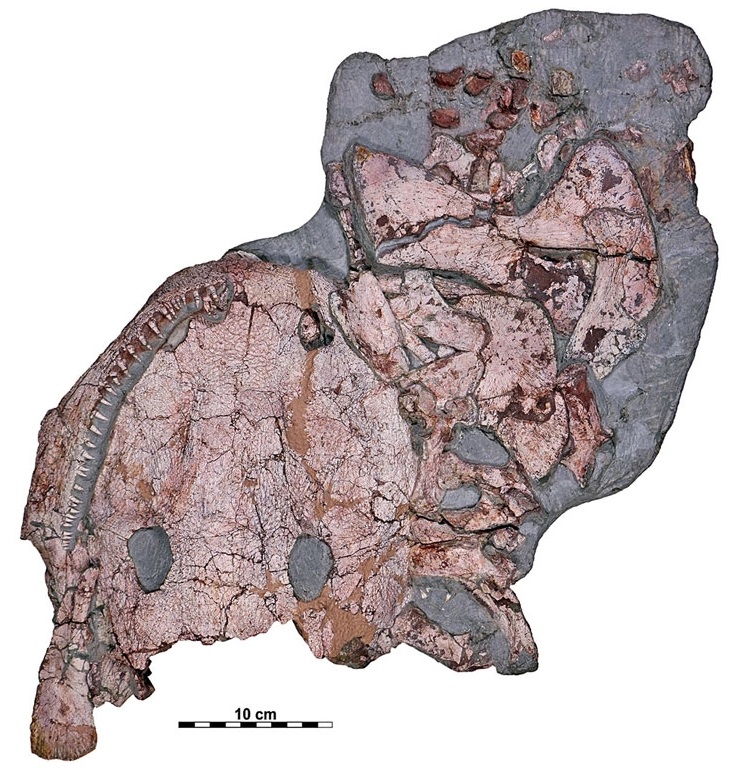
Stenokranio boldi n. gen. n. sp., skull with mandibles and anterior postcranial skeleton, paratype NHMMZ/LS PW 2019/5022.
Dorsal skull roof with left mandible, shoulder girdle, and anterior axial skeleton

Systematic paleontology

Tetrapoda Jaekel, 1909
Amphibia Linneaus, 1758
Temnospondyli von Zittel, 1888
Eryopidae Cope, 1882

Stenokranio new genus
 
Etymology: Greek στενός (stenos) for narrow, κρανίο (kranio) for skull.

Stenokranio boldi new species

Etymology: The species name honors the late Rudolf Bold from Rammelsbach near Kusel who found the holotype and only known specimen of the Remigiusberg sphenacodontid Cryptovenator hirschbergeri Fröbisch et al., 2011, in 2002.


Ralf Werneburg, Florian Witzmann, Larry Rinehart, Jan Fischer and Sebastian Voigt. 2024. A New eryopid temnospondyl from the Carboniferous–Permian Boundary of Germany. Journal of Paleontology. FirstView. pp. 1 - 31. DOI: 10.1017/jpa.2023.58


Thursday, December 14, 2023

[Paleontology • 2023] Mobulavermis adustus • A large pelagic lobopodian from the Cambrian Pioche Shale of Nevada, USA


Mobulavermis adustus
 McCall, 2023


Abstract
Lobopodians are an iconic and diverse group of animals from the Cambrian, which alongside radiodonts, present an important window into the evolution of arthropods and the development of Paleozoic ecosystems. Of these, a rare few species outside of Radiodonta possess lateral swimming flaps. The recent discovery of Utahnax provided much-needed insight into the evolution of swimming flaps, suggesting that the ventrolateral flaps of Kerygmachela evolved independently from other flap-bearing lobopodians and radiodonts. Here a new pelagic lobopodian species is described, Mobulavermis adustus new genus new species, the first lobopodian to be reported from the Cambrian-age Pioche Shale of Nevada. Mobulavermis adustus was large and possessed more ventrolateral flap pairs than any other known lobopodian or radiodont. It is found to be a close relative of both Kerygmachela and Utahnax, allowing the establishment of the new lobopodian family Kerygmachelidae new family. In addition, an indeterminate euarthropod fossil from the Pioche Formation is described in brief, and the recently described Chengjiang species Parvibellus avatus Liu et al., 2022, thought to have been related to the “gilled lobopodians,” is reinterpreted as a juvenile siberiid lobopodian.
 
Mobulavermis adustus KUMIP 298510 (holotype) from the Pioche Shale, middle Cambrian, Nevada:
(1) KUMIP 298510a (part), immersed, showing curving body and caudal spine preserved in negative relief; (2) KUMIP 298510b (counterpart), immersed, with caudal spine in strong positive relief; (3) KUMIP 298510b (counterpart), dry, closeup of caudal spine in positive relief and some reduced terminal flaps; (4) KUMIP 298510a (part), immersed, closeup of trunk interior, showing digestive tract, possible gut gland, and possible evidence of strong trunk annulation; (5) KUMIP 298510b (counterpart), dry, closeup of flap surfaces near anterior of specimen.
Scale bars = 10 mm. afm = anterior flap margin; an = annulations; bw = body wall; cs = caudal spine; dt = digestive tract; fo = flap ornamentation; mg = midgut gland; pfm = posterior flap margin; tf = terminal reduced flaps.

Systematic paleontology

Superphylum Panarthropoda Nielsen, Reference Nielsen1995

Family Kerygmachelidae new family
Type genus: Kerygmachela Budd, 1993.

Other taxa included: Utahnax Lerosey-Aubril and Ortega-Hernández, 2022, Mobulavermis n. gen.

Diagnosis: Lobopodians with lobopod-derived ventrolateral swimming flaps and lacking dorsal flaps or setal blades; trunk elongate, roughly cylindrical, and annulated; paired frontal appendages large and raptorial.


Genus Mobulavermis new genus

Type species: Mobulavermis adustus, by monotypy.

Etymology: From Mobula, the genus name of extant manta rays and devil rays, drawing comparison to the elongate flexible caudal spines and broad swimming flaps of Mobula rays, which resemble the outline of the new taxon, combined with the Latin vermis, meaning “worm.”


Mobulavermis adustus new species 
Anomalocaridid gen. indet. sp. indet.; Lieberman, 2003; p. 683, fig. 6.4.
indeterminate anomalocaridid; Lerosey-Aubril and Ortega-Hernández, 2022; p. 15.
 
Diagnosis: Lobopodian with vermiform body terminating in an elongate, flexible caudal spine; numerous broad, densely packed, lobopod-derived ventrolateral body flaps strongly overlapping successively; posterior ventrolateral body flaps decreasing in size linearly toward base of caudal spine until becoming flush with trunk; ventrolateral body flap posterior margins convex, anterior margin begins perpendicular to body wall before gradually curving posteriorly.

Occurrence: Pioche Formation, Combined Metals Member (Cambrian Series 2, Stage 4, Nephrolenellus multinodus Biozone), Lincoln County, Nevada; ....

Etymology: From the Latin adustus, meaning “burnt,” “singed,” or “sun-burnt,” in reference to the dramatic yellow, red, and black coloration of the two known specimens and to the arid conditions of the type locality.

Digital life reconstruction of Mobulavermis adustus, shown swimming in a Cambrian ocean alongside small bivalved arthropods and early chordates (speculative anterior morphology based on Kerygmachela kierkegaardi).


Christian R.A. McCall. 2023. A large pelagic lobopodian from the Cambrian Pioche Shale of Nevada. Journal of Paleontology. First View. DOI: 10.1017/jpa.2023.63 


 Non-technical Summary: Lobopodians are an iconic group of animals from the Paleozoic that includes Hallucigenia and Opabinia, as well as living animals such as tardigrades and velvet worms. They would also eventually give rise to the first arthropods by developing a hard, sclerotized exoskeleton. During the Cambrian, a rare subset of lobopodians possessed large swimming flaps, sometimes alongside ventral walking limbs. A new, large-bodied pelagic lobopodian from the Cambrian of Nevada is described, possessing more swimming flaps than any other lobopodian or radiodont.

Monday, November 20, 2023

[Paleontology • 2022] Needmorella simoni • A New Trilobite Genus (Dalmanitidae: Synphoriinae) from the Lower–Middle Devonian of West Virginia


Needmorella simoni 
Holloway & Scott, 2022


Abstract 
The trilobite Needmorella new genus, with type species Needmorella simoni new genus new species from the late Emsian to mid-Eifelian Needmore Shale of West Virginia, is a distinctive member of the subfamily Synphoriinae. It also occurs in the same formation in Pennsylvania and Virginia. It is not very similar to other Devonian representatives of the subfamily and is considered to have its origins in a morphologically less-derived ancestor because it shares certain similarities with Silurian genera, including the very short anterior cephalic border unmodified by crenulations or spines, S2 that is not largely reduced to a deep pit adaxially, the relatively low inflation of L3, and the well-defined interpleural furrows on the pygidium. Other particularly distinctive characters of the genus include the very long genal spines and the abaxially inflated and expanded posterior pleural bands on the thorax and pygidium that project slightly distally. The conventional concept of the Devonian synphoriine Anchiopsis Delo, 1935 appears to be incompatible with the holotype of the type species, judging from the early illustrations of the specimen, and the genus could be a synonym of Synphoria Clarke, 1894.


David J. Holloway and Brian M. Scott. 2022. Needmorella, A New Trilobite Genus of the Synphoriinae (Dalmanitidae) from the Lower–Middle Devonian of West Virginia. Journal of Paleontology. DOI: 10.1017/jpa.2022.96

Tuesday, June 27, 2023

[PaleoOrnithology • 2023] Eudyptula wilsonae • Pliocene Fossils support A New Zealand Origin for the Smallest Extant Penguins (Sphenisciformes: Spheniscidae)


Eudyptula wilsonae
Thomas, Tennyson, Marx & Ksepka, 2023

Artwork by Simone Giovanardi twitter.com/GiovaFavazzi
 
Abstract
A late Pliocene (3.36–3.06 Ma) exposure of the Tangahoe Formation on the North Island of New Zealand preserves close fossil relatives of many extant seabird clades. Here, we report an extinct member of the little penguin (Eudyptula Bonaparte, 1856) lineage from the Tangahoe Formation—the smallest extinct crown penguin yet known. Eudyptula wilsonae n. sp. is based on the nearly complete skulls of an adult and a fledged but immature individual. Both skulls show more slender proportions than modern little penguins and precede genome-derived estimates for the divergence between Eudyptula minor minor Forster, 1781 (endemic to New Zealand) and Eudyptula m. novaehollandiae Stephens, 1826 (native to Australia and recently established in New Zealand). This raises the possibility that the fossil taxon represents a lineage directly ancestral to extant little penguins. Our results support a Zealandian origin for little penguins, with subsequent Pleistocene dispersal to Australia and a more recent Holocene range expansion of Eudyptula m. novaehollandiae back into New Zealand.


Eudyptula wilsonae n. sp. 


Daniel B. Thomas, Alan J.D. Tennyson, Felix G. Marx and Daniel T. Ksepka. 2023. Pliocene Fossils support A New Zealand Origin for the Smallest Extant Penguins. Journal of Paleontology. First View, 1 - 11. DOI: 10.1017/jpa.2023.30

Friday, May 19, 2023

[Paleontology • 2023] Archopterus anjiensis • The First Documentation of An Ordovician eurypterid (Chelicerata) from China


Archopterus anjiensis
Wang, Braddy, Botting & Zhang, 2023

Artwork: Dinghua Yang.

Abstract
An early form of eurypterids (Chelicerata), Archopterus anjiensis n. gen. n. sp., is described from the uppermost Ordovician Wenchang Formation of Anji County, Zhejiang Province, South China. It is the earliest record of eurypterids in China and likely the oldest representative of the Adelophthalmidae. The species, represented by a single specimen, is diagnosed by a ventrally preserved prosoma with a parabolic carapace, Hughmilleria-type prosomal appendages, a short vase-shaped metastoma, and a three-segmented type A (female) genital appendage. The specimen is preserved, together with diverse sponges, graptolites and occasional nautiloids, in a 10 m thick shale of marine deep-water setting. This finding extends the stratigraphic range of adelophthalmids from the previously recorded early Silurian into the Late Ordovician (some 10 million years older) and supports an earlier cryptic phase of eurypterid evolution in Gondwana.

Systematic paleontology
Subphylum Chelicerata Heymons, Reference Heymons1901
Order Eurypterida Burmeister, Reference Burmeister1843
Suborder Eurypterina Burmeister, Reference Burmeister1843

Family Adelophthalmidae Tollerton, Reference Tollerton1989

Genus Archopterus new genus
 
Etymology: Genus name from the Latin prefix arch-, meaning “ancient,” and -opterus, a common suffix for eurypterids, meaning “wing.”


Archopterus anjiensis n. gen. n. sp.

Holotype: NIGP 164906, Nanjing Institute of Geology and Palaeontology, CAS, China.

Diagnosis: Adelophthalmid with a parabolic carapace, Hughmilleria-type prosomal appendages, vase-shaped metastoma, and three-segmented type A (female) genital appendage.

Occurrence: Hirnantian (Metabolograptus persculptus Biozone) of the Wenchang Formation of Tianfucun, Anji County, Zhejiang Province, South China.

Etymology: The species is named after Anji County, where the type specimen was discovered.

 
Han Wang, Simon J. Braddy, Joseph Botting and Yuandong Zhang. 2023. The First Documentation of An Ordovician eurypterid (Chelicerata) from China. Journal of Paleontology. First View. DOI: 10.1017/jpa.2023.21

Thursday, February 9, 2023

[PaleoOrnithology • 2023] Kumimanu fordycei & Petradyptes stonehousei • Largest-known Fossil Penguin provides insight into the early Evolution of sphenisciform Body Size and Flipper Anatomy


 Kumimanu fordycei & Petradyptes stonehousei
 Ksepka, Field, Heath, Pett, Thomas, Giovanardi & Tennyson, 2023

Life reconstructions by Simone Giovanardi.

Abstract
Recent fossil discoveries from New Zealand have revealed a remarkably diverse assemblage of Paleocene stem group penguins. Here, we add to this growing record by describing nine new penguin specimens from the late Paleocene (upper Teurian local stage; 55.5–59.5 Ma) Moeraki Formation of the South Island, New Zealand. The largest specimen is assigned to a new species, Kumimanu fordycei n. sp., which may have been the largest penguin ever to have lived. Allometric regressions based on humerus length and humerus proximal width of extant penguins yield mean estimates of a live body mass in the range of 148.0 kg (95% CI: 132.5 kg–165.3 kg) and 159.7 kg (95% CI: 142.6 kg–178.8 kg), respectively, for Kumimanu fordycei. A second new species, Petradyptes stonehousei n. gen. n. sp., is represented by five specimens and was slightly larger than the extant emperor penguin Aptenodytes forsteri. Two small humeri represent an additional smaller unnamed penguin species. Parsimony and Bayesian phylogenetic analyses recover Kumimanu and Petradyptes crownward of the early Paleocene mainland NZ taxa Waimanu and Muriwaimanu, but stemward of the Chatham Island taxon Kupoupou. These analyses differ, however, in the placement of these two taxa relative to Sequiwaimanu, Crossvallia, and Kaiika. The massive size and placement of Kumimanu fordycei close to the root of the penguin tree provide additional support for a scenario in which penguins reached the upper limit of sphenisciform body size very early in their evolutionary history, while still retaining numerous plesiomorphic features of the flipper.

 
Life reconstructions of Kumimanu fordycei and Petradyptes stonehousei,
by Simone Giovanardi. twitter.com/GiovaFavazzi

Skeletal reconstructions of (left to right) Kumimanu fordyceiPetradyptes stonehousei, and Aptenodytes forsteri a modern emperor penguin.


Daniel T. Ksepka, Daniel J. Field, Tracy A. Heath, Walker Pett, Daniel B. Thomas, Simone Giovanardi and Alan J.D. Tennyson. 2023. Largest-known Fossil Penguin provides insight into the early Evolution of sphenisciform Body Size and Flipper Anatomy. Journal of Paleontology. First View , pp. 1 - 20
UUID: zoobank.org/15b1d5b2-a5a0-4aa5-ba0a-8ef3b8461730