Showing posts with label Mozambique. Show all posts

Wednesday, April 22, 2026

[Herpetology • 2026] Nadzikambia nubila, N. evanescens, N. franklinae & N. goodallae • Sky Islands of Mozambique harbour Cryptic Species of Chameleons: Description of Four New Species of Sylvan Chameleons (Squamata: Chamaeleonidae: Nadzikambia Tilbury, Tolley & Branch, 2006)


 A adult male Nadzikambia mlanjensis (Broadley, 1965); B adult male N. baylissi Branch & Tolley, 2010;
C adult male Nadzikambia franklinae sp. nov.; D adult male N. goodallae sp. nov.;
E adult male N. evanescens sp. nov.; F adult female N. nubila sp. nov. 
Tolley & Conradie, 2026

  
Abstract
Several populations of forest-living chameleons in the genus Nadzikambia have been recorded from the montane sky island forests in northern Mozambique. These populations have not been evaluated for their species status, despite the potential for these allopatric populations having diverged at the species level due to vicariance of forest since the mid-Miocene. With only two described species of Nadzikambia, we hypothesised that candidate (new) species occur on each of four additional montane sky islands surveyed. We applied an integrative taxonomic approach to evaluate this, using morphological and genetic data collected from each population. Their distributions were mapped, the morphological dataset was quantitatively analysed using a multivariate analysis, and one nuclear and three mitochondrial genes were sequenced to generate a phylogeny and allele networks. Independent species delimitation analyses were applied to the genetic dataset (mPTP, SpeciesIdentifier, p distances) as supporting evidence for candidate species. By applying integrative taxonomy under the General Lineage Species Concept, we find support for four new species of Nadzikambia. The montane forests where they occur have declined in extent due to slash and burn agriculture and these forest endemics are presumed to be in a proportional decline as their habitat contracts. By examining historical and present-day satellite imagery, we show that all Nadzikambia species have lost significant proportions of their range. Given they do not occur outside these forests, these species are in imminent danger of extinction.

Keywords: Africa, Chamaeleonidae, conservation priority, Critically Endangered, habitat loss, morphological conservatism, reptiles, species declines, species delimitation, taxonomy
 
Life photos of Nadzikambia: A adult male N. mlanjensis (PEM R18445), B adult male N. baylissi (unvouchered specimen),
C adult holotype male N. franklinae sp. nov. (PEM R21165), D adult holotype male N. goodallae sp. nov. (PEM R24394),
E adult holotype male N. evanescens sp. nov. (PEM R24372), F adult paratype female N. nubila sp. nov. (NHMUK 2025.3278).


Nadzikambia franklinae sp. nov.
Namuli sylvan chameleon

Etymology. The new species is named after the British chemist Rosalind Franklin (1920–1958) whose work on X-Ray crystallography, particularly her legendary “photo 51”, revealed the structure of DNA (Franklin and Gosling 1953). Her ground-breaking work subsequently allowed for the field of phylogenetics to develop, decades later. Today, nearly all modern taxonomy is phylogenetically informed, including the description of N. franklinae sp. nov.

Nadzikambia goodallae sp. nov.
Ribáuè sylvan chameleon

Etymology. This species is named after Jane Goodall (1934–2025), an inspirational scientist who lived and worked in Africa throughout her lengthy career. Although her work was dedicated to the study of Pan troglodytes, the Chimpanzee, she spent much of her life living and working in tropical forest, in particular at Gombe National Park, Tanzania. Like her own study species, this chameleon is a forest endemic and the destruction of forest, and other habitats, both at Mount Ribáuè as well as within the home range of P. troglodytes in Central and West Africa is causing forest-living species to decline to the brink of extinction.

Nadzikambia evanescens sp. nov.
Inago sylvan chameleon

Etymology. This species is named Nadzikambia evanescens with the specific epithet from the Latin ‘evanescens’ meaning ‘vanishing’. The name is a present participle that can be used as an adjective or a noun in apposition, and the specific epithet is the same for all genders. The etymology is to highlight the rapidly vanishing forest on Mount Inago and the peril that this species is currently under. The forest has already been reduced to a few small patches, and the uncontrolled conversion of forest to agriculture is continuing. The consequence could be the demise of this endemic forest species, if action is not taken to stop the forest destruction.

Nadzikambia nubila sp. nov.
Chiperone sylvan chameleon

Etymology. This species is named after the “Ciperoni” – the term used locally for the weather that brings heavy clouds and orographic rainfall to the area. The cloud sustains the mid-elevation wet forest on this mountain. The epithet ‘nubila’ is derived from the Latin ‘nubilus’ meaning “cloudy,” and is modified to the feminine form to agree with the feminine gender of the genus Nadzikambia.


 Krystal Tolley and Werner Conradie. 2026. Sky Islands of Mozambique harbour Cryptic Species of Chameleons: Description of Four New Species of Sylvan Chameleons (Squamata: Chamaeleonidae: Nadzikambia Tilbury, Tolley & Branch, 2006). Vertebrate Zoology. 76: 207-246. DOI: doi.org/10.3897/vz.76.e178403 [21 Apr 2026]

Tuesday, September 23, 2025

[Ichthyology • 2025] Heteromormyrus dolichorhynchus, H. angusticaudata, H. tangwenai, ... • Review of the southern African Slender Stonebashers, Genus Heteromormyrus Steindachner 1866 (Teleostei: Mormyridae), with Description of Six New Species

Heteromormyrus dolichorhynchus, H. angusticaudata,
H. xanekweorumH. chilembwei
H. tangwenai and H. ndauorum 
Mutizwa, Kadye, Bragança & Chakona, 2025


Abstract
Recent molecular studies have advanced our knowledge of the taxonomic diversity and generic placement of the slender stonebashers, previously placed in the genus Hippopotamyrus, in southern Africa. These fishes were recently transferred to the genus Heteromormyrus whose range encompasses the Kwanza, Kunene, Okavango, Zambezi, Pungwe and Buzi River systems in southern Africa, as well as the southern tributaries of the Congo River system. The present study builds on previous research that identified at least eight candidate species within the Heteromormyrus ansorgii species complex by providing formal descriptions for six new species and redescriptions of Heteromormyrus pauciradiatus and H. ansorgii s.s. The Kwanza River system is peculiar because it currently has five known species in this genus, some of which are co-distributed, whereas the other river systems have only one or two species in this genus. Two of the new species, Heteromormyrus dolichorhynchus sp. nov. and Heteromormyrus angusticaudata sp. nov., are endemic to the Kwanza River system. Heteromormyrus xanekweorum sp. nov. is confined to the Okavango River system, Heteromormyrus chilembwei sp. nov. occurs in the Ruo River (lower Zambezi River system), Heteromormyrus tangwenai sp. nov. is endemic to the Pungwe River system and Heteromormyrus ndauorum sp. nov. is endemic to the Buzi River system. Species in this genus exhibit high morphological similarity, but they can be separated by a combination of characters, including scale counts, dorsal- and anal-fin ray counts, vertebral counts, caudal peduncle depth, position of nostrils, head shape and variation in colour pattern. Taxonomic diversity within this genus is likely to be higher than currently known, and future studies, particularly in the Kwanza and upper Zambezi rivers, are anticipated to uncover additional new species.

Keywords: diversity, freshwater, mormyrids, southern Africa, taxonomy


Heteromormyrus dolichorhynchus sp. nov. 
Heteromormyrus angusticaudata sp. nov.
Heteromormyrus xanekweorum sp. nov. 
Heteromormyrus chilembwei sp. nov. 
 Heteromormyrus tangwenai sp. nov. 
 Heteromormyrus ndauorum sp. nov.

The range of colour patterns observed in Heteromormyrus lineages and species from southern Africa. 
 (b) Heteromormyrus sp. ‘K5’ (SAIAB 203161) had a clearly visible dark blotch present near the flexion point of the caudal fin.
(c) Heteromormyrus sp. ‘K3’ (SAIAB 84790) had a clearly visible dark blotch present near the flexion point of the caudal fin and a dark vertical bar just anterior to this blotch.
 (d) Heteromormyrus sp. ‘K1’ (SAIAB 85039) had a series of clearly visible thin curved vertical bars that were more conspicuous in the anterior portion of the flank.
 Scale bar = 1 cm.


Tadiwa I. Mutizwa, Wilbert T. Kadye, Pedro H. N. Bragança and Albert Chakona. 2025. Review of the southern African Slender Stonebashers, Genus Heteromormyrus Steindachner 1866 (Teleostei: Mormyridae), with Description of six new species. Journal of Fish Biology. DOI: doi.org/10.1111/jfb.70191 [17 September 2025] 

Saturday, November 30, 2024

[Ichthyology • 2024] Pollimyrus ibalazambai, P. krameri, ... • Morphometric Synthesis of Pollimyrus (Osteoglossiformes: Mormyridae) with the Description of Four New Species


 Pollimyrus ibalazambai 
Pollimyrus krameri 
 Pollimyrus weyli 
Dierickx, Lunkayilakio, Bills & Vreven, 2024


Abstract
Mormyridae, a species-rich family endemic to Africa, remains taxonomically understudied. This has been the case for the genus Pollimyrus Taverne, 1971, which hinders further understanding of the distribution, ecology, and conservation of its species. Therefore, an in-depth morphometric comparison of all currently valid species is carried out using most of the available type specimens. Species delineations were re-evaluated, and four species new to science described: Pollimyrus ibalazambai sp. nov. (the Luki River, the Democratic Republic of the Congo), Pollimyrus krameri sp. nov. (the Lugenda River, Mozambique), Pollimyrus vanneeri sp. nov. (the Kouilou-Niari River, the Republic of the Congo), and Pollimyrus weyli sp. nov. (the Buzi River, Mozambique). In this study, Pollimyrus guttatus is confirmed to belong to Pollimyrus, whereas Pollimyrus eburneensis and Cyphomyrus plagiostoma seem more similar to species allocated to other genera. No or only little morphological differences were found between the type series of several species, which could indicate the need for synonymization of these species (Pollimyrus cuandoensis with Pollimyrus marianne and Pollimyrus nigripinnis with Pollimyrus pulverulentus). As such 20 species are currently morphologically identifiable in the genus Pollimyrus. The present study highlights the critical need for further synthetic efforts and new collecting efforts across Africa for this and other Mormyridae genera.

Keywords: morphology, Pollimyrus ibalazambai sp. nov., Pollimyrus krameri sp. nov., Pollimyrus vanneeri sp. nov., Pollimyrus weyli sp. nov., taxonomy
 
Class Actinopterygii Klein, 1885
Order Osteoglossiformes Berg, 1940

Family Mormyridae Bonaparte, 1831
Subfamily Mormyrinae Bonaparte, 1831

Genus Pollimyrus Taverne, 1971
Pollimyrus Taverne, 1971: 140 
(type species: Mormyrus isidori Valenciennes, 1847, by original designation).i


Pollimyrus ibalazambai sp. nov.

Etymology: The specific epithet is a noun honoring Professor Dr. Armel Ibala Zamba (1975–) (Université Marien Ngouabi, the Republic of the Congo) for his contributions to African ichthyology and his work in the Luki River basin (DRC) within the framework of his PhD (2005–2010).

Pollimyrus krameri sp. nov.

Etymology: The specific epithet is a noun honoring Professor Dr. Bernd Kramer (1943–) (University of Regensburg, Germany) for his contributions to ichthyology and study of weakly electric fish, southern African Mormyridae in particular.

Photograph of dead, but not yet fixed, holotype specimen of Pollimyrus krameri sp. nov. (South African Institute for Aquatic Biodiversity [SAIAB] 73892: 45.6 mm SL [standard length]) from the Lugenda River (by R.B., August 22, 2003).
Photograph of dead, but not yet fixed, holotype of Pollimyrus weyli sp. nov. (South African Institute for Aquatic Biodiversity [SAIAB] 67639: 51.43 mm SL [standard length]) from the Mussapa River (by R.B., September 27, 2002).
Photograph of a live type specimen of Pollimyrus ibalazambai sp. nov. from the Luki River, near the Kimbozi Bridge (by S.W.L., Mbisa-Congo I, August 10, 2016).

Pollimyrus vanneeri sp. nov.

Etymology: The specific epithet is a noun honoring Professor Dr. Wim Van Neer (1954–) (Royal Belgian Institute of Natural Sciences, Brussels, and KU Leuven, Leuven, Belgium) for his contributions to ichthyoarchaeology in Europe and northern Africa.

Pollimyrus weyli sp. nov.

Etymology: The specific epithet is a noun honoring the late Professor Dr. Olaf L.F. Weyl (1972–†2020) (SAIAB) for his contributions to African ichthyology and his work in the Buzi River system within the framework of his PhD, expanding the collections housed at SAIAB and increasing the understanding of the biodiversity in the region.
 

Katrien Dierickx, Soleil Wamuini Lunkayilakio, Roger Bills and Emmanuel Vreven. 2024. Morphometric Synthesis of Pollimyrus (Teleostei, Mormyridae) with the Description of Four New Species. Journal of Fish Biology. DOI: doi.org/10.1111/jfb.15983

Monday, March 18, 2024

[Ecology • 2024] A Biogeographical Appraisal of the threatened South East Africa Montane Archipelago Ecoregion

 
Location and extent of the South East Africa Montane Archipelago (SEAMA) 
Examples of SEAMA endemics. (a) Rhinolophus mabuensis (AM), (b) Chamaetylas choloensis (JB), (c) Nothophryne inagoensis (WC), (d) Atheris mabuensis (WRB), (e) Epamera malaikae (TCEC), f) Rhampholeon maspictus (JB), (g) Nadzikambia baylissi (WRB), (h) Maritonautes namuliensis (JB), (i) Euphorbia mlanjeana (ID), (j) Widdringtonia whytei (JB), (k) Encephalartos gratus (JB).

in Bayliss, Bittencourt-Silva, Branch, Bruessow, Collins, Congdon, Conradie, ... et Platts, 2024.


Abstract
Recent biological surveys of ancient inselbergs in southern Malawi and northern Mozambique have led to the discovery and description of many species new to science, and overlapping centres of endemism across multiple taxa. Combining these endemic taxa with data on geology and climate, we propose the ‘South East Africa Montane Archipelago’ (SEAMA) as a distinct ecoregion of global biological importance. The ecoregion encompasses 30 granitic inselbergs reaching > 1000 m above sea level, hosting the largest (Mt Mabu) and smallest (Mt Lico) mid-elevation rainforests in southern Africa, as well as biologically unique montane grasslands. Endemic taxa include 127 plants, 45 vertebrates (amphibians, reptiles, birds, mammals) and 45 invertebrate species (butterflies, freshwater crabs), and two endemic genera of plants and reptiles. Existing dated phylogenies of endemic animal lineages suggests this endemism arose from divergence events coinciding with repeated isolation of these mountains from the pan-African forests, together with the mountains’ great age and relative climatic stability. Since 2000, the SEAMA has lost 18% of its primary humid forest cover (up to 43% in some sites)—one of the highest deforestation rates in Africa. Urgently rectifying this situation, while addressing the resource needs of local communities, is a global priority for biodiversity conservation.

Location and extent of the South East Africa Montane Archipelago (SEAMA) showing core sites in red, and an outline boundary of the convex hull of the ecoregion (created using QGIS version 3.28.12 LTR https://qgis.org/en/site/).

Examples of SEAMA endemics. (a) Rhinolophus mabuensis (AM), (b) Chamaetylas choloensis (JB), (c) Nothophryne inagoensis (WC), (d) Atheris mabuensis (WRB), (e) Epamera malaikae (TCEC), f) Rhampholeon maspictus (JB), (g) Nadzikambia baylissi (WRB), (h) Maritonautes namuliensis (JB), (i) Euphorbia mlanjeana (ID), (j) Widdringtonia whytei (JB), (k) Encephalartos gratus (JB).


Julian Bayliss, Gabriela B. Bittencourt-Silva, William R. Branch, Carl Bruessow, Steve Collins, T. Colin E. Congdon, Werner Conradie, Michael Curran, Savel R. Daniels, Iain Darbyshire, Harith Farooq, Lincoln Fishpool, Geoffrey Grantham, Zacharia Magombo, Hermenegildo Matimele, Ara Monadjem, Jose Monteiro, Jo Osborne, Justin Saunders, Paul Smith, Claire N. Spottiswoode, Peter J. Taylor, Jonathan Timberlake, Krystal A. Tolley, Érica Tovela and Philip J. Platts. 2024. A Biogeographical Appraisal of the threatened South East Africa Montane Archipelago Ecoregion. Scientific Reports. 14, 5971. DOI: 10.1038/s41598-024-54671-z

  news.mongabay.com/2024/03/new-ecoregion-proposed-for-southern-africas-threatened-sky-islands
  news.mongabay.com/2018/10/secrets-revealed-scientists-explore-unique-isolated-forest-in-mozambique

Subjects: Adaptive radiation, Biodiversity, Biogeography, Climate and Earth system modelling, Conservation biology, Ecological modelling, Ecology, Ecosystem ecology, Ecosystem services, Evolution, Forest ecology, Palaeoecology, Speciation, Taxonomy, Tropical ecology, Zoology

Monday, March 4, 2024

[Botany • 2022] Hartliella txitongensis (Linderniaceae) • A New Species from Mozambique


Hartliella txitongensis Osborne & Eb.Fisch.,

in Osborne, Datizua, Mucaleque et Fischer, 2022. 

Summary
Hartliella txitongensis Osborne & Eb.Fisch., a species new to science from Niassa Province in Northern Mozambique, is described and illustrated. Hartliella txitongensis is the only species of Hartliella known from outside the Upper Katanga region of the Democratic Republic of the Congo and the adjacent region of Zambia. The species is provisionally assessed as Critically Endangered under IUCN criterion B and its potential to be a metallophyte is highlighted. A key to the five species of Hartliella is provided.

Keywords: Chitonga, metallophyte, Niassa, plant taxonomy, Txitonga


Hartliella txitongensis Osborne & Eb.Fisch. sp. nov.

RECOGNITION. Hartliella txitongensis is similar to H. bampsii, but differs in the pairs of stem leaves being closely spaced with a short and condensed internode, thus forming a rosette at base (stem leaves are usually more distant in H. bampsii on a ± elongated stem), the leaves being obovate to elliptic, 2 – 7.5 × 1 – 3.5 cm (vs broadly obovate, 4 – 8 × 2.4 – 2.9 cm in H. bampsii), the slightly longer corolla tube, 8 – 9 mm long (vs 5 – 7 mm in H. bampsii), the undivided upper lip of the corolla (upper lip of corolla bifid in H. bampsii) and the bilobed appendage at the base of the abaxial filaments (simple globose in all other Hartliella species). It differs from Hartliella capitata in the elongated stem below the inflorescence and the shape of the leaves (these being broadly obovate to lanceolate, (3 –) 5 – 7.5 × (1.5 –) 3 – 6 cm in H. capitata) and the shorter corolla tube (12 mm long in H. capitata). A key to species of Hartliella is given below and differences are summarised in Table 1.

ETYMOLOGY. Named after the Txitonga (= Chitonga) Mountains in order to highlight the conservation value of the area.
 

Jo Osborne, Castigo Datizua, Papin Mucaleque and Eberhard Fischer. 2022. Hartliella txitongensis (Linderniaceae), A New Species from Mozambique. Kew Bulletin. DOI: 10.1007/s12225-022-10034-3

Monday, January 15, 2024

[Botany • 2023] Crepidorhopalon droseroides (Linderniaceae) • A New and possibly carnivorous Species from Mozambique


Crepidorhopalon droseroides Eb.Fisch., Wursten & I.Darbysh.,

in Fischer, Wursten & Darbyshire, 2023.

Abstract
The new species Crepidorhopalon droseroides from Mozambique is described and illustrated. It represents the third strict Mozambique endemic in Linderniaceae, and it differs from all known species of Crepidorhopalon in the long sticky glandular hairs. The hypothesis that the species may be carnivorous is discussed. The Conservation Status is preliminarily assessed.

Keywords: Crepidorhopalon droseroides, endemics, carnivory, IUCN Red List, Philcoxia, taxonomy, Eudicots


Eberhard Fischer, Bart Wursten and Iain Darbyshire. 2023. A New and possibly carnivorous Species of Crepidorhopalon (Linderniaceae) from Mozambique.  Phytotaxa. 603(2); 191-198. DOI: 10.11646/phytotaxa.603.2.6

Kew’s top 10 new species of 2023
Kew’s scientists and international partners share their 10 favourite new species named to science in 2023.

Monday, May 15, 2023

[Entomology • 2023] A Review of the Assassin-fly Genus Anypodetus Hermann, 1907 (Diptera: Asilidae) with the Description of A New Species, Anypodetus londti, from Mozambique and Zimbabwe


[36-38] Anypodetus londti  Dikow & Dubus, 2023

[1, 2] A. fasciatus Hermann, 1907
[4] A. fascipennis Engel, 1924


Abstract
The genus Anypodetus Hermann, 1907 (Diptera, Asilidae, Laphriinae) is reviewed. Currently, eight species are recognized from Botswana, Mozambique, Namibia, South Africa, Zimbabwe, and southern-most Zambia, i.e., Anypodetus arachnoides Oldroyd, 1974 widespread, Anypodetus fasciatus Hermann, 1907 widespread, Anypodetus fascipennis Engel, 1924 widespread, Anypodetus leucothrix Londt, 2000 restricted to southern Namibia and south-western South Africa, Anypodetus macroceros Londt, 2000 restricted to west-central Namibia, Anypodetus nigrifacies Ricardo, 1925 restricted to eastern-most South Africa and southern Mozambique, Anypodetus phalaros Londt, 2000 Namibia and South Africa, and Anypodetus unicolor Oldroyd, 1974 Namibia, eastern South Africa, adjacent Mozambique, and southern Zimbabwe. One new species, Anypodetus londti sp. nov. from Mozambique and Zimbabwe, is described for a total of nine species in the genus. Study of the secondary type specimens of A. unicolor from Namibia revealed that these specimens do not represent this species, reducing the number of species recorded from Namibia to six. Anypodetus leucothrix is recorded with several additional collecting events in central and northern Namibia extending its range significantly. Distribution, biology, occurrence in biodiversity hotspots sensu Conservation International, and seasonal imago flight activity are discussed. Diagnoses, photographs, specimen occurrence data, and an identification key to species are provided with the new species described in detail. The sexual dimorphism in the development of the mystax and wing vein variation in regard to the alignment of M2 and M3 are discussed and illustrated.

Keywords: Afrotropical, mystax sexual dimorphism, robber fly, wing vein variation

Photographs of Anypodetus species in nature
1 A. fasciatus male near Windhoek, Khomas, Namibia, 12 Nov 2012 2 A. fasciatus male at Namib-Naukluft NP, Erongo, Namibia (see habitat photo in Fig. 7, iNaturalist observation inaturalist.org), 8 Feb 2012
3, 4 A. fascipennis female and male in copula at Aberdeen NR, Eastern Cape, South Africa (see habitat photo in Fig. 6, iNaturalist observation inaturalist.org), 5 Dec 2015.
 Photographs by S. Marshall (1) and T. Dikow (2–4).

Anypodetus londti sp. nov.
36 ♂ holotype (USNMENT01140568), lateral 37 same, dorsal 38 same, head anterior.
Scale bars: 5 mm.
 

 Torsten Dikow and Meliah Dubus. 2023.  A Review of the Assassin-fly Genus Anypodetus Hermann, 1907 with the Description of A New Species (Insecta, Diptera, Asilidae). In: Dikow T, Williams K, Midgley J (Eds) Festschrift for Jason Gilbert Hayden Londt. African Invertebrates. 64(2): 165-206. DOI: 10.3897/afrinvertebr.64.104283


Wednesday, January 18, 2023

[Mollusca • 2023] Jorunna liviaeCan you find me? A New Sponge-like Nudibranch from the Genus Jorunna Bergh, 1876 (Gastropoda: Discodorididae)


Jorunna liviae
Tibiriçá, Strömvoll & Cervera, 2023

C. Jorunna liviae sp. nov. near its egg mass, and Favorinus sp. feeding on it; D. Close-up of Favorinus sp.; E. Jorunna liviae sp. nov. mating; F. Details of Jorunna liviae sp. nov. egg mass.

Abstract
The nudibranch diversity of the western Indian Ocean is comparatively one of the least studied in the world. In this paper a sponge-like Discodoridae nudibranch Jorunna liviae sp. nov. is described. The description is based on integrative anatomy, including molecular analysis of two genes (the mitochondrial COI and the nuclear H3), dissections, electron microscopy (SEM) of buccal elements, micro tomography of the spicule’s arrangements and ecological observations. This study provides the first ever molecular data of Jorunna species from the western Indian Ocean, helping to fill the gap to further understand this apparent paraphyletic genus.

Key Words: biodiversity, Heterobranchia, Mozambique, new species, phylogeny, sea slugs

Jorunna liviae sp. nov. (MNCN15.05/200187) external morphology.
A. Dorsal view; B. Ventral view; C. SEM photography of dorsal caryophyllids; D. Rhinophores sheath details; E. Rhinophore; F. Gill branches.

Jorunna liviae sp. nov. in situ.
 A. Hosting sponge Amphimedon brevispiculifera (Dendy, 1905); B. Jorunna liviae sp. nov. resting on sponge; C. Jorunna liviae sp. nov. near its egg mass, and Favorinus sp. feeding on it; D. Close-up of Favorinus sp.; E. Jorunna liviae sp. nov. mating; F. Details of Jorunna liviae sp. nov. egg mass.


Order Nudibranchia Cuvier, 1817

Superfamily Doridoidea Rafinesque, 1815
Family Discodorididae Bergh, 1891

Genus Jorunna Bergh, 1876

Jorunna liviae Tibiriçá, Strömvoll & Cervera, sp. nov.

Diagnosis: Body elongate-ovulated. Dorsum pale gray to pink, covered on highly dense caryphyllidia; rhinophores short, with up to nine lamellae, ending in a knob apex; six to nine bipinnate branchial leaves encircling the anal pore. Radula with five to seven very thin pectinated outermost teeth bearing long bundled fibrous denticles. Labial cuticle smooth. Copulatory spine with bifid apex.

Etymology: This species is dedicated to Livia Renée Cornelius, daughter of the second author of this paper.

Habitat: Specimens were collected on submerged subtropical compressed sandstone reefs in Ponta do Ouro, Mozambique.


 Yara Tibiriçá, Jenny Strömvoll and Juan Lucas Cervera. 2023. Can you find me? A New Sponge-like Nudibranch from the Genus Jorunna Bergh, 1876 (Mollusca, Gastropoda, Discodorididae). Zoosystematics and Evolution 99(1): 63-75. DOI: 10.3897/zse.99.95222

Saturday, October 8, 2022

[Arachnida • 2022] The Ground Spider Genera Leptodrassex Murphy, 2007 and Leptopilos Levy, 2009 (Araneae: Gnaphosidae) in southern Africa, Including the Description of A New Genus and Seven New Species


  Habitus of living Leptodrassinae spiders from southern Africa:
1. Female and 2. Juvenile Afrodrassex balrog sp. nov. from Bloemfontein, South Africa;
 3. Female and 4. Male Leptodrassex murphyi sp. nov. from Bloemfontein, South Africa;
5, 6. Male Leptopilos digitus sp. nov. from Namaqua National Park, South Africa.

in Haddad &  Booysen, 2022. 
 Photos: R. Booysen.
 
Abstract
The ground spider genera Leptodrassex Murphy, 2007 and Leptopilos Levy, 2009 are recorded from southern Africa for the first time, with the description of five new species: Leptodrassex murphyi sp. nov. (♂ ♀) from Mozambique and South Africa, and L. capensis sp. nov. (♀) from South Africa; Leptopilos butleri sp. nov. (♂ ♀) and L. vasivulva sp. nov. (♂ ♀) from Botswana, South Africa and Zimbabwe, and L. digitus sp. nov. (♂ ♀) from South Africa. Further, the new genus Afrodrassex gen. nov. is described, with the type species A. balrog sp. nov. (♂ ♀) from South Africa and Angola, and A. catharinae sp. nov. (♂ ♀) from South Africa described therein. Details of the somatic and genitalic morphology of all three genera are examined by scanning electron microscopy, and revised descriptions of Leptodrassex and Leptopilos are presented.

Keywords: Araneae, Afrotropical, Angola, Botswana, endemic, Leptodrassinae, Mozambique, South Africa, Zimbabwe


  Habitus of living Leptodrassinae spiders from southern Africa:
1. Female and 2. Juvenile Afrodrassex balrog sp. nov. from Bloemfontein, South Africa;
 3. Female and 4. Male Leptodrassex murphyi sp. nov. from Bloemfontein, South Africa;
5, 6. Male Leptopilos digitus sp. nov. from Namaqua National Park, South Africa.
 Photos: R. Booysen.


   Charles R. Haddad and Ruan Booysen. 2022. The Ground Spider Genera Leptodrassex Murphy, 2007 and Leptopilos Levy, 2009 (Araneae: Gnaphosidae) in southern Africa, Including the Description of A New Genus and Seven New Species. Zootaxa. 5194(1); 1-32. DOI: 10.11646/zootaxa.5194.1.1

Friday, August 5, 2022

[Botany • 2022] Cladoceras rovumense (Gentianales: Rubiaceae) • A New Species from southeast Tanzania and northeast Mozambique


  Cladoceras rovumense I.Darbysh., J.E.Burrows & Q.Luke,  

in Darbyshire, Burrows, Luke & Langa, 2022. 

ABSTRACT
Following a review of the circumscription of the genus Cladoceras Bremek. (Rubiaceae) in relation to Tarenna Gaertn., the new species Cladoceras rovumense I.Darbysh., J.E.Burrows & Q.Luke sp. nov. is described from the dry forests of the Rovuma Centre of Plant Endemism (CoE) in southeast Tanzania and northeast Mozambique. This species has previously been known as Tarenna sp. 53, following the revision of African Tarenna by Jérôme Degreef. A comparison to Cladoceras subcapitatum (K.Schum. & K.Krause) Bremek., the only other member of this genus as currently circumscribed, is provided. The new species is assessed as Endangered under the criteria of the IUCN Red List. New records for Mozambique of two further Rovuma CoE endemics are recorded: Celosia patentiloba C.C.Towns. (Amaranthaceae) and Cordia fissistyla Vollesen (Boraginaceae), both of which are globally threatened. 

Keywords: new record, new species, Rovuma, taxonomy, threatened

  Cladoceras rovumense I.Darbysh., J.E.Burrows & Q.Luke sp. nov.
A. Habit, fruiting shoot. B. Habit, flowering shoot. C. Stipule, external face. D. Hairs revealed beneath fallen stipule. E. Portion of flowering stem showing indumentum. F. Leaf, adaxial indumentum. G. Leaf, abaxial indumentum. H. Dissected corolla with androecium. I. Style and stigma. J. Longitudinal section of ovary. K. Mature fruit. L. Fruit, partially dissected to reveal seeds. M. Seed in two views.
A, E–G, K–M from S. Bidgood et al. 1357; B, H–I from Q. Luke 13883; C–D, J from Q. Luke et al. 10116.
Drawn by Andrew Brown.


 Species of Cladoceras Bremek. in the field.
A–B. Cladoceras rovumense I.Darbysh., J.E.Burrows & Q.Luke sp. nov.
C–D. Cladoceras subcapitatum (K.Schum. & K.Krause) Bremek.
(photos: A. Q. Luke; B. P.A. Luke, Mozambique; C.-D. W.R.Q. Luke, Base Titanium nursery, Kwale County, Kenya).


  Cladoceras rovumense I.Darbysh., J.E.Burrows & Q.Luke sp. nov.
 
Diagnosis: Cladoceras rovumense sp. nov. resembles C. subcapitatum in floral and fruit morphology, but differs most markedly in (a) being a free-standing tree or shrub, lacking modified spinose lateral branches (vs a scandent shrub with some lateral branches modified to form ± recurved spines to aid climbing in C. subcapitatum); (b) the leaves being obovate or obovate-elliptic, larger, up to 17.5 × 10.5 cm, with surfaces pubescent particularly on the veins beneath and midrib above, becoming scabridulous at maturity (vs leaves elliptic to oblong-oblanceolate, smaller, up to 12 × 4.8 cm, glabrous); (c) the inflorescences being borne on leafless lateral branches (vs inflorescence-bearing branches with one or more pairs of leaves at least in flower, sometimes caducous at fruiting); (d) the inflorescence being dense, capitate and with 20+ flowers (vs less dense and usually with clear branching, 9–15-flowered); (e) the calyx lobes being rounded to broadly and convexly triangular, with an irregular, sometimes toothed margin (vs calyx lobes acute-triangular to -lanceolate); and (f) the style and stigma together measuring 17–19 mm long (vs 8–10 mm long in C. subcapitatum); see Table 1.

Etymology: The epithet denotes that this species is endemic to the proposed Rovuma Centre of   Plant Endemism in coastal southern Tanzania and northern Mozambique.


Iain Darbyshire, John E. Burrows, Quentin Luke and Clayton Langa. 2022. Cladoceras rovumense sp. nov. (Gentianales-Rubiaceae), A New Species from southeast Tanzania and northeast Mozambique. European Journal of Taxonomy. 833(1), 46-59. DOI: 10.5852/ejt.2022.833.1883


Saturday, September 25, 2021

[Entomology • 2021] Gonamytta deboisselae • A New Gonamytta Katydid (Orthoptera: Tettigoniidae: Meconematinae) from central Mozambique


Gonamytta deboisselae
 Guta, Macamo & Naskrecki, 2021


Abstract
A new small predatory katydid Gonamytta deboisselae sp. n. is described from mid-elevation montane forest habitat in central Mozambique; this species is a putative endemic of Mt. Gorongosa. The call of the new species is ultrasonic, with the peak frequency at 38.2 kHz. Anepitacta (A.) scrofina Beier, 1965 is transferred to Gonamytta based on the morphology of the male terminalia.
 
Keywrods: Orthoptera, Katydids, new species, endemic, Mozambique


 Ricardo Guta, Laura Macamo and Piotr Naskrecki. 2021. A New Gonamytta Katydid from central Mozambique (Orthoptera: Tettigoniidae: Meconematinae). Zootaxa. 5027(1); 120-126.  DOI: 10.11646/zootaxa.5027.1.6


Tuesday, March 30, 2021

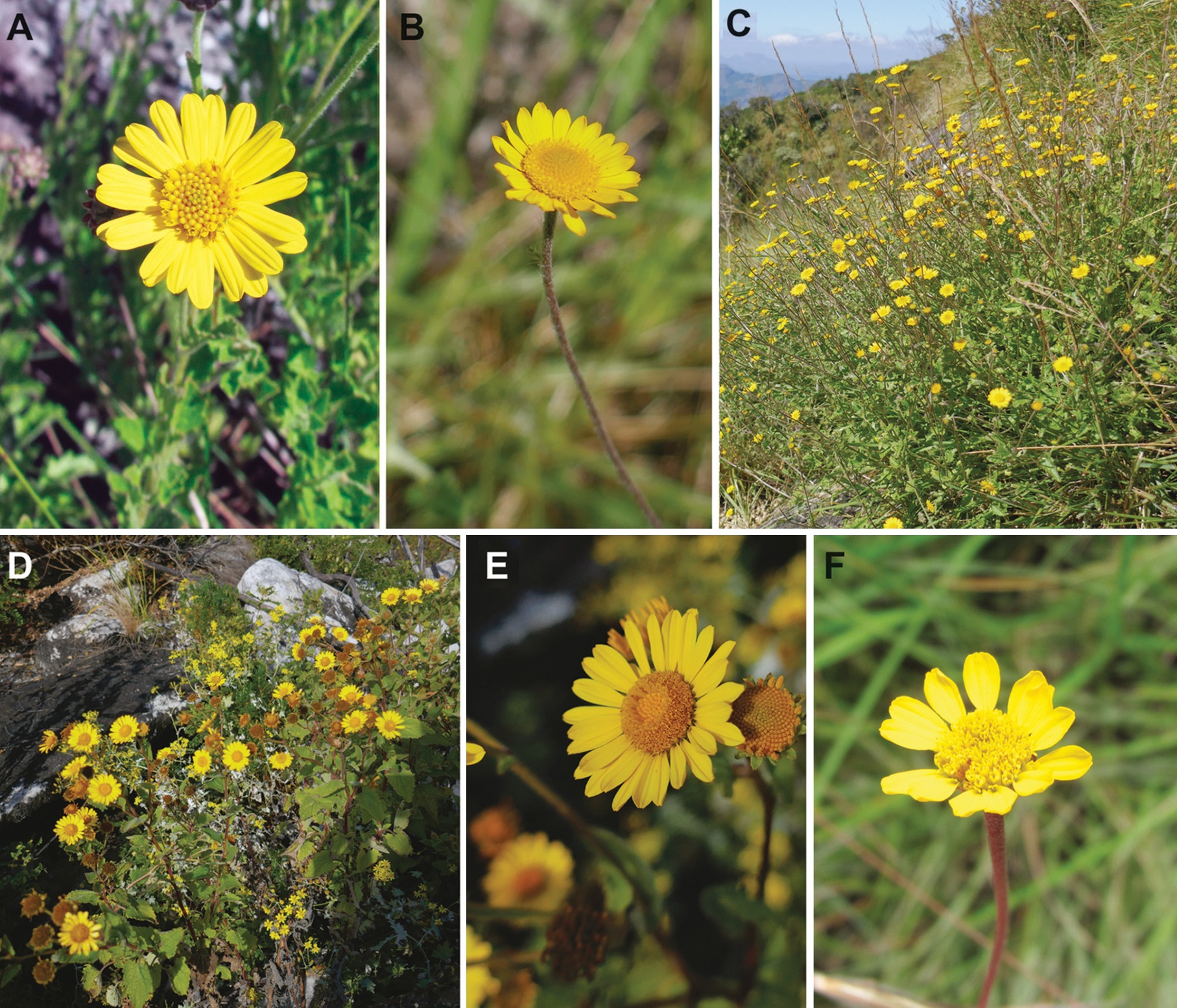
[Botany • 2021] Phylogeny of Anisopappus (Asteraceae: Athroismeae) with Species Circumscriptions revisited


A, Anisopappus paucidentatus from Chimanimani mountains, Mozambique;
 B & C, Anisopappus lastii subsp. lastii from Pico Muli, Mozambique;
D & E, Anisopappus buchwaldii subsp. iodotrichus from Serra Choa, Mozambique;
 F, Anisopappus davyi from Mutinodo Wilderness, Zambia.

in Bengtson, Osborne & Anderberg, 2021. 
— Photos by Jo Osborne, B & C taken during an expedition to Mt. Lico and Pico Muli in Mozambique organized by Julian Bayliss.

Abstract
Anisopappus (Asteraceae: Athroismeae) is a genus with its main distribution in Africa (one species also in Asia), currently considered to include around 21 species. A molecular phylogenetic study of Anisopappus is presented for the first time, based on plastid (ndhF, trnL‐trnF, trnQ‐rps16) and nuclear (ETS, ITS) data. Anisopappus is confirmed to be monophyletic, and species interrelationships are resolved. The results differ from earlier treatments based on morphology, and the phylogenetic analyses reveal a need for changes in species circumscriptions as compared to those of the most recent treatment. Consequently, many taxa currently treated as synonyms are here shown to represent separate species indicating that the genus includes well over 40 species. Distribution patterns now emerge where several clades are found to consist of species restricted to a particular geographical region. The Anisopappus of Madagascar, many of which were earlier placed in synonymy with species found on the African continent, are here shown to be endemic, and the results reveal a need for further studies of that group.

Keywords: Anisopappus, Asteraceae, Athroismeae, Compositae, molecular phylogenetics, taxonomy

 
Representatives of Anisopappus.
A, Anisopappus paucidentatus from Chimanimani mountains, Mozambique; capitula ca 2.2 cm diam.; B & C, Anisopappus lastii subsp. lastii from Pico Muli, Mozambique; capitula ca 1.6 cm diam.;
D & E, Anisopappus buchwaldii subsp. iodotrichus from Serra Choa, Mozambique; capitula ca 2.8 cm diam.; F, Anisopappus davyi from Mutinodo Wilderness, Zambia; capitula ca 1.8 cm diam.

— Photos by Jo Osborne, B & C taken during an expedition to Mt. Lico and Pico Muli in Mozambique organized by Julian Bayliss.


Conclusions: 
The study presents a first molecular phylogenetic study of the genus Anisopappus that aims at resolving the relationships between the different taxa and testing earlier classifications of species delimitations. The results show the synonymization and classification of Ortiz & al. (1996; Ortiz, 2005), where a large number of species were synonymized under Anisopappus chinensis, to be largely unsupported, and instead support the classification of Wild (1964) to a major extent. The results reveal a need for changes in species circumscriptions. The number of species is here shown to be well over 40 rather than the 21 recognized prior to this study (Bengtson & al., 2017). Almost all species that were recognized prior to the revision by Ortiz & al. (1996) are resurrected. Several new species have recently been discovered, and yet more may be found as the taxa from Madagascar are studied in detail. Additionally, a few of the species recognized by Wild (1964) are here shown to consist of more than one morphologically similar taxon. Closely related species are often found in the same area, and several clades show a distinct geographical pattern with species limited to a particular region. Most of the taxa found on Madagascar form a Malagasy endemic clade, and the study reveals a need for further studies of the group.


Annika Bengtson, Jo Osborne and Arne A. Anderberg. 2021. Phylogeny of Anisopappus with Species Circumscriptions revisited (Asteraceae: Athroismeae). Taxon. DOI: 10.1002/tax.12448