Showing posts with label Troglobite. Show all posts

Wednesday, March 11, 2026

[Invertebrate • 2026] Quapawjapyx osage & Holjapyx nimiipuu • New Cave japygids (Diplura: Japygidae) from North America


Quapawjapyx osage Sendra gen. et sp. nov.
Holjapyx nimiipuu Sendra sp. nov.,

in Sendra, Jiménez-Valverde, Selfa et Cupello, 2026. 

Abstract
We studied a significant collection of Japygidae (Diplura) deposited in the Texas A&M University Insect Collection, sampled from several caves in North America, mostly in the early 21st century by a group of American speleologists. Among this biological material, a new genus and species, Quapawjapyx osage Sendra gen. et sp. nov., is described from four caves in Arkansas, and a new species, Holjapyx nimiipuu Sendra sp. nov., from five caves in Idaho; both are named in honor of native American tribes. Quapawjapyx osage can be distinguished from IndjapyxPaurojapyx, and Parindjapyx – which share symmetrical cerci – by the combination of the shape and disposition of the glandular and sensory setae on the first urosternite, together with differences in cercal ornamentation. Holjapyx nimiipuu is characterized by the presence of two conspicuously large predental denticles on the right cercus. Both new taxa of cavernicolous japygids show slight cave-adaptation features, such as large body size, slight elongated appendages, and a small increase in the placoid sensilla of last antennomere. These two new taxa double the number of known cave-adapted japygids in North America, a seemingly low figure that is nonetheless comparable to other karst regions worldwide.

Keywords: Japygoidea, cave-adapted fauna, Nearctic region, taxonomy

Class Diplura Börner, 1904
Superfamily Japygoidea Ewing, 1942

Family Japygidae Haliday, 1864

Quapawjapyx osage Sendra gen. et sp. nov.
A. Paratype, ♂ (TAMU-ENTO X1831026). B, D–E. Paratype, ♂ (TAMU-ENTO X1832015). C. Holotype, ♀ (TAMU-ENTO X1831147).
A. Habitus. B. Last antennomere; placoid sensilla remarked by spotted line. C. Lacinia with interior laminae and mandible. D. Dorsal portion on third antennomere with pores. E. Metathoracic claws.

Genus Quapawjapyx Sendra gen. nov.

Etymology: The generic name is in honor of the Quapaw Nation of Native Americans, who thrived along the lowlands of the Arkansas river five hundred years ago. Today, they live alongside much later European settlersfrom other nations.

Quapawjapyx osage Sendra gen. et sp. nov.

Etymology: The specific epithet is in honor of the Osage Nation of Native Americans, who now reside in Osage County, Oklahoma. They arrived and thrived a few hundred years ago in the northern mountains of Arkansas.


Holjapyx nimiipuu Sendra sp. nov., holotype,  ♀ (TAMU-ENTO X1831140).
A. Habitus. B. Last antennomere. C. Distal portion of urite X including cerci. D. Left cercus. E. Right cercus; placoidsensilla remarked by dash line.

 Holjapyx nimiipuu Sendra sp. nov.

Etymology: Nimiipuu’ (‘we, the people’) is the name by which the Nez Perce Native American tribe refers to themselves. They have thrived in  the Pacific Northwest of North-America for  more than ten   thousand years and today live primarily on their tribal reservation in Idaho. We dedicate this new species to the Nimiipuu people and to their enduring struggle for survival.


Alberto Sendra, Alberto Jiménez-Valverde, Jesús Selfa and Mario Cupello. 2026. New Cave japygids (Diplura: Japygidae) from North America. European Journal of Taxonomy. 1043(1); 166–198. DOI: doi.org/10.5852/ejt.2026.1043.3217 
 

Tuesday, January 13, 2026

[Chilopoda • 2023] Plutogeophilus jurupariquibaba Assessing Troglomorphic and Phylogenetically Informative Traits in Troglobionts: A New Cave-dwelling Centipede (Geophilidae) illuminates the Evolution of A Soil-dwelling Lineage


 Plutogeophilus jurupariquibaba
Bonato & Ferreira, 2023


Abstract
Cave-dwelling species are of special interest in evolutionary biology, because (i) many share particular traits associated with the cave habitat (troglomorphic traits), and (ii) some represent relict lineages that may conserve ancestral traits or possibly transitional traits, which may provide insights into the evolution of other highly derived species. However, these different kinds of characters are hard to assess thoroughly in troglobionts belonging to little known terrestrial arthropod groups. We describe a new species of centipedes from the Areias System caves, Brazil, namely, Plutogeophilus jurupariquibaba gen.n. sp.n., which adds to the few putative troglobionts known among Chilopoda Geophilomorpha. We analyzed a suite of characters in the light of a phylogenetic analysis and by direct comparison with epigean relatives, controlling for interindividual variation and its confounding sources. We found that: (i) troglomorphic traits of P. jurupariquibaba may include large body, elongate antennae, elongate legs and claws, and possibly also elongate setae and large coxal pores; (ii) the cave-dwelling Plutogeophilus is the sister lineage of the soil-dwelling Macronicophilus, whose morphology is highly derived and whose phylogenetic position remained unclear; (iii) compared with other extant geophilids, symplesiomorphic traits and apparently intermediate traits found in Plutogeophilus provide insights on the origin of the morphology of Macronicophilus, suggesting a stepwise modification of labrum, forcipular apparatus and ultimate legs, and the derivation of the unique rounded and spiny tip of the second maxillae from a pointed claw.

Keywords: Neotropics, Chilopoda, MacronicophilusPlutogeophilus jurupariquibaba, Transitional morphology, Troglomorphy

 Plutogeophilus jurupariquibaba gen.n. sp.n.:
a anterior part of body, dorsal view; b–c head and forcipular segment, dorsal and ventral views, respectively; d–e posterior part of body, dorsal and ventral views, respectively.
 Photos: ♂, ISLA 11879, holotype. Scale bars: 0.4 µm

Living specimen of Plutogeophilus jurupariquibaba gen.n. sp.n. in the Areias de Cima cave, 7.IV.2012 (photo by Robson Zampaulo)
 
Plutogeophilus gen.n. 
Etymology: from the ancient Greek “Ploutōn,” who was the ruler of the underworld in classical mythology.

 Plutogeophilus jurupariquibaba sp.n.

Etymology: from the Tupi-Guarani “jurupariquibaba,” which literally means “devil’s comb” and is used by Brazilian Indians to refer to centipedes.


Lucio Bonato and Rodrigo Lopes Ferreira. 2023. Assessing Troglomorphic and Phylogenetically Informative Traits in Troglobionts: A New Cave-dwelling Centipede illuminates the Evolution of A Soil-dwelling Lineage (Chilopoda: Geophilidae). Organisms Diversity & Evolution. DOI: doi.org/10.1007/s13127-023-00618-7 
 

Thursday, January 8, 2026

[Mollusca • 2025] Cavernacmella dentata • A New Species (Caenogastropoda: Truncatelloidea: Assimineidae) endemic to the Sekigahara Limestone Cave, central Honshū, Japan


 Cavernacmella dentata  Fukuda, Sawada & Kameda,

in Sawada, Kameda et Fukuda. 2025. 

ABSTRACT
Cavernacmella dentata Fukuda, Sawada & Kameda, n. sp. is described from the inside of the Sekigahara Limestone Cave, Gifu Prefecture, central Honshū, Japan. The new species is unique in the genus and the Assimineidae in having a strong fold on the parietal lip of the aperture, but according to its internal anatomy and a molecular phylogenetic analysis it is a member of Cavernacmella Habe, 1942.

KEYWORDS: Cavernicolous species, endemism, Gifu Prefecture, land snail, new species, subterranean, taxonomy, troglobiont
 
 Cavernacmella dentata n. sp. 
A, shell of holotype (OMNH-Mo 42707); B, shell of paratype (OMNH-Mo 42708);
C, shell of paratype, juvenile (OMNH-Mo 42709); D, live individual at the type locality.

Cavernacmella dentata Fukuda, Sawada & Kameda, n. sp.

Etymology: The species epithet dentata (Latin) means ‘toothed’ and refers to the strong fold on the parietal lip of the present new species.


Naoto Sawada, Yuichi Kameda and Hiroshi Fukuda. 2025. Cavernacmella dentata n. sp. (Caenogastropoda: Truncatelloidea: Assimineidae) endemic to the Sekigahara Limestone Cave, central Honshū, Japan. Molluscan Research. DOI: doi.org/10.1080/13235818.2025.2592643 [17 Dec 2025]

岐阜県関ケ原鍾乳洞に固有の新種セキガハラゴマオカチグサ (新生腹足類: クビキレガイ上科: カワザンショウ科)
和文摘要 (JAPANESE ABSTRACT): 岐阜県関ケ原鍾乳洞内部から新種 Cavernacmella dentata Fukuda, Sawada and Kameda, n. sp. セキガハラゴマオカチグサを記載する。この新種は殻口内唇に強いパリエタル歯をもつ点でカワザンショウ科全体でも比類がないが, 内部形態および分子系統解析の結果は Cavernacmella Habe, Citation1942 ゴマオカチグサ属の一員であることを示している。

Saturday, November 29, 2025

[Entomology • 2025] Araneibatrus antennatus, A. thamluang, Batrisocenus filum, Nipponobythus haozhu, Tribasodites circinatus, Zopherobatrus excavatus, ... • Illuminating the Darkness: An exceptionally Diverse Fauna of subterranean Pselaphinae (Coleoptera: Staphylinidae) in Asian Karsts


Araneibatrus thamluang Yin, 2025 
 

Abstract
Subterranean ecosystems, particularly the karst environments of Asia, represent a significant but underexplored frontier for biodiversity exploration. This paper focuses on the rove beetle subfamily Pselaphinae (Coleoptera: Staphylinidae) from caves and related subterranean habitats throughout the continent. Drawing upon extensive material accumulated primarily from China and Thailand, supplemented by records from Vietnam, Laos, and the Philippines, an exceptionally diverse subterranean fauna is herein delineated, including the description of 43 new species: Araneibatrus antennatus sp. nov., A. huangsunbini sp. nov., A. leclerci sp. nov., A. thamluang sp. nov., A. thamphamon sp. nov., A. thamphathong sp. nov., A. thamprakaiphet sp. nov.; Batrisiella longlina sp. nov.; Batrisocenus affinis sp. nov., Batrisocenus dushizi sp. nov., Batrisocenus filum sp. nov., Batrisocenus mojiachengi sp. nov., Batrisocenus shilin sp. nov., Batrisocenus trungtrang sp. nov., Tribasodites circinatus sp. nov., T. disuensis sp. nov., T. duanus sp. nov., T. guilinensis sp. nov., T. huchanghaoi sp. nov., T. miaoting sp. nov., T. pakchong sp. nov., T. shui sp. nov., T. uncinus sp. nov., T. zhouhanpingi sp. nov.; Zopherobatrus excavatus sp. nov., Z. kaiyangus sp. nov., Z. sinanus sp. nov., Z. wulongensis sp. nov.; Batraxis soparki sp. nov.; Nipponobythus haozhu sp. nov., N. jinji sp. nov., N. liyunchuni sp. nov., N. long sp. nov., N. minor sp. nov. (soil-dwelling), N. niubi sp. nov., N. platycephalus sp. nov., N. proiectus sp. nov., N. punctatus sp. nov., N. qian sp. nov., N. sanxian sp. nov., N. suxian sp. nov., N. wufengensis sp. nov., and N. zengtingkaii sp. nov. The present work nearly doubles the documented diversity of cavernicolous Pselaphinae in Asia, increasing the number of known species from 48 to 90, highlighting the profound geographical biases in previous research and the immense, cryptic diversity harbored within these habitats. Identification keys to supertribes, tribes, genera, and species are provided, along with a checklist of cavernicolous Pselaphinae recorded from Asia. Moreover, this study reports novel instances of pronounced male antennal polymorphism and identifies potential morphological correlates of sexual conflict, specifically, putative female resistance traits, within these cave-adapted lineages, thereby illuminating evolutionary dynamics operative in aphotic ecosystems. Collectively, this work establishes a crucial taxonomic framework for the Asian cavernicolous fauna and stresses the urgent need for continued biospeleological exploration to effectively catalogue and conserve the unique biodiversity endemic to these karst systems.

taxonomy, cavernicolous, biodiversity, male polymorphism, sexual conflict


Zi-Wei YIN. 2025. Illuminating the Darkness: An exceptionally Diverse Fauna of subterranean Pselaphinae (Coleoptera: Staphylinidae) in Asian Karsts. Insect Systematics and Diversity. 9(5); ixaf046. DOI: doi.org/10.1093/isd/ixaf046 [03 November 2025] 

Friday, November 21, 2025

[Ichthyology • 2025] Sinocyclocheilus changlensis • A New eyeless Cavefish Species of the Genus Sinocyclocheilus (Cypriniformes: Cyprinidae) from Guangxi, China


Sinocyclocheilus changlensis Liu, Mao & Yang, 

in Liu, Mao, Sudasinghe, Zhou, Chen, Yang & Meegaskumbura, 2025 
Changle Golden-line Barb | 长乐金线鲃  ||  DOI: doi.org/10.1002/ece3.72370

ABSTRACT
The extensive limestone landscapes of southwestern China form one of the world's largest karst regions, providing ideal conditions for cavefish evolution. Within this region, Sinocyclocheilus, the most speciose cavefish genus globally, comprises 84 species adapted to dark environments. Despite the many species, the region is still poorly explored, with new species currently being added to the total. Here, using integrative taxonomic methods involving morphological and molecular analyses, we describe Sinocyclocheilus changlensis, a new troglobitic species discovered in a cave in central Guangxi, China. This species is characterized by the absence of eyes, an unpigmented and complete scaled body, and a forked, horn-like structure at the dorsal posterior edge of the head. Morphologically, S. changlensis differs from its congeners by having pelvic-fin rays that do not reach the anus when extended, 42–46 lateral line scales, and a posterior operculum margin reaching the base of the pectoral fin at vertical. Molecular phylogenetic analyses using mitochondrial markers (cytb and ND4), genetic distances, and geometric morphometric analysis further confirmed S. changlensis as a distinct species. The description of this new species contributes to the understanding of cave-dwelling fish diversity in China and underscores the importance of further exploration of stygomorphic species across this poorly explored karstic landscape.

Keywords: blindness, cavefish, Hongshui River, landmarks, molecular systematics, morphology, Sinocyclocheilus, stygomorphic


Sinocyclocheilus changlensis, GXU2020000041, HOLOTYPE, 137.8 mm SL.
(a) Lateral view of preserved specimen; (b) dorsal view of head in preserved specimen; (c) live specimen.

Sinocyclocheilus changlensis Liu, Mao & Yang, sp. nov.

Diagnosis: Sinocyclocheilus changlensis can be distinguished from all other congeners by the following combination of characters: eye absent (eyeless); pelvic-fin rays tip not reaching the anus when pelvic-fin rays are extended backward; having a forked horn-like structure at the dorsal posterior edge of the head; albinotic body without pigmentation; lateral line scales 42–46; posterior margin of operculum close to the base of pectoral-fin origin; a distinct hump in the predorsal profile; rostral barbel not reaching the depression after eye degeneration; maxillary barbel not reaching the posterior margin of preoperculum; pharyngeal teeth pattern 1,3,4–3,3,1; vertebrae 4 + 35–36; 11 outer rakers on the first gill arch.


Yewei Liu, Tingru Mao, Hiranya Sudasinghe, Jiajun Zhou, Rongjiao Chen, Jian Yang, Madhava Meegaskumbura. 2025. Description of A New Eyeless Cavefish Species Using Integrative Taxonomic Methods—Sinocyclocheilus changlensis (Cypriniformes, Cyprinidae), From Guangxi, China. Ecology and Evolution.15(11); e72370.  DOI: doi.org/10.1002/ece3.72370 [19 November 2025]
 

Thursday, October 30, 2025

[Arachnida • 2022] Jingneta siyu • A new eyeless Leptonetid spider (Araneae: Leptonetidae) from Beijing, China


Jingneta siyu
 Liu & Zhang, 2022


A new troglobitic spider of the genus Jingneta Wang & Li, 2020 is described from Siyu Cave, Beijing, China: Jingneta siyu sp. nov.. Detailed description and illustrations are provided.

 Photos of living Jingneta siyu sp. nov.
A. J. siyu sp. nov. on rock face. B, D. Subadult male in an artificial environment. C. J. siyu sp. nov. hanging upside down on web.


 LIU Bo & ZHANG Feng. 2022. A new eyeless Leptonetid spider from Beijing, China (Araneae, Leptonetidae) 北京无眼弱蛛1新种记述(蜘蛛目:弱蛛科). Acta Arachnologica Sinica. 31(1): 44–48. DOI: 10.3969/j.issn.1005-9628.2022.01.007 

Wednesday, October 29, 2025

[Crustacea • 2022] Iansaoniscus leilae & I. paulae • Two New troglobitic Species of Iansaoniscus (Isopoda: Pudeoniscidae) from Brazilian caves


Iansaoniscus paulae
Cardoso, Bastos-Pereira & Ferreira, 2022


Abstract
Iansaoniscus species are troglobitic terrestrial isopods of the Pudeoniscidae family. In this work two new species are described from caves in the Bahia state, northeastern Brazil; I. leilae sp. nov. from Toca do Gonçalo cave, in the municipality of Campo Formoso; and I. paulae sp. nov. from Lapa do Bode cave in the municipality of Itaeté. Additionally, ecological notes and conservation status are provided for both new species.

Keywords: Cave fauna, Neotropics, Oniscidea, terrestrial isopods, troglobites

Iansaoniscus leilae sp. nov. habitat
A Toca do Gonçalo cave entrance B cave floor in the inner portion of the cave, where specimens were found C water table at the cave lower level D adult specimen inside the cave, frontal view E adult specimen inside the cave, lateral view F diesel pump installed inside the cave in the 70’s G electric pump installed inside the cave in 2010.

Iansaoniscus paulae sp. nov. habitat
 A limestone bordering the Paraguaçu river, where the Lapa do Bode cave’s entrance is located B one of the entrances of Lapa do Bode cave C a secondary entrance of Lapa do Bode cave D adult specimen inside the cave.


 Giovanna Monticelli Cardoso, Rafaela Bastos-Pereira and Rodrigo Lopes Ferreira. 2022. Two New troglobitic Species of Iansaoniscus from Brazilian caves (Crustacea, Isopoda, Pudeoniscidae). Subterranean Biology. 43: 127-143. DOI: doi.org/10.3897/subtbiol.43.81308 


Sunday, July 20, 2025

[Arachnida • 2025] Spelaeochthonius dugigulensis, S. yamigulensis ... • Four New Species of Dragon Pseudoscorpions (Pseudoscorpiones: Pseudotyrannochthoniidae: Spelaeochthonius) from Caves in South Korea revealed by integrative taxonomy


Spelaeochthonius dugigulensis
Jeong, Harms, Yoo & Kim, 2025


Abstract
Karst research in Korea is still in its infancy and the invertebrate fauna of subterranean systems across the country is poorly known. One of the very diverse lineages in caves across Korea, the pseudoscorpions, are almost undocumented although they represent stunning examples of cave adaptations and troglomorphism. In this study, we provide a phylogenetic hypothesis for the pseudoscorpion Spelaeochthonius Morikawa, 1954 (Pseudoscorpiones: Pseudotyrannochthoniidae) in South Korea; a genus that exclusively occurs in caves across China, Japan and the Korean Peninsula. We report seven species of which four are newly described and illustrated based on molecular, distributional and morphological data: Spelaeochthonius dugigulensis sp. nov., S. geumgulensis sp. nov., S. magwihalmigulensis sp. nov. and S. yamigulensis sp. nov. All species are strongly cave-adapted and known from a single cave or karst system only, emphasizing the need to implement conservation strategies for Korean karst systems and their fauna.
 
Habitus of Spelaeochthonius dugigulensis sp. nov.
A. Holotype male, dorsal view; B. Holotype male, ventral view;
C. Paratype female, dorsal view; D. Paratype female, ventral view.
Scale bar: 1 mm.

Spelaeochthonius dugigulensis sp. nov., 
S. geumgulensis sp. nov., 
S. magwihalmigulensis sp. nov. 
S. yamigulensis sp. nov.


Kyung–Hoon Jeong, Danilo Harms, Jung-sun Yoo and Sora Kim. 2025. Four New Species of Dragon Pseudoscorpions (Pseudoscorpiones: Pseudotyrannochthoniidae: Spelaeochthonius) from Caves in South Korea revealed by integrative taxonomy. PLoS One. 20(7): e0325375.  DOI: doi.org/10.1371/journal.pone.0325375 [July 9, 2025]

Friday, April 11, 2025

[Arachnida • 2025] Tyrannochthonius rudongyanensis, T. tiani & T. yanwuensis • Three New Cave-dwelling Species of Tyrannochthonius Chamberlin, 1929 (Pseudoscorpiones: Chthoniidae) from Guangxi, China


Tyrannochthonius rudongyanensis
Sun, Guo & Zhang, 2025


Abstract
Three new Tyrannochthonius species are described, including detailed diagnosis and illustrations: T. rudongyanensis sp. nov., T. tiani sp. nov., and T. yanwuensis sp. nov. All samples were collected from the hypogean habitats in Guangxi, China. A distribution map of all Tyrannochthonius species in Guangxi is provided.

Keywords: Diversity, karst, morphology, taxonomy

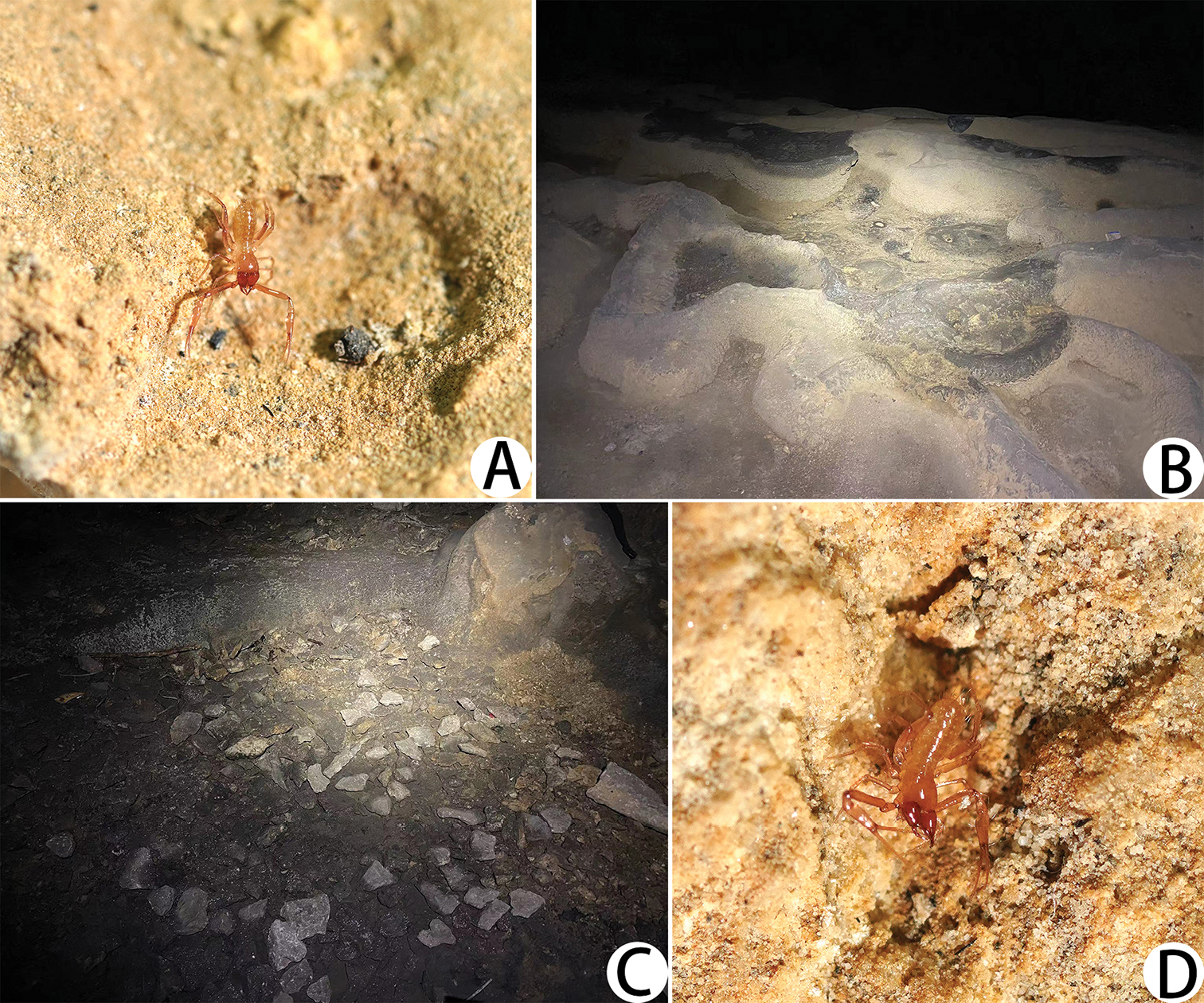
Rudongyan Cave, type locality of Tyrannochthonius rudongyanensis sp. nov.,
A, D live female T. rudongyanensis sp. nov. in its natural environment
B, C areas where T. rudongyanensis sp. nov. specimens were collected.


 Jianzhou Sun, Xiangbo Guo and Feng Zhang. 2025. Three New Cave-dwelling Species of Tyrannochthonius Chamberlin, 1929 (Pseudoscorpiones, Chthoniidae) from Guangxi, China. Subterranean Biology. 51: 115-133. DOI: doi.org/10.3897/subtbiol.51.146465  

Wednesday, March 26, 2025

[Diplopoda • 2025] Acanthophorella didi, A. spinicoxa, ... • Four New cavernicolous Species of the Genus Acanthophorella Antić & Makarov, 2016 (Diplopoda: Chordeumatida: Anthroleucosomatidae) from Georgia, Caucasus


 Acanthophorella didi, A. gaumarjos
 A. eto
, A. spinicoxa 

AntićMargalitadze & Šević, 2025

Abstract
Four new, presumably troglobiotic species of the chordeumatidan genus Acanthophorella Antić & Makarov, 2016 are described from several Georgian caves. Acanthophorella didi sp. nov. and A. gaumarjos sp. nov. were discovered in three and one cave in the Racha karst massif, respectively, while A. eto sp. nov. and A. spinicoxa sp. nov. are known each from two caves in the Sataplia-Tskaltubo karst massif and Zemo Imereti plateau, respectively. All four species are properly diagnosed, described, and richly illustrated. Vulvae are described for the first time in Acanthophorella barjadzei Antić & Makarov, 2016, and new records are added for A. valerii Antić in Antić et al., 2023. Notes on the ecology and localities are given for new species. The distribution map and a key to all 10 species of the genus are presented. Distribution and troglomorphism within the genus are briefly discussed.

 Myriapoda, biospeleology, cave, millipedes, Sakartvelo, troglomorphism


Acanthophorella didi Antić, Margalitadze & Šević sp. nov.
Acanthophorella eto Antić, Margalitadze & Šević sp. nov.
Acanthophorella gaumarjos Antić, Margalitadze & Šević sp. nov.
Acanthophorella spinicoxa Antić, Margalitadze & Šević sp. nov.


Dragan ANTIĆ, Ana MARGALITADZE and Mirko ŠEVIĆ. 2025. Four New cavernicolous Species of the Genus Acanthophorella Antić & Makarov, 2016 (Diplopoda, Chordeumatida, Anthroleucosomatidae) from Georgia, Caucasus.  Zootaxa. 5609(1); 41-69. DOI: doi.org/10.11646/zootaxa.5609.1.3 [2025-03-19]

Tuesday, January 28, 2025

[Invertebrate • 2025] Coecobrya microphthalma • The Thermal Tolerance of Springtails in a Tropical Cave, with the Description of a New Coecobrya Species (Collembola: Entomobryidae) from Thailand


 Coecobrya microphthalma Manee & Jantarit,
 
in Manee, Deharveng, D’Haese, Nilsai, Shimano et Jantarit, 2025. 

Abstract
A new species of Collembola in the genus CoecobryaC. microphthalma sp. nov., is described from a cave environment in Saraburi province, central Thailand. The new species is the second described species of the boneti-group found in the country. It is most similar to C. chompon Nilsai, Lima & Jantarit, 2022, which is also described from a Thai cave. However, the new species is morphologically different from C. chompon in having orange dot pigmentation on its body and a combination of other morphological characteristics such as the number of sublobal hairs on the maxillary outer lobe and the number of medio-sublateral mac on Th. II, Abd. I, Abd. III and Abd. IV and the anterior face of the ventral tube. The morphological comparison of all known boneti species and a key to the world species of Coecobrya of the boneti-group are given. Coecobrya microphthalma sp. nov. was successfully cultured in the laboratory. The thermal tolerance of the new species was studied and tested with seven different temperature experiments (27 °C as a control, 30, 32, 33, 34, 35 and 36 °C). The results showed that C. microphthalma sp. nov. cannot survive at a temperature higher than 32 °C after exposure to the experimental heat for 7 and 14 consecutive days. At 27, 30 and 32 °C, C. microphthalma sp. nov. remained alive and produced eggs, but the duration of egg production and number of egg-laying days significantly declined when the temperature increased (p < 0.001). An interesting aspect of their reproduction concerns temperature. At 32 °C (5 °C above the control temperature), the F1 generation survived, was active and was able to molt to the adult stage. However, specimens were unable to produce the next generation of offspring. For postembryonic development, C. microphthalma sp. nov. required six molts to reach the adult stage. The development rate (from egg to adult) varied and differed significantly between the tested temperatures (p < 0.001). An increase in temperature from the control temperature significantly accelerated the developmental rate from egg to juvenile instars to adult with a statistical significance (p < 0.01). This study is the first attempt that provide information on the impact of increasing temperature on the population dynamics, reproductive capacity and life history of a subterranean tropical Collembola.

Keywords: breeding experiment; cave species; global warming; life history traits; thermal tolerance; taxonomy

 Coecobrya microphthalma sp. nov. 
(A) habitus under microscope; (B) habitus under SEM; (C) head and black eyepatch under slide; (D) head and eye (arrow) under SEM; (E) enlargement of eye under SEM.
Scale bar: (A,B)= 500 μm, (D) = 100 μm, (E) = 10 μm ((A,C): microscope images; (B,D,E): SEM images).

Taxonomy
Class Collembola Lubbock, 1870
Order Entomobryomorpha Börner, 1913

Family Entomobryidae Tömösváry, 1882
Subfamily Entomobryinae Schäffer, 1896

Genus Coecobrya Yosii, 1956

Coecobrya microphthalma sp. nov. Manee and Jantarit, 2025

Remarks. Coecobrya microphthalma sp. nov. belongs to the boneti-group characterized by the presence of eyes. The new species has 1+1 small eyes like six other species of the same group (C. boneti (Denis, 1948), C. sanmingensis Xu and Zhang, 2015, C. indonesiensis (Chen and Deharveng, 1997), C. tukmeas Zhang, Deharveng and Chen, 2009, C. oculata Zhang, Bedos and Deharveng, 2016 and C. chompon). Among Thai cave species, Coecobrya microphthalma sp. nov. is most similar to C. chompon in having relatively long antennae, labial chaetae as mrel1l2, presence of long smooth straight chaetae on antennae, 3 medio-medial mac on Th. II, 3 central mac on Abd. II, 1 central mac and ...

Etymology. Coecobrya microphthalma sp. nov. is derived from the Latin meaning “having small eyes”.


  Nongnapat Manee, Louis Deharveng, Cyrille A. D’Haese, Areeruk Nilsai, Satoshi Shimano and Sopark Jantarit. 2025. The Thermal Tolerance of Springtails in a Tropical Cave, with the Description of a New Coecobrya Species (Collembola: Entomobryidae) from Thailand. Insects. 16(1), 80. DOI: doi.org/10.3390/insects16010080  
(This article belongs to the Section Other Arthropods and General Topics)

Simple Summary: A new species of Collembola, Coecobrya microphthalma sp. nov., is described from a cave in Saraburi province, central Thailand. This species is the second boneti-group member found in the country. It closely resembles C. chompon Nilsai, Lima & Jantarit, 2022 but differs in having orange body dots and distinct morphological traits, such as the number of sublobal hairs and mac on various body segments. A comparison of all boneti-group species globally and a key to their identification are provided. Coecobrya microphthalma sp. nov. was cultured in the laboratory, and its thermal tolerance was tested at seven different temperatures (27 °C as control, 30, 32, 33, 34, 35, and 36 °C). The results showed that it cannot survive above 32 °C after 7 and 14 days of exposure. At 27, 30, and 32 °C, the species remained alive and produced eggs, though egg-laying duration and number of days decreased with higher temperatures. At 32 °C, the F1 generation survived and molted to adulthood, but no further offspring were produced. Development from egg to adult required six molts, with development rates increasing with higher temperatures. This study is the first attempt to examine how temperature affects the population dynamics, reproductive capacity, and life history of a subterranean tropical Collembola.

Thursday, October 24, 2024

[Mollusca • 2023] Sohtsuia diting • Integrative Taxonomy revealing A Troglobitic New Genus of Diplommatinidae (Gastropoda: Caenogastropoda: Cyclophoroidea) from Jiangxi, China


Sohtsuia Z.-Y. Chen,
Sohtsuia diting 
Chen, Lyu & Chen, 2023 


Abstract
A new subterranean diplommatinid snail is described and illustrated from Jiangxi, China. The species is diagnosed by its cylindrical-fusiform shell and absence of internal columellar lamellae and parietal folds. The morphological and molecular phylogenetic characterization of the new species supports the erection of a new genus, Sohtsuia Z.-Y. Chen, gen. nov. A molecular phylogeny of representative East Asian continental species of Diplommatina Benson, 1949 is provided and the relationships of the new genus are discussed. Sohtsuia diting sp. nov. is described as new species.

Keywords: Gastropoda, China, Diplommatinidae, new genus, new species, systematics, taxonomy 
 
Shell of Sohtsuia diting gen. & sp. nov. Scale bar: 1 mm

Sohtsuia diting sp. nov.  
 
  Type locality (A) and living specimens (b) of Sohtsuia diting gen. & sp. nov.  


Zhe-Yu Chen, Zhi-Tong Lyu and Hui-Ming Chen. 2023. Integrative Taxonomy revealing A Troglobitic New Genus of Diplommatinidae from Jiangxi, China (Gastropoda: Caenogastropoda: Cyclophoroidea). Zootaxa. 5231(4); 491-500. DOI: 10.11646/zootaxa.5231.4.10


Monday, September 30, 2024

[Entomology • 2023] Lathrobium neostygium • A New troglobiontic Rove Beetle (Coleoptera: Staphylinidae: Paederinae) from central Honshu, Japan


Lathrobium neostygium Senda, 2023 


Abstract 
A new troglobiontic species, Lathrobium neostygium sp.n. (Coleoptera: Staphylinidae: Paederinae), is described from Gifu Prefecture, central Honshu, Japan. Photographs of the male and female habitus, of the aedeagus and of the type locality are provided. This finding represents the easternmost record of a Japanese troglobiontic species of Lathrobium GRAVENHORST, 1802. The L. nomurai species group is redefined, and a checklist of the species of this group is provided

Key words: Coleoptera, Staphylinidae, Paederinae, Lathrobium, subterranean biodiversity, East Asia, Japan, endemic species, new species, taxonomy


 Lathrobium neostygium:
 A–B) habitus of A) male, holotype and B) female, paratype, C) abdominal ventrites of male, showing secondary sexual characters, D) type locality.
Scales: A–B: 5.0 mm, C: 2.0 mm. 
Photographs by Y. Senda (A–C) and K. Kawamura (D).

Lathrobium neostygium sp. n.

  DIAGNOSIS: The new species is similar to Lathrobium tanakai described from Kii Peninsula (WATANABE 1998) in external and aedeagal features, but differs from it in the following characteristics: 1) lateral sides of the posterior excision asymmetrically produced in the caudal margin of male abdominal ventrite VIII (feebly and symmetrically produced in L. tanakai); 2) apical projection of aedeagal dorsal sclerite comparatively robust, with rounded apex (slender, with pointed apex in L. tanakai); 3) apical projection of paramere distinctly curved dorsad at about 1/5 (slightly curved dorsad at about 1/6 in L. tanakai).

ETYMOLOGY: The epithet is a combination of the traditional Japanese geographical name “Neo” (an area in the western part of Gifu Prefecture, where the new species was collected) and the Latin adjective “stygius” (stygian, being part of the underworld). The name is used as an adjective.


Yoshihiro Senda. 2023. Lathrobium neostygium, A New troglobiontic Rove Beetle from central Honshu, Japan (Coleoptera: Staphylinidae: Paederinae) – Koleopterologische Rundschau – 93_2023: 189 - 197. 

Sunday, June 30, 2024

[Entomology • 2024] Spinanycta alabamensis • A New Genus and Species of nicoletiid Silverfish (Zygentoma: Nicoletiidae) from Caves of northern Alabama, USA


Spinanycta alabamensis Espinasa, Gutierrez & Niemiller, 

in Espinasa,  Gutierrez, Hinkle et Niemiller, 2024. 

Abstract
A new genus and species of troglobiotic nicoletiid (Insecta, Zygentoma, Nicoletiidae) is described from northern Alabama, USA. The type species was collected from three caves in the Highland Rim section of the Interior Low Plateau physiographic province on the northern side of the Tennessee River Valley. Morphological and genetic analysis using the mitochondrial 16S rRNA locus show that Spinanycta alabamensis sp. nov. is quite distinct from related nicoletiids in North America. The species differs from members of other genera by its urosternum I, which in males is modified with a central pointy extension. The new species significantly extends the distribution of cave-dwelling members of the family into the southeastern United States and suggests that additional nicoletiid diversity remains to be discovered from karst regions of the eastern United States.

Keywords: Insect, Interior Low Plateau, subterranean, Thysanura, troglobite, troglobiont

Spinanycta alabamensis sp. nov.
A male holotype (left) and female paratype (right) B–L male holotype B, C pedicellus D head E macrochaetae by insertion of antennae F labium G last article of labial palp H sensilla of maxillary palp I maxilla J apex of lacinia K conules of galea L sensilla of maxillary palp.

Spinanycta alabamensis sp. nov. female in life, observed on 13 September 2023 at the type locality Bobcat Cave, Madison County, Alabama, USA.
Photograph by Eric C. Maxwell.

Class Insecta Linnaeus, 1758

Order Zygentoma Börner, 1904
Suborder Neozygentoma Engel, 2006
Infraorder Euzygentoma Grimaldi & Engel, 2005

Family Nicoletiidae Escherich, 1905

 Spinanycta Espinasa, Gutierrez & Niemiller, gen. nov. 

 Spinanycta alabamensis Espinasa, Gutierrez & Niemiller, sp. nov.

Diagnosis: An American nicoletiid with Urosterna II–VII subdivided into two coxites and one sternite. Urosterna I, VIII and IX of male entire. Coxites on segments II–IX with styli. Urosternum I of males modified with a central pointy extension. Urosternum VIII of male flat posteriorly, without emarginations or projections in between the styli of this segment. Paramera with a distal semi-eversible vesicle and short chaetae, their length being about 1/4 the width of the paramera. Subgenital plate of females subtriangular. Tergum X with one distinct macrochaetae on posterior angles. Cercus of male with sensory pegs (spines) and appendix dorsalis without sensory pegs.

Etymology: Spinanycta. From spina = Greek for spine. It references the diagnostic spine in urosterum I, and nycta = Greek for night. It references in Greek mythology the occupation of caves by Nyx, the primordial goddess of night.

Distribution: This genus is known from just three cave systems on the north side of the Tennessee River Valley in southern Madison and southeastern Limestone counties, Alabama, within the Highland Rim section of the Interior Low Plateau physiographic province (Fig. 1).


 Luis Espinasa, Abrianna Gutierrez, Amata Hinkle and Matthew L. Niemiller. 2024. A New Genus and Species of nicoletiid Silverfish (Insecta, Zygentoma, Nicoletiidae) from Caves of northern Alabama, USA. Subterranean Biology. 49: 1-17. DOI: 10.3897/subtbiol.49.119986