Showing posts with label Crocodyliformes. Show all posts

Tuesday, June 30, 2026

[Paleontology • 2026] Antusuchus rionegrinus • A New early peirosaurid terrestrial Crocodile (Notosuchia: Peirosauridae) from La Buitrera (Candeleros Formation), Río Negro, Argentina


Antusuchus rionegrinus 
Fernández-Dumont, Apesteguía, Pol, Bona, Pérez Mayoral & Vega, 2026
 

ABSTRACT
Notosuchia represents one of the most morphologically diverse groups of Mesozoic crocodyliforms and was particularly abundant in the Cretaceous of Gondwana. Among them, Peirosauridae comprises medium-sized terrestrial predators widely distributed across southern continents during the Late Cretaceous. Here we describe a new peirosaurid crocodyliform, Antusuchus rionegrinus gen. et sp. nov., from the Cenomanian Candeleros Formation of the Neuquén Basin (Río Negro Province, Argentina). The material, recovered from the La Buitrera Palaeontological Area, includes cranial and postcranial remains. Micro-computed tomography and anatomical comparisons reveal a unique combination of characters, including a short rostrum, an elongated palatal depression adjacent to the maxillary tooth row, a rod-shaped jugal bar, and a prominent sagittal crest. The dentition is ziphodont and includes a hypertrophied third maxillary tooth, consistent with predatory habits. Phylogenetic analyses recover Antusuchus rionegrinus as the earliest-branching member of Peirosauridae, sister to all remaining peirosaurids. This discovery provides new insights into the early evolution of peirosaurids and highlights the importance of the La Buitrera fauna for understanding mid-Cretaceous terrestrial ecosystems and the diversification of notosuchian crocodyliforms.

KEYWORDS: Peirosauridae, La Buitrera, Cretaceous, Notosuchia, Candeleros Formation, Neuquén Basin

Systematic Palaeontology
Crocodyliformes Hay, 1930
Notosuchia Gasparini, 1971 [Ruiz et al., 2021]

Peirosauria Leardi et al., 2024
Peirosauridae Gasparini, 1982 [Leardi et al., 2024]


Antusuchus rionegrinus gen. et sp. nov.
 
Etymology: Antu means sun in the Mapudungún language. Suchus is Latinised from Greek Souchos in references to the Egyptian crocodile-headed god Sebek. Rionegrinus named after Río Negro Province.

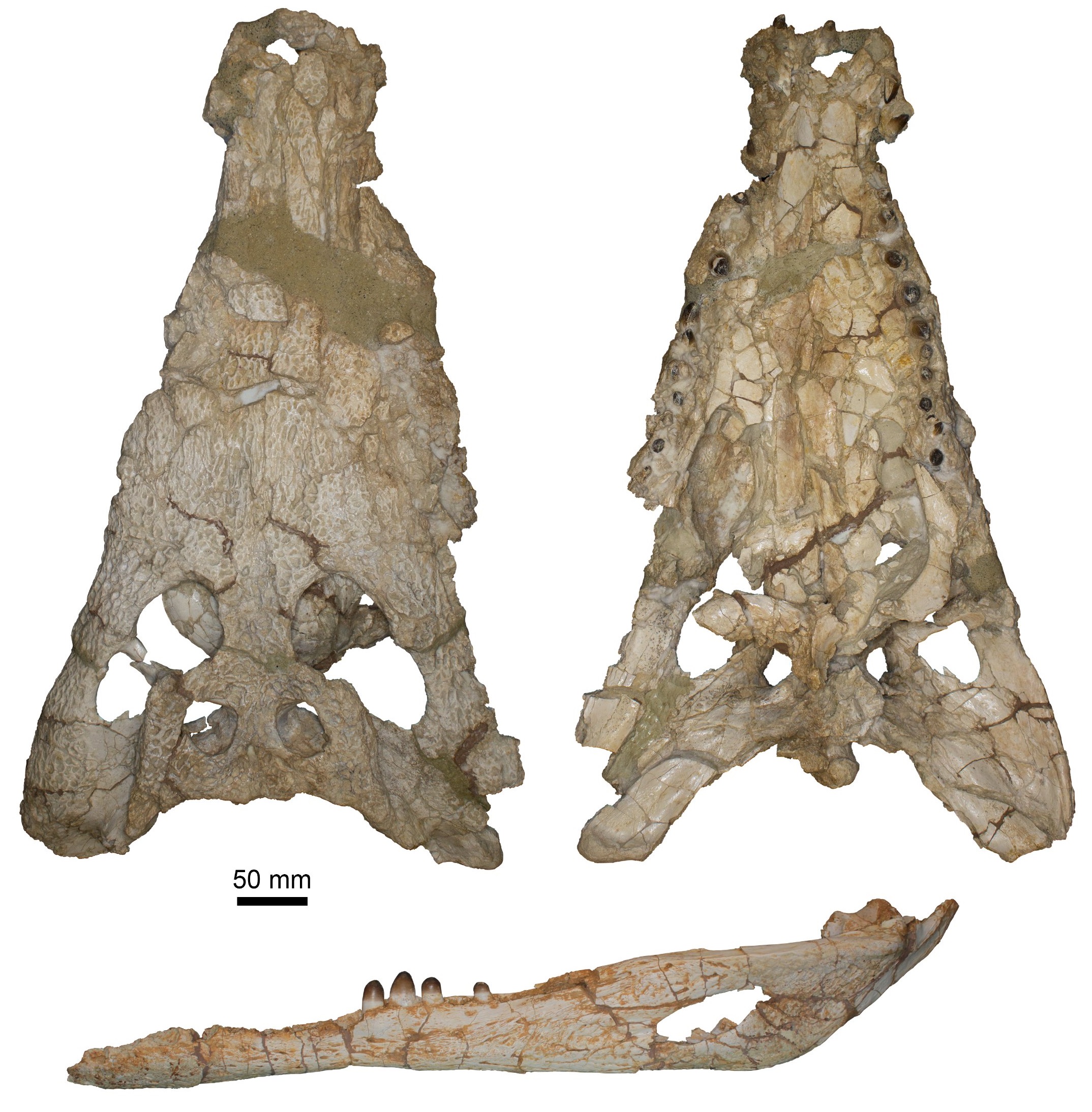
Holotype: MPCA PV 1294 (Figures 37), articulated skull and jaws.

 
Geographical and geological proceeding: The material was found in rocks representing the last 50 m of the Candeleros Formation deposit, at the base of the levels containing the La Buitrera fauna. The site corresponds to the base of the ‘Cañadón de Las Tortugas’ site, within the La Buitrera locality, one of the localities of the LBPA.

Diagnosis: A notosuchian crocodyliform characterised by the following unique combination of characters (autapomorphies indicated with asterisk): third premaxillary tooth larger than the fourth; large elongated depression close to the medial margin of the mid maxillary toothrow*; rostrum shorter than 50% of the total skull length; maxillary contribution to antorbital fossa as dorsoventrally high as the maxillary lateral surface between antorbital fossa and alveolar margin and extending posteriorly up to the posterior end of the antorbital fossa*; antorbital fossa restricted to posteroventral corner of antorbital fenestra; lacrimal extensively sutured to jugal; subtriangular ...


María Lucila Fernández-Dumont, Sebastián Apesteguía, Diego Pol, Paula Bona, Joaquín Pérez Mayoral and Nahuel Vega. 2026. A New early peirosaurid terrestrial Crocodile (Notosuchia) from La Buitrera (Candeleros Formation), Río Negro, Argentina. Historical Biology: An International Journal of Paleobiology. DOI: doi.org/10.1080/08912963.2026.2683112 [23 Jun 2026]


Monday, October 27, 2025

[Paleontology • 2025] Wadisuchus kassabi • An early dyrosaurid (Pseudosuchia: Crocodyliformes) from the Campanian of Egypt sheds light on the Origin and Biogeography of Dyrosauridae

 
Wadisuchus kassabi
Saber, Salem, Ouda, Gohar, El-Sayed, O’Connor & Sallam, 2025 

Paleoart by Nathan Dehaut. 

Abstract
Dyrosauridae are a clade of crocodyliforms characterized by diverse cranial morphologies and a broad palaeogeographic distribution from the Late Cretaceous to the Palaeogene. However, their early evolutionary history remains poorly understood due to a significant fossil gap during the Campanian. Here, we describe Wadisuchus kassabi gen. et sp. nov., an early-diverging dyrosaurid from the middle Campanian Quseir Formation of Egypt, based on two partial skulls and three partial mandibles. This new taxon displays transitional cranial features—including reduced premaxillary alveoli, modified occlusion patterns, and dorsally positioned external nares—that clarify aspects of cranial evolution related to longirostry in early dyrosaurids. Phylogenetic analyses consistently recover Wadisuchus as the earliest-diverging dyrosaurid, closely related to Chenanisuchus and distinct from Elosuchus, supporting a transition from dyrosauroids to dyrosaurids. Its Campanian age extends the temporal range of the clade and suggests that transatlantic dispersal from Africa to South America occurred earlier than previously recognized. Alongside Brachiosuchus kababishensis from Sudan, the new Egyptian taxon also implies that reverse dispersal into Africa preceded the Maastrichtian. Wadisuchus provides critical insights into the early diversification, palaeobiogeography, and cranial evolution of Dyrosauridae, confirming longirostry as an early-acquired trait and highlighting North Africa as a key region in their origin.

Campanian, Quseir Formation, Egypt, North Africa, Dyrosauridae, phylogeny

Life reconstruction of Wadisuchus kassabi from the Late Cretaceous of Egypt, showing an adult capturing a lungfish in a wetland, with a juvenile nearby. The scene highlights the ancient ecosystem, including turtles and lush vegetation, based on fossil evidence from the Quseir Formation.
Paleoart by Nathan Dehaut. / MUVP—Scientific supervision

Wadisuchus kassabi gen. et sp. nov.

Sara Saber, Belal S Salem, Khaled Ouda, Abdullah S Gohar, Sanaa El-Sayed, Patrick M O’Connor and Hesham M Sallam. 2025. An early dyrosaurid (Wadisuchus kassabi gen. et sp. nov.) from the Campanian of Egypt sheds light on the Origin and Biogeography of Dyrosauridae. Zoological Journal of the Linnean Society. 205(2) zlaf134. DOI: doi.org/10.1093/zoolinnean/zlaf134 [27 October 2025]

Thursday, September 25, 2025

[Paleontology • 2025] Thikarisuchus xenodentes • A New, diminutive, heterodont Neosuchian from the Vaughn Member of the Blackleaf Formation (Cenomanian), southwest Montana, and Implications for the Paleoecology of heterodont neosuchians


Thikarisuchus xenodentes
Allen, Wilberg, Turner & Varricchio, 2025  

Illustration by Dane Johnson/Museum of the Rockies

ABSTRACT
Although crocodyliforms from the Campanian–Maastrichtian of North America have received considerable attention, taxa occurring earlier in the Cretaceous have only recently begun to be more thoroughly studied. Of particular interest amongst these recent discoveries is the heterodont neosuchian Wannchampsus kirpachi Adams 2014 and the similar, undescribed ‘Glen Rose Form’ (USNM 22039). Both hold an unclear phylogenetic position, either forming a clade sister to Atoposauridae, a group of small, heterodont neosuchians from the Jurassic and Cretaceous of Laurasia, or to Paralligatoridae, a clade of larger, platyrostral, homodont neosuchians from the Cretaceous of Asia and North America. Here we describe a new species of diminutive, heterodont neosuchian, Thikarisuchus xenodentes gen. et sp. nov., from the early–middle Cenomanian Vaughn Member of the Blackleaf Formation of southwest Montana. The specimen includes cranial, mandibular, axial, and appendicular elements in articulation and dense concentration. It is recovered in a sister relationship with Wannchampsus and USNM 22039. We propose the name Wannchampsidae (clade nov.) for this group of small, heterodont neosuchians endemic to the Cretaceous of North America. Wannchampsidae is more confidently recovered sister to Atoposauridae due to the recognition of new synapomorphies. The new taxon provides greater clarity on the potential diet and paleoecology of Wannchampsidae and Atoposauridae and displays similar craniomandibular and dental characteristics to the notosuchian group Uruguaysuchidae, strongly suggesting these neosuchian groups were also omnivorous or insectivorous and terrestrially adapted, respectively representing a unique diet and reversion to terrestriality within Neosuchia.

SYSTEMATIC PALEONTOLOGY
CROCODYLOMORPHA Hay, 1930 (sensu Nesbitt, 2011)
CROCODYLIFORMES Hay, 1930 (sensu Clark, 1986)
NEOSUCHIA Clark in Benton and Clark, 1988

WANNCHAMPSIDAE, family nov.

Type Genus—Wannchampsus kirpachi Adams, 2014.

Etymology—'The family of Wannchampsus.’ The stem Wannchamps- is based on the designated type genus Wannchampsus. -idae, is a Latin patronymic suffix.

Under Article 29.2 of the Zoological Code, the suffix -idae denotes a family rank within the family-group.

Phylogenetic Definition—Branch-based clade comprising all taxa more closely related to Wannchampsus kirpachi Adams, 2014 than to Theriosuchus pusillus Owen, 1878 or Shamosuchus djadochtaensis Mook, 1924.


 Skeletal diagram of preserved elements of Thikarisuchus xenodentes (MOR 11969). Preserved ribs and osteoderms are not shown. Silhouette based off Araripesuchus spp., illustrating the convergence in craniodental characteristics and terrestrial affinities between these distantly related crocodyliform taxa.

THIKARISUCHUS XENODENTES, gen. et sp. nov.

Locality, Horizon, and Age—Vaughn Member of the upper portions of the Blackleaf Formation (early–middle Cenomanian). Material originates from The Mound (BL-9) in the Lima Peaks area of southwest Montana, southeast of the town of Lima, MT and was recovered on the surface in float or was surface screened, sifted, and later identified/recovered within the lab.

Diagnosis—A small neosuchian crocodyliform with the following unique combination of characters (autapomorphies denoted by an asterisk): longitudinal groove on posterior dentary laterally adjacent to dentary toothrow for reception of posterior maxillary teeth*; extreme mesiodistal elongation and low apicobasal height of posterior ‘low crowned’ maxillary and dentary teeth*; development of frontoparietal midline ridge into a symmetric, elongate hexagonal boss at frontal-parietal suture*; extension of lateral angular ridge onto lateral surface of posterior dentary*; oreinirostral snout; anteriorly oriented external nares; small, anteroposteriorly aligned sulcus present posterior to triple junction of sutures of the premaxilla, maxilla, and nasals; orbitonasal sulcus (sensu Turner, 2015) on lateral surface of maxilla; occlusal pit on palatal process of maxilla adjacent to 4th and 5th maxillary teeth; ventral surface of posterolateral portion of palatal process of maxilla possesses a shallow groove that accommodates some posterior dentary teeth; internal choana bounded almost entirely by pterygoids, with palatines contributing to anterior margin; procoelous cervical, dorsal, and caudal vertebrae; humeral head convex, with the center of the humeral head positioned proximally above the rest of the surface; humerus proximal to deltopectoral crest strongly deflected medially at ∼45° compared with humeral shaft; highly reduced postacetabular process of ilium; elongate proximal process on fibula.

Etymology—After “thikari,” the diminutive form of the Greek word “thiki” meaning sheath, referring to the way in which the posterior maxillary teeth ‘sheath’ within the longitudinal groove on the dentary adjacent to the dentary toothrow as well as the diminutive size of the specimen, and “suchus,” from the Latinized form of “soukhos,” Greek for crocodile. After “xeno,” Greek for strange, and “dentes,” Latin for teeth, referring to the strange heterodont dentition and extremely mesiodistally elongate and apicobasally low posterior teeth.

An artistic rendering of Thikarisuchus xenodentes, an extinct crocodyliform from the Cretaceous of Montana.
Illustration by Dane Johnson/Museum of the Rockies


Harrison J. Allen, Eric W. Wilberg, Alan H. Turner and David J. Varricchio. 2025. A New, diminutive, heterodont Neosuchian from the Vaughn Member of the Blackleaf Formation (Cenomanian), southwest Montana, and Implications for the Paleoecology of heterodont neosuchians. Journal of Vertebrate Paleontology. e2542185. DOI: doi.org/10.1080/02724634.2025.2542185 [22 Sep 2025] 


Thursday, August 28, 2025

[Paleontology • 2025] Kostensuchus atrox • A New large hypercarnivorous Crocodyliform (Mesoeucrocodylia: Peirosauridae) from the Maastrichtian of Southern Patagonia, Argentina


Kostensuchus atrox
Novas, Pol, Agnolín, Carvalho, Manabe, Tsuihiji, Rozadilla, Lio & Isasi, 2025
  

Abstract
The first crocodyliform specimen from the Maastrichtian Chorrillo Formation (Austral Basin, Patagonia) is here described. The discovery was made about 30 km to the SW of the town of El Calafate (Province of Santa Cruz, Argentina) and consists of a beautifully preserved and articulated skull and jaws, and part of the postcranial skeleton that were preserved encased in a large concretion. This new taxon belongs to the notosuchian clade Peirosauridae, representing the latest and southernmost record for this group of crocodyliforms. The new taxon is recovered as closely related to other robust and broad-snouted peirosaurids that lived by the end of the Cretaceous Period, such as Colhuehuapisuchus from the Maastrichtian of Central Patagonia and Miadanasuchus oblita from the Maastrichtian of Madagascar. The completeness of the new specimen reveals, for the first time, the anatomy and body plan of a large and broad snouted peirosaurid. The new taxon bears large ziphodont teeth, a broad oreinirostral snout that is only slightly longer than 50% the skull length, and a deep adductor chamber in the temporal region and posterior mandibular ramus. The anterior region of its postcranial skeleton is preserved and shows broad scapula and a robust humerus features previously known in large predatorial notosuchians. The new crocodyliform adds to the predatorial component of terrestrial ecosystems at high paleolatitudes by the end of the Cretaceous Period.


Systematic paleontology

Crocodyliformes Hay, 1930
Mesoeucrocodylia Whetstone and Whybrow, 1980

Peirosauria Leardi et al., 2024
Peirosauridae Gasparini, 1982

Kostensuchus atrox gen. et sp. nov.

Etymology. Kosten, refers to the Patagonian wind in Aonikenk language; and suchus, latinized from the Greek Souchos in references to the Egyptian crocodile-headed god (Sebek). The species epithet atrox means harsh in Greek.

Holotype. MPM-PV 23554, articulated skull, jaws, cervical, axial skeleton remains including cervical, dorsal, and sacrals, rows of osteoderms along the vertebral sequence, cervical and dorsal ribs, scapular and pelvic girdles, complete right humerus and partial left humerus, and fragmentary remains of the hindlimbs.

Locality, horizon, and age. Lower section of the Chorrillo Formation, at Estancia La Anita, approximately 30 km SW from El Calafate city (Fig 1). The specimen comes from a concretionary level exposed at the locality “Puma cave” (locality 4, 5), approximately 60 meters from the base of the Chorrillo Formation.

Diagnosis. Kostensuchus gen. nov. is among the largest known peirosaurids (dorsal skull length = 49 cm) diagnosed by the following combination of characters (autapomorphies marked by *): skull proportionally shorter, wider and higher than in other peirosaurids (e.g., Hamadasuchus, Lomasuchus, Montealtosuchus); rostrum comprising slightly over 50% the total skull length; sinusoidal alveolar margin of maxilla (shared with Hamadasuchus); completely ossified internarial bar; lacrimal lateral surface faintly ornamented and slightly depressed between antorbital fenestra and orbit*; jugal reaching the ventral end of a circular antorbital fenestra; subtrapezoidal external supratemporal fenestra, occupying close to 70% of skull roof width; absence of anterior floor of supratemporal fossa; flat dorsal surface of parietal in occipital view; distinct step on dorsal surface of the posterolateral process of squamosal; broad palatine anterior margin, forming a bread transversal suture with maxilla; paired parasagittal ridges on the ventral surface of the basisphenoid; convex dorsal edge of surangular and craniomandibular articulation located above the level of dentary toothrow; ziphodont teeth; humerus with vertical orientation of insertion area of M. subscapularis above internal tuberosity; distal end of deltopectoral crest curves medially surpassing the lateromedial midpoint of humeral shaft; anterior surface of distal end of humerus separated from shaft by a distinct step forming a shelf.

Skull and jaw of Kostensuchus atrox gen. et sp. nov.
Photographs in (A) right lateral, (B) dorsal, and (C) ventral views. Interpretative drawings in (D) right lateral, (E) dorsal, and (F) ventral views.
 Abbreviations: ang, angular; ap, anterior palpebral; de, dentary; ec, ectopterygoid; fr, frontal; j, jugal; la, lacrimal; mx, maxilla; pa, parietal; pal, palatine; pmx, premaxilla; pnf, perinarial fossa; po, postorbital; pp, posterior palpebral; pt, pterygoid; q, quadrate; qj, quadratojugal; na, nasal; rarp, retroarticular process; sang, surangular; sof, suborbital fossa; spl, splenial; sq, squamosal; stf, subtympanic foramen. Scale bar 5 cm.


 Fernando E. Novas, Diego Pol, Federico L. Agnolín, Ismar de Souza Carvalho, Makoto Manabe, Takanobu Tsuihiji, Sebastián Rozadilla, Gabriel L. Lio and Marcelo P. Isasi. 2025. A New large hypercarnivorous Crocodyliform from the Maastrichtian of Southern Patagonia, Argentina. PLoS One. 20(8): e0328561.  DOI: doi.org/10.1371/journal.pone.0328561 [August 27, 2025]
 

Friday, July 25, 2025

[Paleontology • 2025] Direct Evidence of Trophic Interaction between a crocodyliform and a large terror bird in the Middle Miocene of La Venta, Colombia


 a caimanine alligatorid (Purussaurus neivensis) preying/scavenging on a large phorusrhacid bird.
 
in Link, Moreno-Bernal, Degrange, Cooke, ... et Salas-Gismondi, 2025.
Illustrations by Julian Bayona Becerra. 

Abstract
Direct evidence of predation and other trophic relationships provide valuable information about trophic interactions between species in palaeo-communities. Data on ecological interactions amongst extant apex predators open a unique opportunity to better understand how sympatric apex predators coexisted or interacted with each other in the past. Here, we describe direct evidence of a predation or scavenging event in which we hypothesize that a medium-sized caiman (possibly Purussaurus neivensis) consumed (either through scavenging or through direct predation) a large terror bird. The distal part of a left tibiotarsus from a phorusrhacid had four pits inflicted on the cortical bone, and no signs of healing, suggesting it did not survive this trophic event. This record contributes to our current understanding of prey consumed by P. neivensis in the wetlands of the Pebas System of South America and indicates that large phorusrhacids might have had higher predation risk than previously expected. This study provides evidence of a trophic relation between apex predators and the complexity of trophic interactions in the diverse vertebrate palaeo-community of La Venta in the Middle Miocene of northern South America.

Keywords: apex predators, Phorusrhacidae, Purussaurus, superpredation, taphonomy, Caimaninae, scavenging
 
(a) Superimposed 3D models of MT−0200 and a skull of extant black caiman (Melanosuchus niger UF-Herp-53600). Both models at the same scale, the M. niger model is archived on Morphosource (https://doi.org/10.17602/M2/M359353). Total length estimated for the specimen of M. niger is 4.84 meters and is used here as an analogy to a medium sized Purussaurus (skull or mandible not available) [49]. Scale bar is 50 mm. (b) Detail of the superimposed model, showing the close match between the teeth of UF-Herp-53600 and the tooth marks on MT-0200. Scale bar is 50 mm.
(c) Artistic representation of a caimanine alligatorid (Purussaurus neivensis) preying on a large phorusrhacid bird. (d) Artistic representation of a caimanine alligatorid (Purussaurus neivensis) scavenging on a large phorusrhacid bird. Illustrations by Julian Bayona Becerra.  


Andres Link, Jorge Wilson Moreno-Bernal, Federico Javier Degrange, Siobhan B. Cooke, Luis Gonzalo Ortiz-Pabon, Cesar Augusto Perdomo-Rojas and Rodolfo Salas-Gismondi. 2025. Direct Evidence of Trophic Interaction between a crocodyliform and a large terror bird in the Middle Miocene of La Venta, Colombia. Biol. Lett. 21; 20250113. DOI: doi.org/10.1098/rsbl.2025.0113 [23 July 2025]

Friday, May 2, 2025

[Paleontology • 2025] A South American sebecid from the Miocene of Hispaniola documents the presence of Apex Predators in early West Indies Ecosystems


a group of hungry sebecids have caught a large crocodile on land

in Viñola López, Velez-Juarbe, Münch, Milan, Antoine, Marivaux, Jimenez-Vasquez et Bloch, 2025.
Illustration by Hodari Nundu and Jorge Machuky instagram.com/hodarinundu 

Abstract
The absence of terrestrial apex predators on oceanic islands led to the evolution of endemic secondary apex predators like birds, snakes and crocodiles, and loss of defence mechanisms among species. These patterns are well documented in modern and Quaternary terrestrial communities of the West Indies, suggesting that biodiversity there assembled similarly through overwater dispersal. Here, we describe fossils of a terrestrial apex predator, a sebecid crocodyliform with South American origins from the late Neogene of Hispaniola that challenge this scenario. These fossils, along with other putative sebecid specimens from Cuba and Puerto Rico, show that deep-time Caribbean ecosystems more closely resembled coeval localities in South America than those of today. We argue that Plio-Pleistocene extinction of apex predators in the West Indies resulted in mesopredator release and other evolutionary patterns traditionally observed on oceanic islands. Adaptations to a terrestrial lifestyle documented for sebecids and the chronology of West Indian fossils strongly suggest that they reached the islands in the Eocene–Oligocene through transient land connections with South America or island hopping. Furthermore, sebecids persisted in the West Indies for at least five million years after their extinction in South America, preserving the last populations of notosuchians yet recovered from the fossil record.

Imagine a crocodile built like a greyhound—that's a sebecid. Standing tall, with some species reaching 20 feet in length, sebecids were top predators until they went extinct during the Miocene.
Illustration by Jorge Machuky

a group of hungry sebecids have caught a large crocodile on land

Illustration by Hodari Nundu and Jorge Machuky


Lázaro W. Viñola López, Jorge Velez-Juarbe, Philippe Münch, Juan N. Almonte Milan, Pierre-Olivier Antoine, Laurent Marivaux, Osvaldo Jimenez-Vasquez and Jonathan Bloch. 2025. A South American sebecid from the Miocene of Hispaniola documents the presence of Apex Predators in early West Indies Ecosystems. Proc. R. Soc. B. 292: 20242891. DOI: doi.org/10.1098/rspb.2024.2891 [30 April 2025]

Thursday, April 24, 2025

[Paleontology • 2025] Expanded Phylogeny elucidates Deinosuchus relationships, Crocodylian Osmoregulation and Body-size Evolution


Deinosuchus riograndensis  

in Walter, Massonne, Paiva, Martin, Delfino et Rabi, 2025. 
illustration by Márton Szabó

Abstract
Transmarine distribution and gigantism in the Late Cretaceous North American crocodyliform Deinosuchus has been difficult to reconcile with consistently inferred phylogenetic relationships to alligatorids, an otherwise freshwater and smaller-bodied group. We present an expanded phylogeny with increased spatiotemporally coherence that reinterprets species of Deinosuchus as stem-group crocodylians together with further putative alligatoroids, Leidyosuchus canadensis and the European Diplocynodon spp. (closely related to North American Borealosuchus). The novel topology elucidates the evolution of osmoregulation in Crocodylia and its close relatives by inferring plesiomorphic saltwater tolerance for Deinosuchus and the crown-group as well as secondary loss already in stem-group alligatorids. Divergence of Alligatoroidea coincided with extreme mid-Cretaceous sea level highs and the distribution of Deinosuchus across the Western Interior Seaway can be best explained by marine dispersal. Phylogenetic body-length analysis using a head-width proxy reveals phyletic dwarfism early in alligatoroid evolution and a reasonable total length estimate for the most complete specimen of Deinosuchus riograndensis. We find that gigantism in crocodyliforms is correlated with high-productive extensive aquatic ecosystems in the present and the past.


Jules D. Walter, Tobias Massonne, Ana Laura S. Paiva, Jeremy E. Martin, Massimo Delfino and Márton Rabi. 2025. Expanded Phylogeny elucidates Deinosuchus relationships, Crocodylian Osmoregulation and Body-size Evolution. Communications Biology. 8: 611. DOI: doi.org/10.1038/s42003-025-07653-4 [23 April 2025]
https://www.science.org/content/article/ancient-megareptile-gets-revised-family-tree
https://edition.cnn.com/2025/04/23/science/terror-crocodile-dinosaur-eating-saltwater/index.html

Wednesday, February 19, 2025

[Paleontology • 2025] Thilastikosuchus scutorectangularis • A New notosuchian (Crocodyliformes: Mesoeucrocodylia) from the Quiricó Formation, Lower Cretaceous, Sanfranciscana Basin, Brazil


Thilastikosuchus scutorectangularis
 de Carvalho, Santos, Pinto & Santucci, 2025 

ABSTRACT
Notosuchians comprise a clade of mostly terrestrial crocodyliforms generally found in Cretaceous Gondwanan deposits. They evolved into many forms and some species show convergences with mammalian features such as the development of a high degree of heterodonty and multicuspid teeth. South American deposits concentrate the highest number of described notosuchian species, which is more than twice the number of taxa known from strata elsewhere. Here, a novel candidodontid notosuchian, Thilastikosuchus scutorectangularis, gen. et sp. nov., is presented and described, comprising a new monospecific genus and the oldest notosuchian record found in Brazil, and likely from South America. This new taxon lacks the sharp hypertrophied caniniform teeth of closely related forms, such as Malawisuchus and Pakasuchus, but shares the posterior molariform teeth with increasingly wider crowns and denticulated cingula. Additionally, the phylogenetic analysis with the inclusion of the new Brazilian material places Candidodontidae as the earliest notosuchian radiation, shedding new light into its origins.


Thilastikosuchus scutorectangularis, gen. et sp. nov.


Thilastikosuchus scutorectangularis gen. et sp. nov.
reconstruction by Felipe Elias


Joyce Celerino de Carvalho, Daniel Martins dos Santos, Ricardo Lourenço Pinto and Rodrigo Miloni Santucci. 2025. Anatomical Description and Systematics of A New notosuchian (Mesoeucrocodylia; Crocodyliformes) from the Quiricó Formation, Lower Cretaceous, Sanfranciscana Basin, Brazil. Journal of Vertebrate Paleontology. e2452947. DOI: doi.org/10.1080/02724634.2025.2452947  

Sunday, September 1, 2024

[Paleontology • 2024] Epoidesuchus tavaresae • A new Peirosauridae (Crocodyliformes: Notosuchia) from the Adamantina Formation (Bauru Group, Late Cretaceous), with a revised phylogenetic analysis of Sebecia


Epoidesuchus tavaresae
Ruiz, Queiroz, Martins, Godoy, Iori, Langer, Montefeltro & Bronzati, 2024
 
 Artwork by Guilherme Gehr

Abstract
Peirosauridae (Crocodyliformes, Notosuchia) is one of the fossil lineages of crocodyliforms ubiquitous in the Cretaceous deposits of the Bauru Basin. Here, we describe a new species of a longirostrine Peirosauridae from the Adamantina Formation (Bauru Basin, Late Cretaceous). The specimen consists of a partially preserved skull with a cranial roof, interorbital region, and fragments of the posterior portion of the rostrum, including the prefrontal and lacrimal; left hemimandible, with 14 alveoli and 12 teeth; and a single cervical rib fragment. The specimen is associated with Peirosauridae by three cranial synapomorphies, and it can be assigned to a new genus and species by presenting seven cranial and one tooth apomorphies. To clarify the position of the new taxon, an updated phylogenetic analysis was performed with increased sampling of taxa of Notosuchia, especially Peirosauridae, and phylogenetically relevant characters. Our results indicated the monophyly of Peirosauridae, formed by two main lineages, the oreinirostral and presumably terrestrial Peirosaurinae and the longirostrine and presumably semi-aquatic Pepesuchinae. The recovering of both lineages as distinct entities was also reinforced through a morphospace analysis. Pepesuchinae were notable by exploring a position of the morphospace not explored by any other Notosuchia. Their longer rostra and the assumption of them being gradually specialized to aquatic habits reflects the unique diversity of these crocodyliforms through the Cretaceous deposits of South America and Africa.

Keywords: Bauru Basin, freshwater Tetrapoda, Mesoeucrocodylia, Pepesuchinae, South America


Epoidesuchus tavaresae, from the Adamantina Formation (Late Cretaceous), a new pepesuchine peirosaurid, which was long-snouted and semiaquiatic.
  paleoart by Guilherme Gehr


 Juan V. Ruiz, Marcos V. L. Queiroz, Kawan C. Martins, Pedro L. Godoy, Fabiano V. Iori, Max C. Langer, Felipe C. Montefeltro and Mario Bronzati. 2024. A new Peirosauridae (Crocodyliformes, Notosuchia) from the Adamantina Formation (Bauru Group, Late Cretaceous), with a revised phylogenetic analysis of Sebecia. The Anatomical Record. DOI: doi.org/10.1002/ar.25559 

Graphical Abstract: This study presents a new species of Peirosauridae, Epoidesuchus tavaresae, from the Adamantina Formation, Cretaceous of Brazil. In the most complete phylogenetic analysis of this lineage conducted to date, Peirosauridae was recovered encompassing two main lineages, Peirosaurinae (usually orenirostrine forms) and Pepesuchinae (usually longirostrine forms). 

Monday, August 5, 2024

[Paleontology • 2024] Araripesuchus manzanensis • A New Species of Araripesuchus with durophagous dentition increases the ecological disparity among uruguaysuchid crocodyliforms


Araripesuchus manzanensis
Dumont, Pol, Bona & Apesteguía. 2024. 

 
Abstract
Notosuchia is a group of crocodyliforms with mostly terrestrial habits that lived during the Mesozoic and up to the Miocene. Within this group Uruguaysuchidae is so far represented by eight species, six of them clustered in the genus Araripesuchus. Two species of this genus, A. patagonicus and A. buitreraensis, come from different localities in Patagonia (Argentina) from the Candeleros Formation (Cenomanian age). Here we present a third species of Araripesuchus from this formation. The new species comes from the same locality as Araripesuchus buitreraensis, but differs in numerous features including the presence of different molariform teeth. The new species was included in a phylogenetic analysis and, in agreement with previous analyses, Uruguaysuchidae is recovered as monophyletic and placed within Notosuchia as the sister clade of Peirosauridae. Uruguaysuchidae includes all species of Araripesuchus as well as Anatosuchus minor and Uruguaysuchus aznarezi. The new species adds new information to the ecological diversity of the group its bulbous molariforms with a quadrangular occlusal surface bounded by mamelons is interpreted as indicative of a durophagous diet, suggesting the presence of niche partitioning between the two sympatric species A. manzanensis and A. buitreraensis.  

Keywords: Notosuchia, Araripesuchus, Patagonia, La Buitrera, durophagous diet, niche partitioning


María Lucila Fernández Dumont, Diego Pol, Paula Bona and Sebastián Apesteguía. 2024. A New Species of Araripesuchus with durophagous dentition increases the ecological disparity among uruguaysuchid crocodyliforms. Journal of Systematic Palaeontology. 22(1);  2373987. DOI: doi.org/10.1080/14772019.2024.2373987 

Monday, June 17, 2024

[Paleontology • 2024] Caipirasuchus catanduvensis • A New Species of vocalizing Crocodyliform (Notosuchia: Sphagesauridae) from the Late Cretaceous of Brazil


Caipirasuchus catanduvensis 
 Iori, Ghilardi, Fernandes & Dias, 2024


ABSTRACT
Caipirasuchus is a genus of sphagesaurid notosuchian from the Bauru Basin (Upper Cretaceous), southeast Brazil. They were small-sized herbivorous/omnivorous animals, that measured around 1 metre in length, and had a wide diversity and geographical dispersion in the basin. Here, we diagnosed the 6th species of the genus, originating from sandstones of the Adamantina Formation in the municipality of Catanduva, São Paulo State. Caipirasuchus presents a significant variation in the morphology of structures in the choana region. In particular, the new species has chambers in the wings of the pterygoids that connect with an extension of the airways, suggesting a region of resonance used in vocalisation. The different palatal structures in Caipirasuchus may be related to distinct bioacoustic signatures and indicate apossible improvement in the social organisation of Caipirasuchus.

KEYWORDS: Crocodylomorpha, crocodyliformes, Adamantina formation, bioacoustics, vocalization, Bauru Basin


Caipirasuchus catanduvensis 


Fabiano V. Iori, Aline M. Ghilardi, Marcelo A. Fernandes and Willian A.F. Dias. 2024. A New Species of vocalizing Crocodyliform (Notosuchia, Sphagesauridae) from the Late Cretaceous of Brazil. Historical Biology: An International Journal of Paleobiology. DOI: 10.1080/08912963.2024.2364332

Thursday, March 7, 2024

[Paleontology • 2024] Asiatosuchus oenotriensis • A New Crocodyloidea from the middle Eocene of Zamora (Duero Basin, Spain)


Asiatosuchus oenotriensis
 Narváez, de Celis, Escaso, de Jesús, Pérez-García & Ortega, 2024
 

Abstract
The eusuchian crocodyliforms recorded in the Eocene levels of the Spanish Duero Basin belong to three lineages: Planocraniidae, with the species Duerosuchus piscator; Alligatoroidea, represented by several specimens of the genus Diplocynodon; and Crocodyloidea, which includes several specimens traditionally attributed to Asiatosuchus. The genus Asiatosuchus, established in 1940 based on a middle Eocene species from Mongolia, has subsequently served as a wastebasket taxon for Paleogene remains belonging to several species, not only from Asia but also belonging to the European and North American records. Many of these species are known by highly fragmentary remains, sharing the presence of characters such as a flat and triangular skull, and long symphyses in the lower jaw, recognized as characteristic for the crocodyloids. In addition to isolated cranial remains, among the material traditionally attributed to Asiatosuchus at the Duero Basin stands out a nearly complete skull and a left mandible, from the middle Eocene area of Casaseca de Campeán (Zamora Province). The present study analyses in detail these specimens, previously reported during the 1980s, but analyzed in a very preliminary way. They are included for the first time in a phylogenetic analysis to establish the systematic position of this Spanish form. The results confirm that it corresponds to a new species of basal crocodyloid, defined here as Asiatosuchus oenotriensis sp. nov.

Keywords: Asiatosuchus oenotriensis sp. nov., Crocodylidae, Lutetian, Spanish record, Zamora Province


Asiatosuchus oenotriensis sp. nov.


SYSTEMATIC PALEONTOLOGY
Crocodylomorpha Walker, 1970.
Crocodyliformes Hay, 1930.
Eusuchia Huxley, 1875.

Crocodylia Gmelin, 1789.
Crocodyloidea Fitzinger, 1826.

Asiatosuchus Mook, 1940.
Type species: A. grangeri Mook, 1940.

Distribution: Lutetian (middle Eocene) of Asia and Europe.

Asiatosuchus oenotriensis sp. nov. 

Diagnosis. Basal crocodyloid characterized by the following exclusive combination of characters respect to other non Crocodylidae and non Mekosuchinae Crocodyloidea (sensu Rio & Mannion, 2021): nasals not contacting the external naris; palatine process extending significantly beyond the anterior margin of the suborbital fenestrae, reaching anteriorly the level of the eighth maxillary alveoli; ectopterygoid maxillary ramus forming more than two-thirds of the suborbital fenestra lateral margin; and presence of shallow depressions on the sutural intersection of the frontal with the postorbital and parietal.
...

Etymology. oenotri- refers to Oenotria (from the Greek, “the Land of Wine”) in reference to Tierra del Vino, the name of the natural region where the type locality is located; and -ensis, from the Latin, “belonging to.”

Type locality and horizon. Lutetian (middle Eocene) of Casaseca de Campeán (Zamora Province, Duero Basin, Castile and Leon Autonomous Community, central Spain) (see Ortega et al., 2022; and references therein).


CONCLUSIONS: 
A detailed study of the remains of a crocodyloid from the middle Eocene of Casaseca de Campeán (Province of Zamora, Spain) reveals a set of exclusive characters allowing the establishment of a new crocodyloid taxon, A. oenotriensis sp. nov. Regardless of the phylogenetic analysis carried out, A. oenotriensis sp. nov. is recovered as an early branching crocodyloid closely related to the German synchronous species A. germanicus. Asiatosuchus oenotriensis sp. nov. can be distinguished from the other “Asiatosuchus-like complex” taxa from the European Paleogene on the basis of a unique combination of characters such as the absence of contact between the nasals and the external naris, the presence of a palatine process that extends significantly beyond the anterior end of the suborbital fenestrae, an ectopterygoid maxillary ramus forming more than two-thirds of the lateral margin of the suborbital fenestra, and shallow depressions on the sutural intersection of the frontal with the postorbital and parietal.

In addition, A. oenotriensis sp. nov. shares several characters widely observed in specimens related to the “Asiatosuchus-like complex”, such as the length of the mandibular symphysis, a large medial jugal foramen, the position of the surangular-angular suture, and a short dorsal premaxillary process. Among the “Asiatosuchus-like complex,” A. oenotriensis sp. nov. shows features only shared with the species A. germanicus, such as the participation of the splenial in the mandibular symphysis, a splenial having an anterior perforation for the mandibular branch of cranial nerve V, the presence of 16 mandibular alveoli, a lingual dental occlusion, and a linear frontoparietal suture with a modest entry into the supratemporal fenestrae.

Finally, the recognition of this new middle Eocene basal crocodyloid species increases knowledge on the diversity and distribution of the “Asiatosuchus-like complex” taxa, and adds valuable information to the knowledge of the systematics of the relatively diverse crocodyliform fauna from the Spanish Duero Basin.

 
Iván Narváez, Ane de Celis, Fernando Escaso, Santiago Martín de Jesús, Adán Pérez-García and Francisco Ortega. 2024. A New Crocodyloidea from the middle Eocene of Zamora (Duero Basin, Spain). The Anatomical Record. DOI: 10.1002/ar.25422
  twitter.com/Godzillin/status/1713834021421986095