Showing posts with label Caridea. Show all posts

Friday, March 27, 2026

[Crustacea • 2026] Alpheopsis gorei • A mesophotic alpheid Shrimp (Decapoda: Caridea: Alpheidae) from the western Atlantic


Alpheopsis gorei  Anker, 2026

Papéis Avulsos De Zoologia. 66;  
 Photograph by Sarah Tweedt. 

Abstract
A new mesophotic alpheid shrimp, Alpheopsis gorei sp. nov., is described from several offshore localities in the northern and north-eastern Gulf of Mexico off Texas, Louisiana and western Florida. However, the distribution range of the new species extends to the Atlantic coast of Florida, with a previous record from deep-water reefs off Key Largo, under A. trispinosa Stimpson, 1860. The presently known bathymetric range of A. gorei sp. nov. is 42.1-126.2 m and the species appears to be free-living, mainly among coralline nodules and in crevices of deep coral rubble. The new species is morphologically closest to the eastern Altantic A. africana Holthuis, 1952 and A. azorica Anker, Poddoubtchenko & d’Udekem d’Acoz, 2005, the eastern Pacific A. equidactylus Lockington, 1877, and the Indo-West Pacific A. trispinosa, A. garricki Yaldwyn, 1971 and A. keijii Anker, 2007, differing from each of them by at least two morphological characters.

Keywords: Atlantic Ocean, USA, Gulf of Mexico, Florida, Crustacean, Deep-water shrimp, Alpheidae, ROV, ARMS

Alpheopsis gorei sp. nov., paratype, ov. female, cl 3.5 mm, off Louisiana, USA (USNM 1745065), shrimp alive, dorsal. Photograph by Sarah Tweedt.  

Alpheopsis gorei sp. nov.

Etymology: The new species is named after the decapod taxonomist, marine ecologist and biogeographer, Dr. Richard H. Gore, who first reported it from Florida (Gore, 1981, as A. trispinosus). 


Arthur Anker. 2026. Description of Alpheopsis gorei sp. nov., A mesophotic alpheid Shrimp from the western Atlantic (Decapoda: Caridea). Papéis Avulsos De Zoologia. 66; e202666006. DOI: 10.11606/1807-0205/2026.66.006 [2026-03-03]

[Crustacea • 2026] Caridina tashanica • A New cave Shrimp Species (Decapoda: Atyidae) from Sulphidic Water in southwestern Iran


 Caridina tashanica sp. nov. (both ovigerous females)
from Tashan Cave, Khuzestan Province in southwestern Iran.

 Jugovic, Malek Hosseini & Zakšek,

in Jugovic, Malek Hosseini, Fatemi, Flot, Kuntner et Zakšek, 2026. 

Abstract
A new cave species of atyid shrimp of the genus Caridina H. Milne Edwards, 1837 was discovered during a survey of a subterranean habitat in southwestern Iran (Khuzestan Province, Tashan Cave). This is the first record of a cave atyid shrimp in Iran and the first documented occurrence of a Caridina species inhabiting sulphidic groundwater. Phylogenetic analyses and genetic distances support the status of Caridina tashanica sp. nov. as a distinct species, closely related to C. shahrazadae. Morphologically, the new species is characterised by reduced eyes and pigmentation, and by an extremely elongated rostrum with numerous teeth. Males have specific, triangular endopodite of pleopod I, and a rod-like appendix masculina of pleopod II with numerous long setae. Ovigerous females lay relatively large, oval, white eggs, which clearly indicate a landlocked life cycle. This study contributes to the knowledge of atyid shrimps in the Middle East and to the subterranean biodiversity of the sulphidic Tashan Cave ecosystem in Iran.

Keywords: Atyids, groundwater, Middle East, subterranean, sulphidic, Tashan Cave

Photo of two cave shrimps Caridina tashanica sp. nov. (both ovigerous females) from Tashan Cave, Khuzestan Province in southwestern Iran.
Photo credit: YF and MJMH, photographed on 8 December 2018.


Caridina tashanica Jugovic, Malek Hosseini & Zakšek, sp. nov.

Diagnosis. Caridina tashanica sp. nov. is the only species of cave shrimp (depigmented and with strongly reduced eyes without pigmentation; Fig. 6) from Iran of the family Atyidae. It is characterised by an extremely long rostrum (Fig. 3) with numerous teeth (13–19+3–5/9–22), uropodal diaeresis with 7–10 spiniform setae and 4–6 pairs of dorsomarginal spiniform setae on the telson of which the distal pair is dorsomarginal-terminal. Propodus of pereiopod III and V bears only 7–14 and 9–18 spiniform setae, respectively, while dactylus of pereiopod V bears ...


 Jure Jugovic, Mohammad-Javad Malek Hosseini, Yaser Fatemi, Jean-François Flot, Matjaž Kuntner and Valerija Zakšek. 2026. Caridina tashanica sp. nov., A New cave Shrimp Species (Decapoda, Atyidae) from Sulphidic Water in southwestern Iran. Subterranean Biology. 55: 137-160. DOI: doi.org/10.3897/subtbiol.55.184889 [23 Mar 2026]

Wednesday, February 25, 2026

[Crustacea • 2026] Alpheus madhusoodanai • A New Species of Mangrove associated Snapping Shrimp of Genus Alpheus Fabricius, 1798 (Decapoda: Caridea: Alpheidae) from southwest coast of India


Alpheus madhusoodanai  
Vishnu, Deepak, Nidhin, Krishna & Harikrishnan, 2026 

 
Abstract
The present account describes a new species of alpheid shrimp, Alpheus madhusoodanai sp. nov., belonging to the brevirostris group, collected from the Cochin estuary, the south west coast of India. This represents the first species of alpheid shrimps described from the estuary. The morphological and molecular characteristics of the new species are compared with those of its closely related congeners. The newly described species is separated from its morphological congener A. rapax, by its wider major chela and longer merus of the first cheliped. Molecular data also confirmed the delimitation of A. rapax with A. madhusoodanai sp. nov. Habitat and distribution details are also discussed, highlighting the potential for further taxonomic exploration in the Cochin estuary and the importance in uncovering its hidden biodiversity.

Keywords: alpheid shrimp, estuary, integrative taxonomy, new species, south east Arabian Sea


Alpheus madhusoodanai sp. nov. Colour pattern, male, non-type, recently deceased (Cl- 10.9 mm, SIF/HK/CR/25/122), Cochin estuary, Kochi, Kerala, India.

 Alpheus madhusoodanai sp. nov.

Etymology: The new species is named after Dr. B. Madhusoodhana Kurup, for his significant contributions to fish biodiversity, fisheries taxonomy and ecology, and sustainable management of fisheries resources in the state of Kerala, south India.


Kaimakulangara Vishnu, Jose Deepak, Balachandran Nidhin, Unnikrishnan Abhai Krishna, Mahadevan Harikrishnan. 2026. Alpheus madhusoodanai sp. nov.: A New Species of Mangrove associated Snapping Shrimp of Genus Alpheus Fabricius, 1798 (Decapoda: Caridea: Alpheidae) from southwest coast of India. Journal of the Marine Biological Association of the United Kingdom. 106; e12. DOI: doi.org/10.1017/S0025315426101052 [26 January 2026]
 

Monday, February 23, 2026

[Crustacea • 2026] Palaemon bijagosensis • A New Species of Palaemon (Decapoda: Caridea: Palaemonidae) from the tropical eastern Atlantic


Palaemon bijagosensis
Fransen & Wirtz, 2026


Abstract
Fieldwork in the Bijagos Islands, Guinea-Bissau, in 2023, yielded specimens of a species of Palaemon new to science. The specimens are herein described, illustrated, and compared with related species. We obtained sequences of the mitochondrial markers 16S and COI, as well as of the nuclear marker H3 of the Palaemon specimens from the Bijagos Islands. We used these sequences to analyse the phylogenetic position of the new species within the genus Palaemon. The new species is most closely related to P. floridanus and P. northropi from the tropical western Atlantic.

Keywords: Decapoda; Caridea; Palaemon; new species; phylogeny; East Atlantic

Palaemon bijagosensis spec. nov., live specimen. Photo credit Peter Wirtz.

Taxonomy 
Family Palaemonidae Rafinesque, 1815 
Genus Palaemon Weber, 1795 

Palaemon bijagosensis spec. nov.  

Etymology.— The specific name is after the archipelago where the type material was collected.


 Charles H.J.M. Fransen and Peter Wirtz. 2026. A New Species of Palaemon (Decapoda, Caridea, Palaemonidae) from the tropical eastern Atlantic. Crustaceana. 1–36. DOI: doi.org/10.1163/15685403-bja10509 [30 Jan 2026]

Friday, January 9, 2026

[Crustacea • 2024] Alpheus cangiopalus • A New mud-dwelling Species of the Genus Alpheus Fabricius, 1798 (Decapoda: Alpheidae) from anoxic mangrove swamps of South Vietnam


Alpheus cangiopalus 
Marin & Thịnh, 2024


ABSTRACT
 The article describes a new species of the genus Alpheus Fabricius, 1798 (Decapoda: Caridea: Alpheidae), referring to the “Alpheus malabaricus” species complex, which is characterized by unusually long and thin fingers of minor cheliped (pereiopod I). Alpheus cangiopalus sp. n. was found to live exclusively in highly specific shallow water muddy lagoons located in deep anoxic mangrove swamps of the Cần Giờ Mangrove Biosphere Reserve in South Vietnam. Detailed morphological comparison with Alpheus malabaricus (Fabricius, 1775) and other taxa earlier synonymized with the former species are provided. The trophic position of the new species was evaluated based on analysis of δ15N/δ13C stable isotopes, and a discussion on other ecological features of the species is also represented in the article.

KEY WORDS: Crustacea, diversity, mangroves, communities, Asia, Indo-West Pacific.

Order Decapoda Latreille, 1802 
Infraorder Caridea Dana, 1852 

Family Alpheidae Rafinesque, 1815 

Genus Alpheus Fabricius, 1798

Alpheus cangiopalus sp. n., habitus, showing living coloration:
a — holotype ♂, ZMMU Ma-6233, lateral and dorsal views;
b — paratype ♂, ZMMU Ma-6235, lateral and dorsal views.

Alpheus cangiopalus sp. n. 

ETYMOLOGY. The species name, cangiopalus, was given after Cần Giờ Mangrove Biosphere Reserve; and the habitat of the new species, “palus” (Latin.) means “swamp”. The species epithet can be translated as “living in the swamps of Can Gio”.


Ivan N. Marin and Nguyễn Văn Thịnh. 2024. A New mud-dwelling Species of the Genus Alpheus Fabricius, 1798 (Decapoda: Alpheidae) from anoxic mangrove swamps of South Vietnam. Arthropoda Selecta. 33(4); 536–548. DOI: doi.org/10.15298/arthsel.33.4.09 

Wednesday, December 24, 2025

[Paleontology • 2025] Mandocaris polyphaga • A New caridean Shrimp Fossil (Caridea: Acanthephyridae) with exceptionally preserved organs from the Middle Jurassic of La Voulte-sur-Rhône, France


Mandocaris polyphaga
Lagrange, Audo, Odin, De Grave, Fernandez, Dollman & Charbonnier, 2025


We used propagation phase contrast synchrotron X-ray micro-computed tomography (PPC-SRμCT) on an exceptionally preserved fossil caridean from the Callovian of the La Voulte-sur-Rhône Konservat-Lagerstätte. The tomographic data reveal the shape of the mandible and pereiopodal epipods allowing the description of a new genus and species of Acanthephyridae (Caridea) shrimp, Mandocaris polyphaga gen. et sp. nov. Most organs are exceptionally preserved in either mineral denser to X-ray than matrix, interpreted to be sulfides, or in mineral of lower density than the matrix, interpreted as carbonate/phosphate such as fluorapatite. We herein propose a taphonomic scenario for the preservation of M. polyphaga gen. et sp. nov.: it died from unknown causes not caused by an injury, as no wound is visible, falling on the sediment/water interface, it laid on its right side, and was probably covered by sediments and/or a microbial mat, thus quickly becoming entombed in the anoxic zone of the sedimentary column. Once there, many anatomic structures were replaced by phosphates. Sulfides precipitated concomitantly or quickly afterwards, probably aided by both internal and external source of metal ions. The importance of the external source of metal ions (hydrothermalism) is clear due to the prevalence of sulfides in the ventral side of the specimen, an area more permeable due to its abundance in thin membranes prone to decay. The loss of integrity thereafter led to sediment invading the body cavity, thus obliterating a few ventral anatomic details, including some pereiopodal muscles, part of the hepatopancreas, most of the gills, and possibly reproductive organs. The nodule was then formed, closing the system, and protecting the specimen from further diagenetic degradation.

Key words: Crustacea, Caridea, synchrotron, tomography, anatomy, Konservat-Lagerstätte, Callovian, Middle Jurassic.

Overview of the caridean shrimp Mandocaris polyphaga gen. et sp. nov. (holotype, MNHN.F.A58277) from the Callovian (Middle Jurassic) of La Voulte, France.
Specimen in right lateral (A1) and dorsal (A2) views. Cephalothorax in right lateral view (A3). 3D reconstruction of the holotype in right lateral view (A4), exposing the organs (A5). Abbreviations: a, branchiocardiac groove; a1, antennula; a2, antenna; b1, hepatic groove; e1e, cervical groove; hc, hepatic carina; hs, hepatic spine; mxp3, third maxilliped; phc, posterior hepatic carina; P1–5, pereiopods 1–5; pl1–4, pleopods 1–4; s1–6, pleonites 1–6. White arrows point to the front of the animal.

Mandocaris polyphaga gen. et sp. nov. 
 

Flavien Lagrange, Denis Audo, Giliane P. Odin, Sammy De Grave, Vincent Fernandez, Kathleen Dollman, and Sylvain Charbonnier. 2025. A New caridean Shrimp Fossil with exceptionally preserved organs from the Middle Jurassic of La Voulte-sur-Rhône, France. Acta Palaeontologica Polonica. 70(4); 775-794. DOI: 10.4202/app.01275.2025

Wednesday, December 17, 2025

[Crustacea • 2025] Alpheus sarapis • A New, conspicuously coloured Snapping Shrimp (Decapoda: Alpheidae) from the north-western Indian Ocean


Alpheus sarapis 
Anker, 2025 


Abstract
A new, brightly coloured and morphologically distinctive species of the alpheid genus Alpheus Fabricius, 1798 is described based on a single female specimen collected in shallow waters of Masirah Island, Oman. Alpheus sarapis sp. nov. appears to be morphologically somewhat intermediate between the A. leviusculus Dana, 1852, A. edwardsii (Audouin, 1826) and A. paracrinitus Miers, 1881 species groups, although the presence of slight sinuses on the major chela palm suggests that it may be a derived member of either of the former two groups.

Keywords: Caridea, Alpheid shrimp, New taxon, Oman, Indo-West Pacific, Marine biodiversity


Alpheus sarapis sp. nov. 


Arthur Anker. 2025. A New, conspicuously coloured Snapping Shrimp from the north-western Indian Ocean (Malacostraca: Decapoda: Alpheidae: Alpheus). Papéis Avulsos De Zoologia. 65; e202565008. DOI: doi.org/10.11606/1807-0205/2025.65.008
 x.com/PAZ_journal/status/1994362857547252095


Thursday, November 27, 2025

[Crustacea • 2025] Macrobrachium debaratae • Morphology and Molecular Phylogeny of A New Species of the Genus Macrobrachium (Caridea: Palaemonidae) from Songkhram River, Northeast Thailand


Macrobrachium debaratae Siriwut, 

in Siriwut, Chaowvieng, Jeratthitikul, Chanabun, Panha et Sutcharit, 2025. 
Tropical Natural History. Suppl. 8; 
กุ้งเทพรัตน์  ||  https://li01.tci-thaijo.org/index.php/TNH 

Abstract
The recognized diversity of Macrobrachium prawns in Thailand has increased recently due to taxono-mic investigation using integrative approaches, i.e. from morphology and DNA barcoding. The freshwater habitats in northeast Thailand such as riparian wetland ecosystems provide diverse ecological conditions that promote adaptive diversification among organisms. The varying condition of the freshwater bodies can support the existence of cryptic species among the aquatic animal fauna, including in prawns of the genus Macrobrachium. Several Macrobrachium species have previously been reported in association with the vast network of tributaries that form the Mekong River basin. Newly described species and unidentified morphospecies have particularly been reported from this area in previous systematic studies, which indicates that the current known diversity of the aquatic fauna is likely to be largely incomplete. In this study, a new species of the genus Macrobrachium from the Songkhram River, one of the Mekong tributaries, is described and named as Macrobrachium debaratae Siriwut, sp. nov. This new species contains several distinct morphological characters from its congeneric and co-existing species group, such as the rostral teeth formula, the size and the shape of second pereiopods, and the tooth present on the cutting edge of the fingers of the chelae of the second pereiopods. Genetic distance analysis among the known Macrobrachium species supported this morphological classification as a new species with an interspecific COI divergence of 13%. The COI phylogenetic tree indicated that M. debaratae Siriwut, sp. nov. was monophyletic and was placed close to M. sirindhorn, a member within the M. pilimanus species group. This study highlights the need for a detailed morphological inspection to examine the variability in the taxonomic characters of Macrobrachium, particularly in the M. pilimanus species group found in mainland Southeast Asia tributaries. Further taxonomic review based on intensive sampling is required to provide a more adequate understanding of the diversity of Macrobrachium in the Mekong basin.
 
Keywords: Macrobrachium, Thailand, Songkhram River, New species, COI barcode

Morphological characteristics and chromatophore pattern variation in Macrobrachium debaratae sp. nov.
 A, B, D, E.Colouration and morphology of male specimens. C.Colouration and morphology of female specimen. Scale bar indicates 5 mm.

Macrobrachium debaratae Siriwut, sp. nov. 

Etymology.–The specific name “debaratae”derives from “Debaratana”, which means the insignia gem of goddess.The name is given in honor of Her Royal Highness Princess Maha Chakri Sirindhorn as a token of recognition. Her Royal Highness has been devoted to supporting and kindly participating in several pioneer projects studying Thai biodiversity and conservation led by government and private sectors.

Habitat of Macrobrachium debaratae sp. nov.  
A. Location of type locality. B.Aquatic plant (Potamogeton crispus L.) found dominantly in type locality. C, D. Habitat characteristics of middle Songkhram River.


Warut Siriwut, Apisara Chaowvieng, Ekgachai Jeratthitikul, Ratmanee Chanabun, Somsak Panha and Chirasak Sutcharit. 2025. Morphology and Molecular Phylogeny of A New Species, Macrobrachium debaratae sp. nov. (Caridea, Palaemonidae) from Songkhram River, Northeast Thailand. Tropical Natural History. Suppl. 8;  493-511. 

Tuesday, January 7, 2025

[Crustacea • 2024] Lebbeus parvirostris • A New Species of the thorid shrimp Genus Lebbeus White, 1847 (Decapoda: Caridea) from the Amami Rift hydrothermal vent field in the Ryukyu region, Japan


Lebbeus parvirostris 
Komai & Chen, 2024


Abstract
A new species of the thorid shrimp genus Lebbeus White, 1847, is described and illustrated on the basis of two specimens collected from the recently discovered Amami Rift hot vent field in the Ryukyu region in southwestern Japan, at a depth of 628 m. Lebbeus parvirostris sp. nov. is morphologically similar to L. microceros (Krøyer, 1841), L. mundus Jensen, 2006, L. saldanhae (Barnard, 1947), L. schrencki (Bražnikov, 1907), L. spongiaris Komai, 2001, and L. tosaensis Hanamura & Abe, 2003, but differs from all of them in the lack of a pterygostomial tooth on the carapace in the female. Other diagnostic characters useful in differentiating the new species from the aforementioned close relatives are also discussed. Genetic analyses using sequences of two mitochondrial markers, including cytochrome c oxidase subunit I (COI) and 16S rRNA, are also presented to provide preliminary support for the status of the new species. Lebbeus parvirostris sp. nov. is the second representative of Lebbeus known from active hydrothermal vents in the Ryukyu region.

 Crustacea, COI, deep sea, genetic analyses, Lebbeus parvirostris, 16S rRNA
 
Lebbeus parvirostris sp. nov., habitus in lateral view of a specimen photographed on-board R/V Yokosuka, showingthe living colouration.

Lebbeus parvirostris sp. nov. 

Etymology. From the combination of the Latin “parvus” (= small, short) and “rostris” (= front), in reference to the short rostrum in the new species. Used as a noun in apposition. 


Tomoyuki KOMAI and Chong CHEN. 2024. A New Species of the thorid shrimp Genus Lebbeus White, 1847 (Decapoda: Caridea) from the Amami Rift hydrothermal vent field in the Ryukyu region, Japan.  Zootaxa. 5523(2); 254-268. DOI: doi.org/10.11646/zootaxa.5523.2.7

Monday, December 9, 2024

[Crustacea • 2024] Cryptione grandis • Resurrection of the parasitic isopod genus Cryptione Hansen, 1897 (Epicaridea: Bopyridae) and Description of A New Species of parasitic isopod (Epicaridea: Bopyridae) from the deep-sea shrimp Notostomus gibbosus (Caridea: Acanthephyridae) with an analysis of its phylogenetic position based on molecular data


Cryptione grandis sp. nov. from Notostomus gibbosus

 Williams, Horch, Ceballos & Bracken-Grissom, 2024

Abstract
A new species of pseudionine parasite is described from the deep-sea shrimp Notostomus gibbosus A. Milne-Edwards, 1881, collected in the Gulf of Mexico, the first record of a bopyrid parasitizing any member of the family Acanthephyridae Spence Bate, 1888. Morphological and molecular data are provided to support the inclusion of the new species and 12 other branchial ectoparasites of caridean shrimps in the genus Cryptione Hansen, 1897 that is resurrected herein. Cryptione is sister to the genus Pseudione sensu stricto, ectoparasites of axiid and callianassid shrimps as well as nephropid lobsters. The new species Cryptione grandis can be distinguished from its closest congeners including C. parviramus (Adkison, 1988) from the Gulf of Mexico by several female and male characters. The epicaridium larvae of C. grandis were examined with scanning electron microscopy (SEM), only the second description of this stage for any species in the genus. A table listing all species in Cryptione and taxonomic notes on some species are provided.

Keywords: Bopyrid, Ectoparasite, Epicaridium larva, New species, Pseudioninae

Systematics
Order Isopoda Latreille, 1816
Suborder Epicaridea Latreille, 1825

Superfamily Bopyroidea Rafinesque, 1815
Family Bopyridae Rafinesque, 1815
Subfamily Pseudioninae Codreanu, 1967

Cryptione Hansen, 1897

Cryptione grandis sp. nov. from Notostomus gibbosus
(a–d female holotype (USNM 1716194); e male allotype (USNM 1716195)).
 a Lateral view of N. gibbosus with C. grandis sp. nov. extending from right branchial chamber (ventral view of female with larvae in brood chamber shown); b lateral view of N. gibbosus with C. grandis sp. nov. removed and positioned dorsal side up (male attached to posterior pleon, shown with arrow); c female dorsal view; d female ventral view; e male dorsal view.
Scale bars: a–d = 5 mm; e = 1.5 mm

Cryptione grandis sp. nov.

Etymology: The species epithet grandis is Latin for large or great, denoting the size of the female parasite.

Type locality: Northern Gulf of Mexico ...; type host: Notostomus gibbosus.


Jason D. Williams, Amanda P. Horch, Angela Ceballos and Heather Bracken-Grissom. 2024. Resurrection of the parasitic isopod genus Cryptione Hansen, 1897 (Epicaridea: Bopyridae) and Description of A New Species of parasitic isopod (Epicaridea: Bopyridae) from the deep-sea shrimp Notostomus gibbosus (Caridea: Acanthephyridae) with an analysis of its phylogenetic position based on molecular data. Marine Biodiversity. 54, 86. DOI: doi.org/10.1007/s12526-024-01475-z 
 

Wednesday, November 20, 2024

[Crustacea • 2023] Polkamenes gen. nov. & Tympanicheles gen. nov. • Polka-dotted Treasures: Revising A Clade of Ascidian- and Bivalve-associated Shrimps (Caridea: Palaemonidae)
 

Polkamenes pycnodontae (Bruce, 1978),
  Tympanicheles ornatus (Holthuis, 1952),

 B) Anchistus australis, 
D) A. demani,  
F, H) A. miersi,

in de Gier et Fransen. 2023.  
photographs by C.H.J.M Fransen

Abstract
Most marine shrimp species of the family Palaemonidae are characterized by symbiotic associations with hosts that belong to a wide range of invertebrate phyla. One clade of related endosymbiotic species has evolved to live inside the branchial chambers of ascidians and the mantle cavities of bivalve molluscs. The phylogeny of this clade (comprising 15 bivalve-associated species in the genera Anchistus, Neoanchistus, and Paranchistus, and three species of ascidian-associated species in the genus Dasella) is the topic of the present study, which is based on both morphological and molecular data. A concatenated phylogeny reconstruction was built by using the markers coi and 16S. With the help of a total evidence approach (with a scored morphological datamatrix), species could be added for which no molecular data were available. An ancestral character state analysis was performed to detect host switches. In contrast to another endosymbiotic clade, the ancestral host state was found to be slightly in favour of bivalves. The phylogenetic relevance of morphological features is discussed with a focus on a tympanal organ located in the major chelipeds of some bivalve-associated shrimp species. This little-known anatomical structure is illustrated by sem and µCT scans. Its possible function is discussed. In the phylogeny reconstructions, both Anchistus and Paranchistus were found to be polyphyletic. They were reclassified to obtain a more natural classification: Anchistus custoides and Anchistus custos were transferred to the resurrected genus Ensiger. Paranchistus liui, P. nobilii, P. pycnodontae, and P. spondylis were transferred to Polkamenes gen. nov. Anchistus pectinis and P. ornatus were transferred to Tympanicheles gen. nov. Per genus, a key to the species is provided.
 
Keywords: commensal shrimp, host switching, symbiosis, taxonomic revision, total evidence

A) Anchistus australis Bruce, 1977, RMNH.CRUS.D.58048, stn ber.28, in Tridacna squamosa Lamarck, 1819; B) A. australis, RMNH.CRUS.D.53540, stn ter.12, in T. squamosa;
C) Anchistus demani Kemp, 1922, RMNH.CRUS.D.42792, stn sey.792, in Tridacna maxima (Röding, 1798); D) A. demani, RMNH.CRUS.D.58049, stn thu.07, in T. maxima;
E) Anchistus gravieri Kemp, 1922, RMNH.CRUS.D.58052, stn FR15, in Hippopus hippopus (L., 1758);
F) Anchistus miersi (De Man, 1888), RMNH.CRUS.D.42970, stn sey.720, in T. squamosa: G) A. miersi, RMNH.CRUS.D.46473, sw Sulawesi, in T. squamosa; H) A. miersi, RMNH.CRUS.D.53568, stn ter.19, in T. squamosa. 
photographs by C.H.J.M Fransen

Polkamenes pycnodontae (Bruce, 1978) RMNH.CRUS.D.48261, from Hyotissa hyotis (L., 1758)

 Genus Polkamenes gen. nov.

Etymology. ‘Polkamenes’: named after the characteristic blue-, red-, and orange-dotted pattern seen on the species’ carapace, abdomen, and appendages ‘Polka dots’ (English, in combination with the common palaemonid suffix ‘-menes’; see e.g., Ancylomenes Okuno & Bruce, 2010, Laomenes Clark, 1919, Periclimenes). Gender: masculine.

recognize four species: Polkamenes liui (Li, Bruce & Manning, 2004); Polkamenes nobilii (Holthuis, 1952); Polkamenes pycnodontae (Bruce, 1978); and Polkamenes spondylis (Suzuki, 1971).

Distribution. Shiraiso, Manazura-Machi, Kanagawa Prefecture, Japan, (cf. Suzuki, 1971, Hayashi, 2005, 2006); South China Sea (Li et al., 2004).


  Tympanicheles ornatus (Holthuis, 1952), RMNH.CRUS.D.42794, from Atrina vexillum (Born, 1778) 

Genus Tympanicheles gen. nov.

Etymology. ‘Tympanicheles’: named after the ‘drum-like’ veil on the species’ major chela. Built from ‘Tympani-’, a suffix for drum in Latin (‘Tympanum’), and ‘-cheles’ for claws in Latin. Gender: masculine.
 
  recognize two species: Tympanicheles ornatus (Holthuis, 1952), and Tympanicheles pectinis (Kemp, 1925).
 

 Werner de Gier and Charles H.J.M. Fransen. 2023. Polka-dotted Treasures: Revising A Clade of Ascidian- and Bivalve-associated Shrimps (Caridea: Palaemonidae). Contributions to Zoology. 92(3); 179-282. DOI: doi.org/10.1163/18759866-bja10042

Tuesday, October 8, 2024

[Crustacea • 2023] Automate arturi • A New Species of Automate (Decapoda: Alpheidae) from the Persian Gulf


Automate arturi
Ashrafi & De Grave, 2023 

 
Abstract
During 2019, two specimens belonging to a new species of the alpheid shrimp genus Automate De Man, 1888 were collected from two islands in the northern part of the Persian Gulf. The new species is a member of the A. hayashii group which hitherto only comprised two species. However, the new species Automate arturi can be separated from them by several morphological features: a shorter rostrum with rounded tip, a shorter stylocerite barely extending beyond the first antennular article, the scaphocerite not reaching to the end of the second antennular article, the third maxilliped coxa with a subtriangular-shaped lateral plate, the ischia of the first pereiopods (chelipeds) dorsally armed with spiniform setae and ventrally with a small tubercle, and the ischia of the walking pereiopods armed with a single ventrolateral spiniform seta.

Keywords: Automate, new species, Persian Gulf, northern Indian Ocean

Automate arturi sp. nov., female holotype, Hengam Island, Persian Gulf (MNHN-IU-2014-1264).
 A, major cheliped, mesialview; B, same, lateral view; C, same, distal portion of palm and fingers, lateral view; D, minor cheliped, mesial view; E, same, lateralview; F, same, distal portion of palm and fingers, lateral view. 


Automate arturi sp. nov., female paratype, Abu-Musa Island, Persian Gulf (MNHN-IU-2014-1265).
A, right, dorsolateralaspect; B, left lateral aspect.
Photos by Rashed Abdollahi.

Automate arturi 
 

Hossein Ashrafi and Sammy De Grave. 2023. A New Species of Automate (Crustacea: Decapoda) from the Persian Gulf. Crustacean Research. 52; 79-89. DOI: 10.18353/crustacea.52.0_79 

Monday, July 29, 2024

[Crustacea • 2024] Alpheus schubarti • A New alpheid Shrimp (Decapoda: Caridea: Alpheus) from the tropical western Atlantic


Alpheus schubarti 
Anker, 2024


Abstract
A new shallow-water species of the alpheid shrimp genus Alpheus Fabricius, 1798 is described based on five specimens from Maceió, Alagoas, northeastern Brazil. Alpheus schubarti sp. nov., belongs to the A. paracrinitus Miers, 1881 species complex and is most closely related to the eastern Pacific A. rostratus Kim & Abele, 1988, from which it can be separated by several morphological differences and the colour pattern of the major and minor chelae.

Keywords: Decapod crustaceans, Alpheidae, Snapping shrimp, Transisthmian speciation, New taxon, West Atlantic


Alpheus schubarti sp. nov.


Arthur Anker. 2024. Description of A New alpheid Shrimp from the tropical western Atlantic (Decapoda: Caridea: Alpheus). Papéis Avulsos de Zoologia (São Paulo). 64: e202464022. DOI: doi.org/10.11606/1807-0205/2024.64.022  

Thursday, July 4, 2024

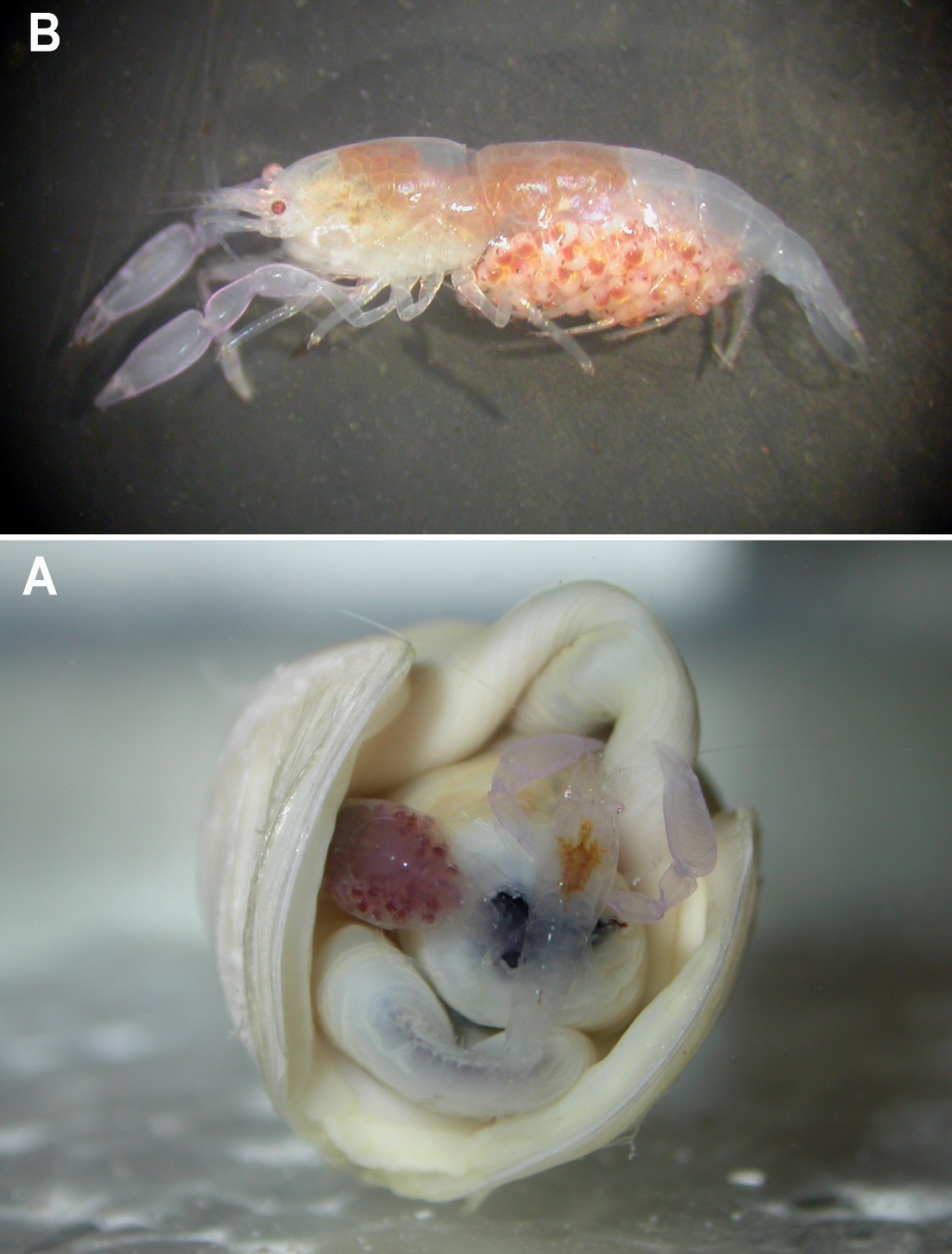
[Crustacea • 2024] Platypontonia ngae • A New symbiotic Shrimp (Decapoda: Palaemonidae) living inside a boring gastrochaenid bivalve mollusk from the Philippines


Platypontonia ngae  Fransen, 2024
ovigerous female holotype & male-female pair in gastrochaenid bivalve

 
Abstract
A new symbiotic palaemonid shrimp Platypontonia ngae sp. nov., is described based on a male-female pair found inside the mantle cavity of a gastrochaenid bivalve mollusk collected on a coral slope on the island Panglao, Philippines. The new species constitutes the third member of the genus Platypontonia Bruce, 1968. The new species is described, figured and compared with its congeners.

Crustacea, Malacostraca, Caridea, Symbiosis, Mollusca, Gastrochaenidae, Philippines


Platypontonia ngae sp. nov.:
A, male-female pair in gastrochaenid bivalve; B, ovigerous female holotype, RMNH.CRUS.D.58061.
Photographs by Stefano Schiaparelli.


Charles H.J.M. Fransen. 2024. Platypontonia ngae sp. nov., A New symbiotic Shrimp (Decapoda: Palaemonidae) living inside a boring gastrochaenid bivalve mollusk from the Philippines.  Zootaxa. 5476(1); 89-98. DOI: 10.11646/zootaxa.5476.1.11