Showing posts with label Western Thailand. Show all posts

Sunday, August 2, 2026

[Herpetology • 2026] Acanthosaura syrax • A New Species of mountain horned dragon (Squamata: Agamidae) from high-elevation habitats of western Thailand


Acanthosaura syrax  
P. Trivalairat, K. Trivalairat, Moungkhaek, Caponov & Lorsunyaluck. 2026. 

Syrax mountain horned dragon | กิ้งก่าเขาหนามเล็กไซแรกซ์ 

Abstract
A new species of mountain horned dragon, Acanthosaura syrax sp. nov., is described from the high–elevation evergreen forests of Mae Wong National Park in western Thailand. Morphological comparisons distinguish the new taxon from its congeners by its smaller body size and the fact that it possesses the smallest nuchal and dorsal scales recorded within the genus. Phylogenetic analysis of mitochondrial ND2 and COI gene sequences further supports this distinction, identifying the new species as a reciprocal monophyletic lineage with 76% and 99% nodal support in maximum–likelihood analyses and 0.78 and 1.00 nodal support in Bayesian Inference analyses based on ND2 and COI genes, respectively. Interspecific pairwise genetic distances between A. syrax sp. nov. and other congeners range from 14.1–15.9% in ND2 gene and 14.96–28.13% in COI gene, while intraspecific variation remains low at 0–0.01% and 0–0.34% in ND2 and COI, respectively. This discovery brings the number of Acanthosaura species to 23 and highlights the significant and unique biodiversity found within the high–altitude evergreen ecosystems of western Thailand.

Key words: COI, Mae Wong National Park, morphology, ND2, reptile, Tak–Kamphaeng Phet Province, taxonomy, tropical rainforest

Adult male holotype (THNHM31129) of Acanthosaura syrax sp. nov. from Mae Wong District, Kampheang Phet Province, Thailand, at 1,340 m a.s.l.
A. Left lateral view; B. Right lateral view; C. Dorsal view.

Acanthosaura syrax sp. nov. 
Adult female paratype (THNHM31130 for (A–C), THNHM31131 for (D–F))  
A, B. Right lateral view; C, F. Dorsal view. D, E. Left lateral view.

Acanthosaura syrax sp. nov.

Diagnosis. A small-sized species (maximum SVL 101.2 mm for females and 69.6 mm for males) with a single tiny conical spine above the posterior margin of the eye (maximum PS 2.7 mm for females and 2.0 mm for males); small spine on the occiput between the tympanum and the nuchal crest (maximum OS 4.1 mm for females and 2.4 mm for males); tympanum scaleless, small, roundish; less developed gular pouch; present small scales intermixed with three set of medium keeled scales line transversely from dorsal to ...

Acanthosaura syrax sp. nov. 
Adult female paratype (THNHM31130 for (A–C), THNHM31131 for (D–F)) o
A, B. Right lateral view; C, F. Dorsal view. D, E. Left lateral view.


Etymology. The specific epithet syrax is a noun in apposition, named in reference to the dragon “Syrax”, the mount of Queen Rhaenyra Targaryen [from George R.R. Martin’s A Song of Ice and Fire universe]. This name is inspired by the species’ distinctive yellow-hued coloration, its relatively diminutive size compared to its congeners, and its significant reproductive output, reflected in its high clutch size. We suggest the following common names, “Syrax mountain horned dragon” (English) and “King Ka Khaow Naam Lek Syrax” (กิ้งก่าเขาหนามเล็กไซแรกซ์) (Thai). 


Poramad Trivalairat, Krittiya Trivalairat, Nawee Moungkhaek, Simon Caponov and Benchapol Lorsunyaluck. 2026. Acanthosaura syrax sp. nov., A New Species of mountain horned dragon from high-elevation habitats of western Thailand (Squamata, Agamidae). ZooKeys. 1287: 47-76.  DOI: doi.org/10.3897/zookeys.1287.186636

Thursday, December 25, 2025

[Entomology • 2025] Coeliccia sirindhornae • A New Damselfly (Odonata: Platycnemididae) from Northwest Thailand


Coeliccia sirindhornae
Makbun, Phan, Ignatius & Keetapithchayakul, 2025

 Tropical Natural History. Suppl. 8 
แมลงปอเข็มท้องยาวเทพรัตน์  ||  DOI: doi.org/10.58837/tnh.25.8.266860 
photographed by Noppadon Makbun

Abstract
A new species of the genus Coeliccia Kirby, 1890, C. sirindhornae sp. nov., is described based on specimens of both sexes collected from Kanchanaburi Province, Thailand. This species can be differentiated from its congeners by its unique combination of morphological characters, including the shape of antehumeral stripe, the structure and pattern of prothorax, and the shape of anal appendages in both sexes, and the markings on the terminal abdominal segments in female.

Keywords: Damselfly, new species, Zygoptera, Kanchanaburi, Coeliccia

Coeliccia sirindhornae sp. nov. A. Holotype ♂. B. Paratype ♀.

Coeliccia sirindhornae sp. nov. 
แมลงปอเข็มท้องยาวเทพรัตน์   

Coeliccia sirindhornae sp. nov., in typical location.
A. Male. B. Female.
Kanchanaburi, Sangkhla Buri, Prangphle, 2–iv–2017
 photographed by Noppadon Makbun


Noppadon Makbun, Quoc Toan Phan, Kaewpawika Jitthamma Ignatius and Tosaphol Saetung Keetapithchayakul. 2025. Coeliccia sirindhornae sp. nov., A New Damselfly (Odonata: Platycnemididae) from Northwest Thailand.  Tropical Natural History. Suppl. 8;  415-425. DOI: doi.org/10.58837/tnh.25.8.266860 

Sunday, August 17, 2025

[Botany • 2025] Derris longiracemosa (Fabaceae) • A New Species from Thailand with extraordinary limestone adaptations and the longest inflorescences ever recorded


Derris longiracemosa  Boonprajan & Sirich.,  

in Boonprajan, Oncham et Sirichamorn, 2025.
เปรียงประจิม  ||  DOI: 10.3897/phytokeys.261.156249 

Abstract
A new species of Derris Lour. (Fabaceae), Derris longiracemosa Boonprajan & Sirich., sp. nov., is described as the species bearing the longest inflorescences recorded in the genus to date, reaching up to 155 cm in length. Endemic to limestone areas in southwestern Thailand, it is possibly the third known limestone-adapted Derris species. Compared with its closest morphological relative and a partially sympatric species, D. solorioides, D. longiracemosa exhibits a longer and differently structured inflorescence, lower numbers of ovules per ovary (fewer than five ovules), and flowers that turn pinker with maturity. Leaf anatomical study reveals several differences, such as the shape of epidermal cells, the presence of secretory-like cavities, an atypical stomatal type that occasionally occurs, the presence of schizogenous cavities in the midrib cortex, and the distinct absence of lysigenous cavities in the pulvini cortex, as well as a thicker mesophyll compared to D. solorioides. Molecular phylogenetic analysis using nuclear ITS and plastid trnL-F and trnK-matK sequences confirms all four sampled populations as a single, well-supported species, distinct from other Derris taxa but showing a close relationship with D. rubrocalyx only in Bayesian inference. This combination of morphological, anatomical, and molecular evidence supports the recognition of Derris longiracemosa as a distinct species. A detailed description, distribution map, line drawing, photographs, and preliminary IUCN conservation status are provided.

Key words: Endangered, IUCN, leaf anatomy, legume, Leguminosae, Millettieae, Papilionoideae, Thailand’s southwestern forest

Derris longiracemosa sp. nov.
A. Inflorescence with leaf; B. Close-up of the inflorescence; C. Close-up of the inflorescence (close bud with brachyblast); D–F. Flowers (front and side view); G. Standard petal; H. Keel petal; I. Wing petal; J. Stamens; K. Pistil; L. Adaxial; M. Abaxial leaves; N. Pods; O. Seeds.
Scale bars: 5 cm (A); 1 mm (B–K, O); 1 cm (L–N). 
Drawn by Yotsawate Sirichamorn (A, C, L–O) and Punvarit Boonprajan (B, D–K).

Derris longiracemosa.
A, B. Habit and habitat; C, D. Inflorescence; E. Close-up of inflorescence, showing flowers on brachyblasts; F. Flowers on a late blooming day, turning to a more pink hue; G. Flowers on an early blooming day, displaying white coloration; H. Pods; (I–III) flowers (front and side view); (IV) standard petal; (V) wing petals; (VI) keel petals; (VII) stamens and pistil; (VIII) pistil; (IX) stamens; (X) inflorescence with leaves. Scale bars: 1 mm (IV–IX); 2 mm (I–III); 10 cm (X).
Photos by Punvarit Boonprajan (A–C, G, X), Yotsawate Sirichamorn (D–F, H), and Saruta Oncham (I–IX).

 Derris longiracemosa Boonprajan & Sirich., sp. nov.
 
Diagnosis. The species exhibits several morphological traits that distinguish it from the coexisting species Derris solorioides. The texture of the leaflets is subcoriaceous to coriaceous (compared to chartaceous in D. solorioides). The leaflet apices are more emarginate. The inflorescences are clearly pseudoracemose or pseudopaniculate with brachyblasts (vs. a true panicle without brachyblasts in D. solorioides). These inflorescences can reach up to 155 cm in length, making them the longest recorded in the genus. The peduncle, rachis, and lateral branches of the inflorescence – including brachyblasts, pedicels, and calyces – are pubescent (as opposed to almost glabrous in D. solorioides). The number of flowers per brachyblast is also highest, with up to 16 flowers. Petal color changes during maturation, ranging from pure white to pink. The ovary contains fewer ovules, with 1 to 4 ovules (vs. ca. 8 in D. solorioides). Additionally, the flowering time is slightly earlier, occurring from November to December (vs. January to February in D. solorioides).

Etymology. The specific epithet highlights the species’ distinction of possessing the longest inflorescence ever documented within the genus.

Thai name: (assigned here). “Priang prachim” (เปรียงประจิม) consists of two components: Priang is an archaic and rarely used noun with an unclear etymology. It has three distinct meanings, one of which refers to a vine or climbing plant; and Prachim, a Thai term influenced by the Sanskrit word “paschimaam”, meaning “the west.” Thus, Priang Prachim translates to “vines of the west.” The name reflects the plant’s habit as a liana and its occurrence in Thailand’s western forests.


Punvarit Boonprajan, Saruta Oncham and Yotsawate Sirichamorn. 2025. Derris longiracemosa (Fabaceae), A New Species from Thailand with extraordinary limestone adaptations and the longest inflorescences ever recorded. PhytoKeys. 261: 13-32. DOI: 10.3897/phytokeys.261.156249

Saturday, December 14, 2024

[Entomology • 2024] Prodasineura sangkhla • A New Damselfly (Odonata: Platycnemididae) from western Thailand


Prodasineura sangkhla
Keetapithchayakul, Makbun, Ignatius & Phan, 2024
 
แมลงปอเข็มท้องเข็มสังขละ  ||  DOI: doi.org/10.11646/zootaxa.5551.1.5
 
Abstract
Prodasineura sangkhla sp. nov. is described from the Takhian Thong waterfall near the Thai-Myanmar border, Kanchanaburi Province, Thailand. It differs from all other species of Prodasineura Cowley, 1934 by the combination of the characters including white pruinescence on prothorax, synthorax and some parts of legs, blue markings on S10 and anal appendages, shape of anal appendages in males, and shape of occipital band and posterior process of posterior lobe in females.

Odonata, dragonfly, Zygoptera, new species, morphology


Prodasineura sangkhla sp. nov.


Tosaphol Saetung Keetapithchayakul, Noppadon Makbun, Kaewpawika Jitthamma Ignatius, Quoc Toan Phan. 2024. Prodasineura sangkhla sp. nov., A New Damselfly from western Thailand (Odonata: Platycnemididae). Zootaxa. 5551(1); 131-140. DOI: doi.org/10.11646/zootaxa.5551.1.5

[News] แมลงปอเข็มท้องเข็มสังขละ (Prodasineura sangkhla) แมลงปอชนิดใหม่ชนิดแรกและชนิดส่งท้ายปี 2024
แมลงปอเข็มท้องเข็มสังขละได้รับการบรรยายเป็นชนิดใหม่สด ๆ ร้อน ๆ วันนี้ในวารสาร Zootaxa ครับ
คณะผู้บรรยายค้นพบแมลงปอเข็มชนิดนี้พร้อม ๆ กับแมลงปอเข็มท้องเข็มชนิดอื่น ๆ อีก 3 ชนิดคือ แมลงปอเข็มท้องเข็มดำ (Prodasineura autumnalis) แมลงปอเข็มท้องเข็มเอราวัณ (P. laidlawii) และแมลงปอเข็มท้องเข็มเสี้ยวส้ม ฟอร์มตะวันตก (P. sp. [nec. verticalis]) แต่ด้วยลักษณะอันโดดเด่นของตัวผู้ ทำให้เราแยกแมลงปอเข็มท้องเข็มสังขละได้ไม่ยาก กล่าวคือ อกและโคนท้องที่มีสีขาว และปลายท้องและรยางค์ปลายท้องที่มีสีฟ้า แต่สำหรับตัวเมีย หากมองด้วยตาเปล่า อาจจะแยกได้ยาก เพราะมีลายสีเหลืองสลับดำเหมือนกันหมด ต้องมานั่งจ้องลักษณะอกปล้องแรก (หรือที่เรียกกันง่าย ๆ ว่า คอ) และจำนวนหนามที่อยู่ด้านล่างของปลายรยางค์ปลายท้อง ถึงจะสามารถจำแนกได้อย่างถูกต้องแม่นยำครับ

แมลงปอเข็มชนิดนี้พบเกาะตามปลายใบไม้และกิ่งไม้เหนือลำธารที่อำเภอสังขละบุรี จังหวัดกาญจนบุรี และคาดการณ์ว่าน่าจะเจอทางฝั่งประเทศเมียนมาด้วยเช่นกัน เพราะจุดที่เจอมันอยู่ใกล้ชายแดนครับ
---
A new species of genus Prodasineura, P. sangkhla, was described from Sangkhla Buri, Kanchanaburi Province. The description was published in Zootaxa today.
This new species co-occurs with other three members of the genus, that is P. autumnalis, P. laidlawii and P. sp. [nec. verticalis]. With white pruinosed thorax and blue abdomenal tip, males of P. sangkhla is easily differentiated from those species. Unlike the males, the general appearance of the females are similar to the congeners found in the area but you need to look at shape of prothorax and number of ventral spine on cerci for making an accurate ID.
Prodasineura sangkhla was spotted perching on leaf or twig along the stream in Sangkhla, Kanchanaburi Province and expected to be found in nearby area in Myanmar.

Friday, October 18, 2024

[Herpetology • 2024] Tylototriton soimalai • A New Species of the Genus Tylototriton (Urodela: Salamandridae) from Tak Province, northwestern Thailand


 Tylototriton soimalai  
Pomchote, Peerachidacho, Khonsue, Sapewisut, Hernandez, Phalaraksh, Siriput & Nishikawa, 2024 

กะท่างน้ำดอยสอยมาลัย  || DOI: 10.3897/zookeys.1215.116624 

Abstract
A new species of the crocodile newt genus Tylototriton from Doi Soi Malai located at Mae Tuen Wildlife Sanctuary, Tak Province, northwestern Thailand is described based on molecular and morphological evidence, and named as Tylototriton soimalai sp. nov. The new species is the seventh recorded species of the genus Tylototriton reported in Thailand. It differs morphologically from its congeners by a combination of the following morphological characteristics: head longer than wide; snout blunt or truncate; sagittal ridge on head narrow, short and distinct; dorsolateral bony ridges on head pronounced and rough; parotoids distinct; vertebral ridge prominent, wide and not segmented; 14–16 distinct, rounded and isolated rib nodules but posterior nodules connected; tips of fore- and hind limbs overlapping when adpressed along the body. The body background color is black, while the color markings are orange. Molecular analysis indicated that Tylototriton soimalai sp. nov. is a distinct lineage and sister to T. uyenoi with a 4.1% genetic sequence divergence based on the mitochondrial NADH dehydrogenase subunit 2 gene. The new species is currently restricted to the hill evergreen forests of Doi Soi Malai. The implementation of a strategic plan is recommended to protect both the species and its habitat from anthropogenic activities.

Key words: Conservation, crocodile newt, morphology, phylogeny, Tylototriton soimalai sp. nov.


The male holotype of Tylototriton soimalai sp. nov. (CUMZ-A-8253) observed at the type locality.

The two larvae of  Tylototriton soimalai sp. nov. in life.

 Tylototriton soimalai sp. nov.
 (Thai name: Ka Tang Nam Doi Soi Malai - กะท่างน้ำดอยสอยมาลัย) 
(English name: Doi Soi Malai Crocodile Newt)

Diagnosis: Tylototriton soimalai sp. nov. is assigned to the genus Tylototriton by having a combination of dorsal granules present, dorsolateral bony ridges on head present, knob-like warts or rib nodules on dorsolateral body present, and quadrate spine absent. Tylototriton soimalai sp. nov. is distinguished from its congeners by a combination of the following morphological characters: (1) medium-sized, adult SVL 66.3–66.5 mm in males; (2) skin rough with fine granules; (3) head longer than wide; (4) snout blunt or truncate in dorsal view, and extending beyond the lower jaw in lateral view; (5) sagittal ridge on head narrow, short, and distinct; (6) dorsolateral bony ridges on head pronounced, with rough surface, posterior ends weakly or hardly ...

Etymology: The specific epithet soimalai refers to Doi Soi Malai, Mae Tuen Wildlife Sanctuary, the type locality of the new species; it is a noun in apposition, thus invariable.

Current distribution of the genus Tylototriton in Thailand.
Tylototriton verrucosus
 (pale blue); T. anguliceps (green); 
T. uyenoi (red); T. cf. uyenoi (red outlined with dark red); 
T. soimalai sp. nov. (tan); T. phukhaensis (black); and T. panhai (dark blue).
NP = National Park and WS = Wildlife Sanctuary.
 The map is modified from https://www.mitrearth.org.
  

 Porrawee Pomchote, Parada Peerachidacho, Wichase Khonsue, Pitak Sapewisut, Axel Hernandez, Chitchol Phalaraksh, Parunchai Siriput and Kanto Nishikawa. 2024. The Seventh Species of the Newt Genus Tylototriton in Thailand: A New Species (Urodela, Salamandridae) from Tak Province, northwestern Thailand.  ZooKeys. 1215: 185-208. DOI: doi.org/10.3897/zookeys.1215.116624  


Tuesday, November 14, 2023

[Botany • 2021] Artabotrys angustipetalus (Annonaceae) • A New Species from Thailand, including a plastid phylogeny and character evolutionary analyses of thorn occurrence in Artabotrys


Artabotrys angustipetalus Photikwan & Chaowasku, 

in Photikwan, Damthongdee, Jongsook et Chaowasku, 2021. 
การเวกกลีบเรียว  ||  DOI: 10.3372/wi.51.51106

Abstract
Artabotrys R. Br. is one of the larger genera of Annonaceae with over 100 species distributed throughout the palaeotropics plus northern Australia. Although the genus is morphologically very well circumscribed, species delimitation is quite problematic owing to overlapping morphological characteristics. In Thailand, 20 species of Artabotrys have been reported, including A. multiflorus C. E. C. Fisch. Detailed comparisons with the type specimen from Myanmar revealed that A. multiflorus occurring in Kanchanaburi Province of Thailand represents a new species herein described as A. angustipetalus Photikwan & Chaowasku. The new species differs from A. multiflorus by having fewer flowers per hook, linear (vs oblong to oblong-lanceolate) petals, acute (vs obtuse) petal apex, longer and narrower petals and fewer carpels per flower. A multi-locus plastid phylogeny including an accession of A. angustipetalus and 30 accessions of other species of Artabotrys has been reconstructed. The results uncover a well-supported clade consisting of thorn-bearing species of Artabotrys, with A. angustipetalus recovered outside this clade. To understand the evolution of thorns in Artabotrys, ancestral character-state reconstructions were carried out; this trait is inferred to have evolved only once in Artabotrys. The benefits of thorns in Artabotrys species are discussed and hypothesized.


Artabotrys angustipetalus Photikwan & Chaowasku, sp. nov.  
การเวกกลีบเรียว

Holotype: Thailand, Kanchanaburi Province, Thung Yai Naresuan Wildlife Sanctuary, ...

Diagnosis — Artabotrys angustipetalus is morphologically close to A. multiflorus C. E. C. Fisch. The former differs primarily from the latter by having more or less five flowers (vs > 12) per hook, linear (vs oblong to oblong-lanceolate) petals, acute (vs obtuse) petal apex, longer and narrower petals and fewer carpels per flower.


Ekkaphon Photikwan, Anissara Damthongdee, Hathaichanok Jongsook and Tanawat Chaowasku. 2021. Artabotrys angustipetalus (Annonaceae), A New Species from Thailand, including a plastid phylogeny and character evolutionary analyses of thorn occurrence in Artabotrys. Willdenowia. 51(1); 69-82. DOI: 10.3372/wi.51.51106 


นักวิจัยวิทย์ มช. พบ กระดังงา 5 ชนิดใหม่ของโลก สวยงาม หายาก และใกล้สูญพันธุ์

Sunday, March 19, 2023

[Entomology • 2023] Polyrhachis longipilosa • The Thai Species of the Polyrhachis (Myrmatopa) flavicornis Smith, 1857 Species Group (Hymenoptera: Formicidae: Formicinae), with Description of A New Species


Polyrhachis longipilosa
Jaitrong, Yamane & Noon-anant, 2023


Abstract
The Polyrhachis (Myrmatopa) flavicornis species group in Thailand is reviewed. Four species are recognized, of which one species closely related to Polyrhachis constructor Smith, 1857 is described and illustrated as new to science based on the worker caste under the name Polyrhachis longipilosa sp. nov. The queens of P. flavicornis Smith, 1857 and P. constructor, and the males of P. flavicornis and P. varicolor Viehmeyer, 1916 are described. The new species is distributed in western Thailand in the area north of the Isthmus of Kra, while P. constructor is distributed in Malaysia (West Malaysia and Sabah), Indonesia, Singapore, southern and western Thailand. Polyrhachis piliventris Smith, 1857 and Polyrhachis elii Emery, 1900 are synonymized with P. constructor. A key to the Thai species of the Polyrhachis flavicornis species group is given. The type series of P. longipilosa was collected from the canopy of a dry evergreen forest.

Keywords: Formicinae, new species, Polyrhachis, spiny ants, taxonomy, Thailand, Hymenoptera


Polyrhachis longipilosa sp. nov. 


Weeyawat Jaitrong, Seiki Yamane and Nawee Noon-anant. 2023. The Thai Species of the Polyrhachis (Myrmatopa) flavicornis Smith, 1857 Species Group, with description of A New Species (Hymenoptera, Formicidae, Formicinae). Zootaxa. 5249(4); 446-464. DOI: 10.11646/zootaxa.5249.4.3
 มดหนามชนิดใหม่ของโลก Polyrhachis longipilosa Jaitrong, Yamane et Noon-anant 
อาศัยอยู่บนยอดไม้สูงประมาณ 25 เมตรจากพื้นดิน (น่าจะสร้างรังใต้หรือระหว่างใบไม้) 
พบที่อำเภอทองผาภูมิ จังหวัดกาญจนบุรี


Friday, December 30, 2022

[Entomology • 2022] Alainites siamensis • A New Species of Alainites (Ephemeroptera: Baetidae) from Thailand


Alainites siamensis  
Phlai-ngam, Tungpairojwong & Gattolliat, 2022
 

Abstract
A new species of Baetidae, Alainites siamensis sp. nov., is described from Thailand. This new species is closely related to Alainites lingulatus Tong & Dudgeon, 2000, Alainites laetificus (Kang & Yang, 1994) and Alainites yixiani (Gui & Lu, 1999). Species delimitation based on morphological and molecular (mitochondrial COI sequences) evidence is provided. The discovery of this species confirms the wide distribution of Alainites Waltz & McCafferty, 1994 in Southeast Asia.

Key Words: distribution, diversity, mayflies, Southeast Asia, systematic

Alainites siamensis sp. nov., female larva (middle instar larva) habitus:
 A Dorsal view; B Lateral view; C Ventral view.
Scale bar: 1 mm.

Alainites siamensis sp. nov.

Diagnosis: Alainites siamensis sp. nov. is closely related to A. lingulatus, A. laetificus and A. yixiani; these species are distributed in the Southeast Asia. The new species can be separated from the other species by the following combination of characters: i) the shape of labial palp, ii) the setation on tibia, iii) the number of denticles of the claws, iv) the degree of development and spination of paraproct prolongation, v) the number of spines on distal margin of paraproct, vi) number of pairs of gills (Table 4).

Ecological notes: The larvae of Alainites siamensis sp. nov. mainly live among aquatic plants and roots of riparian plants in slow to moderately flowing streams (Fig. 6). The species seems to be rather widely distributed in the northwestern and northern Thailand, but is rare and not abundant (Fig. 7).

Etymology: The specific epithet of this species, siam (noun), refers to the old name of Thailand and to the known distribution of the species.

The sampling sites and habitats of Alainites siamensis sp. nov. larvae:
A–B Yakruae stream, Nam Nao National Park, Phetchabun Province (type locality);
C–D Stream in Mae Ra Mad District, Tak Province;
E–F Stream near the Mining Dr. Phol Kleepbuathe, Thong Pha Phum District, Kanchanaburi Province.


Sirikamon Phlai-ngam, Nisarat Tungpairojwong and Jean-Luc Gattolliat. 2022. A New Species of Alainites (Ephemeroptera, Baetidae) from Thailand. Alpine Entomology. 6: 133-146.  DOI: 10.3897/alpento.6.96284

Tuesday, December 20, 2022

[Herpetology • 2022] Hoplobatrachus salween • A New Species of the Genus Hoplobatrachus Peters, 1863 (Anura: Dicroglossidae) from northwestern Thailand


Hoplobatrachus salween
Thongproh, Chunskul, Sringurngam, Waiprom, Makchai, Cota, Duengkae, Duangjai, Hasan, Chuaynkern & Chuaynkern, 2022

Salween Bullfrog | กบสาละวิน  ||  kasetsartjournal.ku.ac.th

Abstract
Importance of the work: Northwestern Thailand lacks any intensive survey of amphibian fauna; thus, this area is suspected to have undiscovered populations of amphibians. Therefore, conducting field surveys in such areas is essential to fill knowledge gaps about species richness in this animal group. Objectives: To describe a new species of frog genus Hoplobatrachus as new to science. Materials & Methods: A new species was described based on specimens collected from Salawin National Park, Mae Sariang District, Mae Hong Son province, northwestern Thailand. The new species was separated from its congeners inferred from molecular (16S and Cytb genes) and morphological information. Results: The new species was distinguished from its congeners based on mitochondrial DNA sequence analyses and morphological comparisons. The species was characterized by the following characters: pointed snout; large size (snout-vent length [SVL] of adult males = 94.8–102.4 mm, SVL of females = 93.2–96.3 mm); presence of mid-dorsal stripe; absence of thin stripe on inner side of tibia; presence of sexual dichromatism; yellow external vocal sac; presence of nuptial pad on base of first finger in adult males; relative length of finger II < IV < I < III, toe I < II < V < III < IV.  

Keywords: Hoplobatrachus, Hoplobatrachus litoralis, Hoplobatrachus rugulosus, Hoplobatrachus tigerinus, Tiger frog

Photographs of a live adult Hoplobatrachus salween sp. nov. male paratype (KKUC 01176/THNHM 26832) showing the coloration and pattern: 
 (A) dorsolateral view; (B) ventral part of head and body; (C) lateral view; (D) posterior thigh. 

Hoplobatrachus salween sp. nov.

Diagnosis: Hoplobatrachus salween sp. nov. is characterized by the following combination of characters: body slightly stout; pointed snout; SVL of adult males 98.6 ± 5.42 (94.8–102.4 mm, n = 2), females 94.1 ± 1.49 (93.2–96.3 mm, n = 4); presence of mid-dorsal stripe; absence of thin stripe on inner side of tibia; presence of sexual dichromatism (completely yellow in whole body and limbs); presence of external vocal sac and vocal sac opening in adult males; presence of nuptial pad on base of the first finger in adult males; relative finger lengths II < IV < I < III, toe I < II < V < III < IV; phylogenetic topological position close to H. litoralis (3.1% of 16S and 11.5% of Cytb) and H. tigerinus (5.1% of 16S and 12.3% of Cytb).

Etymology and other namesThe specific name “salween” refers to the Salween River (known in Myanmar as the Thanlyin River and in China as the Nu River). The Salween, which is the 26th longest river (about 2,880 km) in the world, is a very important river for China, Myanmar and Thailand. The river flows from the Tibetan Plateau through China, Myanmar, and Thailand into the Andaman Sea. 
An English name “Salween Bullfrog” and a Thai name “กบสาละวิน - Kob Salawin” are suggested by the current study.
กบเหลืองสาละวิน; อุทยานแห่งชาติสาละวิน อำเภอแม่สะเรียง จังหวัดแม่ฮ่องสอน 


Prapaiporn Thongproh, Jidapa Chunskul, Yutthana Sringurngam, Likhit Waiprom, Sunchai Makchai, Michael Cota, Prateep Duengkae, Sutee Duangjai, Mahmudul Hasan, Chantip Chuaynkern and Yodchaiy Chuaynkern. 2022. A New Species of the Genus Hoplobatrachus Peters, 1863 (Anura, Dicroglossidae) from northwestern Thailand. Agriculture and Natural Resources -- formerly Kasetsart Journal (Natural Science). 56(6); 1135-1152.  kasetsartjournal.ku.ac.th/abstractShow.aspx?param=YXJ0aWNsZUlEPTcwODZ8bWVkaWFJRD03NTI2 


Saturday, May 21, 2022

[Botany • 2022] Wurfbainia ellipticarpa, W. geostachyoides, W. parviflora, etc. • Six New Species of Wurfbainia (Zingiberaceae) from Thailand


Wurfbainia yingyongii Kaewsri, 

in Kaewsri & Sangvirotjanapat, 2022. 

ABSTRACT
Six new species are described from Thailand: Wurfbainia ellipticarpa, W. geostachyoides, W. globosa, W. longiflora,  W. parviflora and W. yingyongii. A line drawing and photographs, information on phenology,  distribution, ecology and etymology, and a proposed IUCN conservation category are provided for each species. A key to the species of Wurfbainia in Thailand is also provided.
 
Keywords: AmomumCardamom, Ginger, Flora, Taxonomy

Wurfbainia ellipticarpa Kaewsri, sp. nov.
 A, Ligule; B, leaves; C, inflorescence; D, mature infructescence; E, young infructescence.
All photographs of the type collection (Kaewsri 024), taken by W. Kaewsri.

Wurfbainia ellipticarpa Kaewsri, sp. nov.

Similar to Wurfbainia villosa (Lour.) Škorničk. & A.D.Poulsen but differs in its narrower labellum (c.1 cm vs c.1.5 cm), inflorescence lax (vs congested) and fruit ellipsoid (vs globose to ovoid).

Habitat. Thrives in dry evergreen forest in light gaps at 800 m altitude.

Etymology. The specific epithet refers to the ellipsoid fruit. 


 Wurfbainia geostachyoides Kaewsri, sp. nov.
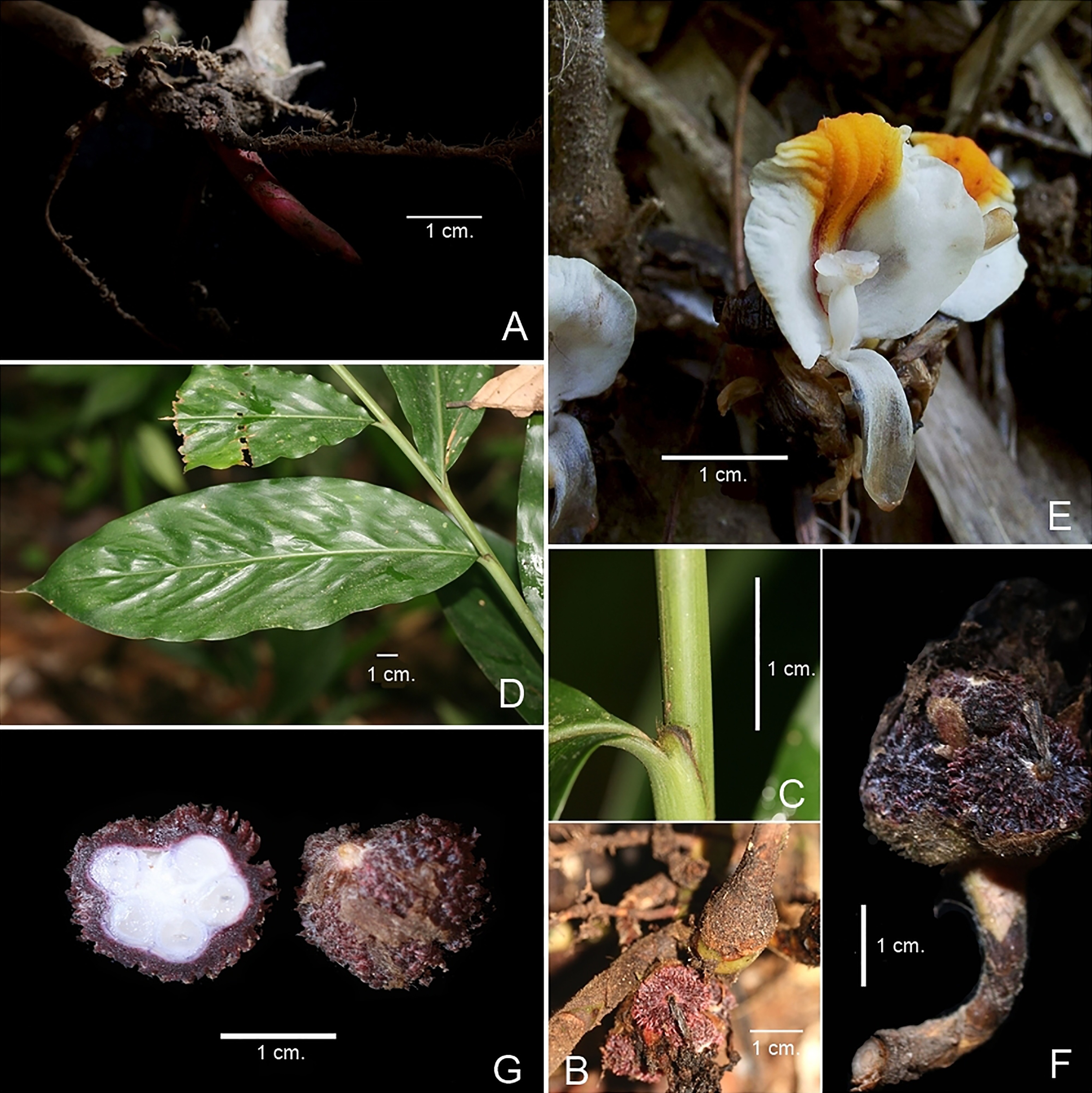
 A, Habit; B, stilt roots and inflorescences; C, ligule; D, leaves; E, flower; F, flowers; G, young fruits; H, ripe fruits.
All photographs of the type collection (Kaewsri 223), taken by W. Kaewsri.

Wurfbainia geostachyoides Kaewsri, sp. nov.

Similar to Wurfbainia microcarpa (C.F.Liang & D.Fang) Škorničk. & A.D.Poulsen but differs in its shorter ligule (c.2 mm vs 7–10 mm), abaxial blade surface glabrous (vs tomentose) and lateral staminode apex truncate (vs rounded and hooded).

Habitat. Dry evergreen and tropical rain forest under shrubs or trees or on hill slopes at 260–950m altitude.

Etymology. The specific epithet refers to the distinctly woody rhizome raised above ground with stilt roots, which recalls the genus Geostachys (Baker) Ridl.


  Wurfbainia globosa Kaewsri, sp. nov.
 A, Leaves; B, inflorescence and infructescence; C, flower; D, bract; E, bracteole; F, calyx; G, corolla (dissected); H, labellum; I, stamen; J, stigma; K, fruit.
Drawn from Kaewsri 027 by W. Kaewsri.

Wurfbainia globosa Kaewsri, sp. nov.

Similar to Wurfbainia villosa (Lour.) Škorničk. & A.D.Poulsen but differs in its ligule apex bilobed (vs round or emarginate), calyx apex bilobed (vs trilobed) and labellum apex bilobed (vs shallowly trilobed).

Habitat. Dry evergreen forest under shrubs or trees at 215m altitude.

Etymology. The specific epithet refers to the globose fruit.


Wurfbainia longiflora Kaewsri, sp. nov.

Similar to Wurfbainia uliginosa (J.Koenig) Škorničk. & A.D.Poulsen but differs in its shorter leafy shoot (0.6–1.7 m vs 2.4–4.1 m), inflorescence size (3 × 1.2 cm vs 3–5 × 2–3 cm), longer floral tube (3.7–4.2 cm long including ovary vs c.2.5 cm long including ovary) and young fruit white (vs green).

Habitat. Tropical rain and evergreen forest under shrubs and trees at 215 m altitude.

Etymology. The specific epithet refers to the distinct long floral tube.


Wurfbainia parviflora Kaewsri, sp. nov.

Similar to Wurfbainia micrantha (Ridl.) Škorničk. & A.D.Poulsen but differs in its blade size (11–21 × 2–4 cm vs 15–30 × 0.6–2 cm), blade pubescent on both sides (vs glabrous on both sides) and calyx tube apex bilobed (vs trilobed).

Habitat. Dry evergreen forest in light gaps at c.800 m altitude.

Etymology. The specific epithet refers to the small flower.


Wurfbainia yingyongii Kaewsri, sp. nov.
A, Young leafy shoot; B, pseudostem base; C, ligule; D, leaves; E, inflorescence; F, infructescence; G, fruit (cross-section).
All photographs of the type collection (Kaewsri 001), taken by W. Kaewsri.

Wurfbainia yingyongii Kaewsri, sp. nov.

Similar to Wurfbainia biflora (Jack) Škorničk. & M.F.Newman but differs in its labellum ovate (vs obovate) and orange middle band on labellum (vs mid-red to dark red band).


Habitat. Dry evergreen forest, under shade of shrubs and trees, c.400 m altitude.

Etymology. The specific epithet honours Associate Professor Dr Yingyong Paisooksantivatana, who dedicated his life to the study of Amomum sensu lato in Thailand.

 
W. Kaewsri and S. Sangvirotjanapat. 2022. Six New Species of Wurfbainia (Zingiberaceae) from Thailand. EDINBURGH JOURNAL OF BOTANY. 79; Article 369 (1–23). DOI: 10.24823/EJB.2022.369