Showing posts with label Ceratopsia. Show all posts

Wednesday, September 4, 2024

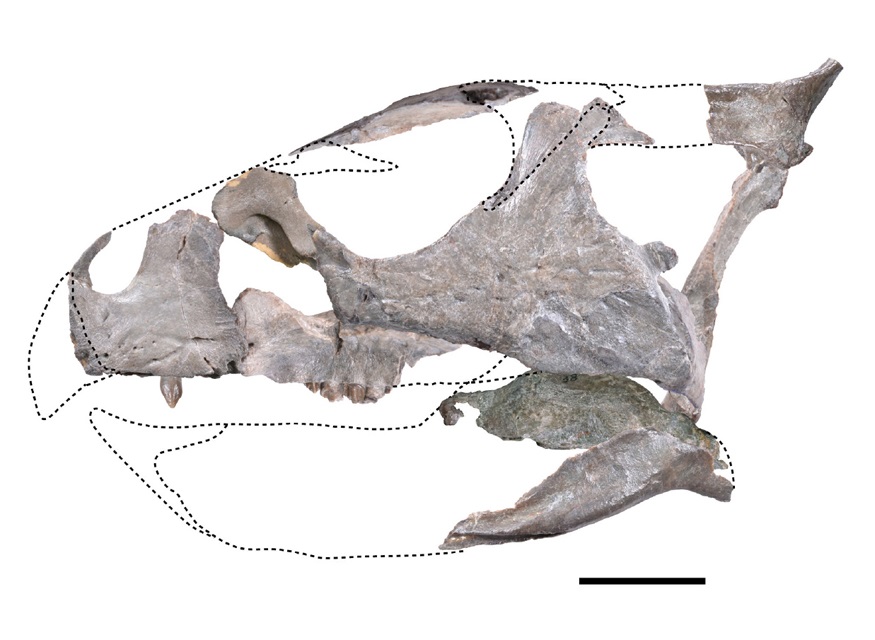
[Paleontology • 2024] Sasayamagnomus saegusai • A New neoceratopsian (Ornithischia: Ceratopsia) from the Lower Cretaceous Ohyamashimo Formation (Albian), southwestern Japan


Sasayamagnomus saegusai
 Tanaka, Chiba, Ikeda & Ryan, 2024

「ササヤマグノームス・サエグサイ」DOI: 10.1002/spp2.1587
artwork by Kanon Tanaka  facebook.com/kanontanaka165

Abstract
The herbivorous dinosaur clade Ceratopsia flourished in the northern hemisphere during the Late Jurassic to Late Cretaceous. Previous palaeobiogeographic studies have suggested that their initial diversification occurred in Asia, with early-branching neoceratopsians extending their geographical range to North America sometime during the Barremian to Albian. However, the specific timing and mode of their dispersal from Asia to North America remains unknown. Here we describe a new, early-branching neoceratopsian, Sasayamagnomus saegusai gen. et sp. nov., from the Albian Ohyamashimo Formation in southwestern Japan, representing the easternmost fossil record of ceratopsians in Asia. Sasayamagnomus exhibits three diagnostic features in the jugal, squamosal and coracoid, respectively, and also has a unique combination of characters in the lacrimal. Our phylogenetic analysis indicates that Sasayamagnomus forms a clade with Aquilops americanus, one of the earliest neoceratopsians from North America, followed by the sister taxon Auroraceratops rugosus from China. The present time-calibrated phylogenetic tree indicates that the immigration of neoceratopsians from Asia to North America occurred during the latest Aptian or early Albian, refining the previously suggested timeframe. This aligns with fragmentary neoceratopsian fossil records from the Lower Cretaceous of North America and the initial formation of the Bering land bridge. Furthermore, the simultaneous occurrence of global warming (which enabled the development of extensive forests in the Arctic region) and the emergence of the Bering land bridge during the Aptian–Albian, probably played a crucial role in facilitating the immigration of neoceratopsians from Asia to North America.

Keywords: Neoceratopsia, Japan, Albian, Bering land bridge, palaeobiogeography, Early Cretaceous Laurasian interchange event 


Sasayamagnomus saegusai gen. et sp. nov.


Tomonori Tanaka, Kentaro Chiba, Tadahiro Ikeda and Michael J. Ryan. 2024. A New neoceratopsian (Ornithischia, Ceratopsia) from the Lower Cretaceous Ohyamashimo Formation (Albian), southwestern Japan. Papers in Palaeontology. 10(5); e1587. DOI: doi.org/10.1002/spp2.1587
 facebook.com/kanontanaka165/posts/1049483200227362  #復元画 #illustration
#恐竜 #角竜類 #イラスト #イラストレーション

Thursday, June 20, 2024

[Paleontology • 2024] Lokiceratops rangiformis gen. et sp. nov. (Ceratopsia: Ceratopsidae: Centrosaurinae) from the Campanian Judith River Formation of Montana reveals Rapid Regional Radiations and Extreme Endemism within centrosaurine dinosaurs


Lokiceratops rangiformis
 Loewen​​, Sertich​, Sampson, O’Connor, Carpenter, Sisson, Øhlenschlæger, Farke, Makovicky, Longrich & Evans, 2024


Abstract
 The Late Cretaceous of western North America supported diverse dinosaur assemblages, though understanding patterns of dinosaur diversity, evolution, and extinction has been historically limited by unequal geographic and temporal sampling. In particular, the existence and extent of faunal endemism along the eastern coastal plain of Laramidia continues to generate debate, and finer scale regional patterns remain elusive. Here, we report a new centrosaurine ceratopsid, Lokiceratops rangiformis, from the lower portion of the McClelland Ferry Member of the Judith River Formation in the Kennedy Coulee region along the Canada-USA border. Dinosaurs from the same small geographic region, and from nearby, stratigraphically equivalent horizons of the lower Oldman Formation in Canada, reveal unprecedented ceratopsid richness, with four sympatric centrosaurine taxa and one chasmosaurine taxon. Phylogenetic results show that Lokiceratops, together with Albertaceratops and Medusaceratops, was part of a clade restricted to a small portion of northern Laramidia approximately 78 million years ago. This group, Albertaceratopsini, was one of multiple centrosaurine clades to undergo geographically restricted radiations, with Nasutuceratopsini restricted to the south and Centrosaurini and Pachyrostra restricted to the north. High regional endemism in centrosaurs is associated with, and may have been driven by, high speciation rates and diversity, with competition between dinosaurs limiting their geographic range. High speciation rates may in turn have been driven in part by sexual selection or latitudinally uneven climatic and floral gradients. The high endemism seen in centrosaurines and other dinosaurs implies that dinosaur diversity is underestimated and contrasts with the large geographic ranges seen in most extant mammalian megafauna.


Skull of Lokiceratops rangiformis n. gen et n. sp. (EMK 0012).
(A) Skull of Lokiceratops rangiformis in dorsal view. (B) Skull reconstruction in anterior view. (C) Skull reconstruction in lateral view interpreted from both sides. Reconstructions are based on 3D surface scans with deformation and parallax removed. The mandible was not found with EMK 0012.
Stippled artwork by Sergey Krasovskiy. Scale bar equals 1 m.


Systematic Paleontology
Dinosauria Owen, 1842; sensu Padian & May, 1993
Ornithischia Seeley, 1887; sensu Sereno, 1998

Ceratopsia Marsh, 1890; sensu Dodson, 1997
Ceratopsidae Marsh, 1888; sensu Sereno, 1998
Centrosaurinae Lambe, 1915; sensu Dodson, Forster & Sampson, 2004

Albertaceratopsini clade nov.
 
Diagnosis—Albertaceratopsini is defined as a stem-based clade that consists of all taxa more closely related to Albertaceratops nesmoi than to Centrosaurus apertus.

Lokiceratops gen. nov.

Lokiceratops rangiformis gen. et sp. nov.

Diagnosis—Lokiceratops rangiformis is an albertaceratopsin centrosaurine ceratopsid distinguished from other centrosaurines by the following autapomorphies: presence of unadorned nasal; elongate, uncurved ep1 epiossification directed in plane of frill along posterior margin of parietosquamosal frill; hypertrophied, lateral curving epiparietal ep2 directed in plane of frill. The hypertrophied ep2 is relatively larger than any other parietal epiossification within Centrosaurinae. Both ischia are distinctly kinked distally at about two-thirds of the length of the shaft, at the point where the two ischia contact medially. Postorbital horncore bases are deeply excavated by sinuses penetrating a distance equivalent to the orbital diameter of each horncore, to an extent unobserved in other long horned centrosaurs.
 
Etymology— The generic name refers to the god Loki from Norse mythology, and ceratops, (Greek) meaning “horned face.” The species name refers to the bilateral asymmetry of frill ornamentations, similar to the asymmetry in antlers of the reindeer/caribou genus Rangifer.


Holotype Locality—EMK 0012 was recovered from the Loki Quarry in Kennedy Coulee, south of the Milk River in Hill County, northern Montana (Fig. 1). The quarry is 3.6 km from the Montana-Alberta border and 922 m above sea level. Exact coordinates are available at the Evolutionsmuseet, Knuthenborg, Maribo, Denmark, and the Natural History Museum of Utah, United States of America.

Holotype Horizon—EMK 0012 was recovered from lower Judith River Formation horizons that correlate to the McClelland Ferry Member to the south, and to the lower part of the Oldman Formation of southern Alberta, 3.6 km to the north. EMK 0012 was located 11.4 m above the Marker A Coal equivalent to the Taber Coal Zone (at the top of the Foremost Formation) and laterally equivalent to the Herronton Sandstone Zone near the base of the Oldman Formation 3.6 km to the north in Alberta.

Age—High-precision U–Pb analyses of zircons by the CA-ID-TIMS method in a bentonite within the Marker A Coal (KC061517-1; 11.4 m below the Loki Quarry) date to 78.549 ± 0.024 Ma (Ramezani et al., 2022). Using the median Bayesian age model developed by Ramezani et al. (2022) for the stratigraphic position of the Loki Quarry recovers a date of roughly 78.1 Ma, with a lower modeled bound of 78.38 Ma and an upper modeled bound of 77.18 Ma.


Mark A. Loewen​​, Joseph J. W. Sertich​, Scott Sampson, Jingmai K. O’Connor, Savhannah Carpenter, Brock Sisson, Anna Øhlenschlæger, Andrew A. Farke, Peter J. Makovicky, Nick Longrich and David C. Evans. 2024. Lokiceratops rangiformis gen. et sp. nov. (Ceratopsidae: Centrosaurinae) from the Campanian Judith River Formation of Montana reveals Rapid Regional Radiations and Extreme Endemism within centrosaurine dinosaurs. PeerJ. 12:e17224. DOI: 10.7717/peerj.17224


Wednesday, May 1, 2024

[Paleontology • 2024] Osteology, Phylogenetic Affinities, and Palaeobiogeographic Significance of the bizarre ornithischian Dinosaur Ajkaceratops kozmai from the Late Cretaceous European Archipelago


Ajkaceratops kozmai  Ősi, Butler & Weishampel, 2010

in Czepiński & Madzia, 2024. 
artistic restoration by Edyta Felcyn-Kowalska

Abstract
At the climax of their evolutionary history in the latest Cretaceous, ceratopsian dinosaurs were among the most dominant components of North American and Asian land ecosystems. In other continental landmasses, however, ceratopsians were extraordinarily rare and the affinities of their proposed representatives often turned out to be inconclusive. Arguably the most significant evidence of Ceratopsia from outside North America and Asia is represented by Ajkaceratops kozmai from the Santonian (Upper Cretaceous) of Hungary. We provide a detailed osteological description of Ajkaceratops and highlight its bizarre anatomy. Ajkaceratops has been ‘traditionally’ interpreted to represent a Bagaceratops-like coronosaur, and its occurrence on the European islands was hypothesized to probably result from an early Late Cretaceous dispersal event from Asia. However, while the snout of Ajkaceratops may resemble that of some ceratopsians, closer inspection of the preserved elements indicates that these similarities are largely superficial. While it cannot be ruled out that Ajkaceratops represents a highly peculiar member of the clade, its placement is far from certain. Still, the discovery of Ajkaceratops exemplifies the importance and uniqueness of European dinosaur faunas.

Ceratopsia, Late Cretaceous, Ornithischia, osteology, palaeobiogeography, phylogeny


Łukasz Czepiński and Daniel Madzia. 2024. Osteology, Phylogenetic Affinities, and Palaeobiogeographic Significance of the bizarre ornithischian Dinosaur Ajkaceratops kozmai from the Late Cretaceous European Archipelago. Zoological Journal of the Linnean Society. zlae048. DOI: 10.1093/zoolinnean/zlae048

Wednesday, August 17, 2022

[Paleontology • 2022] Bisticeratops froeseorum • A New Chasmosaurine Ceratopsid from the Upper Cretaceous (Campanian) Farmington Member of the Kirtland Formation, New Mexico


Bisticeratops froeseorum
 Dalman, Jasinski & Lucas, 2022


A nearly complete skull of a new ceratopsid dinosaur, Bisticeratops froeseorum, is described from the Farmington Member of the Kirtland Formation (late Campanian, Upper Cretaceous) of New Mexico. Bisticeratops is distinguished by several diagnostic cranial characters, including those of the premaxilla (stepped dorsal margin), maxilla (short jugal process lacking the ventral pocket-like fossa), jugal (short maxillary process of the jugal), and palpebral ornamentation (short with moderate ornamentation). It differs from other known chasmosaurines, especially from stratigraphically older species in the same geographic region, Pentaceratops sternbergi and Titanoceratops ouranos, by a strongly reduced jugal process of the maxilla and an unusual maxilla/jugal contact, which forms a shallow, triangular-shaped lateroposteriorly concave sulcus. A phylogenetic analysis recovers Bisticeratops froeseorum as sister species to the unnamed Almond Formation chasmosaurine and as a member of a potentially new southern clade of chasmosaurines, outside the Triceratopsini, and distinct from other southern Laramidian chasmosaurines such as Pentaceratops. The dinosaur fauna of the Farmington Member is comparatively poorly understood, especially compared to stratigraphically older faunas in the San Juan Basin. Therefore, the new, presumably rare species Bisticeratops froeseorum, together with several recently named and described chasmosaurines such as Navajoceratops sullivani, Sierraceratops turneri, and Terminocavus sealeyi, add to the diversity and disparity of chasmosaurines and provides further support for latitudinal variation in the ceratopsid fauna during the Late Cretaceous interval in the Western Interior Basin of North America.


Sebastian Dalman, Steven E. Jasinski and Spencer G. Lucas. 2022. A New Chasmosaurine Ceratopsid from the Upper Cretaceous (Campanian) Farmington Member of the Kirtland Formation, New Mexico. New Mexico Museum of Natural History and Science Bulletin. 90: 127–153. 
twitter.com/TheDarknix/status/1559635224165695492


Thursday, April 28, 2022

[Paleontology • 2022] Cretaceous Dinosaurs across Alaska Show the Role of Paleoclimate in Structuring Ancient Large-Herbivore Populations


Examples of vertebrate fossil data used in this study.
(1) Prince Creek Formation, North Slope, C1, bonebed.
(2) lower Cantwell Formation, Denali National Park, C2, ceratopsian footprint.
(3) Chignik Formation, Aniakchak National Monument, C3 hadrosaur footprint.

in Fiorillo, McCarthy, Kobayashi & Suarez, 2022.

Abstract
The partially correlative Alaskan dinosaur-bearing Prince Creek Formation (PCF), North Slope, lower Cantwell Formation (LCF), Denali National Park, and Chignik Formation (CF), Aniakchak National Monument, form an N–S transect that, together, provides an unparalleled opportunity to examine an ancient high-latitude terrestrial ecosystem. The PCF, 75–85° N paleolatitude, had a Mean Annual Temperature (MAT) of ~5–7 °C and a Mean Annual Precipitation (MAP) of ~1250 mm/year. The LCF, ~71° N paleolatitude, had a MAT of ~7.4 °C and MAP of ~661 mm/year. The CF, ~57° N paleolatitude, had a MAT of ~13 °C and MAP of ~1090 mm/year. The relative abundances of the large-bodied herbivorous dinosaurs, hadrosaurids and ceratopsids, vary along this transect, suggesting that these climatic differences (temperature and precipitation) played a role in the ecology of these large-bodied herbivores of the ancient north. MAP played a more direct role in their distribution than MAT, and the seasonal temperature range may have played a secondary role.

Keywords: hadrosaurs; ceratopsians; Arctic; ancient Arctic; terrestrial ecosystems; ecosystem reconstruction

Figure 1. Maps showing general locations of study areas. (A) Modern Alaska. (B) Polar projection of tectonic plates during the Late Cretaceous (Base map from PLATES Project, University of Texas Institute of Geophysics). The inner latitudinal ring on map represents 45° N.
 (C) Examples of vertebrate fossil data used in this study. (1) Prince Creek Formation, North Slope, C1, bonebed. (2) lower Cantwell Formation, Denali National Park, C2, ceratopsian footprint, Denali National Park. (3) Chignik Formation, Aniakchak National Monument, C3 hadrosaur footprint.


Examples of vertebrate fossil data used in this study. (1) Prince Creek Formation, North Slope, C1, bonebed. (2) lower Cantwell Formation, Denali National Park, C2, ceratopsian footprint, Denali National Park. (3) Chignik Formation, Aniakchak National Monument, C3 hadrosaur footprint.


 Anthony R. Fiorillo, Paul J. McCarthy, Yoshitsugu Kobayashi and Marina B. Suarez. 2022. Cretaceous Dinosaurs across Alaska Show the Role of Paleoclimate in Structuring Ancient Large-Herbivore Populations. Geosciences. 12(4)  (Special Issue: Terrestrial Paleoclimatology and Paleohydrology of the Cretaceous Greenhouse World); 161. DOI: 10.3390/geosciences12040161

Cover Story: The impacts of a changing climate are of major societal concern with great interest on mitigation or modeling how a future, warmer world would look. It is also broadly recognized that the impacts of a warming Earth are most profoundly expressed in the polar regions. Climate change encompasses many components. Our new study reviews the ample evidence for a flourishing ancient Arctic terrestrial ecosystem during the Late Cretaceous greenhouse mode in Earth history, an ecosystem where the local paleoclimate was a primary driver in structuring the relative abundances of large-bodied herbivores in local environments. Further, analysis suggests that mean annual precipitation (MAP) played a more direct role in determining the distribution of herbivorous dinosaurs than mean annual temperature (MAT) did. 


Wednesday, April 6, 2022

[Paleontology • 2022] A New Juvenile Yamaceratops (Dinosauria, Ceratopsia) from the Javkhlant Formation (Upper Cretaceous) of Mongolia


Yamaceratops dorngobiensis  

in Son, Lee​, Zorigt, Kobayashi, ... et Lee, 2022. 

Abstract 
Here we report a new articulated skeleton of Yamaceratops dorngobiensis (MPC-D 100/553) from the Khugenetjavkhlant locality at the Shine Us Khudag (Javkhlant Formation, ?Santonian-Campanian) of the eastern Gobi Desert, Mongolia, which represents the first substantially complete skeleton and the first juvenile individual of this taxon. The specimen includes a nearly complete cranium and large portions of the vertebral column and appendicular skeleton. Its skull is about 2/3 the size of the holotype specimen, based on mandibular length. Its juvenile ontogenetic stage is confirmed by multiple indicators of skeletal and morphological immaturity known in ceratopsians, such as the long-grained surface texture on the long bones, the smooth external surface on the postorbital, open neurocentral sutures of all caudal vertebrae, a large orbit relative to the postorbital and jugal, the low angle of the lacrimal ventral ramus relative to the maxillary teeth row, narrow frontal, and straight ventral edge of the dentary. Osteohistological analysis of MPC-D 100/553 recovered three lines of arrested growth, implying around 3 years of age when it died, and verified this specimen’s immature ontogenetic stage. The specimen adds a new autapomorphy of Yamaceratops, the anteroventral margin of the fungiform dorsal end of the lacrimal being excluded from the antorbital fossa. Furthermore, it shows a unique combination of diagnostic features of some other basal neoceratopsians: the ventrally hooked rostral bone as in Aquilops americanus and very tall middle caudal neural spines about or more than four times as high as the centrum as in Koreaceratops hwaseongensis, Montanoceratops cerorhynchus, and Protoceratops andrewsi. The jugal with the subtemporal ramus deeper than the suborbital ramus as in the holotype specimen is also shared with A. americanus, Liaoceratops yanzigouensis, and juvenile P. andrewsi. Adding 38 new scorings into the recent comprehensive data matrix of basal Neoceratopsia and taking into account the ontogenetically variable characters recovered Y. dorngobiensis as the sister taxon to Euceratopsia (Leptoceratopsidae plus Coronosauria). A second phylogenetic analysis with another matrix for Ceratopsia also supported this position. The new phylogenetic position of Y. dorngobiensis is important in ceratopsian evolution, as this taxon represents one of the basalmost neoceratopsians with a broad, thin frill and hyper-elongated middle caudal neural spines while still being bipedal.

Systematic paleontology
Dinosauria Owen, 1842
Ornithischia Seeley, 1887

Marginocephalia Sereno, 1986

Ceratopsia Marsh, 1890
Neoceratopsia Sereno, 1986

Yamaceratops dorngobiensis Makovicky & Norell, 2006

Holotype. IGM 100/1315, an articulated skull from an adult that lacks the rostral, premaxillae, nasals, the predentary, anterior process of the lacrimal, left elements around the temporal region, left posterior mandible, and the parietal (Makovicky & Norell, 2006).

Studied specimen. MPC-D 100/553, a reasonably complete articulated skeleton with the left proximal femur and partial foot, but no cervical vertebrae, pectoral girdles, left arm, right hand, other parts of the left leg, and the right foot. Measurements are in the Supplemental Information (Tables S1–S4).

Locality, horizon, and age. Khugenetjavkhlant, Dornogovi Province, Mongolia; middle unit of the Javkhlant Formation; Upper Cretaceous (?Santonian-Campanian). The specimen was preserved on top of a trough cross-bedding sandstone that is poorly sorted, as was described for the typical coarse-grained deposits in the middle Javkhlant Formation (Eberth et al., 2009).

Skeleton of Yamaceratops dorngobiensis (MPC-D 100/553) in right dorsolateral view.
 (A) Photograph; (B) Interpretive drawing.
Bones are bounded by solid lines and colored beige; the matrix is gray. Shaded areas represent the broken surface of bones.
Abbreviations: cd, caudal vertebrae; dr, dorsal ribs; dv, dorsal vertebrae; f, femur; fi, fibula; h, humerus; L, bone on the left side; p, isolated parietal; pp, pedal phalanges; R, bone on the right side; ra, radius; sk, skull; sv, sacral vertebrae; ti, tibia; u, ulna; il, ilium; is, ischium.

Skeletal reconstruction of juvenile Yamaceratops dorngobiensis (MPC-D 100/553) in right lateral view. (A) Reconstruction of the skeleton with preserved parts colored in white and missing bones in gray; (B) reconstruction of the complete skeleton, restored based on other basal neoceratopsian skeletons.


Minyoung Son, Yuong-Nam Lee​, Badamkhatan Zorigt, Yoshitsugu Kobayashi, Jin-Young Park, Sungjin Lee, Su-Hwan Kim and Kang Young Lee. 2022. A New Juvenile Yamaceratops (Dinosauria, Ceratopsia) from the Javkhlant Formation (Upper Cretaceous) of Mongolia. PeerJ. 10:e13176 DOI:  10.7717/peerj.13176


Monday, October 4, 2021

[Paleontology • 2021] Sierraceratops turneri • A New Chasmosaurine Ceratopsid (Dinosauria: Ceratopsidae) from the Hall Lake Formation (Upper Cretaceous) of south-central New Mexico


Sierraceratops turneri 
Dalman, Lucas, Jasinski & Longrich, 2021


Abstract
The horned dinosaurs (Ceratopsidae) were a diverse family of herbivorous dinosaurs originating in the Late Cretaceous in western North America (Laramidia). As one of the most species-rich dinosaur groups, their diversity and distribution are important to understanding Cretaceous dinosaur evolution. Ceratopsids have previously been hypothesized to have high levels of endemism despite inhabiting a relatively small land mass with few barriers to dispersal. Here, we document a new chasmosaurine ceratopsid, Sierraceratops turneri gen. et sp. nov., from the Upper Cretaceous (latest Campanian–Maastrichtian) Hall Lake Formation of south-central New Mexico, consistent with the hypothesis that southern Laramidia supported an endemic dinosaur fauna. Sierraceratops is distinguished by its relatively short, robust, and mediolaterally compressed postorbital horns; a flattened medial ridge on the posterior end of the pterygoid; a jugal with pronounced anterior flanges; a long pyramid-shaped epijugal horncore; a D-shaped cross section of the median parietal bar; and a squamosal with a pointed tip and low episquamosal ossifications. Phylogenetic analysis recovers Sierraceratops as sister to Bravoceratops and Coahuilaceratops, part of a clade endemic to the southwestern United States and Mexico. Sierraceratops adds to the diversity and disparity of the Chasmosaurinae in the Late Cretaceous and provides additional evidence for Laramidian endemism. Together with Sierraceratops, the Hall Lake Formation dinosaur fauna suggests that the latest Cretaceous of southern Laramidia was characterized by endemic clades and distinct community structures.

Keywords: Dinosauria, Ceratopsidae, Chasmosaurinae, Hall Lake Formation, New Mexico


Sierraceratops turneri gen. et sp. nov.


 Sebastian G. Dalman, Spencer G. Lucas, Steven E. Jasinski and Nicholas R. Longrich. 2021. Sierraceratops turneri, A New Chasmosaurine Ceratopsid from the Hall Lake Formation (Upper Cretaceous) of south-central New Mexico. Cretaceous Research. In Press, 105034. DOI: 10.1016/j.cretres.2021.105034