Showing posts with label Australo-Papua. Show all posts

Saturday, July 12, 2025

[Botany • 2024] Rhododendron mulyaniae & R. engelbertii (Ericaceae) • Two New Species of Vireya Rhododendron from Tambrauw, Papua, Indonesia


Rhododendron mulyaniae Mambrasar,

in Mambrasar, Elliott et Cameron, 2024. 

Abstract

Two new species of Vireya Rhododendron, Rhododendron mulyaniae sp. nov. and R. engelbertii sp. nov. were discovered in Tambrauw, Papua, Indonesia. Rhododendron mulyaniae resembles R. angiense in that the scales under the leaf are dendroid, but differs in having elliptic to narrowly elliptic leaves, lacking hairs on petiole, having a tubular funnel shaped corolla. Rhododendron engelbertii resembles to R. carstensense in leaf shape but differs by having narrowly tapering leaf base, scales present on the petiole, and a corolla densely scaly on the outside. Detailed descriptions, illustrations and provisional conservation threat status of these newly described species are provided.

Keywords: Gunung Botak, new species, Tambrauw, Vireya Rhododendron
 

Rhododendron mulyaniae Mambrasar sp. nov.  

Rhododendron engelbertii Mambrasar sp. nov.  


Yasper M. Mambrasar, Alan C. Elliott and Kennet M. Cameron. 2024. Two New Species of Vireya Rhododendron (Ericaceae), from Tambrauw, Papua, Indonesia. Nordic Journal of Botany. DOI: doi.org/10.1111/njb.04545 [26 September 2024]  

Tuesday, May 7, 2024

[Herpetology • 2021] Xenorhina ventrimaculata • A New Xenorhina species (Anura: Microhylidae) from northwestern Papua New Guinea


Xenorhina ventrimaculata
 Günther, Dahl & Richards, 2021


Abstract
We describe a new species of the asterophryine microhylid genus Xenorhina from the lowlands of northwestern Papua New Guinea. It is a medium-sized species (SUL of two males 29.2 and 29.9 mm; of four females 29.9–33.0 mm) that can be distinguished from congeners by having a single short, triangular odontoid spike (palatal tooth) on each vomeropalatine bone, moderately short legs (TL/SUL 0.40–0.44) and ventral surfaces heavily spotted with reddish-brown blotches or reticula. The advertisement call comprises 7–10 loud, melodious hooting notes lasting 141–165 ms and produced at a repetition rate of 2.19–2.35 notes/s. Description of this species brings to 41 the number of Xenorhina known from New Guinea and surrounding islands.

Key words: Amphibia, New Guinea, Sepik River Basin, new species, advertisement call, taxonomy, ecofaunistics

 Holotype (SAMA R71741) of Xenorhina ventrimaculata sp. nov. (a) dorsolateral view in life, (b) ventral view in life; (c) ventral view of right hand of preserved specimen, (d) ventral view of right foot of preserved specimen.
 Ventral view of the preserved type series of Xenorhina ventrimaculata sp. nov.  

Xenorhina ventrimaculata sp. nov.
 
Diagnosis: A species of Xenorhina characterized by the unique combination of: medium size (SUL of two males 29.2–29.9 mm; of four females 29.9–33.0 mm); vomeropalatines each with one short triangular odontoid spike; legs moderately short (TL/SUL 0.40–0.44); all fingers and toe 1 without, and toes 2–5 with, expanded terminal discs; eye-naris distance greater than internarial distance (END/IND 1.10–1.21); tympanum about same size as eye (TyD/ED 0.95–1.16); dorsal surfaces in life different tones of brown with small blackish spots; ventral surfaces light ivory heavily spotted with reddish-brown blotches or reticula; advertisement calls uttered in series containing 7–10 loud hooting calls = notes each lasting 141–165 ms and produced at a rate of 2.19–2.35 calls/s.

Etymology: The specific epithet is an adjective compound of two Latin words. Venter is a substantive and means belly or underside of the body and maculata is a feminine adjective meaning flecked or spotted. The specific epithet refers to the conspicuously spotted ventral surfaces of most specimens of the new species.
 

 Rainer Günther, Chris Dahl and Stephen J. Richards. 2021. Description of A New Xenorhina species (Anura, Microhylidae) from northwestern Papua New Guinea. Vertebrate Zoology. 71: 621-630. DOI: 10.3897/vz.71.e66954


Sunday, December 10, 2023

[Botany • 2017] Trichotosia gabriel-asemiana (Orchidaceae) • A New Species from Tambrauw, West Papua Province, Indonesia


Trichotosia gabriel-asemiana Mambrasar & Schuit., 

in Mambrasar et Schuiteman. 2017.

Abstract
A new species of orchid, Trichotosia gabriel-asemiana Mambrasar & Schuit. from West Papua, Indonesia, is described and illustrated, including a colour photograph.

Keywords: New species, Tambrauw, Trichotosia gabriel-asemiana

Trichotosia gabriel-asemiana Mambrasar & Schuit., spec. nov. 
Habit and flower. Photo taken from type location by YM Mambrasar (BO).

Trichotosia gabriel-asemiana Mambrasar & Schuit., spec. nov. 

Diagnosis. This species is similar to Trichotosia microphylla Blume and T. dalatensis by its slender, creeping rhizome, short leaves (less than 2 cm long), and solitary flowers with an abaxial, conical callus near the lip apex. Trichotosia dalatensis has flowers that are similar in size and in the maroon colour, but differs in having a glabrous, uniformly thick lip with a distinct adaxial callus, whereas T. gabriel-asemiana has a lip that is sparsely pilose abaxially and which is abruptly divided into a fleshy basal part and a thin  textured upper part, but lacks an adaxial callus. Trichotosia microphylla has larger, yellowish green flowers (lip ca. 9 mm long, vs. 4 mm in T. gabriel-asemiana), with the lip not pubescent abaxially, and not abruptly divided into a fleshy basal part and a thinner upper part.

Etymology. Named in honour of Gabriel Asem, Regent of Tambrauw Regency since 2011, who in 2015 declared Tambrauw regency a conservation zone.
 

Yasper Michael Mambrasar and Andre Schuiteman. 2017. Trichotosia gabriel-asemiana (Orchidaceae), A New Species from Tambrauw, West Papua Province, Indonesia. REINWARDTIA. 16(2); 107–110. DOI: 10.14203/reinwardtia.v16i2.3310

Monday, October 30, 2023

[Herpetology • 2023] Litoria ridibunda • Revision of Litoria rothii (Anura: Pelodryadidae) from northern Australia


 Litoria ridibunda
Donnellan, Catullo, Rowley, Doughty, Price, Hines & Richards, 2023


Abstract
Litoria rothii is a widespread pelodryadid frog with a charismatic “laughing” advertisement call, distributed across the Australian Monsoon Tropics and southern New Guinea. Given its large distribution spanning well-known biogeographic barriers, variation in male advertisement calls and the prevalence of unresolved species complexes in the Australian frog fauna, we examine the genetic, morphological and acoustic diversity in the species from across its range. Our analyses reveal the presence of a previously unrecognised species in western parts of the range of L. rothii sensu lato, which we describe herein as a new species. Litoria ridibunda sp. nov. is distinguished from L. rothii on the basis of paraphyly of nuclear gene trees with L. everetti from Indonesia, colour patterns on the posterior thigh and male advertisement calls. Compared to L. rothii, the new species has a less contrasting pattern on the posterior thigh and a male advertisement call with a greater number of notes per call and a greater call duration. In particular, the magnitude of call differences between the species is highest where the ranges of the two species are in proximity in north-western Queensland. Our study further emphasises the undiagnosed diversity that remains in Australian frogs, even in relatively large, charismatic, frequently encountered species that often share human dwellings.

Keywords: Amphibia, frog, single nucleotide polymorphisms, mitochondrial DNA, taxonomy, Carpentarian Gap 


Litoria ridibunda  
 Western Laughing Tree Frog  


S.C. Donnellan, R.A. Catullo, J.J.L. Rowley, P. Doughty, L. Price, H.B. Hines and S.J. Richards. 2023. Revision of Litoria rothii (Anura: Pelodryadidae) from northern Australia.  Zootaxa. 5352(1); 73-108. DOI: 10.11646/zootaxa.5352.1.3


Tuesday, August 1, 2023

[Herpetology • 2023] Litoria azuroscelis • A New large Green Treefrog (Anura: Pelodryadidae) from western New Guinea, with the Description of A New Diagnostic Character for the Litoria graminea Group


Litoria azuroscelis 
Günther, Richards, Hamidy, Trilaksono, Sulaeman & Oliver, 2023

RAFFLES BULLETIN OF ZOOLOGY. 71 
Photographs: Rainer Günther.

Abstract
 The Litoria graminea group currently consists of seven nominal species of large, predominately green canopy-associated treefrogs from New Guinea and surrounding islands. Here, we first describe a character that appears to diagnose this species group from the similarly large and green Litoria infrafrenata group, specifically nuptial pads comprised of relatively large asperities versus more numerous and tiny asperities. We then describe a new species of this group from the Wondiwoi Mountains at the base of the Wandammen Peninsula in Indonesian New Guinea. The new species differs from other members of the Litoria graminea group in aspects of body proportions, extent of hand webbing, colouration, and size and shape of the male nuptial pad. Discovery of this new species emphasises the until-recently overlooked pattern of multiple co-occurring species of large, green and highly arboreal Litoria in lowland and foothill rainforest areas across much of New Guinea. Over 40 species of frogs were documented in the vicinity of the type locality, emphasising the high species richness of forests on the Wandammen Peninsula. 

Key words. frog alpha diversity, Litoria infrafrenata group, Indonesia, nuptial pads

Litoria azuroscelis, new species, holotype MZB Amph. 32893 in life.
 A, lateral view, B, more dorsal view highlighting blue wash on groin and hidden surfaces of hindlimbs.
Photographs: Rainer Günther.

Litoria azuroscelis, new species 
Azure-thighed Treefrog 
Katak-pohon paha-biru

Diagnosis. A treefrog that differs from other New Guinean Litoria in the following unique combination of characters: body large (adult male SVL to at least 66.6 mm) and robust; vomero-palatines large, prominently raised, each with ~6 small teeth; labial stripe narrow, white, not extending beyond rictus of jaw; dorsum in life predominantly or entirely dark green; enlarged parotoid glands absent; scapular region lacking deep skin creases; webbing on hands extending slightly beyond distal edge of subarticular tubercles at base of penultimate phalanges on inside of Finger 4 and outside of Finger 3; webbing on feet extending to discs on all toes except Toe 4, where it reaches to midway between disc and subarticular tubercle at base of penultimate phalanx; discs very wide (3FD/SVL 0.073–0.074; 4TD/SVL 0.067–0.069); nuptial pads elongate, broader anteriorly than posteriorly, comprised of distinct almost conical asperities; hidden surfaces of limbs purplish blue in life; iris reddish brown; upper half of nictitating membrane largely clear except for dark dorsal margin; and advertisement call consisting of a harsh note (= call) produced singly or more often in series of 2–7 calls with a mean repetition rate of 2.02 calls/s.


Etymology. Named after the colouration on the hidden surfaces of the hindlimbs, from the combination of the Greek azur (deep blue) and scelis, latinised version of Greek skelos (leg).


 Rainer Günther, Stephen J. Richards, Amir Hamidy, Wahyu Trilaksono, Taufan N. Sulaeman and Paul M. Oliver. 2023. A New large Green Treefrog (Litoria: Pelodryadidae) from western New Guinea, with the Description of A New Diagnostic Character for the Litoria graminea Group. RAFFLES BULLETIN OF ZOOLOGY. 71; 417–429. 
https://lkcnhm.nus.edu.sg/wp-content/uploads/sites/10/2023/07/RBZ-2023-0031.pdf

Sunday, May 14, 2023

[Botany • 2023] Bulbophyllum wiratnoi (Orchidaceae: Epidendroideae: Bulbophyllinae) • A New Species of section Epicrianthes from Indonesian New Guinea


 Bulbophyllum wiratnoi  Saputra, Schuit., Mustaqim & J.Champ.,

in Saputra, Mustaqim, Champion et Schuiteman, 2023. 

Abstract
A new species of Bulbophyllum sect. EpicrianthesBulbophyllum wiratnoi Saputra, Schuit., Mustaqim & J.Champ., is described based on specimens from Indonesian New Guinea. A detailed morphological description and diagnosis, information on distribution and ecology, a preliminary conservation assessment, and a discussion are provided. A key to species of Bulbophyllum sect. Epicrianthes in Indonesian New Guinea is also presented.

Keywords: Bulbophyllum, Epicrianthes, orchids, Papua Barat, Sorong Nature Recreation Park, Monocots

  Line drawing Bulbophyllum wiratnoi.
 A. Plant habit. B-D. Lip (adaxial, abaxial, side view). E. Column side view. F. Petal with appendages. G. Dorsal sepal. H. Lateral sepal. I. Polinia. J. Anther cap. All from holotype.
 Illustrated by Reza Saputra.

 Morphology of Bulbophyllum johannuli and Bulbophyllum wiratnoi.
 A. Bulbophyllum johannuli.
B–I. Bulbophyllum wiratnoi: B. Plant with inflorescence. C–D. Flower (front view, oblique view). E. Polinator. F–H. Lip (side view, oblique view, front view). I. Petal front view.
 Scale: B = 5 mm, C–L = 1 mm. 
Photographs A by Peter Jongejan, C, E, F, G, H, I by Reza Saputra and B, D by Jeffrey Champion.

Bulbophyllum wiratnoi Saputra, Schuit., Mustaqim & J.Champ., sp. nov.

Diagnosis:— This species is similar to Bulbophyllum johannuli Vermeulen (1982: 22–23) in the apically filiform petal appendages but differs in having longer leaves 5.5–5.6 cm [index 2–2.3] (vs. 4.2 × 2.8 cm [index 1.5] in B. johannuli), larger sepals (ca. 12 × 4.5–5 mm vs 8 × 3 mm), petal appendages filiform from a dilated base, ca. 9.7-12 mm long (vs. filiform, 5 mm long, not dilated at the base), with pandurate labellum (vs. spathulate), having longer (ca. 0.23 mm long) and denser papillae on the abaxial side of the lip (vs. papillae ca. 0.14 mm long).

Distribution:— INDONESIA: Papua Barat Daya Province, Bird’s Head Peninsula. Endemic.

Habitat and ecology:—Epiphyte on branches of a large tree in lowland rainforest, ca. 114 m asl.
 
Etymology:—The specific epithet honours Wiratno, prominent Indonesian conservation figure and former Director-General of Conservation of Natural Resources and Ecosystems, Ministry of Environment and Forestry, who was responsible for many breakthroughs in Indonesian conservation development. His ideas about new ways to manage conservation areas in Indonesia are already positively impacting the lives of local people, while preserving ecosystems and their biodiversity.


Reza Saputra, Wendy A. Mustaqim, Jeffrey Champion and André Schuiteman. 2023. Bulbophyllum wiratnoi (Orchidaceae), A New Species of section Epicrianthes from Indonesian New Guinea. Phytotaxa. 589(3); 283-288. DOI: 10.11646/phytotaxa.589.3.7
   

Friday, April 14, 2023

[Herpetology • 2023] Litoria gracilis, L. haematogaster, L. naispela, etc. • Five New Species of the Genus Litoria Tschudi (Anura: Pelodryadidae) from the southern versant of Papua New Guinea’s Central Cordillera, with Observations on the Diversification of Reproductive Strategies in Melanesian Treefrogs


Litoria haematogaster,
Litoria naispela & 
Litoria gracilis
Richards, Donnellan & Oliver, 2023
 
 
Abstract
New Guinea has the most diverse insular frog fauna in the world, and rates of species discovery and description have increased rapidly in the last two decades. Pelodryadid treefrogs are the second most diverse family of anurans on the island but their taxonomy, relationships, and especially ecology remain poorly documented. Based on differences in morphology, advertisement calls (where available) and phylogenetic analyses of a 787 base pair alignment from the mitochondrial ND4 gene and flanking tRNA, we describe five new species of small treefrogs from hill and lower montane forests in the high rainfall belt that straddles the southern versant of Papua New Guinea’s Central Cordillera. Three of these species are known only from forest growing on karst substrates, adding to the growing number of herpetofauna species currently known only from the extensive karst habitats of Papua New Guinea’s South-fold Mountains. We also describe the arboreal breeding strategies of two of the new species, and report obligate treehole (phytotelm) breeding in New Guinean frogs for the first time. The new phytotelm–breeding species has juveniles with colour and patterning that closely resemble bird droppings, suggesting defensive mimicry or masquerade. A preliminary phylogeny suggests that arboreal-breeding frogs do not form a monophyletic group and that arboreal breeding has evolved multiple times within the New Guinean pelodryadid radiation. A further striking feature of the phylogeny is poor support for most basal nodes in the most diverse radiation of Melanesian Pelodryadidae, suggesting rapid ecological diversification and speciation, potentially following colonisation from Australia and/or mountain uplift. These new taxa and observations highlight previously unrecognised ecological and reproductive diversity in the Melanesian Pelodryadidae.
 
Keywords: Amphibia, arboreal breeding, bird-dropping mimicry, Central Cordillera, frogs, karst, phylogeny, phytotelm-breeding, taxonomy  

slender spotted treefrog Litoria gracilis.
Photo: Steve Richards

Darai Plateau treefrog Litoria daraiensis.
Photo: Steve Richards

Lisa’s treefrog Litoria lisae.
Photo: Steve Richards

 red-bellied treefrog Litoria haematogaster.
Photo: Steve Richards

 crater mountain treehole frog Litoria naispela.
Photo: Steve Richards

A young crater mountain treehole frog with coloring like bird droppings.
Photo: Steve Richards 


Stephen J. Richards, Stephen C. Donnellan and Paul M. Oliver. 2023. Five New Species of the pelodryadid Genus Litoria Tschudi from the southern versant of Papua New Guinea’s Central Cordillera, with Observations on the Diversification of Reproductive Strategies in Melanesian Treefrogs. Zootaxa. 5263(2); 151-190. DOI: 10.11646/zootaxa.5263.2.1
https://www.aol.com/news/five-treefrog-species-including-poo-162249418.html

Wednesday, March 22, 2023

[Herpetology • 2023] Litoria lakekamu • A New Species of Small Green Treefrog (Anura: Pelodryadidae) from the Lakekamu Basin in Southern Papua New Guinea


Litoria lakekamu 
Richards & Bickford, 2023


Abstract
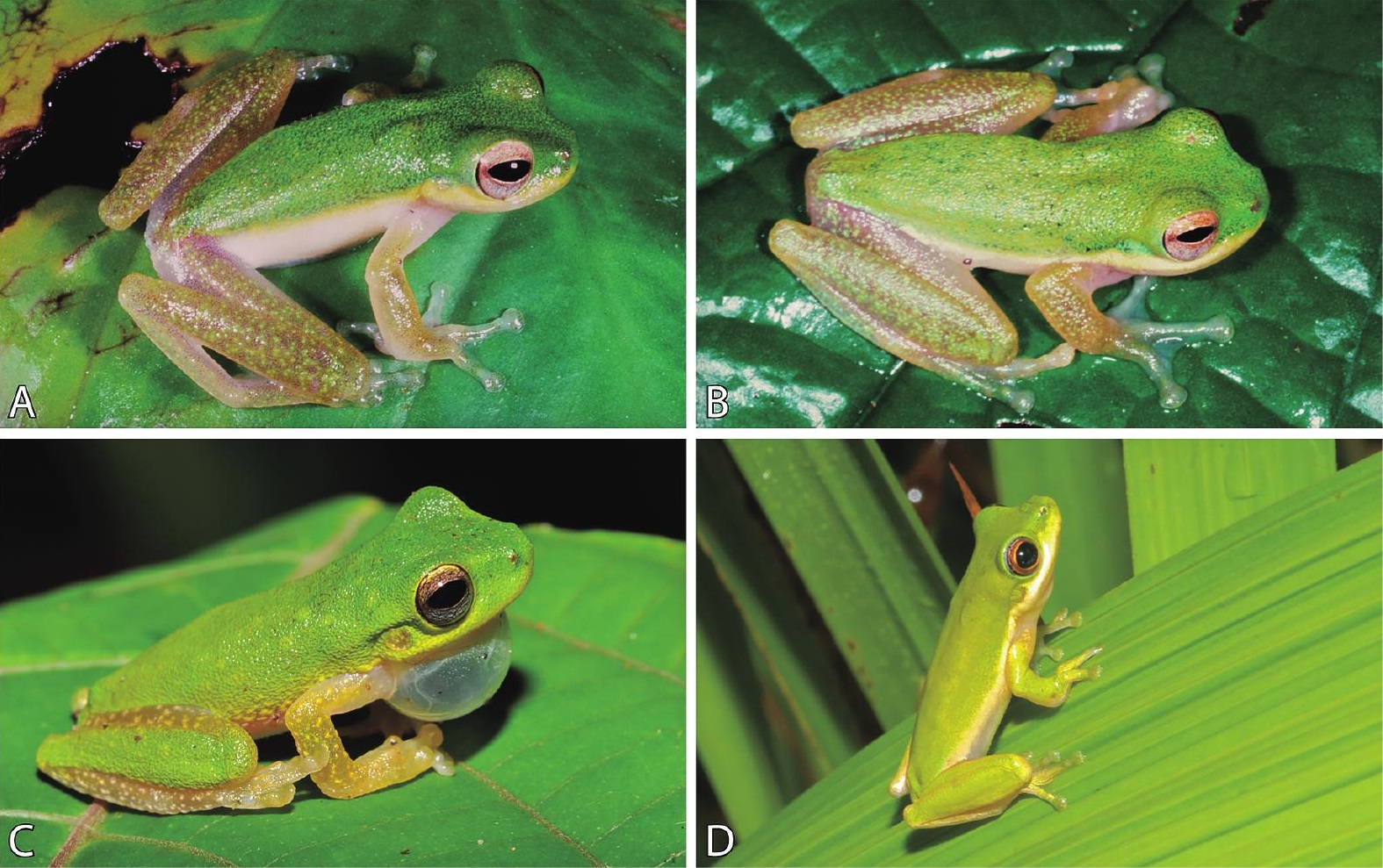
We describe a new species of very small (male body length 22.0–22.8 mm), green treefrog in the pelodryadid genus Litoria Tschudi from lowland rainforest on the southern margin of Papua New Guinea's central cordillera. The new species is morphologically most similar to Litoria leucova, a small green treefrog known only from the north-flowing Sepik River catchment in western Papua New Guinea. It differs from that species by having longer limbs (TL/SVL 0.56–0.60 vs. 0.53–0.55), a poorly defined (vs. prominent) tympanum, in having a distinct lemon yellow mid-lateral line, and in its unique advertisement call comprising a slowly repeated series of short clicks followed by a discrete group of pulses produced rapidly but with highly variable inter-pulse intervals. Although genetic data are not available, the new species' association with a fast-flowing rocky stream suggests that its relationships may lie with other torrent-dwelling Litoria species.

KEYWORDS: advertisement calls, frog, Litoria lakekamu sp. nov, morphology, taxonomy
 

Images in life of: (A) Litoria lakekamu sp. nov. paratype SAMA R70114, (B) Litoria lakekamu sp. nov. paratype PNGNM (FN: 11625),
(C) Litoria leucova SAMA R71844 from the Sepik River catchment, northern Papua New Guinea, (D) Litoria lodesdema SAMA R64772 from New Britain Island, Papua New Guinea.
Photographs by S. Richards.

Litoria lakekamu sp. nov.
(English name: Lakekamu pygmy treefrog)

Diagnosis: The new species is distinguished from all other Litoria by the following unique combination of characters: size very small (SVL of four males 20.0–22.8 mm, females unknown); dorsum in life predominantly green; vomerine teeth absent; tympanum indistinct; finger webbing extensive, reaching distal edge of subarticular tubercle at base of penultimate phalanx on outer edge of Finger 3 and inner edge of Finger 4; finger discs slightly larger than or same size as toe discs; webbing on toes extending nearly to base of all discs except Toe 4 where it reaches midway between subarticular tubercle at base of penultimate phalanx and disc on both sides of digit; dermal fringes on limbs and below vent absent; pigmentation on nictitating membrane restricted to scattered flecks at dorsal margin; advertisement call a series of short (0.017–0.053 s) distinctly pulsed rasping notes repeated at 2.1–6.5 s intervals, followed by a discrete group of rapidly repeated pulses with highly variable inter-pulse intervals.

Etymology: The specific name lakekamu is a noun in apposition referring to the type and only known locality [Lakekamu Basin, Gulf Province, Papua New Guinea] of this species.

Torrential stream habitat of Litoria lakekamu sp. nov. on the Sapoi River near Ivimka Camp, Lakekamu Basin, Gulf Province, Papua New Guinea. Males were calling from vegetation along the stream bank.
Photograph by S. Richards.


Stephen J. Richards and David Bickford. 2023. A New Species of Small Green Treefrog (Pelodryadidae: Litoria) from the Lakekamu Basin in Southern Papua New Guinea. Current Herpetology. 42(1);  43-54. DOI: 10.5358/hsj.42.43

Friday, March 3, 2023

[Herpetology • 2023] Cophixalus gigiraensis • Another Giant Species of the microhylid Frog Genus Cophixalus Boettger, 1892 (Anura: Microhylidae) from the mountains of Papua New Guinea and First Records of procoracoids in the Genus


Cophixalus gigiraensis  
Günther, Dahl & Richards, 2023 

Mount Gigira Giant Nursery Frog || DOI: 10.3897/zse.99.97006

Abstract
A new arboreal species of the microhylid genus Cophixalus Boettger, 1892 is described from montane rainforest on Papua New Guinea’s central cordillera. With a male SUL exceeding 44.0 mm, the new species is among the largest members of the genus; the only other Papuan species known to reach this size is C. riparius Zweifel, 1962. The new species differs from C. riparius in a small number of mensural characters and by its distinct advertisement call, a single explosive ‘bark’ uttered singly or in rapid series. In contrast, calls of C. riparius recorded near the type locality are a series of drawn out, rasping croaks. Calls of the two species are analysed and compared. The two species also appear to have different ecologies, with the new species found only high in trees, while C. riparius is often encountered in vegetation on or near the forest floor. Examination of osteological features revealed the presence of cartilaginous procoracoids in both species, representing the first records of procoracoids in the speciose genus Cophixalus. Lack of procoracoids is traditionally considered an important diagnostic character for defining Cophixalus but both species also lack clavicles, a character considered diagnostic for Cophixalus and a key feature distinguishing the genus from the closely related Oreophryne Boettger, 1895. Because preliminary published genetic data indicate that they are nested within Cophixalus, we retain both species in that genus until a comprehensive molecular phylogeny of Cophixalus and related genera, particularly Oreophryne, is completed.

Key Words: Amphibia, bioacoustics, central cordillera, montane rainforest, morphology, New Guinea, taxonomy

Holotype of Cophixalus gigiraensis sp. nov. in life
a. Dorsolateral view; b. Ventral view; c. Palmar view of right hand; d. Plantar view of right foot.

a–c. Juvenile paratype of Cophixalus gigiraensis sp. nov. in life.

 Cophixalus gigiraensis sp. nov.
Mount Gigira Giant Nursery Frog
Oreophryne ? sp. 5 ‘loud grunter’ (Richards & Armstrong, 2017).
Cophixalus sp. 5 ‘loud grunter’ (Richards & Armstrong, 2018).
Cophixalus sp. 4 ‘loud grunter’ (Richards et al., 2021).
  
Diagnosis: With a snout-urostyle length of 44.4 mm in an adult male the new species is among the largest species of the genus; in New Guinea only Cophixalus riparius reaches a similar size. It is distinguished from C. riparius and all other congeners by the following unique combination of characters: body robust, head short (HL/SUL 0.31); legs moderately short (TL/SUL 0.42), third toe longer than fifth; fingers and toes with greatly expanded triangular terminal discs, all with circum-marginal grooves; discs of fingers much larger than those of toes (T4D/F3D 0.76); dorsal surfaces including rear of tarsus with scattered low tubercles, ventral surfaces smooth; most of dorsal surfaces brown-olive (RAL 8008) with irregular beige (most similar to RAL 1001) flecking; ventral surfaces whitish overlain with moderately dense reddish-brown pigmentation; advertisement call a loud explosive ‘bark’ produced singly or in groups of up to eight, each containing 13–19 pulses lasting 60–80 ms, dominant frequency 1.5 kHz.

Emergent Nothofagus trees in montane forest on Gigira Ridge. Male Cophixalus gigiraensis sp. nov. called from the upper canopy of these large emergent trees making collection difficult.

Etymology: The specific epithet gigiraensis refers to the type locality of this species, Gigira Ridge, otherwise known as Hides Ridge. Gigira is the local Huli Community’s name for this mountain.


Rainer Günther, Chris Dahl and Stephen J. Richards. 2023. Another Giant Species of the microhylid Frog Genus Cophixalus Boettger, 1892 from the mountains of Papua New Guinea and First Records of procoracoids in the Genus. Zoosystematics and Evolution. 99(1): 173-183. DOI: 10.3897/zse.99.97006

Friday, February 10, 2023

[Herpetology • 2023] Oreophryne chlorops • A New large Oreophryne Species (Anura: Microhylidae) from the Mountains of Papua Province, Indonesian New Guinea


Oreophryne chlorops 
Günther, Iskandar & Richards. 2023 


Abstract
The microhylid genus Oreophryne reaches its greatest diversity in the New Guinea region, where more than 60 species have been documented to date. Most Oreophryne are small (<30 mm SVL) and only three species, O. anthonyi, O. idenburgensis and O. inornata, exceed 40 mm SVL adult body size. Here we describe a fourth large species of Oreophryne that was collected in 1998 from the mountains of Papua Province in western New Guinea. In having a cartilaginous connection between the procoracoid and scapula it is most similar to O. idenburgensis, a species known only from the mountains of central-western New Guinea but differs from that species in a suite of morphological characters including a broader head, a hidden (vs. visible) tympanum and a more pointed snout.

Key Words: Central cordillera, frog, Indonesia, morphology, new species, taxonomy

Adult male holotype of Oreophryne chlorops sp. nov.:
 c, d dorsal and ventral views of body; e, f palmar and plantar views, in preservative.

Adult male holotype of Oreophryne chlorops sp. nov.:
 a dorsolateral view of body; b lateral view of head, in life. 

Oreophryne chlorops sp. nov.
 
Diagnosis: A species of Oreophryne based on the presence of eleutherognathine maxillae and clavicles that do not extend to the scapulae. Size large (>40 mm SUL); bony clavicle strongly curved; cartilaginous procoracoid reaching scapula; fifth toe slightly longer than third; tympanum not visible externally; iris blue-green in life; W-shaped scapular folds and eye spot in lumbar region present.

Etymology: The specific epithet is a combination of the ancient Greek adjective chloros meaning green, and the ancient Greek substantive ops meaning eye. Chlorops is a compound noun in apposition meaning green-eye and refers to the blue-green iris colour of the holotype.

Wet mossy forest interior at the type locality of Oreophryne chlorops sp. nov.


 Rainer Günther, Djoko T. Iskandar and Stephen J. Richards. 2023. A New large Oreophryne Species from the Mountains of Papua Province, Indonesian New Guinea (Amphibia, Anura, Microhylidae). Vertebrate Zoology. 73: 153-159. DOI:  10.3897/vz.73.e94207


Friday, January 27, 2023

[Herpetology • 2023] Litoria hastula • A New Species of Torrent-breeding Treefrog (Anura: Pelodryadidae) from the mountains of Papua, Indonesia, with New Records and Observations of Litoria dorsivena (Tyler, 1968)


Litoria hastula 
Oliver, Iskandar & Richards, 2023

photographs by S.J. Richards.

Abstract
The mountains of New Guinea are home to species-rich but poorly understood communities of stream or torrent-breeding pelodryadid treefrogs. Here we describe a new species of moderately sized torrent-breeding Litoria from the mountains of Papua Province, Indonesia. The new species is most similar to Litoria dorsivena but differs from that species in aspects of body size, skin texture and especially the shape of the snout. Based on recent collections, we also present new data on the distribution and colour in life of L. dorsivena. Both species show marked sexual size dimorphism when compared to most other pelodryadid treefrogs, and the colour pattern of the new species may also vary between males and females. The torrent-breeding treefrogs of New Guinea remain poorly known and, given declines of ecologically similar pelodryadids in Australia, should be a priority group for taxonomic research and population monitoring.

Keywords: Cryptic extinction risk, New Guinea, sexual size dimorphism, taxonomy

Colouration of Litoria hastula sp. nov. in life:
A lateral view of adult male paratype SAMA R72334; B hidden coloration in thighs of male paratype SAMA R72335; C lateral view of adult female paratype MZB Amph.32872; D ventral view of adult female paratype MZB Amph.32872.
All photographs by S.J. Richards.


Litoria hastula sp. nov.

Diagnosis: A species of Litoria that can be distinguished from all congeners by the following unique combination of characters: moderate size and strong sexual size dimorphism (4 adult males 30.4–31.8 mm SVL, one adult female 48.9 mm SVL); snout moderately long (EN/IN 0.69–0.80), with sharply acuminate tip and with concave dorsal surface; canthus rostralis nearly straight, sharply defined; limbs moderately long (TL/SVL 0.55–0.60); finger webbing moderate, not extending beyond third phalanx between Finger 3 and Finger 4; toe webbing extensive, extending to penultimate phalanx between all digits except Toe 1 and Toe 2; dorsal skin relatively smooth with scattered small tubercles; heel with 2–3 distinct conical tubercles; vomeropalatines prominent; vocal slits present in males; dorsal colouration predominately light to mid-brown with scattered darker-brown spots and or blotches; venter largely buff with little to no pattern; and advertisement calls produced in series of 5–7 calls, each comprising a single short note that is unpulsed or slightly pulsatile but may become longer, with discrete pulses, in terminal calls of the series.

Etymology: Latin, “little spear’, combining spear hasta” with the diminutive suffix “-ula” in reference to the elongate and sharply pointed snout of the species.

Details of habitat at the type locality for Litoria hastula sp. nov.:
 A dense and very mossy mid-montane forest, and B small fast-flowing rocky stream. The type series was collected from low vegetation along this stream at night.
 All photographs by S.J. Richards.


Paul M. Oliver, Djoko T. Iskandar and Stephen J. Richards. 2023. A New Species of Torrent-breeding Treefrog (Pelodryadidae: Litoria) from the mountains of Papua, Indonesia, with New Records and Observations of Litoria dorsivena (Tyler, 1968). Vertebrate Zoology. 73: 127-139. DOI: 10.3897/vz.73.e91111

Monday, October 31, 2022

[Herpetology • 2022] Resolving the Deep Phylogeny: Implications for early Adaptive Radiation, Cryptic, and Present-day Ecological Diversity of Papuan Microhylid Frogs (Anura: Microhylidae: Asterophryinae)


in Hill, Fraser, Gao, ... et Butler, 2022. 

Highlights
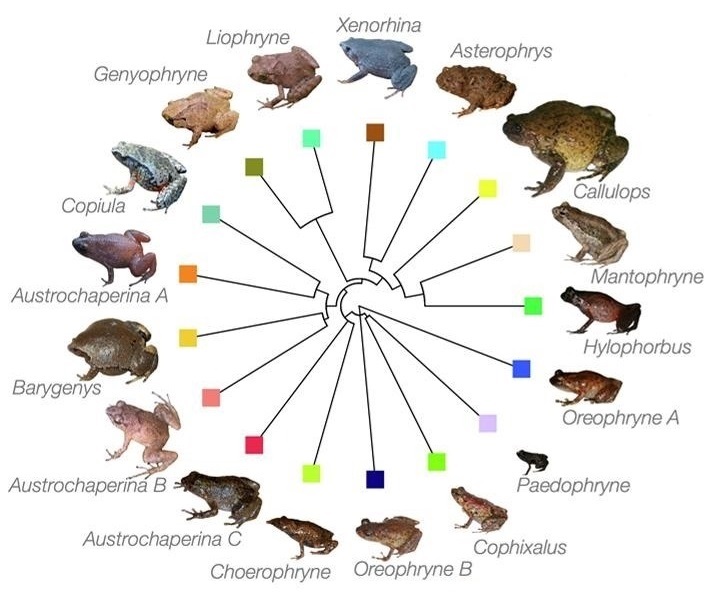
• A robust phylogeny is resolved for 205 species of Papuan microhylid frogs.
• The problematic backbone is resolved revealing ancient adaptive radiation.
• Extensive cryptic diversity is discovered, putting all “widespread” species into doubt.
• Present-day communities are ecologically diverse with up to 5 lifestyles and 14 species.
• Communities are randomly assembled suggesting adaptive and non-adaptive radiation.

Abstract
The microhylid frogs of the New Guinea region are the largest and most ecologically diverse subfamily (Asterophryinae) of one of the largest anuran families in the world and can live in communities of up to 20 species. While there has been recent progress in resolving the phylogenetic relationships of Asterophryinae, significant uncertainties remain, impeding further progress in understanding the evolution of microhabitat use, parental care, and life history variation in this group. In particular, the early divergences at the base of the tree remain unclear; as does the monophyly of some genera; and recent studies have discovered that species with wide geographic distribution are instead cryptic species complexes. In this study, we fortified geographic sampling of the largest previous phylogenetic effort by sequencing an additional 62 taxa and increased data quality and quantity by adding new layers of data vetting and by filling in previously incomplete loci to the five gene dataset (2 mitochondrial, 3 nuclear protein-coding genes) to obtain a dataset that is now 99% complete in over 2400 characters for 233 samples (205 taxa) of Asterophryinae and 3 outgroup taxa, and analyzed microhabitat use data for these taxa from field data and data collected from the literature. Importantly, our sampling includes complete community complements at 19 sites as well as representatives at over 80 sites across New Guinea and its offshore islands. We present a highly resolved molecular phylogeny which, for the first time, has over 95% of nodes supported (84% highly supported) whether using Maximum Likelihood or Bayesian Inference, allowing clarification of all genera (whether monophyletic or clearly not), their sister genera relationships, as well as an age estimate for the Asterophryinae at approximately 20MYA. Early generic diversification occurring between 17 and 12 MYA gave rise to a surprising diversity of about 18 genera as well as the 5 putative microhabitat types. Our tree reveals extensive cryptic diversity calling any widespread taxa into doubt, and clearly demonstrates that complex multispecies communities of Asterophryinae are ecologically diverse, are numerous, and of ancient origin across New Guinea. We discuss the implications of our phylogeny for explaining the explosive diversification of Asterophryinae as the result of adaptive radiation, niche conservatism, and non-adaptive radiation.
 
Keywords: Community assembly, Phylogenetics, Diversification, Adaptive radiation, Anura, Microhylidae, Asterophryinae, Cryptic species


Ethan C. Hill, Claire J. Fraser, Diana F. Gao, Mary J. Jarman, Elizabeth R. Henry, Bulisa Iova, Allen Allison and Marguerite A. Butler. 2022. Resolving the Deep Phylogeny: Implications for early Adaptive Radiation, Cryptic, and Present-day Ecological Diversity of Papuan Microhylid Frogs. Molecular Phylogenetics and Evolution. 177, 107618. DOI: 10.1016/j.ympev.2022.107618