Showing posts with label Death Feigning. Show all posts

Tuesday, November 6, 2012

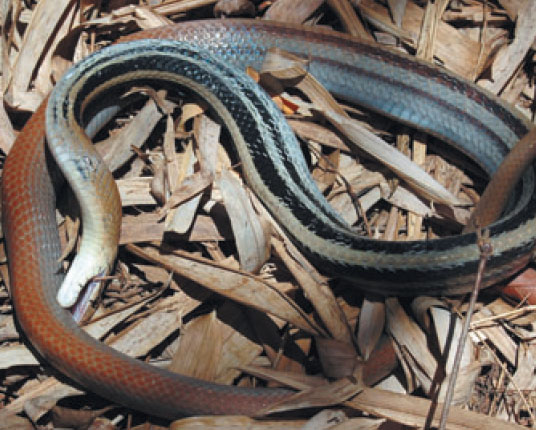
[Herpetology • 2011] Death Feigning behavior in two species of the genus Lycodon of Asia (Squamata: Colubridae); Lycodon cf. aulicus and Lycodon capucinus


Thanatosis meaning ‘putting to death’ in Greek is commonly referred to as Death feigning. Death feigning is a form of defensive behavior, in which an animal becomes immobile as if dead (McFarland, 1981) which has been reported from various group of animals including mammals, birds, fishes, reptiles, amphibians and arthropods (Vogel & Han-Yuen, 2010). This behavior has long been known from some snake species but no extensive work has been done to formally report  this behavior in Asian snakes. Among Indian snakes, death feigning has been known from the following two species: Xenochrophis piscator (Schneider, 1799) and (Coelognathus radiatus Fitzinger, 1843) (Vogel & HanYuen, 2010)


2011. Death feigning behavior in two species of the genus Lycodon of Asia (Squamata: Colubridae)
Death feigning behavior in Lycodon cf. aulicus and Lycodon capucinus

[Herpetology • 2010] Death Feigning Behavior in three colubrid species of tropical Asia ; Coleognathus radiatus, Macrocalamus chanardi & Xenochrophis piscator


Death feigning by Macrocalamus chanardi, Cameron Highlands, West-Malaysia, photograph by Allan Teo.

Death feigning was reported for the first time for the species Coleognathus radiatus and Macrocalamus chanardi. In Xenochrophis piscator this behavior is reported for the second time since 1947. These are the first reports on death feigning in snakes for the Indochinese and Malayan subregions. 

Keywords: death feigning, Coelognathus radiatus, Macrocalamus chanardi, Xenochrophis piscator, Oriental region.

Death feigning by Coelognathus radiatus, Tak Province Thailand.


Death feigning by Natrix natrix. Photograph by Petr Vlèek.


CONCLUSION
 Death feigning is a phenomenon in snakes that seems to be widely neglected in documentation. It is not really known which species show this behavior, and in which way. Nor have the different kind of death feigning “stages” been compared among species. It is our opinion, that there must surely be many more snake species that demonstrate death feigning behavior than what is presently known, and we encourage researchers to report such observations.

Vogel, G. and Han-Yuem, H.K. 2010. Death feigning behavior in three colubrid species of tropical Asia. Russian Journal of Herpetology. 17 (1): 15–21.