Showing posts with label Phasmatodea. Show all posts

Friday, August 1, 2025

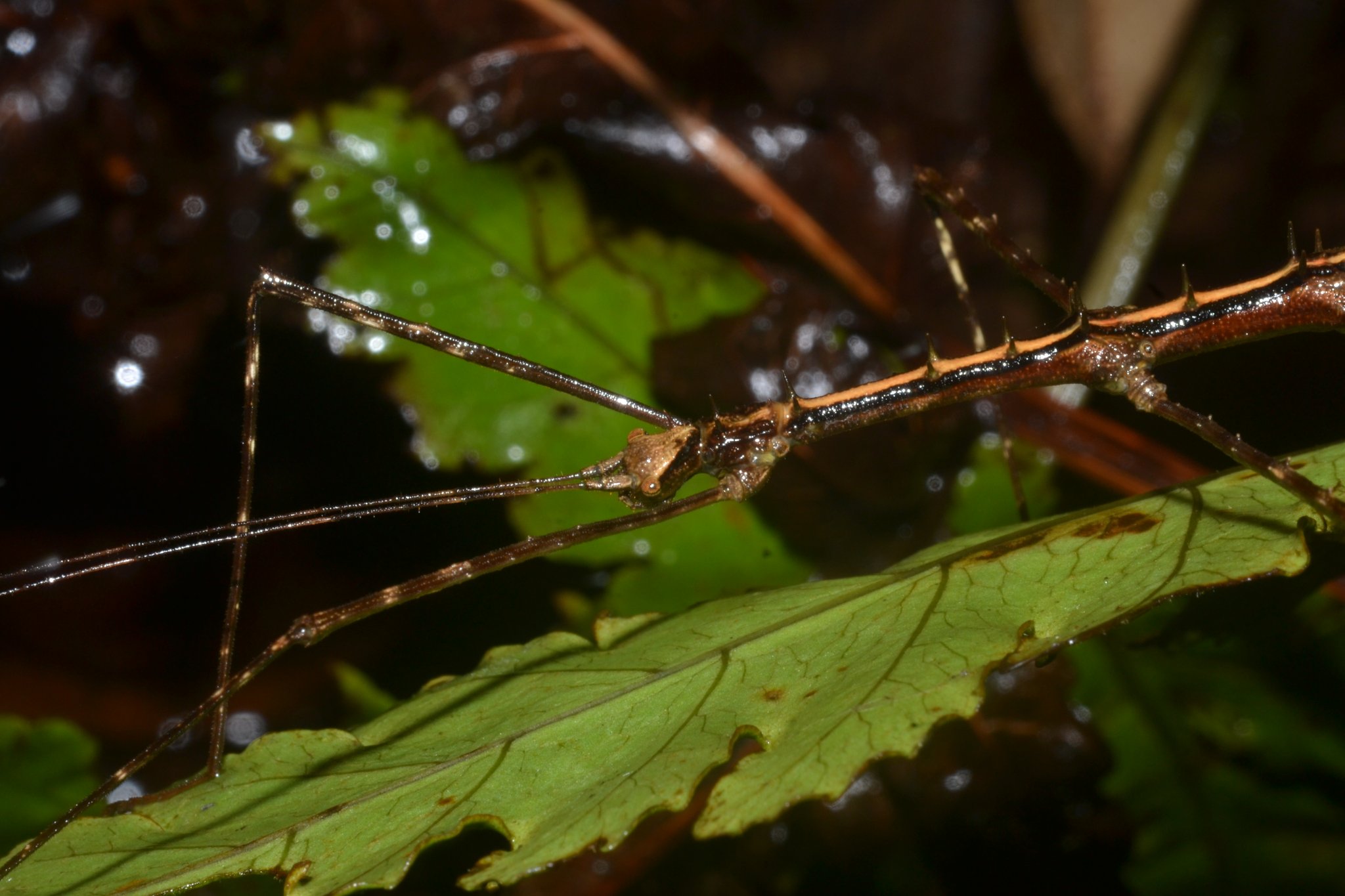
[Entomology • 2025] Acrophylla alta • A New giant Species of Acrophylla Gray, 1835 (Phasmida: Phasmatidae: Phasmatini) from the highlands of the Wet Tropics, Queensland, Australia


Acrophylla alta 
Coupland & Emmott, 2025


Abstract
Searching of suitable habitat during the wet season months has revealed a spectacular new species of phasmid from Queensland, Australia: Acrophylla alta sp. nov., which is described and figured from the holotype and paratype females only, also eggs. A key is provided to compare it with other similar species within the genus. Habitat type and known foodplants are noted.

Phasmatodea, Stick insect, Acrophylla alta new species, cloud forest, Atherton Tablelands, altitude, endemic, taxonomy


 Acrophylla alta sp. nov.


Ross M. COUPLAND and Angus J. EMMOTT. 2025. A New giant Species of Acrophylla Gray, 1835 (Phasmida: Phasmatidae: Phasmatini) from the highlands of the Wet Tropics, Queensland, Australia. Zootaxa. 5647(4); 371-383. DOI: doi.org/10.11646/zootaxa.5647.4.4 [2025-06-17]


Monday, August 26, 2024

[Entomology • 2024] Presbistus muka • A New Species and a new record of the Oriental Stick Insect Genus Presbistus (Phasmatodea: Aschiphasmatidae) from Thailand


 Presbistus muka Kamtanom & Bresseel, 

in Kamtanom, Jiaranaisakul, Paejaroen et Bresseel, 2024. 
แมลงกิ่งไม้ท้ายใหญ่มูก้า  ||   facebook.com/TaiwaniaOffice

Abstract
The genus Presbistus and the family Aschiphasmatidae are recorded from Thailand for the first time. A new species of Presbistus Kirby, 1896, Presbistus muka sp. nov., is described from the Mahidol University Campus in Kanchanaburi,West Thailand based on both sexes and eggs. The new species is diagnosed and differentiated from its congenerics by its distinct colouration and by the notably short wings. Illustrations of adults, specimens in situ, host plants, records on biology and a distribution map are provided. A second Presbistus species, Presbistus vitivorus Bresseel & Constant, 2022 is also recorded from West Thailand, its distribution and morphology are briefly discussed.

Keyword: Aschiphasmatidae, Phasmatodea, Presbistus, Presbistus muka, Presbistus vitivorus, stick insect, taxonomy

Aschiphasmatidae Brunner von Wattenwyl, 1893 
Aschiphasmatinae Brunner von Wattenwyl, 1893 
Aschiphasmatini Brunner von Wattenwyl, 1893 

Presbistus Kirby, 1896


Presbistus muka Kamtanom & Bresseel sp. nov.

Diagnosis. Presbistus muka sp. nov. can be separated from all other species of Presbistus by the following combination of characters: (1) body pale brown with darkened apex of abdomen in males, olive brown in females; (2) femora black with pale apex; (3) tegmina short, narrow and pointed, only reaching bases of alae; alae short, not surpassing posterior margin of tergum III; (4) male with apex of anal segment cleft, with the left anal lobe (lal) shorter than the right (ral), and the right anal lobe twisted; (5) praeopercular organ indistinct, present as posteromedian hump on sternum VII; slightly projecting over base of subgenital plate; (6) posterior pole of egg broadly rounded.

Etymology. The specific name “muka” is a noun in apposition, derived from the abbreviation of Mahidol University Kanchanaburi Campus [MUKA], the type-locality where the specimens were found and collected for the first time.

 Presbistus muka Kamtanom & Bresseel sp. nov., living specimens,
 A. male, in situ, B. maiting pair, in situ.


Saichon Kamtanom, Kawin Jiaranaisakul, Paiphan Paejaroen and Joachim Bresseel. 2024. A New Species and a new record of the Oriental Stick Insect Genus Presbistus (Phasmida: Aschiphasmatidae) from Thailand. Taiwania. 69(3); 348-355. DOI: 10.6165/tai.2024.69.348

Wednesday, December 27, 2023

[Entomology • 2021] Resolving A Century-old Case of generic mistaken Identity: Polyphyly of Chitoniscus sensu lato resolved with the Description of the endemic New Caledonia Trolicaphyllium gen. nov. (Phasmatodea: Phylliidae)


  Trolicaphyllium gen. nov. 

in Cumming, Le Tirant & Büscher, 2021. 

Abstract
With every molecular review involving Chitoniscus Stål, 1875 sensu lato samples from Fiji and New Caledonia revealing polyphyly, the morphology from these two distinct clades was extensively reviewed. Morphological results agree with all previously published molecular studies and therefore Trolicaphyllium gen. nov. is erected to accommodate the former Chitoniscus sensu lato species restricted to New Caledonia, leaving the type species Chitoniscus lobiventris (Blanchard, 1853) and all other Fijian species within Chitoniscus sensu stricto. Erection of this new genus for the New Caledonian species warrants the following new combinations: Trolicaphyllium brachysoma (Sharp, 1898), comb. nov., Trolicaphyllium erosus (Redtenbachher, 1906), comb. nov., and Trolicaphyllium sarrameaense (Größer, 2008a), comb. nov. Morphological details of the female, male, freshly hatched nymph, and egg are illustrated and discussed alongside the Chitoniscus sensu stricto in order to differentiate these two clades which have been mistaken as one for decades.

Keywords: Camouflage, Drehu, Grande Terre, Ile de Bélep, L’Île-des-Pins, Lifou, Lifu, Maré, mimicry, new combination, Phasmida, Tiga, walking leaf


Figure 31. Unidentifiable Trolicaphyllium gen. nov. male nymph photographed on Tiga Island in August 2020 by Damien Brouste (New Caledonia) (iNaturalist user: damienbr)
A dorso-anterior view B same nymph, dorsal habitus C unidentified host plant on which the nymph was recorded.


Figure 30. Live nymphs of Trolicaphyllium gen. nov. which could not be identified to species. Images from endemia.nc (CC BY-NC-SA 4.0)
A Frédéric Desmoulins, Plaine des Lacs, April 2014 B Hendrik Oesterlin, Koé (Dumbéa) elevation 185 meters, June 2006 C Julien Barrault, Hienghène, November 2010
D Daniel and Irène Létocart, Tchamba, October 2009 E Bernard Suprin, Dumbéa, April 2004 F Gildas Gâteblé, Ouenghi, October 2012.


Royce T. Cumming, Stephane Le Tirant and Thies H. Büscher. 2021. Resolving A Century-old Case of generic mistaken Identity: Polyphyly of Chitoniscus sensu lato resolved with the Description of the endemic New Caledonia Trolicaphyllium gen. nov. (Phasmatodea, Phylliidae). ZooKeys. 1055: 1-41. DOI: 10.3897/zookeys.1055.66796

Monday, August 7, 2023

[Entomology • 2023] Phyllium iyadaon, Phyllium samarense, Pulchriphyllium anangu, Pulchriphyllium heracles, etc. • On Seven undescribed Leaf Insect Species (Phasmatodea: Phylliidae) revealed within the Recent “Tree of Leaves”


Pulchriphyllium anangu
Cumming, Le Tirant, Linde, Solan, Foley, Eulin, Lavado, Whiting, Bradler & Bank, 2023


Abstract
With the recent advance in molecular phylogenetics focused on the leaf insects (Phasmatodea, Phylliidae), gaps in knowledge are beginning to be filled. Yet, shortcomings are also being highlighted, for instance, the unveiling of numerous undescribed phylliid species. Here, some of these taxa are described, including Phyllium iyadaon sp. nov. from Mindoro Island, Philippines; Phyllium samarense sp. nov. from Samar Island, Philippines; Phyllium ortizi sp. nov. from Mindanao Island, Philippines; Pulchriphyllium heracles sp. nov. from Vietnam; Pulchriphyllium delislei sp. nov. from South Kalimantan, Indonesia; and Pulchriphyllium bhaskarai sp. nov. from Java, Indonesia. Several additional specimens of these species together with a seventh species described herein, Pulchriphyllium anangu sp. nov. from southwestern India, were incorporated into a newly constructed phylogenetic tree. Additionally, two taxa that were originally described as species, but in recent decades have been treated as subspecies, are elevated back to species status to reflect their unique morphology and geographic isolation, creating the following new combinations: Pulchriphyllium scythe (Gray, 1843) stat. rev., comb. nov. from Bangladesh and northeastern India, and Pulchriphyllium crurifolium (Audinet-Serville, 1838) stat. rev., comb. nov. from the Seychelles islands. Lectotype specimens are also designated for Pulchriphyllium scythe (Gray, 1843) stat. rev., comb. nov. and Pulchriphyllium crurifolium (Audinet-Serville, 1838) stat. rev., comb. nov. from original type material.

Key words: India, Indonesia, Kalimantan, Phasmida, Philippines, Seychelles, Vietnam, walking leaf

 Pulchriphyllium ortizi sp. nov. live individuals from captive culture highlighting aspects of their coloration. 
 A adult male and female pair, dorsal habitus B adult female, postero-ventral view, showing the bright orange coxae coloration C adult male, habitus, dorsal D adult male, habitus, ventral E brown form nymph, same individual as in Fig. 1B before the final molt.
Photographs by Maxime Ortiz (France)

Live males and nymphs of Pulchriphyllium scythe (Gray, 1843) stat. rev., comb. nov.
A male habitus, dorsal, found in Vaisam, Damchhara R. F., Tripura, India, 30 June 2019 and photographed by Michael Lalruatfela (India) B male habitus, dorsal, found in Badshahi Forest, Assam, India, 18 September 2020 and photographed by Rejoice Gassah (India) (https://www.inaturalist.org/observations/64092851) C nymph, dorso lateral view, found in Lawachara National Park, 31 July 2019, photographed by Hassan-al Razi Chayan (Bangladesh) (https://www.inaturalist.org/observations/103359437) D nymph, dorso-anterior view, found in Dosdewa Khasi Village, Katamoni, Assam, India, 24 April 2021 and photographed by Rejoice Gassah (India) (https://www.inaturalist.org/observations/79254856). Photographs used were uploaded to iNaturalist and here used under license (CC BY-NC 4.0) or with explicit permission by the photographer.

Pulchriphyllium bhaskarai sp. nov. live holotype female.
A coloration shortly after being found in the wild, dorsal habitus B altered coloration after several months in captivity, dorsal habitus C habitus, dorsolateral view.
 Photographs by Edy Bhaskara (Indonesia) 

Live Pulchriphyllium anangu sp. nov.
A adult female, dorsal habitus, observed July 2016 at Kadumane Estate, India by iNaturalist user @ashwinv (Ashwin Viswanathan) inaturalist.org) B freshly hatched nymph, observed October 2021 at Chikkamagaluru, Karnataka, India by iNaturalist user @prashanthakrishnamc (Prashantha Krishna M C) inaturalist.org) C freshly hatched nymph, observed January 2021 in Ponmudi, India by iNaturalist user @hari_krishnan_ (Harikrishnan S) inaturalist.org). Uploaded to iNaturalist and used under license CC BY-NC 4.0.

Live Pulchriphyllium anangu sp. nov.
A adult male, dorsal habitus observed October 2006 in B.R. Hills, Karnataka, India by iNaturalist user @prashanthns (Prashanth N S) (inaturalist.org) B adult male, dorsal habitus observed November 2019 in Pakkalakunja, Karnataka, India by iNaturalist user @sanath_ramesh_manimoole (Sanath R M) (inaturalist.org) C male nymph, dorsal habitus observed February 2020 in Shimoga, Karnataka, India by iNaturalist user @girishgowda (Girish Gowda) (inaturalist.org) D nymph, dorsal habitus, hiding under a leaf in the daylight observed August 2020 near Agali, India by iNaturalist user @manavsajan (inaturalist.org). Uploaded to iNaturalist and used under license CC BY-NC 4.0.
 

 Royce T. Cumming, Stéphane Le Tirant, Jackson B. Linde, Megan E. Solan, Evelyn Marie Foley, Norman Enrico C. Eulin, Ramon Lavado, Michael F. Whiting, Sven Bradler and Sarah Bank. 2023. On Seven undescribed Leaf Insect Species revealed within the Recent “Tree of Leaves” (Phasmatodea, Phylliidae). ZooKeys. 1173: 145-229. DOI: 10.3897/zookeys.1173.104413

Sunday, August 6, 2023

[Entomology • 2015] Phyllium (Pulchriphyllium) maethoraniae • A New Giant Leaf Insect Species of the Genus Phyllium (Phasmatodea: Phylliidae) from Thailand


Phyllium (Pulchriphyllium) maethoraniae 
Delfosse, 2015


Abstract
A new species of leaf insect is described from Thailand, Phyllium (Pulchriphyllium) maethoraniae n. sp., very close to P. (Pulchriphylliumsinense Liu, 1990, but differs by various distinct characters such as the armature of the mesonotum, shape of the anterior legs, abdomen and abdominal apex. Like P. sinense, P. maethoraniae n. sp. is only known from the female. A table is given to distinguish between the two species.

Keywords: Leaf insect, new species, female, taxonomy, Thailand, identification key.


Phyllium (Pulchriphyllium) maethoraniae n. sp., ♀ holotype.
 1-2, Dorsal and ventral view. – 3, Head detail, dorsal view. – 4-5, Details of dorsal and ventral view of the abdominal segments VI-X.

Phyllium (Pulchriphyllium) maethoraniae n. sp.  

Diagnosis. – Very broad, with a spectacular and unusual shape of the abdomen. Mesonotum almost smooth. Legs with large foliaceous lobes, very large on profemora and mesofemora. Protibiae with exterior and interior lobes. Lateral margins of tergum VIII strongly lobed, with the posterior margin deeply curved inward and forming on each side a rounded posteriorly directed lobe which distinctly surpasses the abdominal apex. Tergum X not surpassing distinctly tergum IX.

Differentiation. – Phyllium (Pulchriphyllium) maethoraniae n. sp. and Phyllium (P.) sinense are similar and obviously closely related species but can be separated by various characters (tables I-II; Liu, 1990) even if some variation must be assumed for both species. Within the bioculatum species-group of the subgenus Pulchriphyllium this new species is apparently closest to P. sinense
...

Etymology. – Named after Mae Thorani (sometimes noted Phra Toranee or Jao Meh Torani) who is the goddess of mother earth. She is the personification of Gaia and cited in old texts about the life of Buddha.


 Emmanuel Delfosse. 2015. A New Giant Leaf Insect Species of the Genus Phyllium from Thailand (Phasmatodea, Phylliidae). Bulletin de la Société entomologique de France. 120(3); 411-415.  

Résumé. – Une nouvelle espèce de phyllie géante du genre Phyllium, de Thaïlande (Phasmatodea, Phylliidae). Une nouvelle espèce de phasme-feuille est décrite de Thaïlande, Phyllium (Pulchriphyllium) maethoraniae n. sp., très proche de P. (Pulchriphyllium) sinense Liu, 1990, mais s’en distinguant par divers caractères marqués comme la structure du mésonotum, la forme des pattes antérieures, de l’abdomen et de l’apex abdominal. Comme P. sinense, P. maethoraniae n. sp. est seulement connu par le sexe femelle. Un tableau est donné pour différencier les deux espèces. 


Monday, March 13, 2023

[Entomology • 2023] Stenobrimus pilipinus • Synoptic Review of Stenobrimus Redtenbacher, 1906 (Phasmatodea: Heteropterygidae: Obriminae), with the Description of A New Species from the Cavinti Karst Landscape, Laguna, Philippines


  Stenobrimus pilipinus Eusebio, Lit & Lucañas, 

in Lit, Eusebio, Lucañas, Barrion-Dupo, Abenis, Taray, Alviola et Naredo, 2023.

The unique Philippine spiny stick insect genus Stenobrimus, was reviewed. One new species, S. pilipinus Eusebio, Lit & Lucañas, sp. nov., is described from the forest over limestone outside the Cavinti Underground River and Cave Complex (CURCC) in Cavinti, Laguna Province. S. pilipinus, sp. nov., is unique among Stenobrimus species in having post-median mesonotal spines in both males and females. Its morphologically nearest congeners, S. bolivari Redtenbacher and S. tagalog Rehn & Rehn, are redescribed. The distribution of the genus in relation to karst forests and the historical biogeography of the Philippines is briefly discussed. Revised keys to the identification of Stenobrimus species for males, females, and eggs are presented.

Keywords: cave and karst landscape, karst forest arthropods, slender spiny stick insects

TAXONOMY: 
Order Phasmatodea 
Family Heteropterygidae Kirby 
Subfamily Obriminae Brunner von Wattenwyl 

Tribe Obrimini Brunner von Wattenwyl 

Genus Stenobrimus Redtenbacher

  Stenobrimus pilipinus Eusebio, Lit & Lucañas, sp. nov.

Diagnosis. Based on the armature of the mesonotal area, S. pilipinus, sp. nov., is unique among its congeners for having post-median mesonotal spines on both males and females. Stenobrimus pilipinus, sp. nov., is morphologically close to both S. tagalog and S. bolivari in having median mesonotal spines, which are absent in S. lumad. The eggs of both S. pilipinus, sp. nov., and S. lumad have the lateral arms of the micropylar outline appearing as connected to each other forming a circular band. However, they may differ from each other in the position and shape of the formed band with that of S. lumad having the ventral arm distinctly transverse and positioned on the posterior half, whereas that of S. pilipinus, sp. nov., is on the anterior half of the egg capsule and forming a somewhat semi-circular band.

Etymology. S. pilipinus Eusebio, Lit & Lucañas, sp. nov., is named after and dedicated to the Filipino people and is an assertion that nationalism, bravery, and dedication to our country and people should continue to inspire us, even in science, to be proud of Philippine treasures (which include endemic species) and continue to have the courage to do what is right for our country – including pushing for scientific literacy and scientific culture, and conservation of our biological diversity


Ireneo L. Lit Jr., Orlando L. Eusebio, Cristian C. Lucañas, Aimee Lynn A. Barrion-Dupo, Kristine O. Abenis, Kirk J. Taray, Marnelli S. Alviola and Jeremy Carlo B. Naredo. 2023. Synoptic Review of Stenobrimus Redtenbacher, 1906 (Phasmatodea: Heteropterygidae: Obriminae), with the Description of A New Species from the Cavinti Karst Landscape, Laguna, Philippines. Philipp J. Sci. 152(3): 783–796.

Thursday, January 12, 2023

[Entomology • 2022] Austrocarausius coronatus, A. eirmosus, A. truncatus, etc. • Integrative Taxonomy of the Stick Insect Genus Austrocarausius Brock, 2000 (Phasmatodea: Lonchodidae) reveals Cryptic Species in Remnant Queensland Rainforests, Australia


(a) Austrocarausius mercurius 
(b) Austrocarausius nigropunctatus
 
in Jones, Brock, Mantovani, ... et Lo. 2022.
photos by Paul D. Brock & Beth Ripper

Abstract
Austrocarausius Brock, 2000 is a stick insect (Phasmatodea: Lonchodidae) genus containing two species restricted to the tropical rainforests of northern Queensland. Recent specimen collections between the two species’ type localities, Lizard Island and Rockhampton, have suggested that Austrocarausius might represent more than the two nominal species. Here, we apply morphological and molecular analyses to revise the taxonomy of this genus. Using both field-collected and historic museum samples, we developed morphological species hypotheses and descriptions. Genetic sequencing of mitochondrial COI and 16S were undertaken for species delimitation and phylogenetic analysis, including an estimate of the evolutionary timescale of the genus. Based on these results, we propose nine new Austrocarausius species, increasing the number of species in the genus to eleven: A. nigropunctatus (Kirby, 1896), A. mercurius (Stål, 1877), A. coronatus sp. nov., A. decorus sp. nov., A. eirmosus sp. nov., A. gasterbulla sp. nov., A. tuberosus sp. nov., A. macropunctatus sp. nov., A. truncatus sp. nov. A. waiben sp. nov. and A. walkeri sp. nov. Our results suggest Austrocarausius species diversified over the last c. 25–70 Ma, resulting in the now endemic distributions in the tropical rainforests of the central and northern Queensland coasts. This is the first integrative systematic study of an Australian phasmid genus, combining morphological, molecular and biogeographical methods. Additional species of Austrocarausius likely remain undescribed as can be inferred from methodical sampling of rainforest patches along the Queensland coast.

Keywords: biogeography, dispersal, integrative taxonomy, molecular dating, morphological analysis, phylogenetic, systematics, taxonomy.

 (a) Austrocarausius mercurius in copula from Byfield, note diagnostic whitish knees (photo by Paul D. Brock).
(b) Austrocarausius nigropunctatus from Home Rule Camping, Rossville in copula (photo by Beth Ripper).


 Austrocarausius eggs, lateral and dorsal views.
(a) A. nigropunctatus. (b) A. waiben. (c) A. decorus. (d) A. macropunctatus. (e) A. eirmosus.


Braxton R. Jones, Paul D. Brock, Barbara Mantovani, Perry Beasley-Hall, David K. Yeates and Nathan Lo. 2022. Integrative Taxonomy of the Stick Insect Genus Austrocarausius Brock, 2000 (Phasmatodea: Lonchodidae) reveals Cryptic Species in Remnant Queensland Rainforests. Invertebrate Systematics. 36(9); 849-873. DOI: 10.1071/IS21076

Thursday, December 8, 2022

[Entomology • 2022] Calvisia (Calvisia) khlongsokana • A New Species of Calvisia (Phasmida: Lonchodidae: Necrosciinae) from Thailand and Myanmar and Notes on C. (Calvisia) sangarius from Peninsular Malaysia


Calvisia (Calvisia) khlongsokana
Bresseel, Constant, Jiaranaisakul & Hübner, 2022


colourful new species of Calvisia Stål, 1875, Calvisia (Calvisia) khlongsokana sp. nov., is described from Southwest Thailand and South Myanmar based on both sexes, nymphs and eggs. The new species is placed in the subgenus C. (Calvisia) Stål, 1875 and compared to the closely related species C. (Calvisia) sangarius (Westwood, 1859). The female of C. (Calvisia) sangarius (Westwood, 1859) and both sexes and egg of C. (Calvisia) khlongsokana sp. nov. are illustrated and a distribution map for both species is provided. Females of the new species occur in two distinct colour forms presumed to be aposematic. Several hypotheses are provided for the natural occurrence of these two morphs with frequency-dependant selection as a possible driver.

Keywords: Stick insect, Phasmatodea, aposematism, sexual dichromatism, sex-limited polymorphism.


Joachim Bresseel, Jérôme Constant, Kawin Jiaranaisakul and Christian Hübner. 2022. A New Species of Calvisia (Calvisia) from Thailand and Myanmar and Notes on C. (Calvisia) sangarius from Peninsular Malaysia (Phasmida, Lonchodidae, Necrosciinae). Belgian Journal of Entomology. 133:1-23. 


Tuesday, December 14, 2021

[Entomology • 2021] Pylaemenes scrupeus • A New Datamini (Phasmida: Heteropterygidae: Dataminae) from Thailand


Pylaemenes scrupeus 
 Bresseel & Jiaranaisakul, 2021


The new species Pylaemenes scrupeus sp. nov. from Ratchaburi province, Thailand is described and illustrated based on both sexes and the egg. The new species is diagnosed and differentiated from closely related species. The constitution of Pylaemenes Stål, 1875 and the problems arising with generic attribution of species, considering recent phylogenetic studies, are discussed. The genus is for the first time recorded from Thailand and pictures of living specimens and the habitat as well as a distribution map of continental Pylaemenes species are provided. Dares ziegleri Zompro & Fritzsche, 1999 is transferred to Orestes Redtenbacher, 1906 leaving the genus Dares Stål, 1875 restricted to Borneo and Palawan.

Keywords: Myanmar, taxonomy, Phasmatodea, stick insect


Family Heteropterygidae Kirby, 1869 
Subfamily Dataminae Rehn & Rehn, 1939 
Tribe Datamini Rehn & Rehn, 1939 

Genus Pylaemenes Stål, 1875


Pylaemenes scrupeus sp. nov. 

DIAGNOSIS & DIFFERENTIATION. The new species is currently attributed to the genus Pylaemenes Stål, 1875 even though the current constitution of the genus has shown to be paraphyletic (BANK et al., 2021; see discussion below). It is diagnosed by the conically elevated back of the head, formed by four converging carinae; the thickened lateral edges of meso- and metanotum, and the medially elevated and compound anterior margin of the mesonotum. The females resemble those of Pylaemenes pui Ho, 2013, with whom they share the short and broad mesonotum, the strongly widening abdominal terga II-IV and the straight lateral margins of the anal segment; but they can be differentiated by the lack of a central coronal and the less pronounced leg armature. The males resemble those of Pylaemenes mitratus (Redtenbacher, 1906), with whom they share the strongly developed supra-antennals, the triangularly raised anterior margin of the mesonotum and a pair of posteromedial mesonotal spines but can be differentiated by the presence of armature on the metanotum and a pair of rough blunt spines on tergum V instead of a pair of smooth conical spines as in P. mitratus.

ETYMOLOGY. The species epithet “scrupeus” (adjective, Latin) means rugged, referring to the general shape of this species.  


Joachim Bresseel and Kawin Jiaranaisakul. 2021. Pylaemenes scrupeus sp. nov., A New Datamini from Thailand (Phasmida: Heteropterygidae: Dataminae). Belgian Journal of Entomology. 

Monday, August 9, 2021

[Entomology • 2021] A Tree of Leaves: Phylogeny and Historical Biogeography of the Leaf Insects (Phasmatodea: Phylliidae)


(b) female of Phyllium elegans, (d) female of Phyllium hausleithneri,
(e) couple of Phyllium rubrum and
(f) male of Phyllium letiranti.  

in Bank, Cumming, ... et Bradler, 2021. 
 Photographs by Bruno Kneubühler.

Abstract
The insect order Phasmatodea is known for large slender insects masquerading as twigs or bark. In contrast to these so-called stick insects, the subordinated clade of leaf insects (Phylliidae) are dorso-ventrally flattened and therefore resemble leaves in a unique way. Here we show that the origin of extant leaf insects lies in the Australasian/Pacific region with subsequent dispersal westwards to mainland Asia and colonisation of most Southeast Asian landmasses. We further hypothesise that the clade originated in the Early Eocene after the emergence of angiosperm-dominated rainforests. The genus Phyllium to which most of the ~100 described species pertain is recovered as paraphyletic and its three non-nominate subgenera are recovered as distinct, monophyletic groups and are consequently elevated to genus rank. This first phylogeny covering all major phylliid groups provides the basis for future studies on their taxonomy and a framework to unveil more of their cryptic and underestimated diversity.


Fig. 1: Photographs of leaf insect specimens (Phylliidae).
a, b phenotypic variations of Phyllium elegans females, c female of Phyllium letiranti, d female of Phyllium hausleithneri, e couple of Phyllium rubrum and (f) male of Phyllium letiranti.
   Photographs by Bruno Kneubühler.


Fig. 6: Schematic overview of the historical biogeography of Phylliidae.
a–c Palaeogeography of SE Asia and the SW Pacific (adapted from Hall72) showing the northward movement of the Sahul shelf and the drift of the fragments of the Philippines and Wallacea. The dotted line in (a) indicates which landmasses will be connected via the Vitiaz arc (~30 mya). Note that the depiction of landmasses does not necessarily imply that they were emergent at that time. Both Sunda and Sahul shelves may have been exposed as dry land during low sea–level stands. d Main dispersal events of extant leaf insects with origin in the Australasian/Pacific region (0). The numbering illustrates our suggested chronological order of colonisation. Colour code corresponds to Fig. 5. Bo Borneo, Ha Halmahera, Ja Java, Pa Palawan, NC New Caledonia, NG New Guinea, SCA South Caroline arc, So Solomon Islands, Su Sulawesi, Sum Sumatra.


Sarah Bank, Royce T. Cumming, Yunchang Li, Katharina Henze, Stéphane Le Tirant and Sven Bradler. 2021. A Tree of Leaves: Phylogeny and Historical Biogeography of the Leaf Insects (Phasmatodea: Phylliidae). Communications Biology. 4: 932. DOI: 10.1038/s42003-021-02436-z

Monday, February 22, 2021

[Entomology • 2021] Cryptophyllium gen. nov., the Hidden Leaf Insects • Descriptions of A New Leaf Insect Genus and Thirteen Species from the former celebicum Species Group (Phasmatodea, Phylliidae)


Cryptophyllium phami 
Cumming, Bank, Bresseel, Constant, Tirant, Dong, Sonet & Bradler, 2021


Abstract
While the leaf insects (Phylliidae) are a well-supported group within Phasmatodea, the genus Phyllium Illiger, 1798 has repeatedly been recovered as paraphyletic. Here, the Phyllium (Phyllium) celebicum species group is reviewed and its distinctiveness from the remaining Phylliini genera and subgenera in a phylogenetic context based on morphological review and a phylogenetic analysis of three genes (nuclear gene 28S and mitochondrial genes COI and 16S) from most known and multiple undescribed species is shown. A new genus, Cryptophyllium gen. nov., is erected to partially accommodate the former members of the celebicum species group. Two species, Phyllium ericoriai Hennemann et al., 2009 and Phyllium bonifacioi Lit & Eusebio, 2014 morphologically and molecularly do not fall within this clade and are therefore left within Phyllium (Phyllium). The transfer of the remaining celebicum group members from Phyllium Illiger, 1798 to this new genus creates the following new combinations; Cryptophyllium athanysus (Westwood, 1859), comb. nov.; Cryptophyllium celebicum (de Haan, 1842), comb. nov.; Cryptophyllium chrisangi (Seow-Choen, 2017), comb. nov.; Cryptophyllium drunganum (Yang, 1995), comb. nov.; Cryptophyllium oyae (Cumming & Le Tirant, 2020), comb. nov.; Cryptophyllium parum (Liu, 1993), comb. nov.; Cryptophyllium rarum (Liu, 1993), comb. nov.; Cryptophyllium tibetense (Liu, 1993), comb. nov.; Cryptophyllium westwoodii (Wood-Mason, 1875), comb. nov.; Cryptophyllium yapicum (Cumming & Teemsma, 2018), comb. nov.; and Cryptophyllium yunnanense (Liu, 1993), comb. nov.

The review of specimens belonging to this clade also revealed 13 undescribed species, which are described within as: Cryptophyllium animatum gen. et sp. nov. from Vietnam: Quang Nam Province; Cryptophyllium bankoi gen. et sp. nov. from Vietnam: Quang Ngai, Thua Thien Hue, Da Nang, Gia Lai, Quang Nam, and Dak Nong Provinces; Cryptophyllium bollensi gen. et sp. nov. from Vietnam: Ninh Thuan Province; Cryptophyllium daparo gen. et sp. nov. from China: Yunnan Province; Cryptophyllium echidna gen. et sp. nov. from Indonesia: Wangi-wangi Island; Cryptophyllium faulkneri gen. et sp. nov. from Vietnam: Quang Ngai and Lam Dong Provinces; Cryptophyllium icarus gen. et sp. nov. from Vietnam: Lam Dong and Dak Lak Provinces; Cryptophyllium khmer gen. et sp. nov. from Cambodia: Koh Kong and Siem Reap Provinces; Cryptophyllium limogesi gen. et sp. nov. from Vietnam: Lam Dong, Dak Lak, and Dak Nong Provinces; Cryptophyllium liyananae gen. et sp. nov. from China: Guangxi Province; Cryptophyllium nuichuaense gen. et sp. nov. from Vietnam: Ninh Thuan Province; Cryptophyllium phami gen. et sp. nov. from Vietnam: Dong Nai and Ninh Thuan Provinces; and Cryptophyllium wennae gen. et sp. nov. from China: Yunnan Province. All newly described species are morphologically described, illustrated, and molecularly compared to congenerics.

With the molecular results revealing cryptic taxa, it was found necessary for Cryptophyllium westwoodii (Wood-Mason, 1875), comb. nov. to have a neotype specimen designated to allow accurate differentiation from congenerics. To conclude, male and female dichotomous keys to species for the Cryptophyllium gen. nov. are presented.

Keywords: Description, Greek Mythology, new species, Phasmida, Phylliini, Phyllium, Southeast Asia, Vietnam


Paratype Cryptophyllium phami sp. nov. where it was found in Cat Tien N.P. (Vietnam) feeding on a Guava tree (Psidium guajava) in July 2012 by Jérôme Constant (RBINS) and Joachim Bresseel (RBINS). The photograph was taken without flash to show how they appear naturally from underneath with the light passing through their thin bodies like the light passing through a leaf.


 Royce T. Cumming, Sarah Bank, Joachim Bresseel, Jérôme Constant, Stéphane Le Tirant, Zhiwei Dong, Gontran Sonet and Sven Bradler. 2021. Cryptophyllium, the Hidden Leaf Insects – Descriptions of A New Leaf Insect Genus and Thirteen Species from the former celebicum Species Group (Phasmatodea, Phylliidae). ZooKeys. 1018: 1-179. DOI: 10.3897/zookeys.1018.61033