Showing posts with label Australian Botany. Show all posts

Thursday, December 29, 2022

[Botany • 2022] Solanum scalarium (Solanaceae) • A Newly-described Dioecious Bush Tomato from Judbarra/Gregory National Park, Northern Territory, Australia


Solanum scalarium Martine & T.M.Williams,

in Williams, Hayes, McDonnell, Cantley, Jobson & Martine, 2022.

Abstract
A new species of functionally dioecious bush tomato of Solanum subgenus Leptostemonum is described. Solanum scalarium Martine & T.M.Williams, sp. nov., is a member of the taxonomically challenging “Kimberley dioecious clade” in Australia and differs from other species in the group in its spreading decumbent habit and conspicuously prickly male floral rachis. The species is so far known from one site in Judbarra/Gregory National Park in the Northern Territory. Ex situ crosses and confirmation of inaperturate pollen grains produced in morphologically cosexual flowers indicate that these flowers are functionally female and the species is functionally dioecious. The scientific name reflects the ladder-like appearance of the inflorescence rachis armature of male individuals, the stone staircase that provides access to the type locality at the Escarpment Lookout Walk, and the importance of maintaining equitable and safe access to outdoor spaces. The common name Garrarnawun Bush Tomato is proposed in recognition of the lookout point at this site, a traditional meeting place of the Wardaman and Nungali-Ngaliwurru peoples whose lands overlap in this area.

Keywords: Australia, dioecy, inaperturate pollen, Judburra/Gregory National Park, new species, Northern Territory, Solanaceae, Solanum dioicum


Solanum scalarium Martine & T.M.Williams, in the field
A, C, F type locality and habitat, Escarpment Walk, Judbarra National Park, Northern Territory B–D immature green fruits enclosed in prickly calyx and E prickly male rachis after male flowers have dropped off.
 (Photos by A.J. McDonnell.).

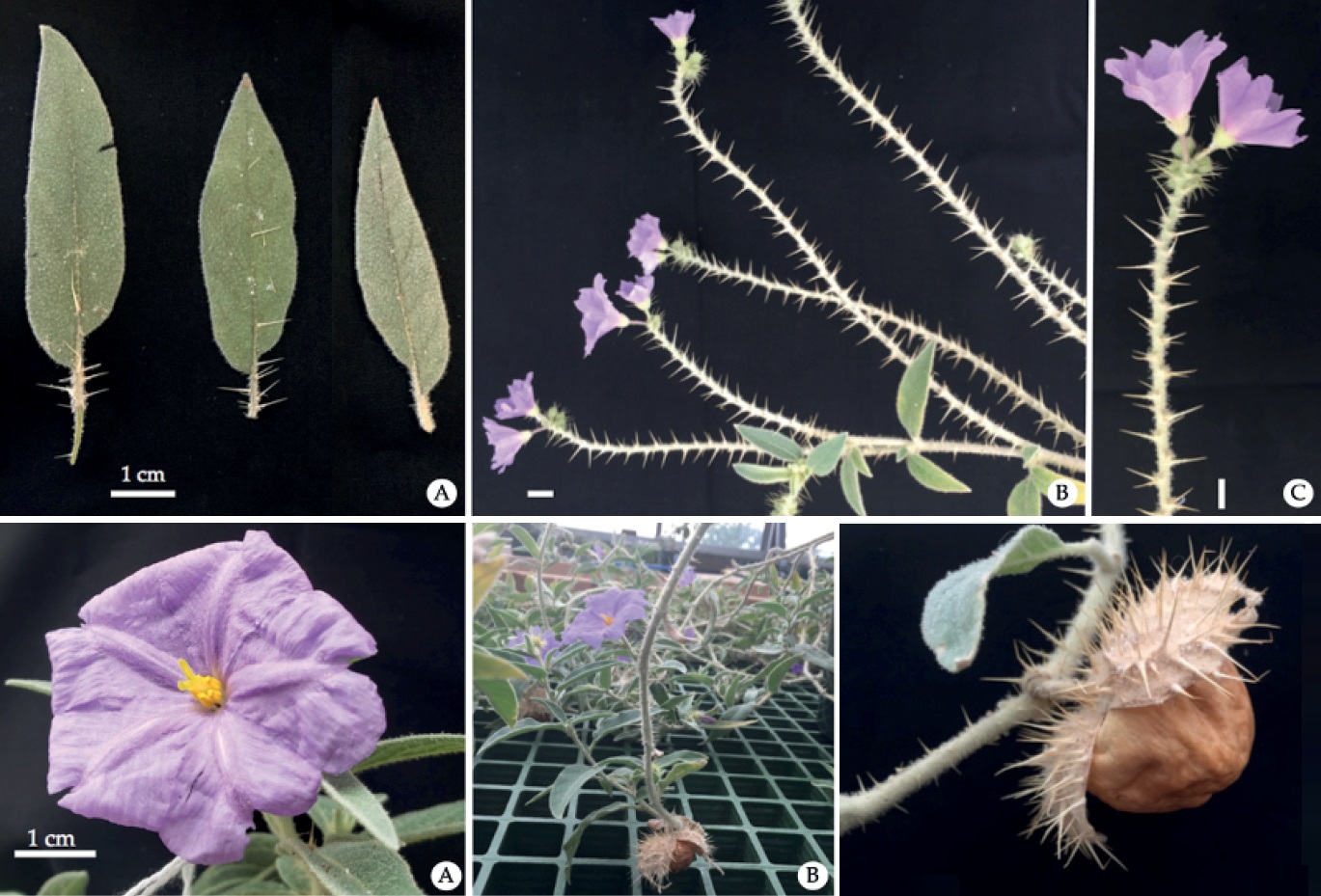
Functionally male individuals of Solanum scalarium in cultivation:
A leaf shape and B, C inflorescence axes of male individuals; note the distinctive spreading straight prickles that give the inflorescence axis a ladder-like appearance.  
Functionally female individuals of Solanum scalarium in cultivation:
 A flower B reproductive branch C leaf shape D, E reflexing of calyx around brown, bony fruits and F overall habit.
(Photos by T.M. Williams.).

 Solanum scalarium Martine & T.M.Williams, sp. nov.

Diagnosis: This species is distinguished from Solanum dioicum W.Fitzg. (as currently delineated) and other Australian functionally dioecious Solanum species of the “Kimberley dioecious clade” by the combination of a spreading decumbent habit and the staminate inflorescence axis armed with relatively stout, spreading, straight prickles.


Etymology: Latin scalare from scala, ladder or stair, and suffix aris, pertaining to; the epithet scalarium is the genitive plural of scalare, indicating ladder-like appearance of staminate inflorescence rachises, which are conspicuously and unusually armed with relatively stout, spreading, straight prickles resembling ladder steps. It is also a nod to the type locality at the Escarpment Walk, Judbarra/Gregory National Park, where stone stairs lead from the car park up to the habitat of this species. By choosing this name we acknowledge the access these steps provide to the newly-described species as well as the importance of providing broad access to nature, outdoor recreation, and scientific discovery. We suggest the use of Garrarnawun Bush Tomato for the English-language common name of the species in recognition of the Garrarnawun Lookout near where the type collection was made, a traditional meeting place of the Wardaman and Nungali-Ngaliwurru peoples whose lands overlap in this area (Parks and Wildlife Commission of the Northern Territory 2021).


Tanisha M. Williams, Jonathan Hayes, Angela J. McDonnell, Jason T. Cantley, Peter Jobson and Christopher T. Martine. 2022. Solanum scalarium (Solanaceae), A Newly-described Dioecious Bush Tomato from Judbarra/Gregory National Park, Northern Territory, Australia. PhytoKeys. 216: 103-116.  DOI: 10.3897/phytokeys.216.85972

Saturday, November 20, 2021

[Botany • 2021] Ficus desertorum (Moraceae) • A New Species of Rock Fig for Central Australia


Ficus desertorum B.C.Wilde & R.L.Barrett,

in Wilde & Barrett, 2021.
Photos: A–D by B.C. Wilde; E, F by R.L. Barrett.

Abstract
A new species of lithophytic fig, Ficus desertorum B.C.Wilde & R.L.Barrett, endemic to arid Central Australia, is described and illustrated. It is distinguished from other species in Ficus section Malvanthera Corner by having stiff lanceolate, dark green, discolorous leaves; many parallel, often obscure lateral veins; petioles that are continuous with the midrib; with minute, usually white hairs and non- or slightly sunken intercostal regions on the lower surface. Previously included under broad concepts of either Ficus platypoda (Miq.) Miq. or Ficus brachypoda (Miq.) Miq., this species has a scattered distribution throughout Central Australia on rocky outcrops, jump-ups (mesas) and around waterholes. This culturally significant plant, colloquially referred to as the desert fig, grows on elevated landscapes in central Australia, including Uluru (Ayers Rock), Kata Tjuta (The Olgas) and Karlu Karlu (Devils Marbles), three of Central Australia’s best-known natural landmarks. Evidence is provided to show these plants are geographically and morphologically distinct from Ficus brachypoda, justifying the recognition of F. desertorum as a new species. Taxonomic issues with F. brachypoda and F. atricha D.J.Dixon are also discussed. Lectotypes are selected for Urostigma platypodum forma glabrior Miq. and Ficus platypoda var. minor Benth.

Keywords: Central Australia; rock figs; Ficus; systematics; taxonomy; ethnobotany


Ficus desertorum B.C.Wilde & R.L.Barrett. 
A: fruiting branch. B: detail of leaf venation, abaxial surface. C: detail of stem and petiole. D: leaf, abaxial surface. E: leaf base and petiole detail. F: mature fruit lateral view. G: longitudinal section of fruit. H: habit and habitat.
Vouchers: A from G. Chippendale s.n. (NSW 927786); B, C, E-G from cultivated material; D from G. Chippendale s.n. (NSW 452252). 
Scale bar: A = 30 mm, b = 10 mm, c, e, f = 15 mm, d = 20 mm, g = 5 mm, h = no scale.
 Illustration by Lesley Elkan.

Ficus desertorum B.C.Wilde & R.L.Barrett.
A: habit on Uluru, NT. This individual has a decumbent habit and flows down the face of Uluru. B, C: foliage and young figs showing typical upright branches and leaves, Karlu Karlu, NT. D: variation in leaf shape. This individual is growing in sand, Simpsons Gap, NT. E: Fruiting branchlet on cultivated plant. F: Figs, petioles and apical bracts on cultivated plant.
Photos: A–D by B.C. Wilde; E, F by R.L. Barrett.


Ficus desertorum B.C.Wilde & R.L.Barrett, sp. nov. 

Type: Uluru (Ayers Rock-Mt Olga) National Park: Uluru (Ayers Rock), Mutitjulu (Maggie Springs) walk, on the ring road, 1.7 km NE of Ranger Station, 19 May 1988, M. Lazarides & J. Palmer 252 (holo: CANB 385988; iso: DNA D0046821).

Diagnostic characters. Distinguished from other Australian species in Ficus section Malvanthera by having stiff lanceolate, dark green, discolorous leaves; many parallel, often obscure lateral veins; petioles that are continuous with the midrib (not constricted); leaves with minute, white or rusty hairs and not or slightly sunken intercostal regions on the lower surface (the aeroles appearing very slightly raised). The leaves of this species separate it from most other native Australian figs, with petioles 9–34 mm long, 1.2–2.7 mm wide, and the lamina lanceolate (occasionally broadly lanceolate or elliptic), (40–)46–120 mm long, (15–)19–44 mm wide, a distinctive length/ width ratio (Fig. 5). Some populations of F. brachypoda s. lat. from the Pilbara region of Western Australia do have a similar leaf shape, but all specimens assigned to F. brachypoda s. lat. differ in the strongly sunken, finely reticulate intercostal regions (or intercostal veins appearing raised) on the lower surface.


Etymology. The epithet refers to the unusual habitat of this species (for Ficus) in the arid centre of Australia, dominated by desert environments

Indigenous names. tywerrk (Alyawarr; Anmatyerr); tjurrka (Arrente); utyeerk, utyeerke (Eastern Arrente); tywerrke (Western Arrente); ili, witjirrki, yili (Pintupi); ili (Pitjantjatjara / Yankunytjatjara); wÿirrki (Warlpiri). The figs as a food are known as mai pulka (Yankunytjatjara). (See Kemp 1891; Cleland and Johnston 1933, 1937, 1939; Johnstone and Cleland 1943; Meggitt 1957; Cleland and Tindale 1959; Maconochie 1970; Hale 1975; Hansen and Hansen 1977; O’Connell et al. 1983; Latz 1995; Everard et al. 2002.) 

Common names. Desert fig (preferred); Wild fig; Rock fig; Native fig.

Distribution. Most common in the greater MacDonnell Ranges of the Northern Territory, from the Devils Marbles, south to the Everard Ranges in South Australia and west to the Rawlinson and Walter James Ranges in Western Australia (Fig. 2A, within dashed ellipse).

Conservation status. The species is widespread and present in a number of national parks and other conservation reserves, but it is usually only found as small populations, so threats such as fire may have localised impacts. 

 
Brendan C. Wilde and Russell L. Barrett. 2021. Hiding in Plain Sight, Ficus desertorum (Moraceae), A New Species of Rock Fig for Central Australia. Telopea: Journal of Plant Systematics. 24; 283–301. DOI: 10.7751/telopea14668

Thursday, August 12, 2021

[Botany • 2021] Nicotiana insecticida (Solanaceae) • A New Species from Western Australia


Nicotiana insecticida M.W.Chase & Christenh.

in Chase & Christenhusz, 2021. 

Illustration: Deborah Lambkin. 

Summary

The new species Nicotiana insecticida, which is remarkable in its insect trapping abilities, is described here. It is illustrated from plants that were grown from seeds collected near the Minilya Roadhouse on the Northwest Coastal Highway in Western Australia, Australia. They were cultivated at the Royal Botanic Gardens, Kew. Its distinguishing features, taxonomy, ecology, cytology and cultivation are discussed.


Nicotiana insecticida M.W.Chase & Christenh.
A, flower, × 3; B, corolla, face view, opened out, × 3; C, corolla, opened out, × 3; D, style and ovary, × 3; E, leaf, × 3/4; F, habit, × 1/6; G, upper stem, × 9; H, fruit, with calyx, × 3; I, fruit, calyx removed, × 3; J, stem hairs showing dead insects, × 3; K, calyx hairs, × 9.
Drawn by Deborah Lambkin from specimens cultivated at Kew.

Nicotiana insecticida M.W.Chase & Christenh.

Illustration by Deborah Lambkin 

Nicotiana insecticida M.W.Chase & Christenh., spec. nov.  

Etymology: From the Latin for insect killer, a reference to this species killing numerous small insects with its extremely sticky hairs covering all parts of these plants.


Mark W. Chase and Maarten J. M. Christenhusz. 2021. 994. NICOTIANA INSECTICIDA: Solanaceae. Curtis's Botanical Magazine. DOI: 10.1111/curt.12402
Illustrations by Deborah Lambkin 

Thursday, June 20, 2019

[Botany • 2019] Solanum plastisexum (Solanaceae) • An Enigmatic New Bush Tomato from the Australian Monsoon Tropics Exhibiting Breeding System Fluidity


Solanum plastisexum Martine & McDonnell

in McDonnell, Wetreich, Cantley, Jobso & Martine, 2019. 

Abstract
A bush tomato that has evaded classification by solanologists for decades has been identified and is described as a new species belonging to the Australian “Solanum dioicum group” of the Ord Victoria Plain biogeographic region in the monsoon tropics of the Northern Territory. Although now recognised to be andromonoecious, Solanum plastisexum Martine & McDonnell, sp. nov. exhibits multiple reproductive phenotypes, with solitary perfect flowers, a few staminate flowers or with cymes composed of a basal hermaphrodite and an extended rachis of several to many staminate flowers. When in fruit, the distal rachis may abcise and drop. A member of Solanum subgenus Leptostemonum, Solanum plastisexum is allied to the S. eburneum Symon species group. Morphometric analyses presented here reveal that S. plastisexum differs statistically from all of its closest relatives including S. eburneum, S. diversiflorum F. Meull., S. jobsonii Martine, J.Cantley & L.M.Lacey, S. succosum A.R.Bean & Albr. and S. watneyi Martine & Frawley in both reproductive and vegetative characters. We present evidence supporting the recognition of S. plastisexum as a distinctive entity, a description of the species, representative photographs, a map showing the distribution of members of the S. eburneum species group and a key to the andromonoecious Solanum species of the Northern Territory of Australia. This new species is apparently labile in its reproductive expression, lending to its epithet, and is a model for the sort of sexual fluidity that is present throughout the plant kingdom.

Keywords: New species, andromonoecy, Solanaceae, Leptostemonum

Figure 2. Closely related species of andromonoecious bush tomatoes included in this study.
 A Solanum jobsonii B S. watneyi C S. succosum
Solanum plastisexum E S. diversiflorum and F S. eburneum.  

Figure 1. Morphology and the earliest-known herbarium specimen of Solanum plastisexum.
 A Flowering stem with a single staminate flower in 2016 B Mature fruit C Erect inflorescences bearing staminate flowers in 2018 and D Specimen collected by P. Latz in 1974, held at DNA and annotated by D. Symon with an annotation indicating his confusion about the reproductive morphology of the specimen (male rachis visible above fruit on far left).


Solanum plastisexum Martine & McDonnell, sp. nov.

Diagnosis: Like Solanum eburneum, Solanum watneyi and Solanum succosum, but differing by having elliptic, unlobed (or rarely very shallowly lobed) leaves, small apical leaves, long calyx lobes on the staminate flowers and fully erect staminate inflorescence branches.
...

Etymology: The name is based on the Latin “plastus” (“deceptive,” but derived from the Greek “plastikos/plasticos/plasticus” for “able to be molded, changeable”) and the Latin “sexus” for sex. We suggest the use of Dungowan Bush Tomato for the common name of this species, which refers to the cattle station on which the majority of the collections have been made.


 Angela J. McDonnell, Heather B. Wetreich, Jason T. Cantley, Peter Jobso and Christopher T. Martine. 2019. Solanum plastisexum, An Enigmatic New Bush Tomato from the Australian Monsoon Tropics Exhibiting Breeding System Fluidity. PhytoKeys 124: 39-55. DOI: 10.3897/phytokeys.124.33526
Meet Australia’s New Sex-Changing Tomato: Solanum plastisexum nyti.ms/2MSzL01
Scientists challenge notion of binary sexuality with naming of new plant species  eurekalert.org/e/9J0Z via @Pensoft @EurekAlert

Tuesday, June 4, 2019

[Botany • 2019] Gymnosiphon queenslandicus (Burmanniaceae) • A New Addition to the Mycoheterotroph Flora of Tropical Rainforest in Australia


Gymnosiphon queenslandicus B.Gray & Y.W.Low

in Gray, Mahyuni & Low, 2019.
 DOI: 10.1071/SB18035 

Abstract
The mycoheterotrophic genus Gymnosiphon Blume is recorded for Australia for the first time after the recent discovery of plants at Mossman Gorge, Queensland. On the basis of examination of living plants in the field as well as materials preserved in spirit, the Mossman Gorge Gymnosiphon taxon is a novelty closely related to Gymnosiphon affinis J.J.Sm., which is known only from New Guinea. The new species is here described as Gymnosiphon queenslandicus B.Gray & Y.W.Low based on floral characteristics important for species distinction in the genus.

 Keywords: Dioscoreales, endemic, monocots, Queensland.


Bruce Gray, Ridha Mahyuni and Yee Wen Low. 2019. Gymnosiphon queenslandicus (Burmanniaceae), A New Addition to the Mycoheterotroph Flora of Tropical Rainforest in Australia. Australian Systematic Botany.  32(3) 139-145.  DOI: 10.1071/SB18035