Showing posts with label Saturniidae. Show all posts

Thursday, November 28, 2024

[Entomology • 2023] Salassa sunwukongi • A New Species and A New Group of Salassa Moore, 1859 (Lepidoptera: Saturniidae) with a molecular study based on partial COI


 Salassa sunwukongi  Zheng & Wang, 2023
 (A-D) male; (E, F) female.
 
 
Abstract
Salassa is a genus of the family Saturniidae. It comprises over 30 species that are widely distributed in Asia. This study describes a new species, Salassa sunwukongi sp. nov., found in Chinese Yunnan province. The first molecular study of Salassa was conducted using COI fragments. Molecular and morphological analyses revealed the presence of a monophyletic group, royi-group, distributed in the Himalayas. A key to members of the royi-group, along with species lists and distinguishing characteristics of all three groups of Salassa, is provided.

Lepidoptera, Salassinae, giant silk moth, systematics, taxonomy

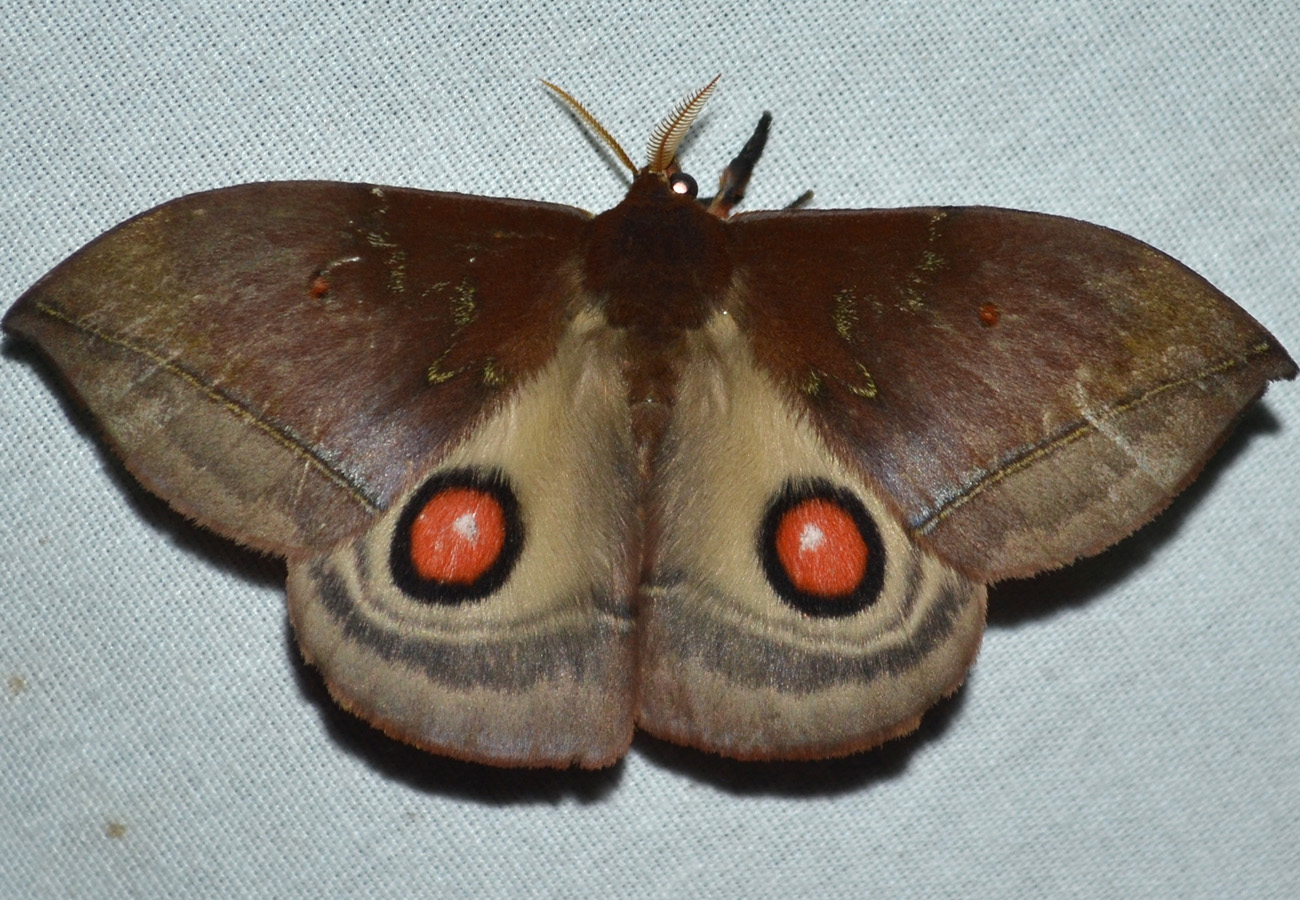
 Adults of Salassa sunwukongi sp. nov.:
 (A) male holotype (dorsal view); (B) male holotype (ventral view);
(C) male paratype (dorsal view); (D) male paratype (dorsal view);
(E) female paratype (dorsal view); (F) female paratype (ventral view).
Scale bars: 10.0 mm.
 

Salassa sunwukongi sp. nov.

Distribution. China: Yunnan Province.

Etymology. The new species was named after Sun Wukong, the Monkey King in Chinese Mythology, for the diverse colours and monkey-face-like pattern in the hindwing of the new species.


Xuhongyi ZHENG and DONG WANG. 2023. Description of A New Species and A New Group of Salassa Moore, 1859 (Lepidoptera: Saturniidae) with a molecular study based on partial COI.  Zootaxa. 5375(2); 285-296. DOI: doi.org/10.11646/zootaxa.5375.2.10 
 facebook.com/LeslieLin9562/posts/7213681108650789

Tuesday, November 26, 2024

[Entomology • 2024] Celaenorrhinus qianhanae • A New Species of the Genus Celaenorrhinus Hübner, [1819] (Lepidoptera: Hesperiidae) from Hainan, China


Celaenorrhinus qianhanae Li & Li, 
C. aspersa Leech, 1891

in H.-Z. Li, Liu et J.-L. Li. 2024.  

Abstract
A new species, Celaenorrhinus qianhanae Li & Liu sp. nov., is described from Hainan, China. Its unique genital characteristics and wing markings are compared with other congeneric species from this island and adjacent regions, including Vietnam and China, etc. In addition, its COI gene is sequenced for molecular analysis, and the secondary sexual character, hair tufts on hind tibiae, is discussed for comparison.

Lepidoptera, Tagiadinae, Celaenorrhinini, genitalia, phylogeny


Hua-Zhao LI, Zhe LIU and, Jia-Ling LI. 2024. A New Species of the Genus Celaenorrhinus Hübner, [1819] from Hainan, China (Lepidoptera, Hesperiidae). Zootaxa. 5405(2); 265-272. DOI: doi.org/10.11646/zootaxa.5405.2.6 
 Researchgate.net/publication/377777709_A_new_species_of_Celaenorrhinus_from_Hainan_China
 www.yahoo.com/news/peculiar-winged-creature-found-island-225546214.html

Monday, March 15, 2021

[Entomology • 2021] Gamelia bennetti • A New Saturniidae Species (Lepidoptera: Bombycoidea) from Trinidad and Tobago


 Gamelia bennetti 
Cock & Rougerie, 2021


Abstract
Gamelia bennetti sp. nov. is described from Trinidad, Trinidad and Tobago, West Indies, and compared with members of the Gamelia abas species group: G. abas (Cramer, [1775]), G. berliozi Lemaire, 1967, G. lichyi Lemaire, 1973, G. rubriluna (Walker, 1862) and G. septentrionalis (Bouvier, 1936). A photographic record suggests G. bennetti sp. nov. may also occur in Tobago.

Keywords: Lepidoptera, Hemileucinae, Neotropical Region, taxonomy, DNA barcoding


Figure 4. Left, putative living  Gamelia bennetti sp. nov. female, Trinidad and Tobago, Trinidad, East of Cunaripa, Bedes Buxoo Trace, by night, 30 May 2020, R. Deo [iNaturalist observation 48063102]. © R. Deo, with permission.
Right, a possible living G. bennetti sp. nov. female, Trinidad and Tobago, Tobago, near Speyside, +11.301, -60.534, at light, 29 November 2014, P. Davis. © P. Davis, with permission.

Living  Gamelia bennetti sp. nov., Trinidad and Tobago, Trinidad, Bush Bush, 18 October 2014, K. Sookdeo.
© K. Sookdeo, with permission.

Gamelia bennetti Cock and Rougerie sp. nov.

Diagnosis. There are several similar Gamelia species from the Amazon-Guiana-Venezuela area with which this species can be confused, including G. abas, G. rubriluna (Walker, 1862), G. lichyi Lemaire, 1973 and G. berliozi Lemaire, 1967. Given the variability noted between the holotype, paratype and female photo of G. bennetti sp. nov., it is not really possible to point to reliable diagnostic characters of wing markings. The male genitalia are very similar to species in the Gamelia abas group (Lemaire 2002), particularly G. rubriluna and G. lichyi, and to a lesser extent G. septentrionalis (Bouvier, 1936) and G. berliozi (Lemaire 2002, Brechlin & Meister 2012), so we consider G. bennetti sp. nov. to be an additional species of the Gamelia abas group. The genital structure (Fig. 3 A, D) is more elongate than that of G. rubriluna, but less so than in the other three species. The saccus (Fig. 3 D–F) is longer than that of G. rubriluna, but shorter than that of G. lichyi. The long slender lobes of the succus (‘lobes of the vinculum’ in Lemaire (2002)) curl back over the saccus before arching back to emerge under the uncus; it is difficult to compare this curvature with the other species of the group as Lemaire only provides ventral views, and images in Brechlin & Meister (2012) are from microscope slides, whereas lateral or partial lateral views (Fig. 3 F–I) are needed to observe this character. The saccus lobes of G. rubriluna and G. lichyi joined in their basal half (see figures in Lemaire (2002) and Brechlin & Meister (2012)), but are completely separate throughout in G. bennetti sp. nov. The aedeagus of G. bennetti sp. nov. has a ventral spike (Fig. 3 N) as do G. rubriluna and G. lichyi, but not G. septentrionalis and G. berliozi (Lemaire 2002). The aedeagus caecum in G. bennetti sp. nov. is a quadrate flange with the distal margin concave (Fig. 3 L–N), whereas this flange is basally rounded in G. lichyi, G. rubriluna and G. berliozi and the distal margin is concave in G. lichyi, but straight or rounded in G. rubriluna and G. berliozi (Lemaire 2002; Brechlin & Meister 2012). The sternite of abdominal segment 8 (A8) (Fig. 3 J) resembles that of G. rubriluna. The tergite of abdominal segment 7 (A7) (Fig. 3 K) resembles that of G. lichyi, and does not have the bottleneck shape of G. rubriluna. At this time, G. bennetti sp. nov. is the only species of the genus Gamelia known from Trinidad, and is only known from the eastern part of the island of Trinidad and perhaps eastern Tobago (see Distribution paragraph). Hence location will give a good pointer as to its identity, although there is no reason to think G. bennetti sp. nov. will not be found to occur more widely in Trinidad or on the mainland in north-eastern Venezuela and/or Guyana. It is therefore fortunate that both the male genitalia and the DNA barcodes can be reliably used to separate G. bennetti sp. nov. from other Gamelia species.

 Etymology. This species is named with thanks and appreciation after Dr Fred D. Bennett (Frank 2019), who was director of the Commonwealth Institute of Biological Control (now integrated within CABI) in Trinidad, during the five years that the first author was based there. Fred’s support, encouragement and help with the study the insects of Trinidad has contributed to the first author’s subsequent four decades long interest in the Lepidoptera of Trinidad and Tobago.


Matthew J.W. Cock and Rodolphe Rougerie. 2021. Gamelia bennetti sp. nov., A New Saturniidae Species from Trinidad and Tobago (Lepidoptera: Bombycoidea). Zootaxa. 4942(3); 339–350. DOI:  10.11646/zootaxa.4942.3.2
 

Friday, February 20, 2015

[Entomology / Behaviour • 2015] Moth Tails divert Bat Attack: Evolution of Acoustic Deflection


Luna moth Actias luna
 photo: Geoff Gallice | flic.kr/p/7TwV7q

Abstract
Adaptations to divert the attacks of visually guided predators have evolved repeatedly in animals. Using high-speed infrared videography, we show that luna moths (Actias luna) generate an acoustic diversion with spinning hindwing tails to deflect echolocating bat attacks away from their body and toward these nonessential appendages. We pit luna moths against big brown bats (Eptesicus fuscus) and demonstrate a survival advantage of ∼47% for moths with tails versus those that had their tails removed. The benefit of hindwing tails is equivalent to the advantage conferred to moths by bat-detecting ears. Moth tails lured bat attacks to these wing regions during 55% of interactions between bats and intact luna moths. We analyzed flight kinematics of moths with and without hindwing tails and suggest that tails have a minimal role in flight performance. Using a robust phylogeny, we find that long spatulate tails have independently evolved four times in saturniid moths, further supporting the selective advantage of this anti-bat strategy. Diversionary tactics are perhaps more common than appreciated in predator–prey interactions. Our finding suggests that focusing on the sensory ecologies of key predators will reveal such countermeasures in prey.

Keywords: antipredator defense; bat–moth interactions; Lepidoptera; Saturniidae


Jesse R. Barber, Brian C. Leavell, Adam L. Keener, Jesse W. Breinholt, Brad A. Chadwell, Christopher J. W. McClure, Geena M. Hill and Akito Y. Kawahar. 2015. Moth Tails divert Bat Attack: Evolution of Acoustic Deflection. PNAS. doi: 10.1073/pnas.1421926112


Why Do Luna Moths Have Such Absurdly Long Tails? http://on.natgeo.com/1D5tpvs via  @ngphenomena
Luna moths’ gorgeous wings throw off bat attacks  http://po.st/ZV8dO9 via @SmithsonianMag