Showing posts with label Inselberg. Show all posts

Wednesday, October 22, 2025

[Botany • 2025] Stigmatodon minimus (Bromeliaceae: Tillandsioideae) • A diurnal New Species of Stigmatodon from vertical rock walls of the Atlantic Forest inselbergs, Espírito Santo state, Brazil


 Stigmatodon minimus  D.R. Couto & Leme,

in Couto, Manhães et Leme, 2025. 

Abstract
The authors describe and illustrate Stigmatodon minimus, a new species with the smallest stature within the genus, and discuss its taxonomic affinities and conservation status. Furthermore, this new species is the only one, among all others with typical tubo-laciniate stigma type, to present diurnal anthesis, reddish-wine to purplish-wine bracts, and unappendaged white petals, contrasting with the morphological characteristics of other previously known species of Stigmatodon s.str. The new species is closely to S. amadoi, with which it is compared, and considered a microendemic, Vulnerable [VU: D2] species due to its restricted habitat, reduced population size, and threats from ornamental rock mining.

Bromeliaceae, Poales, rocky outcrops, tubo-laciniate stigma, Vrieseinae, Monocots
 
 Stigmatodon minimus.
A. General view of Pedra da Fortaleza, the type locality in the municipality of Nova Venécia, Espírito Santo state. B. Close up of the summit of Pedra da Fortaleza. C. The hyperepilithic habitat of S. minimus on vertical rock walls. D-E. Flowering individual of S. minimus growi ng mixed with small islands of rock vegetation
(A–B photos by V. Manhães; C–D photos by D.R. Couto).

 Stigmatodon minimus (A-Q). A. Habit. B. Side view of the inflorescence. C. Back view of the inflorescence. D. Plantlets developed at the old basal portion of the stem. E. Basal leaf. F. Floral bract. G. Lateral view of the corolla. H. Frontal view of the corolla. I. Flower. J. Sepal. K. Distal part of the petal. L. Petal. M. Pistil. N. Ovules. O. Stigma. P. Frontal view of the anther. Q. Back view of the anther.
Stigmatodon amadoi (Leme 5953, R-S). R. Frontal view of the flower. S. Habit
(A, D-S photos by E. Leme; B-C photos by D.R. Couto). 
Bars: A-I, R-S = 10 mm, J-N, P-Q = 2 mm, O = 0.5 mm.

Stigmatodon minimus D.R. Couto & Leme, sp. nov.

Etymology:— The name of this species is based on the Latin word “minimus”, meaning very small, minimum, the smallest, as a direct reference to its size, which is the smallest within the genus Stigmatodon.


Dayvid R. COUTO, Vitor Da Cunha MANHÃES and Elton M. C. LEME. 2025. A diurnal New Species of Stigmatodon (Bromeliaceae, Tillandsioideae) from vertical rock walls of the Atlantic Forest inselbergs, Espírito Santo state, Brazil.  Phytotaxa. 720(2); 149-156. DOI: doi.org/10.11646/phytotaxa.720.2.5 [2025-09-30]
 

Sunday, October 19, 2025

[Botany • 2020] Stigmatodon attenuatoides (Bromeliaceae: Tillandsioideae) • A New mat-forming Species on inselbergs of southeastern Brazil


Stigmatodon attenuatoides D.R.Couto, Manhães & A.F.Costa, 

in Couto, Manhães et Costa, 2025. 
 
Abstract
During the taxonomic revision of the genus Stigmatodon, we found an unknown epilithic mat-forming species, morphologically close to S. belloi, on vertical granitic surfaces on inselbergs in southern Espírito Santo state, Brazil. We described and illustrated the new species, including a comparative analysis of characters that distinguish it from similar species. We also provide data on habitat, ecology, geographical distribution and evaluation about its threat of extinction according to the criteria of the IUCN.

Atlantic Forest, cliff ecosystems, conservation, granitic rocky outcrops, monocotyledonous mats, Vrieseinae, Monocots


Stigmatodon attenuatoides D. R. Couto, Manhães & A. F. Costa, sp. nov.

Etymology:—The epithet of this new species alludes to the resemblance between its leaves and those of Agave attenuata Salm-Dyck (1834: 303, Asparagaceae), which are green and covered by a thick layer of white epicuticular wax too. 


Dayvid Rodrigues COUTO, Vitor da CUNHA MANHÃES, Andrea Ferreira da COSTA. 2020. Stigmatodon attenuatoides (Tillandsioideae, Bromeliaceae): A New mat-forming Species on inselbergs of southeastern Brazil.  Phytotaxa. 468(1); 143–149. DOI: doi.org/10.11646/phytotaxa.468.1.11 [2020-10-23]

Monday, May 12, 2025

[Botany • 2021] Tillandsia oliveirae (Bromeliaceae: Tillandsioideae) • A New Species from an inselberg in Bahia, Brazil


Tillandsia oliveirae E.H.Souza & Leme,

in E.H.D. Souza, Leodegario, Aona, F.V.D. Souza et Leme, 2021.
 
Abstract
The authors describe, discuss, and illustrate Tillandsia oliveirae, a new species from the inselbergs of the Caatinga biome in the municipality of Itatim, Bahia, Brazil. The new species is similar to T. hofackeri, differing by morphological characters such as larger size of the plant, longer peduncle, more laxly arranged leaves, which are more numerous, and whitish petals. It is an endemic species with a restricted area of distribution, being considered critically endangered (CR) due to illegal extractivism, specifically for regional and international trade.

Bromeliad, Caatinga, illegal trade, Tillandsia hofackeri, Tillandsioideae, Monocots


Tillandsia oliveirae E.H.Souza & Leme


Everton Hilo De SOUZA, Marcio De Melo LEODEGARIO, Lidyanne Yuriko Saleme AONA, Fernanda V. D. SOUZA and Elton M. C. LEME. 2021. Tillandsia oliveirae (Bromeliaceae): A New Species from an inselberg in Bahia, Brazil. Phytotaxa. 527(1); 60-66. DOI: doi.org/10.11646/phytotaxa.527.1.6 [2021-11-26]

Sunday, February 23, 2025

[Botany • 2023] Lindernia barthlottii (Linderniaceae) • A New Species from Inselbergs in northern Madagascar


Lindernia barthlottii  Eb.Fisch., Andriant. & Sieder,

in Fischer, Andriantiana et Sieder, 2023.  
 
Abstract
The new species Lindernia barthlottii from an inselberg in Northern Madagascar is described and illustrated. It differs from all Madagascan Lindernia species in the small rosulate habit with condensed stems, the broad obtuse sepals, and the large and except for the palate entirely blue corolla. A short discussion on the other four species of Linderniaceae (Linderniella cerastioides, L. horombensis, L. pygmaea, Crepidorhopalon microcarpaeoides) endemic to inselbergs in Madagascar is provided.

Eudicots, endemic, Linderniella cerastioidesL. horombensisL. pygmaeaCrepidorhopalon microcarpaeoides, ephemeral flush vegetation, taxonomy


 Lindernia barthlottti Eb.Fisch., andriant. & Sieder sp. nov.
a,. detail of habitat.-b. habit.
Photographs: a.Sieder, 8 February 2020. Scale bars: a. 5 mm -b. 2 mm.


EBERHARD FISCHER, JACKY LUCIEN ANDRIANTIANA and ANTON SIEDER. 2023. Lindernia barthlottii (Linderniaceae), A New Species from inselbergs in Madagascar.  Phytotaxa. 626(3)191-198. DOI: doi.org/10.11646/phytotaxa.626.3.5 

Tuesday, January 21, 2025

[Botany • 2021] Aloe uigensis (Asphodelaceae: Alooideae) • A New Species from northwestern Angola


 Aloe uigensis Gideon F. Sm. & T. Lautenschl.,

in Smith et Lautenschläger, 2021. 
 
Abstract
A new species of Aloe, A. uigensis (Asphodelaceae subfam. Alooideae), is described from northwestern Angola. It is a non-proliferous, single-stemmed species that bears narrowly elongated, acuminate racemes with orange to pale reddish flowers. Aloe uigensis is compared to some long-known as well as recently described species of Aloe from Angola, but does not have close relatives with which it can be confused in the country.

Ambuila, inselbergs, limestone rocks, taxonomy, Uíge, Monocots


Aloe uigensis Gideon F. Sm. & T. Lautenschl. 2021, sp. nov.

Etymology:— Aloe uigensis is named for the province of Uíge in northern Angola, from where the type specimen was collected.


Gideon F. SMITH and Thea LAUTENSCHLÄGER. 2021. Aloe uigensis (Asphodelaceae subfam. Alooideae), A New Species from northwestern Angola.  Phytotaxa. 521(3); 227-231. DOI: doi.org/10.11646/phytotaxa.521.3.8
https://tu-dresden.de/tu-dresden/newsportal/news/neue-aloe-art-entdeckt

Tuesday, July 30, 2024

[Herpetology • 2024] Panaspis ericae & P. mundavamboA Treasure Trove of Endemics: Two New Species of Snake-eyed Skinks of the Genus Panaspis Cope, 1868 (Squamata: Scincidae) from the Serra da Neve Inselberg, southwestern Angola


 Panaspis ericae  
 Marques, Parrinha, Lopes-Lima, Tiutenko, Bauer & Ceríaco, 2024

photos by Arthur Tiutenko.

 Abstract
Four species of the genus Panaspis P. cabindae, P. wahlbergii, P. maculicollis and P. mocamedensis – are currently known from Angola. The analysis of recently collected specimens from Serra da Neve Inselberg, an isolated mountain located in northern Namibe Province, revealed unexpected taxonomic diversity in the group. Using an integrative taxonomy approach based on morphological and DNA sequence data, with both mitochondrial (16S) and nuclear (RAG-1) genes, we were able to distinguish two distinct populations, described here as two new species, Panaspis ericae sp. nov. and P. mundavambo sp. nov. Both species are assumed to be endemic to the inselberg. This reinforces our notion of southwestern Angola as a hotspot of skink diversity, and highlights the urgent need for the conservation of Serra da Neve.

Key Words: Reptiles, integrative taxonomy, Africa, herpetofauna, cryptic species


Live photos of Panaspis ericae sp. nov. 
the holotype (MUNHAC/MB03-001525) from vicinity of Catchi, Serra da Neve.  
 the paratype (MUNHAC/MB03-001531) from vicinity of Maylowe, Serra da Neve.
photos by Arthur Tiutenko.

 Panaspis ericae sp. nov.

Etymology: The specific epithet “ericae” is formed in the genitive singular and is feminine. It is given in honor of Erica Tavares (1997–), an Angolan biologist and conservationist. Through her work in the Angolan environmental platform “Eco Angola” (of which Erica is a co-founder), Erica has revolutionized the Angolan conservation and ecological discourse, providing opportunities for members of the Angolan civil society, students, and young researchers to learn, debate and contribute to environmental causes. We suggest “Erica’s Snake-Eyed Skink” and “Lagartixa da Manta-Morta de Erica” as the English and Portuguese common names, respectively, for this species.


 Panaspis mundavambo sp. nov.

Etymology: The specific epithet “mundavambo” refers to the Mukwando (local tribe) name for Serra da Neve Inselberg (Opunda Mundavambo), to which the species is endemic, and is applied here as a substantive in apposition. We propose the English vernacular name “Serra da Neve Snake-Eyed Skink” and the Portuguese vernacular name of “Lagartixa da Manta-Morta da Serra da Neve”.

 
Mariana P. Marques, Diogo Parrinha, Manuel Lopes-Lima, Arthur Tiutenko, Aaron M. Bauer and Luis M. P. Ceríaco. 2024. A Treasure Trove of Endemics: Two New Species of Snake-eyed Skinks of the Genus Panaspis Cope, 1868 (Squamata, Scincidae) from the Serra da Neve Inselberg, southwestern Angola. Evolutionary Systematics. 8(2): 167-182. DOI: doi.org/10.3897/evolsyst.8.121103

Wednesday, June 5, 2024

[Botany • 2024] Praxelis cleggiae (Asteraceae: Eupatorieae: Praxeliinae) • A New Species from the Granite Inselbergs in the east of the Departamento de Santa Cruz, Bolivia


Praxelis cleggiae D.J.N.Hind & S.L.Edwards,

in Hind et Edwards, 2024.
 
Summary
Praxelis cleggiae (Compositae: Eupatorieae: Praxeliinae) is described and illustrated from the granite inselbergs (upon which it is most common), and on road crown chippings on old roads, in the Departamento de Santa Cruz, Bolivia; it has a disjunct distribution and is also found on the Serranía San Simón, in the San Ignacio Schist belt, Departamento de Beni. Material of this species was mostly determined as P. insignis (Malme) R.M.King & H.Rob., a Brazilian species, described from the metamorphosed sandstone of what is now the Parque Nacional da Chapada dos Guimarães in Mato Grosso State. The two species have some superficial resemblance, but differ significantly in plant size, internode length (relative to leaf length), branching, leaf shape and size, phyllaries, achenes and pappus. The total number of species of Praxelis recognised in Bolivia is now seven, and 20 species in the genus worldwide. 

Key Words: Asteraceae, ChromolaenaEupatoriopsis, Island-like Systems, Praxeliopsis


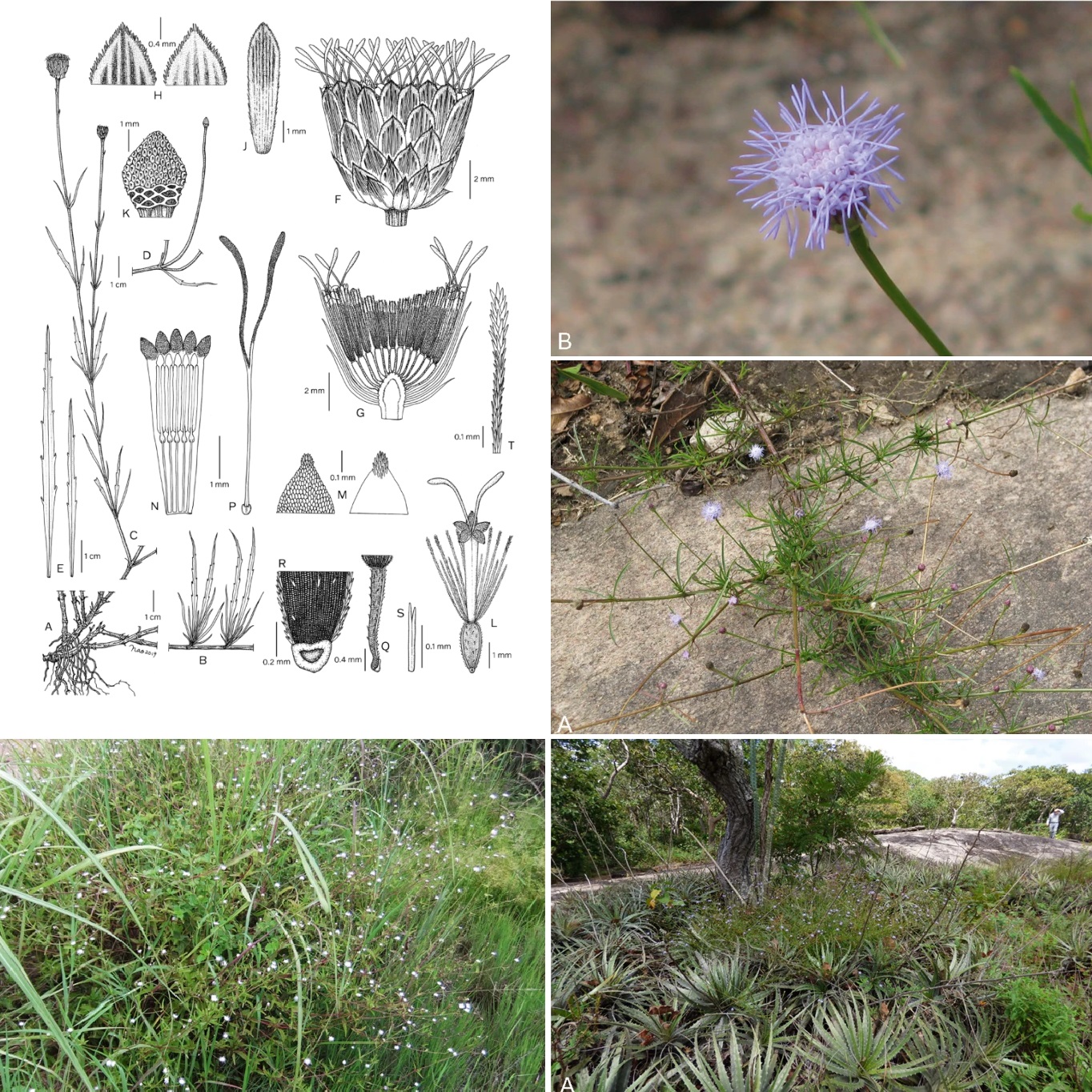
Praxelis cleggiae. A rootstock; B prostrate stem portion with axillary clusters/tufts of leaves; C upper part of flowering stem; D apical part of flowering stem bearing one old capitulum, post-dehiscence of phyllaries and achenes, showing just the conical receptacle; E leaves; F capitulum; G l.s. capitulum; H middle phyllary apex — l.h. showing abaxial view, r.h. showing adaxial view; J innermost phyllary; K detail showing surface of receptacle; L floret; M detail of corolla lobe apex (l.h. view of adaxial surface, r.h. view of abaxial surface); N corolla opened out showing position of anther cylinder; P style and style arms; Q achene (obcompressed) in lateral view showing asymmetric carpopodium facing right (towards attachment point on receptacle); R base of achene showing adaxial surface and carpopodium; S detail of setula from achene body; T detail of apex of pappus seta.
 A, C, D, F – T from Wood et al. 24182 (holotype in K); B & E from Wood et al. 13202 (K). 
Drawn by Naoko Yasue.


Praxelis cleggiae D.J.N.Hind & S.L.Edwards, sp. nov.

RECOGNITION. Praxelis cleggiae is similar to P. insignis in that both species are procumbent and spreading, commonly have a single capitulum per inflorescence (if terminal) or inflorescence branch, and possess inconspicuously bracteolate pedicels. Praxelis cleggiae is distinguished from P. insignis in possessing markedly longer internodes (c. 2 – 9 cm vs c. 0.3 – 0.8 cm), with leaves scarcely longer than internode (vs leaves c. 3 – 6+ times longer than ...

ETYMOLOGY. The species is named after Rosemary (Rosie) Clegg, formerly TIPAs Bolivia Co-ordinator, at RBG, Kew, now a post graduate student being co-supervised by the first author of this paper. Rosie first brought the issue of this species to the attention of the first author when she began assessing the species for Red Data listing, at which point a critical assessment was made of the material.

 
D. J. Nicholas Hind and Sara L. Edwards. 2024. Praxelis cleggiae (Compositae: Eupatorieae: Praxeliinae), A New Species from the Granite Inselbergs in the east of the Departamento de Santa Cruz, Bolivia.  Kew Bulletin. DOI: s12225-024-10189-1

Sunday, May 19, 2024

[Botany • 2023] Krenakanthus ribeiranus (Bromeliaceae: Bromelioideae) • A “hairy situation” in Minas Gerais, Brazil: A striking New Species of Krenakanthus covered with uniseriate trichomes

 
 Krenakanthus ribeiranus 

in Leme, Gonella, Couto, Fernandez, De Carvalho, De Almeida et Mariath, 2023. 
 
Abstract
A new species of Krenakanthus, a member of the bromelioid “Cryptanthoid complex”, is described based on plants discovered through collaborative citizen science. Krenakanthus ribeiranus and its only congener K. roseolilacinus are endemic to the “João Pinto Center of Biodiversity”, a still poorly explored region with Campos Rupestres and associated vegetation in the Rio Doce Valley, in eastern Minas Gerais state, Brazil. The unusual combination of morphological characters of K. ribeiranus, highlighted by plant delicacy and almost all leaf and flower parts covered by uniseriate, hair-like trichomes, is illustrated and discussed in comparison with K. roseolilacinus, including leaf and seed anatomy, as well as pollen morphology. This micro-endemic species is assessed as Critically Endangered, reinforcing the need for strategy to protect the biodiversity of the region. The morphology of the new species validates and strengthens the diagnostic flower characters used in the circumscription of Krenakanthus, suggesting as secondary diagnostic characters the habit, stature, and leaf conformation.  

Keywords: Monocots, anatomy, Campos Rupestres, Cryptanthoid complex, João Pinto Center of Biodiversity, morphology, uniseriate trichomes

 Krenakanthus ribeiranus (J.C.S. Ribeiro 001):
 A. General aspect of the shaded rocky habitat alongside creeks at the type locality. B–D. Subpopulations at the type locality composed of individuals growing on organic-rich, shallow soils accumulated on sandstone rock surfaces among mosses.  
Photos: J.C.S. Ribeiro.


 A–F.  Krenakanthus ribeiranus (J.C.S. Ribeiro 001):
A Habit in three stages of flower development. B. Habit, highlighting an individual in fruit stage. C. Small-sized aspect of the leaf rosette in an adult individual. D. Frontal view of the fan blade-like corolla. E. Lateral view of the corolla. F. Abundant seedlings growing not far from mother-plants.
Photos: J.C.S. Ribeiro.

Krenakanthus ribeiranus (J.C.S. Ribeiro 001; A, C, F–G, I, K, M) and K. roseolilacinus (Leme 8922; B, D–E, H, J, L, N):  
 A–B. Frontal view of the corolla. C–D. Petals and stamens. E. Petal. F. Pistil and the stamens, highlighting the unequal filaments. G–H. Sepals. I–J. Fruits. K–L. Anthers. M–N. Stigma.
 Bars = 5 mm (C–E, J). Bars = 2 mm (F–I). Bars = 1 mm (K–N). 
  Photos: A. J.C.S. Ribeiro. B–N. E. Leme.


Elton M. C. Leme, Paulo M. Gonella, Dayvid R. Couto, Eduardo P. Fernandez, Jordano D. T. De Carvalho, Pedro S. De Almeida and Jorge E. A. Mariath. 2023. A “hairy situation” in Minas Gerais, Brazil: A striking New Species of Krenakanthus (Bromeliaceae: Bromelioideae) covered with uniseriate trichomes. Phytotaxa. 619(1); 39-62. DOI: 10.11646/phytotaxa.619.1.2


Friday, May 3, 2024

[Botany • 2016] Behuria mestrealvarensis (Melastomataceae) • A New Species on an inselberg in Espírito Santo, Brazil


Behuria mestrealvarensis D.T.Iglesias & R.Goldenb., 

in Iglesias, Dutra et Goldenberg, 2016.

Abstract
Behuria mestrealvarensis (Melastomataceae) from the state of Espírito Santo, Brazil, is described, illustrated and compared with B. capixaba, the species most similar to it. Behuria mestrealvarensis differs from B. capixaba by the glabrous petioles and hypanthia, by the solitary flowers or these in simple or compound triads up to 7 flowers, elliptic bracteoles almost the same size of the pedicel and hypanthium, sepals with eciliate margins and ovary apex with trichomes up to 0.5 mm. It occurs in a single locality, on an isolated, ca. 800m elev. inselberg. Due to its restricted occupancy area, fragmented landscape and poor habitat quality, this species must be considered as Critically Endangered according to IUCN criteria.

Keywords: Atlantic rain forest, taxonomy, endemism, Eudicots, Brazil


Behuria mestrealvarensis D.T.Iglesias & R.Goldenb.


Diego Tavares Iglesias, Valquíria Ferreira Dutra and Renato Goldenberg. 2016. Behuria mestrealvarensis (Melastomataceae): A New Species on an inselberg in Espírito Santo, Brazil. Phytotaxa. 255(3); 281–286. DOI: 10.11646/phytotaxa.255.3.10

Wednesday, March 27, 2024

[Botany • 2024] Stigmatodon medeirosii (Bromeliaceae: Tillandsioideae) • A New hyperepilithic bromeliad from granitic inselbergs of Minas Gerais, Brazil.


Stigmatodon medeirosii  

in Couto et Gonella. 2024. 
 
Abstract
Stigmatodon medeirosii (Bromeliaceae, Tillandsioideae), a new hyperepilithic species, restricted to vertical rock walls of the inselbergs of eastern Minas Gerais, in the medium Rio Doce River basin, southeastern Brazil, is described and illustrated. Diagnostic characters and affinities of the new species are discussed, accompanied by notes on its ecology, geographic distribution, and conservation status. The new species is most similar to S. fontellanus and S. lemeanus from Espírito Santo state but distinguished by a set of vegetative and reproductive characters. Following the criteria of the IUCN Red List, S. medeirosii is to be assessed as Vulnerable (VU), reinforcing the need for attention to the conservation of inselbergs and associated vegetation in eastern Minas Gerais.

Atlantic Forest, conservation, rock-climbing plants, rock outcrops, Vrieseinae, Monocots


Dayvid Rodrigues Couto and Paulo Minatel Gonella. 2024. Stigmatodon medeirosii, A New hyperepilithic bromeliad (Tillandsioideae) from granitic inselbergs of Minas Gerais, Brazil. Phytotaxa. 637(3); 242-250. DOI: 10.11646/phytotaxa.637.3.2

Thursday, February 29, 2024

[Botany • 2022] Tillandsia ertonii & T. nathanii (Bromeliaceae: Tillandsioideae) • Two New Species from Brazil


Tillandsia ertonii  E.H.Souza & Leme,
Tillandsia nathanii E.H.Souza & Leme,

in de Souza, Cavalcante, França, Aona, Souza et Leme, 2022. 
  
Abstract
The authors describe, discuss, and illustrate two new species of Tillandsia from a granitic outcrop in the municipality of Petrópolis, Rio de Janeiro state, and from an inselberg located in the municipality of Belo Jardim, Pernambuco state, Brazil. The species are endemic with a restricted area of distribution, being considered critically endangered (CR) mainly due to habitat fragmentation and illegal extractivism, specifically for regional and international trade. We also present the phenology, a distribution map of the species, and compare them with morphologically similar taxa.

Key-words: Atlantic Forest, Caatinga, illegal trade, Tillandsia burle-maxiiT. mantiqueirae, Monocots


A–C: Inselberg where Tillandsia ertonii was found in Belo Jardim, Pernambuco, Brazil. A: Habitat, a steep face of granitic outcrop. B: Collecting the species showing the difficulty. C: Natural population showing the clumps of the species.
D: Overview of the granitic outcrop where Tillandsia nathanii was found in Petropolis, Rio de Janeiro, Brazil. E: Close up of a few plants on the granite. F: Acollected plant of the species.
 Photos: A–C: E. M. Almeida; D–E: N. M. G. David.


Tillandsia ertonii E.H.Souza & Leme, sp. nov.


Tillandsia nathanii E.H.Souza & Leme, sp. nov.


Everton Hilo de Souza, Brayan P. Cavalcante, Rivã Ribeiro Do N. França, Lidyanne Y. S. Aona, Fernanda V. D. Souza and Elton M. C. Leme. 2022. Two New Species of Tillandsia (Bromeliaceae: Tillandsioideae) from Brazil. Phytotaxa. 560(1); 93-1030. DOI: 10.11646/phytotaxa.560.1.7


Wednesday, January 24, 2024

[Botany • 2023] Linderniella porembskii (Linderniaceae) • A New Species from central Malagasy Granitic Inselbergs


Linderniella porembskii Andriamiar. & Rabarim., 

in Andriamiarisoa, Rabarimanarivo et Porembski, 2023.

Abstract
rupicolous, resurrection, inselberg specialist plant is newly described and illustrated. Linderniella porembskii Andriamiar. & Rabarim. (Linderniaceae) is restricted to central Malagasy granitic inselbergs in the Amoron'i Mania Region. It differs from the other Malagasy species of the genus by its habit with dense and richly branched stems, decumbent to erect, and by being glabrous to glabrescent and having obovoid-acuminate capsule. A detailed description of the species is provided, accompanied by illustrations and an identification key to the Malagasy species of the genus. The new species is assessed as “Endangered” using to IUCN Red List Categories.

KEYWORDS: LINDERNIACEAE, Linderniella, Madagascar, inselberg, new species, Resurrection plant

Linderniella porembskii Andriamiar. & Rabarim.
 A. Habit; B. Distal leaf; C. Basal leaf; D. Sepal; E. Corolla (open); F. Staminode; G. Stamens; H. Pistil; I–K. Fruits; L. Seed.
[Rabarimanarivo et al. 741, TAN]
 [Drawings: R.L. Andriamiarisoa]


Linderniella porembskii Andriamiar. & Rabarim., sp. nov. 

Linderniella porembskii Andriamiar. & Rabarim. can be distinguished from the most similar L. horombensis (Eb. Fisch.) Eb. Fisch. et al. by its habit with dense and richly branched stems, decumbent to erect (vs. stems usually single, erect from a basal rosette), plants glabrous to glabrescent (vs. pubescent), and its capsules obovate-acuminate (vs. acuminate-attenuate).


Roger Lala Andriamiarisoa, Marina N. Rabarimanarivo and Stefan Porembski. 2023. A New Species of Linderniella (Linderniaceae) from central Malagasy Granitic Inselbergs. Candollea. 78(1); 11-15. DOI: 10.15553/c2023v781a2

 
Andriamiarisoa, R.L., M.N. Rabarimanarivo & S. Porembski (2023). Une nouvelle espèce de Linderniella (Linderniaceae) des inselbergs granitiques du centre de Madagascar. Candollea 78: 11–15.  
Une plante rupicole, reviviscente, spécialistes des inselbergs est nouvellement décrite et illustrée. Linderniella porembskii Andriamiar. & Rabarim. (Linderniaceae) est restreinte aux inselbergs granitiques du centre de Madagascar, dans la Région d'Amoron'i Mania. Elle se distingue des autres espèces malgaches du genre par son port herbacé avec des tiges richement ramifiées et touffues, décombantes et dressées, des plantes glabres à glabrescentes et sa capsule obovoïde-acuminée. Une description détaillée de l'espèce est fournie, accompagnée d'illustrations et d'une clé d'identification des espèces malgaches du genre. La nouvelle espèce est considérée comme “En danger” selon les Catégories de la Liste rouge de l'UICN.

Friday, September 22, 2023

[Herpetology • 2023] Acontias mukwando • A New Species of African Legless Skink, Genus Acontias Cuvier, 1816 “1817” (Squamata: Scincidae) from Serra da Neve Inselberg, south-western Angola


 Acontias mukwando
Marques, Parrinha, Tiutenko, Lopes-Lima, Bauer & Ceríaco, 2023

 
ABSTRACT
During a recent survey of the Serra da Neve inselberg in south-western Angola, a population of legless skinks of the genus Acontias was found. Only three species of this genus have been recorded for the country so far – A. occidentalis, A. kgalagadi and A. jappi. Using an integrative approach and combining molecular and morphological data we found that the Serra da Neve population represents a new species, closely related to species such as A. percivali and some members of the A. occidentalis species complex. In this paper, we describe this population as a new species, Acontias mukwando sp. nov. and provide brief comments on its conservation and biogeography.

KEYWORDS: Acontinae, taxonomy, endemism, speciation, systematics


Mariana P. Marques, Diogo Parrinha, Arthur Tiutenko, Manuel Lopes-Lima, Aaron M. Bauer and Luis M. P. Ceríaco. 2023. A New Species of African Legless Skink, Genus Acontias Cuvier, 1816 “1817” (Squamata: Scincidae) from Serra da Neve Inselberg, south-western Angola. African Journal of Herpetology. DOI: 10.1080/21564574.2023.2246487

RESUMO: No decorrer de um levantamento herpetológico da ilha-montanha da Serra da Neve no sudoeste de Angola, descobriu-se uma população de escincos-lança do género Acontias. Apenas três espécies deste género foram até agora registadas para Angola - A. occidentalis, A. kgalagadi and A. jappi. Adotando uma abordagem integrativa e combinando dados morfológicos e moleculares, os nossos resultados indicam que a população da Serra da Neve representa uma nova espécie, com relações próximas a outras espécies rupícolas tais como A. percivali e membros do complexo de espécies A. occidentalis. Neste artigo descrevemos esta população como uma nova espécie, Acontias mukwando sp. nov. e apresentamos breves comentários sobre a sua conservação e biogeografia.