Showing posts with label Anostomidae. Show all posts

Monday, September 7, 2026

[Ichthyology • 2026] Petulanos jasteri • A New Species of Petulanos (Characiformes: Anostomidae) from the Rio Araguari, Amapá State, Brazil


Petulanos jasteri
Birindelli, Lima & Gama, 2026


Abstract
The Neotropical family Anostomidae comprises over 150 valid species, though its true diversity remains underestimated. The genus Petulanos currently includes four species distributed across northern South America, all characterized by upturned mouths, compressed multicuspid dentition, and distinctive color patterns. In this study, we describe Petulanos jasteri, a new species apparently endemic to the rio Araguari, Amapá state, Brazil. Despite hosting extensive protected areas, Amapá remains poorly surveyed, and its ichthyofauna is still insufficiently documented. The new species is readily distinguished from congeners by its color pattern, consisting of three vertically elongated dark blotches on the posterior half of the trunk (without pale margins) combined with eight to ten dark vertical bars. It lacks the horizontal stripes that characterize P. brevior, as well as the rounded blotch above the pectoral fin present in P. intermedius, P. plicatus, and P. spiloclistron, and has 38 or 39 lateral-line scales (vs. 40 to 42 in P. spiloclistron). Osteological characters confirm its assignment to Petulanos, sharing synapomorphies such as four branchiostegal rays, bicuspid symphyseal premaxillary tooth, symplectic with a distinctive triangular ventral lamina, and open cranial fontanel. Petulanos jasteri, new species, is the first species of the genus reported from the rio Araguari. Its discovery emphasizes the underestimated diversity of the Anostomidae and highlights the need for further surveys and integrative studies in poorly explored basins of northern Brazil.

Petulanos jasteri.
(A) Holotype, IEPA 6078, 72.9 mm SL, Amapá, Ferreira Gomes, rio Mutum, tributary to rio Araguari, at Parque Nacional Montanhas do Tumucumaque.
(B) Paratype, ZUEC 14774, 83.7 mm SL, Amapá, Ferreira Gomes, rio Araguari.
(C) Paratype, ANSP 211099 (ex. IEPA 6079), 64.1 mm SL, rio Mutum, tributary to rio Araguari, at Parque Nacional Montanhas do Tumucumaque, photographed alive.
Scale bar = 10 mm. 

Petulanos jasteri, a new species 

Etymology.—The specific name jasteri honors Dr. Christoph Bernhard Jaster, formerly chief of the Tumucumaque National Park and the Amapá National Forest, for having made possible many field expeditions in these Conservation Units for the IEPA Ichthyology team, being a great supporter of basic science and biological surveys at Amapá State.


José L. O. Birindelli, Flávio C. T. Lima, Cecile S. Gama. 2026. New Species of Petulanos (Characiformes, Anostomidae) from the Rio Araguari, Amapá State, Brazil. Ichthyology & Herpetology. 114(3):451-460. DOI: doi.org/10.1643/i2025080 [28 August 2026]

Sunday, January 19, 2025

[Ichthyology • 2024] Leporinus lignator • New banded Leporinus (Characiformes: Anostomidae) from the Madeira River basin, Brazil, and Redescription of L. bleheri, based on integrative taxonomy


Leporinus lignator
Boaretto, Ohara, Souza-Shibatta & Olivan Birindelli, 2024

 Neotrop. ichthyol. 22(4)

Abstract
Leporinus bleheri was described for the Guaporé-Iténez basin, in the border between Bolivia and Brazil. More recently, specimens of a similar-looking banded Leporinus were sampled in distinct rivers in the Madeira basin. Herein, we use an integrative approach combining molecular and morphological data to investigate the taxonomic status of the new samples. Morphometric data were used to perform a Principal Components Analysis (PCA). Both species specimens were cleared and double-stained for osteological description. DNA barcodes were used to investigate the genetic distance between samples and for species delimitation analyses. Molecular markers COI, CytB, 16S, Myh6, RAG1, and RAG2 were applied to estimate the phylogenetic relationships of the two species. Our results show morphological and genetic differences between samples of L. bleheri and the new species. Both species are herein (re)described and illustrated. The new species is distinguished from L. bleheri by having 12 scale rows around the caudal peduncle (vs. 16). The genetic distance between the new species and L. bleheri was of 3.93%, and species delimitation analysis recovered the samples as separated molecular units. The multi-loci analysis corroborated the sister-group relationships between both species, including them within the Leporinus fasciatus group, which was recovered as non monophyletic.

Keywords: Anostomoidea; Amazon; Ostariophysi; Species delimitation analysis; Taxonomy

Leporinus lignator, MZUEL 21727, holotype, 152.96 mm SL
(A), MZUEL 21726, paratype, 117.01 mm SL (B), and holotype in life (C), type-locality
(D), Machado River, Madeira River basin, Brazil.


Leporinus lignator, new species

Diagnosis. Leporinus lignatoris distinguished from all other anostomids except L. affinis, L. altipinnis, L. bleheri, L. desmotes, L. enyae, L. fasciatus, L. jatuncochi, L. pearsoni, L. tigrinus, L. villasboasorum, and L. y-ophorus, by having dark vertical bars encircling the body in adults and nine branched pelvic-fin rays (vs. horizontal bars, dark blotches or dark transversal bars not encircling the body, and eight branched pelvic-fin rays). Leporinus lignator is distinguished from the formers except for L. bleheri and L. tigrinus by having three unicuspid teeth on the premaxillary and four on the dentary (vs. 3/3 or 4/4). Leporinus lignator is distinguished from L. bleheri and L. tigrinus by having 12 scales around the caudal peduncle (vs. 16).

Etymology. The specific epithet, lignator, is allusive to its type-locality, the Machado River, part of the Madeira River basin. In Portuguese, Machado means axe, and Madeira means wood. Lignator is Latin (m.) for a lumberjack who cuts trees into logs, often using axes. A noun in apposition.


Boaretto, Mariana; Pascoal Ohara, Willian; Massaharu Souza-Shibatta, Lenice; Olivan Birindelli, José Luís. 2024. New banded Leporinus (Characiformes: Anostomidae) from the Madeira River basin, Brazil, and Redescription of L. bleheri, based on integrative taxonomy. Neotrop. ichthyol. 22(4)https://www.scielo.br/j/ni/a/tRpkwnSVH3PndG7cmztzv8C/ 


Friday, November 22, 2024

[Ichthyology • 2024] Schizodon unimaculatus • A New Species from the lower Rio São Francisco with a reappraisal of the Schizodon species presenting a caudal-peduncle blotch (Characiformes: Anostomidae)


Schizodon unimaculatus 
Garavello, Britski, Oliveira & Melo, 2024

 
Abstract
Schizodon unimaculatus new species, is described from the lower sections of the Rio São Francisco in northeastern Brazil. The new species differs from all known Schizodon species by the combination of presenting a subinferior mouth, a prominent dark brown blotch on the caudal peduncle, a dark brown longitudinal stripe along the lateral line, and three series of small dark dots horizontally aligned forming interrupted lines on the dorsal and middle regions of the trunk. It differs from congeners with a horizontal stripe and a dark blotch on the caudal peduncle, viz., S. knerii, S. rostratus, S. jacuiensis, S. nasutus, S. isognathus, S. altoparanae, S. vittatus, and S. trivittatus, by the combination of scale counts in lateral line and around caudal peduncle, color pattern, mouth position, and body proportions. The subinferior mouth additionally distinguishes the new species from S. knerii, S. jacuiensis, S. nasutus, S. altoparanae, S. platae, S. isognathus, and S. rostratus. Principal component and canonical variation analyses additionally distinguish the new species from S. knerii, S. altoparanae, and S. nasutus. We discuss the taxonomic history, relationships, and significance of mouth morphology, coloration, and meristic characters in taxonomic studies of Schizodon.

 Pisces, Anostomoidea, Characiformes, morphometrics, Ostariophysi, taxonomy


Schizodon unimaculatus


Julio C. Garavello, Heraldo A. Britski, Alexandre K. Oliveira and Bruno F. Melo. 2024. Schizodon unimaculatus, A New Species from the lower Rio São Francisco with a reappraisal of the Schizodon species presenting a caudal-peduncle blotch (Teleostei: Anostomidae).  Zootaxa. 5537(2);  288-294245-258. DOI: doi.org/10.11646/zootaxa.5537.2.5

Wednesday, June 12, 2024

[Ichthyology • 2020] Megaleporinus gaiero • A New endangered Species of Megaleporinus (Characiformes: Anostomidae) from the Rio de Contas Basin, eastern Brazil


Megaleporinus gaiero
 Birindelli, Britski & Ramirez, 2020
 
 
Abstract
A new species of Megaleporinus is described from the Rio de Contas, a coastal drainage of eastern Brazil, and its phylogenetic relationships are studied using molecular data. The new species is unique among Anostomidae by possessing two exclusive features: an irregular dark longitudinal stripe from supracleithrum to second midlateral blotch and anterior cranial fontanel partially closed. In addition, the new species is diagnosed by having three premaxillary teeth, three dentary teeth, 37 or 38 scales in lateral line, 16 scale rows around caudal peduncle, three dark midlateral blotches on body, and red fins in life. The new species is closely related to M. obtusidens from the São Francisco basin, corroborating previous studies that indicated that the latter represents a species complex as currently defined. The new species exhibits the first rib enlarged in mature males, a feature described for some congeners. The new species is herein considered to be Endangered under the IUCN criteria.

Keywords: anostomoidea, neotropical, phylogeny, systematics, taxonomy


Megaleporinus gaiero, new species:
 (a) paratype, MZUEL 18000, 289.2 mm LS, (b) holotype, MZUSP 112112, 323.0 mm LS and (c) paratype, MZUSP 111130, 311.0 mm LS.
All from Rio de Contas, Bahia, and photographed live.
 Scale bars = 10 mm

  MEGALEPORINUS GAIERO, new species

Etymology: The specific name gaiero is in reference to the vernacular name of the species, “piau-gaiero”, which means a species of Megaleporinus (“piau”) with preference for tree trunks, in allusion to the fact that specimens when caught (especially when using hook and line) tend to hide below submerged tree trunks. In Brazilian Portuguese, “gaio” is a vernacular word for “galho”, meaning tree branches. A noun in apposition.


José L. O. Birindelli, Heraldo A. Britski and Jorge L. Ramirez. 2020. A New endangered Species of Megaleporinus (Characiformes: Anostomidae) from the Rio de Contas Basin, eastern Brazil. Journal of Fish Biology. DOI: 10.1111/jfb.14299 

Sunday, May 8, 2022

[Ichthyology • 2022] Biogeographic Reconstruction of the Migratory Neotropical Fish Family Prochilodontidae (Teleostei: Characiformes)


in Frable, Melo, Fontenelle, et al., 2022.

Abstract
Geographically, widespread Neotropical fish lineages offer opportunities to reconstruct historical biogeography patterns and infer processes leading to modern ichthyological diversity and distribution. The characiform family Prochilodontidae is well suited for such reconstruction because their migrations limit population substructure within river systems. Therefore, their biogeographic history should match closely the history of connectivity among Neotropical river basins. Here, we combine a time-calibrated phylogeny with biogeographic model testing to recover the history of this family's diversification. Results support the Miocene rise of the Andean Eastern Cordillera as a dispersal barrier, but also indicate a much earlier Eocene origin of the trans-Andean genus Ichthyoelephas. Despite the early origin of the family and its three constituent genera, most prochilodontid lineages originated during the Miocene in Greater Amazonia, likely due to drainage reorganizations caused by Andean uplift. Subsequent speciation appears linked to interbasin exchanges and expansions of Amazonian lineages into Brazilian coastal systems. The modern richness of Prochilodus in easterly drainages appears to be relatively young, with only Prochilodus vimboides likely reaching that region prior to the late Miocene. The rise of the Vaupes Arch coincides with two splits between Orinocoan and Amazonian lineages circa 9 million years ago (Ma). However, two instances of later dispersal between these drainages reveal the permeability of the Vaupes Arch, suggesting that it may promote periodic speciation. This study illustrates how model-based biogeographic studies of widespread groups can reconstruct historic paths of dispersal and help reveal how landscape evolution promoted modern diversity patterns.

Keywords: Amazon, BioGeoBEARS, Eastern Cordillera, historical biogeography, Ostariophysi


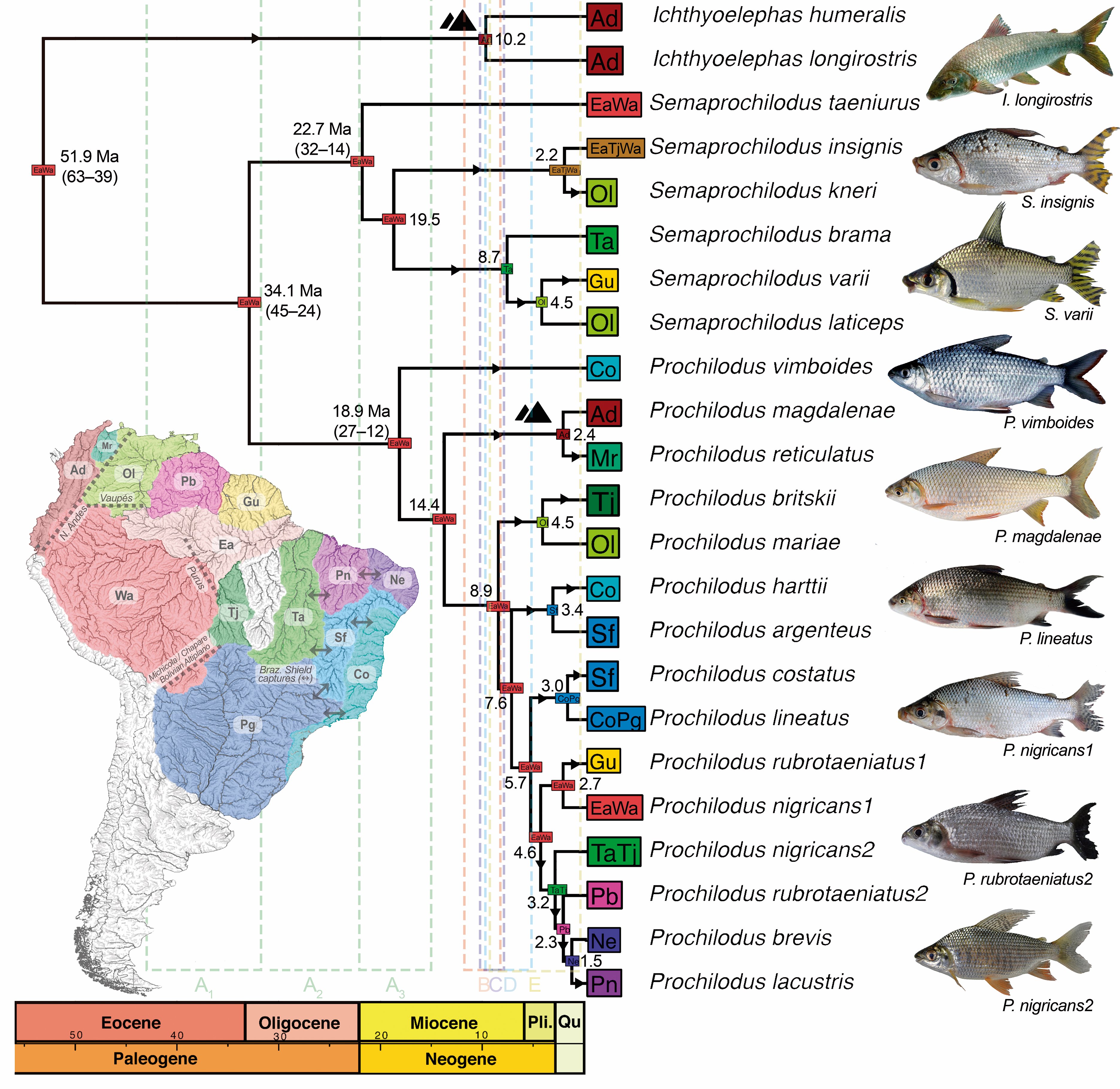
Time-calibrated phylogeny and ancestral range evolution of Prochilodontidae estimated by BEAST and BioGeoBEARS.

Photos by A. Nobile (Prochilodus lineatus), B. Melo (Semaprochilodus insignis, P. nigricans1, P. rubrotaeniatus2), J. García-Melo (Ichthyoelephas longirostris), M. Sabaj (S. varii, P. magdalenae, P. nigricans2) and R. Castro (P. vimboides).


Benjamin W. Frable, Bruno F. Melo, João P. Fontenelle, Claudio Oliveira and Brian L. Sidlauskas. 2022. Biogeographic Reconstruction of the Migratory Neotropical Fish Family Prochilodontidae (Teleostei: Characiformes). Zoologica Scripta. DOI: 10.1111/zsc.12531 


Tuesday, December 28, 2021

[Ichthyology • 2021] Schizodon trivittatus • Integrative Taxonomy reveals A New Species of Neotropical Headstanding Fish in Genus Schizodon (Characiformes: Anostomidae)


Schizodon trivittatus
Garavello, Ramirez, de Oliveira, Britski, Birindelli & Galetti, 2021


Abstract

Schizodon encompasses approximately 15 species of Neotropical headstanding fishes. Integrative taxonomy, combining molecular and morphometric analyses with traditional taxonomic methods, was used to investigate Schizodon vittatus and its potential new sister species. Molecular differences between the two species in the barcode are greater than intra-specific variation recovered in species of Schizodon, and the two species represent distinct lineages for approximately one million years. The two species are morphologically very similar, and the meristic data showed great overlap. Morphometric analyses also showed overlap among the putative species but indicated differences in caudal-peduncle depth, orbital diameter, and length of anal-fin rays. Color pattern seems to provide a clear diagnostic feature for the two species. Schizodon vittatus usually has four dark brown transversal bars on body, and its sister species has three conspicuous bars, with the fourth, if present, inconspicuous and dorsal to the lateral line. Schizodon vittatus is redescribed based on the type and recently collected specimens, its type locality is revisited, and its known distribution restricted to the Araguaia and Tocantins drainages. The new species, sister to S. vittatus, distributed in the Xingu and Tapajós drainages, is described. A key for the identification of the Amazon clade species of Schizodon is provided.

Keywords: Amazon; Identification key; Ostariophysi; Systematics; Taxonomy

Schizodon trivittatus, new species.
A. holotype, MZUSP 115362, 285.0 mm SL, Brazil, Mato Grosso, São José do Couto, Culuene river, Xingu River tributary;
 B–C. LIA uncatalogued, Xingu river at Altamira, Pará.
 Specimen A alcohol preserved, B–C photographed live 
Scale bars = 10 mm. 
(B, photo by José Birindelli; C, photo by Leandro Sousa).

Schizodon trivittatus, new species

Diagnosis. Schizodon trivittatus is distinguished from S. isognathus, S. jacuiensis, S. knerii, S. nasutus, S. platae, and S. scotorhabdotus, by having conspicuous dark transversal bars on the trunk formed by the epidermal and dermal pigment (vs. vertical bars absent or inconspicuous and formed exclusively by dermal pigment); from S. australis, S. borellii, S. corti, S. dissimilis, S. fasciatus, S. intermedius, by having a dark midlateral stripe on caudal peduncle (vs. caudal peduncle and base of median caudal-fin rays pale in S. borellii, S. dissimilis, S. intermedius, or a single rounded spot in S. australis, S. corti, S. fasciatus); and from S. vittatus by lacking a dark transversal bar ventral to the adipose fin or having an inconspicuous bar restricted to the region dorsal to the lateral line (vs. possessing a conspicuous dark transversal bar ventral to the adipose fin that extends ventral to the lateral line).

Geographical distribution. Schizodon trivittatus occurs widely in the Xingu and Tapajós drainages, including their tributaries, in Mato Grosso and Pará states, Brazil (Fig. 7).

Etymology. The name trivittatus is an adjective in allusion to the presence of three dark vertical bars on the trunk exhibited by the new species, its main diagnostic feature.
 
 
Júlio C. Garavello, Jorge L. Ramirez, Alexandre K. de Oliveira, Heraldo A. Britski, José L. O. Birindelli and Pedro M. Galetti Jr. 2021. Integrative Taxonomy reveals A New Species of Neotropical Headstanding Fish in Genus Schizodon (Characiformes: Anostomidae).  Neotrop. ichthyol. 19(4); DOI: 10.1590/1982-0224-2021-0016  
Resumo: Schizodon engloba aproximadamente 15 espécies de peixes neotropicais. A taxonomia integrativa, combinando análises moleculares e morfométricas com métodos taxonômicos tradicionais, foi utilizada para investigar Schizodon vittatus e sua potencial espécie irmã. As diferenças moleculares (DNA barcoding) entre as duas espécies são maiores do que a variação intraespecífica observada em espécies congêneres, e as duas espécies representam linhagens distintas por aproximadamente um milhão de anos. As duas espécies são morfologicamente muito similares e os dados merísticos mostram grande sobreposição. As análises morfométricas também mostraram sobreposição entre as duas espécies, mas indicaram diferenças na altura do pedúnculo caudal, no diâmetro interorbital, e no comprimento dos raios da nadadeira anal. O padrão de colorido parece fornecer uma característica diagnóstica clara para as duas espécies. Schizodon vittatus normalmente possui quatro faixas escuras transversais no corpo e sua espécie irmã tem três faixas, com a quarta, se presente, inconspícua e dorsal à linha lateral. Schizodon vittatus é redescrita com base no tipo e em espécimes coletados recentemente; sua localidade tipo é revisitada e a sua distribuição conhecida é restringida às drenagens do Araguaia e Tocantins. A nova espécie, irmã de S. vittatus e distribuída nas drenagens do Xingu e Tapajós, é descrita. Uma chave para a identificação das espécies do clado amazônico de Schizodon é apresentada.
Palavras-chave: Amazônia; Chave de identificação; Ostariophysi; Sistemática; Taxonomia

Sunday, July 12, 2020

[Ichthyology • 2020] Hypomasticus santanai • A New Species of Hypomasticus (Characiformes, Anostomidae) from Eastern Brazil Based on Morphological and Molecular Data


Hypomasticus santanai Birindelli & Melo

in Birindelli, Melo, Ribeiro-Silva, et al, 2020. 

Abstract
A new species of Hypomasticus is described from the Rio de Contas, a coastal drainage of eastern Brazil, and its phylogenetic position is proposed based on molecular data. The new species is diagnosed among Anostomidae by possessing a downturned mouth with compressed teeth arranged side by side, 37 or 38 lateral-line scales, three scale series between the dorsal-fin origin and the lateral line and between the lateral line and the pelvic-fin origin, and 12 scale rows around the caudal peduncle. Mitochondrial DNA sequences provide evidence that the new species is closely related to H. mormyrops, H. thayeri, H. copelandii, and H. steindachneri, a clade of species endemic to coastal drainages of eastern Brazil. These results combined with a previous phylogeny support the reallocation of the latter two species from Leporinus to Hypomasticus. The new species is herein considered to be Endangered under the IUCN criteria, due to a small Extent of Occurrence, severely fragmented population, and continued decline of area, extent, and quality of habitat.


Hypomasticus santanai, holotype, MZUEL 18604, 208.2 mm SL,
Brazil, Bahia, Rio Gongogi, tributary of Rio de Contas.

Hypomasticus santanai Birindelli and Melo, new species

Distribution.— Hypomasticus santanai is only known from the Rio Gongogi and so far endemic to the Rio de Contas basin, a coastal drainage in the eastern portion of the state of Bahia, Brazil (Fig. 3).

Etymology.— The new species is named in honor to Edson Santana, a technician at the MZUEL since 1993, for his help in collecting fishes, preparing vertebrate specimens, and maintaining the collections of the MZUEL. His enthusiasm captivated generations of staff and students of the MZUEL. In addition, Edson Santana was in the expedition that resulted in the discovery of H. santanai.

Fig. 4. Sample sites of Hypomasticus santanai.
(A) Rio Gongogi, tributary of Rio de Contas, approximately 2 km above city of Dario Meira, ...; (B) Rio Gongogi, tributary of Rio de Contas, at Zebrinha, ... All in Brazil, Bahia state.

Fig. 5. Maximum likelihood tree of Anostomidae showing the phylogenetic placement of Hypomasticus santanai. Bootstrap support is indicated by black (75-100%) and gray dots (50-75%); nodes with support lower than 50% have no dots. See Data Accessibility for tree file.

José L. O. Birindelli, Bruno F. Melo, Luís R. Ribeiro-Silva, Debora Diniz and Claudio Oliveira. 2020. A New Species of Hypomasticus from Eastern Brazil Based on Morphological and Molecular Data (Characiformes, Anostomidae). Copeia. 108(2); 416-425. DOI: 10.1643/CI-19-335  


Wednesday, July 3, 2019

[Ichthyology • 2019] Leporinus sidlauskasi • A New Species of Leporinus (Characiformes: Anostomidae) from the Rio Tapajós basin, Brazil


Leporinus sidlauskasi  
Britski & Birindelli, 2019


Abstract
A new species of Leporinus is described from the rio Teles Pires, rio Tapajós basin, Amazon basin, Brazil. The new species is diagnosed based on dental formula 3/4, a dark midlateral stripe on body and a series of transversal dark bars on the dorsum. The new species is similar to a handful of congeners based on the color pattern, including L. britski, L. microphysus, L. parvulus, and L. vanzoi, all of which also occur at the rio Tapajós basin. The new species is distinguished from the aforementioned congeners based on number of premaxillary teeth, number of scales in lateral line and/or around caudal peduncle. The new species is apparently endemic to the rio Teles Pires near the Sete Quedas rapids and upstream.

Keywords: Leporinus vanzoi, Taxonomy, Anostomoidea, Rio Teles Pires, Pisces


Leporinus sidlauskasi sp. nov. 


Heraldo A. Britski and José L. Birindelli. 2019. Description of A New Species of Leporinus (Characiformes: Anostomidae) from the Rio Tapajós basin, Brazil.  Zootaxa. 4603(1); 183–191. DOI: 10.11646/zootaxa.4603.1.10  

New fish discovered in Amazon basin named after Oregon State researcher today.OregonState.edu/news/new-fish-discovered-amazon-basin-named-after-oregon-state-researcher