Showing posts with label Hexapoda. Show all posts

Wednesday, April 29, 2026

[Invertebrate • 2025] Alloscopus sago & A. jantapasoae • Two New Species of the Genus Alloscopus Börner, 1906 (Collembola: Orchesellidae: Heteromurinae) from southern Thailand


Alloscopus sago Jantarit & Manee, sp. nov.  
   A. jantapasoae Jantarit, Nilsai & Manee, sp. nov.

in Jantarit, Manee, Nilsai, Mitpuangchon et Pimsai, 2025.

Abstract 
Two new species of Alloscopus Börner (Orchesellidae: Heteromurinae) are discovered and described from southern Thailand. The first species, Alloscopus sago Jantarit & Manee, sp. nov. was found in a sago palm forest (Metroxylon sagu Rottb.), a true sago palm species native to Southeast Asia and typically located in lowland freshwater swamps in Phatthalung Province. The second species, A. jantapasoae Jantarit, Nilsai & Manee, sp. nov. was sampled from a dark zone within a cave environment in Trang Province. Both species are characterized by the absence of eyes and mucronal spines, the presence of a PAO, two rows of smooth chaetae on the manubrium, and dental spines. However, they differ in several morphological features, including the number of macrochaetae on the ‘A’ series of the head, Th. II and Abd. IV; labial basis chaetotaxy; the presence of smooth chaetae on tibiotarsi; the number of chaetae on both the anterior and posterior ventral tube; and the number of the inter-teeth on the claw. The discovery of these two new species increases the total number of Alloscopus species recorded in Thailand to six species with a total of 17 recognized species globally. An updated key to the world species of Alloscopus is also provided.   

Key words: Cave, chaetotaxy, Entomobryoidea, sago palm, taxonomy


Alloscopus sago Jantarit & Manee, sp. nov.   
 A. jantapasoae Jantarit, Nilsai & Manee, sp. nov.


 Sopark Jantarit, Nongnapat Manee, Areeruk Nilsai, Natrada Mitpuangchon and Awatsaya Pimsai. 2025. Two New Species of the Genus Alloscopus Börner, 1906 (Collembola, Orchesellidae, Heteromurinae) from southern Thailand. ZooKeys. 1245: 357-381. DOI: doi.org/10.3897/zookeys.1245.148100 


Wednesday, March 11, 2026

[Invertebrate • 2026] Quapawjapyx osage & Holjapyx nimiipuu • New Cave japygids (Diplura: Japygidae) from North America


Quapawjapyx osage Sendra gen. et sp. nov.
Holjapyx nimiipuu Sendra sp. nov.,

in Sendra, Jiménez-Valverde, Selfa et Cupello, 2026. 

Abstract
We studied a significant collection of Japygidae (Diplura) deposited in the Texas A&M University Insect Collection, sampled from several caves in North America, mostly in the early 21st century by a group of American speleologists. Among this biological material, a new genus and species, Quapawjapyx osage Sendra gen. et sp. nov., is described from four caves in Arkansas, and a new species, Holjapyx nimiipuu Sendra sp. nov., from five caves in Idaho; both are named in honor of native American tribes. Quapawjapyx osage can be distinguished from IndjapyxPaurojapyx, and Parindjapyx – which share symmetrical cerci – by the combination of the shape and disposition of the glandular and sensory setae on the first urosternite, together with differences in cercal ornamentation. Holjapyx nimiipuu is characterized by the presence of two conspicuously large predental denticles on the right cercus. Both new taxa of cavernicolous japygids show slight cave-adaptation features, such as large body size, slight elongated appendages, and a small increase in the placoid sensilla of last antennomere. These two new taxa double the number of known cave-adapted japygids in North America, a seemingly low figure that is nonetheless comparable to other karst regions worldwide.

Keywords: Japygoidea, cave-adapted fauna, Nearctic region, taxonomy

Class Diplura Börner, 1904
Superfamily Japygoidea Ewing, 1942

Family Japygidae Haliday, 1864

Quapawjapyx osage Sendra gen. et sp. nov.
A. Paratype, ♂ (TAMU-ENTO X1831026). B, D–E. Paratype, ♂ (TAMU-ENTO X1832015). C. Holotype, ♀ (TAMU-ENTO X1831147).
A. Habitus. B. Last antennomere; placoid sensilla remarked by spotted line. C. Lacinia with interior laminae and mandible. D. Dorsal portion on third antennomere with pores. E. Metathoracic claws.

Genus Quapawjapyx Sendra gen. nov.

Etymology: The generic name is in honor of the Quapaw Nation of Native Americans, who thrived along the lowlands of the Arkansas river five hundred years ago. Today, they live alongside much later European settlersfrom other nations.

Quapawjapyx osage Sendra gen. et sp. nov.

Etymology: The specific epithet is in honor of the Osage Nation of Native Americans, who now reside in Osage County, Oklahoma. They arrived and thrived a few hundred years ago in the northern mountains of Arkansas.


Holjapyx nimiipuu Sendra sp. nov., holotype,  ♀ (TAMU-ENTO X1831140).
A. Habitus. B. Last antennomere. C. Distal portion of urite X including cerci. D. Left cercus. E. Right cercus; placoidsensilla remarked by dash line.

 Holjapyx nimiipuu Sendra sp. nov.

Etymology: Nimiipuu’ (‘we, the people’) is the name by which the Nez Perce Native American tribe refers to themselves. They have thrived in  the Pacific Northwest of North-America for  more than ten   thousand years and today live primarily on their tribal reservation in Idaho. We dedicate this new species to the Nimiipuu people and to their enduring struggle for survival.


Alberto Sendra, Alberto Jiménez-Valverde, Jesús Selfa and Mario Cupello. 2026. New Cave japygids (Diplura: Japygidae) from North America. European Journal of Taxonomy. 1043(1); 166–198. DOI: doi.org/10.5852/ejt.2026.1043.3217 
 

Monday, January 26, 2026

[Invertebrate • 2026] Alloscopus ramanai • A New Collembola Species (Orchesellidae: Heteromurinae) from central Thailand, with complete mitochondrial genome and phylogenetic placement


Alloscopus ramanai  Nilsai, Jantarit & Jaitrong, 

in Nilsai, Jantarit, Jeenthong, Detcharoen et Jaitrong, 2026.

Abstract
Background: Alloscopus is one of the genera within the subfamily Heteromurinae, recently recorded in Thailand and is currently represented by six species from two regions of the country. In the northern part, A. tetracanthus Börner, 1906 and A. thailandensis Mari Mutt, 1985 have been recorded from forested habitats. In the southern part, A. whitteni Jantarit & Sangsiri, 2020, A. namtip Jantarit & Sangsiri, 2020 and A. jantapasoae Jantarit, Nilsai & Manee, 2025 have been reported from a cave habitat, while A. sago Jantarit & Manee, 2025 was recently described from a sago palm forest.

New information: A new species, Alloscopus ramanai sp. nov., is described from central Thailand, based on an integrative taxonomic approach combining morphological and molecular data. The new species closely resembles A. tetracanthus Börner, 1906, sharing several diagnostic characters including a dark red ocular patch and PAO shape and the number of M and S series chaetae on the dorsal head. Additional similarities include the number of spiniform labral papillae, labial basis chaetae, the number of pseudopores on the manubrium, the number of central and lateral macrochaetae on Th.II, the number of central macrochaetae on Th.III and Abd.IV. However, A. ramanai sp. nov. can be clearly distinguished from A. tetracanthus by a unique combination of traits, including the number of lateral macrochaetae on Abd. III and Abd. IV and the number of chaetae on the anterior side of the ventral tube. A detailed diagnosis and illustrations of the new species are provided herein. A key for species of Alloscopus in Thailand is also included. The complete mitochondrial genome of A. ramanai sp. nov. is 14,757 bp in length and comprises 13 concatenated protein-coding genes (PCGs), 22 transfer RNA (tRNA) genes and two ribosomal RNA (rRNA) genes. Phylogenetic analysis, based on mitochondrial genome data, indicates that A. ramanai sp. nov. forms a sister lineage to Alloscopus bannaensis Zhang, 2020. The description of this new species contributes to a more comprehensive understanding of Heteromurinae diversity in Thailand and underscores the need for expanded mitogenomic sampling across Collembola.

Keywords: Entomobryoidea, mitogenome, new species, taxonomy, phylogeny

A Habitus of Alloscopus ramanai sp. nov. (SEM image, upper; wet specimen, lower). Scale bars = 0.5 mm;
B–C The type locality of the new species, a forest plantation of the Natural History Museum of the National Science Museum Thailand (THNHM);
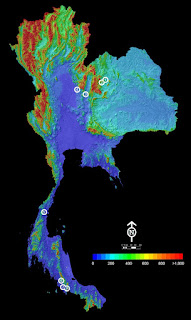
D The localities of Alloscopus recorded in Thailand. 1, A. tetracanthus Börner, 1906 and A. thailandensis Mari Mutt, 1985. 2, A. whitteni Jantarit & Sangsiri, 2020. 3, A. namtip Jantarit & Sangsiri, 2020. 4, A. jantapasoae Jantarit, Nilsai & Manee, 2025. 5, A. sago Jantarit & Manee, 2025.

Alloscopus ramanai Nilsai, Jantarit & Jaitrong, sp. nov.

Diagnosis: Alloscopus ramanai sp. nov. exhibits the morphological similarity to A. tetracanthus Börner 1906, a species reported from Australia, Indonesia, Malaysia, Singapore, Papua New Guinea, India, New Britain, Micronesia and Thailand (Chiang Mai Province). Both species share several morphological characters, including a dark red eye patch with reddish to dark dot pigmentation, a semi-divided PAO, labial basis M1(m)m2rel1l2, four spiniform labral papillae, 4–5 central and 4–5 posterior mac on Th. II, six central mac on Th. III, two central mac on Abd. IV, 0–2 inner unpaired ungual teeth, the presence of teeth on the unguiculus, smooth chaetae on the tibiotarsi, a similar number of chaetae on the manubrium and 4–7 spines on the dens. However, Alloscopus ramanai sp. nov. can be distinguished from A. tetracanthus by the absence of eyes (vs. 1+1), orange dot pigmentation (vs. lack of pigmentation) and the presence of five macrochaetae on the “A” series of the dorsal head chaetotaxy (vs. four). Furthermore, A. ramanai sp. nov. can ...

Etymology: The new species was collected in the vicinity of the Rama 9 Museum, part of the National Science Museum, Thailand, which serves as the locality. The specific epithet ramanai is derived from the name of the Museum and is used as a noun in apposition, honouring the institution.


 Areeruk Nilsai, Sopark Jantarit, Tadsanai Jeenthong, Matsapume Detcharoen and Weeyawat Jaitrong. 2026. Alloscopus ramanai sp. nov. (Orchesellidae, Heteromurinae), A New Collembola Species from central Thailand, with complete mitochondrial genome and phylogenetic placement. Biodiversity Data Journal. 14: e173157. DOI: doi.org/10.3897/BDJ.14.e173157

Thursday, November 27, 2025

[Invertebrate • 2025] Lepidonella sirindhornae • A New Collembola Species (Entomobryidae: Paronellinae) from Southern Thailand


Lepidonella sirindhornae Nilsai & Jantarit,

in Nilsai, Engchuan et Jantarit. 2025. 
 Tropical Natural History. Suppl. 8;  
แมลงหางดีดถ้ำเจ้าฟ้า  || https://li01.tci-thaijo.org/index.php/TNH 

Abstract
The genus Lepidonella is widely distributed across Southeast Asia, South Asia, Papua New Guinea, the Melanesian region, Australia, Africa, and the Americas. To date, only a single species of the genus has been formally recorded from Thailand. However, numerous undescribed species, particularly from southern Thailand, have been reported, indicating a greater diversity than currently recognized. This study presents the first formal description of a Lepidonella species from a cave habitat in the country. Lepidonella sirindhornae Nilsai & Jantarit, sp. nov. is described and illustrated from Tham Phraya Bangsa in Satun Province. The new species is distinguished from its congeners by a unique combination of morphological characters, including labial chaetotaxy formula (M1m2rEL1L2), elongation of antennal length (3.5–5.1 antenna: head ratio), presence of 6+6 eyes and a distinctive number of chaetae on both the anterior and posterior surfaces of the ventral tube. Additionally, this study provides a distribution map of the genus Lepidonella found in Thailand, underscoring the diversity of cave-dwelling species in the region and the need for further taxonomic investigation.

Keywords: cave, Entomobryoidea, Isthmus of Kra, new species, taxonomy


Lepidonella sirindhornae Nilsai & Jantarit, sp. nov.
แมลงหางดีดถ้ำเจ้าฟ้า
 from Tham Phraya Bangsa, Satun Province

Areeruk Nilsai, Ronnaphon Engchuan and Sopark Jantarit. 2025. The Lepidonella sirindhornae sp. nov., A New Collembola species from Southern Thailand.  Tropical Natural History. Suppl. 8;  449-459. 

Sunday, September 14, 2025

[Invertebrate • 2025] Salina aurantiamaculata & S. pseudomontana • Two New Species of Salina MacGillivray (Collembola: Entomobryidae), with Descriptive Notes on Two endemic Species from India


Salina aurantiamaculata  
 Salina pseudomontana
P. Mandal, G. P. Mandal & Kar, 2025
 
 
Abstract
Two new species of the genus Salina MacGillivray are herein described in detail. The bright orange color pattern of Salina aurantiamaculata sp. nov. and its chaetotaxy distinguish it from other species of the genus. Salina pseudomontana sp. nov. shares similarities with Salina (Salina) montana (Imms) and Salina (Salina) yosiii Salmon in color pattern, though the new species differs in chaetotaxy from the latter one. Two endemic species from India, Salina (Salina) quattuorfasciata (Handschin) and Salina (Salina) striata (Handschin) have their original descriptions improved, with additions to their morphology, especially their chaetotaxy. Finally, we also provide an identification key comprising the known species of Salina recorded from India.

Collembola, Chaetotaxy, epiedaphic Collembola, identification key, Entomobryomorpha, Salininae


Salina aurantiamaculata sp. nov. 
 Salina pseudomontana sp. nov.


Pritha MANDAL, Guru Pada MANDAL and Surajit KAR. 2025. Two New Species of Salina MacGillivray (Collembola: Entomobryidae), with Descriptive Notes on Two endemic Species from India. Zootaxa. 5679(3); 340-364. DOI: doi.org/10.11646/zootaxa.5679.3.2 [2025-08-14]
 https://indiasendangered.com/new-animal-and-plant-species-august-2025/

Tuesday, January 28, 2025

[Invertebrate • 2025] Coecobrya microphthalma • The Thermal Tolerance of Springtails in a Tropical Cave, with the Description of a New Coecobrya Species (Collembola: Entomobryidae) from Thailand


 Coecobrya microphthalma Manee & Jantarit,
 
in Manee, Deharveng, D’Haese, Nilsai, Shimano et Jantarit, 2025. 

Abstract
A new species of Collembola in the genus CoecobryaC. microphthalma sp. nov., is described from a cave environment in Saraburi province, central Thailand. The new species is the second described species of the boneti-group found in the country. It is most similar to C. chompon Nilsai, Lima & Jantarit, 2022, which is also described from a Thai cave. However, the new species is morphologically different from C. chompon in having orange dot pigmentation on its body and a combination of other morphological characteristics such as the number of sublobal hairs on the maxillary outer lobe and the number of medio-sublateral mac on Th. II, Abd. I, Abd. III and Abd. IV and the anterior face of the ventral tube. The morphological comparison of all known boneti species and a key to the world species of Coecobrya of the boneti-group are given. Coecobrya microphthalma sp. nov. was successfully cultured in the laboratory. The thermal tolerance of the new species was studied and tested with seven different temperature experiments (27 °C as a control, 30, 32, 33, 34, 35 and 36 °C). The results showed that C. microphthalma sp. nov. cannot survive at a temperature higher than 32 °C after exposure to the experimental heat for 7 and 14 consecutive days. At 27, 30 and 32 °C, C. microphthalma sp. nov. remained alive and produced eggs, but the duration of egg production and number of egg-laying days significantly declined when the temperature increased (p < 0.001). An interesting aspect of their reproduction concerns temperature. At 32 °C (5 °C above the control temperature), the F1 generation survived, was active and was able to molt to the adult stage. However, specimens were unable to produce the next generation of offspring. For postembryonic development, C. microphthalma sp. nov. required six molts to reach the adult stage. The development rate (from egg to adult) varied and differed significantly between the tested temperatures (p < 0.001). An increase in temperature from the control temperature significantly accelerated the developmental rate from egg to juvenile instars to adult with a statistical significance (p < 0.01). This study is the first attempt that provide information on the impact of increasing temperature on the population dynamics, reproductive capacity and life history of a subterranean tropical Collembola.

Keywords: breeding experiment; cave species; global warming; life history traits; thermal tolerance; taxonomy

 Coecobrya microphthalma sp. nov. 
(A) habitus under microscope; (B) habitus under SEM; (C) head and black eyepatch under slide; (D) head and eye (arrow) under SEM; (E) enlargement of eye under SEM.
Scale bar: (A,B)= 500 μm, (D) = 100 μm, (E) = 10 μm ((A,C): microscope images; (B,D,E): SEM images).

Taxonomy
Class Collembola Lubbock, 1870
Order Entomobryomorpha Börner, 1913

Family Entomobryidae Tömösváry, 1882
Subfamily Entomobryinae Schäffer, 1896

Genus Coecobrya Yosii, 1956

Coecobrya microphthalma sp. nov. Manee and Jantarit, 2025

Remarks. Coecobrya microphthalma sp. nov. belongs to the boneti-group characterized by the presence of eyes. The new species has 1+1 small eyes like six other species of the same group (C. boneti (Denis, 1948), C. sanmingensis Xu and Zhang, 2015, C. indonesiensis (Chen and Deharveng, 1997), C. tukmeas Zhang, Deharveng and Chen, 2009, C. oculata Zhang, Bedos and Deharveng, 2016 and C. chompon). Among Thai cave species, Coecobrya microphthalma sp. nov. is most similar to C. chompon in having relatively long antennae, labial chaetae as mrel1l2, presence of long smooth straight chaetae on antennae, 3 medio-medial mac on Th. II, 3 central mac on Abd. II, 1 central mac and ...

Etymology. Coecobrya microphthalma sp. nov. is derived from the Latin meaning “having small eyes”.


  Nongnapat Manee, Louis Deharveng, Cyrille A. D’Haese, Areeruk Nilsai, Satoshi Shimano and Sopark Jantarit. 2025. The Thermal Tolerance of Springtails in a Tropical Cave, with the Description of a New Coecobrya Species (Collembola: Entomobryidae) from Thailand. Insects. 16(1), 80. DOI: doi.org/10.3390/insects16010080  
(This article belongs to the Section Other Arthropods and General Topics)

Simple Summary: A new species of Collembola, Coecobrya microphthalma sp. nov., is described from a cave in Saraburi province, central Thailand. This species is the second boneti-group member found in the country. It closely resembles C. chompon Nilsai, Lima & Jantarit, 2022 but differs in having orange body dots and distinct morphological traits, such as the number of sublobal hairs and mac on various body segments. A comparison of all boneti-group species globally and a key to their identification are provided. Coecobrya microphthalma sp. nov. was cultured in the laboratory, and its thermal tolerance was tested at seven different temperatures (27 °C as control, 30, 32, 33, 34, 35, and 36 °C). The results showed that it cannot survive above 32 °C after 7 and 14 days of exposure. At 27, 30, and 32 °C, the species remained alive and produced eggs, though egg-laying duration and number of days decreased with higher temperatures. At 32 °C, the F1 generation survived and molted to adulthood, but no further offspring were produced. Development from egg to adult required six molts, with development rates increasing with higher temperatures. This study is the first attempt to examine how temperature affects the population dynamics, reproductive capacity, and life history of a subterranean tropical Collembola.

Tuesday, January 30, 2024

[Invertebrate • 2024] Alloscopus arborealis • A New canopy-dwelling Species of the Genus Alloscopus Börner (Collembola: Orchesellidae: Heteromurinae) from Mt. Makiling, Philippines


Alloscopus arborealis
Alviola, Lucañas, Lit,  Soto-Adames & Jantarit, 2024


Abstract
A new species of Alloscopus Börner, 1906 (Orchesellidae: Heteromurinae), A. arborealis sp. nov., is herein described from Mt. Makiling, Laguna, Philippines. The new species is distinct from its blind congeners by the combination of: 7+7 macrochaetae on head ‘An’ series and 1+1 on ‘M’ series; 13+13 macrochaetae on thorax II (vs. 9–12) and 7+7 central on thorax III (vs. 6+6); absence of the microsensilla on abdomen I; abdomen IV with four sensilla (vs. three); and ventral tube with a small number of chaetae on its posterior face (4–5 vs. 11–23) and lateral flap (7 vs. 9–16). The complete body chaetotaxic pattern of the new species and a revised key to the world fauna of Alloscopus are also provided.

Collembola, chaetotaxy, Luzon Island, springtails, taxonomy


Alloscopus arborealis sp. nov.


Marnelli S. Alviola, Cristian C. Lucañas, Ireneo L. Lit Jr.,  Felipe N. Soto-Adames and Sopark Jantarit. 2024. A New canopy-dwelling Species of the Genus Alloscopus Börner (Collembola: Orchesellidae: Heteromurinae) from Mt. Makiling, Philippines.  Zootaxa. 5405(2); 281-295. DOI: 10.11646/zootaxa.5405.2.8 
 facebook.com/AimeeLynn1804/posts/10233343588070095


Sunday, December 11, 2022

[Invertebrate • 2022] Coecobrya satasookae, C. cavicola & C. chompon • First Record of the boneti-Group of Coecobrya Yosii, 1956 (Collembola: Entomobryidae) from Thailand, with the Description of Three New Cave Species of the Genus


(A) Coecobrya satasookae sp. nov. from Chaiyaphum;  
(B) C. cavicola sp. nov. from Phrae; 
(C) C. chompon sp. nov. from Ratchaburi. 

Nilsai, Zeppelini, Bellini, Lima  & Jantarit, 2022 
 
Abstract
Thailand holds one of the most diverse faunas of the genus Coecobrya Yosii, 1956, with 22 species reported from the country so far. In this study three new species of Coecobrya are described from subterranean environments: C. satasookae sp. nov. from Chaiyaphum province, C. cavicola sp. nov. from Phrae province and C. chompon sp. nov. from Ratchaburi province. The first two species belong to the tenebricosa-group, as they lack eyes, while C. chompon sp. nov. has 1+1 eyes and fits the boneti-group. Coecobrya satasookae sp. nov. and C. cavicola sp. nov. can be distinguished from each other and its congeners by the combination of antennal length, clypeal, dorsal head and thoracic chaetotaxy, whereas C. chompon sp. nov. is most similar to C. boneti (Denis, 1948) from Vietnam. However, it differs from the latter taxa mostly by the proportion of the antennae, ventral and dorsal head, thoracic, fourth abdominal chaetotaxy, plus the shape of the tenent hairs. C. chompon sp. nov. is the first record and description of a Coecobrya species from the boneti-group in Thailand. We also discuss the ecological niches of troglomorphic Coecobrya species in Thailand and the status of the boneti-group.

Keywords: Collembola, chaetotaxy, Entomobryinae, eyeless springtails, subterranean environments, troglomorphy 


Areeruk Nilsai, Douglas Zeppelini, Bruno C. Bellini, Estevam C. A. Lima and Sopark Jantarit. 2022. First Record of the boneti-Group of Coecobrya Yosii, 1956 (Collembola: Entomobryidae) from Thailand, with the Description of Three New Cave Species of the Genus. Zootaxa. 5214(3); 365-392. DOI: 10.11646/zootaxa.5214.3.3 

Wednesday, December 15, 2021

[Invertebrate • 2021] Coecobrya troglobia, C. phitsanulokensis, et al. • Four New Species of Troglomorphic Coecobrya Yosii, 1956 (Collembola, Entomobryidae) from Thailand based on Morphological and Molecular Evidence, with An Updated Key of Thai Troglomorphic Species


Coecobrya whitteni Nilsai & Jantarit; C. troglobia Jantarit & Nilsai; 
C. ellisi Jantarit & Nilsai and C. phitsanulokensis Jantarit & Nilsai 
 
in Nilsai, Detcharoen, Godeiro & Jantarit, 2021

Abstract
Four new species of troglomorphic Coecobrya Yosii, 1956 are described from caves located in the central and northeastern regions of Thailand. Coecobrya whitteni sp. nov. and C. troglobia sp. nov. are from Khon Kaen province, C. ellisi sp. nov. is from Phetchabun province and C. phitsanulokensis sp. nov. is from Phitsanulok province. They all exhibit remarkable troglobitic characters i.e. elongated antennae, legs and furca, slender claw complex and large body size. Coecobrya whitteni sp. nov. is similar to C. troglobia sp. nov. and they were found a distance of only 3.4 km from each other. However, they are mainly different in the number of An mac on dorsal head and number of chaetae of Th. II. Likewise, C. ellisi sp. nov. is similar to C. phitsanulokensis sp. nov.. However, they differ in the number of An mac on the dorsal head, the number of central mac on Abd. II, central mac on Abd. IV, lateral mac on Abd. IV and the number of inner teeth of the claw. Moreover, C. ellisi sp. nov. has orange pigment dots on the body, a unique character, considering that all other troglomorphic Coecobrya species in Thailand are devoid of pigmentation. The results of the molecular approach based on two partial mitochondrial markers (COI and 16S rDNA) and a nuclear gene fragment (28S rDNA) supported the results of morphological species discrimination in separating the four nominal populations as valid species. An updated dichotomous key of Thai troglomorphic Coecobrya species is also given.

Keywords: DNA barcoding, Entomobryinae, molecular phylogeny, subterranean habitat, troglomorphy


The distribution map of the troglomorphic Coecobrya in Thailand and the habitus of the four new species.
(1) A Coecobrya whitteni sp. nov. (2) B C. troglobia sp. nov.
(3) C C. ellisi sp. nov. (4) D C. phitsanulokensis sp. nov.
(5) C. chumphonensis Zhang & Nilsai, 2017 (6) C. sirindhornae Jantarit, Satasook & Deharveng, 2019
(7) C. polychaeta Zhang & Nilsai, 2017 and (8) C. cavicta Nilsai & Zhang, 2017.
Scale bar: 1 mm.

Class Collembola Lubbock, 1873
Order Entomobryomorpha Börner, 1913

Family Entomobryidae Schäffer, 1896 sensu Zhang et al, 2019
Subfamily Entomobryinae Schäffer, 1896 sensu Zhang and Deharveng 2015

Genus Coecobrya Yosii, 1956


 Coecobrya whitteni Nilsai & Jantarit, sp. nov.

Etymology: Coecobrya whitteni sp. nov. is named in honor of the late Tony Whitten in appreciation of his enormous contributions to the discovery and conservation of karst and cave invertebrates across Asia.


 Coecobrya troglobia Jantarit & Nilsai, sp. nov.

Ecology: Coecobrya troglobia sp. nov. is restricted to the dark zone of the cave, where it was found in two chambers in an oligotrophic environment. Most individuals were found on the floor, on stalagmites and on the rock walls. The temperature in the dark zone was 21.4–23 °C and the relative humidity was about 75 %.

Etymology: The name of the new species is derived from the Greek stem “trogle (τρώγλη)” which means “hole”, referring to the habitat of this new species which is restricted to the subterranean environment.


 Coecobrya ellisi Jantarit & Nilsai, sp. nov.

Etymology: This species is named in honor of Martin Ellis, a British speleologist who played a role in the Tham Luang cave rescue in Thailand (in 2018), and for his outstanding contribution to the study of cave fauna in Thailand. Our biological surveys have benefited tremendously from his support, including the discovery of this new species.


 Coecobrya phitsanulokensis Jantarit & Nilsai, sp. nov.

Etymology This species is named after the type locality, Phitsanulok province, where the material was collected.


 Areeruk Nilsai, Matsapume Detcharoen, Nerivania Nunes Godeiro and Sopark Jantarit. 2021. Four New Species of Troglomorphic Coecobrya Yosii, 1956 (Collembola, Entomobryidae) from Thailand based on Morphological and Molecular Evidence, with An Updated Key of Thai Troglomorphic Species. Subterranean Biology. 41: 1-42. DOI: 10.3897/subtbiol.41.76926


Friday, July 24, 2020

[Invertebrate • 2020] Borgesminthurinus andinus • A New Genus and Species of Katiannidae (Collembola: Symphypleona) from Bolivia


Borgesminthurinus andinus
Palacios-Vargas Vacaflores-Argandoña, 2020. 


Abstract
The new genus Borgesminthurinus gen. nov. from Bolivia shares with Sminthurinus the presence of antennal segment IV undivided, antennal segment III with one papilla; sacs of ventral tube smooth; each tenacular rami with 3 teeth and a basal appendix. They also have dens with ventral chaetotaxy reduced and lack mucronal seta; but new genus clearly differs in having thick and barbulate setae on head and body, lacking neosminthuroid setae on abdomen and the presence of seta a0 on Abd. VI acuminate. The new genus differs from Katianna which has divided antennal segment IV, vertex of head with spine-like setae and setae of the body long and smooth.

Keywords: Systematics, Neotropical species, La Paz, Collembola


Borgesminthurinus andinus sp. nov.: habitus.

Systematics
Order Symphyleona Börner, 1901
Superfamily Katiannoidea Bretfeld, 1994
Family Katiannidae Börner, 1913

Borgesminthurinus gen. nov. Palacios-Vargas

Diagnosis. Body globular, characterized by having thick, relatively long and slightly barbulate setae, very abundant on head and body; with full set of trichobothria present; A, B, C in a triangle on great abdomen and one pair of trichobothria on lesser abdomen (D); no neosminthuroid setae. Setae in large abdomen are thick but short. in singlets. Normal chewing mouth parts. Ant. IV undivided and longer than Ant. III; Ant. III with papilla divided in lobes. Tibiotarsi with 7 tenent hairs on distal whorl; unguis with pseudonychia and no tunica. Sacs of ventral tube smooth; tenacular rami with 3 teeth and basal appendix, corpus tenaculum with 2 setae. Metathoracic legs with trochanteral organ. Dens with ventral chaetotaxy reduced (formula 4, 2 … 1); mucro small, without seta, internal edge crenulate, external smooth. Seta a0 of Abdominal segment VI of females no furcate and no winged setae on lateral anal valves; subanal appendix of female palmate.

Type species. Borgesminthururinus andinus gen. nov. sp. nov.

Etymology. The new genus is dedicated to Jorge Luis Borges (Buenos Aires, August 24, 1899‒‒Geneva, Switzerland, June 14, 1986), the Argentinean writer, author of the Manual of Fantastic Zoology, which included spherical animals as Symphypleona are

Borgesminthurinus andinus gen. nov., sp. nov. Palacios-Vargas et Vacaflores-Argandoña

Derivatio nominis: The name of the new species is locative, for Los Andes.  


José G. Palacios-Vargas and Ma. René Vacaflores-Argandoña. 2020. A New Genus and Species of Katiannidae (Collembola: Symphypleona) from Bolivia.  Zootaxa. 4819(2); 201–215.  DOI: 10.11646/zootaxa.4819.2.1

Wednesday, April 15, 2020

[Invertebrate • 2020] Whittencampa troglobia • A New Genus and Species of Troglomorphic Plusiocampinae (Diplura: Campodeidae) from China


Whittencampa troglobia 
 Sendra & Deharveng, 2020

  RAFFLES BULLETIN OF ZOOLOGY. Supplement No. 35

Abstract
 Whittencampa troglobia, new genus and new species, is a highly troglomorphic Diplura of the Plusiocampinae subfamily described from Lian Hua Dong Cave in southern China. Whittencampa belongs to the Plusiocampinae subfamily, which is widely distributed in the European region, but also has four species in China. Whittencampa is characterised by its thick setiform pretarsal processes completely covered with long barbs with a tiny hooked tip. Whittencampa shares important features with other members of the subfamily, in particular the distribution pattern of notal, femoral and abdominal macrosetae, including the presence of an isolated pair of macrosetae on the eighth urosternite; the last trait characterises the Chinese Plusiocampinae. Scanning electron microscopy reveals new features for this subfamily such as the large subtriangular ending of the neuroglandular setae on the labial palps, the epidermal glands on the labial palps and the bifurcated or double sac ending of the eversible abdominal vesicles. Whittencampa troglobia has remarkable troglomorphic traits: the most elongated antennae, and the largest number of antennomeres (56) among Plusiocampinae, and cerci up to 2.3 times longer than the body. It lives with other highly troglomorphic arthropods at the type locality, Lian Hua Dong, and provides additional evidence that southern China is one of the major biodiversity world hotspots for subterranean fauna.

Key words: subterranean fauna, East Asia, Whittencampa troglobia, troglomorphy

Figs. 21–24. 21. Habitus of Whittencampa troglobia, new species. 22, Distribution map of troglomorphic cave Campodeidae in China: (1) Whittencampa troglobia, Lian Hua Dong near Du’an (Guangxi); (2) Plusiocampa lipsae, Grotte des Quatre Porches near Yishang (Hubei); (3) Whittencampa cf. troglobia, Ji Dong near Huanjiang (Guangxi); (4) Campodeidae sp., Yan Wu Dong near Leye (Guangxi). 23, Microhabitat of Wtroglobia in Lian Hua Dong cave, with specimens around small pools (in white dotted circles). 24, Well decorated passage in Lian Hua Dong cave.

Fig. 1. Whittencampa troglobia, new species; habitus. Scale bar = 3 mm.

SYSTEMATICS 
Class Hexapoda Blainville, 1816

Order Diplura Börner, 1904
Suborder Rhabdura Cook, 1896

Family Campodeidae Lubbock, 1873
Subfamily Plusiocampinae Paclt, 1957

Whittencampa, new genus 

Type species. Whittencampa troglobia, new species.

Etymology. Whittencampa is named in honour of Tony Whitten, who passed away in November 2017. Tony was an enthusiastic initiator and efficient facilitator of biospeological expeditions in China, which allowed the discovery of this new genus, among many other remarkable taxa. Gender: feminine.

Diagnosis. On pronotum 1+1 ma, 1+1 la4 and 2+2 lp1,3, on meso- and metanotum 1+1 ma, 1+1 la, and 2+2 lp2,3 (Figs. 1–3); two dorsal femoral macrosetae; without tibial macrosetae; unequal claws with lateral-crests (Figs. 12, 13); two thick setiform pretarsal processes completely covered with long barbs (Figs. 12, 13, 15); male and female without glandular field on the posterior part of the first urosternite; first urosternite of male with large subcylindrical appendages with conical ending and carrying long glandular a1 and a2 setae (Figs. 16, 17); female with small subcylindrical appendages with concal ending on first urosternite, with long glandular a1 setae; sac of eversible vesicles with double ending (Figs. 18, 19); 1+1 post urotergal macrosetae on III– IV, 4+4 post on V–VII, 5+5 post on VIII and 7+7 post on IX; 13+13–10+10 macrosetae on urosternite I, 5+5 on II– VII and 1+1 macrosetae on VIII (Fig. 20); large subtriangular ending of neuroglandular setae and epidermal glands on labial palps (Figs. 5–10, under SEM magnification); dense barbs on macrosetae on abdominal sternites, legs and calcars (Fig. 11); glandular a1 and a2 setae long and slender (Fig. 17).

Whittencampa troglobia, new species 

Etymology. The epithet emphasises the ecology of the new species, strictly linked to subterranean habitats (from the greek trogle (τρωγλη), which means hole.


 Alberto Sendra and Louis Deharveng. 2020. Whittencampa troglobia, A New Genus and Species of Troglomorphic Plusiocampinae from China (Diplura: Campodeidae). RAFFLES BULLETIN OF ZOOLOGY. Supplement No. 35; 68-77.


Wednesday, April 1, 2020

[Invertebrate • 2020] Alloscopus whitteni & A. namtip • Two New Species of Alloscopus (Hexapoda: Collembola) from Caves in Thailand, with A Key to World Species of the Genus


Alloscopus whitteni
Jantarit & Sangsiri, 2020

RAFFLES BULLETIN OF ZOOLOGY. Supplement No. 35.

Abstract
 Two new cave species of the Collembola genus Alloscopus are described from southern Thailand: A. whitteni from Phang Nga province and A. namtip from Surat Thani province. Both species are characterised by the absence of eyes and mucronal spine, presence of PAO, two rows of smooth chaetae on manubrium and dental spines. The two new species are different by number of macrochaetae on ‘A’ series of head and Th.II, labial basis chaetotaxy, number of labral papillae, number of chaetae on posterior ventral tube, inter teeth of claw and trochanteral spines. They also differ in rows of smooth chaetae on tibiotarsus and lateral anal valve chaetae. Antennal morphological types were thoroughly observed for the first time in the genus, of which 13 types are recognised and homologised with recent antennal chaetal categories for Verhoeffiella. The complete body chaetotaxic pattern and a key to the world species of the genus are also provided.

Key words: antennal chaetotaxy, Heteromurinae, subterranean, taxonomy, southern Thailand

Fig. 1. Alloscopus whitteni, new species.
Habitus in alcohol with orange dot pigment variation in the population.

Family Entomobryidae Schäffer, 1896
Subfamily Heteromurinae sensu Zhang & Deharveng, 2015
Tribus Heteromurini Absolon & Ksenemann, 1942

Alloscopus Börner, 1906

Alloscopus whitteni, new species

Etymology. Alloscopus whitteni pays special tribute to Tony Whitten in appreciation for his enormous contributions to nature conservation, especially in threatened karstic areas and cave fauna.

Habitat. The individuals were found in soil and on the small patch of bat guano in dark zone of cave near the stream bank.


Alloscopus namtip, new species

Etymology. Alloscopus namtip is named for the type locality [Tham (cave) Namtip, Thachana, Surat Thani Province.] and is used as a noun in apposition.

Habitat. This species was found on ground floor with small patch of bat guano in the twilight to dark zone of the cave.


Sopark Jantarit and Tawin Sangsiri. 2020. Two New Species of Alloscopus from Caves in Thailand, with A Key to World Species of the Genus (Hexapoda: Collembola). RAFFLES BULLETIN OF ZOOLOGY. Supplement No. 35; 48-60.