Showing posts with label Hynobiidae. Show all posts

Friday, May 26, 2023

[Herpetology • 2023] Hynobius bambusicolus • An Isolated and Deeply Divergent Hynobius Species (Caudata: Hynobiidae) from Fujian, China


Hynobius bambusicolus  Wang, Othman, Qiu & Borzée, 

in Wang, Othman, Qiu, Lu, Prasad, Dong, Lu et Borzée, 2023.
虚竹小鲵  ||  DOI: 10.3390/ani13101661 

Abstract
It is important to describe lineages before they go extinct, as we can only protect what we know. This is especially important in the case of microendemic species likely to be relict populations, such as Hynobius salamanders in southern China. Here, we unexpectedly sampled Hynobius individuals in Fujian province, China, and then worked on determining their taxonomic status. We describe Hynobius bambusicolus sp. nov. based on molecular and morphological data. The lineage is deeply divergent and clusters with the other southern Chinese Hynobius species based on the concatenated mtDNA gene fragments (>1500 bp), being the sister group to H. amjiensis based on the COI gene fragment, despite their geographic distance. In terms of morphology, the species can be identified through discrete characters enabling identification in the field by eye, an unusual convenience in Hynobius species. In addition, we noted some interesting life history traits in the species, such as vocalization and cannibalism. The species is likely to be incredibly rare, over a massively restricted distribution, fitting the definition of Critically Endangered following several lines of criteria and categories of the IUCN Red List of Threatened Species.

Keywords: Hynobidae; species description; bamboo forest

Natural habitat and oviposition site for Hynobius bambusicolus sp. nov.
The site is in Quxi village, Liancheng county, People’s Republic of China.

Hynobius bambusicolus sp. nov. Wang, Othman, Qiu and Borzée

Identity, diagnosis, and distribution:  To date, the species is known from its type locality only, Quxi village, Liancheng county (Figure 5). Larvae are typical of Hynobius larvae in shape and color and do not differ from other Hynobius species in the region in their development (Figure 10). The embryos develop in egg sacs (Figure 10A), larvae first swimming freely with balancers (Figure 10B; shown at day 16), then develop non-functional hind limbs (Figure 10C; shown at day 69), which slowly become functional (Figure 10D,E; shown at day 74 and 77), and the gills regress before metamorphosis (Figure 10F; shown at day 84). Juveniles are brown, darkening with age, with a large variation in blue speckles on their dorsum, which disappears as they age (Figure 9). Adults of the species are uniform dark chocolate, with light grey and bluish speckles on the venter (Figure 11). Identification is best assessed based on location, although discrete morphological characters include the combination of 10 or fewer costal grooves with a total length > 180 mm (Figure 6). To facilitate the identification and further study, the OBJ file of this model can be downloaded (Supplementary File S1). The visual representation of the model is provided in Appendix A (Figure A1).

Etymology: The species was first found in Quxi village, Liancheng county, in the west of Fujian province in China. The name H. bambusicolus sp. nov. comes from the habitat of the holotype and the only known habitat type for the species: bamboo forests
The vernacular name of the species, Fujian Bamboo Salamander, reflects the scientific name of the species, as does its Chinese name: 虚竹小鲵 (pronounced: Xū Zhú Xiǎo Ní). This salamander is named after a main character from Jin Yong’s swordsman fiction “The semi gods and semi devils”, with Xuzhu (虚竹) as the main character and where “虚” [xū] means humble, and “竹” [zhú] means bamboo. This character, Xuzhu, was an unknown Shaolin monk, but he inherited the powers of the leader of the Carefree by coincidence and started its legendary journey.
กิมย้ง: แปดเทพอสูรมังกรฟ้า - 天龙八部 - Semi-Gods and Semi-Devils 
(พ.ศ. 2506-2509)

 
 Zhenqi Wang, Siti N. Othman, Zhixin Qiu, Yiqiu Lu, Vishal Kumar Prasad, Yuran Dong, Chang-Hu Lu and Amaël Borzée. 2023. An Isolated and Deeply Divergent Hynobius Species from Fujian, China. Animals. 13(10); 1661. DOI: 10.3390/ani13101661
(This article belongs to the Special Issue Salamanders: Distribution, Diversity, and Conservation)
 
New salamander species from Southern China! 中国南方小鲵新种
 
Simple Summary: What does not have a name is difficult to understand and protect. Upon the unexpected discovery of an Hynobius salamander in Fujian province, China, we worked on understanding its relationship with other species and ultimately describing it. Please welcome the Fujian Bamboo Salamander to science, a segregated species based on genetics and morphology. While it is related to other southern mainland Chinese species, it may have diverged earlier and share some similarities with morphology and behavior with the Anji salamander. The Fujian Bamboo Salamander is special as it produces vocalization when under threat. The species is, however, incredibly rare, fitting the definition of Critically Endangered in the IUCN Red List of Threatened Species.

Sunday, August 28, 2022

[Herpetology • 2022] Hynobius oni • A New Species of Lotic Breeding Salamander (Caudata: Hynobiidae) from Shikoku, Japan


Hynobius oni 
Kanamori​, Nishikawa, Matsui & Tanabe, 2022


Abstract
 
Background: Hynobius hirosei is a lotic-breeding salamander endemic to Shikoku Island in western Japan. Significant allozymic and morphological differences have been found among the populations of this species; however, the degree and pattern of intraspecific variation have not been surveyed using a sufficient number of samples.

Methods: For the taxonomic revision of H. hirosei, we conducted genetic and morphological surveys using samples collected throughout the distribution. Phylogenetic analysis using the cytochrome b region of mitochondrial DNA and population structure analysis using single nucleotide polymorphisms were conducted to evaluate the population structure within the species and the degree of genetic differentiation. Subsequently, a morphological survey based on multivariate and univariate analyses was performed to assess the morphological variation.

Results: Genetic analyses revealed three genetic groups (Tsurugi, Central, and Nanyo) within H. hirosei, with the Nanyo group distributed allopatrically from the others, and the Tsurugi and Central groups distributed parapatrically with the formation of a hybrid zone between them. The Nanyo group was morphologically distinguishable from the remaining samples, including the topotype of H. hirosei, based on a smaller body size and several ratio values of characters to snout-vent length, longer axilla-groin distance, shorter tail length, shorter internarial distance, longer upper eyelid length, and larger medial tail width. These results support the notion that the Nanyo group is an undescribed species. However, the remaining genetically differentiated groups could not be divided in the present study. Herein, we described the Nanyo group as a new species.
 

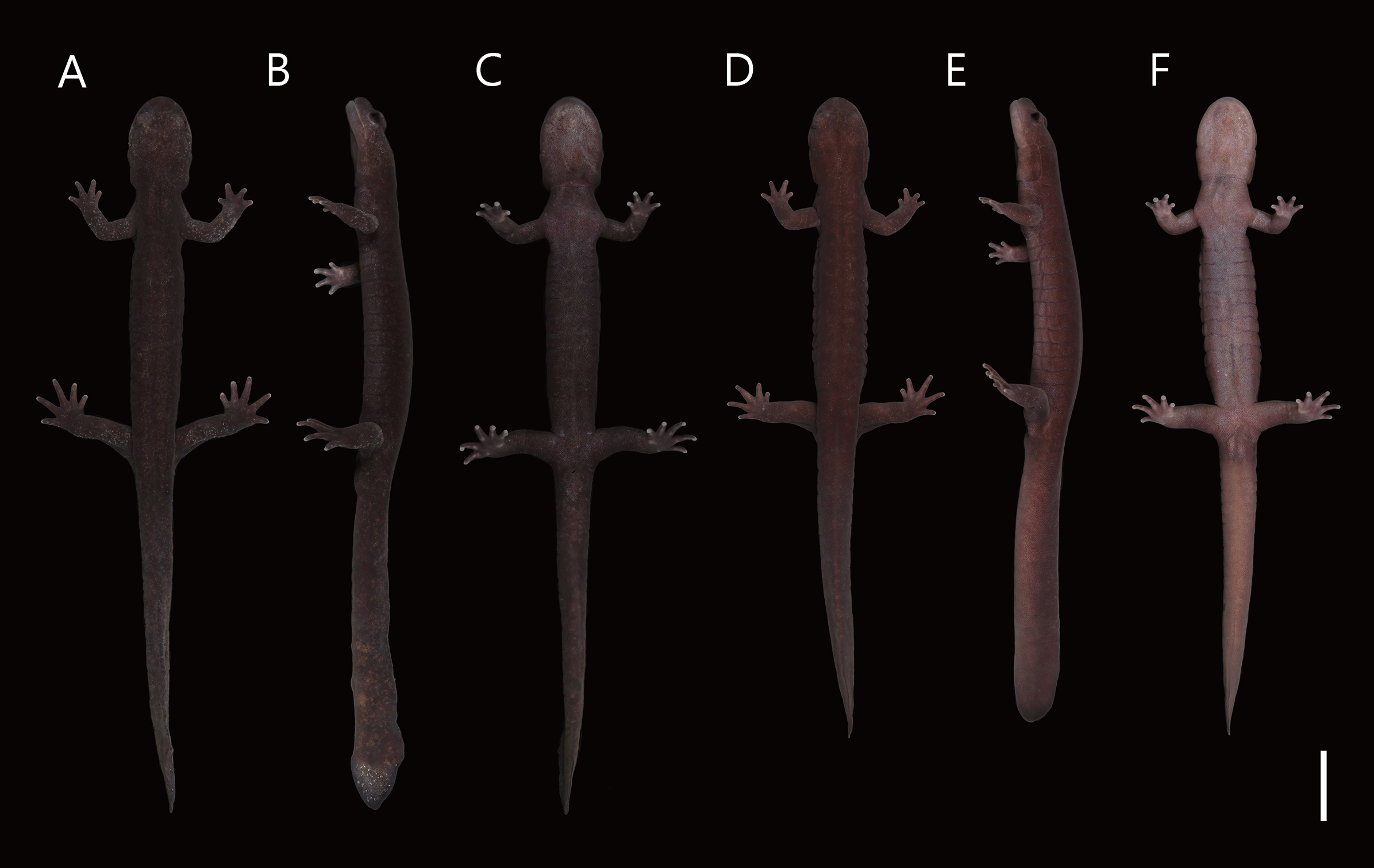
 Live male topotype of Hynobius hirosei (KUHE 62827; A–C)
and male holotype of Hynobius oni (KUHE 62785; D–F).
(A, D) Dorsal views. (B, E) Lateral views. (C, F) Ventral views.
Scale bar shows 20 mm.


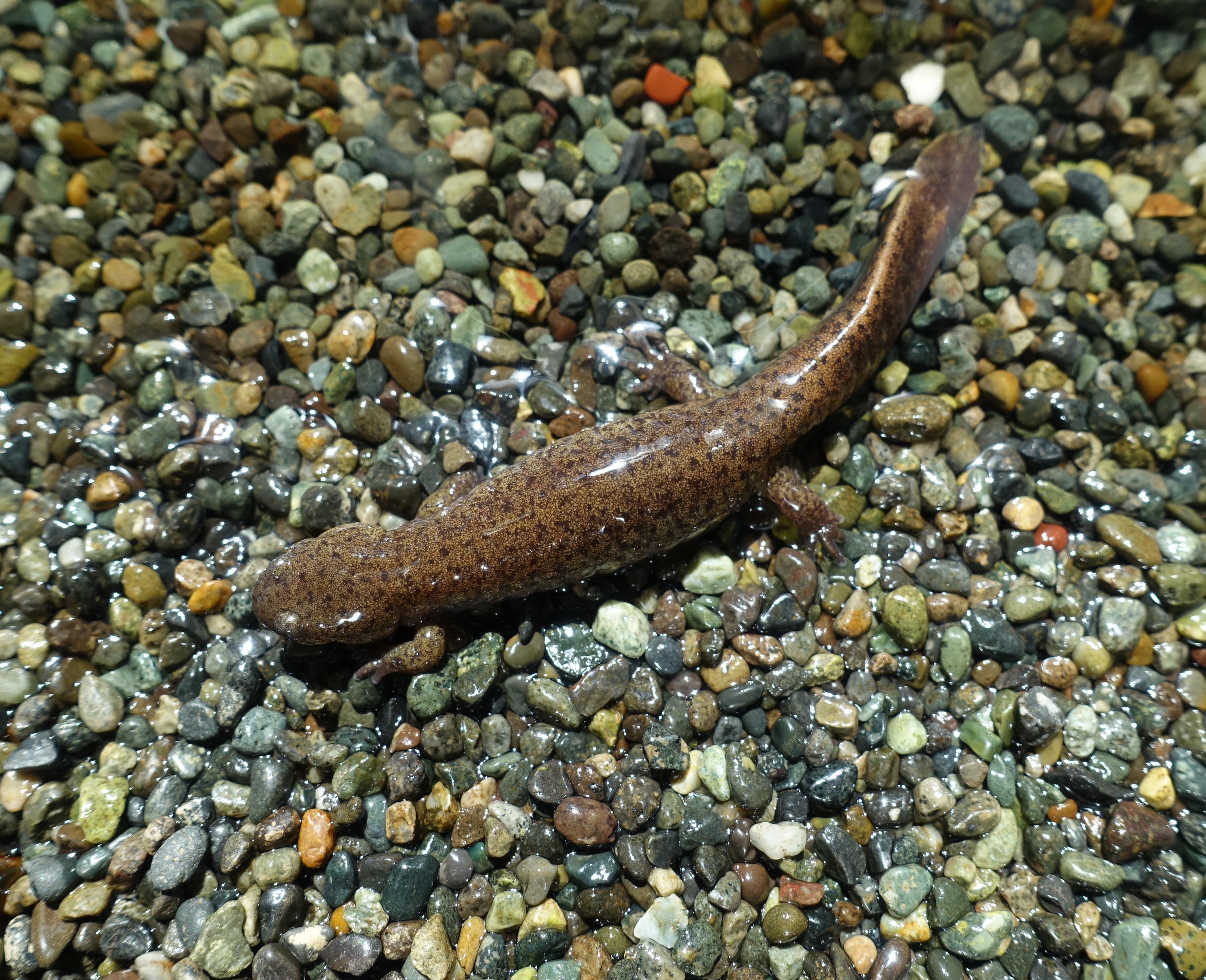
Figure 5: Live individual (KUHE 61096) of Hynobius oni.

Hynobius oni sp. nov.
(Japanese name: Nan-yo-sanshouo)

Diagnosis: A large-sized species (adult SVL 73.6–87.5 mm in males) of the lotic-breeding Hynobius, breeding in montane streams; dorsum uniformly dark reddish brown and immaculate in adult; tips of fore- and hindlimbs adpressed on body scarcely meeting (overlap of −2.0 to 0.0 costal folds in males); fifth toe well developed; ova large, pigmentless; egg sacs relatively long and crescent in shape, with distinct whiptail structure on free end; larvae lack claws on their tips of fingers and toes; most similar to H. hirosei, but distinct based on its smaller body size, longer axilla-groin distance, shorter tail length, shorter internarial distance, longer upper eyelid length, and larger medial tail width. Hynobius oni is genetically closer to H. sematonotos than H. hirosei based on mtDNA; however, H. oni has no large markings on the body, in contrast to many silvery spots on H. sematonotos, and a larger SVL than H. sematonotos.

 Habitat of Hynobius oni in the type locality.

Etymology: The specific name is derived from the “Oni” in Japanese, which is a traditional Japanese demon. The habitats of the new species are areas where prior generations believed that the Oni and Ushi-oni, which is a type of Oni, occurred. The type locality is located in the Oni-ga-jo Mountains, which is considered to be the castle of the Oni.

Conclusions: 
In the present study, the actual genetic population structure and degree of genetic divergence within Hynobius hirosei, which has been reported to have large genetic intraspecies divergence, were evaluated using mtDNA and nuDNA markers (SNP). Phylogenetic analysis using mtDNA revealed three divergent lineages, including the Tsurugi, Central, and Nanyo groups (genetic distance: 6.9–10.3% in cyt b). Further, STRUCTURE analysis using SNP revealed that the Nanyo group is genetically isolated from the other groups and the Tsurugi and Central groups form hybrid zones. Morphological analyses also revealed that the Nanyo is distinct from the other groups. Collectively, these results strongly indicate that Nanyo group is a distinct species, and is referred to as H. oni sp. nov. in this study.

  
Sally Kanamori​, Kanto Nishikawa, Masafumi Matsui and Shingo Tanabe. 2022. A New Species of Lotic Breeding Salamander (Amphibia, Caudata, Hynobiidae) from Shikoku, Japan. PeerJ. 10:e13891. DOI: 10.7717/peerj.13891

Monday, August 8, 2022

[Herpetology • 2022] Onychodactylus sillanus Dwindling in the Mountains: Description of A Critically Endangered and Microendemic Onychodactylus Species (Amphibia: Hynobiidae) from the Korean Peninsula


Onychodactylus sillanus Min, Borzée, & Poyarkov, 

in Borzée, Shin, Poyarkov, Jeon, ... et Min, 2022. 

Species that are not formally described are generally not targets for conservation, regardless of their threatened status. While habitat degradation has increased over the past several decades in the Republic of Korea, taxonomic and conservation efforts continue to lag. For instance, a clade of Onychodactylus clawed salamanders from the extreme southeastern tip of the Korean Peninsula, which diverged ca. 6.82 million years ago from its sister species O. koreanus, is under intense anthropogenic pressure due to its extremely restricted range, despite its candidate species status. Here, using genetics, morphometrics, and landscape modeling, we confirmed the species status of the southeast Korean Onychodactylus population, and formally described it as Onychodactylus sillanus sp. nov. We also determined threats, habitat loss, and risk of extinction based on climatic models under different Representative Concentration Pathways (RCPs) and following the IUCN Red List categories and criteria. Based on several climate change scenarios, we estimated a decline in suitable habitat between 87.6% and 97.3% within the next three generations, sufficient to be considered Critically Endangered according to Category A3 of the IUCN Red List of Threatened Species. These findings should help enable the development of conservation programs and civic activities to protect the population. Conservation action plans are a priority to coordinate the activities required to protect this species.
Onychodactylus sillanus Republic of Korea, in life.
A: adult male from North Gyeongsang Province, Yangsan-si;
B: subadult paratype (CGRB 15907) from North Gyeongsang Province, Unmun Mountain.

  Paratype of Onychodactylus sillanus sp. nov. (CGRB 15907, subadult) from North Gyeongsang Province, Unmun Mountain, Republic of Korea, in life.
 A: Dorsal view; B: Ventral view; C: Head, dorsal view; D: Head, ventral view; E: Head, lateral view; F: Volar view of left hand; G: Plantar view of left foot; H: Ventral view of cloacal area.
 Photos by Nikolay A. Poyarkov.


Range, suitable habitat, and phylogenetic relationships of Onychodactylus sillanus sp. nov.
A: Georeferenced occurrence points of Onychodactylus koreanus and Onychodactylus sillanus sp. nov. Collected occurrence points are based on our survey data as well as the Global Biodiversity Information Facility (GBIF), VertNet, EcoBank platform, and voucher specimens deposited in the Ewha Woman’s University Natural History Museum (EWNHM). Genetic samples and specimens originate from a selection of sites, and all datapoints were used to generate ecological niche models after spatial distance thinning. The same general data collection methodology and resulting occurrence dataset for O. koreanus are provided in Shin et al. (2021). B: Estimated area of Onychodactylus sillanus sp. nov. presence based on Minimum Convex Polygon (MCP) and binary presence area of Maxent output. Note: Maxent binary output (792.7 km2) estimated significantly broader area of presence than MCP (258.3 km2). Maxent output largely fell within higher elevation area of South Gyeongsang Province. Map generated in QGIS v3.10. *: Maxent ranges are binary encoded for presence and absence based on the threshold determined in the Supplementary Materials. C: Maximum-likelihood consensus tree of the genus Onychodactylus derived from analysis of 1 153 bp cyt b, 654 bp COI, and 532 bp 16S rRNA gene fragments. Corresponding voucher specimen information, locality data, and GenBank accession numbers are given in Supplementary Table S3. Black circles indicate strongly supported nodes, empty circles indicate nodes with moderate support levels, no circles correspond to no node support. Numbers at tree nodes correspond to ML ultrafast-bootstrap (UFBS)/BI posterior probability (PP) support values. D, E:
Onychodactylus sillanus sp. nov. in life: adult male from North Gyeongsang Province, Yangsan-si, Republic of Korea (D); larva from South Gyeongsang Province, Yangsan-si, Dong-myeon, Republic of Korea (E). F: Natural habitat of species in North Gyeongsang Province, Yangsan-si, Dong-myeon, Republic of Korea.
 Photos by Amaël Borzée (D) and Nikolay A. Poyarkov (E, F).


Onychodactylus sillanus sp. nov.
Onychodactylus sillanus sp. nov. in life: adult male from North Gyeongsang Province, Yangsan-si, Republic of Korea (D);
 larva from South Gyeongsang Province, Yangsan-si, Dong-myeon, Republic of Korea (E).
F: Natural habitat of species in North Gyeongsang Province, Yangsan-si, Dong-myeon, Republic of Korea.
 Photos by Amaël Borzée (D) and Nikolay A. Poyarkov (E, F).

Onychodactylus sillanus sp. nov. Min, Borzée, & Poyarkov
 
Diagnosis: A slender, medium-sized hynobiid salamander and member of the genus Onychodactylus based on a combination of the following morphological features: lungs absent; black claw-like keratinous structures present on both fore- and hindlimbs in larvae and breeding adults; tail longer than sum of head and body lengths, tail in adults almost cylindrical at base, slightly compressed laterally at distal end; vomerine teeth in transverse row of short arch-shaped series in contact with each other; larvae with skinfolds on posterior edges of both fore- and hindlimbs; breeding males with dermal flaps on posterior edges of hindlimbs; other typical features of genus. The new species can be diagnosed from other members of the genus by the following combination of adult characters: 11–12 costal grooves; vomerine teeth in two comparatively shallow, slightly curved series with 18–22 teeth in each, in contact medially; outer branches of vomerine tooth series slightly longer than inner branches and outer ends of series located more posteriorly than anterior ends; dark ground dorsum, head and tail (slate-black to brown) with numerous, medium-sized (size<SVL/20) yellowish to reddish-orange confluent elongated spots and ocelli, ventral side purplish gray; light dorsal band always absent; juveniles with dark ventral trunk, large yellowish blotches on dorsum and tail.
 
Etymology: The specific name “sillanus” is a toponymic adjective in the nominative singular, masculine gender, referring to the historical Korean Kingdom of Silla (57 BC–935 AC) located on the southeastern parts of the Korean Peninsula, coinciding with the geographic distribution of the new species.

Common names: We suggest “Yangsan Clawed Salamander” as the common name in English and “Yangsan Ggorichire Dorongnyong” (Kkorichire Dorongnyong) (양산꼬리치레도롱뇽) as the common name in Korean, in reference to its distribution.


Amaël Borzée, Yucheol Shin, Nikolay A. Poyarkov, Jong Yoon Jeon, Hae Jun Baek, Chang Hoon Lee, Junghwa An, Yoon Jee Hong and Mi-Sook Min. 2022. Dwindling in the Mountains: Description of A Critically Endangered and Microendemic Onychodactylus Species (Amphibia, Hynobiidae) from the Korean Peninsula. Zoological Research. 43(5); 750-755. DOI: 10.24272/j.issn.2095-8137.2022.048


Saturday, April 30, 2022

[Herpetology • 2022] Hynobius owariensis • Taxonomic Re-examination of the Yamato Salamander Hynobius vandenburghi (Caudata: Hynobiidae): Description of A New Species from Central Honshu, Japan


Hynobius owariensis 
 Sugawara, Fujitani, Seguchi, Sawahata & Nagano, 2022


Abstract
A new species of the genus Hynobius is described from the western part of Aichi Prefecture, Japan. Hynobius vandenburghi can be divided into two groups, the Aichi and Kinki groups, based on molecular and morphological analyses; thus, we described the Aichi group of H. vandenburghi as a new species, Hynobius owariensis sp. nov.. Morphological comparisons revealed that although male H. vandenburghi have distinct bright yellow lines on the dorsal and ventral sides of the tail, males of the new species do not. Additionally, in males, the new species usually has fewer costal folds between its adpressed limbs than are observed in H. vandenburghi. Other significant differences in several morphological characteristics were also found between H. vandenburghi and the new species, and results of discriminant analyses between the two species in both sexes suggested that they are separated in terms of morphological data. The new species is restricted in the western part of Aichi Prefecture, which is threatened with extinction by artificial development or reformation of well-drained paddy fields.

Keywords: Chita Peninsula, discriminant analysis, extinction, Kinki District, mitochondrial DNA


 Holotype of Hynobius owariensis sp. nov. (TMNH-AM-78, adult male, 58.2 mm SVL):
(A) dorsal and (B) ventral views. 

  (A) Live holotype of Hynobius owariensis sp. nov. (TMNH-AM-78), and the (B) larva, (C) banana-shaped egg sacs, and (D) type locality of the new species.

Hynobius owariensis sp. nov.
(New standard Japanese name: Owari-sanshouo)
オワリサンショウウオ

Diagnosis. A comparatively large species (mean SVL = 60.6 mm in males and 59.1 mm in females) within the Japanese lentic Hynobius species: SVL usually > 56 mm in males; ratio of hindlimb length almost always < 30 %SVL in males; distinct and bright yellow stripe on the ventral edge of tail always absent in males and almost always absent in females; distinct and bright yellow stripe on the dorsal edge of tail always absent in males; distinct black dots on the dorsum almost always absent in males; distinct white dots on the ventral and lateral sides of the body usually absent in males; DGM almost always present in males and never present in females; fifth toe of hindlimb always present; U-shaped or V-shaped vomerine teeth series; 13 (rarely 12 or 14) costal grooves; number of costal folds between adpressed limbs usually −3.0 to −1.5 in males and almost always −4.0 to −1.5 in females.


Etymology. The specific epithet “owariensis” refers to the old name of the western part of Aichi Prefecture (= Owari) where the new species occurs.


Hynobius vandenburghi Dunn, 1923 
(Standard Japanese name: Yamato-sanshouo)

Diagnosis. A comparatively small species (with a mean SVL of 53.8 mm in males and 54.3 mm in females) within the Japanese lentic salamander species complex of Hynobius: SVL usually < 56 mm in males; the ratio of hindlimb length usually ≥ 30 %SVL in males; distinct and bright yellow stripe on the dorsal and ventral edges of the tail always present in both sexes; distinct black dots on dorsum usually absent in both sexes; distinct gular mottling never present in females; fifth toe of hindlimb always present; V-shaped or U-shaped vomerine teeth series; 13 (rarely 12 or 14) costal grooves; the number of costal folds between adpressed limbs usually > −1.5 in males and always < −1.0 in females.

 
Hirotaka Sugawara, Takeshi Fujitani, Shota  Seguchi, Takuo Sawahata and Masahiro Nagano. 2022. Taxonomic Re-examination of the Yamato Salamander Hynobius vandenburghi: Description of A New Species from Central Honshu, Japan. Bulletin of the Kanagawa Prefectural Museum (Natural Science). (51); 47-59. DOI: 10.32225/bkpmnh.2022.51_47


Thursday, March 3, 2022

[Herpetology • 2022] Onychodactylus pyrrhonotus • A New Salamander of the Genus Onychodactylus (Caudata: Hynobiidae) from Central Honshu, Japan


Onychodactylus pyrrhonotus
Yoshikawa & Matsui, 2022

 Fireback Clawed Salamander | ホムラハコネサンショウウオ || DOI: 10.5358/hsj.41.82 
 
Abstract
The number of species of salamanders of the genus Onychodactylus in Japan has increased from one to six nominal species over the past decade, by taxonomic studies based not only on morphological but also molecular phylogenetic data. However, the presence of an additional cryptic species has been suggested by a series of previous studies. Here, we describe a new species, Onychodactylus pyrrhonotus sp. nov., from the Kinki, Chubu and Hokuriku Districts of central Honshu, Japan, based on morphological and genetic evidence. It belongs to the O. japonicus species complex and is the sister species of O. kinneburi from Shikoku Island and westernmost part of Honshu with 5.5% sequence divergence in the mitochondrial cytochrome b gene. The range of the new species completely overlaps with that of O. japonicus sensu stricto, and they are syntopic in at least six known localities. As shown in a previous study, reproductive isolation between these sympatric species is substantial. The new species is morphologically most easily distinguished from congeners by coloration, a sharply defined scarlet to pinkish dorsal stripe or mottling on a black background and dusty white dots on the venter.

KEYWORDS: Central Honshu, Japan, Onychodactylus japonicus, Onychodactylus pyrrhonotus new species, Salamander, sympatry, taxonomy


Male holotype of Onychodactylus pyrrhonotus sp. nov. (NSMT-H 13600) in life.

Onychodactylus pyrrhonotus sp. nov. 
Dorsal and ventral views of the male holotype (A and B; NSMT-H 13600, SVL=67.9 mm)
and a female paratype (C and D; KUHE 47970, SVL=72.8 mm).
 Scale bar indicates 10 mm.

Dorsal views of Onychodactylus pyrrhonotus sp. nov. showing variation in dorsal coloration. Discontinuous spots (A: KUHE 38273) and continuous series of blotches (B: KUHE 40002). Dorsal coloration varies the scarlet (A), light orange (B), yellow (C: KUHE 47969) and pink (KUHE 41526).
Scale bar indicates 10 mm.

Onychodactylus pyrrhonotus sp. nov.
(Suggested English name: Fireback Clawed Salamander)
(Suggested Japanese name: Homura-hakonesanshou-uwo
「ホムラハコネサンショウウオ」)

Diagnosis: The new species is a member of the genus Onychodactylus and is diagnosed by the following characters: lungs absent; black horny claws present on tips of fingers and toes of larvae and breeding adults in both sexes; vomerine teeth in two short, transverse, arch-shaped series; larvae with skin folds on posterior edges of limbs; nuptial males with dermal flaps on posterior edge of hindlimb; black tubercles and asperities on palm and sole in nuptial males and on sole in nuptial females; breeding in flowing water under the ground; eggs large, pigmentless, small in number. It is further assigned to a member of the O. japonicus species complex by the genetic evidence and presence of a distinct dorsal stripe or marking. Onychodactylus pyrrhonotus sp. nov. is most similar to O. kinneburi, but differs in morphology (smaller body, fewer presacral vertebrae, wide internarial distance relative to head width) and coloration (scarlet, orange or pink dorsal stripe or marking on purplish black background; purplish gray ventrum with dusty white dots). Body size moderate with mean SVL (±1 SD) of 65.7±3.2 mm and 70.7±5.2 mm in males and females, respectively; tail longer than SVL in both sexes; snout relatively short; pair of dark marking on chest absent or indistinct; presacral vertebrae including atlas usually 18; costal grooves 12–13.
 
Etymology: The specific epithet, combination of ancient Greek words “pyrrho-” (fire-colored) and “-notus” (back), is derived from the beautiful scarlet dorsal coloration of the new species, and is also inspired from the coloration like the venter of the Japanese fire-bellied newt, Cynops pyrrhogaster
The suggested English name is after the specific epithet. The suggested Japanese name is derived from a Japanese word “Homura (flame)” 「火の色の背中」.

Range: Onychodactylus pyrrhonotus sp. nov. is currently known from Kyoto, Mie, Nara, and Shiga Prefectures of the Kinki District, Ishikawa and Fukui Prefectures of the Hokuriku District, and Gifu Prefecture of the Chubu District, all in central Honshu (Fig. 1). To date, the new species is not known from Wakayama Prefecture in the southern Kii Peninsula, but it probably occurs in the area. The geographic range of the new species overlaps entirely with the entire geographic range of O. japonicus, and they are sympatric in at least six localities (Fig. 1).


Natsuhiko Yoshikawa and Masafumi Matsui. 2022. A New Salamander of the Genus Onychodactylus from Central Honshu, Japan (Amphibia, Caudata, Hynobiidae). Current Herpetology41(1); 82-100. DOI: 10.5358/hsj.41.82

Tuesday, October 27, 2020

[Herpetology • 2020] Batrachuperus daochengensis • A New Species of the Genus Batrachuperus (Urodela: Hynobiidae) from Southwestern China


Batrachuperus daochengensis 
Xiong, Luo & Zeng, 2020

稻城山溪鲵  ||  zoores.ac.cn 

Abstract
A new stream salamander species, Batrachuperus daochengensis sp. nov., from southwestern China, is described herein based on morphological and molecular evidence. Molecular phylogeny derived from the mitochondrial gene together with previous nuclear data revealed that B. daochengensis sp. nov. is sister to B. yenyuanensis. The new species differs from all other species of the genus by the following combination of characters: brown horny epidermis on tips of fingers and toes absent; tubercles on palms and soles absent; costal grooves 12; dorsal brown, mottled with blackish spots; fingers 2-3-4-1 in order of decreasing length; tips of longest digits of fore- and hindlimbs largely separated by one to two costal spaces when adpressed towards each other along sides of body. The new species is currently known in the central and southern Shaluli Mountains in southwestern China.

Keywords: Batrachuperus daochengensis sp. nov.,  Salamander,  Taxonomy,  Tibetan Plateau,  New species

Dorsal (C) and ventral (D) views of holotype of Batrachuperus daochengensis sp. nov. (adult female, CIB108172). Dorsal (E), ventral (F), and lateral (G) views of head, and ventral views of right forelimb (H) and right hindlimb (I) of holotype of Batrachuperus daochengensis sp. nov. 
 Photos by Jin-Long Ren.

Batrachuperus daochengensis sp. nov.  
 
Diagnosis: The new species of Batrachuperus differs from all other species of the genus by the following combination of characters: brown horny epidermis on tips of fingers and toes absent; tubercles on each palm and sole absent; costal grooves 12; dorsal brown, mottled with blackish spots; fingers 2-3-4-1 in order of decreasing length; tips of longest digits of fore- and hindlimbs largely separated by one to two costal spaces when adpressed towards each other along sides of body.

Distribution and habitat: Batrachuperus daochengensis sp. nov. is currently known from the central and southern Shaluli Mountains (Figure 1A). The new species is an aquatic salamander adapted to cold water environments. The holotype and paratypes were found under stones of small mountain streams at elevations ranging from 4 000 m to 4 100 m a.s.l. The breeding habits of this species are not well known.

Etymology: The name daochengensis is derived from the name of the county where the holotype was collected. We recommend “Daocheng Salamander” as its English common name and “稻城山溪鲵” as its Chinese common name.


 Batrachuperus daochengensis sp. nov. 
A: Map of southwestern China and sampling sites of the genus Batrachuperus. Chengdu city is presented as a reference point.  

Batrachuperus daochengensis sp. nov. 
B: Phylogeny of the genus Batrachuperus derived from partial cyt b sequences. Terminal taxa are mtDNA haplotypes. Haplotypes are named by location numbers. Haplotypes shared in multiple locations are labelled by all location numbers separated by ‘/’. Numbers in parentheses are numbers of specimens that share haplotype. Numbers above branches are Bayesian posterior probabilities from Bayesian analysis. 
Dorsal (C) and ventral (D) views of holotype of Batrachuperus daochengensis sp. nov. (adult female, CIB108172). Dorsal (E), ventral (F), and lateral (G) views of head, and ventral views of right forelimb (H) and right hindlimb (I) of holotype of Batrachuperus daochengensis sp. nov. 
Photos by Jin-Long Ren.


 Jian-Li Xiong, Wei Luo and Xiao-Mao Zeng. 2020. A New Species of the Genus Batrachuperus (Urodela: Hynobiidae) from Southwestern China. Zoological Research. 41(5); 589-594. 
DOI: 10.24272/j.issn.2095-8137.2020.129

Wednesday, August 30, 2017

[Herpetology • 2017] Hynobius mikawaensis • A New Species of Lentic Breeding Salamander (Amphibia, Caudata) from central Japan


Hynobius mikawaensis
Matsui, Misawa, Nishikawa & Shimada, 2017


A new species of salamander, Hynobius mikawaensis, is described from the eastern part of Aichi Prefecture, central Japan. It is a lentic breeder of the so-called H. lichenatus species group, and is phylogenetically closest to H. nigrescens and H. takedai. Morphologically, it differs greatly from H. nigrescens, but is very similar to H. takedai, from which it could be differentiated by some morphological traits such as shorter forelimbs and hindlimbs, but longer axilla-groin length, all relative to snout-vent length. The new species from the southern Pacific side of central Japan is completely separated geographically from H. nigrescens and H. takedai, both from the northern, Japan Sea side, by the intervening high mountains. This north/south disjunctive distributional pattern is highly unique among Japanese fauna. The range of the species is so small that immediate measure of conservation is necessary.

 Keywords: Conservation, Distribution, Hynobius mikawaensis new species, Hynobius takedai, Lentic breeder


photo: Yasuchika Misawa 

Etymology: The specific name “mikawaensis” refers to the old name of the region (=Mikawa), including Shinshiro-shi, Toyota-shi, and Okazakishi, Aichi Prefecture, where the new species was found. [Japanese name: Mikawa-sansyou-uwo] 


Masafumi Matsui, Yasuchika Misawa, Kanto Nishikawa and Tomohiko Shimada. 2017.  A New Species of Lentic Breeding Salamander (Amphibia, Caudata) From Central Japan. Current Herpetology. 36(2); 116-126.  DOI: 10.5358/hsj.36.116


Wednesday, September 21, 2016

[Herpetology • 2016] Hynobius unisacculus • A New Species of Salamander of the Genus Hynobius (Caudata, Hynobiidae) from South Korea


Hynobius unisacculus 
Min, Baek, Song, Chang & Poyarkov, 2016


Abstract

We describe a new species of lentic-breeding Hynobius salamander from the Naro Islands, near the village of Bongrae-myeon, Goheung-gun, Jeollanam-do, South Korea, on the basis of results of morphological, ecological and genetic analyses. Hynobius unisacculus sp. nov. is distinguished from its congeners by a combination of the following morphological attributes: (1) comparatively small size (adult SVL up to 61 mm; range 38.3–60.3 mm in males and 37.5–59.9 mm in females); (2) relatively slender short limbs; tips of fore- and hindlimbs adpressed on body never meeting, but separated by a large gap (gap of -3.0 to -1.5 costal folds in males and -3.5 to -1.5 in females); (3) comparatively short tail (TL/SVL ratio in adult males varying from 0.54–0.98, in adult females from 0.55 to 0.89), tail flattened and with a low dorsal fin extending to the posterior one-third of tail length; (4) usually 11 (occasionally 12) costal grooves; (5) in adults, dark brown dorsum with indistinct bronze or dark copper spots, lighter greyish-white or pinkish belly; (6) well developed fifth toe; (7) comparatively shallow vomerine tooth series with 13–23 vomerine teeth; (8) small, pigmented ova, located in one, occasionally two, strings in a small, curved egg sac with folded envelope, lacking distinct mucous stalks or whiptail-like structures on both ends. The molecular differentiation among Korean Hynobius is high; Hynobius unisacculus sp. nov. is genetically highly divergent from the morphologically similar H. leechii, H. yangi and H. quelpaertensis: pairwise distances are 9.7%, 9.1% and 8.0% of sequence divergence at the COI mtDNA gene respectively, and 10.9%, 10.9% and 9.4% of sequence divergence at the cyt b mtDNA gene, respectively. At present, the new species is known from coastal areas and offshore islands in southeastern part of Jeollanam-do in South Korea. We suggest the species should be considered as Vulnerable (Vu2a) in accordance with IUCN’s Red List categories. Our study supports the presence of undiagnosed taxonomic diversity among Korean Hynobius.

 Keywords: Amphibia, Hynobius unisacculus sp. nov., H. leechii, H. quelpaertensis, H. yangi, egg sacs, lentic-breeding species, mtDNA, morphology


Mi-Sook Min, Hae-Jun Baek, Jae -Young Song, Min Ho Chang and Nikolay A. Poyarkov. Jr. 2016. A New Species of Salamander of the Genus Hynobius (Amphibia, Caudata, Hynobiidae) from South Korea. Zootaxa. 4169(3); 475–503. DOI: 10.11646/zootaxa.4169.3.4