Showing posts with label Agaricales. Show all posts

Wednesday, August 26, 2026

[Fungi • 2026] Agrocybe himalayensis (Strophariaceae) • A New Species from Indian Himalaya


Agrocybe himalayensis Choudhary, Uniyal & Y.P.Sharma,

in Choudhary, Sharma et Uniyal, 2026. 

Abstract
A new species, Agrocybe himalayensis (Strophariaceae), from Uttarakhand Himalaya, India, is described based on macro- and micro-morphological characters and molecular phylogenetic analyses. This species is characterised by its pale-orange to yellow-brown pileus with distinct umbo, wavy cream margin, crowded pale-salmon to fleshy brown lamellae (often anastomosing), and ellipsoid basidiospores 8.7–11.4 × 6.6–7.8 μm. A phylogenetic tree, line drawings and photographs are provided, as is a table of morphological characters of the new and closely related species. 

Keywords: nrITS, Phylogeny, Strophariaceae, Uttarakhand

Macro- and micromorphological images of Agrocybe himalayensis Choudhary, Uniyal & Y.P.Sharma, sp. nov.
A and B, Fresh basidiomata in the field and basecamp; C, basidiospores; D, basidia; E–G, pleurocystidia; H, cheilocystidia; I, pileocystidia.
Scale bars: A, 10 mm; C–I, 10 μm. All images of the holotype, S. Choudhary, P. Uniyal & Y.P. Sharma 2139, taken by Priyanka Uniyal and Shikha Choudhary.

Agrocybe himalayensis Choudhary, Uniyal & Y.P.Sharma, sp. nov.

Agrocybe himalayensis differs from its closely allied species A.putaminum by its large basidiomata (80mm vs 60mm in A.putaminum), velvety to smooth pale-orange to yellow-brown pileus (vs glabrous, wrinkled, yellow brown), distinct umbo (vs slight umbo), margin not clearly demarcated, wavy, cream (vs inflexed to deflexed – sometimes wrinkled and reflexed, and light brown). It also differs in its crowded, pale-salmon to fleshy brown lamellae often anastomosing (vs well spaced, pale yellow decurrent and toothed), stipe without any velar remnants (vs strongly fibrillose to dark-brown granulose-flocculose), presence of large basidiospores 8.7–11.4 × 6.6–7.8 μm (vs 11.7–13.8 × 7.5–8.5 μm) and with pleurocystidia 26–45.5 × 11.4–18 μm (vs 38.9–56.9 × 13–27 μm) and cheilocystidia 24.5–32.6 × 7.9–14.3 μm (vs 44–63 × 11–14 μm).


S. Choudhary, Y. P. Sharma, P. Uniyal. 2026. AGROCYBE HIMALAYENSIS (STROPHARIACEAE), A NEW SPECIES from INDIAN HIMALAYA. EDINBURGH JOURNAL OF BOTANY. 83, 3599. DOI: doi.org/10.24823/ejb.2026.3599 [2026-08-25]

Saturday, May 30, 2026

[Funga • 2025] Gymnopus sinobrevipes, G. flavoalbus & G. yunnanensis (Agaricomycetes: Agaricales: Omphalotaceae) • Species Diversity of Gymnopus Section Levipedes in Southwestern China, with a Description of Three New Species


(a–c) Gymnopus flavoalbus ((a,b) Holotype, KUN-HKAS144470, (c) KUN-HKAS144471);
(d–f) G. sinobrevipes ((d,e) Holotype, KUN-HKAS108042, (f) KUN-HKAS108101);
(g–i) G. yunnanensis ((g,h): Holotype, KUN-HKAS108570, (i) KUN-HKAS108610).
W.C. Feng, Y.Y. Cui and Q. Cai, 

in Feng, Li, Cui et Cai. 2025.
Bars = 2 cm.
 
Abstract
Species of Gymnopus sect. Levipedes are challenging to delimitate due to the morphological similarity among different taxa. In this study, morphological characteristics, molecular phylogenetic data, and ecological traits were integrated to investigate the species diversity of this section of southwestern China. A total of 17 species were documented in the region, including three new species, namely G. sinobrevipes, G. flavoalbus, G. yunnanensis, and two species new to the studied area—G. bicolor and G. ocior. Detailed descriptions and illustrations of the three new species are presented, along with comparisons to closely related or morphologically similar species. The remaining species included five that were originally described from southwestern China, four that were first identified from Europe, two from the Republic of Korea, and one from North America. Six of these species, originally described outside of China, currently lack molecular evidence to support their distributions in southwestern China. Finally, 11 species with morphological and molecular evidence were recognized in southwestern China. A key to these species is also provided.

Keywords: Agaricales; Omphalotaceae; phylogeny; morphology; three new taxa; taxonomy

 Basidiomata of novel species in Gymnopus sect. Levipedes from southwestern China.
(a–c) G. flavoalbus ((a,b) Holotype, KUN-HKAS144470, (c) KUN-HKAS144471);
 (d–f) G. sinobrevipes ((d,e) Holotype, KUN-HKAS108042, (f) KUN-HKAS108101);
 (g–i) G. yunnanensis ((g,h): Holotype, KUN-HKAS108570, (i) KUN-HKAS108610).
Bars = 2 cm.

Gymnopus flavoalbus W.C. Feng, Y.Y. Cui and Q. Cai, sp. nov. 

Etymology: Referring to the pale yellow center and whitish margin of the pileus.

Diagnosis: Similar to G. macropus Halling, but differs by its light-colored pileus, furcate cheilocystidia, and pileipellis with broadly clavate to spherical terminal cells without pigments.


Gymnopus sinobrevipes W.C. Feng, Y.Y. Cui and Q. Cai, sp. nov. 

Etymology: Referring to the species from China and having short stipe.

Diagnosis: Similar to G. tiliicola J.J. Hu, B. Zhang, and Yu Li, but differs in its smaller pileus and cheilocystidia with knobs.


Gymnopus yunnanensis W.C. Feng, Y.Y. Cui and Q. Cai, sp. nov. 

Etymology: Referring to the locality, Yunnan Province, China, where the holotype was collected.

Diagnosis: Similar to G. dryophiloides, but differs in its oblong to subcylindrical basidiospores and the absence of rhizomorphs at the stipe base.


 Wei-Chao Feng, Xiao-Yan Li, Yang-Yang Cui and Qing Cai. 2025. Species Diversity of Gymnopus Section Levipedes in Southwestern China, with a Description of Three New Species. J. Fungi. 11(2), 88; DOI: doi.org/10.3390/jof11020088 [23 January 2025]

Tuesday, April 28, 2026

[Fungi • 2026] Leucoinocybe danxiashanensis & L. haizhuensis (Basidiomycota: Agaricales) • Two mycenoid Species from southern China


[A-B] Leucoinocybe danxiashanensis Ming Zhang, T.H. Li & Xiang L. Chen,
[C-D] L. haizhuensis Ming Zhang, C.X. Fan & W.X. Xia,

in Xia, Wang, Chen, Sun, Fan, Li, Deng, Yue et Zhang, 2026. 

Abstract
Two new species of Leucoinocybe from southern China are described, illustrated, and compared with phenotypically similar and phylogenetically related species. Morphologically, L. danxiashanensis sp. nov. is characterized by its mycenoid basidiomata, light brown to brownish orange pileus with faintly yellow striations, decurrent lamellae, abundant lageniform to obclavate and thin-walled cystidia on pileus and stipe surface, and broadly ellipsoid to subamygdaliform basidiospores; and L. haizhuensis sp. nov. is characterized by its mycenoid basidiomata, brown, light brown to yellowish white pileus with pubescent, 2-spored basidia, ovoid, diverse cheilocystidia and elliptical to broadly elliptical basidiospores. Phylogenetic analyses based on sequences of the nuclear ribosomal large subunit (nrLSU) and the nuclear ribosomal internal transcribed spacer (nrITS) supported them as two distinct species of Leucoinocybe.

Key words: Mycenoid, new taxon, phylogeny, Porotheleaceae, taxonomy

Basidiomata of Leucoinocybe danxiashanensis. A. Collection GDGM 80114 (holotype); B. Collection GDGM 80184. Scale bars: 10 mm (A, B). 
Basidiomata of Leucoinocybe haizhuensis. A, B. Collection GDGM 102360 (holotype); C. Collection GDGM 95340; D. Collection GDGM 99420. Scale bars: 10 mm (A–D).

Leucoinocybe danxiashanensis Ming Zhang, T.H. Li & Xiang L. Chen, sp. nov.

Leucoinocybe haizhuensis Ming Zhang, C.X. Fan & W.X. Xia, sp. nov.


 Wen-Xiao Xia, Chao-Qun Wang, Xiang-Lian Chen, Rui-Hua Sun, Cun-Xiang Fan, Tai-Hui Li, Wang-Qiu Deng, Hai-Mei Yue and Ming Zhang. 2026. Two mycenoid Species of Leucoinocybe (Agaricales, Basidiomycota) from southern China.  MycoKeys. 129: 325-343. DOI: doi.org/10.3897/mycokeys.129.174720  [12 Mar 2026]

Tuesday, March 31, 2026

[Fungi • 2026] Leucocoprinus roseus (Basidiomycota: Agaricaceae)Molecular Phylogenetic and Morphological Analyses revealed A New Species from Punjab, Pakistan


Leucocoprinus roseus W. Akram, Saba & Asif,  

in Akram, Saba, Asif, Nawaz, F. Ullah, Samen, Maula et M. Ullah, 2026. 
 
Abstract
In this article, we describe a new fungal species, Leucocoprinus roseus, collected in Canal View Park, District Mandi Bahauddin, Punjab, Pakistan. The species is proposed as new based on detailed morphological observations and molecular phylogenetic analysis using nuclear ribosomal DNA internal transcribed spacer (nrITS) sequences. In a phylogenetic reconstruction, L. roseus forms a distinct clade clearly separated from related taxa. It is characterized by small basidiomata, a plano-convex pileus with dark red center becoming pale reddish toward the margins, center covered with squarrose scales, broadly ellipsoid amygdaliform basidiospores and versiform cheilocystidia. A comprehensive description, illustrations, and results of the phylogenetic analysis are provided, along with a comparison with morphologically and genetically related species.

Keywords: molecular phylogeny, Mandi Bahauddin, nrITS, saprotrophic, taxonomy

Macro–Morphological features (a–f) Fresh field pictures of basidiomata of Leucocoprinus roseus.
Photos by: Muhammad Asif and Wajahat Akram.

Leucocoprinus roseus W. Akram, Saba & Asif sp. nov. 

 
Wajahat Akram, Malka Saba, Muhammad Asif, Ayesha Nawaz, Fahim Ullah, Warda Samen, Fazli Maula and Mohsin Ullah. 2026. Molecular Phylogenetic and Morphological Analyses revealed A New Species, Leucocoprinus roseus (Agaricaceae, Basidiomycota), from Punjab, Pakistan. Nordic Journal of Botany.  DOI: doi.org/10.1002/njb.05015 [28 January 2026]

Wednesday, December 31, 2025

[Fungi • 2020] Leucoagaricus callainitinctus • A New Species of Leucoagaricus section Piloselli (Agaricaceae) from tropical India


Leucoagaricus callainitinctus K.P.D. Latha, K.N.A. Raj & Manim.,

in Deepna Latha, Anil Raj et Manimohan, 2020.

Abstract
An interesting species of lepiotaceous fungi, Leucoagaricus callainitinctus sp. nov., is described from Kerala State, India based on morphology and molecular phylogeny. This species is distinguished by basidiocarps that turn dark turquoise on bruising/handling or reacting with NH4OH. A phylogenetic study was conducted based on Maximum likelihood analysis of nrITS sequences. In the phylogram, the new species nested as a distinct lineage in a group, which consisted predominantly of members of section Piloselli of the genus Leucoagaricus. A comprehensive description, photographs of the basidiocarps and the microscopic structures, comparisons with phenetically similar and phylogenetically related species and a phylogram showing the placement of the new species are provided.

Agaricales, Basidiomycota, lepiotoid fungi, phylogeny, taxonomy, Fungi

Leucoagaricus callainitinctus (CAL 1799, holotype).
A-B, D. Basidiocarps in their natural habitat; C. Basidiocarps showing their partial veil; E. Lamellae turning green when reacting with 10 % NH 4 OH.
Scale bars: A = 5 mm, B-E = 10 mm. Photos by: K. N. Anil Raj

Leucoagaricus callainitinctus sp. nov.


K. P. DEEPNA LATHA, K. N. ANIL RAJ and Patinjareveettil MANIMOHAN. 2020. Leucoagaricus callainitinctus—A New Species of Leucoagaricus section Piloselli (Agaricaceae) from tropical India. Phytotaxa. 442(2); 111–120. DOI: doi.org/10.11646/phytotaxa.442.2.6 

Sunday, December 28, 2025

[Fungi • 2025] Sirindhornea siamensis (Basidiomycota: Agaricomycetes) • A New Sequestrate Boletoid Genus of Boletaceae from Thailand


Sirindhornea siamensis  

in Lueangjaroenkit, Doungsin, Jangsantear, Boonwanno, Sintawarak, Sahathippayakul, Supapongsri, Sakolrak, Himaman et Sutthinon, 2025. 
เห็ดก้อนอำพันเจ้าฟ้า | DOI: doi.org/10.58837/tnh.25.8.267496

Abstract
This study investigates sequestrate boletes from southern Thailand and presents a morphologically distinctive specimen with a strong cantaloupe-like odor. Detailed morphological and molecular phylogenetic analyses, utilizing the internal transcribed spacer (ITS), large subunit ribosomal RNA (LSU) and RNA polymerase II second largest subunit (RPB2) genes were performed to determine its taxonomic position. Nonetheless, the new sequestrate bolete exhibited a distinctive morphological features, including a scaly peridium, a characteristic cantaloupe-like odor at maturity. Together with molecular evidence, these characteristics clearly distinguish it from other sequestrate boletoid (Chamonixia, Durianella, Octaviania, Rossbeevera, and Turmalinea). These findings support the recognition of a novel genus within the subfamily Leccinoideae. Therefore, we propose a new genus and new species, Sirindhornea siamensis, for this sequestrate bolete species.

Keywords: fungal taxonomy, new genus, Leccinoideae, sequestrate boletes


Sirindhornea gen. nov.
เห็ดก้อนอำพันเจ้าฟ้า
Sirindhornea siamensis sp. nov. 

 Etymology.–The species epithet siamensis is named from the former name of Thailand, refers to the geographical origin of this new species.

Classification.–Leccinoideae,  Boletaceae,  Boletales, Agaricomycetes, Agaricomycotina, Basidiomycota


Piyangkun Lueangjaroenkit, Nootcharee Doungsin, Panrada Jangsantear; Tanyaporn Boonwanno; Phanin Sintawarak, Ananya Sahathippayakul, Vassana Supapongsri, Baramee Sakolrak, Winanda Himaman, Pornsawan Sutthinon. 2025. Sirindhornea siamensis, A New Sequestrate Boletoid Genus of Boletaceae from Thailand.  Tropical Natural History. Suppl. 8;  481-492. DOI: doi.org/10.58837/tnh.25.8.267496 

Thursday, December 18, 2025

[Fungi • 2025] Cyberlindnera sirindhorniae f.a., sp. nov., Blastobotrys princeps f.a., sp. nov. & B. siamensis f.a., sp. nov. • Three Novel Ascomycetous Yeast Species Isolated from Plant Leaves and Wild Mushrooms Collected in Thailand


Cyberlindnera sirindhorniae f.a., sp. nov. TBRC 19863T.
 
in Khunnamwong, Gungprakhon, Nualthaisong, Sakolrak, Srisuk et Limtong, 2025. 
 Tropical Natural History. Suppl. 8
ยีสต์สิรินธร  ||  DOI: doi.org/10.58837/tnh.25.8.267392

Abstract
Four yeast strains representing three novel species were isolated from two sources in Thailand, one from the leaf surface of a tall-stilt mangrove (Rhizophora apiculata, strain DMKU-RG45) and three from the fruiting bodies of wild mushrooms (strains DMKU-TM03, DMKU-SM11, and DMKU-SM28) collected in Thailand. Sequence analysis of the D1/D2 domain of the large subunit (LSU) rRNA gene and the internal transcribed spacer (ITS) region revealed that these four strains differed by 0.87–8.68% and 2.07–13.55% in their nucleotide divergence from their closest described species in the sequences of the D1/D2 domain of the LSU rRNA gene and the ITS region, respectively. In phylogenetic analyses, the strain DMKU-RG45 belonged to the genus Cyberlindnera and was distinct from other recognized species in this genus, whereas the strains DMKU-TM03, DMKU-SM11, and DMKU-SM28 were members of the genus Blastobotrys. However, they were in two different positions, each of which was distinct from closely related species. Based on molecular analyses and phenotypic characteristics, the strain DMKU-RG45 is proposed as Cyberlindnera sirindhorniae f.a., sp. nov. (the holotype is TBRC 19863T; MycoBank No. is MB 858763). The other three strains (DMKU-TM03, DMKU-SM11, and DMKU-SM28) are proposed as two novel Blastobotrys speciesBlastobotrys princeps f.a., sp. nov. is proposed to accommodate the strain DMKU-TM03 (the holotype is TBRC 19382T; MycoBank No. is MB 858764). Blastobotrys siamensis f.a., sp. nov. is proposed to accommodate both strains DMKU-SM11 and DMKU-SM28 (the holotype is TBRC 19380T; MycoBank No. is MB 858765).

Keywords: Blastobotrys princepsBlastobotrys siamensisCyberlindnera sirindhorniae, Mangrove Forest, Mushroom

Cyberlindnera sirindhorniae f.a., sp. nov. TBRC 19863T.
A‒C.colonies on YM agar after 7 days at 25 °C;
D.budding cells on YM agar after 3 days at 25 °C (bar, 10 μm);
E–G.pseudohyphae with blastoconidia grown on corn meal agar after 7 days at 25 °C.

Cyberlindnera sirindhorniae f.a., sp. nov. [the strain DMKU-RG45]
the holotype is TBRC 19863T; MycoBank No. is MB 858763
ยีสต์สิรินธร
Blastobotrys princeps f.a., sp. nov. [the strain DMKU-TM03]
(the holotype is TBRC 19382T; MycoBank No. is MB 858764)
ยีสต์เจ้าฟ้าหญิง

Blastobotrys siamensis f.a., sp. nov. [strains DMKU-SM11 and DMKU-SM28]
(the holotype is TBRC 19380T; MycoBank No. is MB 858765)


Pannida Khunnamwong, Pajongwan Gungprakhon, Panadda Nualthaisong, Baramee Sakolrak, Nanata Srisuk and Savitree Limtong. 2025. Three Novel Ascomycetous Yeast Species Isolated from Plant Leaves and Wild Mushrooms Collected in Thailand. Tropical Natural History. Suppl. 8; 399-414. DOI: doi.org/10.58837/tnh.25.8.267392 [2025-10-20]

[Fungi • 2025] Calathella sirindhorniae (Basidiomycota: Agaricales) • A New Cyphelloid Fungus from Thailand


Calathella sirindhorniae 

 in Lueangjaroenkit, Sahathippayakul, Supapongsri, Aowpitak, Sangrattanaprasert, Ngernsaengsaruay et Pinruan, 2025. 
 Tropical Natural History. Suppl. 8
เห็ดโกงกางจิ๋วสิรินธร  ||  DOI: doi.org/10.58837/tnh.25.8.267354  

Abstract
A novel cupulate basidiomycete fungus was discovered during a survey of mangrove-associated fungi in Chanthaburi and Phetchaburi Provinces, Thailand. This species, found exclusively on decaying Rhizophora mucronata hypocotyls in intertidal zones, forms minute fruiting bodies and shows close morphological and molecular resemblance to Calathella mangrovei Jones & Agerer, 1992. Phylogenetic analyses of ITS and LSU rDNA regions confirmed its placement within Calathella, as a distinct sister lineage to C. mangrovei. Therefore, these isolates represent a novel species, for which the name Calathella sirindhorniae sp. nov. is proposed.

Keywords: Calathella sirindhorniae, cyphelloid fungus, fungal taxonomy, new species, mangrove

Calathella sirindhorniae (BBH 50085, holotype).
A.under a stereomicroscope, showing the overall structure. The basidiomata, composed of white hyphae, have a brown surface colouration primarily due to mangrove sediment. Scale bar: 1 mm. B.Side view of the basidiomata under the SEM, revealing detailed surface features and structural arrangement. Scale bar: 1 mm. C.Top view under the SEM, highlighting the surface morphology. Scale bar: 500 μm.

Calathella sirindhorniae sp. nov. 

Etymology.–sirindhorniae’ (si.rin.dhorn.ni.ae) this species is named to honour Her Royal Highness Princess Maha Chakri Sirindhorn, in recognition of her deep interest in natural history and her significant contri-butions to biodiversity and environmental conservation in Thailand.


Piyangkun Lueangjaroenkit, Ananya Sahathippayakul, Vassana Supapongsri, Thithawat Aowpitak, Jiroat Sangrattanaprasert, Chatchai Ngernsaengsaruay, Umpawa Pinruan. 2025. Calathella sirindhorniae (Agaricales, Basidiomycota), A New Cyphelloid Fungus from Thailand.  Tropical Natural History. Suppl. 8;  460-471. DOI: doi.org/10.58837/tnh.25.8.267354 

 𝐶𝑎𝑙𝑎𝑡ℎ𝑒𝑙𝑙𝑎 𝑠𝑖𝑟𝑖𝑛𝑑ℎ𝑜𝑟𝑛𝑖𝑎𝑒 หรือ เห็ดโกงกางจิ๋วสิรินธร
 ตั้งชื่อชนิดตามพระนามาภิไธยของสมเด็จพระกนิษฐาธิราชเจ้า กรมสมเด็จพระเทพรัตนราชสุดาฯ สยามบรมราชกุมารี เพื่อถวายพระเกียรติเนื่องในโอกาสเฉลิมฉลอง 70 พรรษา และในฐานะเจ้าฟ้านักอนุกรมวิธานและความหลากหลายทางชีวภาพแห่งประเทศไทย โดยเห็ดโกงกางจิ๋วสิรินธรค้นพบที่สวนพฤษศาสตร์นานาชาติรัชกาลที่ 9 จังหวัดจันทบุรี และโครงการศึกษาวิจัยและพัฒนาสิ่งแวดล้อมแหลมผักเบี้ย อันเนื่องมาจากพระราชดำริ บ้านแหลม จังหวัดเพชรบุรี 

Thursday, October 30, 2025

[Funga • 2025] Laccaria carminostipes, L. mangshanensis & L. sinolateritia • Three New Species and Two New Records of the Genus Laccaria (Basidiomycota: Agaricales) from subtropical China based on morphological and multi-locus phylogenetic evidence


Basidiomata of Laccaria carminostipes (a-c);
L. mangshanensis (d-f); L. sinolateritia (g-i)
 Y.D. Xu & Z.M. He,;
L. japonica Popa & K. Nara (j-k); L. versiforma H.J. Cho & Y.W. Lim (l).   

in Xu, Zhang, Chen et He, 2025
Scale bars: 1 cm.
 
Abstract
Laccaria is a large genus within the family Hydnangiaceae, and many potential species remain to be discovered in China. The present study describes three new species, L. carminostipes, L. mangshanensis and L. sinolateritia, and reports two new records, L. japonica and L. versiforma, which were originally discovered in Japan and Korea, respectively. These species were collected from subtropical mixed forests and identified based on morphological and phylogenetic evidence. Our phylogenetic analysis of the concatenated nucleotide sequences of ITS, LSU, TEF1 and RPB2 demonstrated that the three new species each formed a distinct clade, clearly separated from other known Laccaria species. A detailed description and illustrations of these species are also provided.

Key words: Laccaria, morphological characters, phylogenetic analysis, spore ornamentation, taxonomy

Basidiomata of Laccaria carminostipes (a. MHHNU 31553; b. MHHNU 31552; c. MHHNU 34706, respectively);
L. mangshanensis (d, e. MHHNU 8850; f. MHHNU 8856, respectively);
L. sinolateritia
 (g, h. MHHNU 11956; i. MHHNU 11958, respectively);
L. japonica (j. MHHNU 9589; k. MHHNU 34711, respectively); L. versiforma (l. MHHNU 10896).
Scale bars: 1 cm.

 Laccaria carminostipes Y.D. Xu & Z.M. He, sp. nov. 
Etymology. carminostipes’ (Latin), referring to the carmine stipe surface.


 Laccaria mangshanensis Y.D. Xu & Z.M. He, sp. nov.


 Laccaria sinolateritia Y.D. Xu & Z.M. He, sp. nov.

Etymology. sino’ referring to China, ‘lateritia’ (Latin) referring to its red to brownish orange fruiting body.


You-Di Xu, Ping Zhang, Zuo-Hong Chen and Zheng-Mi He. 2025. Three New Species and Two New Records of the Genus Laccaria (Agaricales, Basidiomycota) from subtropical China based on morphological and multi-locus phylogenetic evidence. MycoKeys. 123: 147-170. DOI: doi.org/10.3897/mycokeys.123.156526 

Tuesday, September 30, 2025

[Funga • 2025] Agaricus aurantifibrillosus, A. fafuinus & A. shenzhenensis • Three New Species of Agaricus (Agaricales: Agaricaceae) from southern China


[A-B] Agaricus aurantifibrillosus;
[C-D] A. fafuinus;
[E-F] A. shenzhenensis
P.H. Liu & S.E. Wang, 

in Wang, Chen, Huang, Lin et Liu, 2025. 

Abstract
The genus Agaricus is the most species-rich genus within the Agaricaceae, comprising more than 500 species globally. Here, we describe three new species of Agaricus based on morphological and multi-locus (ITS + nrLSU + tef1-α) phylogenetic analyses: Agaricus aurantifibrillosusA. fafuinus and A. shenzhenensisAgaricus aurantifibrillosus and A. fafuinus were collected at Fujian province, while A. shenzhenensis was discovered in Shenzhen City, Guangdong Province. The morphological descriptions of each new species are accompanied by basidiomata photographs, and illustrations of microscopic structures.

Key words: Agaricus, morphology, multi-locus phylogeny, new species, taxonomy

The photographs of fresh basidiomata of Agaricus species in this study.
A. A. aurantifibrillosus (FFAAS 3390); B. A. aurantifibrillosus (FFAAS 3391);
C. A. fafuinus (FFAAS 3393); D. A. fafuinus (FFAAS 3394);
E. A. shenzhenensis (FFAAS 3397); F.  A. shenzhenensis (FFAAS 3398).
Scale bars: 1 cm.

 Agaricus aurantifibrillosus P.H. Liu & S.E. Wang, sp. nov.
 
Etymology. aurantifibrillosus (Latin), referring to the pileus covered with arranged orange (5A8) or brownish yellow (5C8) fibrillose squamules.

 Agaricus fafuinus P.H. Liu & S.E. Wang, sp. nov.
 
Etymology. Derived from the acronym FAFU (Fujian Agriculture and Forestry University), where the type specimens of this species were collected.

 Agaricus shenzhenensis P.H. Liu & S.E. Wang, sp. nov.
 
Etymology. shenzhenensis (Latin), meaning from Shenzhen city where the holotype specimen was collected.


 Shi-en Wang, Si-ang Chen, Hai-chen Huang, Dong-mei Lin and Peng-hu Liu. 2025. Three New Species of Agaricus (Agaricaceae, Agaricales) from southern China. MycoKeys. 119: 47-66. DOI: doi.org/10.3897/mycokeys.119.154278 

Friday, May 16, 2025

[Funga • 2025] Clavaria divergens, C. orientalis & C. tongdaoensis • Morphological and Multi-locus Phylogenetic Analyses reveal Three New branched Species of Clavaria (Agaricales: Clavariaceae) from China


 Clavaria divergens   
Clavaria orientalis  
 Clavaria tongdaoensis  
P. Zhang & Ju. Yan,

in Yan, Xiong, Yang, He, Zhang et Liao, 2025.

Abstract
Based on morphological and molecular evidence, 12 specimens have been identified as belonging to three previously unrecognized species of Clavaria, which are here described as C. divergens, C. orientalis, and C. tongdaoensis. Clavaria divergens is characterized by its branched, white basidiomata. Clavaria orientalis and C. tongdaoensis are very similar to C. zollingeri in the field. However, C. orientalis is distinguished by its more robust branches, while C. tongdaoensis differs by its varied or paler color of basidiomata. A concatenated sequence dataset (ITS-nrLSU-RPB2) was used for multi-locus phylogenetic analysis. The phylogenetic tree of Clavaria showed that the three branched species each formed a distinct lineage with strong support. A key to the known branched species of Clavaria in China is provided.

Key words: Clavariaceae, morphology, phylogeny, taxonomy

Basidiomata of Clavaria divergens a MHHNU9857 b MHHNU10165.
Basidiomata of C. orientalis a MHHNU7767 b MHHNU32116.
Basidiomata of C. tongdaoensis a MHHNU11093 b MHHNU11094. 
Scale bars: 2 cm.


Jun Yan, Li Xiong, Li-Xun Yang, Zheng-Mi He, Ping Zhang and Ke Liao. 2025. Morphological and Multi-locus Phylogenetic Analyses reveal Three New branched Species of Clavaria (Clavariaceae, Agaricales) from China. MycoKeys. 115: 137-153. DOI: doi.org/10.3897/mycokeys.115.145774

Monday, January 27, 2025

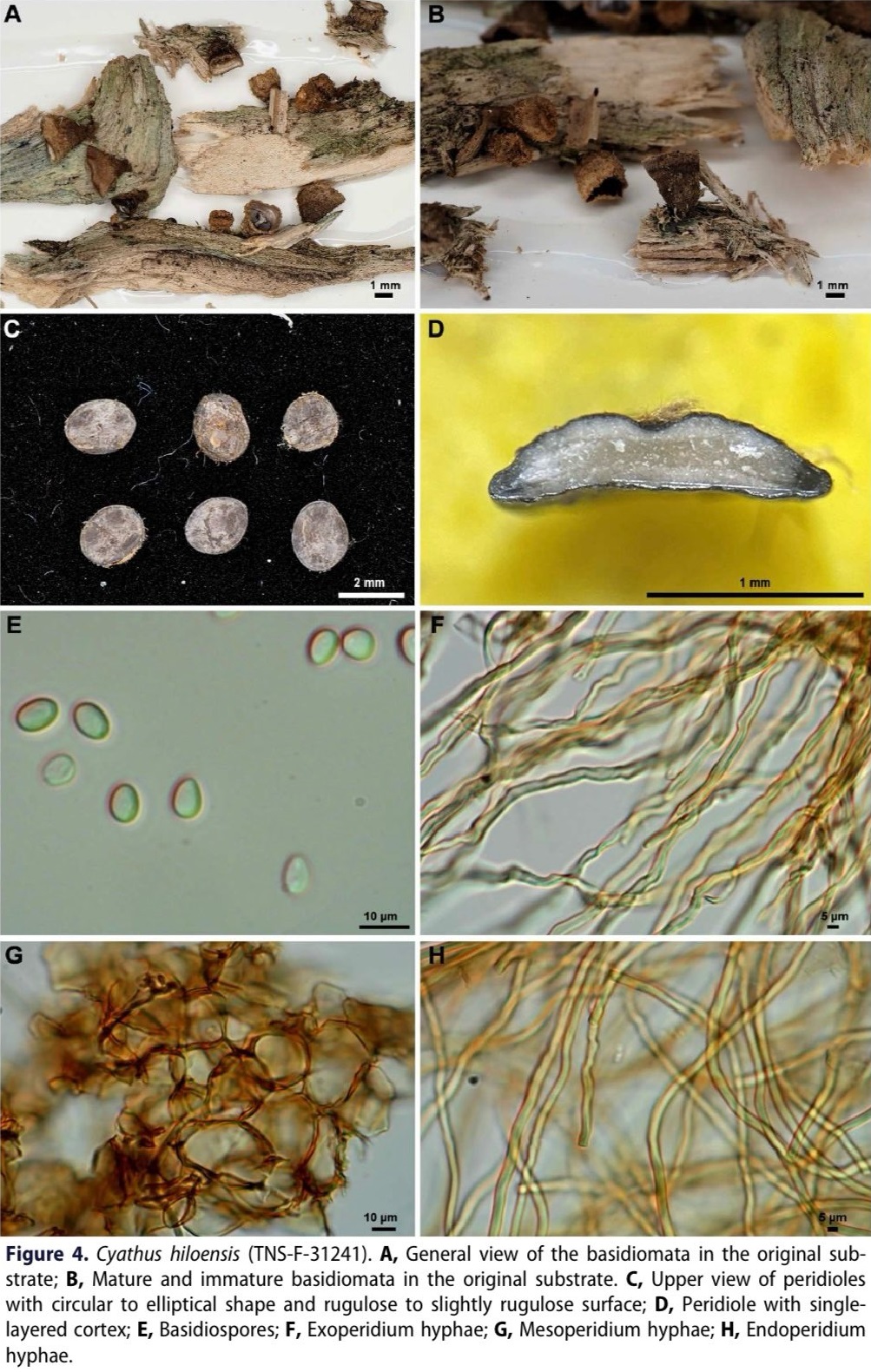
[Funga • 2025] Cyathus hiloensis (Basidiomycota: Nidulariaceae) • A new species in the Hawaiian Archipelago


Cyathus hiloensis  

in Góis, da Cruz, Baseia et Hosaka, 2025. 

ABSTRACT
This study focuses on expanding knowledge of Cyathus species in the Hawaiian archipelago through the description of a newly discovered species from Hilo, the largest town in Hawaii County. Based on morphological and molecular data, Cyathus hiloensis is proposed as new taxon within the pallidum group. A comprehensive description of its distinguishing features is provided, along with a detailed comparison to closely related taxa.

KEYWORDS: Biodiversity, Hawaiian archipelago, Pacific Ocean, taxonomy, systematic


Jefferson dos S. Góis, Rhudson H.S.F. da Cruz, Iuri G. Baseia and Kentaro Hosaka. 2025. A new species Cyathus hiloensis (Nidulariaceae, Basidiomycota) in the Hawaiian Archipelago. New Zealand Journal of Botany. DOI: doi.org/10.1080/0028825X.2025.2454602  


Tuesday, December 10, 2024

[Funga • 2024] Phellodon aquiloniniger, P. castaneoleucus, ... (Basidiomycota: Thelephorales) •  The Genus Phellodon in Europe: Four New Species, One New Combination, Four New Typifications and A First European Record


Phellodon aquiloniniger A.M. Ainsw. & Svantesson,

in Svantesson, E. Larsson, K.-H. Larsson, Parfitt, Suz, et Ainsworth, 2024. 

Abstract 
Phellodon is a globally distributed genus of stipitate hydnoid fungi recognised by a white spore print and an ectomycorrhizal life strategy. In Europe, many Phellodon species have declining populations and are used as indicators of forests with high conservation values. However, their use in this context and the correct assessment of their extinction risk, according to IUCN guidelines, are currently hampered by inconsistent name usage and unclear species delimitations, primarily within the species complexes of P. melaleucus, P. niger and P. tomentosus. We analysed 286 ITS sequences of Phellodon, of which 51 were also analysed in conjunction with the corresponding LSU regions. This work included 102 newly sequenced collections, primarily sourced from Sweden and the UK. Our phylogenetic results show that four species are new to science and hence we formally describe P. castaneoleucus within the P. melaleucus morphological complex, P. aquiloniniger and P. frondosoniger within the P. niger complex and P. dititomentosus as a sister species to P. tomentosus. The combination P. melilotinus is made to accommodate an additional, previously described, species that belongs in the P. niger complex. We designate lectotypes and epitypes for P. melaleucus, P. niger and P. tomentosus as well as an epitype for P. melilotinus. Phellodon ellisianus is recorded as new to Europe and the ecological amplitude of P. secretus and P. violaceus is revealed to be wider than previously believed. We provide a key to all 13 species currently known in Europe and assign them to three habitat-based assemblages based on data from the Nordic countries and the UK. We hope this will facilitate the assessment of such habitats for legal protection and other conservation-related actions.

Keywords: ECM fungi ; conservation; new taxa; stipitate hydnoid; tooth fungi


Phellodon aquiloniniger A.M. Ainsw. & Svantesson


Phellodon dititomentosus 


  Svantesson, S.; Larsson, E.; Larsson, K.-H.; Parfitt, D.; Suz, L.M. and Ainsworth, A.M. 2024. The Genus Phellodon (Thelephorales, Basidiomycota) in Europe: Four New Species, One New Combination, Four New Typifications and a first European record. Fungal Systematics and Evolution. DOI: doi.org/10.3114/fuse.2025.15.01

Tuesday, September 3, 2024

[Funga • 2024] Pseudosperma brunneopilosum (Agaricales: Inocybaceae) • A New Species from West Africa


Pseudosperma brunneopilosum Aïgnon & Fan,   

in Aïgnon, Fan et Matheny, 2024. 

Abstract
A new species of Pseudosperma is described based on collections recently made in Benin in West Africa. Pseudosperma brunneopilosum sp. nov. occurs in forests dominated by ectomycorrhizal Fabaceae Isoberlinia and Phyllanthaceae Uapaca trees. Phylogenetic analysis of combined ITS-LSU-RPB2-TEF1 gene regions shows that P. brunneopilosum is unrelated and distinct from several recently described species of Pseudosperma also from West Africa. Complete descriptions and illustrations, including photographs and line drawings are presented.

Keywords: Benin, ectomycorrhizal fungi, molecular systematics, phylogeny, taxonomy

(a–f) = Basidiomes of Pseudosperma brunneopilosum 
(a = HLA0735 holotype, b = HLA0731 c = HLA0910 and d = HLA0911, e = HLA0763, f = HLA0780).
Bar = 1 cm. Photos by: H. L. Aïgnon.

Microscopic features of Pseudosperma brunneopilosum (HLA0735, holotype).
 (a–b) Basidiospores, (c–g) basidia, (h–k) cheilocystidia in clusters, (l) pileipellis, (m) cross section of lamellae, (n) pileipellis hyphae, (o) oleiferous hyphae, (p) stipe trama hyphae, (q) caulocystida.
 Scale bars: a–q = 10 μm.

Pseudosperma brunneopilosum Aïgnon & Fan sp. nov. 

Diagnosis: A species distinguished from other tropical African Pseudosperma by the combination of the small basidiomata, brownish hairy and rimose pileus, lighter colored stipe, and isolated phylogenetic position.
 
Etymology: brunneopilosum, in reference to brownish densely fibrillose pileus.

 
Hyppolite L. Aïgnon, Yu-Guang Fan and P. Brandon Matheny. 2024. Pseudosperma brunneopilosum, A New Species of Inocybaceae from West Africa. Nordic Journal of Botany. DOI: doi.org/10.1111/njb.04470

Friday, July 5, 2024

[Funga • 2024] Psilocybe ingeli & P. maluti (Agaricales: Hymenogastraceae) • Two novel Psilocybe species from southern Africa and some notes on African traditional hallucinogenic mushroom use


 Psilocybe maluti B. van der Merwe, A. Rockefeller & K. Jacobs,
 
in van der Merwe, Rockefeller, Kilian, Clark, Sethathi, Moult et Jacobs, 2024.
 Photos by C. Clark.

ABSTRACT
Two new Psilocybe species (Hymenogastraceae), P. ingeli and P. maluti, are described from southern Africa. Morphology and phylogeny were used to separate the two novel fungi from their closest relatives in the genus. Psilocybe ingeli was found fruiting on bovine manure–enriched grasslands in the Kwa-Zulu Natal Province of South Africa and differs from its closest relative P. keralensis and others in the internal transcribed spacer ITS1-5.8S-ITS2, partial 28S nuc rDNA, and translation elongation factor 1-alpha regions, distribution, and having larger basidiospores. Similarly, P. maluti was collected from the Free State Province of South Africa and observed in the Kingdom of Lesotho, growing on bovine manure. A secotioid pileus, geographic distribution, and differences in the same DNA regions distinguish P. maluti from its closest relative P. chuxiongensis. Furthermore, the spore dispersal and traditional, spiritualistic use of P. maluti are discussed here.

KEYWORDS: Psilocybe, South Africa, taxonomy, traditional use, new taxa

 Psilocybe ingeli, Kwa-Zulu Natal Province, South Africa, 28 February 2023.
 (A) Stipe white with mycelium. (B) Striations running up the hemispheric pileus. (C) Pale lamellae margin.
Photos by T. Moult.

Psilocybe ingeli B. van der Merwe, A. Rockefeller & K Jacobs, sp. nov.  

Etymology: Psilocybe ingeli is named after the Ingeli mountain range, where the type specimen was found.

Psilocybe maluti B. van der Merwe, A. Rockefeller & K. Jacobs, sp. nov.  

Etymology: Psilocybe maluti is named after the Maluti Mountains that share the same range as this novel Psilocybe, stretching from the Free State and Kwa-Zulu Natal provinces of South Africa to throughout the Kingdom of Lesotho.

 Psilocybe maluti, Kingdom of Lesotho, 31 December 2021.
 (A) Fimicolous habitat. (A–E) Secotioid pileus. (B) Details of the stipe and veil.
 Photos by C. Clark.

 
B. van der Merwe, A. Rockefeller, A. Kilian, C. Clark, M. Sethathi, T. Moult and K. Jacobs. 2024. A Description of Two novel Psilocybe species from southern Africa and some notes on African traditional hallucinogenic mushroom use. Mycologia. DOI: 10.1080/00275514.2024.2363137