Showing posts with label Polychaeta. Show all posts

Wednesday, March 11, 2026

[Invertebrate • 2026] Dalhousiella yabukii & Leocratides watanabeae • Single Origin and Convergent Host Use of hexactinellid Sponge Symbiosis in Hesionidae (Annelida: Polychaeta) with Descriptions of Two New Deep-sea Species


Dalhousiella yabukii  &  Leocratides watanabeae 
 Jimi, Downey, Mella & Hookabe, 2026


Abstract
Symbiotic associations between annelids and sponges are widespread and have evolved repeatedly across diverse families. However, their evolutionary history within Hesionidae remains poorly understood. Using the manned submersible Shinkai 6500, we conducted in situ observations and collected hesionid specimens from a hexactinellid sponge on the Getsuyo Seamount, north-west Pacific Ocean. An integrative taxonomic approach combining morphology and molecular phylogenetics revealed that they belong to two new species, Dalhousiella yabukii sp. nov. and Leocratides watanabeae sp. nov. Phylogenetic analyses suggest that sponge symbiosis in Hesionidae originated once, in the common ancestor of Dalhousiella and Leocratides. Nevertheless, the two new species are not each other’s closest relatives; instead, they form independent sister-clades, each including different congeners. Specimens of the two new species inhabited the same sponge host and probably shared similar ecological niches, suggesting convergent ecological specialization toward the limited resource of hexactinellid sponges in the deep sea. Such niche overlap and convergent evolution between closely related symbiotic species have not been previously reported in Hesionidae. Our findings shed new light on the origin and diversification of sponge symbiosis in Hesionidae and highlight the importance of integrative taxonomy and direct in situ observation for understanding deep-sea biodiversity.

Hesionini, taxonomy, symbiosis, Polychaeta, seamount


Dalhousiella yabukii sp. nov.  
Leocratides watanabeae sp. nov. 


Naoto Jimi, Rachel Downey, María Belén Arias Mella and Natsumi Hookabe. 2026. Single Origin and Convergent Host Use of hexactinellid Sponge Symbiosis in Hesionidae (Annelida: Polychaeta) with Descriptions of Two New Deep-sea Species. Zoological Journal of the Linnean Society. 206(3); zlag028. DOI: doi.org/10.1093/zoolinnean/zlag028 [09 March 2026] 

Thursday, February 12, 2026

[Invertebrate • 2025] Taxonomy and Ecological insights into Melinnopsis shinkaiae sp. nov., A Polychaete with a vertical tube from the Daiichi-Kashima Seamount (Northwest Pacific)

 
Melinnopsis shinkaiae 
Jimi, Hookabe, Woo & Fujiwara, 2025

 
Abstract  
Melinnopsis shinkaiae sp. nov. represents the fifth species of the genus Melinnopsis to be discovered in Japan. The new species was collected using the submersible Shinkai 6500 at 3623 m depth of Daiichi-Kashima Seamount, a locality with relatively unexplored biodiversity. Our in-situ observation revealed that the species inhabits the upper end of a vertical tube built on the seafloor. The species is differentiated from its congeners by combination of the following morphological characteristics: i) the presence of 12 thoracic uncinigers; ii) the absence of a postbranchial dorsal membrane; iii) the arrangement and shape of four pairs of branchiae; iv) thoracic uncini with a small basal tooth on each three teeth above the rostral tooth; v) absence of longitudinal groove in the large buccal tentacle.

Keywords: Terebelliformia, taxonomy, Melinnidae, Polychaeta, seamount

Melinnopsis shinkaiae sp. nov.
A–C, in situ observations of tubes. D, a collected tube.
E, drawing of tubes. White arrows indicate tubes.  
Scale bar: B–C, 30 cm; D, 2 cm

 Melinnopsis shinkaiae sp. nov. 

Etymology. The specific name shinkaiae derives from HOV Shinkai 6500, that was used for sampling of the new species. The new Japanese name “Takeuma-kazarigokai” is derived from the vertical tube that evokes “Takeuma,” which refers to Japanese stilts.


Naoto Jimi, Natsumi Hookabe, Sau Pinn Woo and Yoshihiro Fujiwara. 2025. Taxonomy and Ecological insights into Melinnopsis shinkaiae sp. nov., A Polychaete with a vertical tube from the Daiichi-Kashima Seamount (Northwest Pacific). Plankton and Benthos Research. 20(1); 29-35. DOI doi.org/10.3800/pbr.20.29 [February 28, 2025]

Sunday, December 21, 2025

[Crustacea • 2025] Caecognathia tubicola • Two gnathiid isopods utilizing empty tubes of the polychaete worm Spirobranchus akitsushima in the Seto Inland Sea, western Japan, with the Description of A New Species


 Caecognathia tubicola 
Ota & Yoshimatsu, 2025

Abstract
Two gnathiid species were collected from around Kagawa Prefecture, Seto Inland Sea, western Japan. One species was described as Caecognathia tubicola sp. nov. with detailed morphological examinations of male and female adults and larvae. A total of 130 individuals of C. tubicola were obtained from empty tubes of the polychaetous annelid Spirobranchus akitsushima in the intertidal zone. This species probably completes its life cycle around the aggregation of empty calcareous tubes of S. akitsushima on bedrock, as larvae at all developmental stages were found. Some adult females have significantly narrow thoraxes, a morphology that may be adapted to the elongate tubes. Small numbers of Elaphognathia cornigera (Nunomura, 1992) were also found in empty S. akitsushima tubes.

Keywords: Caecognathia, ectoparasite, intertidal zone, narrow thorax

 Caecognathia tubicola sp. nov. 
Habitat of at Mitoyoshi City, Kagawa Prefecture.
A, intertidal rocky shore with mats of aggregations of tube of polychaete worm Spirobranchus akitsushima;  B, mouth of empty tubes of S. akitsushima; C, male adult of C. tubicola in a tube.
Live specimens (D-F)

Family Gnathiidae Leach, 1814 
Genus Caecognathia Dollfus, 1901 
 
Caecognathia tubicola sp. nov.  
 [Japanese name: Kanzashi-umi-kuwagata]

Diagnosis. Dorsal surface of cephalosome, pereonites 1–3, and anterior part of pereonite 4 densely covered with fine granules; frontal border rounded, slightly dentate, fringed with fine setae; paraocular ornamentation multiple projections, covering part of eyes in dorsal view; pereonite 1 not fused with cephalon and divided into 3 parts; epimera not prominent on pleonites 1–5; pleotelson covered with pectinate scales on anterior half and fine spines on posterior part.


Yuzo Ota and Sadaaki Yoshimatsu. 2025. Two gnathiid isopods utilizing empty tubes of the polychaete worm Spirobranchus akitsushima in the Seto Inland Sea, western Japan, with the description of a new species. Plankton and Benthos Research. 20(4); 248-262. DOI: doi.org/10.3800/pbr.20.248
   x.com/mofumofu_marine/status/1993956358241337851

Tuesday, November 18, 2025

[Invertebrate • 2021] Magelona brachypalpata • A Review of the Magelonidae (Annelida: Polychaeta) of Northeast America, including A Description of A New Species and re-descriptions of Magelona riojai and M. sacculata


Magelona brachypalpata
Mortimer, Blake & Harrendence, 2021

 
Abstract
A new species of Magelona is described based on collections from off Long Island, New York that are identical to an undescribed species reported by M. L. Jones (1968) from the vicinity of Woods Hole, Massachusetts. The species is herein named (Magelona brachypalpata, new species) and described. The new species belongs to the ‘Magelona mirabilis group,' possessing a rounded prostomium, lacking prostomial horns, and having specialized chaetae on chaetiger nine. The new species is most similar to M. riojai and M. sacculata, both of which are here redescribed. Additionally, a dichotomous identification key to the known magelonid species of the northeastern American coast and a worldwide pictorial identification key to the ‘M. mirabilis' group of magelonids are provided.


Magelona brachypalpata, new species


Kate Mortimer, James A. Blake and Kelsey Harrendence. 2021. A Review of the Magelonidae (Annelida: Polychaeta) of Northeast America, including A Description of A New Species and re-descriptions of Magelona riojai and Magelona sacculataProceedings of the Biological Society of Washington. 134(1); 209–242. DOI: 10.2988/0006-324X-134.1.209 

Saturday, November 30, 2024

[Invertebrate • 2024] Erinaceusyllis simonlledoi • A New Species of Erinaceusyllis (Annelida: Syllidae) discovered at A Wood-fall in the eastern Clarion-Clipperton zone, central Pacific Ocean


Erinaceusyllis simonlledoi 
Nilsson, Wiklund, Glover, Bribiesca-Contreras & Dahlgren, 2024  


Highlights: 
• A novel polychaete species was discovered on an abyssal wood-fall.
• Its high abundance on degraded wood displays a tolerance to sulfidic environments.
• Morphology and genetics support placement in Erinaceusyllis of the family Syllidae.
• This constitutes the first finding of abundant syllids on a natural wood-fall.
• Sulfide-tolerant syllids in the East Pacific may originate from the same lineage.

Abstract
In the deep sea, organic falls provide temporary localized enrichments of organic matter to the otherwise nutrient-poor abyssal seafloor. Areas where organic falls land become ephemeral patches of increased biodiversity. Often rich in opportunistic species which are tolerant to the sulfidic environment formed from anaerobic breakdown of organic matter. On a wood-fall at abyssal depths in the eastern Clarion-Clipperton Zone, the novel species Erinaceusyllis simonlledoi (Annelida: Syllidae) was discovered in high abundance. This study entails the first description of a novel syllid species found in high density on a naturally occurring organic fall. Phylogenetic position was investigated using three genetic markers (16S, 18S, COI) and morphology was studied through light- and scanning electron microscopy. Genetic data and morphological analysis supported placement in the syllid genus Erinaceusyllis. Distinguishing features were lack of eyes, dorsal brooding of one egg per egg-bearing segment, lack of visible papillae across the body, incomplete fusion of palps, bidentate chaetae, as well as pyriform antennae and tentacular cirri. Erinaceusyllis simonlledoi sp. nov. is highly similar to a species found on hydrothermal vents belonging to the closely related genus Sphaerosyllis. The similarity between the two species, as well as findings of unspecified Sphaerosyllis species in various types of sulfidic habitats evoke questions of a possible syllid lineage adapted to sulfidic environments.
Previous article in issue

 Keywords: Erinaceusyllis, Sphaerosyllis, Wood-falls, Sulfidic habitats, Clarion-Clipperton zone, Abyssal zone

 The piece of wood on which Erinaceusyllis simonlledoi sp. nov. was discovered. In situ image during collection.
Photo: University of Gothenburg.

 Full body light microscopy images of Erinaceusyllis simonlledoi sp. nov. 
 A – Holotype NHM_9029 dorsal view, chaetigers 13–16 on left side removed for DNA extraction. B – NHM_9029 ventral view. C – Paratype NHM_9081A dorsal view. D – Paratype NHM_9070B lateral view, left side. E – NHM9073 dorsal view, 3 posterior chaetigers and pygidium removed for DNA extraction.
 Scale bar: 100 μm. la – lateral antenna; ma – median antenna; tc – tentacular cirrus; dc – dorsal cirrus; ac -anal cirrus; px – pharynx; pr – proventricle.

Systematics
Phylum: Annelida Lamarck, 1802.
Class: Polychaeta Grube, 1850.
Family: Syllidae Grube, 1850.

Genus: Erinaceusyllis San Martín, 2005

Species: Erinaceusyllis simonlledoi sp. nov.

Etymology: The species is named in honor of Dr. Erik Simon Lledo, a member of the group of scientists onboard the Maersk Launcher on the NORI-D 5E biodiversity baseline research expedition of November–December 2021.


Christian L. Nilsson, Helena Wiklund, Adrian G. Glover, Guadalupe Bribiesca-Contreras and Thomas G. Dahlgren. 2024. A New Species of Erinaceusyllis (Annelida: Syllidae) discovered at A Wood-fall in the eastern Clarion-Clipperton zone, central Pacific ocean. Deep Sea Research Part I: Oceanographic Research Papers. 214, 104415. DOI: doi.org/10.1016/j.dsr.2024.104415
 

Monday, April 15, 2024

[Invertebrate • 2024] Perinereis kaustiana • A New Species (Annelida: Nereididae) for the Saudi Arabian Red Sea Region


Perinereis kaustiana 
 Teixeira, Fourreau, Sempere-Valverde & Carvalho, 2024


Abstract
Annelid biodiversity studies in the Red Sea are limited and integrative taxonomy is needed to accurately improve reference libraries in the region. As part of the bioblitz effort in Saudi Arabia to assess the invertebrate biodiversity in the northern Red Sea and Gulf of Aqaba, Perinereis specimens from intertidal marine and lagoon-like rocky environments were selected for an independent assessment, given the known taxonomic ambiguities in this genus. This study used an integrative approach, combining molecular with morphological and geographic data. Our results demonstrate that specimens found mainly in the Gulf of Aqaba are not only morphologically different from other five similar Perinereis Group I species reported in the region, but phylogenetic analysis using available COI sequences from GenBank revealed different molecular operational taxonomic units, suggesting an undescribed species, P. kaustiana sp. nov. The new species is genetically close and shares a similar paragnath pattern to the Indo-Pacific distributed P. helleri, in particular in Area III and Areas VII–VIII. Therefore, we suggest it may belong to the same species complex. However, P. kaustiana sp. nov. differs from the latter mainly in the shorter length of the postero-dorsal tentacular cirri, median parapodia with much longer dorsal Tentacular cirri, posteriormost parapodia with much wider and greatly expanded dorsal ligules. Additionally, two new records are reported for the Saudi Neom area belonging to P. damietta and P. suezensis, previously described only for the Egyptian coast (Suez Canal) and are distributed sympatrically with the new species, but apparently not sympatric with each other.

Key words: Gulf of Aqaba, mtCOI-5P, NEOM, north-eastern Red Sea, Polychaeta, Saudi Arabia, taxonomy

Perinereis kaustiana sp. nov. All pictures are from the holotype (NTNU-VM-86011) if not stated otherwise
A anterior end, prostomium, dorsal view B anterior end, prostomium, ventral view C jaws and respective jaw canals (JC), dorsal view D pharynx, maxillary ring (Areas III and IV), ventral view; black arrows, lateral patches with two paragnaths each E pharynx, oral ring (Areas VI), dorsal view F pharynx, maxillary ring (Areas I and II), dorsal view G pharynx, oral ring (Areas VII–VIII), ventral view; black arrows, furrow regions; white arrows, ridge regions H posterior end; white arrows, pygidial Tentacular cirri, paratype (NTNU-VM-86015) I anterior body, tentacular cirri reaching chaetiger 9, paratype (NTNU-VM-86015) J worm’s eyes, right side, paratype (NTNU-VM-86015). Abbreviations: chaet., chaetiger; Pyg., Pygidium. Scale bars: 500 μm (A, B, I); 250 μm (E, F, H); 100 μm (D, G); 125 μm (J); 75 μm (C).


Family Nereididae Blainville, 1818

Genus Perinereis Kinberg, 1865

 Perinereis kaustiana sp. nov.

Diagnosis: Four pairs of tentacular cirri, postero-dorsal one reaching chaetiger 7–9; ratio of DPCL / HL = 3.6×. Eversible pharynx with one pair of dark brown curved jaws with seven or eight denticles; two longitudinal canals emerging from the pulp cavity, both in the mid-section of the jaw. Pharynx consisting of maxillary and oral rings with conical shaped paragnaths. Maxillary ring: Area I = 2 small paragnaths arranged in a longitudinal line. Area II = Cluster of 5–7 small paragnaths. Area III = central patch of nine small paragnaths, lateral patches with two small paragnaths each. Area IV = 13 small paragnaths arranged in wedge shape without any bars. Oral ring: Area V = a triangle of three large paragnaths. Area VI (a+b) = two narrow bar-shaped ...

Etymology: The species designation pays tribute to the King Abdullah University of Science and Technology (KAUST) in Saudi Arabia, a globally recognized graduate-level research institution. This naming honours KAUST’s substantial and enduring contributions to marine science, particularly in advancing our understanding of the Red Sea over the course of more than a decade. Through its dedicated research efforts, KAUST has significantly enriched the scientific community’s knowledge of this unique marine environment.


Marcos A. L. Teixeira, Chloé Julie Loïs Fourreau, Juan Sempere-Valverde and Susana Carvalho. 2024. Two New Records and Description of A New Perinereis (Annelida, Nereididae) Species for the Saudi Arabian Red Sea Region.  ZooKeys. 1196: 331-354. DOI: 10.3897/zookeys.1196.115260

Saturday, March 30, 2024

[Invertebrate • 2024] Pectinereis strickrotti • A remarkable New deep-sea nereidid (Annelida: Nereididae) with gills

 
 Pectinereis strickrotti
Villalobos-Guerrero, Huč, Tilic, Hiley & Rouse, 2024


Abstract
Nereidid polychaetes are well known from shallow marine habitats, but their diversity in the deep sea is poorly known. Here we describe an unusual new nereidid species found at methane seeps off the Pacific coast of Costa Rica. Specimens of Pectinereis strickrotti gen. nov., sp. nov. had been observed dating back to 2009 swimming just above the seafloor at ~1,000 m depth but were not successfully captured until 2018. Male epitokes were collected as well as a fragment of an infaunal female found in a pushcore sample. The specimens were all confirmed as the same species based on mitochondrial COI. Phylogenetic analyses, including one based on available whole mitochondrial genomes for nereidids, revealed no close relative, allowing for the placement of the new species in its own genus within the subfamily Nereidinae. This was supported by the unusual non-reproductive and epitokous morphology, including parapodial cirrostyles as pectinate gills, hooked aciculae, elfin-shoe-shaped ventral cirrophores, and elongate, fusiform dorsal ligules emerging sub-medially to enlarged cirrophores. Additionally, the gill-bearing subfamily Dendronereidinae, generally regarded as a junior synonym of Gymnonereidinae, is reviewed and it is here reinstated and as a monogeneric taxon.

 Pectinereis strickrotti gen. nov., sp. nov. male anatomy.
A, B, D-F. Paratype (SIO-BIC A9889), epitokous male: A, whole body of living specimen in dorsal view; B, anterior region of living specimen in dorsal view; D, prostomium of preserved specimen in frontal view; E, posterior end of preserved specimen in dorsal view; F, post-natatory chaetigers and pygidium of preserved specimen in dorsolateral view. C. Holotype (SIO-BIC A9836), epitokous male: anterior region of preserved specimen in dorsal view. Scale bars: A, ~20 mm; B, ~5 mm; C, 5 mm; D, 1 mm; E, 3 mm; F, 0.5 mm. Credits: A, B, Ekin Tilic; C, Tulio Villalobos; D-F, Greg Rouse.

 Pectinereis strickrotti gen. nov., sp. nov. in life.
A, B, D. Several epitokous males swimming near methane seeps of Mound 12 (~1,000 m depth) of the Costa Rica margin and videoed via the submersible DSV Alvin. A. A frame grab from a video taken on Alvin dive 4503 on Feb. 4, 2009. B and D. Frame grabs from video taken on Alvin dive 4987 on Nov. 2, 2018. C. A fragment of an atokous infaunal female was collected at the same depth and locality via sediment pushcore on Alvin dive 4984 on Oct. 30, 2018. A white egg ~350 μm in diameter is visible on the exterior. Scalebar 1 mm. E. An epitokous male swimming near methane seeps of Parrita Scar (~1,000 m depth) of the Costa Rica margin. The specimen was initially caught via slurp with the ROV SuBastian (dive S0218, Jan. 11, 2019) but escaped. Images A, B, D, courtesy of Woods Hole Oceanographic Institute. E, courtesy of Schmidt Ocean Institute.

Family NEREIDIDAE de Blainville, 1818
Subfamily NEREIDINAE de Blainville, 1818

Pectinereis Villalobos-Guerrero, Huč, Tilic, Hiley & Rouse gen. nov. 

Diagnosis: Prostomial anterior region entire. Esophageal caeca absent. Anterior parapodial cirrostyles as comb-like gills. Dorsal cirrostyles attached sub-distally and dorsal ligule attached sub-medially to expanded cirrophores. Notopodial prechaetal, neuropodial postchaetal and inferior lobes present. First two chaetigers without notoacicula. Neuropodial spinigers and falcigers very long, homogomph. Epitoke males divided into four body regions, with distally-bilamellated dorsal cirrophore, elfin-shoe shaped ventral cirrophore, pre-pygidial hooked aciculae, and ensiform spinigers.

Etymology: This genus is named by combining the Latin word pectinis (= ‘comb’) with the name of the type genus of the family, Nereis. The name emphasizes the pectinate (i.e., comb-like) parapodial cirrostyles (gills) in the first anterior chaetigers formed by digitiform filaments. The gender is feminine, as the stem genus-group name.

Pectinereis strickrotti Villalobos-Guerrero, Huč, Tilic, Hiley & Rouse sp. nov.

Etymology: The species is named in honor of Bruce Strickrott, Group Manager and lead submersible pilot of the DSV Alvin (Woods Hole Oceanographic Institution), who chased these worms for many years before finally skillfully succeeding in their capture.

  
Tulio F. Villalobos-Guerrero, Sonja Huč, Ekin Tilic, Avery S. Hiley and Greg W. Rouse. 2024. A remarkable New deep-sea nereidid (Annelida: Nereididae) with gills. PLoS ONE. 19(3): e0297961. DOI: 10.1371/journal.pone.0297961

Monday, December 18, 2023

[Invertebrate • 2019] Polyodontes kuroshio • A New Species of Polyodontes (Annelida: Acoetidae) from Western Japan


Polyodontes kuroshio
Jimi, Tomioka, Orita & Kajihara, 2019


Abstract
Acoetid polychaetes were collected from shallow waters off Kochi Prefecture and Wakayama Prefecture, Japan. The specimens could be assigned to the genus Polyodontes Blainville, 1828, but are different from all the known species of the genus by the following characters: ommatophores with short neck; palps with minute papillae; parapodia without branchiae; the acicular neurochaetae always lacking aristae and having hairs only on a small area of their subdistal end; and antennae with brown dots. They are herein morphologically described as a new species and a partial 658-bp COI sequence as a DNA barcode is provided for future taxonomic studies.

Keywords: Kuroshio coastal region, marine invertebrates, North West Pacific, taxonomy


Polyodontes kuroshio sp. nov., NMST-Pol H-764 (holotype), live specimen, dorsal view.


Polyodontes kuroshio sp. nov. 
[New Japanese name: kurobuchi-bouseki-urokomushi]

 Etymology. This species is named after the Biological Institute on Kuroshio. The holotype from Sukumo was collected by the first author who received funding by the institution. The specific name is a non-declensive noun.

Distribution. This species is known from off Otsuki (Kochi Prefecture) and Hatakejima island (Wakayama Prefecture), Japan, Northwest Pacific


Naoto Jimi, Shinri Tomioka, Ryo Orita and Hiroshi Kajihara. 2019. A New Species of Polyodontes (Annelida: Acoetidae) from Western Japan. Species Diversity. 24: 275–279. DOI  10.12782/specdiv.24.275
  twitter.com/alciopidae/status/1199141243319570432
 

Wednesday, November 15, 2023

[Invertebrate • 2023] Parahesione pulvinata & P. apiculata • Two New Species of Parahesione (Annelida: Hesionidae) associated with Ghost Shrimps (Crustacea: Decapoda) and their phylogenetic relationships


Parahesione pulvinata 
P. apiculata 
Jimi, Gonzalez, Rouse & Britayev, 

in Jimi​, Nakajima, Sato, Gonzalez, Woo, Rouse & Britayev, 2023.
 
Abstract 
Two new species of Hesionidae, Parahesione pulvinata sp. nov. and Parahesione apiculata sp. nov. are described based on materials collected at tidal flats in Okinawa (Japan) from burrows of the ghost shrimps Neocallichirus jousseaumei and Glypturus armatus. The two new species are characterized by having eight enlarged cirri, dorsal cirrophores with dorsal foliose lobe and biramous parapodia, and by lacking median antenna. Parahesione apiculata sp. nov. has digitate lobes on the posterior margin of the dorsal foliose lobe (absent in P. pulvinata sp. nov.). The two new species were never found outside the ghost shrimp burrows, suggesting they are obligate symbionts. Phylogenetic analyses based on four concatenated genes suggest that the symbiotic lifestyle has evolved several times in Hesionidae.

Observations of  Parahesione pulvinata sp. nov. and its hosts in situ.
(A) Sampling at the sandy tidal flat of Uehara; (B) host and the new species; (C) detail of the host Neocallichirus jousseaumei; (D) another host with its symbiont (tube); (E) dorsal view of the new species of a living specimen (NSMT-Pol H-893); (F) dorsal view of a preserved specimen (NSMT-Pol H-893).

Parahesione pulvinata Jimi, Gonzalez, Rouse and Britayev sp. nov.
[New Japanese name: ana-yadori-otohime]

Diagnosis. Parahesione with dorsal foliose lobe, without dorso-lateral digitate extension, and eight tentacular anterior cirri.

Etymology. The specific name “pulvinata”, derived from the Latin pulvinus (meaning cushionpillow), referring to the shape of dorsal cirrophores. The specific name is an adjective in the nominative case.


 Parahesione apiculata sp. nov. and hosts in situ
(A) Sampling location at the Nanjo sandy tidal flat; (B) living specimen of the symbiont; (C) living specimen of the Glypturus armatus (host); (D) dorsal view of a living specimen, lacking posterior most segments (same individual with Fig. 6B, NSMT-Pol P-899).

Parahesione apiculata Jimi, Gonzalez, Rouse and Britayev sp. nov.
[New Japanese name: toge-ana-yadori-otohime]

Diagnosis. Parahesione with dorsal foliose lobe, dorso-lateral digitate extension, and eight tentacular anterior cirri.

Etymology. The specific name “apiculata”, derives from the Latin apiculatus (meaning short pointed) and referring to the digitate extension on dorso-lateral margin of dorsal foliose lobe, is as an adjective in the nominative case.


Conclusions: 
The genus Parahesione, belonging to Hesionidae, is a rare group of symbiotic polychaetes living in ghost shrimp burrows with two different sets of tentacular cirri; in one species there are only six whereas in the other there are eight. Interestingly, the prostomium have different shape being trapezoidal in those species with six pairs of tentacular cirri, and rectangular for those having eight pairs of tentacular cirri. Further, the dorsal parapodial modifications involving a foliose dorsal projection has been only reported in those species with eight pairs of tentacular cirri, whereas it has not been recorded in the only species having six pairs of tentacular cirri. We have discovered two new Parahesione species associated with ghost shrimps from the northwest Pacific. Both species are characterized by a flattened body, expanded foliose bases of cirrophores, and a bright red color. We consider these features as adaptations to thrive in the burrow hypoxic conditions. Reconstruction of the phylogenetic tree using four genes revealed their close relationship with non-symbiotic species of the sister clade Amphiduropsis-Amphiduros, suggested the independent establishment of symbiosis in various clades of the family Hesionidae.


Naoto Jimi​, Hiroki Nakajima, Taigi Sato, Brett C. Gonzalez, Sau Pinn Woo, Greg W. Rouse and Temir Britayev. 2023. Two New Species of Parahesione (Annelida: Hesionidae) associated with Ghost Shrimps (Crustacea: Decapoda) and their phylogenetic relationships. PeerJ. 11:e16346. DOI: 10.7717/peerj.16346


Saturday, October 28, 2023

[Invertebrate • 2023] Syllis belmontensis • Genetic Diversity of Polychaete Annelids from the Saint Peter and Saint Paul Archipelago, Equatorial Atlantic, with Description of A New Species


Syllis belmontensis
 Ribeiro, Freitas, Zanol, de Paiva, Fukuda, Guilment & Ruta. 2023

 
Abstract
The Saint Peter and Saint Paul Archipelago (SPSPA) is located in the mid-equatorial Atlantic and represents a potentially important area for biodiversity research; however, its species diversity remains poorly characterized. Particularly, neglected groups such as invertebrates have not been thoroughly registered or described. For instance, no species inventory is provided for Annelida, the phylum to which segmented worms belong. This study represents the first polychaete species inventory from SPSPA, including genetic and morphological data. We have generated COI mtDNA and 16S rDNA sequences intended as DNA barcode to molecularly identify polychaete species via different methods. First, we used the Barcode of Life Database (BOLD) identification tool; second, we calculated genetic distances and performed maximum likelihood trees with selected sequences from the Genbank database. We found that most species identified from SPSPA are strictly distributed in the Atlantic Ocean. Our methods proved that the accuracy of molecular identification was limited by the shortage of the annelid data available in BOLD and Genbank. Additionally, we describe a new species named Syllis belmontensis sp. nov. Overall, these results can be important resources for comparative studies on the distribution and genetic diversity of polychaetes worldwide.

Keywords: 16S rDNA, Annelida, COI, DNA barcoding, Oceanic island, Marine invertebrates

Syllis belmontensis sp. nov.
 
 
Rannyele P. Ribeiro, Roberta Freitas, Joana Zanol, Paulo Cesar de Paiva, Marcelo V. Fukuda, Thomas Guilment and Christine Ruta. 2023. Genetic Diversity of Polychaete Annelids from the Saint Peter and Saint Paul Archipelago, Equatorial Atlantic, with Description of A New Species. Regional Studies in Marine Science. 68, 103243. DOI: 10.1016/j.rsma.2023.103243

Thursday, October 19, 2023

[Invertebrate • 2023] Diversity and Biogeography of Scale Worms in the Subfamily Lepidonotopodinae (Annelida: Polynoidae) from Indian Ocean Hydrothermal Vents with Descriptions of Four New Species


Levensteiniella pettiboneaeL. longqiensis
 Branchinotogluma jiaolongae
B. kaireiensis
 Han, Zhou, Chen & Wang, 2023


Abstract
Lepidonotopodinae is a subfamily of Polynoidae endemic to deep-sea chemosynthetic ecosystems around the world. Nevertheless, their species composition and phylogeny have only been systematically studied in hydrothermal vents of the Eastern and Western Pacific. Here, we morphologically and genetically examined worms in Lepidonotopodinae from vents across three Indian Ocean ridges, revealing two new Branchinotogluma species (B. jiaolongae sp. nov. and B. kaireiensis sp. nov.) and two new Levensteiniella species (L. pettiboneae sp. nov. and L. longqiensis sp. nov.). Primary morphological characters distinguishing them from other congeners include the number and arrangement of both pharyngeal papillae and ventral papillae. The reconstructed molecular phylogeny of Lepidonotopodinae supports a monophyletic Levensteiniella, with the two new Indian Ocean species recovered as sisters. As revealed in previous studies, a paraphyletic Branchinotogluma was also found, with the three Indian Ocean species separated into distinct clades with sister-relationships to species from the Mid-Atlantic, Alarcon Rise, and Manus Basin, respectively. This indicates three separate historical invasions to Indian Ocean vents. Our findings increase the number of Indian Ocean Lepidonotopodinae worms to seven, now the most diverse annelid group there, and help to elucidate the biodiversity, distribution, and biogeography of this subfamily in the Indian Ocean.

Keywords: deep-sea vents, taxonomy, molecular phylogeny, morphology


Yuru Han, Yadong Zhou, Chong Chen and Yueyun Wang. 2023. Diversity and Biogeography of Scale Worms in the Subfamily Lepidonotopodinae (Annelida: Polynoidae) from Indian Ocean Hydrothermal Vents with Descriptions of Four New Species. Zoological Journal of the Linnean Society. zlad140. DOI: 10.1093/zoolinnean/zlad140

Saturday, August 5, 2023

[Paleontology • 2023] Shaihuludia shurikeni • Annelids from the Cambrian (Wuliuan Stage, Miaolingian) Spence Shale Lagerstätte of northern Utah, USA


Shaihuludia shurikeni 
Kimmig, LaVine, Schiffbauer, Egenhoff, Shelton & Leibach, 2023 

 
ABSTRACT
The Spence Shale Member of the Langston Formation in northern Utah and southern Idaho preserves generally non-biomineralized fossil assemblages referred to as the Spence Shale Lagerstätte. The biota of this Lagerstätte is dominated by panarthropods, both biomineralized and soft-bodied examples, but also preserves diverse infaunal organisms, including species of scalidophorans, echinoderms, lobopodians, stalked filter feeders, and various problematic taxa. To date, however, only a single annelid fossil, originally assigned to Canadia sp., has been described from the Spence Shale. This lone specimen and another recently collected specimen were analysed in this study using scanning electron microscopy and energy dispersive X-ray spectrometry. The previous occurrence was reassigned to Burgessochaeta cf. B. setigera. The new fossil, however, has been identified as a novel polychaete taxon, Shaihuludia shurikeni gen. et sp. nov., characterised by the presence of fused, bladed chaetae and a wide body. The occurrence of Burgessochaeta is the first outside the Burgess Shale and its vicinity, whereas Shaihuludia shurikeni gen. et sp. nov. adds to the diversity of annelids in the middle Cambrian and highlights the diversity of the Spence Shale Lagerstätte.

KEYWORDS: Exceptional preservation, worms, Burgess Shale-type preservation, Great Basin, Laurentia

 Shaihuludia shurikeni gen. et sp. nov. from the High Creek locality, Spence Shale Member of the Langston Formation (Wuliuan; Miaolingian).
 (A) Holotype part KUMIP 585569 complete specimen immersed in dilute ethanol under non-polarised light. (B) Interpretive drawing of A with uncertain soft tissue extent denoted with a dotted line. (C) Enlargement of boxed inset in A, showing preserved chaetae and soft-tissue. (D) SEM-EDS elemental maps of the area in A the chaetae and soft-tissue show enhanced levels of Fe, O, and some C, while the host matrix shows enhanced levels of Al, K, Mn, Na, and Si. Scale bars: (A, B) 5 mm, (C, D) 2 mm.


 Reconstruction of Shaihuludia shurikeni gen. et sp. nov. from the Spence Shale of Utah.
 Artistic reconstruction of an adult specimen by R. LaVine.


Julien Kimmig, Rhiannon J. LaVine, James D. Schiffbauer, Sven O. Egenhoff, Kevin L. Shelton and Wade W. Leibach. 2023. Annelids from the Cambrian (Wuliuan Stage, Miaolingian) Spence Shale Lagerstätte of northern Utah, USA. Historical Biology: An International Journal of Paleobiology. DOI: 10.1080/08912963.2023.2196685

Friday, May 26, 2023

[Invertebrate • 2023] Polycirrus aoandon, P. onibi & P. ikeguchii • Investigating the Diversity of Bioluminescent Marine Worm Polycirrus (Annelida), with Description of Three New Species from the Western Pacific


Polycirrus onibi Jimi, P. aoandon Jimi, & P. ikeguchii Jimi,
 
in Jimi, Bessho-Uehara, Nakamura, Sakata, Hayashi, et Ogoh, 2023

Bioluminescence, a phenomenon observed widely in organisms ranging from bacteria to metazoans, has a significant impact on the behaviour and ecology of organisms. Among bioluminescent organisms, Polycirrus, which has unique emission wavelengths, has received attention, and advanced studies such as RNA-Seq have been conducted, but they are limited to a few cases. In addition, accurate species identification is difficult due to lack of taxonomic organization. In this study, we conducted comprehensive taxonomic survey of Japanese Polycirrus based on multiple specimens from different locations and described as three new species: Polycirrus onibi sp. nov., P. ikeguchii sp. nov. and P. aoandon sp. nov. The three species can be distinguished from the known species based on the following characters: (i) arrangement of mid-ventral groove, (ii) arrangement of notochaetigerous segments, (iii) type of neurochaetae uncini, and (iv) arrangement of nephridial papillae. By linking the bioluminescence phenomenon with taxonomic knowledge, we established a foundation for future bioluminescent research development. We also provide a brief phylogenetic tree based on cytochrome c oxidase subunit I (COI) sequences to discuss the evolution of bioluminescence and the direction of future research.

Keywords: Polycirrus aoandon sp. nov., Polychaeta, Polycirrus onibi sp. nov., Polycirrus ikeguchii sp. nov., terebelliformia, bioluminescence

Polycirrus onibi sp. nov.

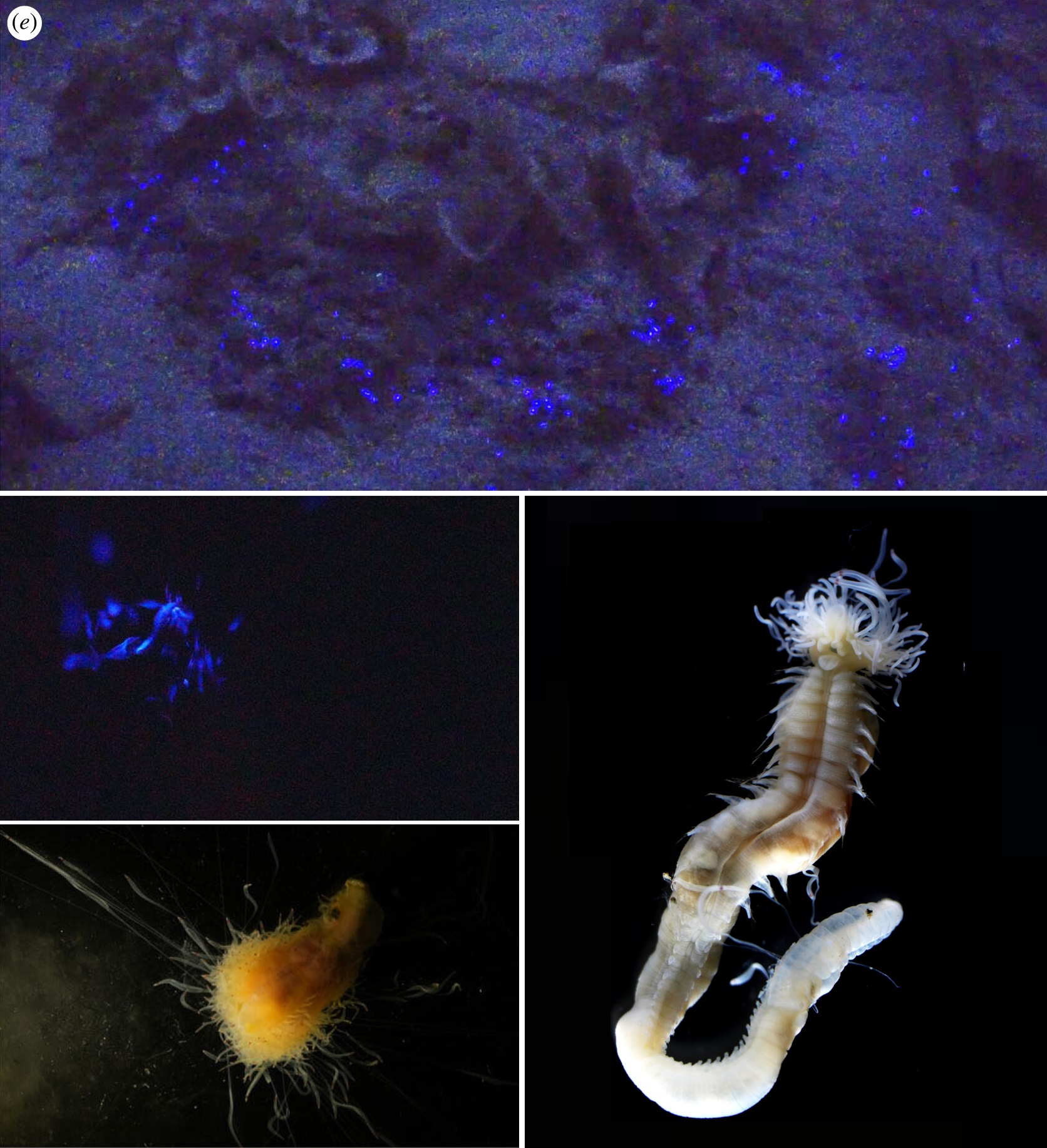
 Bioluminescence of Polycirrus spp.
 (a, c) Polycirrus onibi sp. nov.; (b, d) Polycirrus aoandon sp. nov.;
(e) in situ observation of Polycirrus spp. (mixture of P. ikeguchii sp. nov. and P. onibi sp. nov., most of them are P. ikeguchii sp. nov.) at Notojima.

Genus Polycirrus Grube, 1850 
[New Japanese name: Hikari-Fusa-gokai-zoku]

Type-species. Polycirrus medusa Grube, 1850 [13].

Polycirrus onibi Jimi, sp. nov.
[Japanese name: Onibi-fusa-gokai]

Diagnosis. Polycirrus with transparent body wall, tentacles with subterminal red spots, mid-ventral groove from segment 3, notochaetae on segments 3–14, neurochaetae on segment 15 and following segments, type II uncini, nephridial papillae in anterior area of parapodia on segments 3–14.

Etymology. The new species name derives from the Japanese yōkai onibi’. Onibi represents the soul of a deceased human or animal, manifested as a floating blue flame. It is often equated with the Will-o'-the-wisp. The blue–purple bioluminescence is reminiscent of this yōkai.


Polycirrus ikeguchii Jimi, sp. nov.
[Japanese name: Ikeguchi-fusa-gokai]

Diagnosis. Polycirrus with transparent body wall, tentacles with subterminal red spots, mid-ventral groove from segment 2, notochaetae on segments 3–19, neurochaetae on segment 17 and following segments, type II uncini, nephridial papillae in anterior area of parapodia, on segments 3–17.

Etymology. The species is named after Mr Shinichiro Ikeguchi. He is the former deputy director of the Notojima Aquarium, and he contributed to the discovery of the luminescence phenomenon of this species.


Polycirrus aoandon Jimi, sp. nov.
[Japanese name: Aoandon-fusa-gokai]

Diagnosis. Polycirrus with orange body wall, tentacles without subterminal red spots, mid-ventral groove from segment 3, notochaetae on segments 3–56, neurochaetae on segment 16 and following segments, type I uncini, nephridial papillae in anterior area of parapodia on segments 3–14.


Etymology. The new species name derives from the Japanese yōkai Aoandon’. Aoandon carries a blue (= Ao in Japanese) lantern (= andon in Japanese). The blue–purple bioluminescence is reminiscent of this yōkai.

 
Naoto Jimi, Manabu Bessho-Uehara, Koji Nakamura, Masahiko Sakata, Taro Hayashi, Shusei Kanie, Yasuo Mitani, Yoshihiro Ohmiya, Aoi Tsuyuki, Yuzo Ota, Sau Pinn Woo and Katsunori Ogoh. 2023. Investigating the Diversity of Bioluminescent Marine Worm Polycirrus (Annelida), with Description of Three New Species from the Western Pacific. Royal Society Open Science. DOI: 10.1098/rsos.230039
 phys.org/news/2023-03-newly-sea-worms-dark-creatures.html