Showing posts with label Paul Sereno (paleontologist). Show all posts

Friday, February 20, 2026

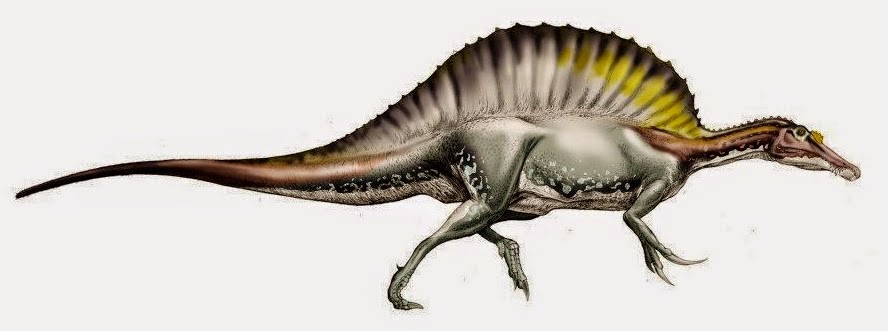
[Paleontology • 2026] Spinosaurus mirabilis • Scimitar-crested Spinosaurus species from the Sahara caps stepwise spinosaurid radiation


Spinosaurus mirabilis
Sereno, Vidal, Myhrvold, Johnson-Ransom, Ciudad Real, Baumgart, Sánchez Fontela, Green, Saitta, Adamou, Bop, Keillor, Fitzgerald, Dutheil,  Laroche, Demers-Potvin, Simarro, Gascó-Lluna,  Lázaro, Gamonal, Beightol, Reneleau, Vautrin, Bertozzo, FGranados, Kinney-Broderick, Mallon, Lindoso, Ramezani & Jahandar, 2026
 
Artwork: Dani Navarro

 Abstract
INTRODUCTION: The fossils of Spinosaurus aegyptiacus, a giant sail-backed, fish-eating theropod dinosaur from northern Africa, have inspired competing lifestyle interpretations, either as a semiaquatic ambush predator stalking shorelines and shallows or a fully aquatic predator in pursuit of prey underwater. Its bones and teeth have been found only in coastal deposits near marine margins, a locale potentially consistent with either lifestyle interpretation.

RATIONALE: In the central Sahara, a new fossiliferous area (Jenguebi) was discovered in beds equivalent in age [Farak Formation; Cenomanian ~95 million years ago (Mya)] to those yielding fossil remains of S. aegyptiacus. We describe from this area a new species, Spinosaurus mirabilis sp. nov., which is very similar to S. aegyptiacus in skeletal form but with a much taller, scimitar-shaped cranial crest. Two new sauropods were found in close association with the new spinosaurid buried in fluvial sediments indicative of an inland riparian habitat.

RESULTS: Spinosaurus mirabilis sp. nov. is distinguished by the low profile of its snout, a hypertrophied nasal-prefrontal crest, greater spacing of posterior maxillary teeth, and other features. Its features highlight the extraordinary specializations of both species of the genus Spinosaurus, including interdigitating upper and lower teeth. Principal component analysis of body proportions places spinosaurids between semiaquatic waders (e.g., herons) and aquatic divers (e.g., darters) distant from all other predatory dinosaurs. A time-calibrated phylogenetic analysis resolves three evolutionary phases: an initial Jurassic radiation when their distinctive elongate fish-snaring skull evolved and split into two distinctive designs, baryonychine and spinosaurine; an Early Cretaceous circum-Tethyan diversification when both reigned as dominant predators; and a final early Late Cretaceous phase when spinosaurines attained maximum body size as shallow water ambush specialists limited geographically to northern Africa and South America.

CONCLUSION: The discovery of the tall-crested S. mirabilis sp. nov. in a riparian setting within an inland basin supports a lifestyle interpretation of a wading, shoreline predator with visual display an important aspect of its biology. At the end of the Cenomanian about 95 million years ago, an abrupt eustatic rise in sea level and the attendant climate change brought the spinosaurid radiation to an end.


Sheathed bony head crests in extinct and living dinosaurs. Spinosaurus mirabilis sp. nov., evolved the tallest head crest of any theropod dinosaur, drawing attention to the midline ornamentation that characterizes the cranium and axial skeleton of all spinosaurids. In life, the crest would have been extended to some degree by a keratinous sheath, as in the living helmeted guinea fowl (Numida meleagris). Visual signaling, as is the case in guinea fowl and other crested avians, was likely the function of spinosaurid cranial crests and trunk and tail sails. Scale bar, 20 cm for S. mirabilis and 3 cm for N. meleagris.

Spinosaurus mirabilis


A single Spinosaurus mirabilis rears over a carcass of the coelacanth Mawsonia on the forested bank of a river some 95 million years ago in what is now the Sahara Desert in Niger. A scimitar-shaped head crest and interdigitating teeth characterize this wading giant, one of the last-surviving species of a spinosaurid radiation some 50 million years in the making.
Artwork: Dani Navarro

Sereno, Paul C.; Vidal, Daniel; Myhrvold, Nathan P.; Johnson-Ransom, Evan; Ciudad Real, María; Baumgart, Stephanie L.; Sánchez Fontela, Noelia; Green, Todd L.; Saitta, Evan T.; Adamou, Boubé; Bop, Lauren L.; Keillor, Tyler M.; Fitzgerald, Erin C.; Dutheil, Didier B.; Laroche, Robert A. S.; Demers-Potvin, Alexandre V.; Simarro, Álvaro; Gascó-Lluna, Francesc; Lázaro, Ana; Gamonal, Arturo; Beightol, Charles V.; Reneleau, Vincent; Vautrin, Rachel; Bertozzo, Filippo; Granados, Alejandro; Kinney-Broderick, Grace; Mallon, Jordan C.; Lindoso, Rafael M.; Ramezani, Jahandar. 2026. Scimitar-crested Spinosaurus species from the Sahara caps stepwise spinosaurid radiation. Science. 391 (6787) eadx5486. DOI: doi.org/10.1126/science.adx5486 [19 Feb 2026] 
 
Editor’s summary: Recent descriptions of and debates about the massive, fish-eating dinosaur Spinosaurus have brought this striking predator to the forefront of the dinosaur pantheon. Its huge size and distinctive morphology have stimulated much debate about the degree to which it lived an aquatic lifestyle. Sereno et al. describe a crested fossil Spinosaurus found in northern Africa as a new species. The researchers argue that this group of dinosaurs underwent three phases of evolution with increasing aquatic adaptations and existence in habitats around the Tethys Sea. —Sacha Vignieri


Friday, September 12, 2014

[Paleontology • 2014] Semiaquatic Adaptations in a Giant Predatory Dinosaur, Spinosaurus aegyptiacus


Cretaceous Leviathan
The only known dinosaur adapted to life in water, Spinosaurus swam the rivers of North Africa a hundred million years ago. The massive predator lived in a region mostly devoid of large, terrestrial plant-eaters, subsisting mainly on huge fish.
Art: Davide Bonadonna. Sources: Nizar Ibrahim, University of Chicago; Cristiano Dal Sasso and Simone Maganuco, Natural History Museum of Milan ngm.nationalgeographic.com


ABSTRACT
We describe adaptations for a semiaquatic lifestyle in the dinosaur Spinosaurus aegyptiacus. These adaptations include retraction of the fleshy nostrils to a position near the mid-region of the skull and an elongate neck and trunk that shift the center of body mass anterior to the knee joint. Unlike terrestrial theropods, the pelvic girdle is downsized, the hind limbs are short, and all of the limb bones are solid without an open medullary cavity, for buoyancy control in water. The short, robust femur with hypertrophied flexor attachment and the low, flat-bottomed pedal claws are consistent with aquatic foot-propelled locomotion. Surface striations and bone microstructure suggest that the dorsal “sail” may have been enveloped in skin that functioned primarily for display on land and in water.

Ibrahim, N., Sereno, P., Dal Sasso, C., Maganuco, M., Martill, D., Zouhri, S., Myhrvold, N., Iurino, D. 2014. Semiaquatic Adaptations in a Giant Predatory Dinosaur. Science.
doi: dx.doi.org/10.1126/science.1258750
http://www.sciencemag.org/content/suppl/2014/09/10/science.1258750.DC1/Ibrahim.SM.pdf

Digital skeletal reconstruction and transparent flesh outline of Spinosaurus aegyptiacus
Color codes are used to show the origin of different parts of the digital skeletal model.
Bones of the neotype and for Suchomimus tenerensis were CT-scanned, surfaced and size-adjusted before being added to the model.
Color coding: red, neotype (FSAC-KK 11888); orange, Stromer’s bones; yellow, isolated bones from the Kem Kem; green, surrogate bones modeled or taken from the spinosaurids Suchomimus, Baryonyx, Irritator or Ichthyovenator; blue, inferred bones from adjacent bones. A red dot below the posterior dorsal centra shows the approximate position of the center of mass.
Model by Tyler Keillor, Lauren Conroy, and Erin Fitzgerald. | phenomena.nationalgeographic.com


A reconstruction of the skull of Spinosaurus, with known elements in blue.
Art by Davide Bonadonna.


Researchers have long debated whether dinosaurs could swim, but there has been little direct evidence for aquadinos. Some tantalizing hints have appeared, however, in claimed "swim tracks" made by the bellies of dinos in Utah and oxygen isotopes indicating possible aquatic habitats in a group of dinosaurs called spinosaurs. Now, a research team working in Morocco has found the most complete skeleton yet of a giant carnivore called Spinosaurus, very fragmentary remains of which were first discovered in 1912 in Egypt. The new fossils not only confirm that Spinosaurus was bigger than Tyrannosaurus rex, but also show that it had evolutionary adaptations—ranging from pedal-like feet to a nostril far back on the head to high bone density like that of hippos—clearly suited for swimming in lakes and rivers.

Michael Balter. 2014. Giant Dinosaur was a Terror of Cretaceous Waterways. Science. 345(6202): 1232. DOI: dx.doi.org/10.1126/science.345.6202.1232


Scientists Report First Semiaquatic Dinosaur, Spinosaurus
Massive Predator Was More Than 9 Feet Longer Than Largest Tyrannosaurus rex
Spinosaurus: The First Semi-Aquatic Dinosaur http://www.science20.com/news_articles/spinosaurus_the_first_semiaquatic_dinosaur-144684 via @science2_0


-------------------------------------------------

pre-2014 PaleoArt 


Spinosaurus aegyptiacus
All Yestered by Rodrigo-Vega on @deviantART 


Wednesday, October 3, 2012

[Paleontology • 2012] Pegomastax africanus | “thick jaw from Africa” • New fanged dwarf dinosaur from southern Africa, ate plants


Pegomastax africanus 

Abstract
Heterodontosaurids comprise an important early radiation of small-bodied herbivores that persisted for approximately 100 My from Late Triassic to Early Cretaceous time. Review of available fossils unequivocally establishes Echinodon as a very small-bodied, late-surviving northern heterodontosaurid similar to the other northern genera Fruitadens and Tianyulong. Tianyulong from northern China has unusual skeletal proportions, including a relatively large skull, short forelimb, and long manual digit II. The southern African heterodontosaurid genus Lycorhinus is established as valid, and a new taxon from the same formation is named Pegomastax africanus gen. n., sp. n. Tooth replacement and tooth-to-tooth wear is more common than previously thought among heterodontosaurids, and in Heterodontosaurus the angle of tooth-to-tooth shear is shown to increase markedly during maturation. Long-axis rotation of the lower jaw during occlusion is identified here as the most likely functional mechanism underlying marked tooth wear in mature specimens of Heterodontosaurus. Extensive tooth wear and other evidence suggests that all heterodontosaurids were predominantly or exclusively herbivores. Basal genera such as EchinodonFruitadens and Tianyulong with primitive, subtriangular crowns currently are known only from northern landmasses. All other genera except the enigmatic Pisanosaurus have deeper crown proportions and currently are known only from southern landmasses.
Keywords: Dinosauria, Heterodontosauridae, Heterodontosaurinae, Heterodontosaurus, tooth replacement, tooth wear, herbivory


Credit: Drawing by Todd Marshall 
new dinosaur dwarf Pegomastax from South Africa. With jaws only 1-inch in length, plant-eating Pegomastax ("thick jaw") is one of the smallest dinosaurs ever discovered. 

Derivation of name. From the Greek pegos and mastax, meaning “strong jaw”.
Derivation of name. From Latin africanus, meaning “pertaining to Africa”.


Credit: Photo and sculpting by Tyler Keillor
  Heterodontosaurus flesh model and skull. Skin, scales and quills are added to a cast of the skull of Heterodontosaurus, the best known heterodontosaurid from South Africa. 


Pegomastax africanus | New fanged dwarf dinosaur from southern Africa, ate plants 
New fanged dwarf dinosaur from southern Africa, ate plants: http://www.eurekalert.org/pub_releases/2012-10/pp-nfd100112.php

Sereno, P.C. 2012. Taxonomy, morphology, masticatory function and phylogeny of heterodontosaurid dinosaurs. ZooKeys. 224: 1-225. doi: http://dx.doi.org/10.3897/zookeys.226.2840

[Paleontology • 2012] Heterodontosauridae: Taxonomy, morphology, masticatory function and phylogeny of heterodontosaurid dinosaurs

Credit: Photo and sculpting by Tyler Keillor
  Heterodontosaurus flesh model and skull. Skin, scales and quills are added to a cast of the skull of Heterodontosaurus, the best known heterodontosaurid from South Africa. 


Abstract
Heterodontosaurids comprise an important early radiation of small-bodied herbivores that persisted for approximately 100 My from Late Triassic to Early Cretaceous time. Review of available fossils unequivocally establishes Echinodon as a very small-bodied, late-surviving northern heterodontosaurid similar to the other northern genera Fruitadens and Tianyulong. Tianyulong from northern China has unusual skeletal proportions, including a relatively large skull, short forelimb, and long manual digit II. The southern African heterodontosaurid genus Lycorhinus is established as valid, and a new taxon from the same formation is named Pegomastax africanus gen. n., sp. n. Tooth replacement and tooth-to-tooth wear is more common than previously thought among heterodontosaurids, and in Heterodontosaurus the angle of tooth-to-tooth shear is shown to increase markedly during maturation. Long-axis rotation of the lower jaw during occlusion is identified here as the most likely functional mechanism underlying marked tooth wear in mature specimens of Heterodontosaurus. Extensive tooth wear and other evidence suggests that all heterodontosaurids were predominantly or exclusively herbivores. Basal genera such as Echinodon, Fruitadens and Tianyulong with primitive, subtriangular crowns currently are known only from northern landmasses. All other genera except the enigmatic Pisanosaurus have deeper crown proportions and currently are known only from southern landmasses.
Keywords: Dinosauria, Heterodontosauridae, Heterodontosaurinae, Heterodontosaurus, tooth replacement, tooth wear, herbivory


Credit: Drawing by Todd Marshall 
new dinosaur dwarf Pegomastax from South Africa. With jaws only 1-inch in length, plant-eating Pegomastax ("thick jaw") is one of the smallest dinosaurs ever discovered. 

Pegomastax africanus | New fanged dwarf dinosaur from southern Africa, ate plants 
New fanged dwarf dinosaur from southern Africa, ate plants: http://www.eurekalert.org/pub_releases/2012-10/pp-nfd100112.php

Sereno, P.C. 2012. Taxonomy, morphology, masticatory function and phylogeny of heterodontosaurid dinosaurs. ZooKeys. 224: 1-225. doi: http://dx.doi.org/10.3897/zookeys.226.2840

Monday, April 30, 2012

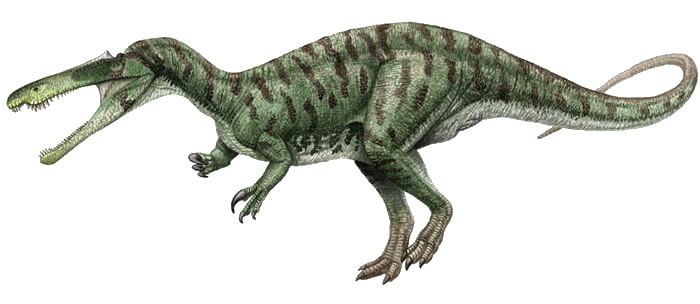
[Paleontology • 1998] Suchomimus tenerensis • A long-snouted predatory dinosaur from Africa and the evolution of spinosaurids


Abstract
Fossils discovered in Lower Cretaceous (Aptian) rocks in the Ténéré Desert of central Niger provide new information about spinosaurids, a peculiar group of piscivorous theropod dinosaurs. The remains, which represent a new genus and species, reveal the extreme elongation and transverse compression of the spinosaurid snout. The postcranial bones include blade-shaped vertebral spines that form a low sail over the hips. Phylogenetic analysis suggests that the enlarged thumb claw and robust forelimb evolved during the Jurassic, before the elongated snout and other fish-eating adaptations in the skull. The close phylogenetic relationship between the new African spinosaurid and Baryonyx from Europe provides evidence of dispersal across the Tethys seaway during the Early Cretaceous.


Sereno, P.C.; Beck, A.L.; Dutheil, D.B.; Gado, B.; Larsson, H.C.E.; Lyon, G.H.; Marcot, J.D.; Rauhut, O.W.M.; Sadleir, R.W.; Sidor, C.A.; Varricchio, D.D.; Wilson, G.P; and Wilson, J.A. 1998. A long-snouted predatory dinosaur from Africa and the evolution of spinosaurids. Science 282 (5392): 1298–1302. DOI: 10.1126/science.282.5392.1298


Thursday, April 26, 2012

[Paleontology • 2009] Raptorex kriegsteini • Tyrannosaurid skeletal design first evolved at small body size


Fig. 1: Skull, endocast, and premaxillary teeth of the Early Cretaceous tyrannosauroid R. kriegsteini. 

Nearly all of the large-bodied predators (>2.5 tons) on northern continents during the Late Cretaceous were tyrannosaurid dinosaurs. We show that their most conspicuous functional specializations—a proportionately large skull, incisiform premaxillary teeth, expanded jaw-closing musculature, diminutive forelimbs, and hindlimbs with cursorial proportions—were present in a new, small-bodied, basal tyrannosauroid from Lower Cretaceous rocks in northeastern China. These specializations, which were later scaled up in Late Cretaceous tyrannosaurids with body masses approaching 100 times greater, drove the most dominant radiation of macropredators of the Mesozoic.


Fig. 2: Postcranial features of the Early Cretaceous tyrannosauroid R. kriegsteini.


Fig. 4: Temporal, geographic, and phylogenetic patterns among tyrannosauroids. 
(A) Temporally calibrated phylogeny of tyrannosauroids based on phylogenetic analysis, showing an early diversity of basal tyrannosauroids (shaded) from localities across Laurasia and plotted on an Early Cretaceous paleogeographic map. Proceratosaurus and Xiongguanlong were excluded from this plot because of limited available morphologic data and age uncertainty, respectively. 
(B) Phylogram scaled to the amount of character change (delayed transformation) 
Circled nodes 1 to 3 outline major transformations in tyrannosauroid evolution. Taxonomic definitions of Tyrannosauroidea, Tyrannosauridae, and other taxa follow. 
Abbreviations for biogeographic area and localities: A, Asia; E, Europe; NA, North America; 
1, Stokesosaurus; 2, Proceratosaurus and Eotyrannus; 3, Aviatyrannis; 4, Guanlong; 5, Dilong; 6, Xiongguanlong; 7, Raptorex.


Sereno, P.; Tan, L.; Brusatte, S. L.; Kriegstein, H. J.; Zhao, X. & Cloward, K. (2009). "Tyrannosaurid skeletal design first evolved at small body size". Science. 326 (5951): 418–422. doi:10.1126/science.1177428


[Paleontology • 2011] Reanalysis of “Raptorex kriegsteini”: A Juvenile Tyrannosaurid Dinosaur from Mongolia


The carnivorous Tyrannosauridae are among the most iconic dinosaurs: typified by large body size, tiny forelimbs, and massive robust skulls with laterally thickened teeth. The recently described small-bodied tyrannosaurid Raptorex kreigsteini is exceptional as its discovery proposes that many of the distinctive anatomical traits of derived tyrannosaurids were acquired in the Early Cretaceous, before the evolution of large body size. This inference depends on two core interpretations: that the holotype (LH PV18) derives from the Lower Cretaceous of China, and that despite its small size, it is a subadult or young adult. Here we show that the published data is equivocal regarding stratigraphic position and that ontogenetic reanalysis shows there is no reason to conclude that LH PV18 has reached this level of maturity. The probable juvenile status of LH PV18 makes its use as a holotype unreliable, since diagnostic features of Raptorex may be symptomatic of its immature status, rather than its actual phylogenetic position. These findings are consistent with the original sale description of LH PV18 as a juvenile Tarbosaurus from the Upper Cretaceous of Mongolia. Consequently, we suggest that there is currently no evidence to support the conclusion that tyrannosaurid skeletal design first evolved in the Early Cretaceous at small body size.

Fowler DW, Woodward HN, Freedman EA, Larson PL, Horner JR (2011) Reanalysis of “Raptorex kriegsteini”: A Juvenile Tyrannosaurid Dinosaur from Mongolia. PLoS ONE. 6(6): e21376. doi:10.1371/journal.pone.0021376


Fig. 1: Skull, endocast, and premaxillary teeth of the Early Cretaceous tyrannosauroid R. kriegsteini. 

Nearly all of the large-bodied predators (>2.5 tons) on northern continents during the Late Cretaceous were tyrannosaurid dinosaurs. We show that their most conspicuous functional specializations—a proportionately large skull, incisiform premaxillary teeth, expanded jaw-closing musculature, diminutive forelimbs, and hindlimbs with cursorial proportions—were present in a new, small-bodied, basal tyrannosauroid from Lower Cretaceous rocks in northeastern China. These specializations, which were later scaled up in Late Cretaceous tyrannosaurids with body masses approaching 100 times greater, drove the most dominant radiation of macropredators of the Mesozoic.


Fig. 2: Postcranial features of the Early Cretaceous tyrannosauroid R. kriegsteini.


Fig. 4: Temporal, geographic, and phylogenetic patterns among tyrannosauroids. 
(A) Temporally calibrated phylogeny of tyrannosauroids based on phylogenetic analysis, showing an early diversity of basal tyrannosauroids (shaded) from localities across Laurasia and plotted on an Early Cretaceous paleogeographic map. Proceratosaurus and Xiongguanlong were excluded from this plot because of limited available morphologic data and age uncertainty, respectively. 
(B) Phylogram scaled to the amount of character change (delayed transformation) 
Circled nodes 1 to 3 outline major transformations in tyrannosauroid evolution. Taxonomic definitions of Tyrannosauroidea, Tyrannosauridae, and other taxa follow. 
Abbreviations for biogeographic area and localities: A, Asia; E, Europe; NA, North America; 
1, Stokesosaurus; 2, Proceratosaurus and Eotyrannus; 3, Aviatyrannis; 4, Guanlong; 5, Dilong; 6, Xiongguanlong; 7, Raptorex.


Sereno, P.; Tan, L.; Brusatte, S. L.; Kriegstein, H. J.; Zhao, X. & Cloward, K. (2009). "Tyrannosaurid skeletal design first evolved at small body size". Science. 326 (5951): 418–422. doi:10.1126/science.1177428


Tyrannosaur Paleobiology: New Research on Ancient Exemplar Organisms