Showing posts with label Journal: BirdingASIA. Show all posts

Monday, January 8, 2018

[Ornithology • 2017] Myzomela irianawidodoae • A Colourful New Species of Myzomela Honeyeater from Rote Island in eastern Indonesia


Myzomela irianawidodoae
Prawiradilaga, Baveja, Suparno, Ashari, Ng, Gwee, Verbelen & Rheindt, 2017

 photo:  Philippe Verbelen 

ABSTRACT
The avifauna of Rote Island in the Lesser Sundas is not well studied and generally considered to be similar to that of adjacent Timor Island. However, some cases of bird endemism have recently been documented on this island. A population of Myzomela honeyeater is one such example. First observed in October 1990, it has been subsumed with Myzomela dammermani from Sumba Island given its superficially similar appearance. Based on extensive morphological inspection and bioacoustic analysis, we here describe this population as a new taxon to science. Apart from previously overlooked plumage distinctions, the new taxon bioacoustically differs from M. dammermani in the presence or absence of several unique call types and considerable differences across two parameters in shared call types. Considering the importance of bioacoustics in avian species delimitation, we propose that the new Rote Myzomela be considered a distinct species. Given continued habitat conversion across its small range, we propose the International Union for Conservation of Nature and Natural Resources (IUCN) threat status Vulnerable for the species.

Key words: bird, Lesser Sundas, Myzomela, new species, Rote Island


Male ‘Rote Myzomela’ Myzomela irianawidodoae sp. nov., near Bolatena village, Rote Island, East Nusa Tenggara Province, Indonesia, April 2014.

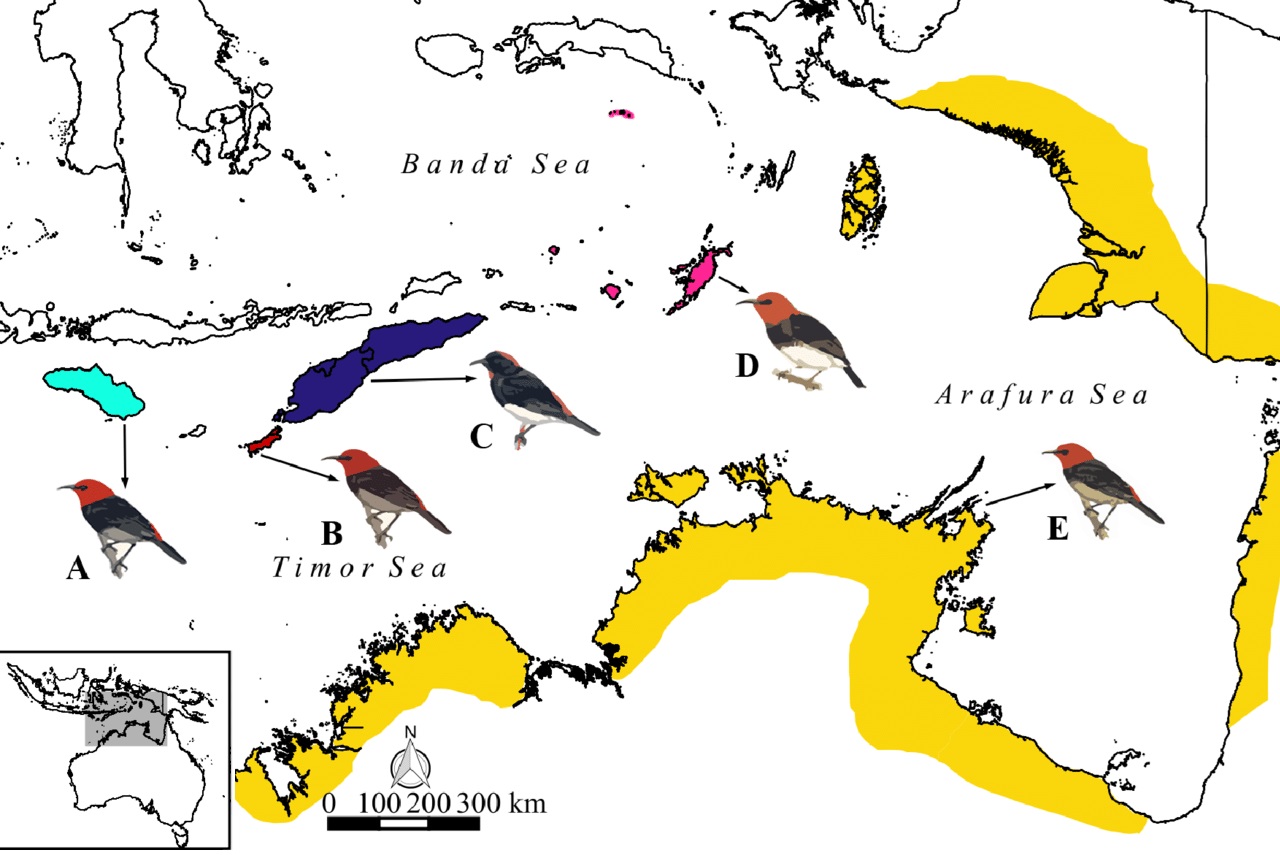
Figure 1. Map showing distribution of a select group of Myzomela taxa with a similar morphology.
A – Sumba Myzomela M. dammermani (Sumba Island; turquoise), B – the newly-described Rote Myzomela [Myzomela irianawidodoae] (Rote Island; red), C – Timor Myzomela M. vulnerata (Timor Island; dark blue), D – Banda Myzomela M. boiei (Banda Island arc and Tanimbar Islands; pink), E –Red-headed Myzomela M. erythrocephala (coastal Australia and Papua, Aru Islands; yellow).

Myzomela irianawidodoae, species nova
English name: Rote Myzomela
Indonesian name: Myzomela Rote

Etymology: We are pleased to name this species after Iriana Widodo, the current First Lady of the Republic of Indonesia, to recognise her keen interest in Indonesia’s birdlife and her valuable stewardship and advocacy for Indonesia’s natural environments.

....


Dewi Malia Prawiradilaga, Pratibha Baveja, Suparno, Hidayat Ashari, Nathaniel Sheng Rong Ng, Chyi Yin Gwee, Philippe Verbelen and Frank Erwin Rheindt. 2017.    A Colourful New Species of Myzomela Honeyeater from Rote Island in eastern Indonesia. Treubia. 44; 77-100.
http://e-journal.biologi.lipi.go.id/index.php/treubia/article/view/3414
 ResearchGate.net/publication/322163070_A_COLOURFUL_NEW_SPECIES_OF_MYZOMELA_HONEYEATER_FROM_ROTE_ISLAND_IN_EASTERN_INDONESIA

Philippe Verbelen, Colin R. Trainor, Veerle Dossche and Rohan P. Fisher. 2017. Rote Island, East Nusa Tenggara Province, Indonesia: an emerging hotspot of avian endemism. BirdingAsia. 27; 57-73.
ResearchGate.net/publication/319099457_Rote_Island_East_Nusa_Tenggara_Province_Indonesia_an_emerging_hotspot_of_avian_endemism

Description d'une nouvelle espèce d'oiseau en Indonésie, le Myzomèle de Rote (d'Iriana Widodo) | Ornithomedia.com: ornithomedia.com/magazine/etudes/description-nouvelle-espece-oiseau-indonesie-myzomele-rote-iriana-widodo-02595.html 


The discovery of Myzomela irianawidodoae — named after Indonesia’s first lady, Iriana Joko Widodo — involved a series of separate field studies between 1990 and 2015 by different groups of researchers, according to a paper published Dec. 31, 2017, in the scientific journal Treubia.

Meet Indonesia’s new honeyeater species from Rote Island news.mongabay.com/2018/01/meet-indonesias-new-honeyeater-species-from-rote-island/ via @Mongabay

Sunday, February 28, 2016

[Ornithology • 2014] Rufous-headed Parrotbill Paradoxornis bakeri and Pale-billed Parrotbill P. atrosuperciliaris in Thailand


Plate 2. Painting of Rufous-headed Parrotbill [นกปากนกแก้วหัวสีส้ม] Paradoxornis bakeri and Black-browed (Pale-billed) Parrotbill [นกปากนกแก้วคิ้วดำ] P. atrosuperciliaris based on field notes made in Mae Moei National Park on 25 June 2000 and field notes and photographs subsequently during 20–21 July 2014.
P. Round, K. Komolphalin, W. Limparungpatthanakij & A. J Pierce, 2014 || Illustration: K. Komolphalin

When Lekagul & Round (1991) was published, Lesser Rufous-headed Parrotbill Paradoxornis atrosuperciliaris was known from the far north of Thailand but Greater Rufous-headed Parrotbill P. ruficeps was listed only as a hypothetical species which was thought likely to occur in Thailand because it was found in both south and east Myanmar, and in north Laos. Since that time, King & Robson (2008) have examined the taxonomic status of P. ruficeps and proposed that the three subspecies be rearranged with P. r. ruficeps (Bhutan) being separated from P. r. bakeri (north-east India and Myanmar) and P. r. magnirostris (Laos and Vietnam), with P. ruficeps taking the new common name White-breasted Parrotbill and P. bakeri becoming Rufous-headed Parrotbill with magnirostris as a subspecies. In the same paper they proposed P. atrosuperciliaris be renamed Pale-billed Parrotbill.

We document the discovery of a population of Rufous-headed Parrotbill P. bakeri in Mae Moei National Park (NP), Tha Song Yang district, Tak province, west Thailand. We also confirm a range extension of the Pale-billed Parrotbill P. atrosuperciliaris at the same site.

...........

 Philip Round, Kamol Komolphalin, Wichyanan Limparungpatthanakij and Andrew J Pierce. 2014. Rufous-headed Parrotbill Paradoxornis bakeri and Pale-billed Parrotbill P. atrosuperciliaris in Thailand. BirdingASIA. 22; 32-36. 

 facebook.com/WeranutN/posts/10204741918772543


Monday, March 9, 2015

[Ornithology • 2014] The Rediscovery of Myanmar’s Jerdon’s Babbler Chrysomma altirostre altirostre in the Ayeyarwady floodplain, Myanmar


Jerdon’s Babbler Chrysomma altirostre altirostre, Udo, Yangon region, 31 May 2014.

.........

One of the least-known species adapted to life in Asia’s grasslands is the Vulnerable Jerdon’s Babbler Chrysomma altirostre, first found by T. C. Jerdon in January 1862 near Thayetmyo, Magway region (19.326°N 95.182°E) in the Ayeyarwady floodplain, Myanmar (Jerdon 1862). Other races were soon found— griseigulare (Hume 1877) from the lower Ganga and Brahmaputra plains of northeast South Asia and scindicum (Harington 1915) from the Indus watershed in Pakistan and Punjab. Despite being the first population to be discovered, Myanmar’s Jerdon’s Babbler C. a. altirostre has spent most of its existence lost somewhere in the Ayeyarwady–Sitaung plain; after its initial discovery the bird quickly disappeared back into the long grass. Eugene Oates (see BirdLife International 2001) collected a few more specimens in the late 1870s and even suggested that it was common in the area between Wau (17.477°N 96.677°E) and Taungoo (18.934°N 96.433°E), Bago region. When Bertram Smythies, Herbert Smith and Peter Garthwaite published the Birds of Burma in 1940, the bird had not been seen again and they stated that the vast grasslands of Jerdon’s and Oates’s days had already been converted to rice paddies, admitting that no-one knew if Jerdon’s Babbler was still present. Fortunately, soon after the book was published, Smith decided to find out. On 9 July 1941 Smith collected a single specimen in the remnants of a huge wetland near Myitkyo (17.605°N 96.809°E), in the Sitaung floodplain. Within a year of this rediscovery Rangoon (now Yangon) was occupied by Japan, and both Smith and Smythies had left Myanmar. In 1953 Smythies added Smith’s discovery to the next edition of his book, admitting that the bird had once again disappeared, perhaps for good.

.........

Frank E. Rheindt, Robert Tizard, Nila Pwint and Naing Lin. 2014. The Rediscovery of Myanmar’s Jerdon’s Babbler Chrysomma altirostre altirostreBirdingASIA. 22 (2014): 13–15. http://orientalbirdclub.org/wp-content/uploads/2015/03/BirdingAsia22-pp13-15.pdf


Jerdon’s Babbler Chrysomma altirostre altirostre in the hand, Udo, Yangon region, Myanmar.
photo: Robert Tizard/WCS | 31 May 2014


'Extinct' Bird Rediscovered in Myanmar, Surprising Scientists http://on.natgeo.com/1KueqCn via @NatGeo

Wednesday, April 30, 2014

[Ornithology / Birding • 2010] Belum-Temengor Forest Complex, north peninsular Malaysia


. Plain-pouched Hornbills Aceros subruficolli
Wrinkled Hornbill Aceros corrugatus
Belum Temengor, peninsular Malaysia

The Belum-Temengor Forest Complex (BTFC), situated in Perak state, north peninsular Malaysia, consists of the Royal Belum State Park and the Belum and Temengor Forest Reserves. On its northern boundary, BTFC is contiguous with both the Hala-Bala Wildlife Sanctuary and the Bang Lang National Park in southern Thailand. This vast transboundary wilderness area, with elevations ranging from 130–1,500 m, consists of mainly Sundaic lowland and hill dipterocarp forest.
..........

LIM KIM CHYE. 2010. Belum-Temengor Forest Complex, north peninsular Malaysia. BirdingASIA. 14: 15–22.

Wednesday, September 25, 2013

[Ornithology • 2013] Discovery of the critically endangered Flores Hawk-Eagle Nisaetus floris on Alor island, Indonesia


The Flores Hawk Eagle Nisaetus floris was first treated as a separate species by Gjershaug et al. (2004) because it is morphologically distinct from Changeable Hawk Eagle N.cirrhatus; it was previously considered to be a subspecies of the latter. It is now an Indonesian endemic only known to occur on Flores, Sumbawa and Lombok as well as on two satellite islands, Satonda near Sumbawa and Rinca near Flores. Komodo was mentioned by Coates & Bishop (1997) as part of the range but no further details were provided. However further confirmation came in November 2011 when a bird was photographed on a tiny island just 800 m from Komodo, perched in mangroves, presumably examining a colony of fruit bats roosting there.

......


Collaerts P, Collaerts E, Verbelen P, Trainor C.R. 2013. Discovery of the critically endangered Flores Hawk-Eagle Nisaetus floris on Alor island, Indonesia. BirdingASIA. 19:48-51.