Showing posts with label Mangrove. Show all posts

Tuesday, September 1, 2026

[Fungi • 2026] Clonostachys kasetsartana (Hypocreales) • A Novel epiphytic Fungus isolated from the mangrove leaves in Thailand


Clonostachys kasetsartana   

in Sahathippayakul​, Supapongsri​, Kuncharoen​, Suwannarach et Lueangjaroenkit, 2026. 

Abstract
Two fungal isolates, DMKU-RG2M15ᵀ and DMKU-RG2P11, were isolated from the phylloplane of healthy leaves of the mangrove tree Ceriops tagal (Perr.) C.B. Rob., collected in Chanthaburi Province, Thailand. Their taxonomic placement was investigated using a polyphasic approach based on morphological, physiological and multilocus phylogenetic analyses. Colonies produced primary conidiophores with verticillate branching, bearing hyaline, smooth-walled, oval to ellipsoidal conidia. Phylogenetic analyses based on a combined dataset of the internal transcribed spacer region, the large subunit rRNA gene, translation elongation factor 1-α, β-tubulin and RNA polymerase II second-largest subunit resolved the two isolates as a distinct and well-supported monophyletic lineage within the genus Clonostachys. Phylogenetic analyses showed that the two isolates are closely related to Clonostachys mangrovei, Clonostachys viticola and Clonostachys reniformis. Morphological and physiological comparisons further distinguished the isolates from their closest relatives. The congruence between phylogenetic and phenotypic data supports the recognition of the two isolates as representing a distinct species. Accordingly, both strains are proposed as a novel species of Clonostachys, for which the name Clonostachys kasetsartana sp. nov. is introduced.

 Keywords: fungal taxonomy, leaf habitat, mangrove forest, multilocus phylogeny and novel fungus


Clonostachys kasetsartana sp. nov.


Ananya Sahathippayakul​, Vassana Supapongsri​, Nattakorn Kuncharoen​, Nakarin Suwannarach and Piyangkun Lueangjaroenkit. 2026. Clonostachys kasetsartana sp. nov., A Novel epiphytic Fungus isolated from the mangrove leaves in Thailand. International Journal of Systematic and Evolutionary Microbiology. 76(8); DOI: doi.org/10.1099/ijsem.0.007273 [19 August 2026]

รายงานการค้นพบเชื้อรา Clonostachys สปีชีส์ใหม่ของโลก คือ Clonostachys kasetsartana ซึ่งแยกได้จากบนผิวใบของต้นโปรงแดง (Ceriops tagal) ในสวนพฤกษศาสตร์ป่าชายเลนนานาชาติ รัชกาลที่ 9 จังหวัดจันทบุรี
 facebook.com/oryzanol.khoe/posts/10164300296533497

Wednesday, February 25, 2026

[Crustacea • 2026] Alpheus madhusoodanai • A New Species of Mangrove associated Snapping Shrimp of Genus Alpheus Fabricius, 1798 (Decapoda: Caridea: Alpheidae) from southwest coast of India


Alpheus madhusoodanai  
Vishnu, Deepak, Nidhin, Krishna & Harikrishnan, 2026 

 
Abstract
The present account describes a new species of alpheid shrimp, Alpheus madhusoodanai sp. nov., belonging to the brevirostris group, collected from the Cochin estuary, the south west coast of India. This represents the first species of alpheid shrimps described from the estuary. The morphological and molecular characteristics of the new species are compared with those of its closely related congeners. The newly described species is separated from its morphological congener A. rapax, by its wider major chela and longer merus of the first cheliped. Molecular data also confirmed the delimitation of A. rapax with A. madhusoodanai sp. nov. Habitat and distribution details are also discussed, highlighting the potential for further taxonomic exploration in the Cochin estuary and the importance in uncovering its hidden biodiversity.

Keywords: alpheid shrimp, estuary, integrative taxonomy, new species, south east Arabian Sea


Alpheus madhusoodanai sp. nov. Colour pattern, male, non-type, recently deceased (Cl- 10.9 mm, SIF/HK/CR/25/122), Cochin estuary, Kochi, Kerala, India.

 Alpheus madhusoodanai sp. nov.

Etymology: The new species is named after Dr. B. Madhusoodhana Kurup, for his significant contributions to fish biodiversity, fisheries taxonomy and ecology, and sustainable management of fisheries resources in the state of Kerala, south India.


Kaimakulangara Vishnu, Jose Deepak, Balachandran Nidhin, Unnikrishnan Abhai Krishna, Mahadevan Harikrishnan. 2026. Alpheus madhusoodanai sp. nov.: A New Species of Mangrove associated Snapping Shrimp of Genus Alpheus Fabricius, 1798 (Decapoda: Caridea: Alpheidae) from southwest coast of India. Journal of the Marine Biological Association of the United Kingdom. 106; e12. DOI: doi.org/10.1017/S0025315426101052 [26 January 2026]
 

Friday, January 9, 2026

[Crustacea • 2024] Alpheus cangiopalus • A New mud-dwelling Species of the Genus Alpheus Fabricius, 1798 (Decapoda: Alpheidae) from anoxic mangrove swamps of South Vietnam


Alpheus cangiopalus 
Marin & Thịnh, 2024


ABSTRACT
 The article describes a new species of the genus Alpheus Fabricius, 1798 (Decapoda: Caridea: Alpheidae), referring to the “Alpheus malabaricus” species complex, which is characterized by unusually long and thin fingers of minor cheliped (pereiopod I). Alpheus cangiopalus sp. n. was found to live exclusively in highly specific shallow water muddy lagoons located in deep anoxic mangrove swamps of the Cần Giờ Mangrove Biosphere Reserve in South Vietnam. Detailed morphological comparison with Alpheus malabaricus (Fabricius, 1775) and other taxa earlier synonymized with the former species are provided. The trophic position of the new species was evaluated based on analysis of δ15N/δ13C stable isotopes, and a discussion on other ecological features of the species is also represented in the article.

KEY WORDS: Crustacea, diversity, mangroves, communities, Asia, Indo-West Pacific.

Order Decapoda Latreille, 1802 
Infraorder Caridea Dana, 1852 

Family Alpheidae Rafinesque, 1815 

Genus Alpheus Fabricius, 1798

Alpheus cangiopalus sp. n., habitus, showing living coloration:
a — holotype ♂, ZMMU Ma-6233, lateral and dorsal views;
b — paratype ♂, ZMMU Ma-6235, lateral and dorsal views.

Alpheus cangiopalus sp. n. 

ETYMOLOGY. The species name, cangiopalus, was given after Cần Giờ Mangrove Biosphere Reserve; and the habitat of the new species, “palus” (Latin.) means “swamp”. The species epithet can be translated as “living in the swamps of Can Gio”.


Ivan N. Marin and Nguyễn Văn Thịnh. 2024. A New mud-dwelling Species of the Genus Alpheus Fabricius, 1798 (Decapoda: Alpheidae) from anoxic mangrove swamps of South Vietnam. Arthropoda Selecta. 33(4); 536–548. DOI: doi.org/10.15298/arthsel.33.4.09 

Thursday, December 18, 2025

[Fungi • 2025] Cyberlindnera sirindhorniae f.a., sp. nov., Blastobotrys princeps f.a., sp. nov. & B. siamensis f.a., sp. nov. • Three Novel Ascomycetous Yeast Species Isolated from Plant Leaves and Wild Mushrooms Collected in Thailand


Cyberlindnera sirindhorniae f.a., sp. nov. TBRC 19863T.
 
in Khunnamwong, Gungprakhon, Nualthaisong, Sakolrak, Srisuk et Limtong, 2025. 
 Tropical Natural History. Suppl. 8
ยีสต์สิรินธร  ||  DOI: doi.org/10.58837/tnh.25.8.267392

Abstract
Four yeast strains representing three novel species were isolated from two sources in Thailand, one from the leaf surface of a tall-stilt mangrove (Rhizophora apiculata, strain DMKU-RG45) and three from the fruiting bodies of wild mushrooms (strains DMKU-TM03, DMKU-SM11, and DMKU-SM28) collected in Thailand. Sequence analysis of the D1/D2 domain of the large subunit (LSU) rRNA gene and the internal transcribed spacer (ITS) region revealed that these four strains differed by 0.87–8.68% and 2.07–13.55% in their nucleotide divergence from their closest described species in the sequences of the D1/D2 domain of the LSU rRNA gene and the ITS region, respectively. In phylogenetic analyses, the strain DMKU-RG45 belonged to the genus Cyberlindnera and was distinct from other recognized species in this genus, whereas the strains DMKU-TM03, DMKU-SM11, and DMKU-SM28 were members of the genus Blastobotrys. However, they were in two different positions, each of which was distinct from closely related species. Based on molecular analyses and phenotypic characteristics, the strain DMKU-RG45 is proposed as Cyberlindnera sirindhorniae f.a., sp. nov. (the holotype is TBRC 19863T; MycoBank No. is MB 858763). The other three strains (DMKU-TM03, DMKU-SM11, and DMKU-SM28) are proposed as two novel Blastobotrys speciesBlastobotrys princeps f.a., sp. nov. is proposed to accommodate the strain DMKU-TM03 (the holotype is TBRC 19382T; MycoBank No. is MB 858764). Blastobotrys siamensis f.a., sp. nov. is proposed to accommodate both strains DMKU-SM11 and DMKU-SM28 (the holotype is TBRC 19380T; MycoBank No. is MB 858765).

Keywords: Blastobotrys princepsBlastobotrys siamensisCyberlindnera sirindhorniae, Mangrove Forest, Mushroom

Cyberlindnera sirindhorniae f.a., sp. nov. TBRC 19863T.
A‒C.colonies on YM agar after 7 days at 25 °C;
D.budding cells on YM agar after 3 days at 25 °C (bar, 10 μm);
E–G.pseudohyphae with blastoconidia grown on corn meal agar after 7 days at 25 °C.

Cyberlindnera sirindhorniae f.a., sp. nov. [the strain DMKU-RG45]
the holotype is TBRC 19863T; MycoBank No. is MB 858763
ยีสต์สิรินธร
Blastobotrys princeps f.a., sp. nov. [the strain DMKU-TM03]
(the holotype is TBRC 19382T; MycoBank No. is MB 858764)
ยีสต์เจ้าฟ้าหญิง

Blastobotrys siamensis f.a., sp. nov. [strains DMKU-SM11 and DMKU-SM28]
(the holotype is TBRC 19380T; MycoBank No. is MB 858765)


Pannida Khunnamwong, Pajongwan Gungprakhon, Panadda Nualthaisong, Baramee Sakolrak, Nanata Srisuk and Savitree Limtong. 2025. Three Novel Ascomycetous Yeast Species Isolated from Plant Leaves and Wild Mushrooms Collected in Thailand. Tropical Natural History. Suppl. 8; 399-414. DOI: doi.org/10.58837/tnh.25.8.267392 [2025-10-20]

[Fungi • 2025] Calathella sirindhorniae (Basidiomycota: Agaricales) • A New Cyphelloid Fungus from Thailand


Calathella sirindhorniae 

 in Lueangjaroenkit, Sahathippayakul, Supapongsri, Aowpitak, Sangrattanaprasert, Ngernsaengsaruay et Pinruan, 2025. 
 Tropical Natural History. Suppl. 8
เห็ดโกงกางจิ๋วสิรินธร  ||  DOI: doi.org/10.58837/tnh.25.8.267354  

Abstract
A novel cupulate basidiomycete fungus was discovered during a survey of mangrove-associated fungi in Chanthaburi and Phetchaburi Provinces, Thailand. This species, found exclusively on decaying Rhizophora mucronata hypocotyls in intertidal zones, forms minute fruiting bodies and shows close morphological and molecular resemblance to Calathella mangrovei Jones & Agerer, 1992. Phylogenetic analyses of ITS and LSU rDNA regions confirmed its placement within Calathella, as a distinct sister lineage to C. mangrovei. Therefore, these isolates represent a novel species, for which the name Calathella sirindhorniae sp. nov. is proposed.

Keywords: Calathella sirindhorniae, cyphelloid fungus, fungal taxonomy, new species, mangrove

Calathella sirindhorniae (BBH 50085, holotype).
A.under a stereomicroscope, showing the overall structure. The basidiomata, composed of white hyphae, have a brown surface colouration primarily due to mangrove sediment. Scale bar: 1 mm. B.Side view of the basidiomata under the SEM, revealing detailed surface features and structural arrangement. Scale bar: 1 mm. C.Top view under the SEM, highlighting the surface morphology. Scale bar: 500 μm.

Calathella sirindhorniae sp. nov. 

Etymology.–sirindhorniae’ (si.rin.dhorn.ni.ae) this species is named to honour Her Royal Highness Princess Maha Chakri Sirindhorn, in recognition of her deep interest in natural history and her significant contri-butions to biodiversity and environmental conservation in Thailand.


Piyangkun Lueangjaroenkit, Ananya Sahathippayakul, Vassana Supapongsri, Thithawat Aowpitak, Jiroat Sangrattanaprasert, Chatchai Ngernsaengsaruay, Umpawa Pinruan. 2025. Calathella sirindhorniae (Agaricales, Basidiomycota), A New Cyphelloid Fungus from Thailand.  Tropical Natural History. Suppl. 8;  460-471. DOI: doi.org/10.58837/tnh.25.8.267354 

 𝐶𝑎𝑙𝑎𝑡ℎ𝑒𝑙𝑙𝑎 𝑠𝑖𝑟𝑖𝑛𝑑ℎ𝑜𝑟𝑛𝑖𝑎𝑒 หรือ เห็ดโกงกางจิ๋วสิรินธร
 ตั้งชื่อชนิดตามพระนามาภิไธยของสมเด็จพระกนิษฐาธิราชเจ้า กรมสมเด็จพระเทพรัตนราชสุดาฯ สยามบรมราชกุมารี เพื่อถวายพระเกียรติเนื่องในโอกาสเฉลิมฉลอง 70 พรรษา และในฐานะเจ้าฟ้านักอนุกรมวิธานและความหลากหลายทางชีวภาพแห่งประเทศไทย โดยเห็ดโกงกางจิ๋วสิรินธรค้นพบที่สวนพฤษศาสตร์นานาชาติรัชกาลที่ 9 จังหวัดจันทบุรี และโครงการศึกษาวิจัยและพัฒนาสิ่งแวดล้อมแหลมผักเบี้ย อันเนื่องมาจากพระราชดำริ บ้านแหลม จังหวัดเพชรบุรี 

Tuesday, November 11, 2025

[Crustacea • 2017] Parasesarma gazi • A New Species of the Genus Parasesarma De Man 1895 (Decapoda: Sesarmidae) from East African Mangroves and Evidence for Mitochondrial Introgression in Sesarmid Crabs


Parasesarma gazi 
Cannicci, Innocenti & Fratini, 

in Cannicci, Schubart, Innocenti, Dahdouh-Guebas, Shahdadi et Fratini, 2017

Abstract
The Sesarmidae (Decapoda; Brachyura: Thoracotremata) is the most speciose family of crabs occurring in the mangroves of East Africa, accounting for 12 species belonging to seven genera. Among these, the genus Parasesarma accounts for a total of four species. Here we describe a new species, Parasesarma gazi sp. nov., based on specimens collected in mangrove forests of Kenya and Tanzania. The phylogenetic position of this new species within the family Sesarmidae was reconstructed, based on three mitochondrial and one nuclear marker. While nuclear data genetically resolve the systematic relationships, mitochondrial data reveal a surprising similarity of Parasesarma gazi sp. nov. and its sister species P. leptosoma. This result may reflect a short history of reproductive isolation or recent mitochondrial introgression between these two species. This is the first time that such an evolutionary event is reported for the family Sesarmidae and for mangrove crabs, in general.

Keywords: Hybridization, Mitochondrial DNA, Nuclear marker, Sesarmidae, Speciation, Molecular phylogeny, Taxonomy

Parasesarma gazi sp. nov. life colours (A), paratype male (14.2 × 11.7 mm) (MZUF 3678); upper view (B).
Parasesarma leptosoma (Hilgendorf, 1869), upper view (C)
Scale bars = 5 mm.

FAMILY SESARMIDAE DANA, 1851

GENUS PARASESARMA, DE MAN, 1895 

PARASESARMA GAZI Cannicci, Innocenti and Fratini sp. nov.
Sesarma (Parasesarma) lenzii De Man 1894.

  Etymology: The name of this new species, Parasesarma gazi, is derived from Gazi Bay (also named Maftaha Bay) and the village of Gazi, on the South coast of Kenya. In Arab, gazi or ghazi is the active participle of the verb gaza ‘to strive for’ or also ‘the one who struggles’. The new species is dedicated to the people of Gazi village and to the staff of the Gazi Mangrove Research Station of KMFRI, since without their help the largest known population of this new species would never have been found. We also believe that ‘the one who struggles’ correspondingly applies to mangrove crabs and their challenging adaptations to intertidal life, and that they are ‘key’ in mangrove ecosystems. The specific name is used as a noun in apposition.

Ecology: At all three sites, Parasesarma gazi sp. nov. was found in the Rhizophora mucronata Lamk, 1804 dominated belt of the mangrove forest, on the muddy floor. Only the specimens collected at Gazi Bay were collected on the lower part of R. mucronata roots, and there was no evidence of climbing behavior, such as in P. leptosoma. In all cases, they were found in areas where the by far dominant crab species was P. guttatum, with which they were mixing and totally overlapping. 


  Stefano Cannicci, Christoph D. Schubart, Gianna Innocenti, Farid Dahdouh-Guebas, Adnan Shahdadi and Sara Fratini. 2017. A New Species of the Genus Parasesarma De Man 1895 from East African Mangroves and Evidence for Mitochondrial Introgression in Sesarmid Crabs.  Zoologischer Anzeiger A Journal of Comparative Zoology269; 89-99. DOI: doi.org/10.1016/j.jcz.2017.08.002


Monday, July 15, 2024

[Crustacea • 2024] Thalassina cangioensis • A New mud lobster of the Genus Thalassina Latreille, 1806 (Decapoda: Gebiidea: Thalassinidae) from the mangrove forest of the Cần Giờ Mangrove Reserve, South Vietnam


Thalassina cangioensis Marin, Kolevatov & Nguyen, 

in Marin, Kolevatov et Nguyễn, 2024. 
 
Abstract
A new species of mud lobster of the genus Thalassina Latreille, 1806 (Decapoda: Gebiidea: Thalassinidae), Thalassina cangioensis sp. nov., is described from mangrove forests of the Cần Giờ Mangrove Biosphere Reserve, located in the Soài Rạp River delta in the downstream of the Dongnai-Saigon River system, South Vietnam. The new species is morphologically mostly similar to T. anomala (Herbst, 1804) in the shape of the rostrum and anterior part of the carapace and the presence of a single median tubercle on pleonal sternites II–V. However, it differs in the strong spinulation on the posterior part of the carapace, the armature of the pereopods I (chelipeds), and the presence of spines on the proximal part of the pleopod I in males. The shape of the pleopod I in males of the new species is mostly similar to that of T. squamifera, but it can be distinguished by the downwardly bulging median part at the tip, which is unique to the genus. Molecular genetic analysis revealed that the new species strongly genetically diverged (by the mitochondrial COI gene marker) from all currently sequenced species of the genus Thalassina, such as T. anomala, T. gracilis, T. kelanang and T. squamifera.

Crustacea, Diversity, barcoding, distribution, Indo-West Pacific, mangroves, new species, Thalassina,

Thalassina cangioensis sp. nov., general view of holotype ♂, ZMMU Ma-6230:
a—lateral view; b—dorsal views; c—carapace, dorsal view. Scale bar—5 cm.


Ivan N. Marin, Vasily M. Kolevatov and Tuấn Anh Nguyễn. 2024. A New mud lobster of the Genus Thalassina Latreille, 1806 (Crustacea: Decapoda: Gebiidea: Thalassinidae) from the mangrove forest of the Cần Giờ Mangrove Reserve, South Vietnam.  Zootaxa. 5474(5); 533-549. DOI: doi.org/10.11646/zootaxa.5474.5.5 

Thursday, May 9, 2024

[Entomology • 2024] Hercostomus obtusus & H. squamatus • New Species and Records of the Genus Hercostomus Loew (Diptera: Dolichopodidae) from Thailand Mangroves, with Notes on the Hercostomus Fauna of Singapore Mangroves


 Hercostomus obtusus
Samoh & Grootaert, 2024

(photos: A. Samoh).
 
Abstract
The long-legged fly genus Hercostomus Loew, 1857 is reported for the first time from mangrove habitats in Thailand. Two new species, Hobtusus sp. nov. and H. squamatus sp. nov. are described based on external morphology and supported by NGS barcoding. Four described species, namely, H. brevicornis Zhang, Yang & Grootaert, 2008, H. brevidigitalis Zhang, Yang & Grootaert, 2008, H. lanceolatus Zhang, Yang & Grootaert, 2008, and H. plumatus Zhang, Yang & Grootaert, 2008, previously known only from Singapore mangroves, are recorded for the first time from Thailand mangroves. In addition, species distributions are mapped and taxonomic notes are provided.

Diptera, taxonomy, NGS barcodes, Southeast Asia


 Hercostomus obtusus sp. nov. Male and female habitus
(photos: Abdulloh Samoh).

Hercostomus squamatus sp. nov.

Etymology. The specific epithet, squamatus refers to the numerous squamiform bristles on the apical border of the cercus.

Bionomics. This species was collected from shaded areas of mangrove creeks and back mangroves, which had an abundance of small pebbles, sand, and muddy soils in their vicinity.

Distribution. THAILAND: Phang Nga and Satun provinces, SINGAPORE: Pulau Semakau (Semakau Island).


 Hercostomus squamatus sp. nov. Male and female habitus
 (photos: Abdulloh Samoh).
 
Hercostomus obtusus sp. nov.

Etymology. The specific epithet, obtusus refers to the obtuse tip of the first flagellomere.

Bionomics. This species was collected from shaded areas of the back mangrove.

Distribution. THAILAND: Phang Nga and Satun provinces (Andaman Seacoasts, southern Thailand). SINGAPORE: common in the back mangrove all over the country.

 
Abdullah Samoh and Patrick Grootaert. 2024. New Species and Records of the Genus Hercostomus Loew (Diptera: Dolichopodidae) from Thailand Mangroves, with Notes on the Hercostomus Fauna of Singapore Mangroves.  Zootaxa. 5446(2); 179-204. DOI: 10.11646/zootaxa.5446.2.2
Researchgate.net/publication/380208310_New_species_and_records_of_the_genus_Hercostomus_from_Thailand_Singapore_mangroves

Monday, April 29, 2024

[Crustacea • 2021] Potamalpheops kisi • A New Species of the Genus Potamalpheops (Decapoda: Alpheidae) from the intertidal Mangrove Swamps of South Vietnam


Potamalpheops kisi 
Marin, 2021


ABSTRACT
A new, possibly, infaunal species of the genus Potamalpheops Powell, 1979 (Crustacea: Decapoda: Alpheidae), Potamalpheops kisi sp.n., is described from the intertidal mangrove swamps of the Can Gio Mangrove Biosphere Reserve, South Vietnam. The new species clearly belongs the “P. monodi” species group, but can be easily separated from related species (P. pininsulae Bruce et Illife, 1992, P. tigger Yeo et P.K.L. Ng, 1997 and P. johnsoni Anker, 2003) by the length and shape of rostrum, the length and proportions of carpus and palm of pereiopods I and II, as well as some other minor morphological features. All individuals of the new species were pumped out of burrows in anoxic swamp mud, while no individuals were collected using a hand net during extensive sampling in the same habitats, suggesting that the new species inhabits in a burrow system. No evidence of relationship to any host species is available, since individuals of the new species were collected from different burrows and never with syntopic larger burrowing animals. Observations in situ at nighttime revealed that individuals of Potamalpheops kisi sp.n. freely move inside burrows located above the water level, similar to other mangrove semi-terrestrial shrimp Merguia oligodon, which possibly allows surviving in anoxic conditions of swamp soils; such behavior is described for the genus Potamalpheops for the first time.

KEY WORDS: Biodiversity, intertidal mangrove swamps, burrows, South Vietnam, Indo-West Pacific.


Ivan N. Marin. 2021. A New Species of the Genus Potamalpheops (Crustacea: Decapoda: Alpheidae) from the intertidal Mangrove Swamps of South Vietnam.  Arthropoda Selecta. 30(2); 179-191. DOI: 10.15298/arthsel.30.2.05

Tuesday, January 23, 2024

[Arachnida • 2022] Liphistius hatyai, L. inthanon, L. keeratikiati • Three New Species of the Spider Genus Liphistius (Araneae: Mesothelae: Liphistiidae) from Thailand


D male, Liphistius hatyai Zhan & Xu, 
E female, L. inthanon Zhan & Xu, 
F male, L. keeratikiati Zhan & Xu,  
  A microhabitat B burrow with trapdoor closed C same, trapdoor opened

in Zhan, Sivayyapram, Liu, Li et Xu, 2022. 

Abstract
We diagnose and describe three new species of the primitively segmented spider genus Liphistius from Thailand, based on male palp and female genital morphology: L. hatyai Zhan & Xu, sp. nov. (♂♀), L. keeratikiati Zhan & Xu, sp. nov. (♂♀), and L. inthanon Zhan & Xu, sp. nov. (♂♀). The classification of the three new species of Liphistius is discussed: L. hatyai sp. nov. and L. keeratikiati sp. nov. are assigned to the trang-group, and L. inthanon sp. nov. is placed in the bristowei-group according to male palp and female genital morphology.

Keywords: Morphology, Southeast Asia, taxonomy, trapdoor spiders

Microhabitat, burrows, and general somatic morphology of three new Liphistius species
A microhabitat B burrow with trapdoor closed C same, trapdoor opened
D male, Liphistius hatyai Zhan & Xu, sp. nov. (XUX-2017-492) E female, L. inthanon Zhan & Xu, sp. nov. (XUX-2017-374) F male, L. keeratikiati Zhan & Xu, sp. nov. (XUX-2017-435)
Scale bars: 5 mm (D, E, F).

Taxonomy
Family Liphistiidae Thorell, 1869
Subfamily Liphistiinae Thorell, 1869

Genus Liphistius Schiødte, 1849

Type species: Liphistius desultor Schiødte, 1849.

Distribution: China (Yunnan Province), Indonesia (Sumatra), Laos, Peninsular Malaysia, Myanmar, and Thailand.

 
 Liphistius hatyai Zhan & Xu, sp. nov.
 
Etymology: The species epithet “hatyai” refers to the location of the type locality in Hat Yai District.

Distribution: Southern Thailand (Songkhla Province) (Fig. 2).


 Liphistius inthanon Zhan & Xu, sp. nov.

Etymology: The species epithet “inthanon” is a toponym referring to the type locality, Doi Inthanon National Park.

Distribution: Northern Thailand (Chiang Mai Province) (Fig. 2).


 Liphistius keeratikiati Zhan & Xu, sp. nov.

Etymology: The specific name is dedicated to Mr Kaweesak Keeratikiat for providing information on the locality of the species.

Distribution: South-central Thailand (Chumphon Province) (Fig. 2).


Yi Zhan, Varat Sivayyapram, Fengxiang Liu, Daiqin Li and Xin Xu. 2022. Three New Species of the Spider Genus Liphistius (Araneae, Mesothelae, Liphistiidae) from Thailand. ZooKeys. 1104: 115-128.  DOI: 10.3897/zookeys.1104.83264

Tuesday, September 19, 2023

[Arachnida • 2023] Chilobrachys natanicharum • A New Electric-blue Tarantula Species of the Genus Chilobrachys Karsh, 1892 (Araneae: Mygalomorphae: Theraphosidae) from Thailand


Chilobrachys natanicharum  
Chomphuphuang, Sippawat, Sriranan, Piyatrakulchai & Songsangchote, 2023


Abstract
The enchanting phenomenon of blue coloration in animals arises from the fact that blue is one of the rarest colors found in nature, and it is a structural color that is produced by the arrangement of biological photonic nanostructures, rather than pigments. This unique coloration has evolved independently in many different species, adding to the fascination and diversity of coloration patterns in the animal kingdom. This study describes a new species of Chilobrachys Karsch, 1892 from southern Thailand that exhibits a blue-violet hue resembling the color of electrical sparks. Photographic illustrations, a morphological description, and the natural habitat of the new species are given. The diagnosis, palpal-bulb structures, spermathecae, and stridulatory organ morphology of related species are discussed.

Key words: Arboreal theraphosid, habitat, mangrove forests, mountainous, rainforests


Mygalomorphae Pocock, 1892

Theraphosidae Thorell, 1869
Selenocosmiinae Simon, 1889

Chilobrachys Karsh, 1892

Chilobrachys natanicharum sp. nov. live
A paratype ♀ ELB03 B holotype ♂ THNHM-At-00000062.

Chilobrachys natanicharum sp. nov.
A type locality B habitat in the type locality of THNHM-At-00000062: Bang Nai Si, Takua Pa District Phang-Nga, elevation 5 m C habitat in the type locality of ELB02: Khuekkhak, Takua Pa District Phang-Nga, elevation 57 m D juvenile build asymmetric funnel webs live in tree holes.

 Chilobrachys natanicharum Chomphuphuang, Sippawat, Sriranan, Piyatrakulchai & Songsangchote, sp. nov.
 
Diagnosis: C. natanicharum sp. nov. was included in Chilobrachys based on the maxillary lyra of the stridulation organ comprising 1–3 rows of heavy claviform bacillae (West et al. 2012). The male of C. natanicharum sp. nov. can be distinguished from C. dominus, C. hardwickei, C. himalayensis, C. hubei, C. jonitriantisvansickleae, C. liboensis, C. lubricus, and C. qishuoi, by the wide base of the embolus, which is flat and knife-like in shape (Figs 6–9) (long and slender in all other known congeners). Chilobrachys natanicharum sp. nov. similar to those of C. dominus, C. guangxiensis, C. hubei, C. jinchengi, C. liboensis, C. lubricus, and C. qishuoi, in having developed apical (A), prolateral inferior (PI), and prolateral superior keels (PS), but it can be distinguished by the presence of parallel longitudinal keels of PI and PS on the distal spine of the embolus (Fig. 8A, C) (not parallel on the distal spine in other species) and the appearance of a groove at the beginning tip of the apical keel (Fig. 9A, B). The males of C. natanicharum sp. nov. can be further distinguished from those of C. dominus by the angle between the lowest and highest points of the embolus (ALH), which is 40° (Fig. 14A–D) (compared to 90° in C. dominus). Females of C. natanicharum sp. nov. resemble C. fimbriatus in the form of the spermathecae, which have fused spermathecae. However, they can be distinguished from C. fimbriatus by the shape of the spermathecae. In C. natanicharum sp. nov., the spermathecae are raised and trapezoidal, with a thick, rounded upper edge (Fig. 12A, B). On the other hand, C. fimbriatus has M-shaped spermathecae, characterized by a shallow hump and a middle hollow (see West et al. 2012: fig. 30). Females of this species can be distinguished from several other species, namely C. assamensis, C. dyscolus, C. guangxiensis, C. hardwickei, C. hubei, C. huahini, C. jonitriantisvansickleae, C. khasiensis, C. lubricus, C. nitelinus, C. paviei, C. qishuoi, C. sericeus, and C. stridulans, by the presence of two separate spermathecae receptacles. Chilobrachys natanicharum sp. nov. differs from all other Chilobrachys species, except C. jonitriantisvansickleae Nanayakkara, Sumanapala & Kirk, 2019, in that female and male juveniles have a metallic color on the legs, carapace, and chelicerae. The new specieds differs from C. jonitriantisvansickleae in terms of color shades. Chilobrachys natanicharum sp. nov. shows a violet-blue metallic color (Fig. 1), whereas C. jonitriantisvansickleae has a shade of metallic grayish-turquoise-blue sheen (Nanayakkara et al. 2019: fig. 1a).

Etymology: Chilobrachys natanicharum sp. nov. The specific epithet for this species was provided by Nichada Properties Co., Ltd., Thailand, the winner of the auction campaign for choosing the scientific name of the new species. The name is a combination of the names of Mr Natakorn Changrew and Ms Nichada Changrew, who are company executives. 
All proceeds from the auction were donated to support the education of Lahu children in Thailand and poor cancer patients. The Lahu people are an indigenous hill tribe in northern Thailand (Musoe) and are known for their vibrant culture and traditional way of life. Unfortunately, many Lahu children are denied access to education due to poverty, leaving them with limited opportunities for their future. The goal is to help change this by providing educational opportunities for Lahu children, giving them a chance to break out of the cycle of poverty. Additionally, cancer remains a significant public health issue globally, affecting millions of people each year. Many cancer patients struggle with financial hardship, which can make accessing quality care even more difficult. We believe that everyone deserves access to quality healthcare, regardless of their financial situation.

Metallic-blue and violet coloration of Chilobrachys natanicharum sp. nov.


 Narin Chomphuphuang, Zongtum Sippawat, Patipan Sriranan, Paveen Piyatrakulchai and Chaowalit Songsangchote. 2023. A New Electric-blue Tarantula Species of the Genus Chilobrachys Karsh, 1892 from Thailand (Araneae, Mygalomorphae, Theraphosidae).  ZooKeys. 1180: 105-128. DOI: 10.3897/zookeys.1180.106278

Friday, August 25, 2023

[Ichthyology • 2023] Ophiocara gigas & O. macrostoma • The Genus Ophiocara (Gobiiformes: Butidae) in Japan, with Descriptions of Two New Species


Ophiocara ophicephalus (Valenciennes in Cuvier & Valenciennes, 1837)

  Ophiocara gigas 
Ophiocara macrostoma
 Kobayashi & Sato, 2023


Abstract
A taxonomic review of the genus Ophiocara Gill 1863 in Japan resulted in a revised diagnosis for Ophiocara ophicephalus (Valenciennes in Cuvier and Valenciennes 1837) and descriptions of two new species, Ophiocara gigas and Ophiocara macrostoma, from the Ryukyu Archipelago. The three species are genetically isolated based on the mitochondrial COI region, being distinguished from each other and other congeners by differing combinations of opercular scale morphology, upper jaw length, caudal fin length, and coloration: Ophiocara ophicephalus is characterized by having ctenoid scales on the operculum and distinct silver or white spots on the head, body, and dorsal and caudal fins, and in juveniles the absence of bright markings on the lower part of the caudal fin base; O. gigas by two broad beige bands on the body, black spots scattered on the trunk, and in juveniles the presence of three bright markings on the caudal fin base; and O. macrostoma by a uniformly dark caudal fin, elongated upper jaw in adults (16.0–17.5% of standard length), and in juveniles the presence of two narrow bright bands on the body and three bright markings on the caudal fin base. One of two distinct color patterns, previously thought to represent intraspecific dimorphism of O. ophicephalus, is now considered characteristic of the new species O. gigas. The three species also exhibited distinct habitats, salinity preference, and maximum body length.

Keywords: Ophiocara gigasOphiocara macrostoma, Taxonomy, Phylogeny, Mangrove


Ophiocara ophicephalus (Valenciennes in Cuvier and Valenciennes 1837)
(English name: Spangled Gudgeon; 
standard Japanese name: Hoshi-madara-haze)

Distribution. Ophiocara ophicephalus is distributed within the Indo-Pacific region, reliable records including Japan (Ryukyu Archipelago: Yakushima, Tanegashima, Okinawa, Kume, Miyako, Irabu, Ishigaki, Iriomote, and Yonaguni islands), Taiwan, the Philippines (Guimaras, Nabunot, Cebu, and Basilan islands), Palau, Cambodia, Thailand, Singapore, Malaysia (Borneo and Tioman islands), Indonesia (Java, Bali, Ceram, and Sulawesi islands), Australia (northern Australia and Lizard Island), the Solomon Islands, and New Caledonia.


Ophiocara gigas sp. nov.
(New English name: Giant Mud-gudgeon; 
new standard Japanese name: Kumo-madara-haze)

Etymology. The specific name “gigas” refers to the adult maximum size in this species, being greater than those of congeners.

Distribution. Ophiocara gigas is distributed in the Indo-Pacific region, reliable records being known from Japan (Ryukyu Archipelago: Amami-oshima, Okinawa, Zamami, Kume, Ishigaki, Iriomote, and Yonaguni islands), the Philippines (Luzon Island), Palau, Micronesia, Indonesia (Peling Island off eastern Sulawesi, and Western Papua), the Solomon Islands, Fiji, Vanuatu, and New Caledonia. This species might be recorded from Papua New Guinea (New Ireland) (see discussion).


Ophiocara macrostoma sp. nov.
(New English name: Dark-fin Gudgeon; 
new standard Japanese name: Yami-madara-haze)

Etymology. The specific name “macrostoma” refers to the large mouth and relatively long jaw in this species.

Distribution. Ophiocara macrostoma is currently known only from Yakushima, Tanegashima, Ishigaki, Iriomote, and Yonaguni islands in the Ryukyu Archipelago, Japan.


Hirozumi Kobayashi and Mao Sato. 2023. The Genus Ophiocara (Teleostei: Butidae) in Japan, with Descriptions of Two New Species. Ichthyological Research. DOI: 10.1007/s10228-023-00919-z 

Tuesday, November 30, 2021

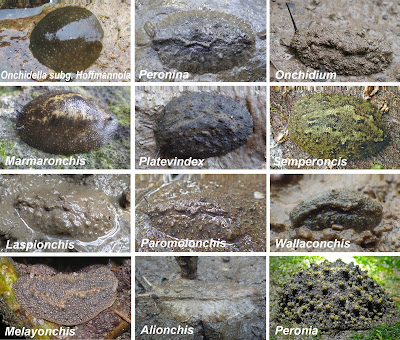
[Mollusca • 2022] Global Diversification and Evolutionary History of Onchidiid Slugs (Gastropoda, Pulmonata: Onchidiidae)


Onchidella (Hoffmannolahansi (Ev. Marcus and Er. Marcus, 1967), Sinaloa, Mexico,
photo by Q. Y. Abadia-Chanona and O. H. Avila-Poveda;  
 Peronina tenera (Stoliczka, 1869), Pulau Burung, Malaysia; 
Onchidium typhae Buchannan, 1800, Andaman Islands, India; 

Marmaronchis vaigiensis (Quoy & Gaimard, 1825), Gilimanuk, Bali, Indonesia;
 Platevindex coriaceus (Semper, 1880),  Mabini, Bohol, Philippines;
 Semperoncis cf. montana (Plate, 1893), Mt. Palali, Luzon, Philippines, at around 1400 m altitude,
photo by R. Lücking; 

Laspionchis boucheti
 
Dayrat & Goulding, 2019, 39 mm long, Can Gio, Vietnam; 
Paromoionchis tumidus (Semper, 1880), Calatagan, Batangas, Philippines; 
Wallaconchis sinanui Goulding & Dayrat, 2018, Lateri, Ambon, Indonesia; 

Melayonchis eloisae 
Dayrat, 2017, Pasir Park, Singapore; 
Alionchis jailoloensis 
Goulding & Dayrat 2018,  Kao, Halmahera, Indonesia; 
Peronia peronii (Cuvier, 1804), Mahebourg waterfront, Mauritius.

in Goulding, Khalil, Tan, et al., 2022.

Highlights: 
• A global molecular phylogeny of onchidiid slugs is reconstructed.
• The common ancestor of onchidiid slugs likely lived in the rocky intertidal.
• Onchidiids transitioned into new habitats in mangrove forests during the Miocene.
• Diversification is the result of allopatric and sympatric (ecological) speciation.

Abstract
Many marine species are specialized to specific parts of a habitat. In a mangrove forest, for instance, species may be restricted to the mud surface, the roots and trunks of mangrove trees, or rotting logs, which can be regarded as distinct microhabitats. Shifts to new microhabitats may be an important driver of sympatric speciation. However, the evolutionary history of these shifts is still poorly understood in most groups of marine organisms, because it requires a well-supported phylogeny with relatively complete taxon sampling. Onchidiid slugs are an ideal case study for the evolutionary history of habitat and microhabitat shifts because onchidiid species are specialized to different tidal zones and microhabitats in mangrove forests and rocky shores, and the taxonomy of the family in the Indo-West Pacific has been recently revised in a series of monographs. Here, DNA sequences for onchidiid species from the North and East Pacific, the Caribbean, and the Atlantic are used to reconstruct phylogenetic relationships among Onchidella species, and are combined with new data for Indo-West Pacific species to reconstruct a global phylogeny of the family. The phylogenetic relationships of onchidiid slugs are reconstructed based on three mitochondrial markers (COI, 12S, 16S) and three nuclear markers (28S, ITS2, H3) and nearly complete taxon sampling (all 13 genera and 62 of the 67 species). The highly-supported phylogeny presented here suggests that ancestral onchidiids most likely lived in the rocky intertidal, and that a lineage restricted to the tropical Indo-West Pacific colonized new habitats, including mudflats, mangrove forests, and high-elevation rainforests. Many onchidiid species in the Indo-West Pacific diverged during the Miocene, around the same time that a high diversity of mangrove plants appears in the fossil record, while divergence among Onchidella species occurred earlier, likely in the Eocene. It is demonstrated that ecological specialization to microhabitats underlies the divergence between onchidiid genera, as well as the diversification through sympatric speciation in the genera Wallaconchis and Platevindex. The geographic distributions of onchidiid species also indicate that allopatric speciation played a key role in the diversification of several genera, especially Onchidella and Peronia. The evolutionary history of several morphological traits (penial gland, rectal gland, dorsal eyes, intestinal loops) is examined in relation to habitat and microhabitat evolutionary transitions and provides the first evidence that the rectal gland of onchidiids is an adaptation to high intertidal and terrestrial habitats.

Keywords: Biogeography, divergence time, ecological speciation, habitat transition, mangroves, rocky intertidal


Photos from top to bottom are
 Onchidella nigricans (Quoy and Gaimard, 1832), 15 mm long, New South Wales, Australia; Onchidella (Hoffmannolahansi (Ev. Marcus and Er. Marcus, 1967), 40 mm long, Sinaloa, Mexico, photo by Quetzalli Yasu Abadia-Chanona and Omar Hernando Avila-Poveda;  France;
 Peronina tenera (Stoliczka, 1869), 36 mm long, Pulau Burung, Malaysia; Onchidium typhae Buchannan, 1800, 40 mm long, Andaman Islands, India;

 Melayonchis eloisae Dayrat, 2017, 15 mm long, Pasir Park, Singapore; Marmaronchis vaigiensis (Quoy & Gaimard, 1825), 23 mm long, Gilimanuk, Bali, Indonesia; 
Platevindex coriaceus (Semper, 1880), 37 mm long, Mabini, Bohol, Philippines; Semperoncis cf. montana (Plate, 1893), Mt. Palali, Luzon, Philippines, at around 1400 m altitude, photo by Robert Lücking;

 Onchidina australis (Semper, 1880), 45 mm long, Blackman Park, New South Wales, Australia; Laspionchis boucheti Dayrat & Goulding, 2019, 39 mm long, Can Gio, Vietnam; 
Paromoionchis tumidus (Semper, 1880), 31 mm long, Calatagan, Batangas, Philippines; Wallaconchis sinanui Goulding & Dayrat, 2018, 9 mm long, Lateri, Ambon, Indonesia; 
Alionchis jailoloensis Goulding & Dayrat 2018, 48 mm long, Kao, Halmahera, Indonesia; Peronia peronii (Cuvier, 1804), 110 mm long, Mahebourg waterfront, Mauritius.


Tricia C. Goulding, Munawar Khalil, Shau Hwai Tan, Rebecca A. Cumming and Benoît Dayrat. 2022. Global Diversification and Evolutionary History of Onchidiid Slugs (Gastropoda, Pulmonata). Molecular Phylogenetics and Evolution. In Press, 107360. DOI: 10.1016/j.ympev.2021.107360