Showing posts with label Cape Floristic Region. Show all posts

Wednesday, February 18, 2026

[Entomology • 2026] Richtersveldiella sanparkensis, Pentamerica gazella, Nama mirifica, ... • A New Genus and Six New Species of Namaini (Coleoptera: Curculionidae: Entiminae) from the Richtersveld (South Africa, Northern Cape)


Richtersveldiella sanparkensis 
Borovec & Meregalli, 2026

 
Abstract
One new genus and six new species of Namaini are described: Richtersveldiella sanparkensis Borovec and Meregalli, new genus and new species (type locality: Koeroegab); Pentamerica gazella Borovec and Meregalli new species (type locality: Kodaspiek); Namaquania hirta Borovec and Meregalli new species (type locality: Armmanshoek valley); Nama mirifica Borovec and Meregalli new species (type locality: south of Helskloof Pass); Nama vanwyki Borovec and Meregalli new species (type locality: Armmanshoek valley); Nama armmanshoek Borovec and Meregalli new species (type locality: Armmanshoek valley). Biological notes and comparative remarks are added, along with considerations on their distribution. An assessment of their conservation status is also proposed.

Coleoptera, weevils, taxonomy, new genus, new species, species discovery, Afrotropical region


Richtersveldiella sanparkensis Borovec & Meregalli, sp. nov.
Nama vanwyki Borovec & Meregalli, sp. nov.

Richtersveldiella sanparkensis Borovec and Meregalli, new genus and new species 

Pentamerica gazella Borovec and Meregalli new species 
Namaquania hirta Borovec and Meregalli new species 

Nama mirifica Borovec and Meregalli new species 
 Nama vanwyki Borovec and Meregalli new species 
Nama armmanshoek Borovec and Meregalli new species


Roman BOROVEC and Massimo MEREGALLI. 2026. A New Genus and Six New Species of Namaini from the Richtersveld (South Africa, Northern Cape) (Coleoptera: Curculionidae: Entiminae).  Zootaxa. 5748(2); 193-214. DOI: doi.org/10.11646/zootaxa.5748.2.2 [2026-01-13]

Wednesday, April 16, 2025

[Herpetology • 2025] Goggia sabula • A New Pygmy Gecko (Squamata: Gekkonidae: Goggia) from the arid Northern Cape Province of South Africa


Goggia sabula
Conradie, Hundermark, Kemp & Keates, 2025


Abstract
The genus Goggia is composed of ten small bodied leaf-toed gecko species endemic to South Africa and adjacent Namibia. Using a combination of phylogenetic and morphological analyses we assessed the taxonomic status of an isolated rupicolous population discovered south of Klein Pella in the Northern Cape Province of South Africa. The newly collected material was recovered as a well supported clade by two independent phylogenetic algorithms (maximum likelihood and Bayesian inference), with little intraspecies structuring. While the particular interspecific relationships among closely related Goggia remain unresolved, the phylogenetic results suggest the novel material is related to G. rupicola, G. gemmula, G. incognita and G. matzikamaensis. This is supported by the similar ecologies (rupicolous lifestyle), geographies (arid western extent of South Africa) and morphologies (prominent dorsal chevrons and yellow-centred pale dorsal spots), which are shared among these closely related species. Despite their similarity, the novel population from Klein Pella remains geographically separate, differs from congeners by an uncorrected ND2 p-distance of 11.03–22.91%, and is morphologically diagnosable. Based on these findings we describe the Klein Pella population as a new species.

Reptilia, Gekkonidae, Namibia, arid, quartzite, cryptic species


Goggia sabula


Werner CONRADIE, Courtney HUNDERMARK, Luke KEMP and Chad KEATES. 2025. New Pygmy Gecko (Goggia: Gekkonidae) from the arid Northern Cape Province of South Africa.  Zootaxa. 5618(4); 552-570. DOI: doi.org/10.11646/zootaxa.5618.4.5 [2025-04-04] facebook.com/feverhunting/posts/10229231279309947


Monday, April 8, 2024

[Botany • 2023] Indigofera gariepensis, I. tanquana, etc. (Fabaceae: Papilionoideae: Indigofereae) • Four New Species from the Greater Cape Floristic Region


 Indigofera barkeri Du Preez & Schrire,
  Indigofera gariepensis Du Preez & Schrire, 
  Indigofera tanquana Du Preez & Schrire, 
  Indigofera dodii Du Preez & Schrire

in du Preez, Schrire, Dreyer, Stirton, Chimphango et Muasya, 2023. 
 
Highlights: 
• Four species new to science are described.
• Detailed photographic plates and distribution maps are included.
• Conservation assessments are provided for all four species.

Abstract
Four new Indigofera species are described from the Greater Cape Floristic Region (GCFR). Indigofera barkeri is a new annual from the Richtersveld, with small flowers, 3.5–4.0 mm long, pinnately trifoliolate leaves and laterally flattened seeds. Indigofera dodii is endemic to the area around Cape Town, growing on granite and shaly slopes. It has apically congested racemes, flowers 6.0–6.5 mm long, digitately trifoliolate leaves, fruit with a hispid indumentum and tuberculate seed testas. Indigofera gariepensis, endemic to dry riverbeds in the eastern Richtersveld, is recognized by its alternate, silky-velutinous leaflets and calyx lobes ± equal in length to its 5.5–6.5 mm long magenta flowers. Indigofera tanquana is known from only two collections and is endemic to the western Tanqua Karoo. It is easily recognized by its broad old grey stems, spinescent branches, simple grey-canescent leaves that aggregate on woody brachyblasts and reddish-magenta flowers. Detailed morphological descriptions are presented with composite photographic plates for each species. Notes on ecology, detailed diagnoses comparing with closely related species, a distribution map and an IUCN red list conservation assessment for each species is also provided.
 
Keywords: Conservation, Desert, Fynbos, GCFR, Leguminosae, Namibia, Richtersveld, South Africa, Taxonomy


  Indigofera barkeri Du Preez & Schrire sp. nov.

  Indigofera dodii Du Preez & Schrire sp. nov.

  Indigofera gariepensis Du Preez & Schrire sp. nov.

  Indigofera tanquana Du Preez & Schrire sp. nov.


B. du Preez, B.D. Schrire, L.L. Dreyer, C.H. Stirton, S.B.M. Chimphango and A.M. Muasya. 2023. Four New Indigofera (Fabaceae: Indigofereae) Species from the Greater Cape Floristic Region. South African Journal of Botany. 162; 680-687. DOI: 10.1016/j.sajb.2023.10.003

Tuesday, January 30, 2024

[Botany • 2024] Indigofera abbottii, I. ngwenyana, etc. (Fabaceae: Papilionoideae: Indigofereae) • New and poorly known Taxa of Indigofera from the Pondoland Centre of Endemism, South Africa: Part 2


Indigofera abbottii Schrire & K.W.Grieve,

in K. W. Grieve, G. R.H. Grieve et Schrire, 2024.

 Highlights: 
• Taxonomic description of new and little known Indigofera species from South Africa.
• Four new Indigofera species, one new variety and two little known species are described.
• One established taxon is raised to specific status and described with a new name.
• An earlier name is found which has priority over an established species name.
• All taxa are associated with the Pondoland Centre of Endemism, ranging to surrounding floristic areas.

Abstract
This second paper describes and clarifies new and poorly known Indigofera species, belonging to sect. Pinnatae (E.Mey.) Harv., from the Pondoland Centre of Endemism and associated neighbouring areas in the Eastern Cape and KwaZulu-Natal provinces, South Africa. Five new species (one with two infraspecific taxa) are recognized: Indigofera abbottii Schrire and K.W.Grieve, I. hillburttii Schrire and K.W.Grieve, I. tysonii Schrire and K.W.Grieve, I. herrstreyi Schrire and K.W.Grieve var. herrstreyi and I. herrstreyi var. helodes K.W.Grieve and Schrire, and I. ngwenyana Schrire and K.W.Grieve. Descriptions are provided for the poorly known I. corniculata E.Mey. and I. gerrardiana Harv., taxa rarely taken up in the literature and both having been mostly synonymised under I. dregeana E.Mey. that occurs outside the area of the present study. The name I. tenuissima E.Mey. was found to be the earliest, correct, name for the widespread species I. longipes N.E.Br. ex Baker f., leaving the coastal Zululand taxon – currently named I. tenuissima E.Mey. – requiring further evaluation.


 Kate W. Grieve, Graham R.H. Grieve and Brian D. Schrire. 2024. New and poorly known Taxa of Indigofera (Fabaceae, Papilionoideae, Indigofereae) from the Pondoland Centre of Endemism, South Africa: Part 2. South African Journal of Botany. 164; 297-321. DOI: 10.1016/j.sajb.2023.11.027
 
Kew’s top 10 new species of 2023
Kew’s scientists and international partners share their 10 favourite new species named to science in 2023.

Thursday, November 2, 2023

[Botany • 2019] Sebaea solaris (Gentianaceae) • A New Species from the Western Cape of South Africa


Sebaea solaris Kissling, 

in Kissling et Zeltner, 2019.
 
Highlights
• A new species of Sebaea has been discovered and is here described.

Abstract
Sebaea solaris (Gentianaceae) is here described as a new species from the Overberg region, Western Cape, South Africa. This new species is at first glance very distinct from all others in the genus mainly due to its relative large yellow flowers of c. 2.5 cm diameter with oblanceolate to obdeltoid erose corolla lobes. The petal ornamentation with several orange lines indicating the flower centre (versus two lines per petal for a few other Sebaea species) and a conspicuous undulated calyx wing are also unique in the genus. Furthermore, the position of large secondary stigmas above the middle of the style (versus at the base of the style for its morphologically closest relative: S. exacoides) possibly indicates differences in pollination strategies.

Keywords: Africa, Cape floristic region, Taxonomy

 Sebaea solaris Kissling:
(A) aerial parts; (B) flower from above; (C) calyx with conspicuous undulated wings; (D) pistil; (E) open flower, showing the respective position of the anthers and pistil; (F) anther furnished with apical and basal glands; (G) anther's basal gland enlarged.
 Drawn from Kissling and Zeltner 214. 
Artist: Lena Ihringer.

Sebaea solaris Kissling, species nova 
 
Diagnosis: Sebaea solaris is a pentamerous annual herb 5–20 cm tall, which differs from all other Sebaea species by its oblanceolate to obdeltoid erose corolla lobes; its petal ornamentation with several orange lines per petal indicating the flower centre (versus two lines per petal for a few other Sebaea species) and a conspicuous undulated calyx wing (Fig. 1). The morphologically closest related species to S. solaris is S. exacoides (L.) Schinz. Sebaea solaris, in addition to the above-mentioned characters, differs from S. exacoides by the orangish outer epidermis of the corolla tube and lobes crossed by conspicuous green veins (versus no conspicuous veins); pistil with secondary stigmas situated at the midst of the style – at the anthers level (versus secondary stigmas situated at the base of the style much below the anthers level).


 J. Kissling and L. Zeltner. 2019. Sebaea solaris (Gentianaceae), A New Species from the Western cape of South Africa. South African Journal of Botany. 123; 20-22. DOI: 10.1016/j.sajb.2019.02.002

Wednesday, September 21, 2022

[Botany • 2022] Geissorhiza seracina (Iridaceae: Crocoideae) • A New High-altitude Species from the Langeberg in southwestern Western Cape, South Africa


  Geissorhiza seracina Goldblatt & J.C.Manning, 

in Goldblatt, Manning et du Preez, 2022. 

Highlights: 
• Geissorhiza seracina is described.
• It is a local endemic of the eastern Langeberg.
• It is illustrated by colour photographs.
• It is distinguished from G. altimontana by a longer perianth tube and filaments.

Abstract
The new species Geissorhiza seracina Goldblatt & J.C.Manning (Iridaceae: Crocoideae) is known from a single locality on the central Langeberg Mountains in Western Cape, South Africa. Discovered in December 2021, G. seracina is restricted to high altitude seepages in peaty soils. The soft corm tunics and moderately large, deep pink flowers suggest that it is allied to another Langeberg endemic, G. altimontana Goldblatt & J.C.Manning of subg. Weihea sect. Weihea, but it differs from that species in lacking fibrous leaf bases, in its mostly fewer leaves, and in its flowers, which have a longer perianth tube 18–23 mm long, with longer filaments, 11–12 mm long, inserted well below the mouth of the tube. It is illustrated by colour photographs. In addition, re-examination of collections of the poorly collected G. outeniquensis Goldblatt necessitates that the recorded length of the perianth tube for that species be significantly extended. Originally recorded as 10–13 mm long, the perianth tube in G. outeniquensis is now determined to be (10–)13–20 mm long.
 
Keywords: Cape Flora, New taxa, Taxonomy, Systematics


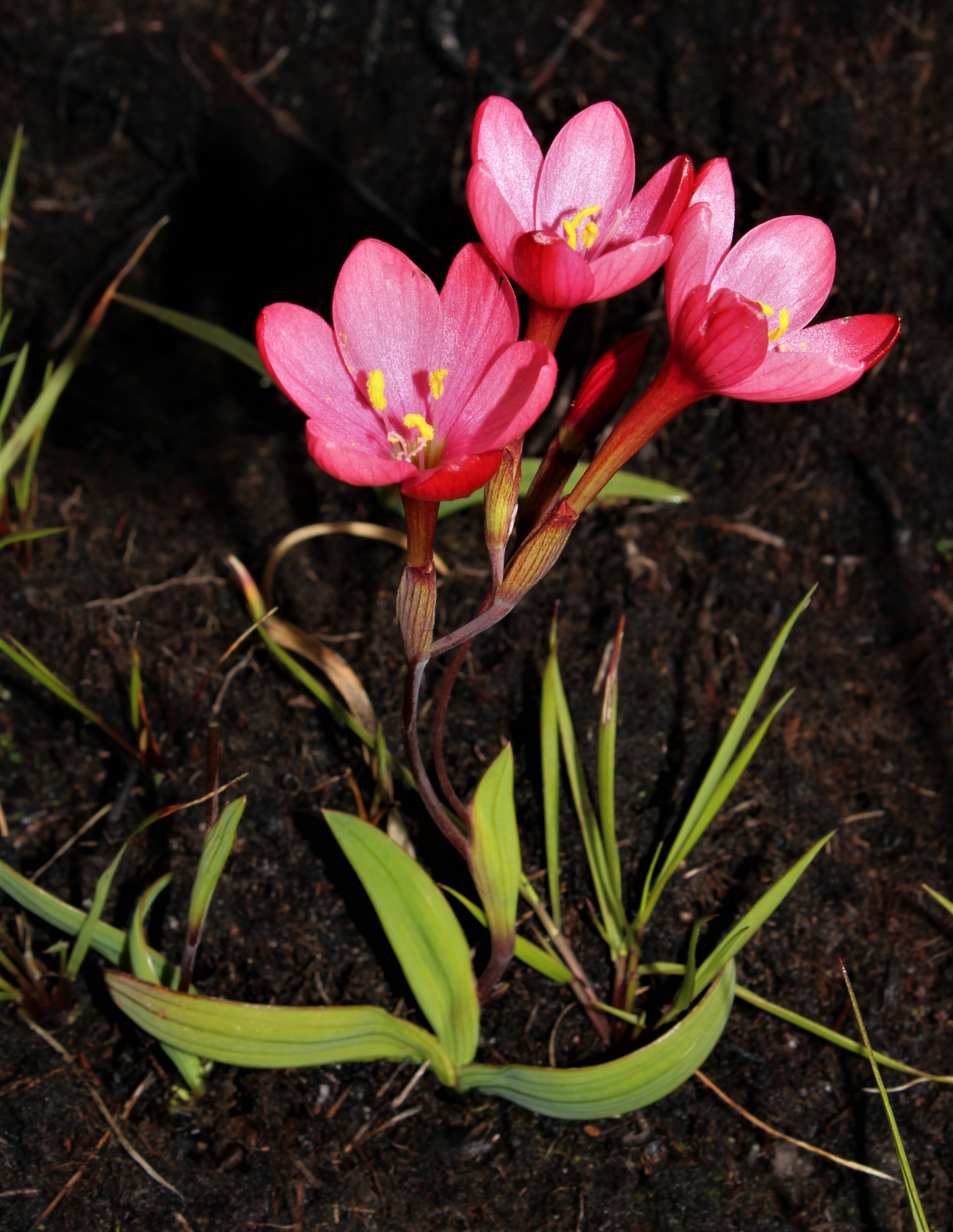
  Geissorhiza seracina.
Western Cape, Langeberg, Boosmansbos Wilderness.
 
  Geissorhiza seracina Goldblatt & J.C.Manning

Etymology: Geissorhiza seracina is named for the cherry-pink flowers.

 
P. Goldblatt, J.C. Manning and B. du Preez. 2022. Geissorhiza seracina (Iridaceae: Crocoideae), A New High-altitude Species from the Langeberg in southwestern Western Cape, South Africa, with notes on G. outeniquensis. South African Journal of Botany. 150; 1022-1025. DOI: 10.1016/j.sajb.2022.09.014 

Sunday, August 14, 2022

[Botany • 2018] Psoralea forbesiae (Fabaceae: Psoraleeae) • A New Species from the Swartberg Mountains of South Africa


  Psoralea forbesiae C.H.Stirt., A.Bello & Muasya, 

in Stirton, Bello & Muasya, 2018.

Abstract
Psoralea forbesiae C.H.Stirt., A.Bello & Muasya is a new species of Psoraleeae, Fabaceae. Psoralea forbesiae is endemic to the Swartberg Mountains and is a tall densely branched re-sprouting shrub up to 2.5 m, with bluish-green stems and with most parts covered in small crater-like glands, leaves pinnately 3-foliolate, linear-oblong, pale bluish-green, semi-conduplicate, somewhat succulent, glabrous, crowded at the end of bare branches on older stems or distributed along short branches on young shoots, petiolate. A description of P. forbesiae, together with photographs and a distribution map are presented.

Keywords: Leguminosae , New species, Endemic, Psoralea , Psoraleeae , South Africa, Taxonomy


  Psoralea forbesiae C.H.Stirt., A.Bello & Muasya:
A front view of flower B Fruiting calyces C Side view of flower D Habit E Back of standard F Stipule G Fruiting calyx H Leaf I Stem.
Photographs by Charles Stirton and Abubakar Bello. 
Voucher Stirton & Muasya 13279 (BOL).

 Psoralea forbesiae C.H.Stirt., A.Bello & Muasya, sp. nov.
 Psoralea sp. 15, Stirton & Schutte 
in Manning & Goldblatt, Strelitzia 29: 574 (2012).

Diagnosis: Similar to P. axillaris L., but differs in being a resprouter with numerous shoots emerging from a woody rootstock; older plants producing a cluster of shoots (burst-branching) at the ends of the previous seasons’ terminal shoots giving an untidy habit (versus a much-branched reseeder with single stem, never with burst branching); stems coarsely fissured and greyish with age (versus furrowed, heavily lenticelled and brownish); leaves 3-foliolate; leaflets partially conduplicate, linear-oblong, with raised crater-like glands and scarcely visible veins (versus leaves 3–5-foliolate; flat, lanceolate, distinctly veined with small sunken glands); lateral leaflets symmetrical, 2–3 mm broad (versus lateral leaflets asymmetrical, 3–8 mm. broad); flowers well exerted from leaves, mauve to pale lavender, wings white (versus mostly hidden within leaves, mauve to purple with purple veins, wings mauve); standard white to pale mauve and with a single purple vertical flash plus a few shorter darker veins towards base of standard, apex greenish on front and back (versus mauve with strongly purple veins and violet basal patch, apex not greenish on front and back); wing petals flared outwards (versus wing petals held vertically).

Distribution, habitat and ecology: Psoralea forbesiae is a locally common species known only from the mid- to upper altitudes on the southern slopes and plateau of the Swartberg Mountains of the Western Cape Province (Fig. 2). It occurs in seepages, gulleys and along streams in mountain fynbos between 1200–1700 m (a.s.l.). It is restricted to the South Swartberg Sandstone Fynbos and North Swartberg Sandstone Fynbos vegetation types (FFs 23 & FFs 24) (Mucina and Rutherford 2006). It forms part of an introgressive hybrid swarm with P. sordida on the flanks of the road leading up the southern slopes of the Swartberg Pass (Bello et al. 2018). The flowers are visited by black Megachilid and Xylocopid bees.
 
Etymology: The specific epithet forbesiae honours Scottish born Helena Madelain Lamond Forbes (1900–1959) who immigrated to South Africa with her parents when young. She worked at the National Herbarium in Pretoria, visited Kew Gardens for one year and ended up as the Curator of the Natal Herbarium (NH). She wrote local floras of Isipingo and Malvern districts in Natal but is best known for her revisions of Tephrosia and Psoralea in South Africa (see Gunn and Codd 1981, Glen and Germishuizen 2010).


 Charles H. Stirton, Abubakar Bello and A. Muthama Muasya. 2018. Psoralea forbesiae (Psoraleeae, Fabaceae), A New Species from the Swartberg Mountains of South Africa. PhytoKeys. 99: 93-98. DOI: 10.3897/phytokeys.99.24765

Thursday, July 28, 2022

[Botany • 2022] Heliophila verna (Brassicaceae) • A New Species from the Northern Cape of South Africa


Heliophila verna

in Al-Shehbaz, Mandáková, Mummenhoff & Lysak, 2022. 

Abstract
The new species Heliophila verna is described, illustrated, and its distinguishing characters from the related glabrous annuals, especially H. namaquana is discussed. Its chromosome number (2n = 18) is reported here.
 
Keywords: Eudicots, Brassicaceae, Cruciferae, cytogenomics, Heliophila, South Africa


Heliophila verna


 Ihsan A. Al-Shehbaz, Terezie Mandáková, Klaus Mummenhoff and Martin Lysak. 2022. Heliophila verna (Brassicaceae), A New Species from the Northern Cape of South Africa. Phytotaxa. 555(2); 195–199. DOI: 10.11646/phytotaxa.555.2.8 

Sunday, June 5, 2022

[Botany • 2022] Cyrtanthus novus-annus (Amaryllidaceae: Cyrtantheae) • A New Species of Cyrtanthus from the Agulhas Plain, Western Cape, South Africa


Cyrtanthus novus-annus Snijman, 

in Snijman, 2022.
 
Highlights
• A new species, Cyrtanthus novus-annus adds another narrowly endemic species on the Agulhas Plain, South Africa.
• Based on morphology Cyrtanthus novus-annus is inferred to be sister to C. guthrieae.
• The species pair occupies divergent edaphic sites.

Abstract
Described is a new species of Cyrtanthus within the monogeneric tribe Cyrtantheae (Amaryllidaceae: Amaryllidoideae) from the low-lying Agulhas Plain, Western Cape, South Africa. Known from the Nuwejaars Wetlands area, Cyrtanthus novus-annus occupies habitats transitional between Elim Ferricrete Fynbos and Central Rûens Shale Renosterveld. The erect, mostly solitary-flowered inflorescence has a nearly sessile, funnel-shaped flower in common with C. guthrieae, which occurs on the mountains close to Bredasdorp in acidic soils of Overberg Sandstone Fynbos. The two species differ in the size, colouring, and markings of the flowers and in their flowering times. Their morphological similarity and the close proximity of their habitats suggest that C. novus-annus and C. guthrieae constitute an example of edaphically differentiated sister taxa, a pattern found in several other endemics of the region, as well as in the sister pair Brunsvigia elandsmontana and B. marginata (tribe Amaryllideae) from contrasting habitats in Swartland lowland alluvium and the abutting sandstone mountains, respectively.
 
Keywords: Core Cape Floristic Region, Edaphic differentiation, Endemics, South Africa, Taxonomy

 Flowering plants. A–C, Cyrtanthus novus-annus;
D, C. guthrieae.
Photographs by G. Nichols (A and B); J. Manning (C); C. Paterson-Jones (D).


Cyrtanthus novus-annus Snijman, sp. nov.

New species allied to C. guthrieae L.Bolus, with which it has few, linear leaves, an erect, mostly solitary-flowered inflorescence and a nearly sessile, funnel-shaped flower. It differs in its lower stature, ± 160 mm when flowering, smaller delicate pink flowers which appear in mid to late summer, smaller tepals 20–25 × 7–8 mm with dark pink keels, and short stamens exserted from the throat by 10–15 mm.

Etymology: The species epithet honours the recent restoration of biodiversity in the Nuwejaars Wetlands area.


 D.A. Snijman. 2022. A New Species of Cyrtanthus (Amaryllidaceae: Cyrtantheae) from the Agulhas Plain, Western Cape, South Africa. South African Journal of Botany. 148; 601-604. DOI: 10.1016/j.sajb.2022.05.027

Saturday, October 2, 2021

[Botany • 2021] Indigofera wenholdiae (Fabaceae, Indigofereae) • A New Species from the Western Cape Province, South Africa


 Indigofera wenholdiae du Preez & Schrire, 

in du Preez, Dreyer, ... et Schrire, 2021. 

Abstract
In this study, Indigofera wenholdiae, a new species of Fabaceae from the Agulhas Plain Region of the Western Cape Province, South Africa, is described. A composite photographic plate is included along with a distribution map, description of habitat and ecology and proposed IUCN conservation status. Indigofera wenholdiae is unique in the I. brachystachya group by having digitately compound (vs. pinnately compound) leaves, white and unscented flowers (vs. pink and sweetly scented flowers) and grows on sandstone hillsides (vs. coastal limestone plains and outcrops).

Keywords: Indigofera, Leguminosae, Greater Cape Floristic Region, fynbos, taxonomy


Figure 1. Indigofera wenholdiae du Preez & Schrire
 A single inflorescence B flower lateral view C leaf abaxial view D multiple inflorescences on branches E whole plant.
Photographs by Brian du Preez. Voucher B. du Preez 836 (BOL).

Indigofera wenholdiae du Preez & Schrire, sp. nov.
 
Diagnosis: Similar to I. brachystachya, but differs in its digitately compound, 5–7 foliolate leaves (versus pinnately compound, 7–9 foliolate leaves), leaflets 4–6 mm long (versus leaflets 9–15 mm long), racemes up to 7 mm long, flowers ± 4–5 per raceme (versus racemes > 10 mm long, flowers > 8 per raceme), flowers creamy white, unscented (versus flowers pale pink, scented), branching divaricate (versus branching random), populations restricted to sandstone fynbos (versus populations restricted to limestone fynbos).

Etymology: The specific epithet “wenholdiae” is assigned in honour of Mrs Hannerie Wenhold who has funded large-scale conservation efforts in this area, including the funding of the botanist post at Grootbos Nature Reserve of Miss Rebecca Dames who brought this species to our attention in April 2020.


 Brian du Preez, Leanne L. Dreyer, Charles H. Stirton, A. Muthama Muasya and Brian D. Schrire. 2021. Indigofera wenholdiae (Indigofereae, Fabaceae), A New Species from the Western Cape Province, South Africa. PhytoKeys. 182: 107-112.  DOI: 10.3897/phytokeys.182.72170


Tuesday, February 23, 2021

[Botany • 2021] Crassula × mortii (Crassulaceae: Crassuloideae) • A New Natural Hybrid Between C. perforata and C. rubricaulis from South Africa’s southern Cape


Crassula ×mortii

in Smith & Crouch, 2021. 

In terms of species-level diversity, the genus Crassula Linnaeus (1753: 282) is by far the most diverse in the Crassulaceae within the Flora of Southern Africa region [Namibia, Botswana, Eswatini (formerly Swaziland), Lesotho, South Africa] (Tölken 1977a, b, 1985). In this region diversity is highest in the Fynbos and Succulent Karoo Biomes, both of which straddle the southern Cape, an area represented in the Western and Eastern Cape provinces.

Keywords: taxonomy, Crassula, nothospecies, Eudicots


Gideon F. Smith and Neil R. Crouch. 2021. Crassula ×mortii (Crassulaceae subfam. Crassuloideae), A New Natural Hybrid Between C. perforata and C. rubricaulis from South Africa’s southern Cape. Phytotaxa. 487(1); 97–102. DOI: 10.11646/phytotaxa.487.1.9

Monday, February 15, 2021

[Botany • 2021] A Monograph of the Genus Polhillia (Fabaceae: Genisteae)


Polhillia fortunata B.du Preez, sp. nov.
  Polhillia groenewaldii B.du Preez, sp. nov.  
 
Subgen. Roseopolhillia B.du Preez, subgen. nov.
Polhillia involucrata (Thunb.) B.-E.van Wyk & A.L.Schutte

in du Preez, Dreyer, Stirton et Muasya, 2021. 
 Scale bars: 4 mm. Photographs by B. du Preez


Highlights: 
• Four new species are described.
• Polhillia canescens synonymized under P. connata.
• Molecular phylogenetic reconstruction confirms monophyly of the genus.
• New monotypic subgenus described.
• Updated Red Data List status for all 11 Polhillia species.

Abstract
Polhillia is a small, but poorly known genus of legumes endemic to the Greater Cape Floristic Region (GCFR) of South Africa. The genus was described three decades ago to accommodate species erroneously placed in Argyrolobium and other Cape legume genera. Polhillia is the third most threatened plant genus in South Africa, hence priority for taxonomic study and current knowledge on distribution patterns are essential for conservation interventions. Eight species were known at the start of this study, all of which are threatened with extinction. Species boundaries were, however, unclear and many Renosterveld fragments, in particular in the Overberg, required further exploration in pursuit of the various Polhillia species. The phylogenetic relationships among species and monophyly of the genus, especially regarding the position of the morphological aberrant P. involucrata, had not been tested. This study was built upon a foundation of widespread field sampling and analysis of herbarium specimens. Having considered morphological, anatomical, palynological and molecular data, we present an updated taxonomy of the genus Polhillia. Morphological characters between species were often obscure and unique characters were uncommon, as such species are recognized based on unique combinations of characters. Pollen and leaf anatomical studies did not provide substantial taxonomically informative characters, although some interspecific differences were noted. Molecular phylogenetic reconstructions confirm Polhillia to be monophyletic and sister to Argyrolobium, and that Argyrolobium may not be monophyletic. The morphologically distinct species, P. involucrata, is strongly supported as sister to the rest of the genus. Internal phylogenetic resolution in Polhillia is weak in many clades, due to the low variability among DNA markers studied, and several polytomies are still present. Based on the morphological and molecular evidence, we place P. involucrata in the new monotypic subgenus Roseopolhillia. Four new species are described (P. fortunata B.du Preez, P. groenewaldii B.du Preez, P. stirtoniana B.du Preez, P. xairuensis B.du Preez), and a previously recognized species (P. canescens C.H.Stirt.) is placed in synonymy under P. connata (Harv.) C.H.Stirt. Red data list assessments are provided for all species to highlight their conservation importance. Maps and compound colour plates are provided for each species.
 
Keywords: Polhillia, Cape flora, Conservation, Legumes, New species, Phylogeny, Taxonomy


Polhillia C.H.Stirt. subgen. Polhillia 
Type species: Polhillia obsoleta (Harv.) B.-E.van Wyk 
(=Polhillia waltersii (C.H.Stirt.) C.H.Stirt.)

Shrubs erect or spreading, sprouting from rootstock after fire; stipules 2, deltoid, sericeous, veins not visible, connate around base, sheathing stem, often persistent; leaves subsessile or petiolate in P. brevicalyx, pubescent, conduplicate (or flattened in P. ignota); flowers single, paired or in clusters (4–5 in P. brevicalyx, P. ignota and P. fortunata), subsessile or pseudo-pedunculate up to 15 mm long; flowers yellow, 8–13 mm long; calyx yellow-green, often flushed red, villous or sericeous; standard broadly ovate, apex emarginate, pubescent abaxially; wing petals variable in shape and sculpturing, mostly glabrous or pilose along midrib; keel petals variable in shape and level of pubescence, usually restricted to the fore edge; pistil green, sericeous or villous, ovules 7–12, style sub-erect to erect; fruit indehiscent, oblong, laterally compressed between seeds, plicate in P. ignota, P. obsoleta, P. groenewaldii, and P. fortunata, sericeous to glabrescent; seeds ovate-reniform, smooth, uniformly coloured, olive green to dark brown (except for P. connata and P. pallens that have occasional mottling).

 Species included: 
1. Polhillia brevicalyx (C.H.Stirt.) B.-E.van Wyk & A.L.Schutte
2. Polhillia connata (Harv.) C.H.Stirt.
3. Polhillia curtisiae C.H.Stirt. & Muasya
4. Polhillia fortunata B.du Preez
5. Polhillia groenewaldii B.du Preez
6. Polhillia ignota Boatwr.
7. Polhillia obsoleta (Harv.) B.-E.van Wyk
8. Polhillia pallens C.H.Stirt.
9. Polhillia stirtoniana B.du Preez
10. Polhillia xairuensis B.du Preez

 Etymology: The generic and subgeneric epithet Polhillia honours the renowned botanist and legume systematist Dr. Roger M. Polhill from the Royal Botanical Gardens, Kew (Stirton. 1986a).


Fig. 20. Composite plate of Polhillia involucrata.
 1 – Inflorescence with pink flowers; 2 – Inflorescence with white flowers; 3 – Side view of inflorescence showing pink-flushed sepals; 4 – Calyx; 5 – Flower side view; 6 – Flower bottom view; 7 – Wing petals; 8 – Keel petal; 9 – Androecium; 10 – Gynoecium; 11 – Fruit; 12 – Dehiscent fruit on bush; 13 – Close-up of leaves and stipules; 14 – Habit.
Scale bars: 4 mm. Photographs by B. du Preez

Fig. 20. Composite plate of Polhillia involucrata.
1 – Inflorescence with pink flowers; 2 – Inflorescence with white flowers;
3 – Side view of inflorescence showing pink-flushed sepals;12 – Dehiscent frfrfruit on bush;
 13 – Close-up of leaves and stipules; 14 – Habit.
Scale bars: 4 mm. Photographs by B. du Preez

Polhillia C.H.Stirt. Subgen. Roseopolhillia B.du Preez, subgen. nov.
 
Type species: Polhillia involucrata (Thunb.) B.-E.van Wyk & A.L.Schutte,
 Kew Bulletin 44: 3 (1989).

Shrubs erect, sprouting from rootstock after fire; stipules 2, deltoid-oblong, glabrous abaxially, villous adaxially with three prominent veins, connate around base, sheathing stem, often persistent; leaves digitately trifoliolate, shortly petiolate, glabrous or rarely sparsely hairy, conduplicate; inflorescence terminal, flowers in clusters of 2–5, subsessile, surrounded by enlarged stipules; flowers rose pink or rarely white, 10–12 mm long; calyx with trifid ventral lip, sparsely pilose, green, often flushed maroon; standard broadly elliptic to ovate, apex emarginate, pubescent only along abaxial midrib; wing petals broadly oblong with lamellate sculpturing along most part of dorsal half; keel petals lunate, pilose along ventral fore edge; stamens 10, monadelphous with single dorsal slit, filaments fused for most of their length, anthers alternating between long and short; pistil sericeous, variable in length, ovules 7, style sub-erect, stigma regular, capitate; fruit dehiscent, pale cream-brown, oblong, laterally compressed between seeds, sericeous; seeds ovate-squared, smooth, dark-brown to mottled pale-orange.

 Species included: Polhillia involucrata (Thunb.) B.-E.van Wyk & A.L.Schutte.

  Etymology: The subgeneric epithet Roseopolhillia was chosen to highlight the distinct and diagnostic rose pink coloured flowers unique to Polhillia species.


 Polhillia fortunata B.du Preez, sp. nov.  1 – Flower front view; 3 – Flower bottom view; 9 – Close-up of leaves and stipules; 11 – Habit.  
 Polhillia groenewaldii B.du Preez, sp. nov. 1 – Flower front view; 2 – Flower side view; 9 – Fruit; 10 – Habit.  

Polhillia stirtoniana B.du Preez, sp. nov. 1 – Flower front view; 2 – Flower side view; 8 – Fruit; 9 – Close-up of recurved leaves and stipules; 10 – Habit. 
Polhillia xairuensis B.du Preez, sp. nov. 1 – Flower front view; 2 – Flower side view; 9 – Leaves and stipules; 10 – Close-up of leaf; 11 – Habit. 
 Scale bars: 4 mm. Photographs by B. du Preez


Polhillia fortunata B.du Preez, sp. nov.  1 – Flower front view; 3 – Flower bottom view; 9 – Close-up of leaves and stipules; 11 – Habit. Scale bars: 4 mm. 
 Polhillia groenewaldii B.du Preez, sp. nov. 1 – Flower front view; 2 – Flower side view; 9 – Fruit; 10 – Habit. Scale bars: 4 mm. 
 Scale bars: 4 mm. Photographs by B. du Preez

Polhillia fortunata B.du Preez

 Etymology: The specific epithet is a direct translation from Latin meaning “lucky”. This epithet was selected as the discovery of this species was fortuitous. The area in which this species occurs was burnt in a massive fire for the first time in nearly 100 years in February 2018, allowing profusion of resprouting shrubs to be visible from the road in what was previously near-senescent Renosterveld vegetation.


Polhillia groenewaldii B.du Preez

Etymology: The specific epithet “groenewaldii” honours Mr Jannie Groenewald who first discovered this species and brought it to our attention. This honours the incredible work he has done in increasing our knowledge of new species and also new populations of threatened species in the Overberg region. This is also in recognition of the tremendous help he provided during fieldwork conducted for this study.


Polhillia stirtoniana B.du Preez, sp. nov. 1 – Flower front view; 2 – Flower side view; 8 – Fruit; 9 – Close-up of recurved leaves and stipules; 10 – Habit. 
Polhillia xairuensis B.du Preez, sp. nov. 1 – Flower front view; 2 – Flower side view; 9 – Leaves and stipules; 10 – Close-up of leaf; 11 – Habit.
 Scale bars: 4 mm. Photographs by B. du Preez
    
Polhillia stirtoniana B.du Preez

Etymology: The specific epithet honours Prof. Charles Howard Stirton for his extensive work on Cape legumes and his late wife, Dr Jana Stirton (Born Žantovská) who shared his love and passion for the diversity and conservation of the Overberg Renosterveld. They assisted in the formation of the Overberg Renosterveld Conservation Trust and establishment of the Haarwegskloof Private Nature Reserve and research centre. Prof. Stirton has significantly mentored the first author in his development as botanist.


Polhillia xairuensis B.du Preez

Etymology: The specific epithet is derived from the Hessequa Khoi name for the Suurbraak area, namely “!Xairu” which means ‘Beauty’ or ‘A place called Paradise’, referring to the beautiful nature of the area (Fourie, 2013). Pronunciation of the epithet can be with or without a click. Although much of the area has now been transformed for agriculture, the Langeberg Mountains above the town of Suurbraak remain scenic and lowland vegetation fragments hold beautiful floral gems such as this Polhillia species.


  B. du Preez, L. L. Dreyer, C. H. Stirton and A. M. Muasya. 2021. A Monograph of the Genus Polhillia (Genisteae: Fabaceae).  South African Journal of Botany. 138; 156-183. DOI: 10.1016/j.sajb.2020.12.022