Showing posts with label Author: Sutcharit. Show all posts

Sunday, June 28, 2026

[Mollusca • 2022] Burmochlamys fasciola, B. albida, B. versicolor, ... • Uncovering local Endemism from southeastern Myanmar: Description of the New Karst-associated Terrestrial Snail Genus Burmochlamys (Eupulmonata: Helicarionidae)


Burmochlamys Pholyotha & Panha,
A Burmochlamys fasciola sp. nov. paratype showing left and right lateral views;  
D B. albida sp. nov. paratype; E B. moulmeinica sp. nov. paratype;
F B. versicolor sp. nov. paratype; G B. whitteni sp. nov. paratype 

in Pholyotha, Sutcharit, Lin et Panha, 2022.   

Abstract
Salween River basin’s karst ecosystems in southeastern Myanmar remain largely unexplored and are likely to harbour a high terrestrial snail diversity that are often associated with high levels of snail endemism. Here, an outstanding group of new karst-associated terrestrial snailsBurmochlamys gen. nov., are discovered. A study of the comparative morphological and anatomical data reveals that the reproductive tract and radula of this new genus are closely related to the helicarionid genus Sophina Benson, 1859 but shell morphology (shape, size, and sculpture) and mantle extensions are distinct from the latter genus. Burmochlamys gen. nov. now consists of four known nominal species, B. cassidula comb. nov., B. cauisa comb. nov., B. perpaula comb. nov., and B. poongee comb. nov., and five new species; B. albida sp. nov., B. fasciola sp. nov., B. moulmeinica sp. nov., B. versicolor sp. nov., and B. whitteni sp. nov. The highlight is that the members of the new genus show site-specific endemism, being restricted to karstic habitat islands of the Salween River basin. In addition, the discovery supports that the unique and complex structure of Salween River basin’s karst ecosystems are habitats in which the terrestrial malacofauna have speciated and become endemic.

Keywords: Diversity, endemic, Indochina, land snail, limestone, Salween River basin, taxonomy


Family Helicarionidae Bourguignat, 1877
Subfamily Durgellinae Godwin-Austen, 1888

Living snails of Burmochlamys species
Burmochlamys fasciola sp. nov. paratype CUMZ 14214 showing left and right lateral views B B. cassidula specimen CUMZ 14209
C B. poongee specimen CUMZ 14210 D B. albida sp. nov. paratype CUMZ 14212
E B. moulmeinica sp. nov. paratype CUMZ 14217 F B. versicolor sp. nov. paratype CUMZ 14219 G B. whitteni sp. nov. paratype CUMZ 14222.

Genus Burmochlamys Pholyotha & Panha, gen. nov.
 
Type species: Burmochlamys fasciola sp. nov., by original designation.

Etymology: The name combines Burmo in reference to Burma, the historical name of Myanmar, and the Greek word chlamys meaning mantle or cloak in reference to land snail with well-developed mantle extensions. Therefore, the generic name means the Burmese land snail with the well-developed mantle extensions. The gender of the new generic name is feminine.

Diagnosis: Shell subglobose to globose, small size, little high spire, and sculptured with spiral furrows and undulating radial lines. Snail with five well-developed mantle extensions; caudal horn raised. Genitalia with penial retractor muscle attached at tip of epiphallic caecum; gametolytic organ with rather short to moderate cylindrical duct and bulbous sac; well-developed dart apparatus; flagellum absent. Radula with large monocuspid central tooth and attached by two smaller teeth; laterals and marginals undifferentiated, large monocuspid, and at base of each tooth on outer side attached by a smaller tooth.

B. cassidula comb. nov., B. cauisa comb. nov.
B. perpaula comb. nov., and B. poongee comb. nov.
and five new species; B. albida sp. nov., B. fasciola sp. nov., 
B. moulmeinica sp. nov., B. versicolor sp. nov., and B. whitteni sp. nov.

A adult of Burmochlamys moulmeinica sp. nov. while climbing slowly on the karst wall after raining at Lun Nya Pagoda B mating pairs of B. versicolor sp. nov. on the karst wall at Bayin Nyi Cave
B. versicolor sp. nov. eaten by the carnivorous snail Carinartemis sp. on the karst wall at Bayin Nyi Cave D B. cassidula eaten by the carnivorous snail Haploptychius sp. on the karst wall at Kaw Gon Cave. 


 Arthit Pholyotha, Chirasak Sutcharit, Aung Lin and Somsak Panha. 2022. Uncovering local Endemism from southeastern Myanmar: Description of the New Karst-associated Terrestrial Snail Genus Burmochlamys (Eupulmonata, Helicarionidae).  ZooKeys. 1110: 1-37. DOI: doi.org/10.3897/zookeys.1110.82461 

Saturday, January 3, 2026

[Mollusca • 2021] Hemiplecta nemorosa • Systematic Review of the Dextral Hemiplecta Albers, 1850 (Eupulmonata: Ariophantidae) from Thailand with Description of A New Species and List of All the Indochinese Species


Hemiplecta humphreysiana from Singapore; B Hemiplecta distincta from Saraburi, Thailand;
D, E Hemiplecta funerea from Nan, Thailand D yellow shell form and E dark shell form;
  F Hemiplecta esculenta from Chiang Mai, Thailand; 
Hemiplecta nemorosa  Sutcharit & Panha, 2021


Abstract
The genus Hemiplecta is a group of large-sized land snails which have long been used as a food resource by Indochinese people. There are five dextral and four sinistral species currently recognized from Thailand. The dextral group is comprised of two previously recorded species (H. humphreysiana and H. distincta), two newly recorded species (H. funerea and H. esculenta), and one new species (Hemiplecta nemorosa sp. nov.) from northern Thailand is being proposed. We reassessed the diagnostic characters of the genitalia, mantle edge, and radula. Specimens were classified into the genus Hemiplecta on the basis of the penial verge and shell lobe, and on the characters of a bulbous gametolytic sac without a gametolytic duct. A complete species list, together with photographs of the name-bearing types or authenticated specimens and the taxonomic status of Hemiplecta s.l. that are known from Indochina including Peninsular Malaysia and Myanmar, is provided for the first time. In total, this species list contains 39 available nominal species names described from this area. Type or authentic specimens can be located for 37 nominal species names, of which 25 are illustrated herein and the other 12 were recently illustrated. However, two available species-level names could not be traced to any type specimens. In addition, lectotypes of H. funerea and H. pluto are designated herein to stabilize the names.

Keywords: Conservation, edible snails, lectotype, Southeast Asia, taxonomy type specimen

Living snail.
Hemiplecta humphreysiana from Singapore (width about 45 mm)
B, C Hemiplecta distincta B from Saraburi, Thailand (width about 65 mm) and C mating pairs
D, E Hemiplecta funerea from Nan, Thailand (width about 50 mm) D yellow shell form and E dark shell form (width about 50 mm)  
Hemiplecta esculenta from Chiang Mai, Thailand (width about 30 mm).


 Chirasak Sutcharit and Somsak Panha. 2021. Systematic Review of the Dextral Hemiplecta Albers, 1850 (Eupulmonata, Ariophantidae) from Thailand with Description of A New Species and List of All the Indochinese Species. ZooKeys. 1047: 101-154. DOI: 10.3897/zookeys.1047.65735

Sunday, August 24, 2025

[Mollusca • 2025] Clostophis udayaditinus • First Record of the Microsnail Genus Clostophis Benson, 1860 (Eupulmonata: Pupilloidea: Hypselostomatidae) from Cambodia, with Description of A New Species


Clostophis udayaditinus Sutcharit & Panha,

in Sutcharit, Thi, Chantha, Chourn, Sophea, Jeratthitikul, Pholyotha, Siriwut, Srisonchai et Panha, 2025. 
Journal of Conchology. 45(3)

Abstract
 Specimens of a new species of hypselostomatid microsnail, Clostophis udayaditinus Sutcharit & Panha, n. sp., were collected from the limestone hills area in Battambang Province, western Cambodia. Besides being a species new to science, this discovery represents a new country record for the genus. The new species differs from all other congeners by its concave-conical shell, with apertural dentition four in number, and hooked parietal and columellar lamellae. Living snails were found crawling on the walls in a cave, and the snails have a colourless, semitransparent soft body.

Key words. Angkor Kingdom, endemic species, limestone, pulmonates, taxonomy

Clostophis udayaditinus n. sp.  from the type locality.
A–C, paratype CUMZ 14466 of living snails crawling on wet tissue paper (three snails at different angles; all shell widths about 1.3 mm). D, light microscope image of paratype CUMZ 14467 with enlarged aperture at different angles.
 Abbreviations: c = columellar lamella, ip = infraparietal lamella, p = parietal lamella, pl = palatal plica.

Clostophis udayaditinus n. sp. from Battambang, Cambodia.
A, holotype CUMZ 14441 with enlarged aperture at different angles, and enlarged columellar lamella and palatal plica, and B, C, protoconch. D, paratype CUMZ 14446 from the type locality.
 Abbreviations: c = columellar lamella, ip = infraparietal lamella, p = parietal lamella, pl = palatal plica.

Family Hypselostomatidae Zilch, 1959 

Clostophis Benson, 1860
 Type species. Clostophis sankeyi Benson, 1860, by monotypy. 

Remarks. Until now, the genus Clostophis has been known to be widely distributed from Peninsular Malaysia to Myanmar, mainland Indochina, and southern China (Páll-Gergely et al. 2020; Páll-Gergely & Hunyadi 2022; MolluscaBase Eds 2024). There are 20 species known from Cambodia, including the new species, described here.

Clostophis udayaditinus Sutcharit & Panha, n. sp. 

Diagnosis. Shell concave-conical, with long, descending tuba and expanded peristome. Apertural dentition four: consisting of one hooked parietal lamella, one small infraparietal lamella, one large, strong palatal plica, and one hooked columellar lamella. Umbilicus wide.

Etymology. The species name udayaditinus is from “udayadit-”, and the suffix “-inus”, meaning possession or belonging to. This name is a memorial to King Udayadityavarman II, who ruled the Angkor Kingdom around 1100 A.D. He also ordered the building of the Bannan Temple (Higham 2014), which became the name of the hill—the type locality of this new species.


Chirasak Sutcharit, Sothearen Thi, Nasak Chantha, Phyroum Chourn, Chhin Sophea, Ekgachai Jeratthitikul, Arthit Pholyotha, Warut Siriwut, Ruttapon Srisonchai and Somsak Panha. 2025. First Record of the Microsnail Genus Clostophis Benson, 1860 (Eupulmonata: Pupilloidea) from Cambodia, with Description of A New Species. Journal of Conchology. 45(3); DOI. doi.org/10.61733/jconch/4538  [23 February 2025] 

Monday, September 23, 2024

[Mollusca • 2024] Cenonovaculina siamensis • Molecular phylogeny reveals Cenonovaculina gen. nov. (Adapedonta: Pharidae), A New freshwater razor clam Genus from Indochina


Cenonovaculina gen. nov. 
Cenonovaculina siamensis (Morlet, 1889), from Bang Pakong River, Prachin Buri, Thailand

in Jeratthitikul & Sutcharit, 2024. 
หอยเสียบน้ำจืดสยาม  ||  DOI: 10.1071/IS24024 
photos: Kongkit Macharoenboon

Abstract  
The razor clam genus Novaculina is a secondary marine-derived freshwater taxa within the otherwise exclusively marine family Pharidae. Novaculina currently comprises four valid species that are distributed allopatrically across several drainages in Asia. We employed an integrated approach, combining morphology and molecular phylogenetic analyses to elucidate the taxonomic placement of members within this genus. The multi-locus phylogenetic trees based on cytochrome c oxidase subunit I (COI), 16S rRNA and 28S rRNA gene sequences demonstrate that Novaculina is polyphyletic. Specimens identified as N. siamensis form a distinct clade that is not sister group to other currently recognised congeners. Furthermore, morphological examination reveals distinct characteristics in ‘N. siamensis’, namely a fused, fringed siphon, in contrast to the separated, smooth siphons observed in other species. Based on these findings, we propose the establishment of a new genus, Cenonovaculina gen. nov., to accommodate ‘N. siamensis’. The new genus is distinguished from other genera in having a short shell, deep pallial sinus, elongate, oval to bean-shaped anterior adductor scar and long fused siphons surrounded by conical tentacles.

Keywords: freshwater razor clams, Indochina, marine-derived freshwater taxa, multi-locus phylogeny, new taxa, Pharidae, siphon anatomy, Thailand.


Ekgachai Jeratthitikul and Chirasak Sutcharit. 2024. Molecular phylogeny reveals Cenonovaculina gen. nov. (Adapedonta: Pharidae), A New freshwater razor clam Genus from Indochina. Invertebrate Systematics 38, IS24024. DOI: 10.1071/IS24024

The taxonomic status of the freshwater razor clam Novaculina siamensis Morlet, 1889 is determined using molecular and morphological analyses. Phylogenetic analyses placed the species separately from other currently recognised Novaculina species. Additionally, N. siamensis also possesses distinct morphological characteristics including fused, fringed siphons instead of separated, smooth siphons, as found in the type species of Novaculina s.s. Therefore Cenonovaculina gen. nov. is proposed to accommodate ‘N. siamensis’. 

Tuesday, May 9, 2023

[Mollusca • 2023] Chamberlainia somsakpanhai • Discovery of A New Endangered Freshwater Mussel Species in the Genus Chamberlainia Simpson, 1900 (Bivalvia: Unionidae) from Mekong Basin


Chamberlainia somsakpanhai 
Kongim, Sutcharit & Jeratthitikul, 2023

Tropical Natural History. Supplement 7 

Abstract
Chamberlainia somsakpanhai sp. nov., the largest freshwater bivalve (Unionidae) in the Mekong Basin, is described using morphological characters and molecular analysis. The new species differs from its congeners by having an ovate shell outline and obtuse and distinct sub-biangulate posterior margin. A multi-locus phylogenetic tree (mitochondrial COI and 16S, and nuclear 28S genes) recognized the new species along with other two members of genus, namely C. hainesiana and C. duclerci. Average genetic divergence between the new species and its congeners is 13.8–14.1% by an uncorrected COI p-distance.

Keywords: conservation, endangered, pearl mussel, endemic, Thailand, Indochina

Holotype of Chamberlainia somsakpanhai sp. nov.


Chamberlainia somsakpanhai sp. nov.

 
Bangon Kongim, Chirasak Sutcharit and Ekgachai Jeratthitikul. 2023. Discovery of A New Endangered Freshwater Mussel Species in the Genus Chamberlainia Simpson, 1900 (Bivalvia: Unionidae) from Mekong Basin. Tropical Natural History. Supplement 7;242-250. 

Sunday, October 24, 2021

[Mollusca • 2021] Namkongnaia inkhavilayi & N. lemeslei • Molecular Phylogeny reveals A New Genus of Freshwater Mussels (Bivalvia: Unionidae) from the Mekong River Basin


Namkongnaia inkhavilayi gen. et sp. nov. 
Namkongnaia lemeslei (Morelet, 1875)

Jeratthitikul, Sutcharit, Ngor & Prasankok, 2021

ABSTRACT
A new genus of freshwater mussels (Bivalvia: Unionidae) is described from the Mekong River Basin as Namkongnaia gen. nov. The validity of the new genus is supported by its unique conchological characteristics, namely the lack of hinge dentition and elongated shells, together with its evolutionary distinctiveness as estimated by multi-locus phylogenetic analyses (mitochondrial COI and 16S, and nuclear 28S genes). The new genus includes two lineages with deep divergence, shown by 5.10% uncorrected COI p-distance. One lineage is a type species described herein as Namkongnaia inkhavilayi gen. et sp. nov. The other is a recognized species under the name ‘Pilsbryoconcha lemeslei (Morelet, 1875)’. Molecular phylogenetic analysis further shows that the new genus belongs to the tribe Pseudodontini, and evolutionarily is closely related to the genus Monodontina Conrad, 1853. However, its conchology is similar to the genus Pilsbryoconcha Simpson, 1900. Time-calibrated phylogeny suggests that the main radiation events of the tribe Pseudodontini occurred during the Late Cretaceous to the Eocene, with the divergence between the new genus and Monodontina placed in the Miocene. The discovery of new freshwater mussel taxa in this study highlights the importance of the Mekong River Basin as one of the world’s biodiversity hotspots for freshwater fauna.

Keywords: Indochina, freshwater mussels, multi-locus phylogeny, new taxa, time-calibrated phylogeny


Family Unionidae Rafinesque, 1820
Subfamily Gonideinae Ortmann, 1916

Tribe Pseudodontini Frierson, 1927
Subtribe Pilsbryoconchina Bolotov et al., 2017

Genus Namkongnaia gen. nov.

Differential diagnosis: The new genus is distinguished from other genera in Pseudodontini by having a narrow, elongated, and less inflated shell. It is also represented as a distinct clade in multi-locus phylogenetic analyses.

Description: Shell Medium-sized, thin, narrow and elongated, rather compressed, very in equilateral; anteriorly round; posteriorly round or somewhat pointed; umbonal area not elevated and usually eroded. Ligament very narrow. Hinge without dentition, posterior end of the hinge structure with V-shaped fossette. Anterior adductor muscle scar shallow, ovate, and fused with pedal retractor muscle scars; posterior adductor muscle scar very shallow. Excurrent aperture smooth, shorter than incurrent; incurrent with 1-2 rows of conical papillae. Gills elongated and slightly ribbed; anterior margin of inner gills slightly longer and wider than outer gills.

Etymology: The generic name “Namkongnaia” is from the word “Namkong”, a name for the Mekong River used by Thai and Lao peoples, and Greek word “naiad” meaning freshwater mussels. The name of this genus thus means “freshwater mussels from Mekong River”.

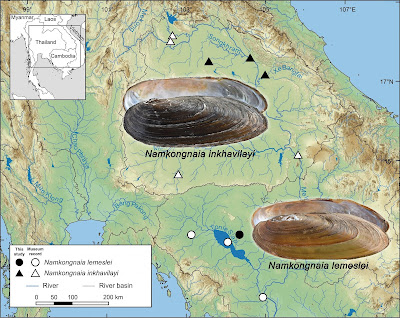
Distribution: Mekong River and its tributaries in Laos, Cambodia, and Thailand (Fig. 3; Brandt 1974; Ng et al. 2020). The distribution range may include the Mae Klong River Basin in Thailand (Brandt 1974), although the taxonomic status of the specimens recorded in Brandt (1974) needs to be confirmed.


Map showing distribution localities of Namkongnaia gen. nov. Boundaries of river basins follow Abell et al. (2008).

Namkongnaia inkhavilayi gen. et sp. nov.

Pilsbryoconcha lemeslei – Brandt 1974: 263, pl. 18 fig. 22 (in part, only records from “Nang Rong (Prov. Burirum)”, Thailand) [non Anodonta lemeslei Morelet, 1875].

Etymology: This new species is dedicated to our colleague and distinguished malacologist, Dr Khamla Inkhavilay, from the National University of Laos


Namkongnaia lemeslei (Morelet, 1875) gen. et comb. nov.

Distribution: This species is restricted to Tonle Sap Lake and its tributaries in Cambodia. Its distribution probably reaches the headwater of Tonle Sap basin in eastern Thailand (Brandt 1974).

Habitat: This species was recorded in mud substrate in still sections of rivers or in lentic habitat, i.e., ponds and lakes (Morelet 1875; Morlet 1889; Brandt 1974).

Distribution: This new species appears to occur in the Lower Mekong watershed. In Laos, it was recorded from several locations near Vientiane, Kammoune, and Champasak Provinces. In Thailand, it is known from the Songkram and Mun river basins in the northeast region (Brandt 1974).

 
Ekgachai Jeratthitikul, Chirasak Sutcharit, Peng Bun Ngor and Pongpun Prasankok. 2021. Molecular Phylogeny reveals A New Genus of Freshwater Mussels from the Mekong River Basin (Bivalvia: Unionidae). European Journal of Taxonomy. 775(1), 119-142. DOI: 10.5852/ejt.2021.775.1553

Thursday, September 30, 2021

[Mollusca • 2020] Hemiplecta ligorica & H. thailandica • Reassessment and Systematic Position of the Sinistral Snails of Genus Hemiplecta from Thailand (Eupulmonata: Ariophantidae), with Description of Two New Species


Hemiplecta ligorica H. thailandica
Sutcharit & Panha, 

in Sutcharit, Jeratthitikul, Tongkerd & Panha, 2021.

Abstract
Indochina land snails of the family Ariophantidae are in need of thorough systematic revision. Here we comprehensively revise the systematics of the large-shelled, sinistral (counterclockwise) coiling snails from Thailand and Peninsular Malaysia. Molecular phylogeny based on mitochondrial (coi and 16S) and nuclear (28S) gene sequences demonstrates that these sinistral snails are not members of Dyakiidae as previously thought, but instead are more closely related to the genus Hemiplecta in the family Ariophantidae. Comparative morphology also reveals similarity of reproductive organ features (globular gametolytic organ, well-developed dart apparatus, and lack of amatorial organ complex). Based on this evidence, we propose to transfer these sinistral snails to the genus Hemiplecta. Molecular phylogenetic analyses further strongly support the monophyly of this sinistral lineage with respect to other members of Hemiplecta. This monophyletic clade consists of five members including three species that were previously classified as “Dyakia”, H. lahatensis, H. retrorsa and H. salangana, and two new species described herein, Hemiplecta ligorica n. sp. and H. thailandica n. sp. This study also suggests that the anatomy of the gametolytic organ in the genus Hemiplecta corresponds well with the phylogenetic relationships and appears to be a taxonomically informative character, while the penial verge has little utility for generic recognition.

Keywords: Pulmonata; Dyakiidae; sinistral; endemic species; Indochina


Family Ariophantidae Godwin-Austen, 1888

Genus Hemiplecta Albers, 1850

1. Hemiplecta retrorsa (Gould, 1843)

2. Hemiplecta salangana (Martens, 1883)

3. Hemiplecta lahatensis (Morgan, 1885)


Shell characters.
A. Hemiplecta lahatensis, specimen cumz 5259/2.
B, C, Hemiplecta thailandica n. sp., (B) holotype cumz 5095/1 and (C) specimen cumz 5098 from Chanthaburi Province.
D, E. Hemiplecta ligorica n. sp., (D) holotype cumz 5093/1 and (E) paratype cumz 5087 from the type locality.


4. Hemiplecta thailandica Sutcharit and Panha, n. sp.

Etymology. The species name “thailandica” refers to the type locality of this new species in Chanthaburi Province, Thailand.

Diagnosis. Large and low conic shell with brown to brownish yellow shell color, rounded last whorl with narrow dark brown spiral band on periphery. Penial sculpture with small penial papillae arranged over nearly entire penis length.

 
5. Hemiplecta ligorica Sutcharit and Panha, n. sp.

Etymology. For the historical name of Nakhon Si Thammarat Province, where the type locality is situated.

Diagnosis. Small, sinistral helicoild shell with whitish color, rounded last whorl with dark brown to brownish spiral band on periphery and upper shell surface. Penial sculpture with small papillae arranged over about half of penis length.


Conclusion: 
Based on phylogenetic results and morphological information in the present study, we have transferred the sinistral species previously and incorrectly assigned to Dyakia (family Dyakiidae) to the genus Hemiplecta (family Ariophantidae). Two previously unrecognised species are described based on consistent differentiation in molecular, shell, and genitalia characters. Our data also provide further support for three other sinistral Hemiplecta species, which are also re-described herein. The results also suggest the synonymization of the formerly recognized as (sub)genus Koratia under the Hemiplecta. Finally, the results indicate the evolutionary instability of shell traits that are often used for land snail classification, while genital characters are highlighted as reliable taxonomic markers for delimiting species and at least some higher taxa. The integration of multiple independent characters including molecular evidence is crucial for delimiting higher systematic levels.


  Chirasak Sutcharit, Ekgachai Jeratthitikul, Piyoros Tongkerd and Somsak Panha. 2021. Reassessment and Systematic Position of the Sinistral Snails of Genus Hemiplecta from Thailand (Eupulmonata: Ariophantidae), with Description of Two New Species. Contributions to Zoology. 90(2); 183–215.